
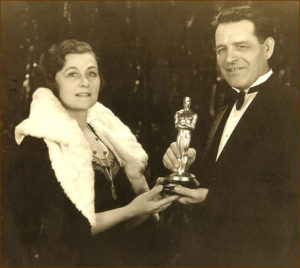
Here is the first exclusive article about Frances Marion and Rudolph Valentino
Born in 1888, Frances Marion like June Mathis is an Academy Award winning screen writer considered one of the most successful in the movie industry. Frances was noticed by Mary Pickford and became her official screen writer. Frances was briefly married to silent film Western star Fred Thomson and they had two children. Frances and her movie star husband like many others in the industry moved out of the area into the suburbs yet close enough to Metro Studio. Large estates began to proliferate around the Benedict Canyon area and Jack Gilberts new home was opposite Frances Marion and Rudolph Valentino. One night, Frances went outside to check on her nieces who were supposedly taking a late-night swim, but instead found them congregated around the telescope that was to be used for stargazing and instead was directed at the Gilbert home. The nieces were taking in every detail of the “uninhibited parties on his terrace”. The newest yet closest neighbor was more to their liking and that was Rudolph Valentino. Valentino often consulted with his neighbor on where to build a stable for his Arabian horses and once again the hillside sustained blasting to create flattened tiers. Rudy built his Falcon Lair by substantially adding on to the small house that was already on the land. Frances Marion first met Valentino through June Mathis, Metro Screen Writer who created a sensation by casting Valentino in “The Four Horsemen”. In contrast to the impression made by publicity about his fur lined bathrobes, his neighbors found him to be shy and modest, they became friends riding the hills together and joining him for homemade pasta. Frank Case noted author confirmed Frances Marion’s impressions of Valentino’s low self esteem after his daughter Margaret worked with Rudy on a Vanity Fair Magazine article and brought him to the Algonquin for lunch. The hotel dining room was more than use to having celebrities dine and the regulars prided themselves on ignoring them, yet “the buzz of excitement that ran through the room at the sight of Valentino, you could hear it vibrate from one of those ordinarily unimpressionable groups to the next”. When Margaret introduced Valentino to her father, Valentino quietly said “I am grateful to be here. I have often wanted to come, but I was told it was difficult to get a table unless you were a known”. After their initial shock, the Cases realized Valentino’s comments were without a hint of sarcasm; it was a genuinely modest statement from a truly modest man. In spite of the obvious excitement he created in public, Valentino could never bring himself to believe he was worthy of the attention. In less than five years, Valentino had been through a variety of studios, two marriages, bigamy charges, hits, and movie flops, but still his drawing power grew. Rudy and his second wife, Natacha Rambova separated after the financing for their increasingly lavish independent productions were pulled and Rudy was deeply in debt by the time his home Falcon Lair was completed. Valentino signed on with United Artists for $10,000 a week and a portion of the profits. He committed to make three films a year. Joe Schenck offered Frances Marion $30,000 to write a first script, and aside from the money she welcomed the opportunity to work with director George Fitzmaurice and the challenge of writing a part of substance for Rudy. He told her, he was tired of playing “mawkish leads” and would appreciate an offbeat role. He agreed with Frances and George on a romantic historical setting and she read through Gabriele D’Annunzio novels and plays to see what was appropriate and available for adaptation. The were setting on “The Flame of Love’ a vivid cruel revelation of D’Annunzio’s love affair with Eleonora Duse, Italy’s finest actress when Joe Schenck suddenly informed them the story search was over. Edith Maude Hull wrote a sequel to her popular novel “The Sheik” entitled enough “The Son of the Sheik” and the studio bought the rights sight unseen. Joe admitted and Frances agreed that “tripe” was a refined word but he told her he didn’t care if she adapted the material or wrote an original tale as long as the title was “The Son of the Sheik” dropping the plural to put the total focus on Valentino. Still, she found freedom frustrating and spent two weeks struggling to find new ways for a captive maiden to fend off a fate worse than death while creating opportunities for the very fate to occur. Frances decided to write an all0out farce of the original Sheik but when she gave the scenario to George Fitzmaurice, he brought her back to reality. “It is one of the most hilarious satires I’ve ever read, and I’d love to make it, but our hands are tied Vilma Banky has been signed to play the lead opposite Rudy. Frances respected Vilma’s acting talents and wanted to help Rudy so with George Fitzmaurice encouragement she begrudgingly rewrote the scenario in a more serious vein, trying to find a balance between drama and comedy. She remained far from pleased with her treatment and privately referred to the film as “The Son of a So and So” but turned it over, trusting George’s taste and judgement to make it work. Rudy quietly accepted the role, disappointed to be playing what they all considered to be a repeat performance and he spoke of making a “graceful exit” from films in a year or two. I am no fool, he told Fred and Frances, I knew from the beginning it could last forever. With the kind of stuff, I have been doing I am surprised my popularity has lasted this long. Frances thought he was too tired to fight and when she asked how he was feeling he mentioned having “severe headaches” and talked of taking a long vacation after filming. They tentatively planned a trip to Napa for the fall for Rudy to look for a new home in the wine country where he could rest and put his knowledge and love of all thing’s agriculture to good use. On 9 Jul 1926, “The Son of the Sheik” premiered in Los Angeles and Frances had to acknowledge the film turned out better than she dared hope. Once again, Rudy captivated women in the audience, even though Adela Rogers claimed his mesmerizing stare was direct result of myopia. “He didn’t want to sweep you into a mad embrace, he just wanted to know who you were”. A few days later, Rudy turned 31 left for New York, and everyone noticed he looked physically exhausted. Rudy’s moves were front page news and when they both heard reports of his hospitalization, they were shocked. When they next read the papers “The Sheik is Dead”. Frances was repulsed by the sideshow that followed his death. She was angered by studio bosses she knew had exploited him as well as the women who dressed in mourning and whose pictures appeared in every newspaper alongside details of fictionalized romances. She gave caustic credit to Pola Negri for being the best actress of the lot when it came to fake romances. Over 100,000 mourners walked past his casket in New York City and there were homages at every stop made by the train that brought his body back to Hollywood. The turnout for his California funeral was on a massive scale and the streets were blocked off and schools were closed. While Pola Negri made pronouncements of creating marble monuments to Rudy, he was laid to rest in a mausoleum at Hollywood Cemetery, provided by fellow screen writer June Mathis. United Artists publicity translated into economic windfalls for the studio as fans poured in when “The Son of the Sheik” was rushed into general release. Valentino’s death made everyone pause to reflect on the quality of their own lives.
 All About Rudolph Valentino
You must be logged in to post a comment.