Posts Tagged With: Tango

1901 – Tango Music its Earliest Beginnings

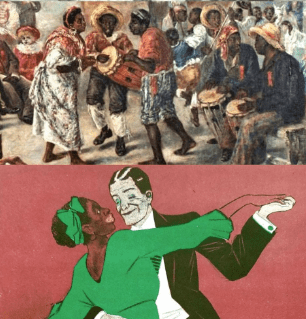
In 1901, tango was in its “infancy,” a period musicologists call the early Guardia Vieja (The Old Guard), which spanned from 1895 to 1910. During this year, the genre was transitioning from a marginalized street sound into a structured musical form. At this time, tango was primarily played by small improvised ensembles known as conjuntos. The typical trio consisted of a flute, violin, and guitar. The guitar provided the rhythmic foundation (often a habanera beat), while the flute and violin carried the melody. While the bandoneón (a German concertina) began arriving in the Río de la Plata region at the end of the 19th century, it was only just starting to replace the flute in these ensembles by 1901. Its inclusion gave tango the “dense and mournful” sound that would eventually define it. Tango was largely confined to the arrabales (slums) and conventillos (crowded tenement houses) of Buenos Aires and Montevideo. It was the music of the working class and immigrants—primarily Italian and Spanish. The Argentine upper class and the Catholic Church viewed tango as “vulgar” and “obscene” because of its association with brothels and dance halls frequented by the lower castes. he music was a raw blend of European styles (polka, mazurka), the Cuban habanera, and the Afro-Argentine candombe

Categories: Uncategorized | Tags: , ,

2021 – Tango Interview Exclusive

In 2001, during the global pandemic, there was a virtual lecture given by the NY Adventures Club titled “Dawn of Tango”, taught by Pierre Baston, tango teacher and lecturer.  I enjoy listening to vintage Tango Music and watching the Tango.  The lecture was the investigation into the black roots and evolution of tango. An analysis of today’s tango movements and how they are directly attributed to African dance and music. I was hoping he would talk about the tango movement in Europe. So, I sent Mr. Baston, an email and a link to a YouTube video that shows Rudolph Valentino in the tango scene in “The Four Horsemen of the Apocalypse”.  I asked the question “This was the beginning of the movie career of Rudolph Valentino. He was taught tango and apache by Juan Duval in Paris.  My question is what are your thoughts about this dance scene? The following was Mr. Baston’s answer “I enjoyed the performance by Valentino in the Four Horseman. I note that he uses the same grip with his left hand gently holding the fingers of his partner’s right hand in the manner that the great Argentine tango master ‘El Cachafaz’ was famous for.  It was considered a sign of respect for the woman’s daintiness that contrasted with the more domineering palm-to-palm grip with which a leader could push or pull his follower around. They execute plenty of quebradas in genuine Argentine style–bending the knees deeply and leaning forward or back in order to bring their bodies into closer contact. The move in which he throws her up in the air from one side to the other is strictly a show move invented for the camera, and I suspect that it comes from his apache experience, since you told me that Valentino danced apache. It was a staged tango dinner show with spectacular choreographed moves that first hooked me on tango. But stage tango and social tango are very different. This performance has strong elements of both”.

Categories: Uncategorized | Tags: , , ,

A WordPress.com Website.