
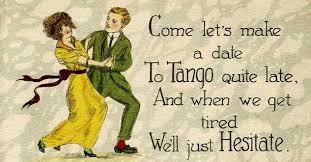
There was something about the new dances that were being introduced to the public. It was these very dances that made this country’s melting pot sizzle. In New York City, there were famous places employing male dancers who catered to women and their preoccupation with pleasure of being in a man’s arms and enjoying an afternoon of lighthearted flirting. There was something of a paradigm shift and a change in standards of acceptable public behavior for woman. For the times they lived in it was quite liberating for women calling all the shots. One newspaper editorial talked about woman swooning in the embraces of the male dancers and their dutiful husbands were working hard. So why couldn’t men move from behind the counter or desk and take their rightful place on the dance floor and make anywhere from $30.00 to $100.00 a week? The movie industry wanted to capitalize on the dance craze, and this was about to occur on a grand scale. In 1921, “The Four Horsemen of the Apocalypse”, an epic melodrama became the biggest box office hit of the 1920’s.
Transformations of the Picturesque The world was dancing Paris had succumbed to the mad rhythm of the Argentine tango. – The Four Horsemen of the Apocalypse (1921)
The movies leading star, Rudolph Valentino became a household name. To women the world over he became “a romantic symbol of the modern age”. Famous Players- Lasky realized the silent movie idol’s appeal to women and immediately capitalized on the frantic publicity. Valentino was a former paid dance companion and exhibition dancer. “The Four Horsemen of the Apocalypse” has different dance scenes that capitalize on the social repercussions when two people dance suggestively. The New York World Newspaper’s movie review wrote that Valentino was well chosen for his leading role. The part calls for an adept dancer of the Argentine tango and he was the type needed for the part. The film was a complex family centered narrative with amazing special effects. The box office advertising you cannot have known how the tango can be danced until you see “The Four Horseman of the Apocalypse”. When Valentino appears in his first movie scene dressed in a gaucho outfit puffing on a cigarette while he stares suggestively at a female dance in a Buenos Aires Dance Hall, this stirs the imaginations of woman movie goers. Then Valentino glides with his partner across the dance floor in the sensuous moves of the tango but the effect is amazing. Julio his male beauty and sex appeal showing his dance partner he is the master of her body in the tango’s controversial hot hip contact. A master of seduction he moves on to his next conquest Marguerite Laurier, an attractive married woman. Their affair starts in a Parisian tango palace and on the dance floor he impresses her with his charm and grace. Then on to his art studio, Julio crushes his lover in a romantic embrace and his hands are all over her body in places one would not normally see on a movie screen. Alas all good things must come to an end and the affair is discovered and Julio must atone for his sexual transgressions. The start of WWI, Julio realizes his love for Marguerite, but he has a greater responsibility and a noble cause to his country. Julio dies on a muddy battlefield and both his family and lover mourn his loss. After this movie release, magazine articles were publishing articles about dancing with Valentino is an ultimate fantasy. For example, Movie Picture World Magazine article “When Valentino Taught Me to Dance” author Mary Winship gives a first-person account. She said “his arm supported me like a brace, I swum myself back, closed my eyes, breathed in the music and followed his movies. The music stopped, Valentino applauded and was so sweet. In 1922, Motion Picture Magazine, published an article “The Perfect Lover”, described Valentino as suave, debonair, with a glistening courtesy alien and disarming. After this article was published, he advised readers to “first dismiss the idea of me being sleek and elegant”. In the same year, another studio magazine Screenland talks about the problems with Valentino’s former profession. Valentino could make a good living as a dancer though he does not like it as a profession. His real qualifications as a landscaper are where he should earn his living. There is doubt whether he could earn a living outside of a studio or a dance hall. Valentino was woman made as a professional dancer since he partnered with already established female dancers. June Mathis described by fan magazines as a maker of young men was besieged by other young Valentino like men who constantly obtrude themselves into her home, imploring to be made with conscientiously amorous eyes. The role of dance in determining Valentino’s popularity was most forcefully illustrated when Valentino walked out on his contract with Famous Players-Lasky. In 1923, Valentino and his second wife Natacha Rambova, a trained ballet dancer, embarked on a successful dance exhibition tour under the sponsorship of Mineralava Beauty Company. In 1924 magazine poll, Valentino being named the fourth most popular dancer in the United States. Valentino’s legal problems with Famous Players Laskey were eventually resolved and he was able to go back to work. In 1925, two movies, “Cobra” and “Eagle” premiered, and Valentino’s moves are dance-like with refinement and grace. Both were not a box office success, but it still cemented his status as fan favorite. In January 1926, Valentino was interviewed for Collier’s Magazine. In the interview dance is portrayed as the last resort of an immigrant’s honest attempts to make a living. The star recounts falling back on his dance talents after he has pursued other jobs such as ‘”polishing brass, sweeping out stores, anything that will put a roof over my head and food in my stomach.” He is quoted as saying of his film career: “I wanted to make a lot of money, and so I let them play me up as a lounge lizard, a soft, handsome devil whose only aim in lite was to sit around and be admired by women. But at the same time, all I am a farmer at heart. In October 1926, The Dance Magazine, satirically declared Hollywood was the heaven of opportunity “where good dancers go when they die.”. Valentino’s sudden death of peritonitis five weeks before the magazine’s appearance demonstrated a deep if no doubt unintended irony in that statement. Death would not end the debate over Valentino’s symbolic place within the perceived crisis in American sexual and gender relation. Valentino, like dance, had become symbolic of social changes, taking place in the system governing American sexual relations in a post Victorian country. Valentino had confronted the country with other uncertainties as well. While some of these gender-based uncertainties converged with those offered by other matinee idols, such as John Barrymore, Valentino presented a higher order of problematics that circulated around the convergence of female fantasy with the dangerous, transformative possibilities of dance and with the highly restrictive norms
 All About Rudolph Valentino
You must be logged in to post a comment.