
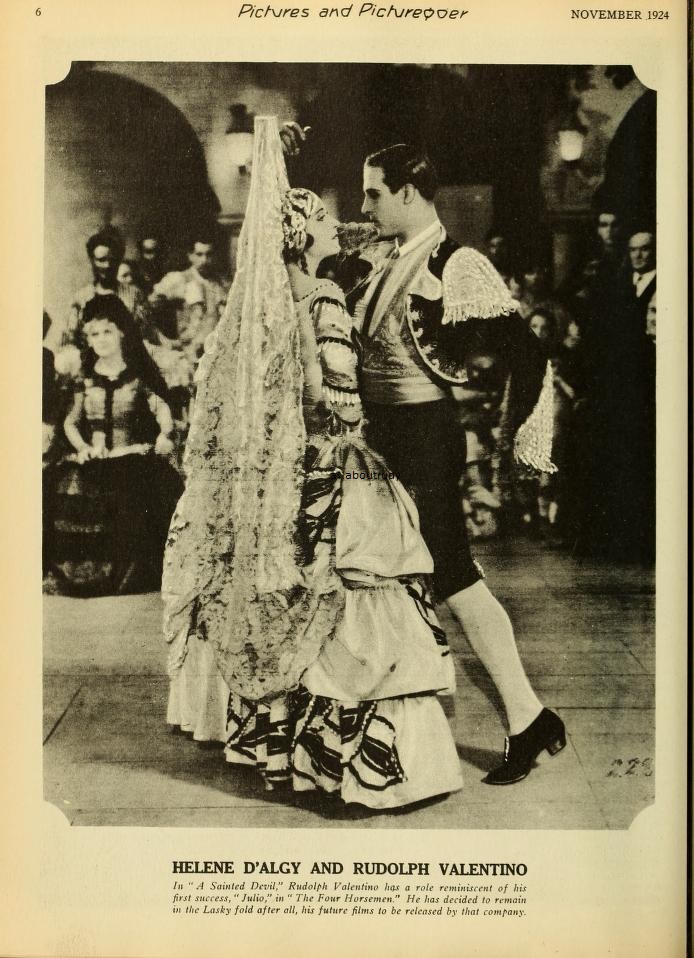
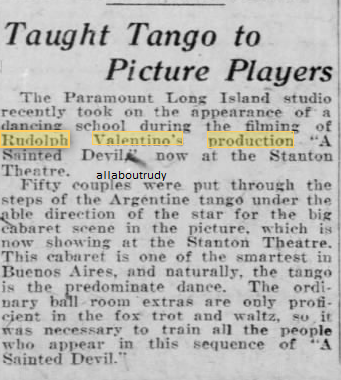
This is a movie review by film critic Mordaunt Hall who went to see Rudolph Valentino’s latest movie “A Sainted Devil” that was screening during the 1924 Thanksgiving weekend.
Memories of brave little Cigarette in “Under Two Flags” came to our mind as we viewed the passing shadows unfolding the story of Gloria Swanson’s latest pictorial effort, “The Wages of Virtue,” which is adorning the Rivoli screen this week. With its background of the headquarters of a contingent of the Foreign Legion in Algiers, this photoplay unlocks a flood of thoughts regarding the blighted lives of many of the men in this heterogeneous mass of humanity, who are burying their identities under a French uniform in the blazing sun of Northern Africa. This idea has not been forgotten in this celluloid presentation, as one sees an east side New Yorker, an Italian strong man, an English crack shot, a Parisian Apache and an American college graduate among the men busy in the barracks. You see them polishing buttons and cartridge cases, cleaning their tunics and boots, it being set forth in the regulations (whether they be murderers, forgers, or only the victims of love affairs) that their accoutrements must be glistening and immaculate. Lithe and vivacious, with swiftly changing moods, Miss Swanson plays the part of Carmelita, the girl who mothers the regiment of gruff soldiers and in a dilettante, manner presides over a café, to which the nondescript volunteers come to forget their disappointments or misdeeds with a cheering glass of cheap wine. Carmelita is filled with the joie de vivre and is able even to get fun out of her sweeping and dusting. She performs her ablutions in a drinking fountain and looks forward to the hour when the thick voiced fighters are due to sit at the tables or stand in the bar of the café.
Marvin, whose sobriquet is Yankee Blue, one evening takes Carmelita in his arms, and misunderstanding her violent struggles, he snatches several kisses. Luigi (Ivan Linow), a brawny giant, who saved Carmelita from drowning, is a brute who pretends to be in love with Carmelita while he is flirting with the matronly cantinière. He lays in wait for Marvin (Ben Lyon), and after Marvin has been badly beaten, he is sent to the military jail, where in the scorching sun he is made to march with heavy packs.
Carmelita, in a huge sunbonnet under which is concealed a bottle of wine, goes forth to procure Marvin’s freedom. She is in love with the handsome American, and he reciprocates her affection. Miss Swanson is particularly good where she pretends to have fallen down a flight of steps in a faint, just as Marvin, after being freed, is entering her café. She takes her audience into her confidence by winking at them when Marvin is not looking and closing her eyes the instant, he lets his gaze fall upon her face.
This story was adapted from one written by Captain Percival Christopher Wren. It seems to us that the dénouement would have been stronger if Luigi were a better character. He saves the girl’s life, and yet she in the end plunges a knife into his back because he has beaten Marvin. The men of the Foreign Legion swear that they will not reveal the fact that Carmelita killed the giant, all agreeing to testify that he was slain by Arabs. It is a strange idea, first, to have Luigi a hero, when he saved Carmelita from a watery grave, and then to make him a murderer, by having him throw a little fiddler into the river, for suggesting to Carmelita that she and he go to Paris. Even after this one does not lose sympathy with Luigi, as he insists that the deed was done because of the musician’s poisonous ideas. It would have been more pleasing to have another villain and to make Luigi a good father, or guardian, to Carmelita. It is also problematical, especially in motion pictures, whether it is wise to have the heroine kill the villain, even under such conditions as Carmelita slew the strong man. Mr. Lyon is efficient in the role of the hero, and Mr. Linow is splendid as Luigi. Norman Trevor delivers a sympathetic performance as the English crack shot, known in the regiment as John Boule. Allan Dwan directed this picture, which, we must say, is just as interesting as “Manhandled,” his previous production with Miss Swanson.
During the silent film era, movie critics took their jobs very seriously when reviewing a new picture. They offered an honest unbiased opinion and wanted to give movie goers and fans thoughts on whether the movie was worth the price of admission.



 All About Rudolph Valentino
You must be logged in to post a comment.