
“Women are not in love with me but with the picture of me on the screen. I am merely the canvas on which women paint their dreams.” – Rudolph Valentino
Posts Tagged With: Rudolph Valentino
“Women are not …
1924-1926 Hollywood Athletic Club 6525 Sunset Blvd, Los Angeles, CA

The first vision of the Hollywood Athletic Club, on Sunset Boulevard came to its founders in 1921, when there was a need for a club in which businessmen could meet and lunch as well as develop their minds and bodies through physical exercise. The idea was born when Frank K. Galloway and George Moore were lunching at Sam Kress’ drugstore. Frank suggested that George start such a club. George called a meeting in the basement of the old library building. As a result, the Hollywood Athletic Club was formed. The outcome of this conclave was the proposal that memberships are sold and the funds be used to purchase a site and build a clubhouse. To accomplish this end, George Moore and Clarence Huron incorporated the Hollywood Finance Company and undertook to sell memberships, first at a nominal cost, but as the idea found favor, at a greatly increased price. Through the efforts of the club’s officers, a deal was struck for the purchase of a site on the northeast corner of Sunset Boulevard at Hudson Avenue. Plans for a large clubhouse were then drawn. The construction of the building and the furnishing and equipping of the facilities required the combined efforts of the various club committees. When the nine-story building was completed in late 1923, by Meyer & Holler, the same architectural firm that built the Grauman’s Chinese Theatre and the Egyptian Theatre. At the time the club was the tallest building in Hollywood. The club had famous film stars of the day such as Johnny Weissmuller, Errol Flynn, Charlie Chaplain, John Wayne, Disney, John Ford, Douglas Fairbanks Sr, Mary Pickford, Cecil B de Mille, Cornel Wilde, Humphrey Bogart, Clark Gable, Jean Harlow, Frances X. Bushman, Howard Hughes, Joan Crawford, Rudolph Valentino, Buster Crabbe and Pola Negri. Club Membership was originally $150 for initiation fees and $10 for monthly dues. Hollywood boasted of having the most modern and envied athletic club in the country. Some of the appointments included such features as a billiard room with six billiard tables, a twenty-five yard indoor swimming pool, a large gymnasium, spacious lounging rooms, library, mens’ and women’s’ locker rooms, barbershop, cigar store, haberdashery, and rooms and apartments for bachelor members. The club was so popular that by 1926, it had close to one thousand members. In addition to the many activities for its own members, the Hollywood Athletic Club sponsored teams in basketball, wrestling, track, tennis, swimming, boxing, squash, handball, water polo and fencing. Even though the club was built primarily for use by men, the wives and daughters of the members were: not lost sight of for one moment. Gymnasium and swimming classes were held regularly, thus providing the women with a complete physical education program. For more than thirty years, the Hollywood Athletic Club had been the inspiration and medium for physical development of its members and the home for numerous service clubs and civic organizations responsible for the development of Hollywood
1920’s 6533 Hollywood Boulevard, Hillview Apartments, Los Angeles, CA

In the beginning, Hollywood was considered a little more than a one horse town with dirt roads. When the movie industry relocated from New York to Los Angeles people were also relocating to try their luck in movie pictures. With this influx of people moving into town there was a serious shortage of places to stay. No one wanted to rent rooms or apartments to anyone that was in the acting profession. In 1917, Jesse Lasky, Sam Goldwyn and Architects Tifal Brothers built a 54 unit apartment complex for the acting community. The apartment complex featured many modern conveniences of the times such as elevators, a garbage incinerator, a basement and a Speak-easy. Hillview Apartments was home to famous silent films stars of the day such as Mae Busch, Jack LaRue, Barbara LaMarr, Mary Astor, Clara Bow Joan Blondell and others. History says at the side of the apartment complex at 1725 North Hudson Ave was a 1500 square foot private speakeasy that was ran by Rudolph Valentino for about a year. Other stories were silent film star Mabel Normand caught her husband, director Mack Sennett, in a compromising situation with actress Mae Busch.
On a personal note extensive research shows that the story of Valentino running a personal speakeasy could be more fact than fiction. But it does make for an interesting story.
1925-1926 2 Bella Drive/1436 Bella Drive/10051 Cielo Drive, Beverly Hills, CA


In 1923, Beverly Hills real estate mogul George Read was both developer and builder of Falcon Lair and the homes first occupant. In 1925, Rudolph
Valentino felt it was time to upgrade his home and lifestyle by buying his last home located in the hills above Benedict Canyon overlooking Beverly
Hills.at 2 Bella Drive/1436 Bella Drive/10051 Cielo Drive, Beverly Hills, California.


George Reed would sell the home to Rudolph Valentino only on the condition that the movie studio would guarantee the loan. So for $175,000 and additional upgrades done on both the main property and surrounding acreage the house was officially his. At the time of this purchase, Rudy and his wife were estranged so all of his efforts were put into making this house a home. The house had 4700 square feet of space, on 4 acres of land and designed in “California Style” with Mediterranean stucco and red-tiled roofing. Rudolph named his new home after a never completed movie called “The Hooded Falcon”. Rudy felt that his dream home should be a retreat from the outside world a place that reflected who he was and filled with things that interested him such as horses, cars and dogs. So this was accomplished by filling it with European furnishings, expensive artwork and antiques purchased from numerous trips made to Europe by him and Natacha. Library shelves filled with leather-bound books, drapes of red velvet, hand carved furniture and closets filled with clothes this home was considered a showplace where dinner parties were held where famous guests such as Charlie Chaplain, Pola Negri, Lillian Gish, Mary Pickford, Douglas Fairbanks, Vilma Banky and others would come by and enjoy Rudolph Valentino’s hospitality. Gloria Swanson would sometimes stop by and go riding with Rudy. Also one of nearest neighbors was another famous silent film star John Gilbert. For added privacy, he had a very high wall erected around the property and his dogs were let loose at night as additional protection. Also, he purchased 6.5 acres of adjourning property. In 1926, Rudolph Valentino died and left his estate to his brother Alberto, Maria and Teresa Werner. Falcon Lair was bought by Doris Duke who died there 1993. Since that time, the house has been sold a few times, gutted with the intent of re-building. Falcon Lairs story has been covered in numerous websites and in newspapers with far more accuracy than depicted here. The purpose of adding Falcon Lair to this blog is to show readers that this house is apart of All About Rudolph Valentino. Falcon Lair is another legacy that has been left in the dust however the memory lives on in pictures and other website posts on the Internet.
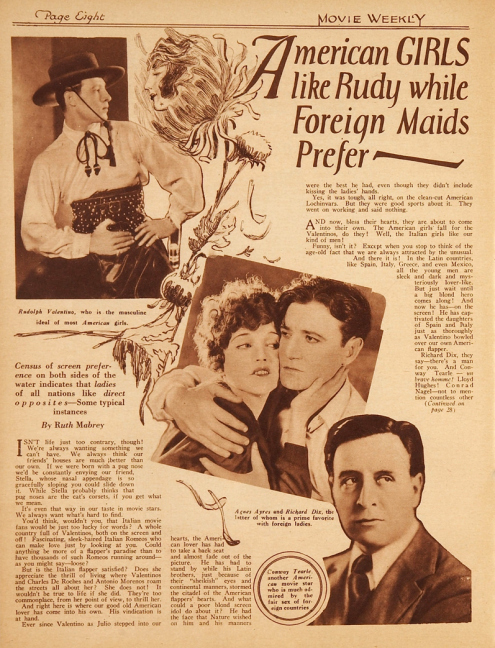
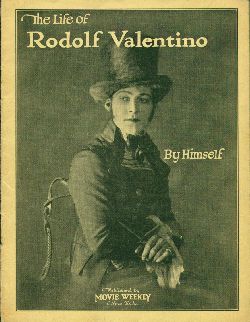
1923 Movie Weekly Magazine The Life of Rudolph Valentino By Rudolf Valentino
The hot and sand-laden breath of the Sahara Desert sweeps across the Mediterranean Sea, turning red the white walls of the dwellings, and filling the air with crimson-tinted dust – in the little agricultural town of Castellaneta, Italy, I first saw the light of day. The town is in the south of Italy, its name doubtless derived from the many ancient citadels which dot the slopes of the country everywhere. The home of my parents was called a “palace” and in America would probably be termed a mansion or an estate; it was very large, I know. I was only eight or nine when I left it, but my memory of the place of my birth is still clear, and I have but to shut my eyes to see again the great, broad sweep of the driveway and the wide stone stairway that led to the upper floors. The lower portion was given over to the stables and coach-house, and the entire structure was of soft stone, the exterior painted white to throw off the heat. Yet, as I have intimated, when the African desert sent its winds across the sea, they were tinted pink by the dust. The upper floor of the building contained, on the one hand, my father’s study and sleeping rooms; on the other, dining room and kitchen, while at the back was the big salon. The ceilings were so high that the two stories of the house would be equivalent to four in the modern structures in this country. This, then, was my boyhood home. It was the scene of my father’s ardent studies in the realms of bacteriology, in which branch of the medical science he had attained considerable fame in the scientific circles of the old world. He was also a retired captain of cavalry. Nearly every man is a soldier in Italy at some period of his life. My first schooling was in a convent where I learned the rudimentary principles. I was only three when I started, so I recall very little until two years later, when I was sent to an elementary school and in about five years was graduated. Then followed the first really important event in my life. I was taken to Taranto to become a student at the military academy Dante Aleghieri. When I was ten, my parents moved to Taranto, and my father died, so I did not finish my schooling at the academy, but took the next big step in my career and went to the military college known as Collegio della Sapienza, at the famous city of Perugia. The school was divided into squadrons, five in number, or grades, as they would be called here, or, more properly still, corresponding somewhat to the freshman, sophomore, junior and senior years. It had a theatre which was used for Shakespearean plays and other classics, and there I acquired perhaps my first taste for the drama, though I took no part, being too young. I remained in this college till I was fifteen, and then, I am afraid, I became too active for the discipline and strict rules and was filially taken out. In any event I manifested no especial interest in the study I had been assigned to primarily-engineering. I wanted to get into the navy. I expect the presence of so much shipping in the harbor of Taranto had excited my youthful imagination and caused me to dream of a life on the ocean. I was never still; always on the move, always impatient, doubtless headstrong and inclined for a life of excitement. The upshot of it was that they sent me to Venice to take the examinations at the Naval Academy, which is preparatory to the actual institution from which youths are graduated as ensigns. I left Perugia without any poignant regrets. True, I had not been unimpressed by the wonders of the old city, once the home of Pope Pius IX, where the masters, Buonfigli and Fiorenzo Perugino, and others, gave their art to the world. In Venice, I learned that there were some three hundred aspirants for about only thirty vacancies in the naval ranks, and yet I had determined that I must win out. With my brother I took up our quarters there and started “cramming,” as the English student would call it. I studied earnestly night and day, consumed innumerable cigarettes and copious cups of coffee, and then-lost out because I was one-inch shy on chest measurement. Need I say how disappointed I was? It was my first bitter setback, but I was to have many another before any sort of success became mine. Someone may say-the cigarettes were to blame! But no. Till then I had smoked sparingly. It was against the rules in the college, of course, to smoke. We wore long cloaks when out-of-doors in the colder weather and used to steal a smoke occasionally beneath their folds. But often the odor or nicotine stains on our fingers were the cause of dire punishment, so we used to scrub our hands with lemons to remove the tell-tale marks. Under such conditions one could hardly become an inveterate smoker. My failure was perhaps due to lack of exercise-a thing I have since remedied. I returned home heart-sick and ambitionless, and stayed a year. I did little except cause my dear mother worry, I fear. Finally, wearying of indolence, I decided that I would study agriculture, and accordingly went to the military academy at Genoa, where I graduated after two years with the degree of Doctor of Agriculture. I was now nearing seventeen of and, as my family had moved to Sorrento, I again made home my residence, spending-money and doing little, for somehow I could not get started on a career. But I tired of this after a time, and one day, with another youth, I drew all that remained of my father’s legacy and started for Paris. I will not detail the experiences in that gay capital, for they were not momentous. I learned a great deal that I had possibly been the better for not learning, did no active work, and spent most of my time in the sheer enjoyment of living. To the Riviera it was but natural I should drift, and there I lost everything I had at Monte Carlo. I had to wire home for money to return. Arriving home, with numerous debts I had incurred, I sold my two Irish jumpers, my Fiat-the first high-powered car of its kind built-and settled what debts I could, aided by my kind mother. Needless to say, I had become more or less stigmatized among my former associates as the “black sheep” of the family. I do not think I was bad, but that restlessness which clung to me with the tenacity of Sinbad’s Old Man of the Sea, would not let me rest. I was like a nervous horse, chafing at his bit; impatient to be doing something different all the time. Besides, I was on probation with my mother and received just one franc a day for cigarettes! Imagine-after the riotous days in Paris and at Monte Carlo! And now, from across the Atlantic, the new world that so long ago my fellow countryman had discovered, was calling. America! My mother was aghast at the idea, but it happened that I had a’ cousin, a cavalry officer, who had rather taken me under his wing-and he was no easy taskmaster. And this cousin said: “Let him go! Either he will betray some of the characteristics of his family and become a gentleman and a credit to us all – or else he will end in jail! In either case it is better than that he should remain here in idleness.” Cold-blooded, you say? Yes, but that was what I needed. His was the iron hand, and this time I welcomed it as a lover might welcome the warm clasp of his beloved’s-later I was to find that he knew whereof he spoke. I never did a dishonest act, nor did I land in jail-but I have known dire poverty and the misery of utter friendliness in a strange land. When I reached New York I found myself in a dilemma. My lack of English was a great handicap, and the prospects of securing a position at all worthy of what I believed to be my talents, seemed very remote. I drifted into the cafe life-met some Italian and French youths and also a couple of young Austrians. Through them I became acquainted with several American girls and in this way picked up a smattering of the language. I read a little in English and in various ways strove to enrich my vocabulary. Meantime, my money was going. Then one day a job loomed! A wealthy man was fixing up an estate in Long Island. He wanted a portion of the grounds landscaped, and I got the billet. But alas, just as everything was in readiness to begin, his wife returned from abroad, decided she wanted to make a golf course where the gardens were to be laid out and I was cast adrift! The only job I ever had at my profession lost before it started! I was in dire distress. My money gone, my clothes going fast, living in a garret, with only a few friends left-most of them having departed when my dollars did, I was in a precarious position.I wonder if you know what real lonesomeness is! I do. Heaven knows what might have happened had I not luckily wandered into Maxim’s one night. The orchestra leader was a friend of mine-one of the few-and I had called to see him in hope of some suggestion that might help me out. He said to me: “Why not become a dancer here?” “What do you mean?” I asked.” Well, there are always women who wish to dance and have no partners. There are many who would like to take lessons. Now possibly you could work into something like that. You have a good appearance-when you’re eating regularly. You look well in evening clothes. I know you’re a fine dancer. Why not?” I thought it over. True, it was an honest occupation, but, like my family, I had always regarded dancing in this way as hardly a man’s job. But beggars can hardly be choosers, and, besides, things were at a pass where I could no longer hesitate without compromising with my honor-a thing I could never do! I thought of New York’s winter snows, and contrasted the dismal vista with that of my own sunny land; I looked mentally into that garret chamber and thought of the comfortable room in my home at Taranto. It envisioned the strange faces in the throng that passed me by and I decided to sink my pride. After some little while at Maxim’s I was introduced to Bonnie Glass, who wanted a partner for her vaudeville dancing specialty. She took me, and we opened at Rector’s. We were an immediate success! Apparently my luck had turned. Later came an engagement with Joan Sawyer, and by this time I was tired of New York. It had held too many unpleasant days for me to be able to regard it with affection-as yet, anyway. I still disliked dancing-this kind of dancing. The classic, of course, is different. Also I wanted to try my hand at agriculture, in which I held my degree. California beckoned-the Golden West! California, I had been told, was somewhat like my own country. And so I accepted, at a greatly reduced salary, an engagement to go on tour with John Cort’s production, The Masked Model I gave up $240 a week for $75 without a qualm. We reached Ogden, Utah, before things got bad. I gave my notice and received my ticket to San Francisco. But not yet was I to escape dancing. Again I encountered difficulties. And again I had recourse to my ability to dance. I gave dancing lessons. I had a brief vaudeville engagement at the Orpheum Theatre, in Oakland, California, and in a haphazard way managed to keep going. Finally I was offered a position to sell stocks and seized upon it as a real opportunity to escape an occupation for which I did not care. Before I had been at it two weeks, America entered the war. The stock market began to turn somersaults. The Liberty bonds were all that were of interest. I was like Othello-occupation gone. I tried to enlist through the Italian channels, but was rejected because my eyes were not good enough. I tried the British recruiting station; I knew socially the Major in charge. The result was the same, however. And so I gave up the hopeless effort to get into the war. I drifted to Los Angeles and met Norman Kerry, then playing in Mary Pickford’s company. He helped me in various ways and tried his best to get me a chance at screen work. No luck. Again I was forced to go back to dancing as a means of livelihood. I danced at a couple of the well-known cafes in Los Angeles and hated it with all my heart. I only hoped that through this I might meet some of the directors or stars and have a chance in pictures. Finally I met some kind people from Pasadena, who declared that I was wasting my talents and should go to the fashionable Maryland Hotel in their city. I was a guest there for a week and gave an exhibition one Thanksgiving. Then I walked into the Alexandria in Los Angeles one day and so into the arms of Emmett J. Flynn, the film director. Hayden Talbott had seen me, it appeared, and thought I was just the type needed for a picture. I was off6red $50 a week in pictures and jumped at it. My chance to break in had come! The picture was called The Married Virgin, and I played the stellar role-a “heavy,” which is somewhat of a novelty. I thought that when it was released, perhaps someone would see possibilities in me. There were difficulties, and the picture was tied up. It was not released until three years later! Thus did luck take another backhanded slap at me. But I managed to exist and succeed in obtaining the leading role opposite Mae Murray in two Universal pictures; two more with Carmel Myers followed, with Paul Powell as director. Mr. Powell, who is now with Paramount Pictures, incidentally is a remarkably fine director and a gentleman in the bargain. From him I learned more of the technique of the screen than from anyone else, and he has always encouraged me and prophesied great things for me. When later I became discouraged, I had but to think of his kind words and I would take new courage to go on. I almost played Richard Barthelmess’ role in Scarlet Days, missing it by the fraction of a hair, and later essayed the heavy role in Eyes of Youth with Clara Kimball Young. I was selected for villains, because of my dark complexion and somewhat foreign aspect, I presume. This was a cause of regret to me, for I realized that the “heavy” man has usually slight chance of attaining the most profitable and desirable positions in motion picture acting, in spite of the artistic effort frequently needed for such roles. I worked in Once to Every Woman, with Alan Holubar; Passion’s Playground with Katherine MacDonald, and then went back to New York, where I did two more heavy roles with Margaret Namara in Stolen Moments, and supporting Eugene O’Brien in a film the name of which for the moment I cannot recall. I concluded this picture on a Saturday and on Sunday left for the Coast once more, to play “Julio” in .The Four Horsemen of the Apocalypse for Metro. June Mathis, it seemed, had seen my work in one of my worst roles, but had long since selected me f or the part of Julio. The success of the picture is too recent to require additional mention here. From this I date my greatest good fortune. There followed the engagement with Paramount Pictures in George Melford’s production, The Shiek, with Agnes Ayres; in Moran or the Lady Letty, with Dorothy Dalton, and my latest work, as leading man in Gloria Swanson’s picture, by Mme., Elinor Glyn, Beyond the Rocks. And now I am a Paramount star. I have been told. that my work on the screen possesses an exotic quality-which is, of, course, natural. However, naturalness in any given role is. what I strive for. I have tastes in literature and art, ideal perhaps, that are peculiar to my origin, and ancestry. I am certain that I have a strong leaning toward the beautiful, even the arabesque. It would be odd were it otherwise. Italy, especially that portion of it from whence I came, bristles with romance; it is hoary with age and its historic associations are plentiful, but, above all, it is famous for its art and its artists. The country is broad and thickly peopled; it presents aspects of sanctity and frivolity of dire poverty and great wealth. So may the memory of my shortcomings fade, when the thread of my days has run through the loom of life, and only the best art that I had it in me to give, remain. Voila! —RODOLF VALENTINO.
Categories: Uncategorized
Tags: Rudolph Valentino
1922-1924 6776 Wedgewood Place, Whitley Heights
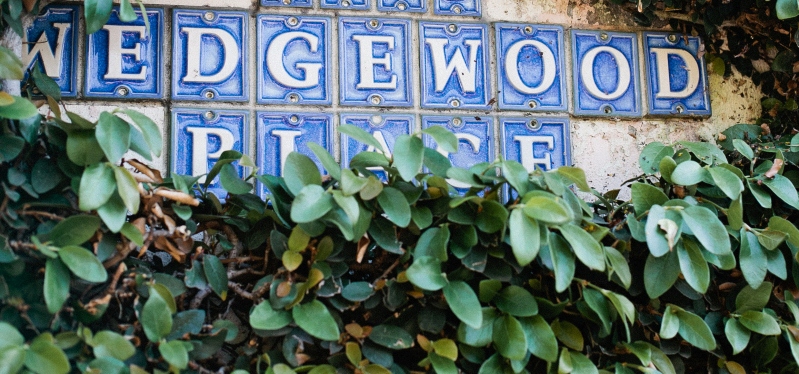
In 1918, Hobart Johnstone Whitley, known as the Father of Hollywood, designed a well-known area located near Beverly Hills called Whitley Heights. Whitley Heights during the golden age of Hollywood was known as prime location where it had the best views with houses done in an Italian style and considered as THE place for film stars to live, party and have privacy. In 1922, it was in this very area, that Rudolph Valentino and his bride Natacha Rambova lived at 6776 Wedgewood Place as well as other famous silent film stars such as Barbara LaMarr, 6672 Whitley Terrace; Maurice Chevalier, Caroline Lombard, Jean Harlow, Charlie Chaplin, Gloria Swanson, Francis X. Bushman and many more. Rudolph Valentino’s home featured a one-car garage, courtyard, small living area in the entryway, and 2 bedrooms with baths. The lower level featured the main living room, dining room, kitchen, and servant’s quarters. Rudy loved walking in his neighborhood while wearing riding gear and walking his dogs. However, the women of the neighborhood always made sure to conveniently be outside while he walked by waving hello. In the 1920’s this area was party central. His next door neighbors were Walter and Margret Teague. Their daughter Frances for a time was a famous silent film star who thought that their very famous neighbor was nice. An interesting mention was bus tours of movie stars homes would often ride through Whitley Heights would find a man dressed in old work clothes while working in a fancy car parked in front of the house. Naturally fans would wave to the man never thinking that they were waving to the famous star. In 1924, Rudolph Valentino purchased Falcon Lair, a Mediterranean styled Home off Benedict Canyon in Beverly Hills. Rudy still owned his Whitley Heights home at the time of his death.
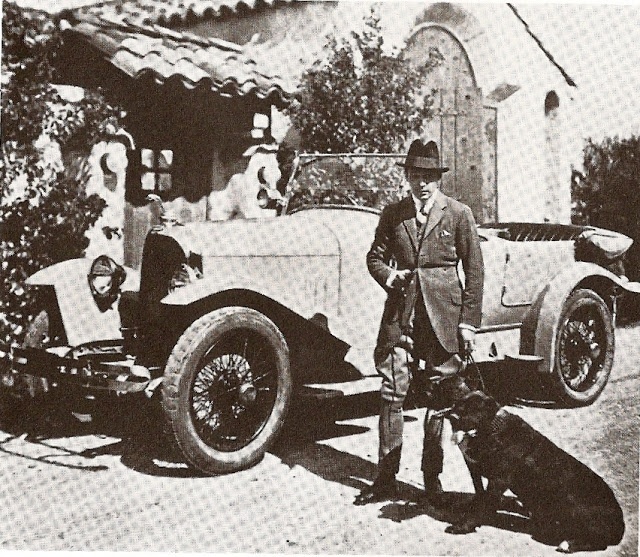
Rudolph Valentino’s first home was also known as Villa Valentino. The home has since been torn down to make way for progress. There are a lot of great pictures and more information about Rudolph Valentino’s first home that exists on the Internet.
1923 Rudolph Valentino in Atlanta GA

The year was 1923, and Rudolph Valentino was at the Georgian Terrace Hotel, Atlanta, Georgia doing a press conference for his latest movie. A writer named Margaret Mitchell representing a local newspaper titled “The Atlanta Journal” would get the opportunity to interview silent actor, Rudolph Valentino. Margaret Mitchell interviews Rudolph Valentino on a side balcony off of the main dining room at the Georgian Terrace Hotel. Margaret Mitchell declared later when she was interviewed she was less thrilled by his looks than his “chief charm”, his “low, husky voice with a soft, sibilant accent”, she described his face as swarthy, so brown that his white teeth flashed in startling contrast to his skin; his eyes—tired, bored, but courteous. Margaret Mitchell was quite thrilled when Valentino took her in his arms and carried her inside from the rooftop of the Georgian Terrace Hotel. The article that Rudolph Valentino interviewed for appeared in the Atlantic Journal’s Sunday Edition on July 1, 1923, titled “Valentino Declares He Isn’t a Sheik”..
Now lets look at the Georgian Terrace Hotel, Atlanta, Georgia. Originally built-in 1879, this building underwent new ownership and was rebuilt at a staggering cost of $500,000 in 1911. There is a book written about this hotel where the author describes the hotel as one-story Palladian windows, wrap around terraces with columns, elliptical staircases and crystal chandeliers attracted scores of well-heeled and socially prominent patrons in the months that followed, prompting the press to label it Atlanta’s “Paris Hotel”. On opening day, over 5,000 people visited the hotel and were serenaded by an orchestra that came over from Spain as uniformed staff hovered quietly about. In 1913, New York tenor, Enrico Caruso who was Rudolph Valentino’s favorite composer and friend came to Atlanta for a two-week run with other cast members of the Metropolitan Opera. While there he made the hotel his home. He grew so fond of the hotel that he would return on a regular basis throughout his life.

 All About Rudolph Valentino
You must be logged in to post a comment.