
Posts Tagged With: The Young Rajah
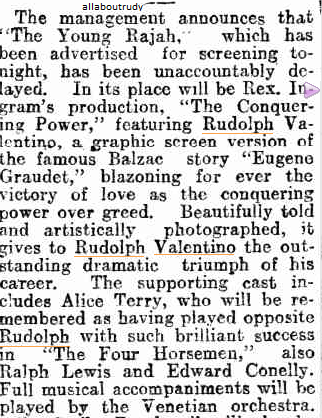
5 Dec 1923 – The Young Rajah Production
Categories: Uncategorized
Tags: Alice Terry, Rudolph Valentino, The Young Rajah
1922 – Studio Backlot Gossip
The Young Rajah,” Rodolph Valentino’s new Paramount picture which Philip E. Rosen is directing, has many fascinating situations and gives the athletic star a chance to show his metal. Wanda Hawley is the pretty leading woman and her co-star Rudolph Valentino is spending all his spare time lately with boxing gloves, fencing foils and a medicine ball—that is, whenever he isn’t riding horseback.
Mr. Rodolph Valentino is back at work on “The Young Rajah,” with Philip Rosen at the megaphone. The adaptation is by June Mathis. The story starts with a mysterious scene and works up to a dramatic climax which it would be hard to excel.
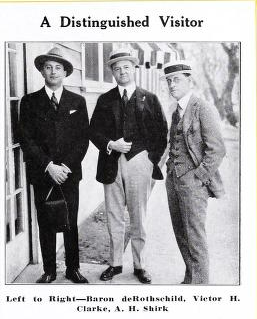
Baron James H. deRothschild, eldest son of the famous French family of financiers, was a guest at our West Coast Studio recently and under the escort of General Manager Victor H. Clarke, Paul Iribe, Fred Kley, Rodolph Valentino, and Adam Hull Shirk, inspected with keen insight and a ready comprehension the intricate W’orkings of the big plant where our pictures are made.
Sensational to the limit are said to be the scenes which Mr. Valentino does sword and cape play before the real fighting bulls. He was trained for the dangerous business by Rafael Palomar, famous Spanish matador, and became highly proficient in the art.
Rodolph goes to San Francisco May 5th to appear at the mammoth benefit to be given by the Mayor’s Citizen Committee to raise funds to help entertain the disabled veterans at the Convention June 26-30 of the Disabled American Veterans of the first World War. Silent Film Star Rodolph Valentino will be escorted by a squadron of cavalry and prominent officials to the hotel and will be royally welcomed.
When Valentino and Naldi were working before the camera, the entire personnel unconsciously drew around them and watched with awe the wonderful acting of this pair. Can you see Mr. Valentino doing a Spanish dance with Nita Naldi, and Lila Lee playing the beautiful Spanish wife? This production was directed by Fred Nihlo, the one and same man who directed “The Three Musketeers”-—that alone should be enough for any exhibitor to know, that together with this marvelous story, under the guiding hand of this capable director and with Rodolph, Nita Naldi and Lila Lee, it will do a record-breaking business at his box-office.
Categories: Uncategorized
Tags: June Mathis, Nita Naldi, Philip Rosen, Rudolph Valentino, The Young Rajah, Wanda Hawley
Feb 1923 – Rodolph Stops The Show
Rodolph Valentino has always refused to make personal appearances, but he made one that wasn’t on the cards. The other evening, in New York Rudy sneaked into the Rivoli Theatre to see how his new picture, The Young Rajah went over with the audience. Somebody recognized him; the news that he was in the audience spread and the crowd applauded until Rudy got up and say a few well chosen words.
Categories: Uncategorized
Tags: Rudolph Valentino, The Young Rajah
17 Aug 1924 – Valentino Helps Quell the Fuss about the Star System in Pictures
What we had to say about the star system in these columns a couple of Sundays back was measurably vindicated by the mob reception of Rudolph Valentino in Monsieur Beaucaire at the Strand Theater in Manhattan last week. What does a film producer care about a star system or any kind of system when the exhibitors are packing them in ten deep back of the orchestra seats? And why should a star like Rudolph Valentino care by whom or in what he is being starred as long as he can keep them coming as they came to the Strand last week? Famous Players-Lasky know a good thing when they see it and as for Mr. Valentino he’d as soon lend his good-looking vaselined scalp to F.P.-L as to any of the other film producers in NY or Hollywood. So there rests the case of the screen star versus the manufacturers of the silent drama and there it will continue to rest until Valentino’s superiors, if there be any, insist that the do another picture like “The Young Rajah” which prompted the sheik to take his much discussed two-year vacation from the screen. The sleek-haired hero of a thousand beauty lotion ads and as many serial lessons in “How to Develop Masculine Charm” have nothing he can take exception to in the generous role of Beaucaire. He is called upon to appear in various multi-colored costumes ranging from the humble raiment of a barber to the more decorative haberdashery of a Bourbon prince. He is presented to advantage in a duel of rather one-sided proportions in which he disperses no less than ten assailants and is rescued by his lackeys only after both his arms had been rendered hors de combat. Then he is photographed in many angled silvery focuses, stripped to the waist the better to display the shoulder blades and biceps made famous by the covers of physical culture magazines. No Valentino can take exception to nothing in the scenario of Monsieur Beaucaire. Concerning those which Booth Tarkington may like to take is a different story. The script for the screen play has been written with but a single purpose in mind. It was prepared for the personal glorification of Rudolph Valentino from the introductory subtitle to the final fade-out arch of his good-looking left eyebrow. It leaves nothing undone to make Valentino’s characterization of Monsieur Beaucaire as much like an Elinor Glyn cavalier as possible. There is too much of the “super spectacle” in it and not enough Booth Tarkington. Those are our impression of Valentino’s first portrayal since his return to the screen and the scenarist’s treatment of what was considered a decidedly good book and a fairly good play. Concerning the direction of Sidney Olcott and the performances of Bebe Daniels, Lois Wilson, Ian MacLaren, Lowell Sherman, and others in the supporting cast we have only words of praise. Taking into consideration the fact that Mr. Olcott was called upon to dramatize a single screen personality rather than the book and play of a famous author. Monsieur Beaucaire reflects a doubly ingenuous direction. He has stitched in a fine thread of subtlety in those scenes in which the action might have been the most obvious. Olcott has eliminated the usual staginess of cinematic fancy dress balls and instead he has given us gorgeous canvases that are more than mere dabs of color. Though their roles are munificent by comparison to that of the star the performances of Miss Daniels, Mr. MacLaren and Sherman are no less impressionable. Monsieur Beaucaire is like the box score in the home team’s shut-out victory. Valentinos pitching wasn’t airtight, but he was given brilliant support.
Categories: Uncategorized
Tags: Monsieur Beaucaire, Rudolph Valentino, The Young Rajah
Leave a comment
 All About Rudolph Valentino
You must be logged in to post a comment.