Posts Tagged With: Death of Rudolph Valentino
Categories: Uncategorized
Tags: Death of Rudolph Valentino, George Ullman, Hollywood Forever Cemetery
1966 – Robert Florey on Rudolph Valentino for La Lanterne Magique
Some months ago, and cameraman Paul Ivano of Nice origins, left to scout locations when the papers informed us that Valentino’s first house was at the hands of the demolitionists. We promptly decided to make a detour to Wedgewood Place to see what was left there. The new freeway linking Los Angeles to the north of Hollywood sliced through the heart of town and passed through the top of Whitley Hill which is called “Ghost Land” because of the disappeared artists who had lived there in the old days. It rejoined Highland and Cahuenga Avenues which crossed at the base of the mountainside north of that hill that hangs over Hollywood Boulevard. The first swing of the wrecking ball had been given some days before and nothing more than a few parts of walls remained, floorboards, stairs, and foundations. All that made the face of Wedgewood Place had been knocked down, such that your gaze plunges directly into the interior of the house which Paul and I had not had the occasion to enter in the last 28 years. I saw before me the rubble of the entry way and of Rudy’s bedroom as well as the stairs that descended towards what would have been the dining room and the living room. The house was built against the side of the hill, the kind whose entry is even with the street and the other rooms are found below. Some boards had been nailed crosswise over gaping openings and writing informed passers that it was dangerous to enter. Passing over the taught rope of the stairway, I entered the house. First off, I found a piece of colored tile that I picked up. Upon looking at it, I remembered that Valentino had bought these tiles when we were together in Italy, more than thirty years ago. In the lower level to the back of which had been the garden, grass pushed up through the cracked cement of the large pool. Some piles of rubble remained throughout and in walking I crushed pieces of glass coming from the high Spanish style windows of the living room. On the lower floor, looking towards the top of the hill, I had the impression of being in the middle of a set in an abandoned studio. Within two or three days not much would remain of anything here. I went back up to the entry, but I was unable to feel the emotion that I had expected. That house was stone dead. As dead as the man who had resided there. Valentino already lived in that house, today gaping open, when Paul Ivano introduced me to him; he was twenty-five years old. He then had completed THE FOUR HORSEMEN and was preparing UNCHARTED SEAS at Metro, with Alice Lake, a Sennett deserter. I was his friend after his period of triumph in THE FOUR HORSEMEN up until his death in 1926. He would be today the same age as George Raft with whom he began his professional dancing career in New York night clubs. If he had lived to the advent talkies, he would have beyond a doubt known the sad disgrace of Ivan Mosjoukine; even with the passing years, he would have never succeeded in perfecting his English. Perhaps the act of conserving, in talkies, those nuances of European pronunciation would lend a certain charm to his diction, sometimes appreciated by Americans? But I think also about the loss of youth, the charm of the young Mediterranean god would fade, as was the case for Ramon Navarro, the same ideal Latin type. Rudy was beautiful, of perfect classical beauty. He was one of the true heroes of the silent screen. Endowed with a strong personality, he was not without good humor, as his spirit was so lively, and he was inclined to gaiety; his joy passed quickly to periods of sadness. With him, he laughed and danced, then, without apparent reason he began at times to be excessively unhappy, constantly fearing the future. At the beginning of the year 1923, Rudolph Valentino asked me one more time to accompany him to visit his palm reader. This guy, Professor Winton, had been in Ocean Park for 15 years in a boutique that had the address 2928 Ocean Front Avenue. The whole world was convinced that he read the future as though reading a book, and most actors came to consult him. He worked between a shooting gallery and souvenir shop. The walls of his narrow consultation salon were covered with the handprints of his most famous clients. In spite of the hangings placed behind the doors, the noises, the cries and the music of popular village faire environment penetrated the sanctuary where the incense odor battled the emanations coming from the fryer of a hot dog seller. Professor Winton enjoyed a good reputation, and the most famous Hollywood personalities would swear by him. It is that his predictions, often, came true. Valentino would return to visit him at twilight to not be recognized on the street. He parked his Cinninham along the curb, a block of houses away from the boutique. We passed along the avenue quickly, fearing the last of the bathers. We would have loved to have been shadows. That night, Valentino ordered the deluxe 5 dollar reading. We had at least forty-five minutes there. Winton told Rudolph that he would soon take a long journey, and that he would still know days of glory, but that his existence would be brief. This is not the first time you have foretold this to me, Valentino told him; I know that my lifeline is short, but I trust in my star. I am certain that twenty years from now I will still come to consult you. -I hope that’s true, responded the professor. Sadly, it is not what I read in your hand. It was nearly nightfall when we left, and Rudolph took leave of Winton laughing. But while we got into the car, he had a fearful air. Let’s eat a bowl of clam chowder at Crystal Pier, he said to me, then we’ll walk around a little. Three minutes later, we had arrived; Malibu didn’t exist at that time, and many movie stars resided at Crystal Pier. Seated on the high stools in the open-air bar railway car of Joe the Greek, we served ourselves some shellfish soup. In the coffee cups, Joe poured us red wine that he bought illegally from a rabbi. Rudolph remained silent. We then went to the end of the pier, gone today, and we sat on a bench. He lit up an Addulah cigarette, blowing out the smoke. Only the sound of the ocean was heard. After a long pause of silence, Valentino then told me:-I don’t believe all that nonsense. Anyway, I won’t go to the professors anymore. -Every time you say the same thing, I said to him, but you always return to him, one time within less than a month. If you don’t add faith to his predictions, why do you still go back to visit? -The first time that he examined my hand through his thick magnifying glass, he told me I was going to become a celebrity. Now, he only talks of my approaching death, and I am not even 29 years old. There is something troubling in it all. You will get to be such a ripe old age that in 1960 you will play character roles in movies wearing a wig, I told him to cheer him up. But he didn’t smile, and continued, as though he were by himself it will be ten years next December that I got off the boat in Brooklyn. The crossing overtook two weeks, and I set foot on land the day before Christmas Eve. I didn’t speak English and I knew no one. I was 19 years old and had 300 dollars in pocket. He was having a melancholy day. It was best to let him vent a little. My mother was French; her father was named Pierre Balbin. She grew up during the Siege of Paris and the commune and saw the “Pruscos” marching on the Champs-Elysées. Later, her father brought her to Italy where she met Giovanni Guglielmi, who was doing his military service in the cavalry. The uniform had its effect; she married the soldier. When he quit the army, he settled in Castellaneta, Italy where I was born, the 6th of May 1895. My parents made the ideal couple. In 1904, they decided to go to live in Tarente. For four years I went to the school in that village. But I preferred to contemplate the extraordinary colors of the sea rather than understand what they were saying in class. I was still so young when my father died. My mother’s grief was deep, but the bond attached to the memory of my father was such that she continued to live and act as if he was always present among us. In 1908, I entered the Della Sapienza High School which was a military prep school. When I reached 15, I dreamed of becoming an officer in the royal cavalry; the marvelous Dragoon uniforms of Savoy made all the young girls swoon. But my mother made me understand that one must be rich to realize such an ambition. Valentino lit another cigarette and continued my father didn’t leave us enough money for me to be able to become an officer of the Dragoons. I would make do with the Naval Academy where the students didn’t need such a grand uniform. Unhappily, I was rejected at the entrance exam, and that was a great humiliation for me. I didn’t know what else to do you could barely see the smoke from the cigarette he held. Only sometimes, when he put it to his mouth and inhaled, a red glow outlined his face. My mother advised me to enter the Academy of Agriculture and she consoled me and told me that Italy was overflowing with officers and soldiers but had run out of farmers. Many of my classmates from that school had been to Paris, and the father of one of them had himself traveled to the United States for many years. Upon listening to them, I began to feel confined in Italy. Suffice it to say that I had had enough of studying agriculture. I asked my mother to let me take a trip to her native country. She had spoken to me about it a great deal, and I wanted so badly to know it. She gave me enough money to put my plan in action. I arrived in Paris dazed, and I stayed some weeks and as my resources were nearly depleted, I returned to Italy by way of Monte Carlo where I left my last liras on the green tabletops of the Casino. During all the year 1913, I dug a hole in my head trying to find a passionate line of work. The only interesting prospect was to migrate to the United States where, it is said, one finds gold on the streets. For several months, I repeated to my mother that my future was in New York, and I begged her to help me make it there. “If you leave for America, Rodolpho, she responded, I will never see you again”. I was stubborn, and she finally gave me the sum that I needed to pack my bags. I embarked for the New World on December 9, 1913, on a quest for glory, fortune, and adventure. Completely disoriented on my arrival in the great city, I rented a room with a compatriot in “Little Italy”, and rapidly spent my savings in restaurants and Broadway theaters. Thanks to my diploma from the Agriculture Academy, I found work in Long Island, on M. Cornelius Bliss’s estate, in the capacity of landscape architect. But that didn’t last long, and I then knew poverty. I slept on benches in Central Park after my bags were confiscated because I could not pay for my room. I slept here and there without ever feeding my hunger: in Europe, the war was raging, and my mother could not subsidize me learned of Italy’s entry into the war one day while I walked aimlessly about 6th Ave. I dreamed of enlisting, but my myopia prevented me from being a soldier. It was then that I became a dancer hall partner in night clubs. I made the acquaintance of Bonnie Glass, and we danced a number at Maxim’s. Next, I danced with Joan Sawyer, who needed a new partner. In those days I knew highs and lows, disenchantments, disillusionments. I was deeply discouraged by the heavy tedium that beat down upon me, so I agreed to leave for San Francisco with a theater group. Some weeks later, the tour was halted, and I danced at a little theater not far from the Barbary Coast. It was there that I was surprised by the U.S entering the war. I went down to Los Angeles without great expectations of hitting it big in the cinema. I only thought that I could go there and work. After about a year, I appeared in a number of films and was even hired by Universal Studios as an Italian military expert. I tried to catch the attention of the directors. Even when I was not called in, I arrived early in the morning. I adopted a conspicuous outfit: riding pants, boots, open collared shirt, and riding crop. I greeted the world smiling. A little after my departure, my mother and my sister Maria returned to France. My mother passed away there, at the end of the war, and the news of her death left me inconsolable. My one true desire was to be successful here, to become rich and famous to get her to come here with me. Upon the remembrance of that death, Rudy again created a long silence that the sound of the sea quietly punctuated. Obviously, that night, death was in sight. I then did intelligent extra parts, then I played some small roles which I threw myself into rather well. Finally, Emmett Flynn got me a very important role in THE MARRIED VIRGIN. He made me change my name because he supposed that Guglielmi was a little too hard to pronounce in English. I chose to call myself Rodolpho du Valentino. My director found that romantic name to his liking. It was not much later that I became Rudolph Valentino. His voice, suddenly, became very metallic, as though a passion had come to life. Today, while having become famous, I guess that I don’t earn enough money to be able to satisfy all of my ambitions. I earn but a few thousand dollars for filming each one of my movies, yet they bring in millions. I don’t want to remain at Famous Players, yet I wonder how it will be possible to break my contract. And then, I would like to be able to return to Europe, see Castellaneta, commune down there with the love of my mother. I am not happy here. Again, he mumbled shadow of a voice, almost a voice beyond the grave. Why have so many troubles come upon me because I married Natacha? My first marriage only lasted one night; four years have passed since then. Now, I love Natacha, but the authorities made her move to New York until the legal period between my divorce and my second marriage is lapsed. And then, Professor Winton begins to upset me with his grievous predictions. My mother told me often that the soul does not die because our bodies stop living. She was right, and I also think, that death is just the beginning of another life. The soul is immortal, I do not fear death after poor Wallace Reid died, I feel like waving to him each time I pass by his place, I feel like telling him “Good morning Wally, we all think of you, we know well that the body dressed in a golf tournament outfit behind the church among the flowers is not you, because we feel your presence among us, you are always young, gay, a jokester…” So, my dear Bob, when I am no longer of this world, my soul will continue to live. I do not know if I will communicate with my friends, but I know that I will not disappear without a trace. It started to get cold. The frothy waves in front of us and the Pacific wind gave us the shivers. – Let’s go back, I said. It’s getting later get rid of your gloomy ideas. If you want, I will go with you to Europe next summer. You will see your sister, your brother, and the house where you were born… Where your salary is concerned, things will turn out alright. Don’t be so impatient, you already realized one of your dreams: you are famous and since it doesn’t come out well for you, don’t go back to Professor Winton’s. You are young, and you have the future ahead of you. Let’s go to Palm Springs tomorrow, we will camp in the desert. Rudy got up, he put his hand on my shoulder. He smiled, and resembled, for a second, my dear Mosjoukine. We slowly came back along the pier. Once returning to his house, high upon Whitley, Rudolph told me that he was as hungry as a wolf. He began to devour slices of salami followed by glasses of contraband red wine. Then he put on his favorite record “Canadian Capers”, and he began to dance, making up steps in the style popularized by Joe Frisco. He became happy again and seemed completely care-free. Before going to bed he told me again next summer, we will go to Europe with Natacha but three years later, Rudolph Valentino died. I stood still a moment. Valentino had been proud of that house, because he had lived in a great number of comfortable apartments, whose luxury varied according to the importance of his means and that were spaced out between Main Street and Hollywood Boulevard. Now, nothing remained but ruins. With Paul Ivano, we decided to continue our pilgrimage, and to revisit the other places where we knew Valentino. But Paul first wanted to go to the cemetery. We went down Vine Street. I turned left on Santa Monica Boulevard and arrived a few moments later at the cemetery that extended to the back of Paramount and RKO studios. After having slowly ridden up the big lane that separates the rows of flowered graves, I stopped near a large, strange building. There, in some coffins that were stacked near others and on top of others, like shoe boxes, laying around smelling strong, were those that did not want to return to the ground after their death. In a book that I wrote about Pola Negri that was published in 1926, I recall the following lines: “The short and tempestuous life of Valentino was concluded with an unexpected and romantic ending. The entire world sent messages to his death bed, and Pola Negri played the great scene of the inconsolable woman. Held back during Rudy’s short illness at Lasky Studios where she was filming IMPERIAL HOTEL, she cabled, telephoned, and radioed some sublime words like those of Annunzio. She returned to New York for the funeral and put herself in mourning. She brought to mind the role of the widow in the supremely esthetic behavior, Isadora Duncan when she lost her two children before the war. The majority of people had been very naïve, but how can we judge those exceptional beings when each act and gesture will be noticed and amplified, and who live in a hypnotic state, among the peaks where masses have place them?” Because Pola found her rare bird, the perfect antithesis to Chaplin, in the leading man of leading men, divorced from Natacha Rambova. Besides, wouldn’t that romantic interlude magnificently serve the publicity interests of two stars? That of Valentino needed a new spark, and Pola, to reign in the heart of the American fans she couldn’t do better than to associate with one of their creations. This way, she became an American citizen. But it was written that so perfect a union, a marriage of royals where the inclinations and the conveniences matched, where sincerity and speculation paired up in a perfect way, perhaps, did not take place. Some days before his departure for New York, I saw the ideal couple for the last time. Rudy drove a convertible limousine that he had brought back from Europe. He was dressed in white cotton flannel, wearing a Borsalino and a matching tie. Pola was seated very close to him, and the good people of Hollywood who, though they had already seen many others, watched them go by, mouths gaping. Some weeks later, when the coffin containing Valentino’s corps returned from New York and was taken out of the baggage car unloaded on the platform of the old Santa Fe train station, there was no question of world glory; a common problem had to be settled: who was going to pay the burial fees? Valentino didn’t save not one dollar, his house wasn’t even entirely paid off, and it was returned to him only from the profits of his last films. And no one seemed to want to take the funeral charges on his behalf. The coffin was then transported to the cemetery on Santa Monica Boulevard and stored, temporarily, after a religious ceremony, under a shed. Silvano Balboni, an Italian comrade, had bought an eternal resting place in the wall of the mausoleum. That concession was made of three places, two places were for his wife, June Mathis, the scenarist, and for his mother-in-law. When Balboni decided to return to his country, he spontaneously offered the third place to Valentino’s coffin. So, Rudy rests now beside June Mathis, who had so ardently recommended him to Rex Ingram. Without the charitable gesture of Silvano Balboni, only God could
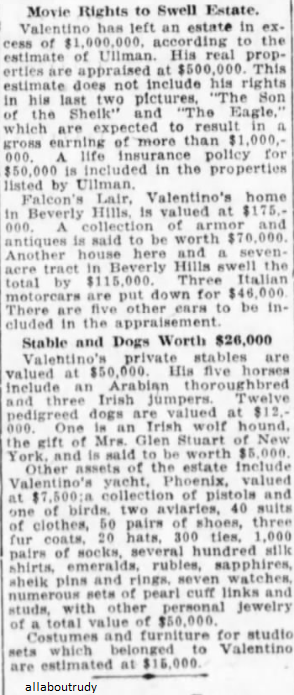
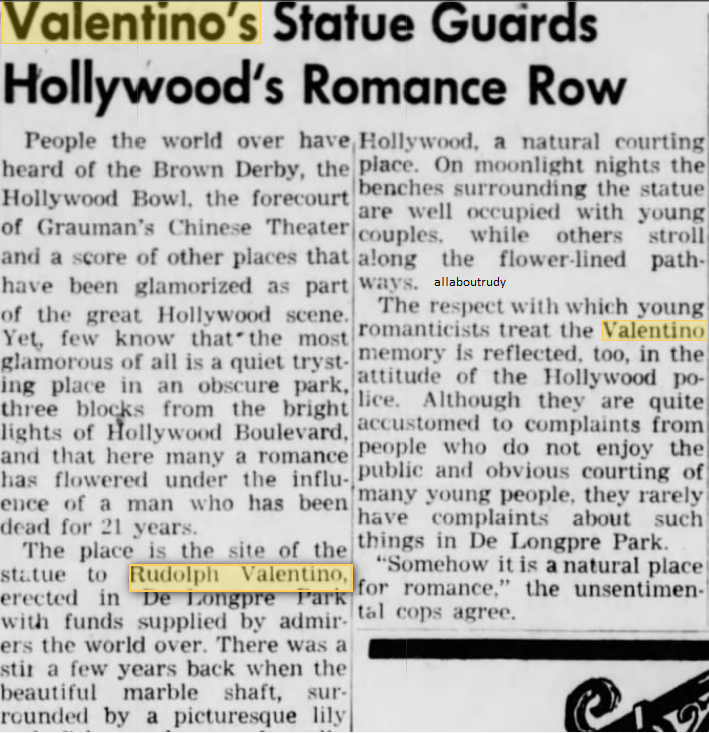
what became of Valentino, because nobody ever had the notion of paying the cost of his burial, especially not the ladies in black or white who came to be photographed in front of the marble plaque where his name is engraved. Elsewhere, there is a big bet that all the publicity amateurs did not know Valentino when he was alive; otherwise, you would still see plenty in the little glass vases placed on either side of the plaque, the violets that he loved so much. Some minutes from the cemetery, towards Sunset Boulevard and Wilcox Avenue, a statue has been erected in the memory of the actor. It is neither pretty nor large. Some children play in the little garden and, as it is difficult to find, few tourists visit it. With Paul Ivano, when we were looking at the bronze patina, a bird posed on his head and began to sing. Was it one of the signs of his soul that Rudy long ago promised to give me? We got back in the car and turned left on Sunset Boulevard which we followed along about ten kilometers. We climbed up to Falcon Lair where Valentino also lived. That house was bigger than Wedgewood Place but did not have a particular style. Valentino’s tastes, he did the furnishings and the decoration, were rather curious. He loved the Renaissance style, the Byzantine and the Latino-Moorish. A comfortable throne, high back with crimson velour, was for him the ideal lounge chair. He loved credenzas, and boxes incrusted with mother of pearl, lapis lazuli, or enamels, sets of swords and circassiens daggers, inlaid work, gilded moldings, velour hangings, and Henri II furniture. While at the house, he paid particular attention to not dress in the latest fashion, or in the upcoming fashion, he would have gladly worn at his house the lovely outfits of Henri III, of Venetian magistrates, or even the burnoose. Rudy didn’t have much time living at Falcon Lair, and he had not even finished the gardens when he died. The residence remained empty for a long time, and it was then that it was alleged to be haunted. Some research proved that it was simply the act of termites: those insects are California pests and, when they get in, at night, to eat the woodwork of the house, the noise of their jaws is of such vibrancy that one can hear it far away. A society of theologians lived at Falcon Lair for some months, then the house was closed again, and finally resold, to the point where one didn’t know exactly who the owner was. The “repaire du Faucon” isn’t even that good a piece of real estate…twelve years in America, five successful, thirteen films of varying success, and today the career of Rudolph Valentino boils down to this? Some memories and silent images that are shown in movie clubs and on television. Some months after Valentino’s death, George Ullman informed me that he was going to sell at public auction all the goods of his friend, as he was the executor of the will. The auctioneer A.H. Weil was first in charge of disposing of Falcon Lair. As it went public, a mob of the curious and tourists arrived at Beverly Hills.The auction began slowly. The first bid didn’t even reach 50,000 dollars. Three hours later, the auctioneer only had 115,000. At the end of the count, New York jeweler Jules Howard snatched the house for 145,000 dollars. An adjacent lot was sold to Mrs. McCoy for 20,000, and the two Voisin automobiles, plus three American cars went for 12,000 dollars. Valentino’s four horses, “Firely, “Yaqui”, Ramadin” and “Haroun” made 3,250 dollars. Some days later, an enormous crowd rushed up Highland Avenue, in front of the Hall of Art Studio where Rudy’s personal effects and objects were going to be dispersed. The thousands of people, who hoped to take back home with them an inexpensive souvenir of the actor, scrambled trying to get inside the gallery, despite the efforts of many dozens of policemen. Inside the grand salon where the sale took place, people were jammed in against one another such that there was no way to move. The list of clothing that was being sold included, among other things, three red riding coats, thirty business suits, thirteen riding vests, seven casual suits, six flannel pants, eight pullover sweaters, sixty pairs of gloves, one hundred twelve ties, one hundred twenty-four shirts, one hundred forty-six pairs of socks, one hundred ten handkerchiefs, twenty pairs of suspenders, sixty pairs of shoes, twenty-two white vests, seventeen hats, almost all in white felt, thirteen canes, six pairs of riding boots, ten coats, ten tux and tails, ten pairs of riding pants, one hundred ten hard collars, twelve swimming trunks, twenty-eight pairs of spats, seventy flannel jackets, and underwear. Add to that a number of objects: cigarette holders, bracelets, watches, cufflinks, chains, rings, scarf pins, and semi-precious stones. George Ullman saved for himself the collection of daggers and sabers. He also bought the better part of Rudy’s wardrobe. The poor man had tears in his eyes, and I didn’t know what to say to console him; I looked at all his effects piled on top of tables and thought that Valentino had chosen much of it with me, while we were in London. I recognized the ties of Burlington Arcade, the hats from Locke’s, the suits from the tailors on Regent Street, and there was even the Dunhill that I had given him. All the books that were put up for auction were those that I had forgotten about at his house, and that he beyond a doubt never read. Adolphe Menjou was the first of the actors present to acquire a dresser and a Spanish room partition for which he paid more than 1,000 dollars. Some shawls, some rugs, some hangings next went on the auction block, and then the Edgewater Club membership card that had cost Rudy 500 dollars and was sold for 200. The auction had started the 10th of December and was drawn out until the 24th, the objects on sale seemed endless. From the silverware to “The Phoenix”, Rudy’s boat that went for 2,910 dollars when he had paid 9,000. His bedroom furniture only made 875 dollars and the throne that he was so proud of was had for 300 dollars. Natacha’s aunt raised the bid to 300 dollars for an album of Chinese costumes that had been bid on for 100 dollars, and Eleanor Boardman-Vidor spent 9 dollars on a book that had Rudy’s signature. Also sold were 20 shares of “El Capitan” theater stock that Valentino possessed. The same Jules Howard who had bought Falcon Lair spent 1,900 dollars for the painting of a partly nude Spanish lady that had decorated Rudy’s bedroom. The buyers fought over the little things, some programs, some post cards, some dance souvenirs, and all the cheap junk left by the artist. Four months after his death, all that belonged to him had been scattered, but as many of those things had not been completely paid for, George Ullman had to use that money to settle the debts that he had left. Emmett Flynn, number one director at Fox, invited me to go see the boxing match that was taking place that evening at Vernon, outside the limits of Los Angeles. Flynn honored me with his friendship and with his consideration because I had showed him one day while he was shooting a scene representing the Emperor of the Ile d’Elbe,that it came off badly showing him on a train reading the newspaper “Comoedia” and smoking a cigar. At first, he didn’t see it, because the trust that he had in his prop man was unlimited, then, details considered, he concluded that I was right. From this incident, he came to call me “professor”. Emmett Flynn, former chauffeur, had come to the cinema like so many others in this heroic time, and his film, A CONNECTICUT YANKEE, made him rank first among the directors of the house. A little before, he had given Valentino a chance by entrusting him with his first important role in THE MARRIED VIRGIN. During that time, I did understand English, but I spoke it with great difficulties: I had been in California for only a few weeks. I was able, however, to ask Emmett what were the reasons that brought about choosing Valentino. “I saw a good-looking guy in front of the studio door every morning, Flynn told me, and sometimes even on the stages having small roles, or again in the cafeteria. He had good facial expression, one of allure, and he would greet me with a warm smile each time he saw me. He was precisely the type that was needed for the character, an Italian aristocrat and I was not able to even think of Antonio Moreno, Vitagraph star, because the role was not important enough for him I called Valentino in the following day. He arrived at my desk, a carnation boutonniere, pearl grey fedora at the ear, and cane at the hand. A bracelet encircled his wrist. His elegance surprised me to the point that I hired him immediately, without even asking him if he was capable of handling the role. He had an air about him that I didn’t doubt for an instant his talent. He couldn’t do worse than anyone else. He threw me a little when he asked me to let him speak in French or in Italian, in order to better play the character. While he was filming, I didn’t have the slightest idea what he was presumably saying. He was convinced that the studio was going to hire him under contract for a year, but nothing came of it. The film was completed, he was let go. So. spoke Emmett Flynn. For him, Valentino had been the token Italian, very noble, and very handsome, who was sensible enough to only play characters whose dialogue he wanted to understand entirely.On my arrival in Los Angeles, I met the director Rex Ingram with his wife Alice Terry. Max Linder introduced me to them: he knew the whole world. Rex Ingram studied sculpture at Yale University, in 1913 and 1914. Then he became a leading man, at Edison first, then at Vitagraph. After the war, he returned to the studios, as a scenarist, then as a director. He had already made a dozen films of no great importance when he was in charge of directing THE FOUR HORSEMEN OF THE APOCALYPSE, by Blasco Ibanez. June Mathis wrote the adaptation and the shooting script. The problem was to find an artist who could embody an Argentine character of French origins, and Ingram did innumerable tests trying. In question was Antonio Moreno, born in Morocco of Spanish parentage and who seemed to have the exclusivity of Latin roles. Next mentioned was Lou Tellegen, but June Mathis recommended Valentino, whom she had seen in A DELICIOUS LITTLE DEVIL, ONCE TO EVERY WOMAN, THE FOG, and PASSION’S PLAYGROUND. Rudy was dressed as a gaucho, then as a French soldier. He was photographed while he mimed certain scenes. The results were conclusive. Rex Ingram was more interested in his lighting and his composition than in the actors’ performances. He loved films of atmosphere, and he was constantly surrounded by hunchbacks, giants, dwarves, and costumed characters. After THE FOUR HORSEMEN OF THE APOCALYPSE, he continued to direct a dozen reels in Hollywood and in Europe, then he converted to Islamism. He retired in a small house, north of Hollywood, where he died near the age of sixty. I had dinner at his house when he had just finished the editing of his film EUGENIE GRANDET. He was preparing THE PRISONER OF ZENDA and TURN TO THE RIGHT. June Mathis told me how Ingram had showed reluctance before accepting Valentino, and how he himself made the mistake of rejecting him. I asked him why. Until then, Ingram told me, I had only directed some ordinary program films at Carl Laëmmle’s, when Richard Rowland, the head of Metro, entrusted me with the June Mathis manuscript, who had recommended me to him. The film was not a small project. Rowland warned me that the directors at his firm were not very determined tackle it: they thought that the public would start to be down on war films. Some insisted on shooting it in spite of everything, Rowland risked his reputation. To stack the cards in my favor, I did not want foreground actors and technicians. I had neither dislike nor animosity towards Valentino. I encountered him many times at Universal, but I did not believe him capable of playing Ibanez’s Julio Desnoyers. In the course of an early conversation, I found him obsequious and aggressive and, having seen A DELICIOUS LITTLE DEVIL again, in which he played an apache in a bowler hat, I thought that he scowled too much. In my mind, Julio should have a very powerful air, above all, very French, and I dreamed of bringing in a star from Paris. But June Mathis was insistent. She tried to make me understand by pleading Valentino’s case to me just as she had pleaded mine to Rowland. Finally, I tried my hand at it. As a result of my being hired, Valentino was hired, then the film took in so much success and the critics declared the actor was the incarnation of Julio Desnoyers. I was happy to work again with Valentino in EUGENIE GRANDET. The following week, I spoke with Valentino about Ingram. He told me how he was grateful to him for having followed June Mathis’s advice, but that it was difficult to work with him, and that their very different temperaments didn’t always get along. He didn’t let me do what I wanted to, Valentino said, he seemed to think too much about his compositions and his lighting effects than about my performance, which at times made me angry. I know what he was saying, because when Valentino was not happy, he became touchy and would sulk for the rest of the day. Rex Ingram was an intelligent director, while Valentino was flat out in training, without great dramatic experience, and he was convinced that everything that he did should be applauded. He didn’t like being corrected, especially in front of his co-workers, he couldn’t stand slightest contradiction, and if Ingram concerned himself with all with his framings, Rudy, to him, made a big deal out of a bunch of important accessories available to characters that he posed. He was the long, elaborate, jeweled cigarette holder, half-leather half-suede shoes, canes, ties, headscarves actor, the European gentleman as he designed him. While we were on tour in the United States, going from town to town, and he did his number each night with Natacha, after having broken his contract with Famous Players Lasky, I often had the occasion of talking with him in the special train car that we occupied. I asked him one day what he would have been in his life instead of accidentally becoming a movie star, had he continued dancing in the night clubs on Broadway. I certainly would not have stayed in the United States, Valentino responded to me. During my first years in New York, I had suffered so much that I came to curse that town and dreamed of leaving. To eat I did all kinds of work. I came to spending the night in small cinemas that ran all night nonstop, when I didn’t have a thing to pay for a room. It was only ten cents to enter and a number of hobos did the same as I did. Most of the time, I slept because I was so exhausted that it was impossible to interest me in the adventures of Charles Ray or of Mary Miles Minter. At that moment I would have been so shocked if you had told me that I was going to be a future cinema anything I found a job in a little bar and I danced with the customers, then I met, in a bar, a guy who did a tap dance number and the Soft Shoe dance. He returned from South America, where he spent a few months, and he told me that he dreamed of going back there. He earned money and was well known. According to him, a dancer hall partner had a greater chance of being successful en Rio or in Buenos Aires than in New York, and one can do lucrative work down there. While listening to him, I imagined that I would be more at ease in Argentina than in Brazil. But the voyage would be expensive, and I didn’t have a dollar in my pocket. As for finding work on the ship, there was no question: you only earned for the voyage and the return. The bold ones who jumped across the land had infinite problems with the authorities, and they had led hidden lives. As the idea of repatriating myself to Europe was unbearable, I continued to faintly wait to depart for South America, without much faith in it. Then I was hired in the touring musical show that went to the coast of California, but I did not dream of doing movies. Everything that happened to me as a result was simply miraculous. From Tacoma, Valentino telegraphed me about meeting on the ninth of June at the station in Denver where his train car, “The Colonial”, would arrive just before nightfall. I met him as such. I had not seen him for two months and he seemed to me not to be worried about his break with Famous Players Lasky. However, the studio had forbidden him to appear in films or on the stage until the end of 1925, which condemned him to wait for about thirty months. He was obligated to do his dance number outdoors, in private ballrooms or even in a tent. The showstopper of the evening was the tango of “The Four Horsemen”, which he danced with Natacha. He would then choose among the crowd the most photogenic young girl, vaguely promising that she would become his screen partner. Some musicians accompanied us on the voyage, and when the train stopped for a few minutes in a small town, a number of women and young girls, alerted by the newspapers, waited for Rudolph, their arms filled with flowers. Almost every day, some of them would board “The Colonial”, trying to hide to be able to travel with their idol. Before departing, we had to look in every nook of the car and make the hidden girls get off the train. Valentino had another method of handling coming face to face with his female admirers that was good for him, a charm method. He would accept the bouquets, sign autographs, and distribute his most recent photo that he had in stockpiles. To Chicago, then New York, it was a delirium. We attended the premiere of his last Paramount picture, THE YOUNG RAJAH, a mediocre movie, accompanied by June Mathis. The packed crowd of Valentino admirers was so intense that we had to leave the theater by way of the fire escape. Behind the Blackstone Hotel in Chicago, we had to beat a path for him. His fans tore buttons off his clothes and tried to undo his tie. The police were powerless against the thousands of people. At the Ritz-Tower in New York, the cheering from the massive crowds on the street obliged him to send greetings from the window, like royalty, and the policemen stayed there permanently to unblock the traffic. Slowly moving back into the room always continuing to smile at the crowd, Valentino said to me: “only a few months before my departure for the West, I would sleep, in the summer, under the Central Park bushes that you see just across the street. In the early morning the policemen would shoo me away and I would roam around that hotel, completely broke, hoping to find something to do in order to make the ten cents necessary to buy a cup of coffee, a doughnut for my breakfast and my clothes were wrinkled, I wasn’t shaven, and I had an empty stomach. No one even gave me a look, and the magic of cinema happened: the crowds who ignored me and who left me to die of hunger are now masses under my window, cheering me. They have seen me on the screen dressed as an Arab, a bull fighter, a soldier, a Hindi, and that was enough for them to wait for me for hours down there. However, I am still the same man. How can you explain the stupidity of the crowd?” Before leaving and facing his public, Rudy would freshen up. He was a little ashamed of his boxer’s ears and of his growing baldness. He used too much hair lotion and came to comb the top part of his head with a sort of heavy black lacquer that stained the hotel pillow cases such that when he checked out, he was made to pay a high price for them. As it became impossible for him to leave through the hotel door due to crowds, a taxi was made to come and wait for him at the employee entrance: he passed like this through the door that he had so wanted to avoid during the time of his difficult years. The studio publicists for whom he toured did, in the United States, monstrous publicity for Valentino, but as his films had not yet been shown in the European market, the weekly papers that I received in 1921 did not publish his photos. Every day, he asked me to do his publicity for France and Italy. In September 1923, none of his films had even been shown in his native country. Rudy, who planned a glorious trip to Europe, realized that he strongly risked being unnoticed. Rome and Paris triumphantly welcomed Douglas Fairbanks, Charlie Chaplin and Mary Pickford. Rudy wished for the same success. I returned to New York in November of 1933 [sic], and I made use of my trip there by paying a visit to Valentino who lived on Sixty Seventh Street, Number One West, where he had to stay for two months. He told me that his movies, filmed by Metro, were shown nonstop in France. He handed me an envelope of photographs and asked me to get him the covers of CINEA, MON CENE, and CINEMAGAZINE. Six weeks later, I made his press clippings follow him from Hollywood. I kept most of his messages. He almost always wrote to me in French, because he was very proud of knowing the language, and today I am reproducing some excerpts because after forty years my correspondence continues to ask me about this subject, posing me questions about his style, about the man that he was, about his manner of speaking, and about his manner of expressing himself. It is shown, upon reading the following paragraphs – whose spelling I have preserved – how publicity was a subject of interest to him. (Letter from December 29, 1922, excerpt) “It is with joy that I received your charming letter, which is the first I have received since your undertaken departure towards beautiful Hollywood, as you call it. I wonder, is it true that you wrote me or is it only to make me think you did…Thank you very much old man for the good publicity that you did for me, and I am going to give the order to Abbe to make me a new photo set for you that I will send as soon as it is ready. At the same time, I am going to send you some speeches I made at the radio exposition, and that nearly a million radio fans heard, about the bad methods of producing the films adopted by Famous Players etc., and another explaining the mission of the future of cinema in world affairs. I would like you to translate it to send it to your foreign magazines. I think that it is good publicity. Tell those two good guys Limur and Caracciolo to write me a word and tell Jean not to forget to exercise my horses with Caracciolo if they really want to. Send me their address. I should stop now because I must leave for Philadelphia to talk on the radio. Greetings to all my good friends and plenty of wishes from me and from my wife also. Take care, always your friend, Rodolph”. (Letter from May 19, excerpts) “In my last letter I promised to write as soon as I had some good news to give, and here I am about to make good my promise. To begin with, I will tell you that I decided to clear out to Europe at the end of this tour, most certainly the 8th of July. I still don’t know if it is because of movies or for a vacation, but it is certain that I am going to leave on the Aquitania or on the Olympic around the 23rd or 24th of July. You are going to say to yourself: “I am happy, but when can I clear out” or at least: “it’s good news for Rudy but not for me….” I told Kenneth Patterson to reserve you a first-class cabin for England leaving New York around 11th or 12th of July so that you can arrange a grand reception for me in London. As soon as all is arranged in London you will go to Paris to do the same thing and return to England in time for us to make the ship. You will reserve some rooms for us and one for you already at the Ritz in London and the Ritz in Paris…It is necessary to have absolute secrecy up until you are on the ship and better yet until I am also in Europe. Thanks again for sending me your Filmland and I am very happy for the success that it has received. We will make a Valentino book and another one also showing my return to Italy after ten years. (Letter from May 20th, excerpts) “I want to tell you also that the other day in New York I posed for new photos, and I chose twenty-eight different poses, and I put in an order for two hundred glossy prints of the different poses so that you will have enough pictures of me to start until I arrive in London and in Paris to take some new ones. I also decided that the tenth of July is a little too late for your departure and I changed your departure for the first of July. (Letter from May 26, 1923, excerpts) “Only a word on the run to tell you that you will leave for England on exactly July 3rd on the Cunard ship Aquitania I have reserved and paid for a first-class cabin. It is a beautiful luxury boat, and I am sure that you will be very comfortable and very at ease. Hurry with your passport etc. because it will not wait until the last minute. On the other hand, you well know that if you were foolish in getting married it would naturally spoil business, and as a friend I tell you frankly not to marry because you have a good future ahead and everything will be ruined by the indulgence that you still have plenty of time to do. When it comes to women, one lost is a thousand found. Besides, you will have enough to do so as not to think about it and go on to have a good time in Europe. A passing friend in New York had told Valentino that I had intentions to marry. That wasn’t true, and Valentino so reacted to the news of that tall tale. I responded to Rudy to reassure him, and to tell him that it didn’t enter my mind to wed before my departure, which brought about him giving me, when I rejoined him, a long speech about his views about marriage. He always dreamed of the ideal mate, an ethereal spouse not made for the flame of desire but for ennobling him, of a woman not only offering grace, sensitivity, harmony, elegance and a blend of material beauty and ideal beauty of form. The woman he was looking for was not of this earth, he desired exquisite, delicate, incomparable, virginal, stunning, angelic, fresh, divine, serine, fascinating, diaphanous, an extreme sweetness in character and above all unearthly. And so, in love, Valentino was disillusioned, or perhaps it is more exact to write that he was disappointed, because his first wife left the honeymoon suite the dawn of the day after their wedding, and his union with his second wife was of short duration. The Valentino’s pre-conjugal adventures, of which we talked often, only left him with bad memories. American women, the female viewing audience of cinema saw him as the ideal lover. They all envied the good fortune of his partners that he kidnapped in the desert on an Arabian horse, and the young girls refused to leave after the showing in order to see the movie again. They forgot to chew their gum or popcornand they wrote him incessant letters that he would show us and then tell us: “You see how I am loved!” In 1912, while spending a few weeks in Paris, he made the acquaintance of a young music hall dancer. For reasons that he never explained to us, she refused to crown his passion and she was insulting. He was barely eighteen years old, but the bitter impression left on him from that rejection continued to affect him ten years later. One day, when we were in Milan, I took some notes for a book about his life, about which he spoke to me. “The girls in the Parisian revues are all ugly, he told me. The pretty girls in the art of Fabiano, Icart, Hérouard, Vincent, Léonnec and Benda, don’t exist except for in their imagination. The naked women of Folies-Bergères are hideous, they are so fat, and not one of them can compare to the New York show girls”. I responded to him that he was exaggerating, and that he must beyond a doubt have his eyes in his pocket, because throughout Paris there are just as many pretty women as in any American town. But he didn’t want to give in, and later when the chapter that we prepared was published, I found in it his denunciation of the esthetics of Parisian women. I told you that I know them, women, and I have paid for knowing them! You are wrong I know that the most beautiful women you have ever seen are Ziegfield’s or on Hollywood Boulevard, I repeat him with his accent that became more pronounced when he was irritated. He never forgot the little Parisian woman from 1912. Changing the conversation, he asked me for the list of names of all the personalities and above all the members of the London aristocracy whom he had met and of whom I took note, and whom he intended to mention in his recollections. He made a big to do about the fact that he had been introduced to Sir Gerald du Maurier, one night we had seen him perform and he had been invited into the artist’s dressing room. Another joy for him was having sailed with George Arliss and having dined in his company. What kind of man was Valentino? How many times have I had to answer that question! It seems to me that the best way of doing it is by reporting certain traits of his behavior. From 1921 to 1923, the group of close friends that would get together at his house comprised of Manuel Reachi, Paul Ivano who had been his photographer before becoming a cameraman, the actor Douglas Gérard, Jean de Limur who was an actor before becoming a director, Mario Caracciolo, aka Carillo, an old Italian army officer, and myself. Some stars, like Chaplin or Max Linder, would come sometimes to his place, but rarely. The only person that Valentino regularly paid a visit to was Alla Nazimova whose support had been so precious to him. Most often during that time, Valentino preferred to stay at his place. He went out, it seemed, as little as possible. He scarcely frequented bars, night clubs, and on rare occasion we would go to the Ship Café in Venice or the Sunset Inn in Santa Monica. He didn’t go to the cinema, except for his previews. Politics, science, literature, history, geography, left him totally indifferent. He was neither a glutton nor a food connoisseur and he ate frugally: he showed such great enthusiasm for rubbing a clove of garlic on a crust of bread it was as though it were a banquet. Some Anchovies, tomatoes with oil, sausageand some fruit were for him the best of meals. He did not appreciate complex dishes, and I often went with him and Caracciolo to the little Italian delis on Main Street where he bought Greek olives, Lombardie chestnuts, and some cans of antipasto from his country. I was never surprised to hear classical music records playing. But he never tired of corny popular songs like “Wabash blues”, “Saint-Louis Blues”, “Cry Baby Blues”, Dapper Dan”, “Everybody Knows”, “Avalon”, “My Man”, and of course, “The Sheik of Araby”. He did not read, so to speak, never opening the new French novels that I would bring him. To the contrary, he would thumb through magazines and sports journals. He loved to horseback ride, especially in Palm Springs, and play with the medicine ball. He spent an hour each morning training his two German guard dogs, Sheik and Marquis, whom he would whip if they didn’t obey fast enough, swearing to them in Italian: because Italian took over when he got carried away or became angry. He was passionate about new sports cars, and he would have owned at least six if his means had allowed him. He kept such bitterness from his poor years that he above all dreamed of amassing a fortune. He wanted to save to shelter himself from material worries. I will never be poor again, he would say, and I will never be hungry again and yet, he spent all that he earned. He sometimes showed extreme generosity, then suddenly he would be tight-fisted for his own good. In the same vein, he was surprisingly naïve and trusting, only the next day to show suspicion and reluctance. We never had serious subjects of conversation with him. He entertained us mostly with what was going on at the studio. One evening, I was waiting for him at his house with Douglas Gérard, and we were talking about the news of the day, a story of masked gangsters who attacked a bank on the Boulevard. The event made a buzz, and we were very revved up. Rudy suddenly burst in the living room and deflated us, shouting “Do you know the news? Rod la Roque is now trimming his sideburns to a point, like I do. He has some nerve! It was impossible for him to stay in one place for a long time, except when he was being fitted for a suit or taking a portrait. He admitted with a laugh having been a rather bad student at elementary school and added that he owed his education to the life that he led. Excluding the designs that Natacha did, among others, of Nazimova’s wardrobe for Oscar Wilde’s SALOME, and the Beltram-Masses paintings representing him, he didn’t have much liking for modern art. But his heritage pushed him to admire pell-mell the paintings of the masters of the Italian Renaissance and the works of rococo style. In the presence of a veritable artist such as John Barrymore, Valentino had an inferiority complex. However, he felt very at ease with the stars who only owed their glory to the miracle of cinema. He was in general even tempered, and he easily laughed. Then suddenly, without apparent reason, he would lapse into the abyss of despair where it was difficult to pull him out. Many times, we saw him with tears in his eyes, upset by dark premonitions. I haven’t made the most of life, he would say to us I hate the films I am obligated to make. I would like to join Natacha in New York. I feel alone. He was also plagued by his stomach which made him suffer a great deal. He would take large quantities of bicarbonate soda. Max Linder organized some famous dinners where the greats of Hollywood convened. He focused on his guest lists. Many times, as he was establishing his guest list, I would ask him to think about Valentino. Your friend is very nice, he responded, and very friendly, but we don’t have anything in common to talk about. When he has dinner at my place, he doesn’t say a word, unless he talks about his films. And, between us, he didn’t invent powder. On the other hand, George Jomier gladly received him. Every week he would get together some friends at his “pigeon house” on Hardford Street and would cook them French style meals. He would use newspapers as a tablecloth and would serve on mismatched dishes. Upon leaving, each person signed the door and Jomier had the intention of bequeathing that door to posterity by way of the Los Angeles Museum. One Sunday, Jomier gathered us with Fatty Arbuckle, Thomas H. Ince, Max Linder, and Gaston Glass. After the meal, Fatty took some dice out of his pocket and proposed we shoot some craps. After an hour, Valentino had lost about fifteen dollars. It wasn’t a big thing, but he was furious because he didn’t like to lose. When leaving “the pigeon house”, he was irate. It was hard for him to thank Jomier and say goodnight to the other guests. I don’t like Fatty, he told me, he always does tricks and jokes that I don’t appreciate. I don’t like losing my money in such a stupid way. If Georges invites him again, I will not be coming back to his place. An hour later, he didn’t think of it anymore. But his anger returned after a bottle of Flora Delle Alpi that his bootlegger supplied him. You see, if I had not gone that Sunday, I would be able to pay for that bottle without having to write a check. It horrifies me to waste my money like that yet if you had won, I told him. It’s all the same to me, I only know one thing: I lost 15 dollars, and with that bottle, that makes twenty-five dollars that left my pocket today. However, Valentino was not stingy, his bank balance proved it. He made more bad blood over some dollars lost in that way than over a more important sum lent to a friend and never paid back. Extras knew it well, never addressing in vain this paradoxical patron. Valentino arrived in London when he learned from me that he was in contract negotiations with J.D. Williams, a well-known producer who was part stockholder of First National, and who now was the founder of Ritz-Carlton Pictures corporation. The negotiations engaged with Famous Players Lasky were well advanced: J.D. Williams tried to arrange things and to avoid a lawsuit. Valentino was persuaded that the court would rule in his favor and that he wouldn’t have shoot movies for company that he had quit when he was still under contract to them. A compromise intervened. Valentino would return for a time to the bosom of Famous Players Lasky, – considering a beautiful augmentation of style, then he would become the star of Ritz-Carlton Pictures corporation. During a press conference that followed those secret negotiations, Valentino then made the following statement “My contract with J.D. Williams, which will take effect when the provisions of my work with Famous Players Lasky are settled, will give me the right to choose directors, scripts, and costars in my next films. It will permit me to make more artistic films than those that are produced by ordinary business: commercial rigidity is a thing that so often paralyses. I will have the privilege of surrounding myself with the best directors, the most skilled writers, and the most prestigious distributors. From choice of story to final cut, I will be entirely responsible for all details of the production. Don’t think me to be presumptuous, as it is to the public that I owe my position of movie star, and I am always anxious when my name is written on the title of a film. What genre of film will you make now? a reporter asked him. Undoubtedly caught in the current, Valentino responded that it was still too early to talk about it. He insisted that it would be Latin, and that he would choose his roles in accordance with his Latin personality. All those beautiful speeches didn’t force him to face reality. MONSIEUR BEAUCIRE, L’HACIENDA ROUGE, COBRA, and THE BLACK EAGLE had no more merit than CAMILE or BLOOD AND SAND. It’s that his waiting public didn’t have anything to do with art. He understood that perfectly, as he reappeared with the well-loved traits of The Sheik. After his death, the producers tried to launch many Latin lovers, clearly inspired by Valentino. But one cannot easily drive away a shadow when it belongs to a legend. But as such, there he rests going on thirty-nine years? In August 1962, there will be no ceremony, no woman in grey, black, or red, at the cemetery. Indifferent to memories, the bulldozers did not spare the luxurious house that stood on the Whitley Heights hill; no trace of the dwelling remains there. Not even a piece of tile made in Florence.
Categories: Uncategorized
Tags: Death of Rudolph Valentino, Natacha Rambova, Robert Florey, Rudolph Valentino
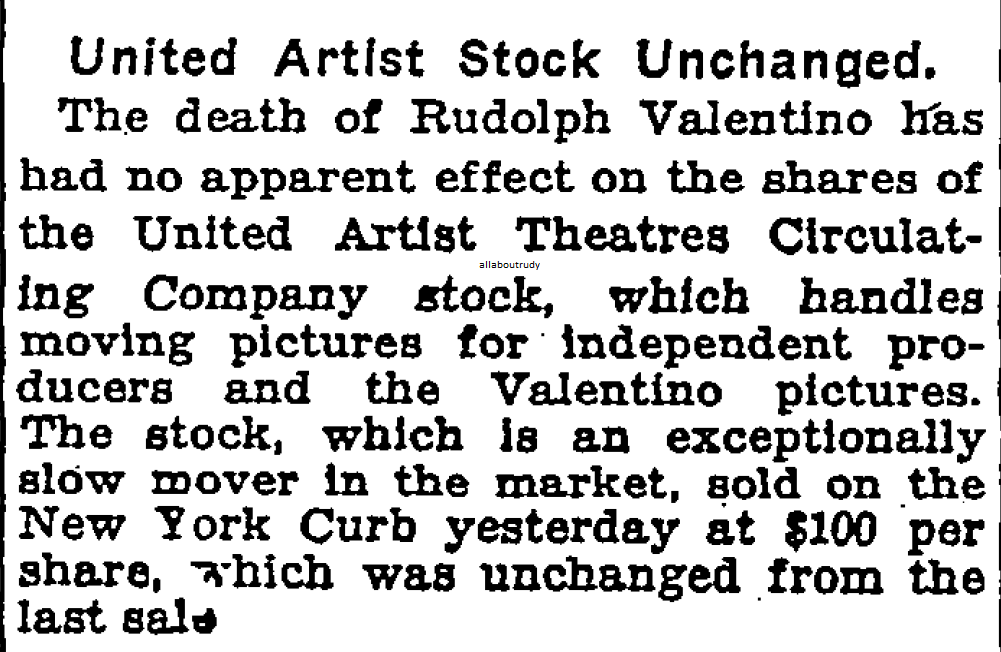
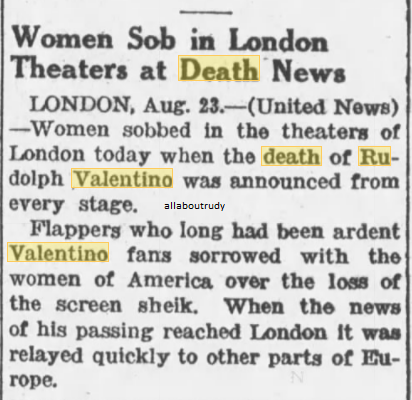
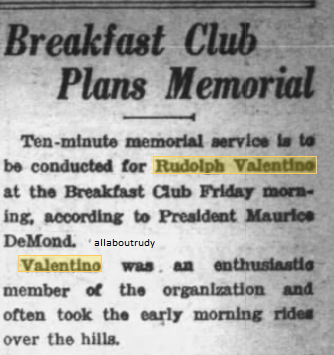
Categories: Uncategorized
Tags: Death of Rudolph Valentino, Hollywood Breakfast Club, Maurice DeMond
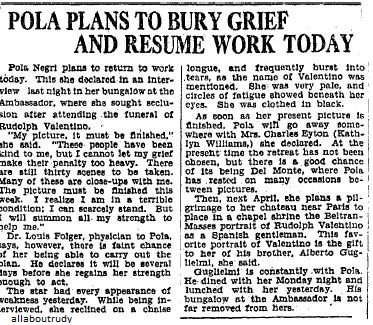
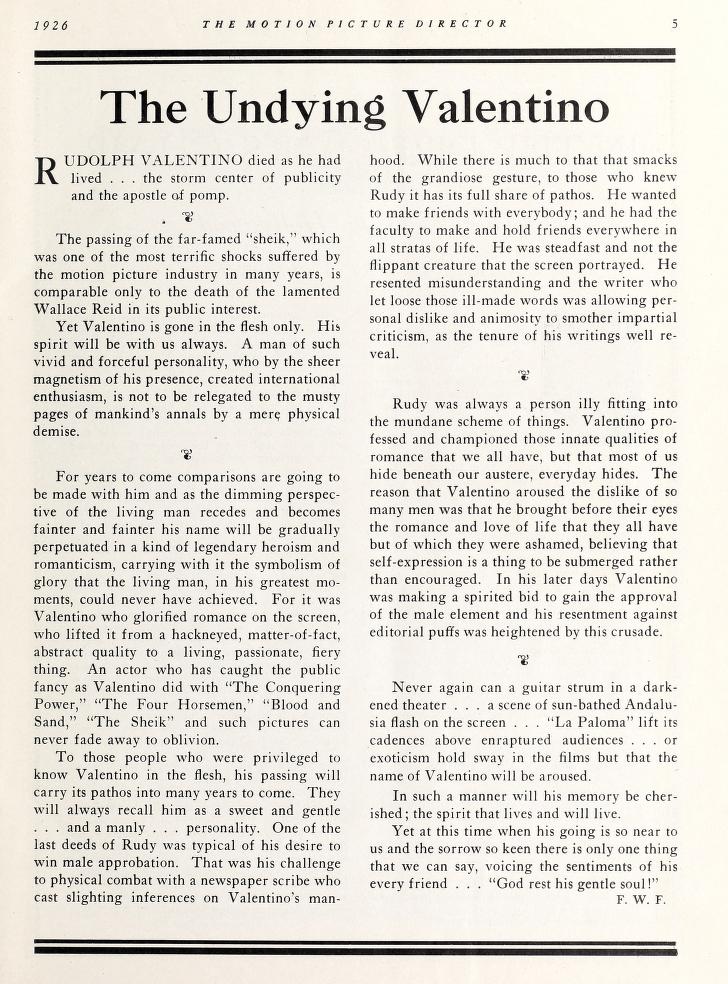

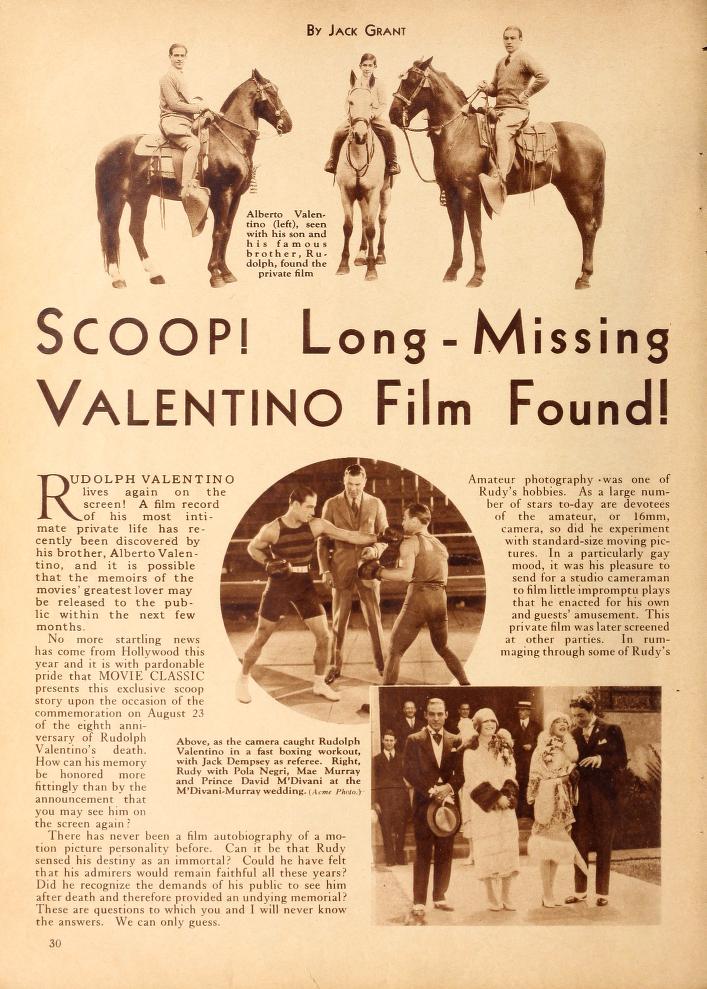
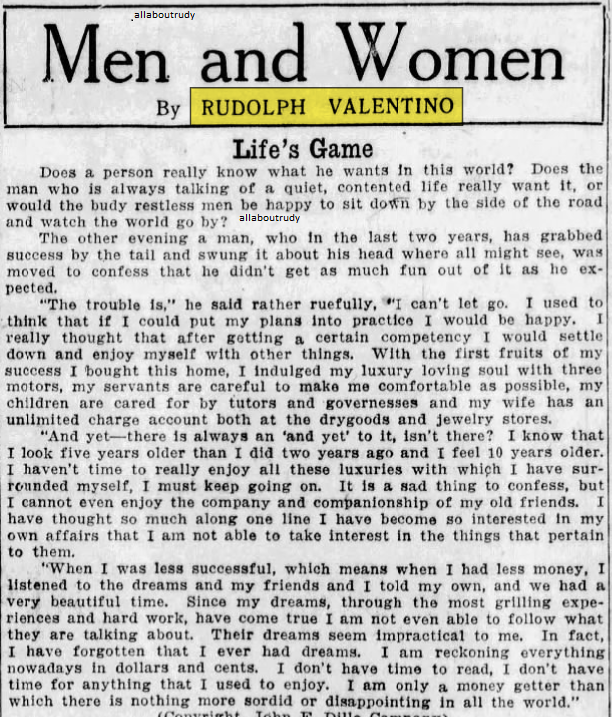
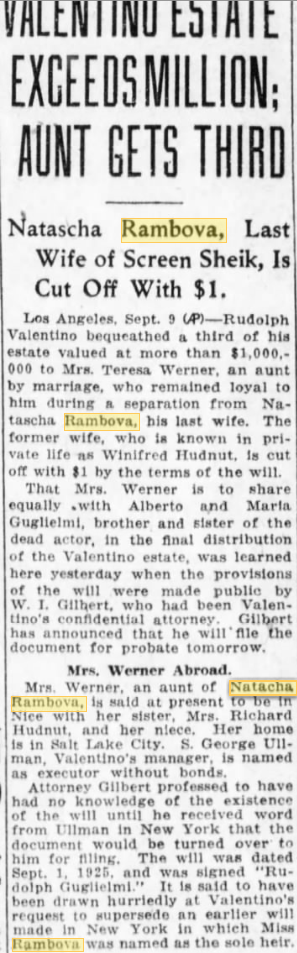
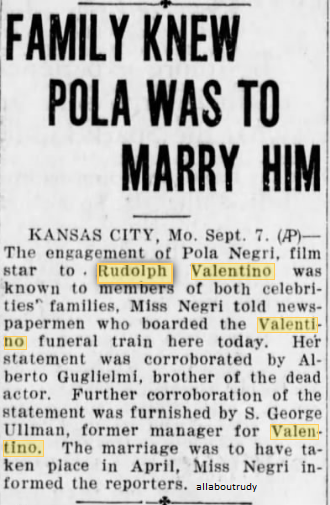
7 Sep 1926 – Well of course, we all knew
Categories: Uncategorized
Tags: Alberto Valentino, Death of Rudolph Valentino, Pola Negri, Rudolph Valentino
2 Sep 1926 – Capitalizing Death
Pola Negri is a movie actress, has a large income, can afford to ride across the continent in a private rail car, and has more than one home. But the size of her income depends very largely upon the amount and character of newspaper publicity she can garner. She has a press agent and has every reason to believe that he is the “high power” variety that knows how she can get more publicity and doubtless draws a big salary to match his power. Pola Negri on the pacific coast saw the spotlight of national attention focused upon the dead Valentino. She had he had been friends and said they were engaged but there was no official confirmation, and it has been all said to be heresy. She hastens to get aboard a private rail car travelling from New York to Los Angeles and this gained her the spotlight she felt was richly deserved. Throughout the land newspapers carried her name on the front page with detailed stories of her career and arrival in New York with her near collapse. Today Pola Negri’s potential wealth is greater by millions than it was before Valentino’s death. Every tear she shed at the dead man’s bier had a commercial value greater than so many of the purest diamonds. The cost of a trip across the continent in a private rail car was like paying postage on a thousand-dollar check. It was a red-letter day commercially speaking in the movie career of the “bella donna”. She swelled the box office receipts of every motion picture theater in the land that hereafter exhibits films in which she plays a leading role. The newspapers in New York and throughout the country printed the news and it was an interesting story they carried Monday morning about the Polish film stars visit to the bier of the dead Valentino. It was legitimate news, too. It was news of the sort of the millions like to read and was carried over the wires of the Associated Press and all other news agencies. In the routine of the days work, and in the line of everyday duty they helped to swell the coffers of those who employ Pola Negri to get and to weep before the camera. The press agent had nothing to do with the transmission of the news throughout the land or the printing thereof in thousands of newspapers. But if he had nothing to do with the setting and the staging that resulted in the front news story, he doubtless would feel almost ashamed to accept his salary on the new pay day. Now, perhaps Pola Negri, was prostrated with real grief one doesn’t truly know. It’s possible she may of loved him or it is possible that none of the tears she shed was of the screen and stage variety. But few people who have seen her on the screen would have thought she was the type of woman who could truly be heart broken by the death of any man. At any rate she could not have overlooked the press agent and financial possibilities in the trip across the continent and the dramatic appearance at the spot where the attention of a nation of motion picture fans was focused. Pola Negri is an actress and the whole thing smacks of capitalizing death.
Categories: Uncategorized
Tags: Death of Rudolph Valentino, Pola Negri
1921-1926 Monte Westmore Rudolph Valentino’s Make-up Artist
Monte Westmore was a famous Hollywood make-up artist, the eldest of six sons of George Westmore. Monte was Rudolph Valentino’s Valet then he became his make-up artist. In 1921, he worked with his father, George, on the silent film “The Sheik”. His father had created Valentino’s look, but it was his son Monte who convinced actor Rudolph Valentino to let him do his makeup. Monte recreated the clean Latin look that had Valentino’s legions of fans swooning. He was Valentino’s makeup artist until the actor’s untimely death from peritonitis at the age of 31 in 1926. Monte’s feature work included: 1922 Blood and Sand (Niblo), 1923 Monsieur Beaucaire (Olcott), 1924 A Sainted Devil (Henabery), 1925 Cobra (Henabery), The Eagle (Brown), 1926, Son of the Sheik (Fitzmaurice), 1926
Categories: Uncategorized
Tags: Death of Rudolph Valentino, George Westmore, Monte Westmore, Rudolph Valentino
28 Aug 1926 GIRL’S DEATH FROM GRIEF.
Categories: Uncategorized
Tags: Death of Rudolph Valentino, Peggy Scott
27 Aug 1926 – Sheik poor Financier, Says Friend
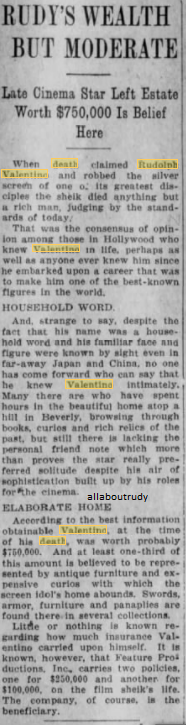
The world’s greatest lover was the world’s poorest financier. If Rudolph Valentino had any bank balance at all when he died, it was but a few hundred dollars, his close friend, Joseph Schenck hazards. Last year the sheik earned between a million and a million and a quarter dollars and spent virtually every cent of it. There was no reverence for money in “Rudy’s” makeup. There was no bent-for its accumulation. Valentino was prodigal, gullible. If he saw something he wanted whether an automobile, a tapestry or a fishing pole he bought it, regardless of price says Schenck., head of United Artists. “I should judge his home at Hollywood was worth $75,000. He always owned four of five cars and some riding horses. “For his home, he bought many painting s and tapestries often at inflated prices. He had a collection of fencing foils, and another of guns/ “Anybody could touch him. He carried $50,000 personal insurance. Friends often advised him to increase the amount, but here again is Valentino’s disregard for money was manifest. Accumulating lasting wealth in life or leaving it in death meant nothing to him. “But for his business manager George Ullman, he might easily have died broke.” Valentino had a 50% interest in the net profits of “The Son of the Sheik” and “The Eagle.” These two pictures still are playing over the country, and the Valentino Estate doubtless will receive a comfortable amount from them. His salary from the production organization of United Artists was $6500 per week $338,000 a year. For making each of his earlier pictures of importance, Valentino generally received $200,000 and a 25% share of the profits. So far, as Schenck knows Valentino never invested in stocks or bonds and owned no real estate other than his house. Thus his estate is without “quick assets” other than his insurance. Both his parents are dead. Valentino was unusually fond of his brother Alberto Guglielmi and his sister Maria. He was devoted to Alberto’s children. To these kin, probably will go such worldly goods as failed to slip through “Rudy’s” fingers.
Categories: Uncategorized
Tags: Death of Rudolph Valentino
26 Aug 1926 Organist Plays Softly
In the early afternoon, while the crowds were still moving past the casket, H.E. Hall a volunteer organist, seated himself at a pipe organist, seated himself at a pipe organ recently installed in the funeral parlors and played softly. Some women were moved to tears. Mrs. Jean Commo, 150 East Third Street, who said she was also from the little Italian town where Valentino was born, was one of the first to arrive in the morning. She carried a bronze crucifix which she laid upon the coffin. A woman and two girls were overcome in the course of the first day. The first was Irene Newman, 22 years old, of 8 Lewis Street, Yonkers. She walked up to the casket when she crumpled to the floor. Drs Fuch and Silver of Reception Hospital attended her. She quickly recovered and went home. Dolly Toth, 19, of 143 Knapp Ave, Clifton, NJ fainted as soon as she entered the room. She was revived and with determination walked up to the coffin, where she fainted for a second time. Rose Tviteva, 14, 449 East 185th Street, Bronx, became hysterical while waiting to view the body. Restoratives were applied to her, and she was sent home. Drs Silver and Fuchs, aided by Dr. Sterling Wyman of the Flower Hospital, and Margaret Dare a nurse of Metropolitan Hospital, were in charge of an emergency hospital established near the bier. Mrs. Richard Rees Whittlemore, widow of the Baltimore Bandit who was recently hanged for murder was recognized in the funeral line last night at 2100 hours. She was in morning and said she had come to pay her respects to Valentino, whom she said she had met once when he was a judge in a beauty contest to select “Miss Baltimore”. Others who were present were James Corbett, former heavyweight champion, and his wife. One of those who wept at the bier was Nellie Savage. She said, she had appeared with Valentino in “The Sainted Devil” and “Monsieur Beaucaire.” The room in which the body laid was nearly filled with floral tributes sent by members of stage and screen. Charlie Chaplin sent a wreath of orchids with a card that read “To Rudy, whom I loved as an artist and a friend”. Other wreaths bore cards from Lois Wilson, Harold Lloyd, Nellie and Mae Savage, Cecil Lean and Cleo Mayfield. June Mathis scenario writer, who was credited by Valentino with having aided him in getting his part in “Four Horsemen”, sent a wreath of roses. Other floral pieces included a spray of lilies from Lola Pierce, one of Valentino’s first dance partners; dahlias and roses from Sam Goldwyn, gladioli, and orchids from Marilyn Miller; a blanket of yellow roses from Joseph Schenck and Norma Tallmadge. Isabel Clough, 58 West 165th Street, who went to view the body, carried a spray of gladioli. Explaining why she brought her flowers, she said “I figured that this would be a clever way to get in. I have always admired Valentino and so I thought I would buy him some flowers so that I could see him at once”. Douglas Fairbanks and Mary Pickford returning from Europe were deeply shocked by a radio message they received at sea from Mr. Schenck. Miss Pickford said they would not go the funeral parlors but would attend the funeral. She said she preferred to remember Valentino as she saw him last in life. Morris Gest and Rex Ingram were also returning and were deeply shocked by his death. Two women were arrested at the funeral parlors on charges of disorderly conduct on Tuesday after they had gotten into arguments with policemen were let off with suspended sentences by Magistrate Goodman in the West Side Court. One wept all the time she was in court and refused to give her name and address. The other defendant described herself as Mrs. Sarah Kaplan, 30 112 East 139th Street.
Categories: Uncategorized
Tags: Death of Rudolph Valentino

23 Aug – Today we Mourn
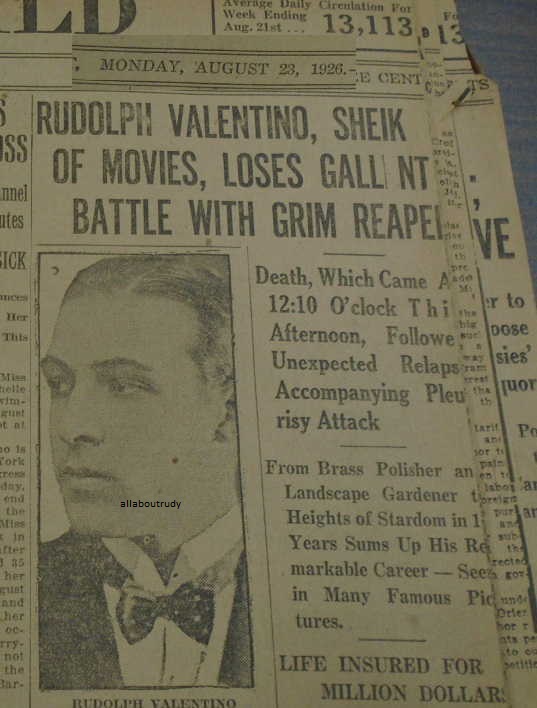
Today, we mourn the loss of silent film star Rudolph Valentino who died 100 years ago. His popularity has never faded with new generations of people who appreciate what he brought to the movie screen.
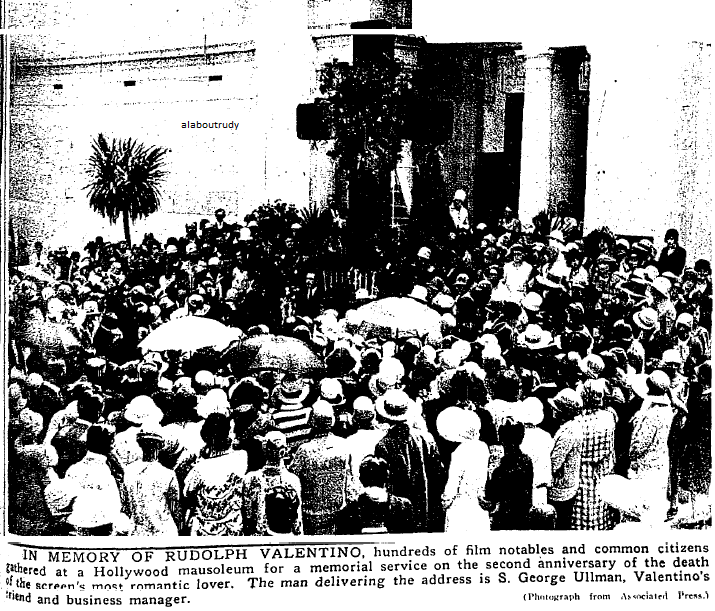
Today, if you’re in the LA area please stop by Hollywood Forever Cemetery where the oldest continuing memorial service Hollywood event will take place at 12:10 pm (PST), Cathedral Mausoleum. I recommend arriving early.
Today, if you’re in the online community the Memorial Service will be shown “live” on Facebook. I will be online watching.
Today, many will be privately grieving his passing and you are not alone.
It’s during this time, I remember my dear friend Pam Colt, who passed away 5 years ago this month. I met her at a Valentino Memorial Service and we became good friends. Also, I would like to personally acknowledge the passing of Ms. Emily Leider a noted author. Lastly Donna Hill a bright star who unselfishly gave and will be forever loved by all who knew her.
One more thing, thank you to the ALL subscribers and supporters of this blog. I appreciate all of you. It has been a labour of love with this blog and my YT channel.
Categories: Uncategorized
Tags: Death of Rudolph Valentino
22 Aug 26 – WHY I Mourn Rudolph Valentino

The serenade of a thousand years ago. The song of a hushed lip. Lives forever in the glass of today. Wherein we see the reflection of it. If we but brush away. The cobwebs of a doubting faith.
I read words he wrote; I watch movies he made; I listen to music about him. It has been one hundred years since his passing and the grief I feel is still fresh.
I could not have known him and yet, after all the years I have spent reading about him, looking at his photographs, watching his films, and trying to separate the real man from the legend that grew around him, there are times when I feel as though I did know him.
That may sound strange. How can we feel that we know someone we never met? Perhaps it happens when we spend enough time following the fragments of his life he left behind in moving images in which we can still watch him smile, walk across the room, become angry, fall in love, dance the tango and wish his dance partner were us. There are photographs, interviews, newspaper stories, and recollections from people of a bygone era who personally knew him. Yet a century later those fragments remain.
Rudolph Valentino has been dead for 100 years and during that century other people have continually rewritten him with truth or lies. While using fiction to remake fact and making money off this.
A century separates us; I care about the man who once occupied a now empty space. When 23 August comes around and I know others may see nothing more than the anniversary of the death of an old movie star. I feel something different. I feel the absence of someone I never met. He’s still in my heart and after all these years I will never apologise and never forget.
Categories: Uncategorized
Tags: Death of Rudolph Valentino
23 August – Annual Rudolph Valentino Memorial Service
As a reminder on 23 August, Hollywood Forever Cemetery, Los Angeles, CA will once again be the site of the Annual Rudolph Valentino Memorial Service. This is THE OLDEST continuing memorial service in Hollywood paying homage to beloved silent film actor whom this blog is dedicated to – Rudolph Valentino. Like many of his fans, I will be watching via Facebook Live. Please join me as I mourn, remember and never forget.
Categories: Uncategorized
Tags: Annual Valentino Memorial Service, Death of Rudolph Valentino, Rudolph Valentino
08 Aug 1960
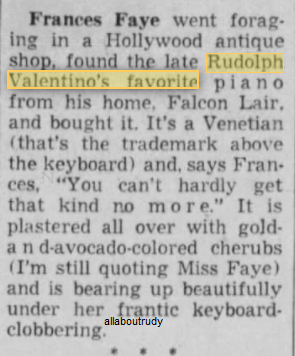
Categories: Uncategorized
Tags: Death of Rudolph Valentino, Frances Faye, venetian piano

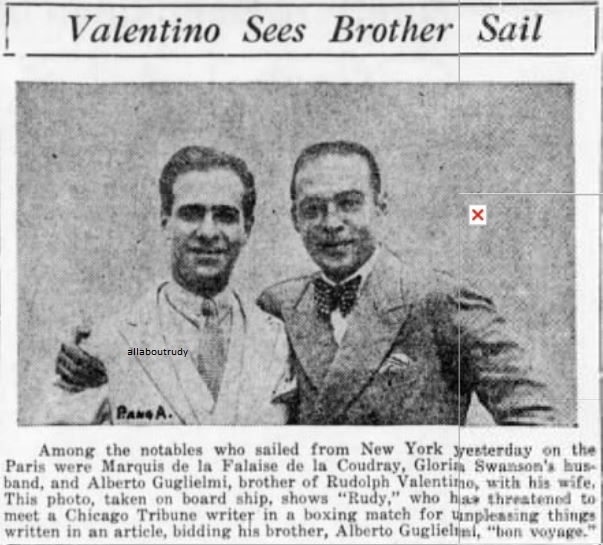
9 Jul 1956 – Rudolph Valentino Shrine Keeps Alive his Memory
Rudolph Valentino the greatest screen lover of them all, will have been dead 50 years on Aug 23 but his spirit lives again in a modest walkup apartment on Hollywood Boulevard. Nearly hidden among the shops is a flight of stairs leading to one of the movie colony’s strangest sights a shrine to Valentino. Its keeper is a stunt man who worked with the late star and so admired Valentino that he changed his own name to Rudolph Florentino. After Valentino died, Florentino devoted his life to collecting the stars photographs, momentous and 10 years ago organized them into a shrine. “I want to keep his memory alive” explained Florentino as he showed me through the three rooms bedecked with Valentino possessions. In our room are Valentino’s fencing rods and the hat he wore in the “Four Horsemen” I even tried on Rudy’s navy-blue yachting jacket or at least the NY Tailor’s label inside the jacket said it was his Valentino was a slender, small man. “I have all his publicity photographs” said Florentino bringing out stacks of negatives. The second room holds a library of books about Valentino plus the actor’s own scrapbooks. The third room is decorated like a sheik’s tent – sand, oriental rugs, and lamps and low couches and tables. On the bed where Florentino himself sleeps are Valentino’s cane and sword. Two candles burn beside a picture of Valentino. His scarves, homburg hat, and spats are above the bed. Florentino proudly wears a silver wrist chain inscribed “To Rudy from Rudolph 1925”.
Categories: Uncategorized
Tags: Death of Rudolph Valentino, Florentino, Rudolph Florentino
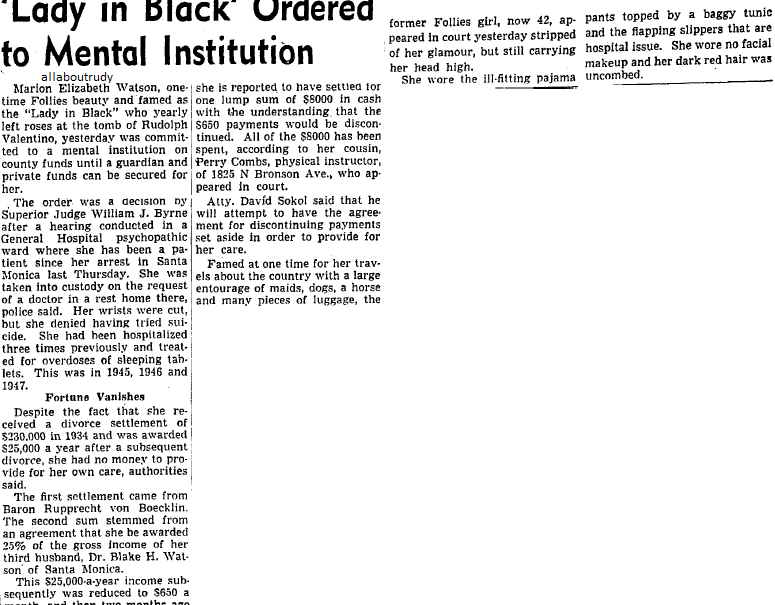
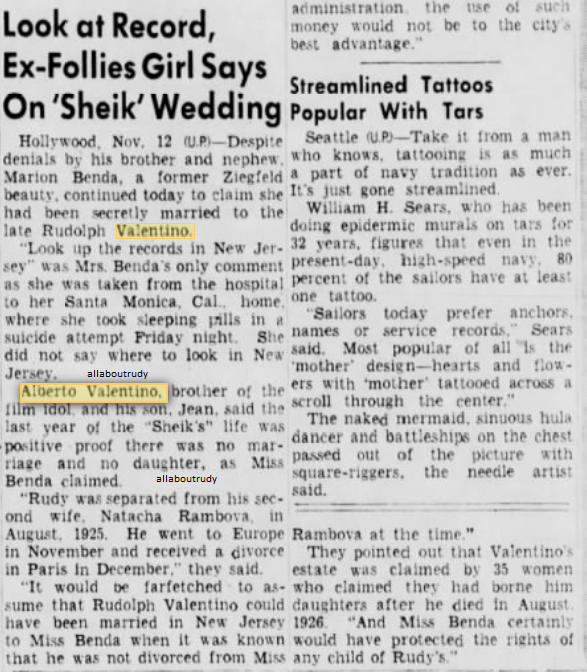
Jul-Aug 1926 – Thoughts on the Death of Valentino
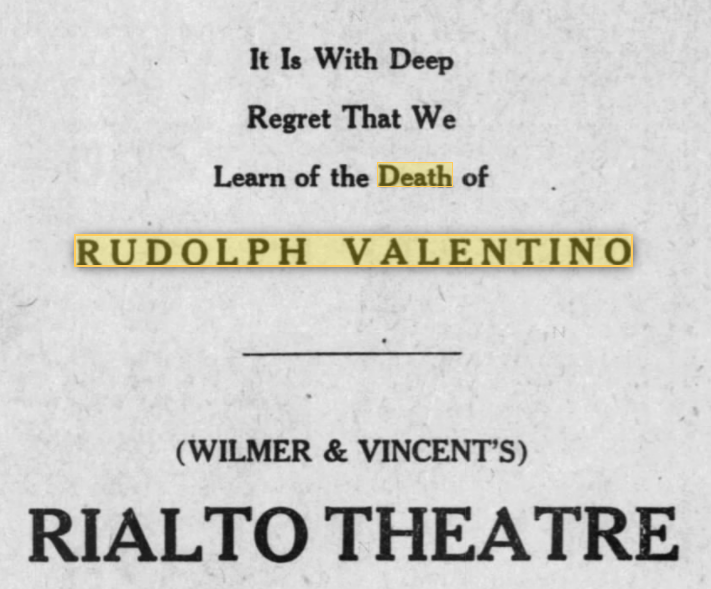
There are three sad months out of the calendar year. July was when Rudolph Valentino started to feel ill. August was when his health started to decline. He had an Italians superstition regarding going to a doctor. Inspite of maintaining a healthy lifestyle minus the smoking, drinking and eating, he died. September was when he was buried.
Although it’s always a poignant moment when one stops to reflect on 23 Aug when Rudolph Valentino passed from this mortal world and has remained in our thoughts ever since.
Millions all over the world as far as moving pictures learned with deep regret his passing. A very young man of intense feeling and earnestness, Rudy held his place, without a noted rival in his field. He came to this melting pot country seeking a better way of life. While his early struggles were known he made his way by hard work and talent that showed the world on the silver screen just how remarkable he truly is. Life on this mortal earth was brief but it was not wasted.
Of course, there were certain people who took advantage of his death by garnering free publicity or behind the scenes stole his personal effects. Colleagues, friends, relatives all talked about how he will be missed, what a great guy and friend he was. No one had a bad word to say about him. Back at Falcon Lair all his animals anxiously waiting for his return but would eventually realize that he was never coming back. They were sold to pay off his debts. Greed was the word of the day. Studios who insured their star for allot of money got that back. United Artists insured Valentino for $250,000. Did they truly care about their star? This author seriously doubts that. All they cared about was how he could make a profit and how they could drum more publicity for their studio now that he was no longer alive. Hollywood ensured they let the fans know they mourned their big profit-making star. Behind the scenes, they were truly glad he was gone since they didn’t have to worry about the drama or the tantrums he caused when things did not go his way while making pictures. So-called friends were backstabbing Valentino and thought now he is no longer alive I can step in and become the next big star. Seems this is no different that when Wally Reid did a victim of the studios. But the people that truly cared and mourned Valentino were his fans. They grieved and were not afraid to let others know how they felt. Fast forward to the twenty-first century, he still has fans of all ages and on 23 Aug, the Valentino community will mourn again.
Categories: Uncategorized
Tags: Death of Rudolph Valentino
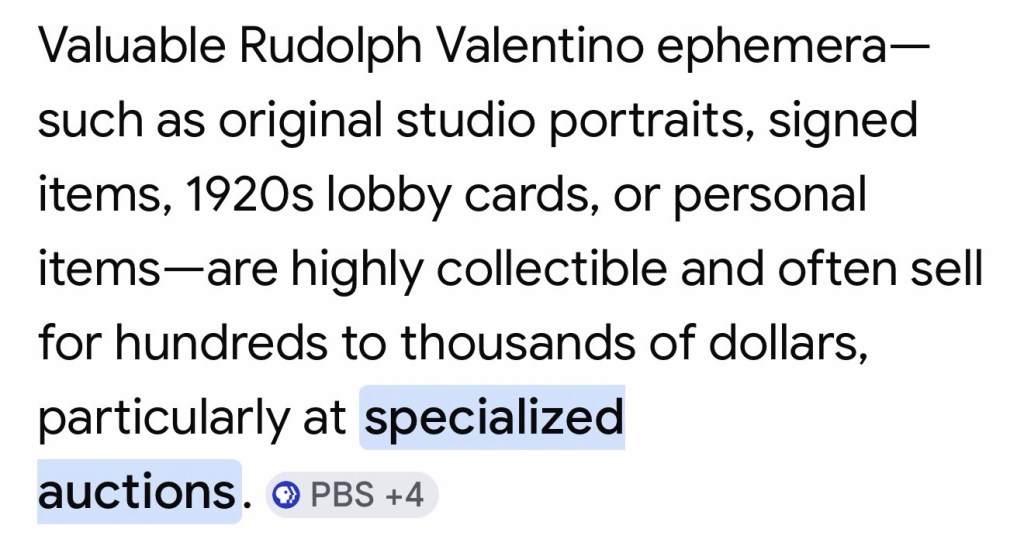
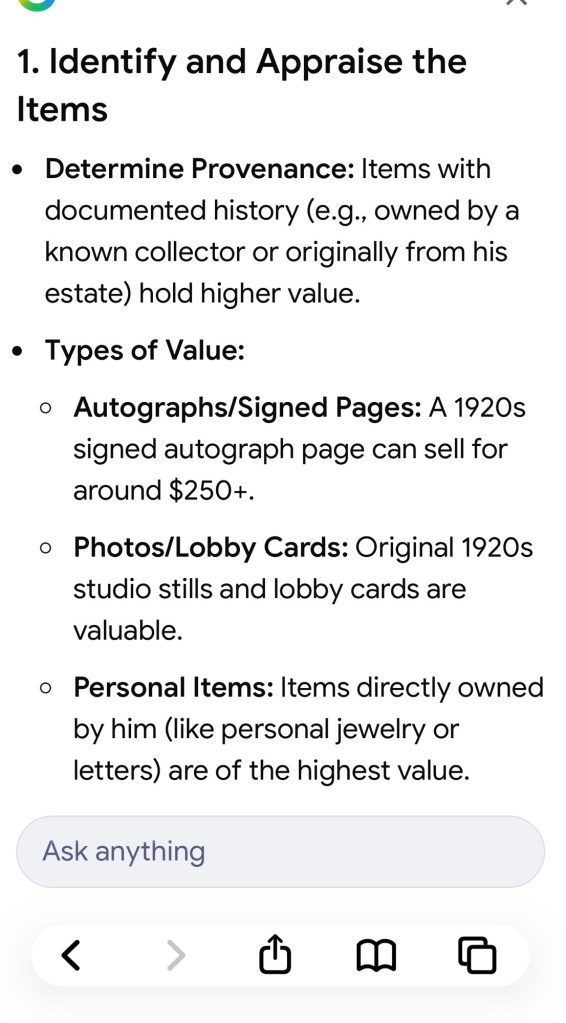
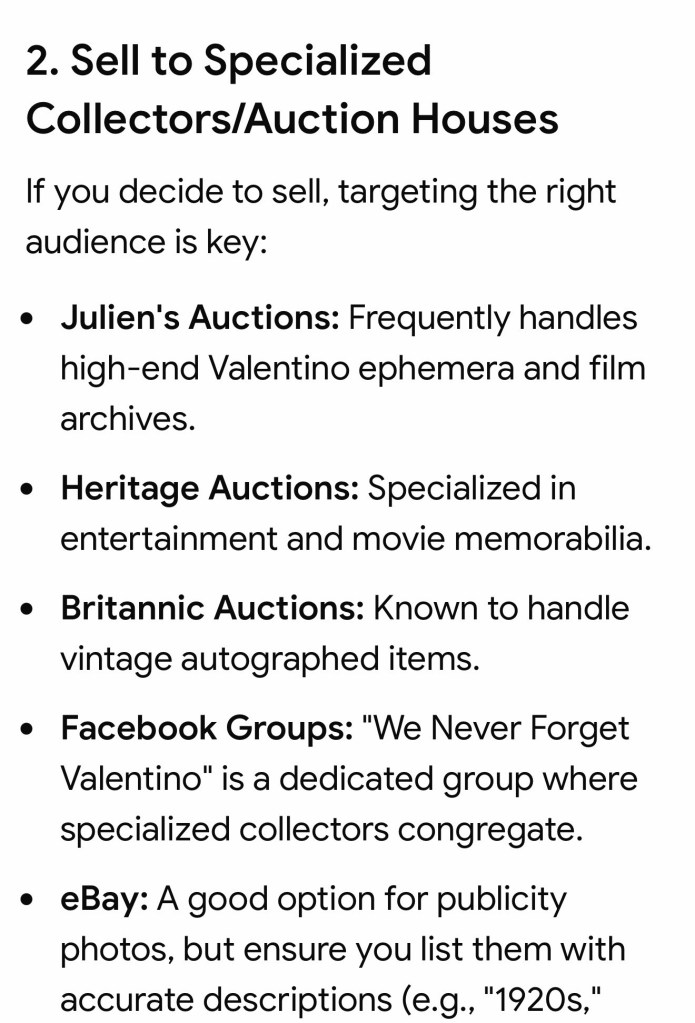
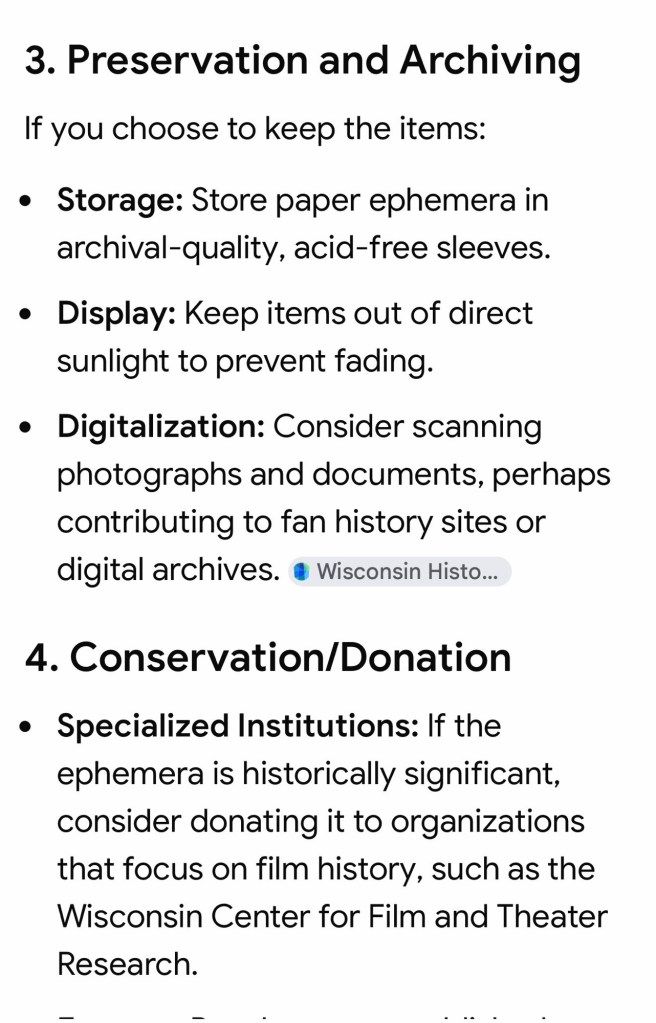
2026 – What to do with your Valentino Collection
As both a fan and collector of ephemera on Rudolph Valentino, I often wondered what would happen to the items, I spent a lifetime of collecting. For example, I was able to a mass an entire collection of books about Rudolph Valentino to include the estate catalogue. Because of my health and age, I decided to donate both books and some Valentino ephemera to the Los Angeles Public Library, Frances Goldwyn Meyer Branch Special Collections. This library is developing special collections that will be available for anyone wanting to know more about Hollywood History. They were very happy and receptive to receiving the items and now I am relieved to know future researchers can go to this particular library and read books about Valentino that I collected and cherished.
While this subject may not be on a lot of persons minds, it should be. Because not everybody is going to want what you dearly love to collect. Also, trying to find a new “home” or “sell” will not be easy which is the whole point of this article to get you to think about the now and not when it’s too late.
Categories: Uncategorized
Tags: Death of Rudolph Valentino, Rudolph Valentino
1926 – Frank E. Campbell Funeral Home, NYC, NY
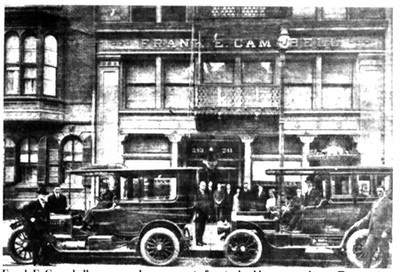
Quietly (and how!), Frank E. Campbell, ”The Funeral Chapel Inc.,” the city’s undertaker to the stars, is celebrating its 90th anniversary this year. It is a hushed affair. There will be, according to an official, ”no formal celebration, no formal acknowledgement” outside the building at 81st and Madison – and not much within. That is the place where, at the end, one could find Rudolph Valentino, Elizabeth Arden, George Balanchine, Bernard Baruch, James Cagney, Terence Cardinal Cooke, to alphabetically name-drop but a few.
”To create a service so sublimely beautiful, in an atmosphere of such complete harmony as to alleviate the sorrow of parting, is to render a service to mankind,” Frank E. Campbell himself said an exceedingly long time ago. Mr. Campbell got his start at age 12, in 1884, at a funeral home in Camp Point, Ill., helping to make caskets. By 1893 he was earning $10 a week in New York at the Stephen Merritt Undertaking and Cremation Company.
By 1898 he was in business for himself on West 23d Street. The rest is the stuff of mortuary legend. According to an in-house history of the concern, it was the founder’s business genius to recognize a need peculiar to New York and fill it. The custom at the time was to have funerals at home. That may have played well elsewhere in the land, but the majority of New Yorkers lived in apartments or residential hotels. This made for a cramped, to say nothing of crabby, funeral. Mr. Campbell ”combined the facility of viewing with the atmosphere of the church” and set the industry on its ear. Most funeral parlors of the period were simply basic storefronts. Mr. Campbell’s place was a showcase of mellow light, decorative furniture, potted palms, and art. By the time he buried Enrico Caruso, in 1921, the parlor had been moved to Broadway and 66th Street. By the time he buried Rudolph Valentino, after a riot at the bier, in 1926, his reputation was writ in stone, after a fashion. The parlor outstripped the competition for celebrity trade. By the time the business moved to 81st and Madison in 1938, Mr. Campbell was dead and buried four years (solid bronze sarcophagus placed in the family mausoleum in North Bergen, N.J.). His widow, Amelia Klutz Campbell, ran the business until she died in 1948 (cremation, ashes in the mausoleum) and it was sold off. There have been three owners since, but the name has remained, because of the reputation. Long after his death, Frank E. Campbell was quoted widely, particularly after Jessica Mitford’s savagely witty 1963 expose, ”The American Way of Death,” helped shore up a national assault on undertakers by clergymen. Writing about these critics in The New York Times, Homer Bigart said: ”They demand a curb on what they call the neo-pagan corpse worship of the modern funeral. Never keen on embalming, cosmetology, fancy coffins and other frills of funerary art, they want a return to simple, inexpensive, and austere rites.” Eventually the din died down, and funerals got neither cheaper nor less elaborate – they are still the third biggest-ticket purchase for most Americans, after homes and cars – but not before one president of Frank E. Campbell told the press: ”These dames that write these books – they do not want to hear anything good. If you kill sentiment, you are a dead pigeon. The world runs on sentiment.”
Today the business is owned by a Houston outfit, Service Corporation International, the largest funeral parlor operator in the country, whose chairman has characterized it as ”the True Value Hardware of the funeral service industry.” The chain, according to Eugene Schultz, assistant regional manager of the funeral division, considers Campbell the jewel in its crown. Having said that, Mr. Schultz offered a tour of the facility, volunteering that the 90th anniversary has been duly marked with a $500,000 restoration. Mr. Schultz walked somberly, at a loss for anecdotes, saying the famous dead are brought here because of quality and service and the knowledge that ”we will do everything possible to carry out any family request.” Asked if he could recall any extraordinary requests, he said, ”Not offhand.” The five-story funeral home was cool, with air-conditioners humming on each floor, quiet, and lovely, even though the elevator was exceptionally narrow, given its depth.
Categories: Uncategorized
Tags: Death of Rudolph Valentino, Frank E Campbelle Funeral Home, Frank E. Campbell
Aug 2025 – 98th Annual Valentino Memorial Service Review
On every 23 August, 1210 hours, the Valentino Community comes together as one, in order to pay their solemn respects, in tribute to a great silent film actor, who still garners admirers and attention, in the 21st Century.
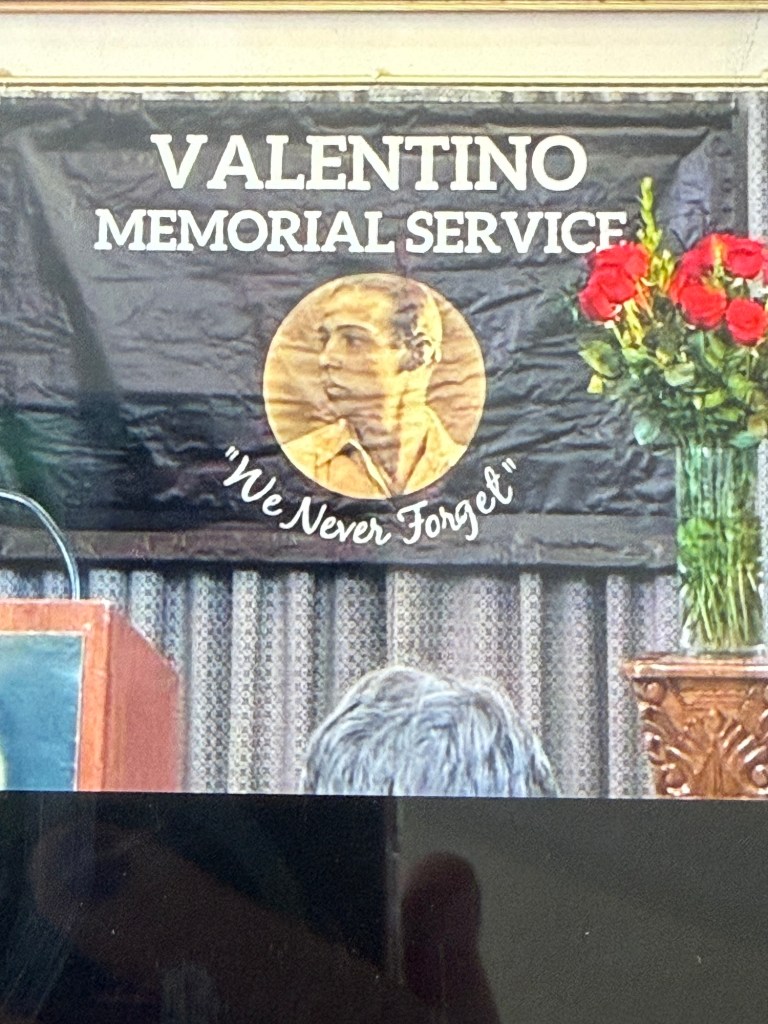
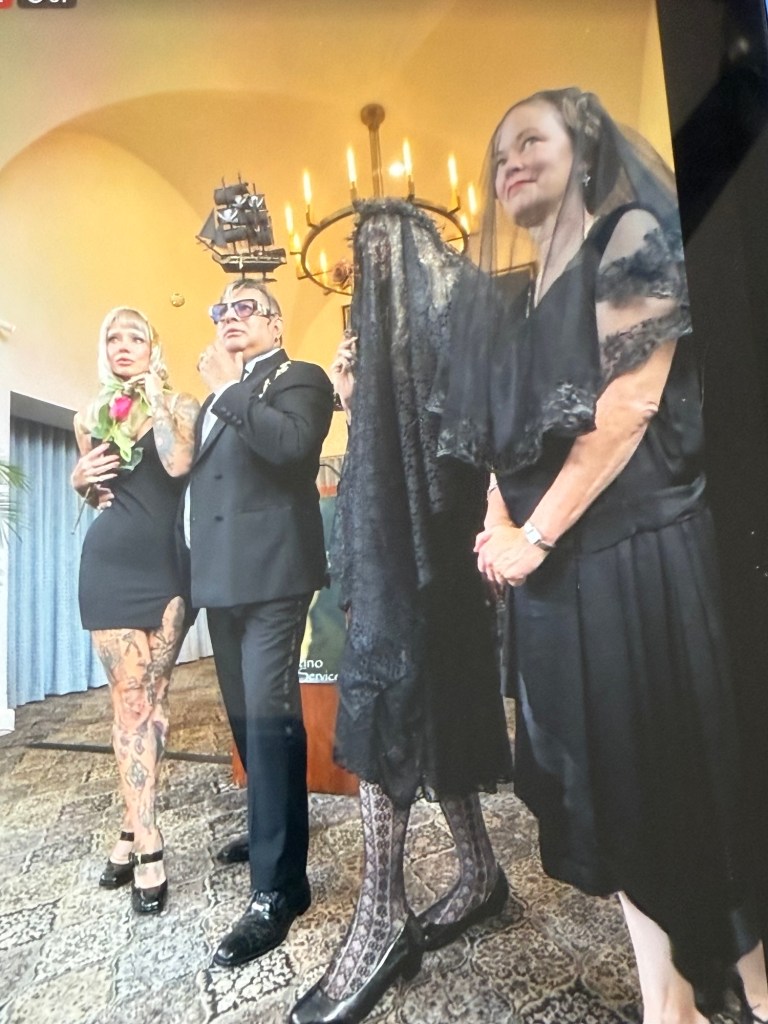
This year’s tribute program, was even more impressive than in years past. From the audio and visual tributes to the speakers, music selections, singing, to most of all a memorable salute to our beloved Donna Hill, everything was done reverently and beautifully.
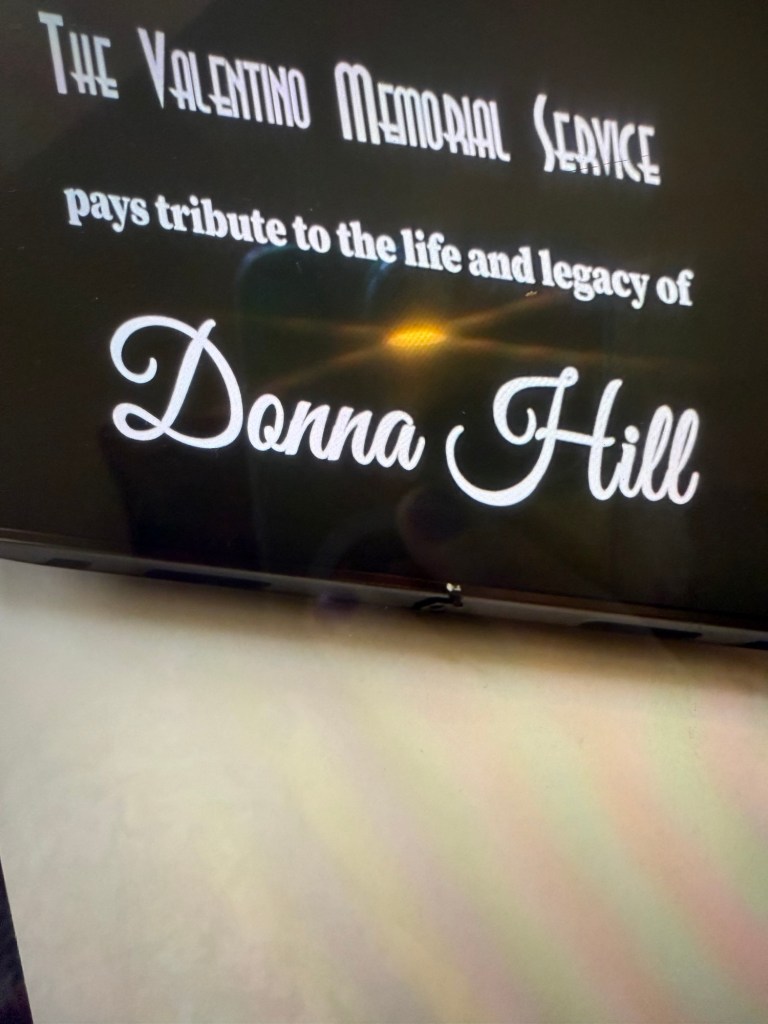
There was something poignant about knowing how much of a compassionate person Donna Hill was. While I did not personally know her. Everyone within the Valentino community, felt as though she was a friend, someone they could go to for questions about Valentino. Her legacy will be remembered for years to come.
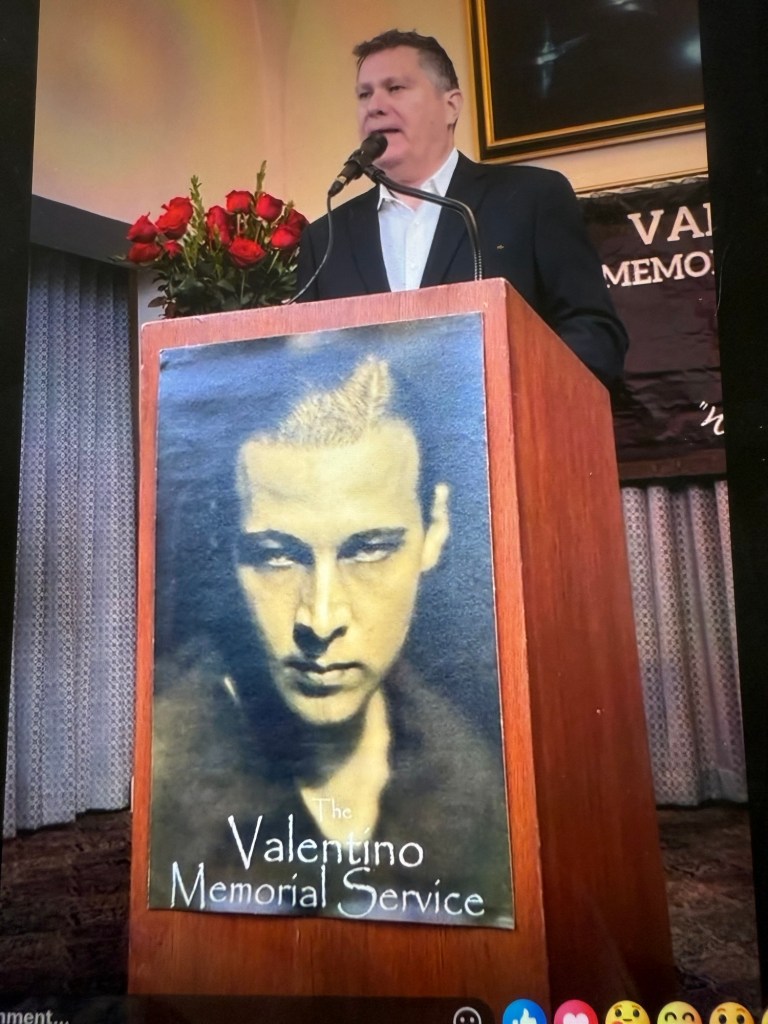
The music selection and the vocal talent of Ms. Katy Jane Harvey was once again, superb. I thoroughly enjoyed listening to my favourite “Ave Maria”.🎶🎤🎧🎼
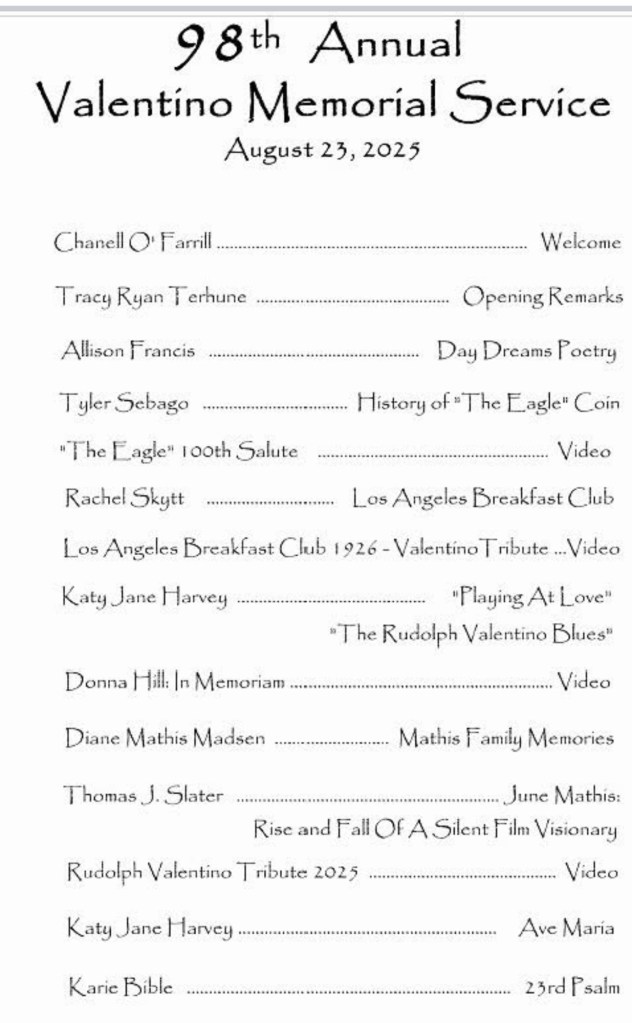
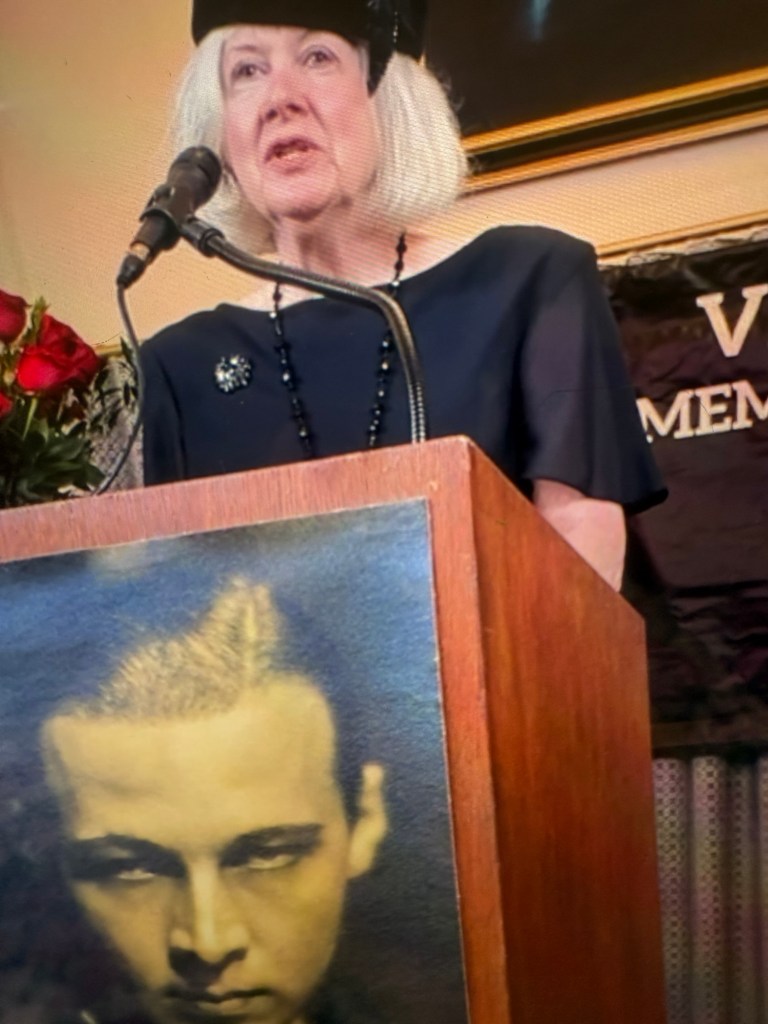
It’s always sad when the Memorial Service ends🥲. But next year, I will be there physically to embrace the memories and see familiar faces once again.
One more thing, a big thank😇you to Tracy Terhune and Zachary Jaydon.✌️
Until next year. 😍🎥🎞️🪦
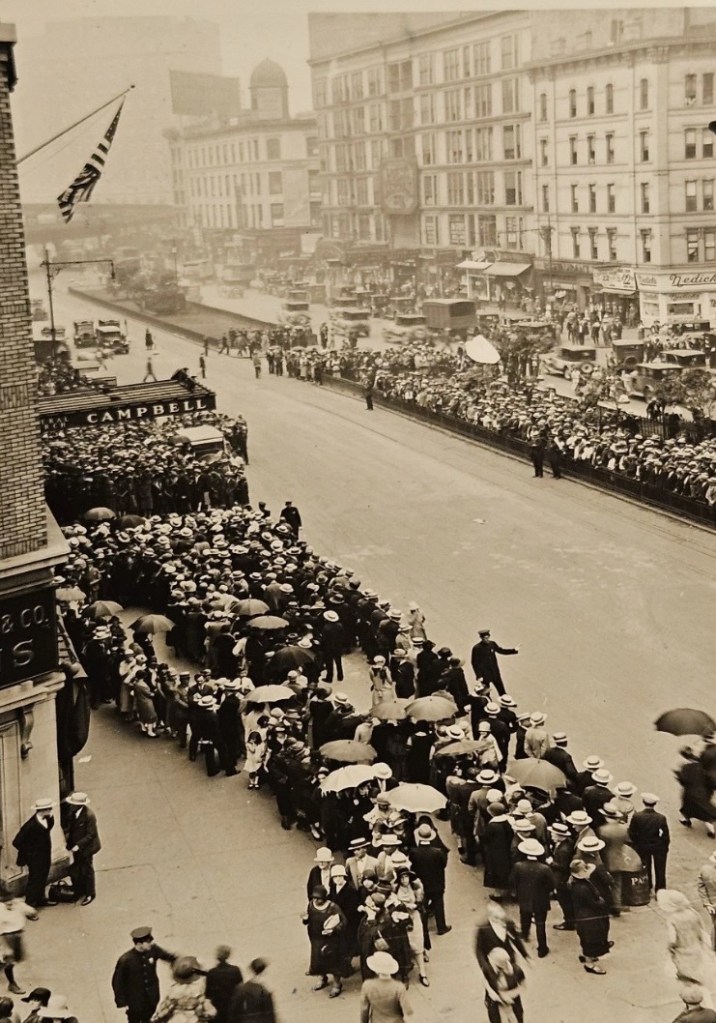
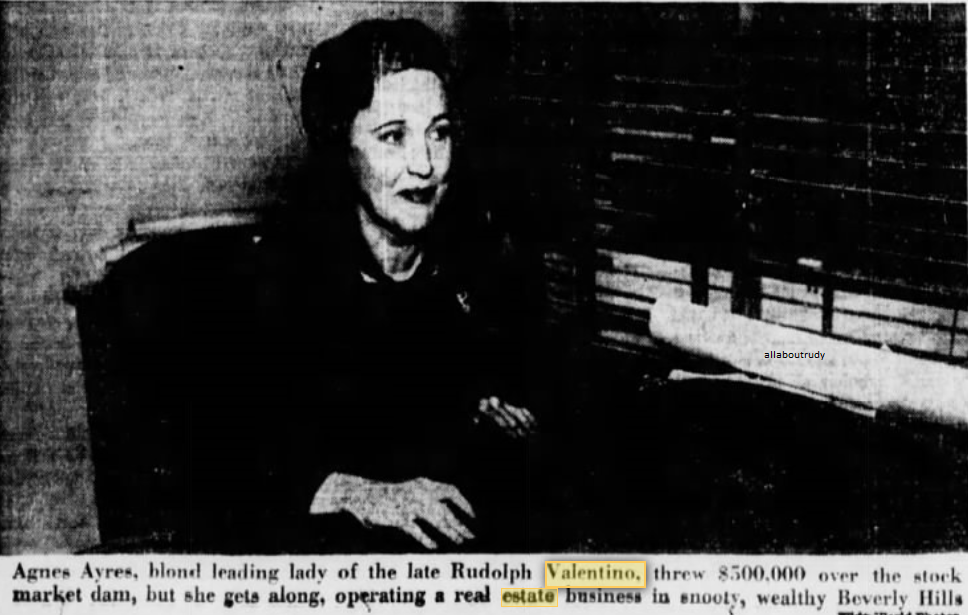
2025 – Annual Valentino Memorial Service
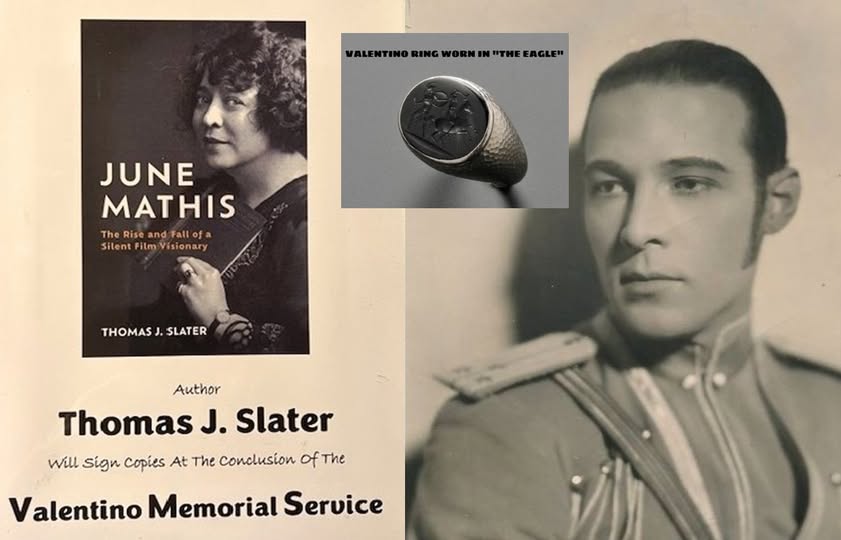
Next month, marks the saddest event on the Valentino Calendar, anniversary of the death of Silent Film Actor Rudolph Valentino. This annual event is held on 23 August 1210 p.m. Hollywood Forever Cemetery, LA, CA. This year author Tom Slater is speaking on his brand-new June Mathis book. At the conclusion of the memorial, he will hold a book signing. Rachel Skytt from the Los Angeles Breakfast Club will speak. The Breakfast Club was founded in 1925 and this marks their 100th anniversary. Rudy was a member, and when he died the Breakfast Club held one of the very first memorial services for Rudy, held just four days after his passing. Also, the 100th anniversary of the Valentino film “The Eagle” and a special remembrance of everyone’s beloved author Donna Hill. If you cannot make it the event will be broadcast live on Facebook Group “We Never Forget”. Also, I would love to hear from you – How will you spend 23 August?
Categories: Uncategorized
Tags: Annual Valentino Memorial Service, Death of Rudolph Valentino, Donna Hill, Tracy R Terhune
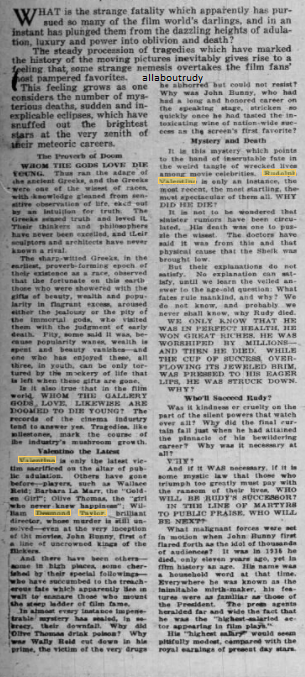
1975 – The Legend of Valentino TV Movie
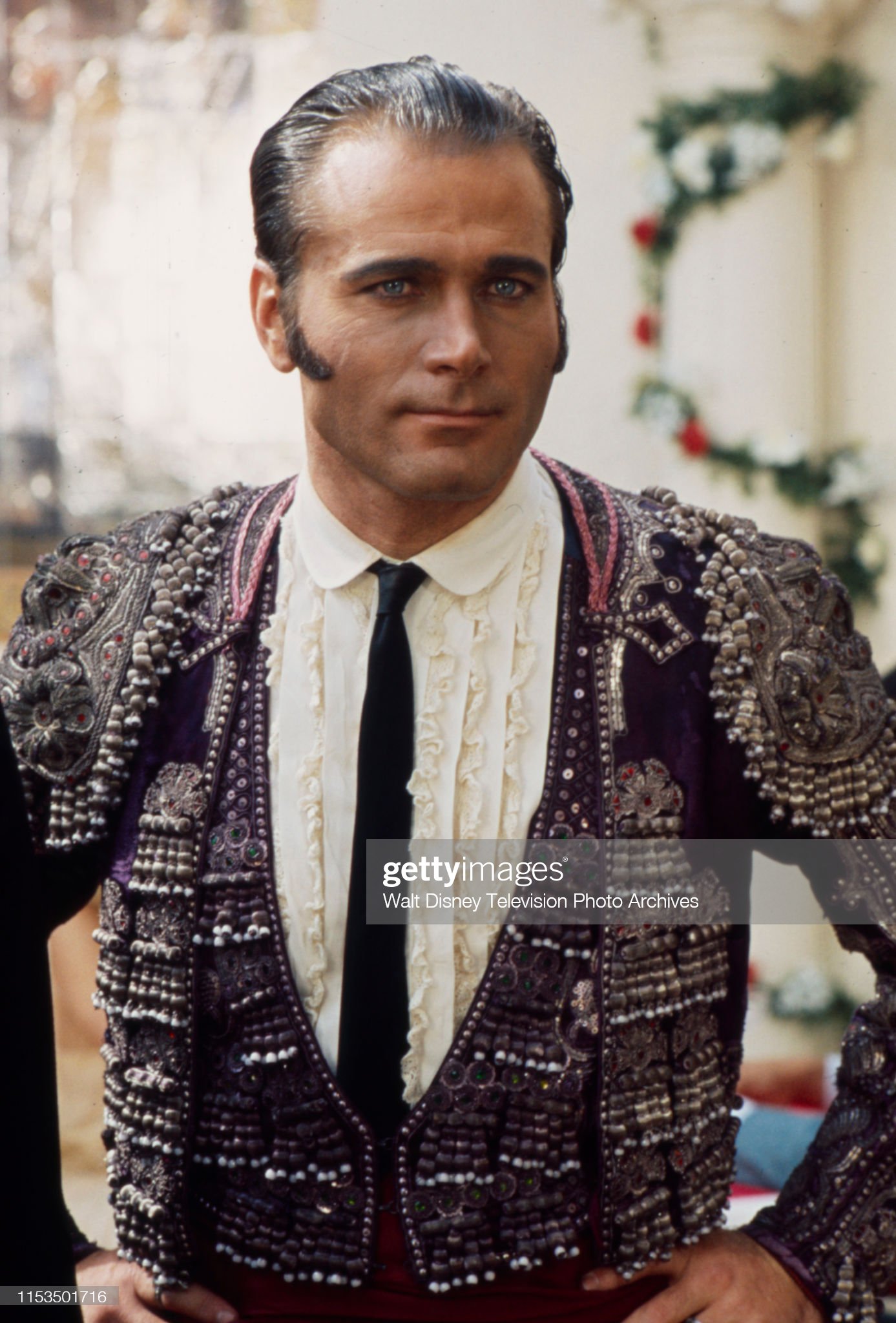
I recently came across a made for television “movie” that I had not seen before and thought I would watch it and provide a review. This is a heavily fictionized story of silent film actor Rudolph Valentino, and Metro Pictures screen writer June Mathis. June Mathis is finishing the script for “The Four Horsemen” and Valentino was caught robbing her home. It was then, she realized the potential this young man had to become a great actor. Through her mentorship June guides her discovery into becoming one of the screens most gifted actors of his time.
The movie’s casting players were all wrong for the roles they played. For example, Franco Nero was a bad choice for the starring role in playing Valentino. Both his look, mannerisms and speech are over dramatic and exaggerated. Susanne Pleshette’s look for the movie was too glamourous and nothing like June Mathis. While she was semi-believable the make-up artists and wardrobe needed to downplay her appearance into a more semblance of what June Mathis might have looked like. Both Yvette Mimieux as Natacha Rambova and Alicia Bond as Nazimova are not even close to the original stars.
I read the original reviews of this made for television trash and I agree this is one that should have never been made a complete waste of both time and money.
Categories: Uncategorized
Tags: Death of Rudolph Valentino, Franco Nero, June Mathis, Natacha Rambova, Rudolph Valentino, Susanne Pleshette
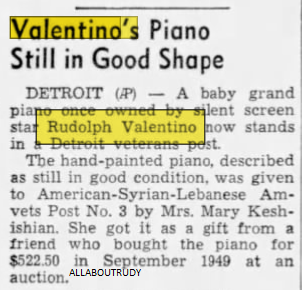
10 Feb 1927 – Hollywood Says..
Without a Rudolph Valentino it is doubtful if Mr. Zukor could have grossed such enormous sums on those pictures. Plus the insurance money certainly helped out now didn’t it.
It was the passionate mastery of Valentino that brought him to such eminence.
The lamented Valentino had this magnetism in superabundant quality.
Without a Famous Players- Laskey Corporation with its vast facilities and ample resources it is highly doubtful if Valentino could have risen to international eminence in such a brief space of time.
It has been almost a year now since Rudolph Valentino probably the greatest personality ever brought forth by the motion picture, has passed on and yet how rarely his name is recalled in that forgetful world we call Hollywood.
It was primarily June Mathis, with the courage of a visionary, who assumed a new perspective on romance in the silent drama and who had the courage to depict a latin as a lover rather than a villian. Before the advent of Valentino, the status of latin in a silent drama was not exactly complimentary. They were always cast as despicable characters, evil plotters lacking moral finesse, philanderers, roustabouts, black-hands and such.
Categories: Uncategorized
Tags: Death of Rudolph Valentino, Famous Players-Lasky, June Mathis
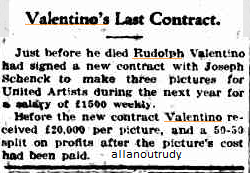
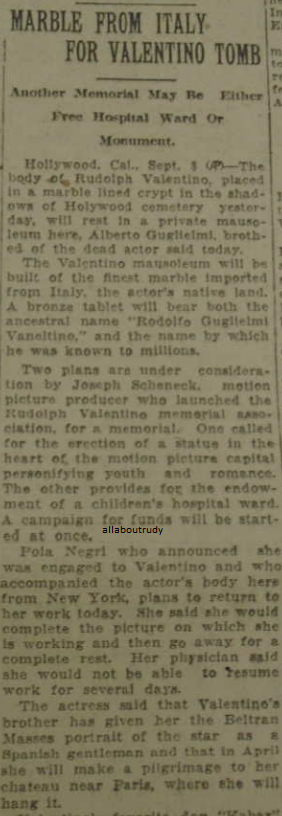
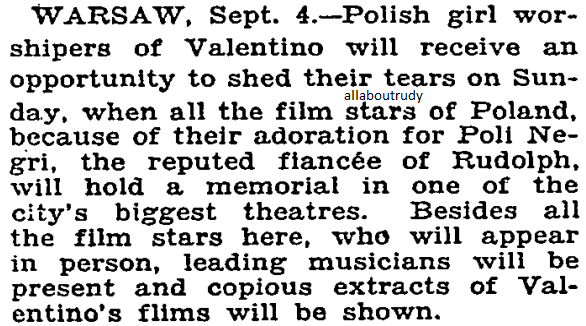
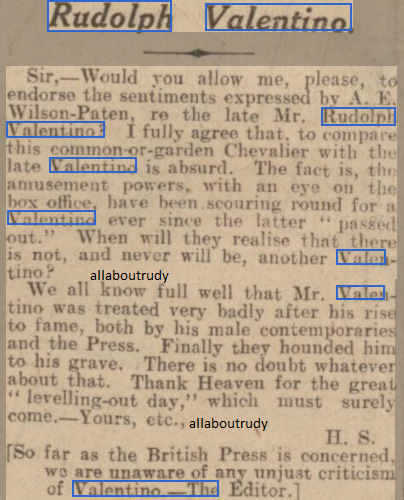
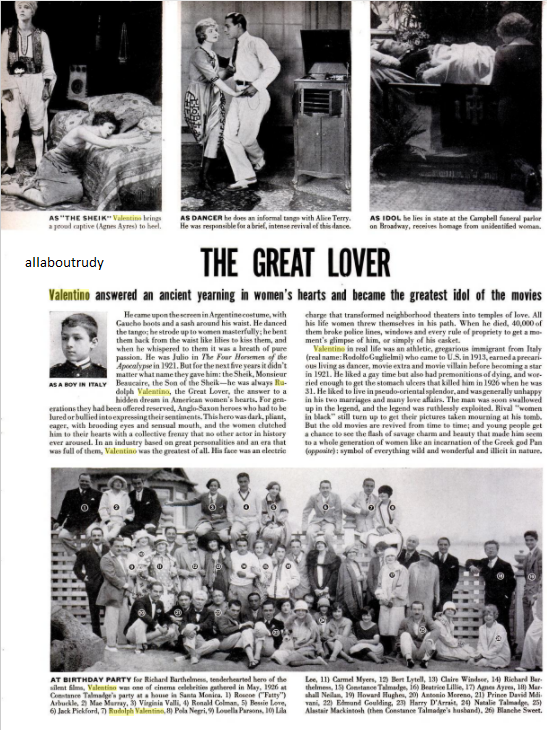
27 Aug 1926 – Nicotine Cause of Death
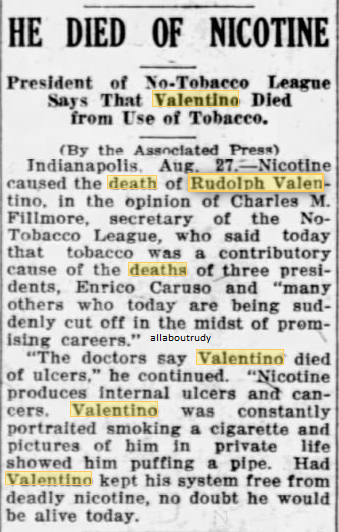
Categories: Uncategorized
Tags: Death of Rudolph Valentino, Enrico Caruso
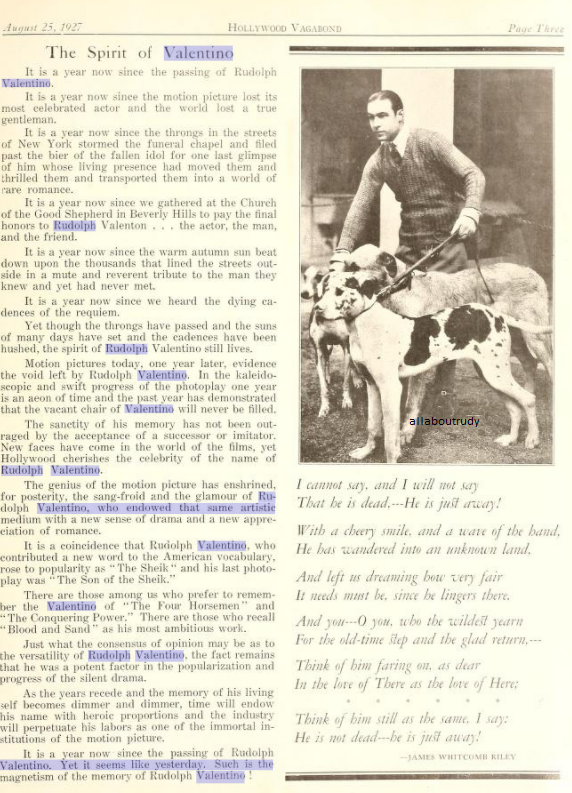
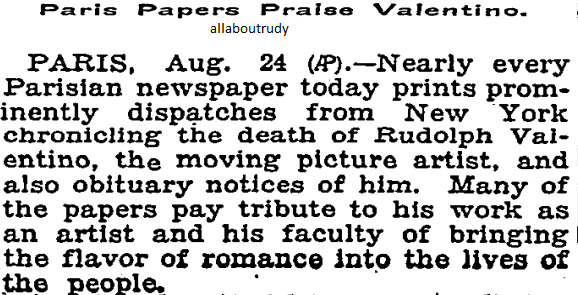
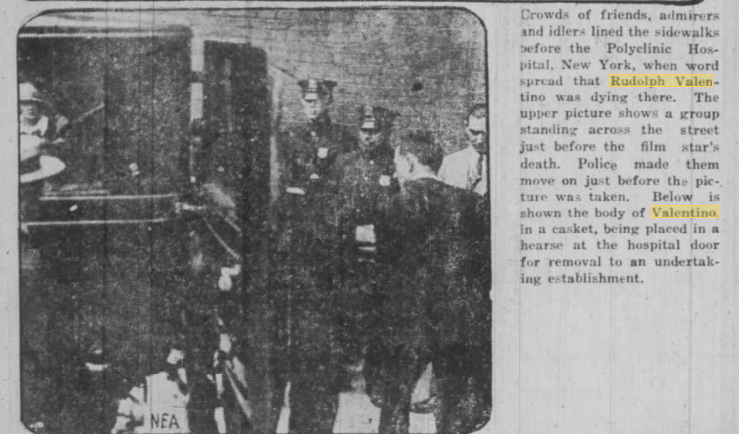
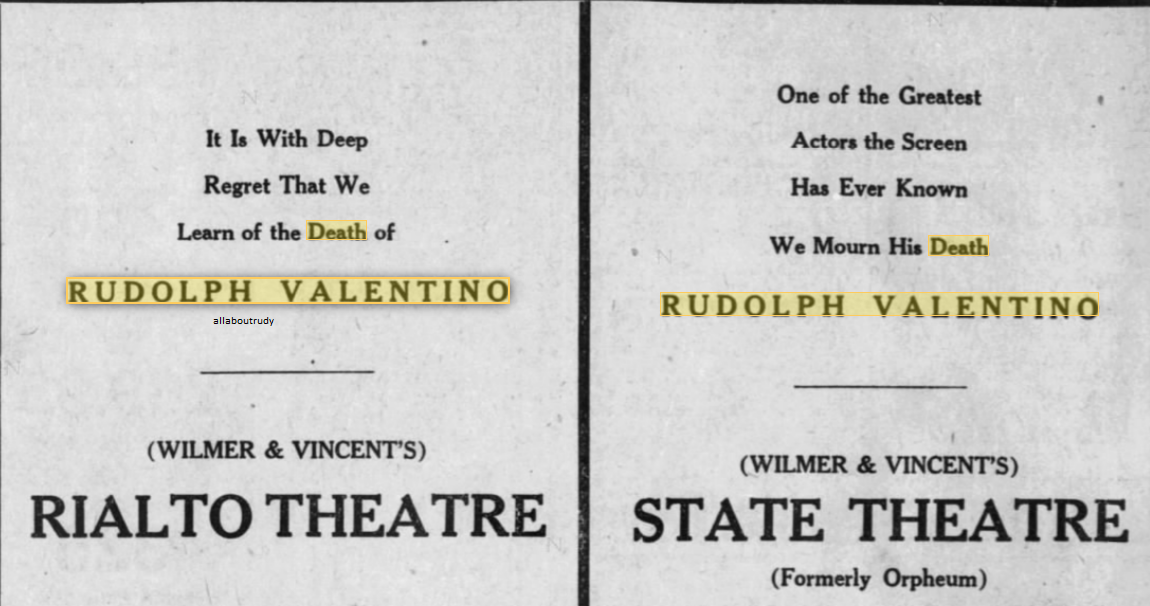
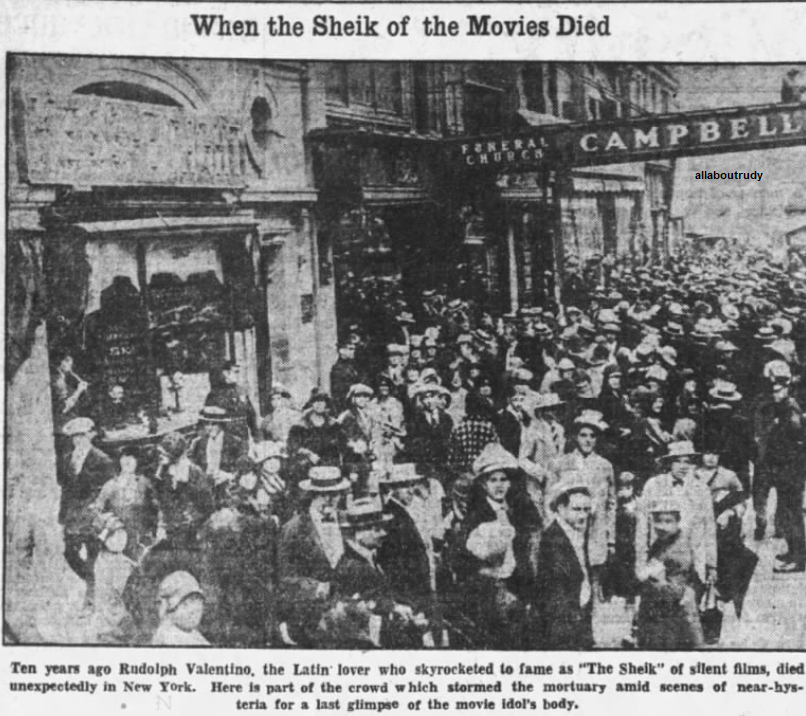
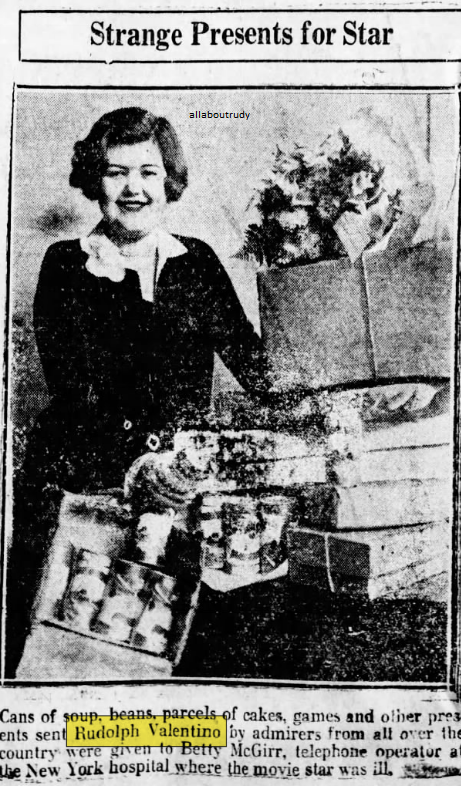
2024 – 1926 Thoughts on Valentino
There are three sad months out of the calendar year. July was when Rudolph Valentino started to feel ill. August was when his health started to decline. He had an Italians superstition regarding going to a doctor. Inspite of maintaining a healthy lifestyle minus the smoking, drinking and eating, he died. September was when he was buried.
Although it’s always a poignant moment when one stops to reflect on 23 Aug when Rudolph Valentino passed from this mortal world and has remained in our thoughts ever since.
Millions all over the world as far as moving pictures learned with deep regret his passing. A very young man of intense feeling and earnestness, Rudy held his place, without a noted rival in his field. He came to this melting pot country seeking a better way of life. While his early struggles were known he made his way by hard work and talent that showed the world on the silver screen just how remarkable he truly is. Life on this mortal earth was brief but it was not wasted.
Of course, there were certain people who took advantage of his death by garnering free publicity or behind the scenes stole his personal effects. Colleagues, friends, relatives all talked about how he will be missed, what a great guy and friend he was. No one had a bad word to say about him. Back at Falcon Lair all his animals anxiously waiting for his return but would eventually realize that he was never coming back. They were sold to pay off his debts. Greed was the word of the day. Studios who insured their star for allot of money got that back. United Artists insured Valentino for $250,000. Did they truly care about their star? This author seriously doubts that. All they cared about was how he could make a profit and how they could drum more publicity for their studio now that he was no longer alive. Hollywood ensured they let the fans know they mourned their big profit-making star. Behind the scenes, they were truly glad he was gone since they didn’t have to worry about the drama or the tantrums he caused when things did not go his way while making pictures. So-called friends were backstabbing Valentino and thought now he is no longer alive I can step in and become the next big star. Seems this is no different that when Wally Reid did a victim of the studios. But the people that truly cared and mourned Valentino were his fans. They grieved and were not afraid to let others know how they felt. Fast forward to the twenty-first century, he still has fans of all ages and on 23 Aug, the Valentino community will mourn again.
Categories: Uncategorized
Tags: Death of Rudolph Valentino

Categories: Uncategorized
Tags: Death of Rudolph Valentino, Jean Acker, Natacha Rambova, Pola Negri, Rudolph Valentino
27 May 1927 – Many Seem to Believe Valentino Lives, Judging by Letters Addressed to Him
Rudolph Valentino has been dead for nine months and yet to hundreds of moving picture fans, he is still alive. United Artists through which Valentino distributed his films receives on average 15 letters a week addressed to Valentino, expressing admiration for his work, asking what his next movie will be and invariably asking for a photograph. Letters arrive from all over the world. One such letter came in from Chicago and a young girl wrote “I saw you in all of your pictures. I would like to know what pictures you are going to be in. Please give me one of your pictures”. Another Dear Mr. Valentino from Detroit “I am writing you a few lines to let you know that I am watching your work on the movie screen. I saw you in many pictures and I like them all very much. Please send me one of your photographs”. From Niles, Ohio “Rudolph, Will you please send me a picture?”. A girl from Treadelphia, West Virginia writes “I saw your pictures in the show and I thought it was very beautiful and would you please send me your picture”. “I like the way you play and would you send me one of your pictures” wrote another from Brooklyn New York. All mail is acknowledged, and the writers are informed Valentino is no longer living.
Categories: Uncategorized
Tags: Death of Rudolph Valentino
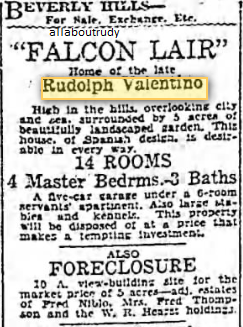


You must be logged in to post a comment.