Posts Tagged With: George Ullman

17 Apr 1934 – GUGLIELMI’S ESTATE. ULLMAN v. GUGLIELMI

District Court of Appeal, First District, Division 2, California. GUGLIELMI’S ESTATE. ULLMAN v. GUGLIELMI ET AL Civ. 9321.

Decided: April 17, 1934

Newlin & Ashburn and Gwyn Redwine, both of Los Angeles, for appellant. Scarborough & Bowen and McGee & Sumner, all of Los Angeles, for respondent Bank of America National Trust & Savings Ass’n.

Appeals were taken from an order of the probate court settling the account current and report of the executor and from an order denying a petition for partial distribution. Both appeals are presented on the same typewritten transcripts.

Rodolpho Guglielmi, also known as Rudolph Valentino, a motion picture actor, died testate August 23, 1926. On October 13, 1926, the appellant herein was appointed executor, and thereupon entered upon the administration of his estate. The pertinent portions of the decedent’s will, which was duly admitted to probate, provide:

“First: I hereby revoke all former Wills by me made and I hereby nominate and appoint S. George Ullman of the city of Los Angeles, County of Los Angeles, State of California, the executor of this my last will and testament, Without bonds, either upon qualifying or in any stage of the settlement of my said estate.

“Second: I direct that my Executor pay all of my just debts and funeral expenses, as soon as may be practicable after my death.

“Third: I give, devise and bequeath unto my wife, Natacha Rambova, also known as Natacha Guglielmi, the sum of One Dollar ($1.00), it being my intention, desire and will that she receive this sum and no more.

“Fourth: All the residue and remainder of my estate, both real and personal, I give, devise and bequeath unto S. George Ullman, of the city of Los Angeles, County of Los Angeles, State of California, to have and to hold the same in trust and for the use of Alberto Guglielmi, Maria Guglielmi and Teresa Werner, the purposes of the aforesaid trust are as follows: to hold, manage, and control the said trust property and estate: to keep the same invested and productive as far as possible; to receive the rents and profits therefrom, and to pay over the net income derived therefrom to the said Alberto Guglielmi, Maria Guglielmi and Teresa Werner, as I have this day instructed him; to finally distribute the said trust estate according to my wish and will, as I have this day instructed him.”

The instructions referred to in paragraph 4 of the will are as follows:

“To S. George Ullman.

“I have this day named you as executor in my last will and testament; it is my desire that you perpetuate my name in the picture industry by continuing the Rudolph Valentino Productions, Inc., until my nephew Jean shall have reached the age of 25 years; in the meantime to make motion pictures, using your own judgment as to numbers and kind, keeping control of any pictures made, if possible.

“Whenever there are profits from pictures made by the Rudolph Valentino Productions, Inc., it is my wish that you will pay to my brother Alberto the sum of $400.00 monthly, to my sister Maria the sum of $200.00 monthly, and to my dear friend Mrs. Werner the sum of $200.00 monthly.

“When my nephew Jean reaches the age of 25 years, I desire that the residue, if any, be given to him. In the event of his death then the residue shall be distributed equally to my sister Maria and my brother Alberto.

“Rodolpho Guglielmi

“Rudolph Valentino.”

In due time the probate court decided that these instructions were made contemporaneously with the will and became a part of the execution of the will, also that the will and the instructions taken together constituted the full terms of the trust created by the will.

Notice to creditors was given, and all claims were paid or settled or had become barred when the account was filed. The inventory and appraisal filed April 13, 1927, showed real and personal property amounting to $244,033.15. A supplementary inventory and appraisal filed January 9, 1928, showed additional real and personal property amounting to $244,550 or a total estate of over $488,000.

On February 28, 1928, appellant filed his first account as executor, to which objections were made by Alberto Guglielmi and Maria Guglielmi Strada, the brother and sister of deceased. Proceedings for the settlement of this account were abandoned. On April 5, 1930, appellant filed a new first account to which objections were made by the same parties, but were not heard. On June 7, 1930, appellant filed his resignation as executor, which was accepted, and the respondent Bank of America was appointed administrator with the will annexed. On August 18, 1930, appellant filed a supplemental account, to which the administrator filed objections, including the objections made by the brother and sister to the former accounts. These accounts, with the objections of the administrator and of these heirs, came on for hearing on November 5, 1930, and on August 8, 1932, the probate court made the decree from which this appeal is taken.

In the course of this hearing, the question arose as to the legality of advances made by appellant to the brother and sister of the deceased and to another beneficiary of the will, and, on the suggestion of the court, a petition for partial distribution was filed by the administrator. On the hearing of that petition, the probate court found that the decedent left surviving him as his only heirs at law Alberto Guglielmi and Maria Guglielmi Strada; that the only persons entitled to benefit from the trust created by the will were said heirs, Teresa Werner, and Jean Guglielmi; that the questions relative to the advances made to three of the above beneficiaries were determined by the decree settling the account entered contemporaneously with this account; and that, because of the condition of the estate, no partial distribution should be decreed.

During his lifetime the decedent had been engaged in various activities in addition to his work as an actor. He was interested in the production and development of pictures under the corporate name of Rudolph Valentino Productions, Inc., which, however, was but an alter ego. He was engaged in the exploitation of chemical discoveries under the corporate name of Cosmic Arts, Inc. He was also sole owner of a cleaning business under the name of Ritz, Inc. In March, 1925, decedent made a contract with a motion picture producer under which he agreed to give his services as a motion picture actor to that producer exclusively. In April, 1925, he assigned his interest in the profits under this contract to Cosmic Arts, Inc. In August, 1925, Cosmic Arts, Inc., assigned its interest in this contract to Rudolph Valentino Productions, Inc. The stockholders in Cosmic Arts, Inc., were the decedent, Natacha Rambova, his wife, and Teresa Werner, his wife’s aunt. Though these three corporations were separate entities, the decedent for a long time prior to his death conducted the affairs of all three under the ostensible name of Rudolph Valentino Productions, Inc., making all expenditures through the latter, with little regard for the corporate identity of the other two concerns. During this period, the appellant served in the capacity of business manager and personal representative of the decedent; superintendent of Ritz, Inc.; secretary, treasurer, and director of Cosmic Arts, Inc.; and manager of Rudolph Valentino Productions, Inc., his compensation for all these services being paid by Rudolph Valentino Productions, Inc.

Immediately upon his qualification as executor, and acting upon the asserted authority of the will to continue the Rudolph Valentino Productions, Inc., for the purpose of perpetuating the name of deceased, the appellant entered upon the management of all these concerns in the same manner in which they had been conducted in the lifetime of the decedent. In these transactions the appellant, seemingly acting as the executor of the estate rather than as trustee under the will, paid all claims outstanding against the decedent, personal as well as those incurred by the corporations mentioned. The exact figures covering these expenditures are not material to this inquiry, but the appellant emphasizes the fact that as executor he took an estate which was heavily involved financially and practically bankrupt, and through his management all indebtedness was cleared and the property of the estate was increased in value to $890,000.

In the course of the conduct of these activities, the appellant borrowed and loaned money, executed mortgages and retired existing liens, purchased new property to be used in the business, and sold property belonging to the estate. To obtain publicity to aid in the display of the decedent’s pictures, two spectacular funerals were held––one in New York and one in Los Angeles––and Valentino Memorial Clubs were organized in many different centers. Because of the financial condition of the estate at the time, these expenditures were paid largely from money borrowed by the executor on his personal obligations, and all, or nearly all, were made without an order of court. When funds accumulated through the distribution of pictures, the appellant made loans, some with security and some without. In September, 1927, he loaned one Mae Murray $22,000 at 7 per cent. In March, 1928, he loaned the Pan American Company $50,000 at seven per cent., secured by Pan American Bank stock of the then value of $78,000; at various times during the year 1928 he loaned one Frank Menillo $40,000 at 8 per cent. The Murray loan was repaid. The Pan American loan was compromised at a loss of $16,000 to the estate, with which amount appellant was charged to account with interest on the full amount of the loan. The Menillo loan was unpaid at the time of the entry of the decree herein, and appellant was charged to account in full with interest.

The ruling of the probate court on these two items presents the principal ground of attack upon the decree. If appellant was authorized to carry on the business of the decedent, to invest and reinvest the funds in his hands, then any losses arising from these transactions must be borne by the estate. If he was not so authorized, the losses are his. The question of the right of an executor to carry on the business of the deceased when so directed by the testator first came directly before our appellate courts in Estate of Ward. 127 Cal. App. 347, 15 P.(2d) 901, a case which was decided after the decree herein was entered. In that case Judge Ames, sitting pro tempore in the appellate court, carefully reviewed the authorities, and concluded that, in the absence of fraud or mismanagement, an executor should not be charged with losses while he is following out the instructions of the testator. Numerous authorities from other jurisdictions are cited by Judge Ames, to which reference may be had in that opinion. This distinction between the two cases should be noted––here all these loans were made from profits of the estate accumulated by the executor; in the Ward Case the losses were in the principal. The conclusions there reached compel a reversal of the decree as to the Pan American and Menillo loans because they were attacked on the sole ground that they were made without order of court or without “sufficient” surety, but were not attacked upon any charge of fraud or mismanagement.

The dual capacity of the executor and trustee involved in this appeal is the same as that considered in the Ward estate, where the court, after reviewing authorities on that subject, held that, taking the will as a whole, it could not have been the intention of the testator to suspend operations of the business during the period of time required for the administration of the estate and the appointment of a trustee. The case here is even stronger than the will interpreted in the Ward Case, because the instructions of the testator to the trustee are so blended and mingled that they could scarcely be separated the one from the other. The directions to the executor to “perpetuate my name in the picture industry by continuing the Rudolph Valentino Productions, Inc.,” and the directions, to the trustee “to hold, manage, and control the said trust, property, and estate; to keep the same invested and productive as far as possible,” disclose an intention of the testator to treat the executor and trustee without the legal distinction that a court would draw between the two offices.

For these reasons we conclude that the executor was both authorized and directed by the will to carry on the business of the decedent as it had been carried on in his lifetime, and that the investments made by him through loans to the Pan American Company and to Menillo were made in the course of the operation of that business, and, being without fraud, the appellant should not be charged for the losses occurring therefrom, nor should he be surcharged with interest on account of any investments made in his management of the estate.

The probate court charged appellant with an item of $17,280.19 expended by him in compliance with a contract of Cosmic Arts, Inc. This item presents an issue closely related to that just discussed. Cosmic Arts, Inc., was a family corporation organized by the deceased. Ten shares of stock were issued, all in the name of Natacha Rambova, the then wife of the decedent. One of these shares was transferred to her aunt, another to the decedent, and the three were the directors. Decedent resigned from the directorship and had the appellant appointed in his place. While the latter was acting as director and treasurer of the corporation and under the authority of the by–laws, he executed a contract with one Lambert obligating the corporation to bear any and all expenses in connection with the patenting, sale, and exploitation of patents covering a chemical discovery called Lambertite. For a considerable period prior to his death, the affairs of this corporation were conducted by the decedent as his alter ego, acting through the appellant as his personal manager in very much the same manner as the affairs of the Rudolph Valentino Productions, Inc., were conducted. The contract referred to was apparently ratified by the corporation, and the expenses of the corporation were paid by the decedent, not only in connection with the patenting of the process, but in the conduct of the laboratory in New York City for the development of the process. Upon his qualification as executor the appellant continued to pay these expenses, amounting to a total of over $19,000 and so accounted to the estate. In the hearing of the objections to this item, the appellant contended that the entire stock of the corporation had been transferred to the decedent through a property settlement made at the time of the separation with his wife, but the separation agreement was not produced. The contract with Lambert was received in evidence, and from this the probate court found that Cosmic Arts, Inc., was entitled to one–third of the profits resulting from the sale and exploitation of the patents, and that therefore it was liable for but one–third of the expenses incurred in the patenting, sale, and exploitation of the process. Upon this theory it was concluded that the decedent and his estate were liable for but one–ninth of these expenses, basing this conclusion solely upon the theory that Cosmic Arts, Inc., was a family corporation organized by the decedent, his wife, and his wife’s aunt, in which the decedent had a one–third interest.

The evidence on this issue is in such an unsatisfactory state that it is impossible at this time to determine the issue. It is manifest that it was tried by the probate court without the benefit of the decision in the Ward Case, and that, if the facts justify the contention of the appellant that Cosmic Arts, Inc., was also an alter ego of the decedent, the business of which appellant was authorized by the will to carry on under the will, then such losses incurred by appellant in the operation of that business as may be found to have been incurred without fraud or mismanagement must, under the rule of the Ward Case, be held to be the losses of the estate and not of the appellant. For these reasons this issue should be retried.

Appellant, complains of the ruling of the probate court surcharging him with interest on the full amount of moneys withdrawn by him on account of his fees for extraordinary services in advance of an order of court authorizing any fee for such services. The evidence discloses that during his period of administration the appellant withdrew from the funds of the estate sums aggregating $22,300, for which he asked credit in the settlement of his account upon the basis of extraordinary services rendered the estate. The probate court disallowed the item and charged appellant to account for interest at the rate of 7 per cent. from the time of each withdrawal. It then allowed the appellant an additional fee for extraordinary services fixed at $15,000. The appellant now argues that this sum should be subtracted from the total amount withdrawn, and that he should be charged to return to the estate the difference, amounting to $7,300, and should be charged interest on that amount only. Authorities cited by the appellant relating to statutory fees to which an executor is entitled as matter of right do not apply to a case of this kind. Extraordinary fees are allowed an executor within the discretion of the probate court, and, unless and until an order is made, there is no obligation on the part of the estate to pay more than the statutory fees. Hence, when an executor upon his own motion withdraws the funds of an estate to pay himself fees in addition to the amount allowed by statute, he is to be charged with the amount thereof, with interest thereon from the date of withdrawal. Estate of Piercy, 168 Cal. 755, 757, 145 P. 91.

It is next contended that the court erred in holding the appellant liable for the advances to the brother and sister of the decedent and to Teresa Werner on account of what he deemed to be their distributive shares of the estate. The court found in its decree settling the account that the executor improperly and without authority or order of court advanced to decedent’s brother over $37,000 out of the funds and property of the estate; to the decedent’s sister over $12,000 in cash and personal property; to Teresa Werner over $7,000 in cash; and to Frank A. Menillo at various times and in various amounts an aggregate sum of $9,100. Having ruled during the hearing on the settlement of the account that it was not competent for the court in that proceeding to determine questions of heirship, and having directed a special proceeding to be instituted for that purpose, the court, contemporaneously with the entry of its decree in the settlement of the account, entered its decree in the other proceeding wherein it was found that the brother and sister were the only surviving heirs at law of the decedent, and that the only persons entitled to benefit under the will were the brother, the sister, Teresa Werner, a stranger, and Jean Guglielmi, a nephew of decedent. It will be recalled that under the terms of the instructions the brother, the sister, and Mrs. Werner were each to receive a stipulated sum monthly until the nephew, Jean, reached the age of 25 years, when the residue was directed to be given to him; that, in the event of the death of the nephew, the residue was to be distributed equally between the brother and sister. It is apparent from these provisions of the will that Teresa Werner was entitled to participate in the assets of the estate only to the extent of a monthly payment out of profits which the executor derived from pictures made under his direction, and that the brother and sister were entitled to a distributive share in the estate only in the event of the death of the nephew, Jean. It necessarily follows that advancements made to these individuals in excess of the monthly payments directed by the will were improper. The appellant does not question this final result, but does criticize the method by which the court expressed its conclusion. In its decree in the proceeding for partial distribution, it declared the issues relative to these advances had been determined by its decree correcting and settling the account of the executor, and that by reason of the foregoing decree said advances “are hereby declared to be void and improper and chargeable to said executor herein.” It is true, as argued by the appellant, that the issue covering the propriety of advances on distributive shares is not one which may be determined on a hearing of a settlement of the executor’s account, but that such issue can be determined only upon a hearing for distribution, partial or final. 12 Cal. Jur. 181. We are not, however, in accord with appellant’s view that the court was in error so far as it went. Though reference is made in its decree to the order settling the account, there is sufficient in the decree denying distribution to constitute a determination that these advances were void and improper and as such chargeable to the executor.

There are certain equities involved in this issue which require comment. In the will proper, which was admitted to probate in October, 1926, the executor was directed to hold all the property in trust “to keep the same invested and productive as far as possible and to pay over the net income derived therefrom” to Alberto and Maria Guglielmi and to Teresa Werner. Four years later, the appellant, in answer to the petition for partial distribution, came into court and for the first time set forth a copy of the written instructions which he alleged had been executed contemporaneously with the execution of the will and which he alleged had been lost, destroyed, or surreptitiously removed from the personal effects and safe of the decedent. In the decree entered in that proceeding the probate court found this to be a true copy of the original instructions executed by the decedent, and declared that said instructions should be taken together as the complete terms of the trust created by the will. Under the terms of these instructions, the appellant was directed to pay to Alberto Guglielmi $400 a month, to Maria Guglielmi $200 a month, and to Mrs. Werner $200 a month out of the “profits from pictures made by the Rudolph Valentino Productions, Inc.” Then for the first time the nephew, Jean, is mentioned, and to him is given the entire residue when he reaches the age of 25 years. This is followed by the proviso that in the event of his death the residue should be distributed equally to Alberto and Maria. It will be noted that under the terms of the will proper the appellant was directed to pay over to Alberto and Maria and to Mrs. Werner the net income derived from the estate as a whole, whereas under the terms of the written instructions he was directed to pay stipulated amounts monthly to each of the three from profits from pictures made by the Rudolph Valentino Productions, Inc. It does not appear from the record who was responsible for the loss of the written instructions following the decedent’s death nor whether the appellant had any information or knowledge of their terms prior to the advancements he made to these three. It does appear that all these advances were made with the consent and at the solicitation of the three beneficiaries involved. We are in accord with the holding of the probate court that these advances were improperly made if the terms of the written instructions are held to be controlling over the terms of the fourth paragraph of the will proper and if these advances are held to have been made from funds other than the net income derived from the estate as a whole. Under the rule of Estate of Willey, 140 Cal. 238, 73 P. 998, this is an issue which cannot be tried or determined in the proceeding for the settlement of the account, but is one which could have been determined on the proceeding for partial distribution. The proper practice is as outlined in the Willey Case to retire from the consideration of the settlement of the account the question of the propriety of advances of distributive shares so that that question can be determined on distribution of the estate. The record on the petition for distribution does not disclose that this question was fully tried and determined. Manifestly, if these three beneficiaries were entitled to the net income derived from the management of the estate as a whole, and if the advances made to them by the appellant were from that net income alone, he should not be charged to account to the estate in full for those advances or for interest as if he had defaulted or misapplied the funds to his own use. On the other hand, if, upon final distribution, it be found that the nephew is dead and that the brother and sister are then entitled under the will to the entire residue, then the amounts advanced to them by the appellant may be held to have been advanced on account of their distributive shares, and appellant would be entitled to a credit accordingly. These considerations were undoubtedly in the contemplation of the probate court when, in rendering its decree denying partial distribution, it found that it was unable to determine whether there would be sufficient funds or property to distribute to the trustee or to permit the trust to be executed and performed, and for that reason reserved its determination of the ultimate practicability of the trust until the final distribution of the estate. But, in any event, if these advances were made in good faith and at the solicitation of the beneficiaries, and appellant is held to be accountable to the estate in full therefor, he should be given an appropriate lien against the beneficial interest of those who participated in the advancement of the property and funds of the estate. In re Moore, 96 Cal. 522, 31 P. 584; Finnerty v. Pennie, 100 Cal. 404, 407, 34 P. 869; Estate of Schluter, 209 Cal. 286, 289, 286 P. 1008.

Though the appellant has not assigned any special error for the reversal of the order denying partial distribution, the equities herein referred to impel a reversal, so that both matters may be before the probate court for new proceedings consistent with the views herein expressed.

The orders appealed from are both reversed.

NOURSE, Presiding Justice.

We concur: STURTEVANT, J.; SPENCE, J.

Categories: Uncategorized | Tags: , , , , ,

12 April 1934 – GUGLIELMI’S ESTATE ULLMAN v. GUGLIELMI

District Court of Appeal

Decided: April 12, 1934

Newlin & Ashburn and Gwyn Redwine, both of Los Angeles, for appellant. Scarborough & Bowen and McGee & Sumner, all of Los Angeles, for respondent Bank of America National Trust & Savings Ass’n.

Appeals were taken from an order of the probate court settling the account current and report of the executor and from an order denying a petition for partial distribution. Both appeals are presented on the same typewritten transcripts.

Rodolpho Guglielmi, also known as Rudolph Valentino, a motion picture actor, died testate August 23, 1926. On October 13, 1926, the appellant herein was appointed executor, and thereupon entered upon the administration of his estate. The pertinent portions of the decedent’s will, which was duly admitted to probate, provide:

“First: I hereby revoke all former Wills by me made and I hereby nominate and appoint S. George Ullman of the city of Los Angeles, County of Los Angeles, State of California, the executor of this my last will and testament, Without bonds, either upon qualifying or in any stage of the settlement of my said estate.

“Second: I direct that my Executor pay all of my just debts and funeral expenses, as soon as may be practicable after my death.

“Third: I give, devise and bequeath unto my wife, Natacha Rambova, also known as Natacha Guglielmi, the sum of One Dollar ($1.00), it being my intention, desire and will that she receive this sum and no more.

“Fourth: All the residue and remainder of my estate, both real and personal, I give, devise and bequeath unto S. George Ullman, of the city of Los Angeles, County of Los Angeles, State of California, to have and to hold the same in trust and for the use of Alberto Guglielmi, Maria Guglielmi and Teresa Werner, the purposes of the aforesaid trust are as follows: to hold, manage, and control the said trust property and estate: to keep the same invested and productive as far as possible; to receive the rents and profits therefrom, and to pay over the net income derived therefrom to the said Alberto Guglielmi, Maria Guglielmi and Teresa Werner, as I have this day instructed him; to finally distribute the said trust estate according to my wish and will, as I have this day instructed him.” The instructions referred to in paragraph 4 of the will are as follows:

“To S. George Ullman.

“I have this day named you as executor in my last will and testament; it is my desire that you perpetuate my name in the picture industry by continuing the Rudolph Valentino Productions, Inc., until my nephew Jean shall have reached the age of 25 years; in the meantime to make motion pictures, using your own judgment as to numbers and kind, keeping control of any pictures made, if possible.

“Whenever there are profits from pictures made by the Rudolph Valentino Productions, Inc., it is my wish that you will pay to my brother Alberto the sum of $400.00 monthly, to my sister Maria the sum of $200.00 monthly, and to my dear friend Mrs. Werner the sum of $200.00 monthly.

“When my nephew Jean reaches the age of 25 years, I desire that the residue, if any, be given to him. In the event of his death then the residue shall be distributed equally to my sister Maria and my brother Alberto.

“Rodolpho Guglielmi

“Rudolph Valentino.”

In due time the probate court decided that these instructions were made contemporaneously with the will and became a part of the execution of the will, also that the will and the instructions taken together constituted the full terms of the trust created by the will.

Notice to creditors was given, and all claims were paid or settled or had become barred when the account was filed. The inventory and appraisal filed April 13, 1927, showed real and personal property amounting to $244,033.15. A supplementary inventory and appraisal filed January 9, 1928, showed additional real and personal property amounting to $244,550 or a total estate of over $488,000.

On February 28, 1928, appellant filed his first account as executor, to which objections were made by Alberto Guglielmi and Maria Guglielmi Strada, the brother and sister of deceased. Proceedings for the settlement of this account were abandoned. On April 5, 1930, appellant filed a new first account to which objections were made by the same parties, but were not heard. On June 7, 1930, appellant filed his resignation as executor, which was accepted, and the respondent Bank of America was appointed administrator with the will annexed. On August 18, 1930, appellant filed a supplemental account, to which the administrator filed objections, including the objections made by the brother and sister to the former accounts. These accounts, with the objections of the administrator and of these heirs, came on for hearing on November 5, 1930, and on August 8, 1932, the probate court made the decree from which this appeal is taken.

In the course of this hearing, the question arose as to the legality of advances made by appellant to the brother and sister of the deceased and to another beneficiary of the will, and, on the suggestion of the court, a petition for partial distribution was filed by the administrator. On the hearing of that petition, the probate court found that the decedent left surviving him as his only heirs at law Alberto Guglielmi and Maria Guglielmi Strada; that the only persons entitled to benefit from the trust created by the will were said heirs, Teresa Werner, and Jean Guglielmi; that the questions relative to the advances made to three of the above beneficiaries were determined by the decree settling the account entered contemporaneously with this account; and that, because of the condition of the estate, no partial distribution should be decreed.

During his lifetime the decedent had been engaged in various activities in addition to his work as an actor. He was interested in the production and development of pictures under the corporate name of Rudolph Valentino Productions, Inc., which, however, was but an alter ego. He was engaged in the exploitation of chemical discoveries under the corporate name of Cosmic Arts, Inc. He was also sole owner of a cleaning business under the name of Ritz, Inc. In March, 1925, decedent made a contract with a motion picture producer under which he agreed to give his services as a motion picture actor to that producer exclusively. In April, 1925, he assigned his interest in the profits under this contract to Cosmic Arts, Inc. In August, 1925, Cosmic Arts, Inc., assigned its interest in this contract to Rudolph Valentino Productions, Inc. The stockholders in Cosmic Arts, Inc., were the decedent, Natacha Rambova, his wife, and Teresa Werner, his wife’s aunt. Though these three corporations were separate entities, the decedent for a long time prior to his death conducted the affairs of all three under the ostensible name of Rudolph Valentino Productions, Inc., making all expenditures through the latter, with little regard for the corporate identity of the other two concerns. During this period, the appellant served in the capacity of business manager and personal representative of the decedent; superintendent of Ritz, Inc.; secretary, treasurer, and director of Cosmic Arts, Inc.; and manager of Rudolph Valentino Productions, Inc., his compensation for all these services being paid by Rudolph Valentino Productions, Inc.

Immediately upon his qualification as executor, and acting upon the asserted authority of the will to continue the Rudolph Valentino Productions, Inc., for the purpose of perpetuating the name of deceased, the appellant entered upon the management of all these concerns in the same manner in which they had been conducted in the lifetime of the decedent. In these transactions the appellant, seemingly acting as the executor of the estate rather than as trustee under the will, paid all claims outstanding against the decedent, personal as well as those incurred by the corporations mentioned. The exact figures covering these expenditures are not material to this inquiry, but the appellant emphasizes the fact that as executor he took an estate which was heavily involved financially and practically bankrupt, and through his management all indebtedness was cleared and the property of the estate was increased in value to $890,000.

In the course of the conduct of these activities, the appellant borrowed and loaned money, executed mortgages and retired existing liens, purchased new property to be used in the business, and sold property belonging to the estate. To obtain publicity to aid in the display of the decedent’s pictures, two spectacular funerals were held––one in New York and one in Los Angeles––and Valentino Memorial Clubs were organized in many different centers. Because of the financial condition of the estate at the time, these expenditures were paid largely from money borrowed by the executor on his personal obligations, and all, or nearly all, were made without an order of court. When funds accumulated through the distribution of pictures, the appellant made loans, some with security and some without. In September, 1927, he loaned one Mae Murray $22,000 at 7 per cent. In March, 1928, he loaned the Pan American Company $50,000 at seven per cent., secured by Pan American Bank stock of the then value of $78,000; at various times during the year 1928 he loaned one Frank Menillo $40,000 at 8 per cent. The Murray loan was repaid. The Pan American loan was compromised at a loss of $16,000 to the estate, with which amount appellant was charged to account with interest on the full amount of the loan. The Menillo loan was unpaid at the time of the entry of the decree herein, and appellant was charged to account in full with interest.

The ruling of the probate court on these two items presents the principal ground of attack upon the decree. If appellant was authorized to carry on the business of the decedent, to invest and reinvest the funds in his hands, then any losses arising from these transactions must be borne by the estate. If he was not so authorized, the losses are his. The question of the right of an executor to carry on the business of the deceased when so directed by the testator first came directly before our appellate courts in Estate of Ward. 127 Cal. App. 347, 15 P.(2d) 901, a case which was decided after the decree herein was entered. In that case Judge Ames, sitting pro tempore in the appellate court, carefully reviewed the authorities, and concluded that, in the absence of fraud or mismanagement, an executor should not be charged with losses while he is following out the instructions of the testator. Numerous authorities from other jurisdictions are cited by Judge Ames, to which reference may be had in that opinion. This distinction between the two cases should be noted––here all these loans were made from profits of the estate accumulated by the executor; in the Ward Case the losses were in the principal. The conclusions there reached compel a reversal of the decree as to the Pan American and Menillo loans because they were attacked on the sole ground that they were made without order of court or without “sufficient” surety, but were not attacked upon any charge of fraud or mismanagement.

The dual capacity of the executor and trustee involved in this appeal is the same as that considered in the Ward estate, where the court, after reviewing authorities on that subject, held that, taking the will as a whole, it could not have been the intention of the testator to suspend operations of the business during the period of time required for the administration of the estate and the appointment of a trustee. The case here is even stronger than the will interpreted in the Ward Case, because the instructions of the testator to the trustee are so blended and mingled that they could scarcely be separated the one from the other. The directions to the executor to “perpetuate my name in the picture industry by continuing the Rudolph Valentino Productions, Inc.,” and the directions, to the trustee “to hold, manage, and control the said trust, property, and estate; to keep the same invested and productive as far as possible,” disclose an intention of the testator to treat the executor and trustee without the legal distinction that a court would draw between the two offices.

For these reasons we conclude that the executor was both authorized and directed by the will to carry on the business of the decedent as it had been carried on in his lifetime, and that the investments made by him through loans to the Pan American Company and to Menillo were made in the course of the operation of that business, and, being without fraud, the appellant should not be charged for the losses occurring therefrom, nor should he be surcharged with interest on account of any investments made in his management of the estate.

The probate court charged appellant with an item of $17,280.19 expended by him in compliance with a contract of Cosmic Arts, Inc. This item presents an issue closely related to that just discussed. Cosmic Arts, Inc., was a family corporation organized by the deceased. Ten shares of stock were issued, all in the name of Natacha Rambova, the then wife of the decedent. One of these shares was transferred to her aunt, another to the decedent, and the three were the directors. Decedent resigned from the directorship and had the appellant appointed in his place. While the latter was acting as director and treasurer of the corporation and under the authority of the by–laws, he executed a contract with one Lambert obligating the corporation to bear any and all expenses in connection with the patenting, sale, and exploitation of patents covering a chemical discovery called Lambertite. For a considerable period prior to his death, the affairs of this corporation were conducted by the decedent as his alter ego, acting through the appellant as his personal manager in very much the same manner as the affairs of the Rudolph Valentino Productions, Inc., were conducted. The contract referred to was apparently ratified by the corporation, and the expenses of the corporation were paid by the decedent, not only in connection with the patenting of the process, but in the conduct of the laboratory in New York City for the development of the process. Upon his qualification as executor the appellant continued to pay these expenses, amounting to a total of over $19,000 and so accounted to the estate. In the hearing of the objections to this item, the appellant contended that the entire stock of the corporation had been transferred to the decedent through a property settlement made at the time of the separation with his wife, but the separation agreement was not produced. The contract with Lambert was received in evidence, and from this the probate court found that Cosmic Arts, Inc., was entitled to one–third of the profits resulting from the sale and exploitation of the patents, and that therefore it was liable for but one–third of the expenses incurred in the patenting, sale, and exploitation of the process. Upon this theory it was concluded that the decedent and his estate were liable for but one–ninth of these expenses, basing this conclusion solely upon the theory that Cosmic Arts, Inc., was a family corporation organized by the decedent, his wife, and his wife’s aunt, in which the decedent had a one–third interest.

The evidence on this issue is in such an unsatisfactory state that it is impossible at this time to determine the issue. It is manifest that it was tried by the probate court without the benefit of the decision in the Ward Case, and that, if the facts justify the contention of the appellant that Cosmic Arts, Inc., was also an alter ego of the decedent, the business of which appellant was authorized by the will to carry on under the will, then such losses incurred by appellant in the operation of that business as may be found to have been incurred without fraud or mismanagement must, under the rule of the Ward Case, be held to be the losses of the estate and not of the appellant. For these reasons this issue should be retried.

Appellant, complains of the ruling of the probate court surcharging him with interest on the full amount of moneys withdrawn by him on account of his fees for extraordinary services in advance of an order of court authorizing any fee for such services. The evidence discloses that during his period of administration the appellant withdrew from the funds of the estate sums aggregating $22,300, for which he asked credit in the settlement of his account upon the basis of extraordinary services rendered the estate. The probate court disallowed the item and charged appellant to account for interest at the rate of 7 per cent. from the time of each withdrawal. It then allowed the appellant an additional fee for extraordinary services fixed at $15,000. The appellant now argues that this sum should be subtracted from the total amount withdrawn, and that he should be charged to return to the estate the difference, amounting to $7,300, and should be charged interest on that amount only. Authorities cited by the appellant relating to statutory fees to which an executor is entitled as matter of right do not apply to a case of this kind. Extraordinary fees are allowed an executor within the discretion of the probate court, and, unless and until an order is made, there is no obligation on the part of the estate to pay more than the statutory fees. Hence, when an executor upon his own motion withdraws the funds of an estate to pay himself fees in addition to the amount allowed by statute, he is to be charged with the amount thereof, with interest thereon from the date of withdrawal. Estate of Piercy, 168 Cal. 755, 757, 145 P. 91.

It is next contended that the court erred in holding the appellant liable for the advances to the brother and sister of the decedent and to Teresa Werner on account of what he deemed to be their distributive shares of the estate. The court found in its decree settling the account that the executor improperly and without authority or order of court advanced to decedent’s brother over $37,000 out of the funds and property of the estate; to the decedent’s sister over $12,000 in cash and personal property; to Teresa Werner over $7,000 in cash; and to Frank A. Menillo at various times and in various amounts an aggregate sum of $9,100. Having ruled during the hearing on the settlement of the account that it was not competent for the court in that proceeding to determine questions of heirship, and having directed a special proceeding to be instituted for that purpose, the court, contemporaneously with the entry of its decree in the settlement of the account, entered its decree in the other proceeding wherein it was found that the brother and sister were the only surviving heirs at law of the decedent, and that the only persons entitled to benefit under the will were the brother, the sister, Teresa Werner, a stranger, and Jean Guglielmi, a nephew of decedent. It will be recalled that under the terms of the instructions the brother, the sister, and Mrs. Werner were each to receive a stipulated sum monthly until the nephew, Jean, reached the age of 25 years, when the residue was directed to be given to him; that, in the event of the death of the nephew, the residue was to be distributed equally between the brother and sister. It is apparent from these provisions of the will that Teresa Werner was entitled to participate in the assets of the estate only to the extent of a monthly payment out of profits which the executor derived from pictures made under his direction, and that the brother and sister were entitled to a distributive share in the estate only in the event of the death of the nephew, Jean. It necessarily follows that advancements made to these individuals in excess of the monthly payments directed by the will were improper. The appellant does not question this final result, but does criticize the method by which the court expressed its conclusion. In its decree in the proceeding for partial distribution, it declared the issues relative to these advances had been determined by its decree correcting and settling the account of the executor, and that by reason of the foregoing decree said advances “are hereby declared to be void and improper and chargeable to said executor herein.” It is true, as argued by the appellant, that the issue covering the propriety of advances on distributive shares is not one which may be determined on a hearing of a settlement of the executor’s account, but that such issue can be determined only upon a hearing for distribution, partial or final. 12 Cal. Jur. 181. We are not, however, in accord with appellant’s view that the court was in error so far as it went. Though reference is made in its decree to the order settling the account, there is sufficient in the decree denying distribution to constitute a determination that these advances were void and improper and as such chargeable to the executor.

There are certain equities involved in this issue which require comment. In the will proper, which was admitted to probate in October, 1926, the executor was directed to hold all the property in trust “to keep the same invested and productive as far as possible and to pay over the net income derived therefrom” to Alberto and Maria Guglielmi and to Teresa Werner. Four years later, the appellant, in answer to the petition for partial distribution, came into court and for the first time set forth a copy of the written instructions which he alleged had been executed contemporaneously with the execution of the will and which he alleged had been lost, destroyed, or surreptitiously removed from the personal effects and safe of the decedent. In the decree entered in that proceeding the probate court found this to be a true copy of the original instructions executed by the decedent, and declared that said instructions should be taken together as the complete terms of the trust created by the will. Under the terms of these instructions, the appellant was directed to pay to Alberto Guglielmi $400 a month, to Maria Guglielmi $200 a month, and to Mrs. Werner $200 a month out of the “profits from pictures made by the Rudolph Valentino Productions, Inc.” Then for the first time the nephew, Jean, is mentioned, and to him is given the entire residue when he reaches the age of 25 years. This is followed by the proviso that in the event of his death the residue should be distributed equally to Alberto and Maria. It will be noted that under the terms of the will proper the appellant was directed to pay over to Alberto and Maria and to Mrs. Werner the net income derived from the estate as a whole, whereas under the terms of the written instructions he was directed to pay stipulated amounts monthly to each of the three from profits from pictures made by the Rudolph Valentino Productions, Inc. It does not appear from the record who was responsible for the loss of the written instructions following the decedent’s death nor whether the appellant had any information or knowledge of their terms prior to the advancements he made to these three. It does appear that all these advances were made with the consent and at the solicitation of the three beneficiaries involved. We are in accord with the holding of the probate court that these advances were improperly made if the terms of the written instructions are held to be controlling over the terms of the fourth paragraph of the will proper and if these advances are held to have been made from funds other than the net income derived from the estate as a whole. Under the rule of Estate of Willey, 140 Cal. 238, 73 P. 998, this is an issue which cannot be tried or determined in the proceeding for the settlement of the account, but is one which could have been determined on the proceeding for partial distribution. The proper practice is as outlined in the Willey Case to retire from the consideration of the settlement of the account the question of the propriety of advances of distributive shares so that that question can be determined on distribution of the estate. The record on the petition for distribution does not disclose that this question was fully tried and determined. Manifestly, if these three beneficiaries were entitled to the net income derived from the management of the estate as a whole, and if the advances made to them by the appellant were from that net income alone, he should not be charged to account to the estate in full for those advances or for interest as if he had defaulted or misapplied the funds to his own use. On the other hand, if, upon final distribution, it be found that the nephew is dead and that the brother and sister are then entitled under the will to the entire residue, then the amounts advanced to them by the appellant may be held to have been advanced on account of their distributive shares, and appellant would be entitled to a credit accordingly. These considerations were undoubtedly in the contemplation of the probate court when, in rendering its decree denying partial distribution, it found that it was unable to determine whether there would be sufficient funds or property to distribute to the trustee or to permit the trust to be executed and performed, and for that reason reserved its determination of the ultimate practicability of the trust until the final distribution of the estate. But, in any event, if these advances were made in good faith and at the solicitation of the beneficiaries, and appellant is held to be accountable to the estate in full therefor, he should be given an appropriate lien against the beneficial interest of those who participated in the advancement of the property and funds of the estate. In re Moore, 96 Cal. 522, 31 P. 584; Finnerty v. Pennie, 100 Cal. 404, 407, 34 P. 869; Estate of Schluter, 209 Cal. 286, 289, 286 P. 1008.

Though the appellant has not assigned any special error for the reversal of the order denying partial distribution, the equities herein referred to impel a reversal, so that both matters may be before the probate court for new proceedings consistent with the views herein expressed.

The orders appealed from are both reversed.

NOURSE, Presiding Justice.

We concur: STURTEVANT, J.; SPENCE, J.

Categories: Uncategorized | Tags: ,

11 Feb 1934 – Ullman Loses Suit

11feb34.PNG

Categories: Uncategorized | Tags: , ,

Categories: Uncategorized | Tags: , ,

Categories: Uncategorized | Tags: , , , ,

Aug 1936 – Ten Years On…

Ten years ago, Rudolph Valentino died in New York City at the age of 31.  Today he lies in a borrowed crypt and his fortune whittled down to nothing. The three women in his life are living successful lives of their own.  His first wife Jean Acker is in Hollywood, substituting for a movie role in Camille vacated by the illness of Adrienne Matzenpauer and still using his name as a means of making money.  His second wife, Natacha Rambova, living in Palma Mallorca and is a wife of a Spanish nobleman.  The third woman Pola Negri who at the time of his death, announced to the world she was his fiancé and went on to marry a fake Prince.

The fortune he had at one time was estimated by friends at $2,000,000 was found to be in reality next to nothing. His manager said, “he was always in debt”.  In 1932, a court appraisal showed $400,000 had been paid out in monetary claims against the estate had dwindled that amount down significantly.  Yet Rudolph Valentino at the time was the highest paid actor.  Joseph Schenck chairman of United Artists said Valentino earned $1,000,000 in the year, before his death and spent it lavishly on jewelry, paintings, travels, and horses.  When he started out, he was early $5.00 a day as an extra. In 1926, he was under contract at $200,000 for two movies a year, plus one fourth of a producer fee a gross income from his pictures more than the value of his salary.

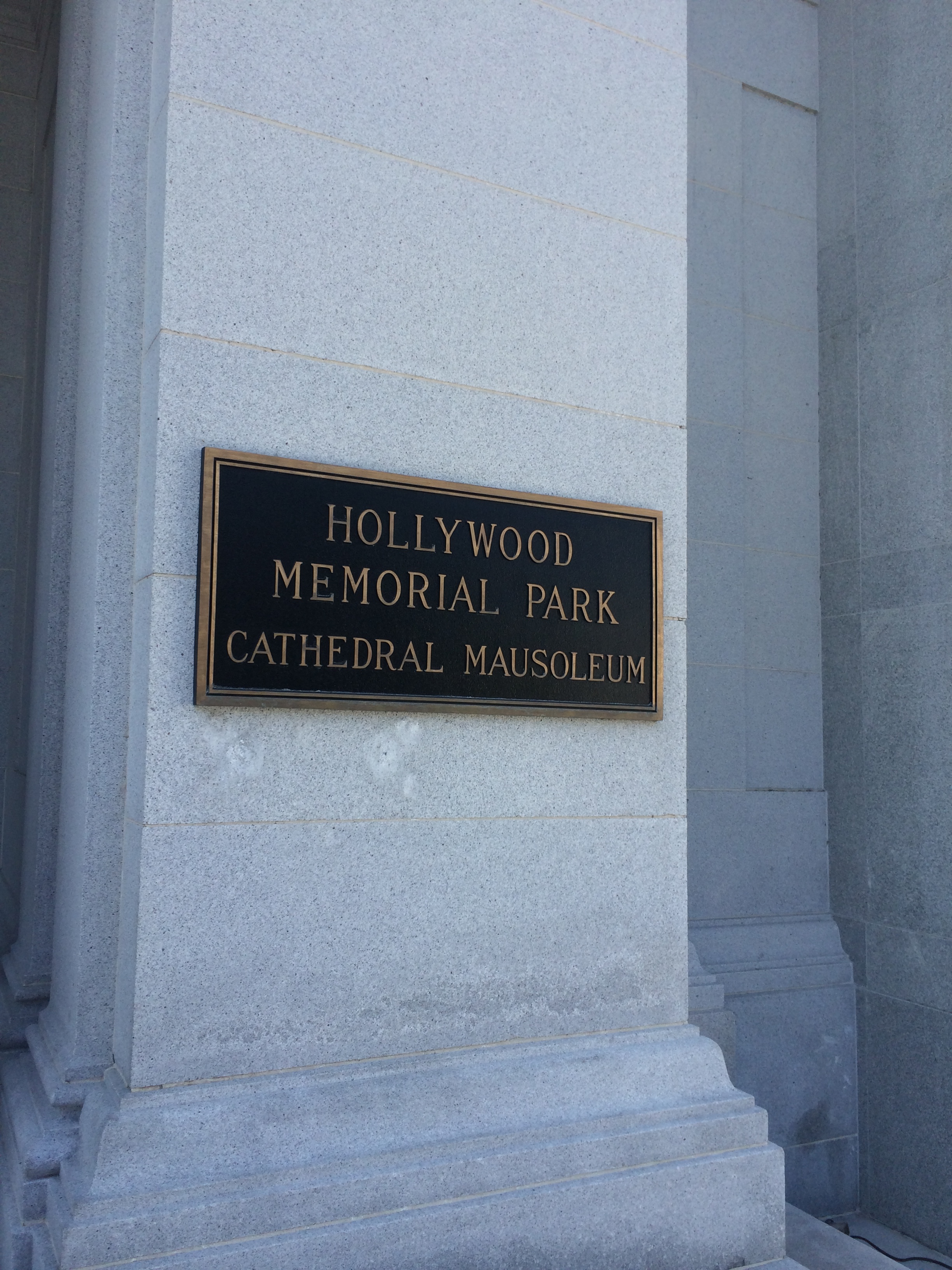
In London, there is a Rudolph Valentino Memorial Association which from time to time inserts obituary notices about him in the newspapers and supports a roof top garden named after him.  In June of this year, buyers paid $23 for the contents of three trunks he left in Turin, Italy he left in 1925.  They contained old clothes.  Roger Peterson manager of Cathedral Mausoleum says from time to time complains to police people are chipping marble off the Valentino crypt. A few women still come occasionally to pray and leave flowers, he said recently, and one visits the tomb regularly and her name is Jean Acker.  Mr. Peterson is talking about writing a book.

Categories: Uncategorized | Tags: , , , ,

1930 – Director Robert Vignola testifies

Motion picture director Robert Vignola testifies in a civil case involving the estate of Rudolph Valentino. Mr. Vignola is an Italian born friend of the late Valentino. Mr. Vignola directed Rudolph Valentino in an uncredit role in the 1916 silent film titled “Seventeen”. After the late actor’s death, Mr. Vignola and a group of fellow Italians to no avail tried to have an Italian Park constructed in Valentino’s memory.

Categories: Uncategorized | Tags: , , ,

Categories: Uncategorized | Tags: , , ,

Categories: Uncategorized | Tags: ,

ull.PNG

George Ullman was Rudolph Valentino’s manager at the time of his untimely passing. The role he played during and after tells a different story.

Categories: Uncategorized | Tags: ,

Categories: Uncategorized | Tags: ,

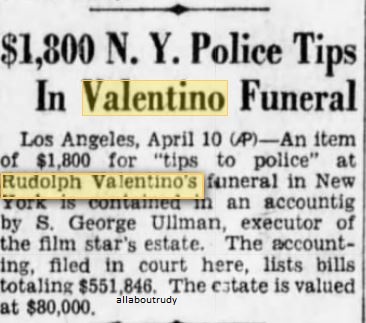
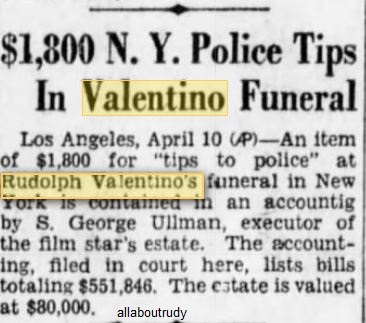
10 Apr 30 Police Tips for Valentino Funeral.JPG

Categories: Uncategorized | Tags: ,

1930 valentino estate.JPG

Categories: Uncategorized | Tags: ,

6 Nov 1930

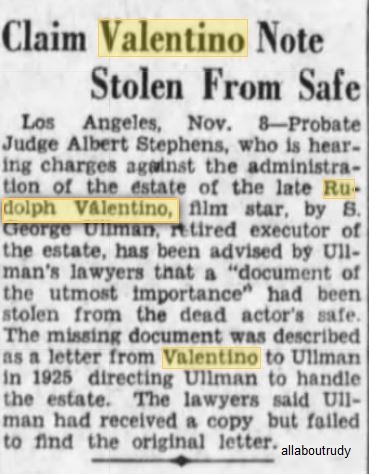
6 nov 30.PNG

Categories: Uncategorized | Tags: ,

25 Aug 1925 – Rudolph Valentino Separates from wife

News reports late coming in – Rudolph Valentino the movie star has come to an agreement with his wife to part. Valentino’s manager in announcing the separation, stated that it was mutually friendly and there is no prospect of divorce. Mrs. Valentino will continue as a producer and Rudolph will continue as a movie star
Categories: Uncategorized | Tags: ,

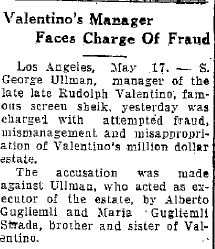
ullman (2).JPG

Categories: Uncategorized | Tags:

4 Apr 1938 – Mystery of the Lucky Valentino ring

When the late Rudolph Valentino’s effects were auctioned off in December 1926, items put on the block included emeralds, rubies, sapphires set in pins and rings and were valued by Executor George Ullman at $50,000. What happened to these jewels after their sale is not known today.  But a simple silver ring, which may not even have belonged to Valentino, has helped keep alive the memory of the handsome Italian boy with the hypnotic smoldering eyes, who rose from sweeping out halls in new York to become a $1,000,000 a year movie star and to be known as the greatest lover of the screen before his untimely death at age 31.  The modest silver band was found by movie starlet Rochelle Hudson in 1939, 13 years after Valentino’s death.  Miss Hudson were in the hills above Falcon Lair, the hill-top home occupied by Valentino at the peak of his fabulous career.  The glint of a small object in the path caught her eye and she picked it up and saw it was tarnished.  There was a brief speculation on how it happened to there.  Without giving it further thought, Rochelle put the band in her picket and continued the hike.  Later that day, Rochelle tossed the ring on her dressing table and forgot about it.  It was found by a maid who cleaned it with silver polish.  As the maid was rubbing the inside of the band, she gasped at the words began to be legible “Rudy Valentino 24”.  The maid excitedly showed the discovery to Miss Hudson.  However, the actress was to young to have known much about the greatest of all movie screen lovers.  She had seen only one of his pictures and could not remember the name.  Rochelle ran the following ad in the classified section of the Los Angeles Examiner: “Ring found, man’s bearing inscription “Rudy Valentino 24”if the mysterious veiled woman who has made an annual trip to Valentino’s grave can identify herself, I will gladly make a present of the ring to her “BOX H9284”.  The news ad first appeared on Tuesday 5 December 1939 and ran for three days with no response. A reporter reading the ad, had given it additional publicity for a story in the news section of the paper. Miss Hudson was surprised.  “I expected at least 50 people claimed to be the ‘mystery’ woman she said.  “Even if there isn’t such an actual person, at least I thought some of Rudy’s admirers would tr to get the ring”.  A short time later, Rochelle gave the ring to a publicity man, Bev Barnett, who made further efforts to find the “woman in Black” without success.  Giving up the search he put the ring in a dresser drawer, in his home. In Feb of 1940, Barnett’s home was robbed, and the Valentino ring was among the missing things.  The rings history began to get even more interesting from this time on.  On 29 October 1940, a neighbor came to the home of Los Angeles Police Officer William F. Mollie and reported that someone was trying to break into her house.  Molle went to investigate and in the rear of the house, he suddenly was fired upon by the bandit. The officer emptied his service revolver at the fleeing man and chased him down the street.  Policeman Molle testified later “he ran right past my wife, Helen, who was standing on our front lawn.  My gun was empty, so I couldn’t have protected her.  As I run past her, she handed me another gun.  “I caught the man, shoved it in his back and he choked:  don’t shoot me anymore.  I’ve got enough then he collapsed from two bullet wounds in the abdomen”.  The lone-wolf burglar, identified as James Willis, dd from his wounds.  In his pockets, was a key which led officers to a warehouse in South Los Angeles and $75,000 in loot.  Among it was the Valentino ring.  Barnett went down and claimed the ring and recovered everything else that had been taken from his house.  Thus, the silver band became known as the lucky ring.  “if the ring hadn’t shown up” said Barnett, “I wouldn’t even have known that other stuff was there”.  Superstitious Hollywood always loves good luck trinkets. Some time later, Gene Autry was in a dispute with Republic Studio. He filed suit to break his contract.  “How about that ring of Valentino’s? he asked, the publicity man.  “Let me wear it”. Gene wore the ring during the first trial of his suit against the studio, which eventually resulted in his departure from Republic.  After World War II the ring came into possession of Actor Robert Armstrong who eventually sent it to a Mrs. Cooper of Chicago, long a collector of Valentino relics.  She in turn, sent it back to Hollywood to James Gleason following the death of his wife, Lucille.  There is no great intrinsic value to the ring, and nobody knows if it is even an authentic souvenir of the screen’s great lover.  If it didn’t belong to him, where did he get it? Did one of this wives or feminine admirers give it to him? Jean Acker his first wife, has said she knows nothing of it.  But then the inscribed date, 24 was after their marriage had been broken up.  Rudy married Winifred Hudnut known as Natacha Rambova in Mexicali, Mexico on 14 May 1922.  A few days later, the famous bigamy charges hit the headlines because Valentino’s divorce from Jean Acker was not due to be final, until 11 Mar 1923.  The excitement died down when Valentino and his exotic bride said the would not live together in California until they could be remarried.  They did go through with the second ceremony in Crowne Point, Indiana.  This was in 1923.  In 1924, the date on the ring, Rudy and Natacha were living in Whitley Heights, in the hills above Hollywood.  Whether it ever belonged to him or not, the ring has done more to keep alive the memory of Valentino than any of his treasures that went under the auctions hammer.  It probably will keep cropping up again as long as Hollywood believes in good luck

Categories: Uncategorized | Tags: , ,

29 Nov 1940 – Shocking

Millions of Rudolph Valentino fans were shocked when his manager George Ullman admitted, during a law suit that he had hired 40 press agents and 1500 policemen to dramatize the star’s funeral.


Categories: Uncategorized | Tags: ,

29 Nov 1940 – Shocking

Millions of Rudolph Valentino fans were shocked when his manager admitted, during a law suit that he had hired 40 press agents and 1500 policemen to dramatize the star’s funeral.
Categories: Uncategorized | Tags: ,

21 Aug 1925 – Mash Notes to Sheik Cause Wife to Leave

This author is not buying the excuse, Mrs. Rudolph Valentino is giving the press these days. “I won’t sit waiting for a husband who goes on lot at 5:00 a.m. and gets home at midnight and gets mails from girls in Oshkosh and Kalamazoo” and trying to look disappointed, reproachful and hurt while giving a press statement. Seems Mrs. Valentino is not good at fibbing and confessed the marital vacation is in reality a separation.  George Ullman, Mrs. Valentino’s personal representative was with her today in charge of negotiations. He is not, her lawyer, and she could not conveniently remember her lawyers address. Ullman admitted he was open to the charge of alienating Mrs. Valentino’s artistic affections.

Categories: Uncategorized | Tags: , ,

1925 Valentino missed by girtls.PNG

Categories: Uncategorized | Tags: ,

2 Sep 1930 – Rudolph Valentino’s Fans Still Care

Hundreds of letters which continue to pour in are from mature women who claim to be in touch with Rudolph Valentino says George Ullman, Former Valentino Business Manager. “Some claim he is their lover, and visits them regularly. Others assert he is trying in vain to get into communication with former friends on earth. They there are the persons who say is trying to relay messages through them about the disposition of his estate. Look at some of the letters which have been addressed on the general subject of Rudolph and his affairs.

From New York – “You might think that I am a sort of flapper, but I am a home girl. I wish you would come to New York and talk to dear Rudy with me. Oh, make haste, the time has come, make haste”.

From Douglas, AZ – “I have been spending the nights in the desert with Rudy and I am enclosing a message”. George, I am so lonesome. June Mathis is with me and she, too is lonesome. It is dark out here and we are afraid. Please George, get in touch with me through this medium Black Feather asks it also”.

From Oneida, NY – “I am told by Rudy that I am the only spirit he cares about. I could never give you an idea of how very romantic Rudy really is..I think he loves me”.

From St Louis, MO – “You should get in touch with Mr. Valentino at once. He is indeed very lonesome and blue. He misses the attention that was showered upon him on earth. He believes that if he is in touch with you conditions will change”.

Hundreds and hundreds of letters like that, but none is answered. The letters which have to do with Spiritism are few indeed compared to the thousands of admirers who write to Ullman for a word of Rudy and now and then comes a pathetic letter from some person in a far-away place who has just learned of his death.

Categories: Uncategorized | Tags: , ,

24 Apr 1929 – Makes you Wonder?

Capture.PNG

Categories: Uncategorized | Tags: , ,

17 Apr 1935 – ZUNILDA MANCINI, Respondent, v. S. GEORGE ULLMAN, Appellant.

Mancini v. Ullman [Civ. No. 10065. Second Appellate District, Division One. April 17, 1935.]
COUNSEL Arthur C. Fisher for Appellant. Herman Tepp, Ivan L. Hiler and Jay J. Stein for Respondent.
.
OPINION Conrey, P. J.  Appellant having filed his opening brief, respondent now moves to dismiss the appeal of defendant, or affirm the judgment, upon the ground that the questions upon which the decision depends are so unsubstantial as not to require argument. The record is presented in a printed transcript which contains the judgment roll, together with a bill of exceptions in which there are no specifications of insufficiency of the evidence to sustain the findings.
[1] On several dates (January 23, 1928, April 12, 1929, and April 28, 1930), respondent, who resided in the city of New York, paid to appellant sums of money, in all amounting to $6,900, all solicited and received as part of a fund to be used for the construction of a monument in the city of Los Angeles, to commemorate the name of Rudolph Valentino. Appellant actually used for that purpose, only $2,000. The court found that his representations to respondent, by means of which he obtained the money, were knowingly false. The transcript begins with an amended complaint, and does not show the date of commencement of this action. However, we accept as presumably correct the statement of counsel in his brief, that the action was not commenced until October 23, 1933. But the facts shown by the findings are sufficient to excuse the failure of respondent to discover the fraud until May, 1933, when she promptly employed an attorney, and demanded repayment of the money sued for in this action, and then filed her complaint. [6 Cal. App. 2d 224] There is, therefore, no merit whatever in appellant’s contention that the plaintiff’s right of action is barred by the provisions of sections 338 and 339 of the Code of Civil Procedure; nor in the further defense based on the ground of laches of the plaintiff in delaying the commencement of her action.
[2] There is no substantial basis for the claim of appellant that the court erred in allowing plaintiff to amend her amended complaint to conform to the proof. Appellant argues that the points of amendment did not conform to the proof. But the trial court thought differently, and in the light of the findings we must assume that the court’s ruling on this matter was supported by the evidence. There was no miscarriage of justice in the rendition of judgment against appellant.
The judgment is affirmed.
Categories: Uncategorized | Tags: ,

20 May 1930 – Executor of Valentino Raises Veil on “Tricks”

How the popularity of Rudolph Valentino motion-picture actor, was capitalized for the benefit of his estate, was disclosed yesterday by George Ullman, Business Manager of the late actor and appointed executor of Valentino’s Will by provision of the testator. Ullman appeared in Superior Judge Stephen’s court to answer the charges of Alberto Guglielmi and Maria Strada, brother and sister of Valentino. It was asserted in a complaint filed by the Guglielmi’s that Ullman had mismanaged the estate, causing a loss of $80,000. When the complaint was filed, Superior Judge Crail suspended Ullman as executor, and yesterday Judge Stephens appointed R.F. Stewart, assistant trust officer of the Bank of Italy to service until the 29th when a hearing on the question of removing Ullman permanently will be conducted. Value of the estate now is $250,000 in real estate and 125,000 in personal property, according to the complainants in the suit to dismiss Ullman, but the defendants declare the property is worth more, and that he built it up from practically nothing. Under the guidance of his attorney, Ullman made a statement which he said will be substantiated by evidence at the hearing. “Instead of losing money for this
estate I converted liabilities into assets so, I have immortalized the name of Valentino, so successfully that I will wager today that all over the world there are thousands of motion-picture fans who do not know that Valentino is dead. “The estate was 160,000 in debt when Valentino died. We had organized the Valentino Production Corporation shortly before, and when I took charge as executor the assets were two films Son of Sheik and The Eagle. It was my job to exploit these films and pay off the indebtedness.” “Pictures by dead actors previously had not proved very successful, but in the case of Valentino I managed things differently. The world knows how the dean man’s friends co-operated with me in gaining thousands of columns of publicity at the time of the funeral. We organized Valentino Clubs all over the world, and they went over big too. “Then I had the task of disposing of my friend’s personal effects. He had about 16,000 worth of hardware, which he had collected as
souvenirs; swords, armor and the like. It cost me 35,000 to fix up legend’s and publicize this stuff, but I sold it for 97,000. And they criticized me for spending this 35,000 too”. Of course, I resorted to some tricks. For
instance, Rudy had lots of books but he had only autographed a few of them, and he didn’t have a book mar. I had a mark designed, stuck it inside the covers of this books which made money for the estate.

Categories: Uncategorized | Tags: , , ,

5 Jan 1938 – Valentino Photo Album

Chaw Mank said that in his estimation the late silent screen star Rudolph Valentino was the greatest personality he saw on the screen. After Valentino’s death, Mank wrote to the late star’s business manager George Ullman and asked for some token from the Valentino home. “I received an album containing photographs of Valentino, pasted by Valentino himself, and captioned in his own handwriting” he said.  He has been offered $500 for the album, he said.

Categories: Uncategorized | Tags: , ,

23 Dec 1926

23dec.PNG

Categories: Uncategorized | Tags: ,

Capture

Categories: Uncategorized | Tags: , | Leave a comment

10 Feb 1927 – Valentino Utopia Plan May Be Aired in Court

Shortly before his departure for NY on the trip that ended with his death, Valentino and Ullman are said to have signed an agreement with the Beverly Ridge Company for the purchase of 110 acres of hills, stretching from Falcon Lair, the Valentino home to the Chaplin and Pickford-Fairbanks estates. The property was to be cut up into home sites of five and ten acres each and sold to members of the film colony. Pola Negri was among those who had agreed to build on the land, according to the report. It was the plan of Valentino to erect a stone wall enclosing the entire tract, with gates keepers lodges at the three entrances. Behind these walls, the residents of Valentinotown were to live shielded from the gaze of curious tourists. The property was valued at approximately a million dollars, the Hanson Finance Company holding a mortgage for $700,000. Valentino and Ullman when they signed the contract calling for the payment of $140,000 within sixty days also issued a note for $20,000 payable in thirty days. The note fell due as the actor lay on his deathbed. Then the contract expired, Ullman failing to make good the $140,000. As a result of this, the Hanson Finance Company foreclosed on the property, throwing the Beverly Ridge Company into bankruptcy, according to attorney Andrews. Beyer as receiver has made several demands on Ullman for the amount of the note and the contract. On the advise of Attorney Gilbert, these have been ignored, resulting in the notice by Andrews of court action.

Categories: Uncategorized | Tags: , , | Leave a comment

27 Aug 1930 – Rudolph Valentino owed some money

A minor Hollywood sensation has been caused by the suit which Alberto Guglielmi and Maria Strada brother and sister of the late Rudolph Valentino have filed against George Ullman. They charge Ullman with mismanagement of the estate and diverting large sums of money for his own use. Ullman, in the answer he has filed to the charges, says that, far from mismanaging the estate, he found it in a debt-ridden condition and spent years ironing it out. It was Valentino who wrecked his own estate, Ullman claims, for he died leaving debits of over $60,000 into a surplus of $100,000 to be distributed among the heirs. A court hearing will take place at the end of this month, and a decision reached as is whether Ullman shall be permitted to continue as manager and executor of the estate.

Categories: Uncategorized | Tags: , , , | Leave a comment

3 May 1938 – Rudolph Valentino By His Wife Natacha Rambova

The morning of Monday, Aug. 16, 1926, while at my father’s chateau in Juan les Pins on the Riviera, I received a cable from George Ullman, sent at Rudy’s request, telling me of his sudden illness and operation. This came as a great shock to all of us for we thought him in the best of health. Although the message hinted that the illness was grave, we had no idea how grave it was. Aware, as we were, of Rudy’s splendid strength and unusual physical resistance, it did not occur to us for a moment that he might not recover. Nevertheless, the news worried me and, in the unexpected anxiety it aroused, all the petty resentment of our misunderstandings faded from my mind. Once again, he was the same old Rudy, in trouble, and he needed me. I cabled immediately that I would come to New York by the first sailing if he wanted me. “I never received an answer to that cable.” If Rudy received it at all it was while he was in a state of unconsciousness. Death came with unexpected swiftness. Even as the next two days passed we did not realize the danger. Mr. Ullman continued to notify us almost hourly of each slight change in Rudy’s condition and the news in his cables, as .they came, seemed favorable rather than discouraging. The actual presage of his death came through psychic communications. It happened that as guest at the chateau at that particular time was George Wehner, the distinguished American psychic, who had led us far along the ways of understanding of the spirit world. It had become our custom to have family sittings from time to time, with Mr. Wehner acting as medium. Wednesday evening during one of these sittings, while Mr. Wehner was in a state of deep trance, Rudy “came through.” We were first aware of his presence by mutterings of a few almost incoherent words and the repeated calling of auntie’s name and mine. This did not surprise or terrify us. Those who have investigated psychic phenomena know that it is not at all unusual for the consciousness of a person still living in the earth world to manifest itself or communicate at a distance while the body is sleeping or unconscious. On waking the person may remember these experiences in the form of a dream. Friday morning my cable from Mr. Ullman brought us news that Rudy was better—greatly improved and on the road to recovery. We were enormously cheered. That evening we were impressed to have another sitting. Almost immediately after Mr. Wehner was in trance, Black Feather, Rudy’s Indian friend who once had saved his life, “came through” to tell us that he was the chief and would not leave him. Then Jenny spoke, saying she had been constantly with Rudy since the beginning of his illness. He himself had seen her and called her name as he was taken to the ambulance. In confirmation of this X received a letter from my sister in New York the very week of Rudy’s passing, giving me details of his illness; explaining among other things, that Mr. and Mrs. Ullman had told her that Rudy kept calling the name of “Jenny” as he was being taken in the ambulance from his hotel. These communications from Jenny and Black Feather worried me. I could not reconcile them to the cheerful news of the morning’s cable for they seemed neither happy nor hopeful. And now, to cause me ever greater concern, a teacher from whom Rudy and I had received many lessons in the past, took control and talked to me gently, kindlv of personal things between Rudy and myself, and with such compassion as I had never heard him use. He spoke of Rudy’s great love for me, his life, his character and career, and explained that his term on this earth schoolroom was completed. Within the next few days he would pass to another plane of consciousness in this ever-continuing life. Early next morning I cabled Mr. Ullman for news of Rudy’s condition. The cable was not answered. What was there to say? We had been given the answer the night before, but had refused to accept it as truth, for what we do not wish to realize we try to stifle in our hearts. Monday morning I awoke to find the atmosphere of my room heavy with the perfume of tuberoses—and then I knew Rudy had passed on. When on Tuesday the delayed cables arrived announcing his death, I was grateful to the prophecy from the other world whose kindness and understanding had softened the cruelty of this news. The third day after his passing Rudy came to us for the first time, led by his mother, Gabriella. His attitude of mind, resentment at having been taken at the height of his career while his work he felt was not yet completed, made this first contact an unhappy one. He spoke not clearly but incoherently, remained with us only a moment, called auntie’s name and left suddenly. Then his mother spoke with us. She was almost distracted by his state of mind and regretted the day she had ever allowed him to leave Italy. What was the benefit of a success that had brought him to such bitterness aad anguish? Then others came to comfort us. They explained in a beautiful way that Rudy’s attitude was only natural. With all the force of world thought and grief directed upon him, nothing else was possible. We must have patience and each of us try to help him in our several ways. They, too, would help him, and this first darkness and despair would soon pass. It has, for I have communicated with Rudy very often since then and I know he is happy, still continuing on another plane the work he only began on this earth. Many will smile at what I am writing now, give it no credence, I discard it as the phantasms of my I brain. But a few years ago those same people would have smiled with I equal skepticism at the messages I the radio brings us to-day. How, I they would ask, can voices picked | out of the air be transmitted by an; unseen force over miles of empty | space? To-day no one doubts the validity of radio transmission. It is I just another scientific phenomenon to which yesterday we were blind. Each new development of science, from the steam car to the aero-plant, from the lightning rod to the telephone was at first hailed as a fraud by those who had not yet tested it. In the astounding revelations of the last quarter century, we are only beginning to comprehend the unseen forces of the universe which man has not yet utilized. Those who have not yet received test messages from the other world find it difficult to believe in communication after death. The man who has never heard a radio would be loud to declare that there is no such thing as music In the air about us. But we who have listened to it pay no attention to his beratings. We know he has never investigated it. For this reason, I am untouched by the stupid criticism of those who insist it is impossible for me to talk with Rudy, who has passed on to another plane apart from and above my own. How do I know these messages are not frauds? Can I see Rudy or touch him? But when my mother calls me by long distance phone from Chicago or from Paris, I cannot see her, but I hear her voice and I know it is she by the idiosyncrasies of her speech, by what she says and the way she says it. Fraud or impersonation would be impossible. The same is true of my messages from Rudy. If during the period I knew and lived with Rudolph Valentino I did not learn to know him better than to be duped by fraudulent messages, then I am a gullible fool! Fraud is for those who are willing to accept it. Truth is for those who seek it. Thus, I dismiss the subject for my belief is secure. Rudy was dead—yet he still lives, for life is ever-continuing. In all contemporary history there is only one young man who in his 20s was strong enough to withstand the great deluge of fame, adulation and flattery that was heaped on Rudolph Valentino.

Categories: Uncategorized | Tags: , , , , | Leave a comment

5 Sep 1926 – Dupe Shows Up Again – Acts as Manager for S. George Ullman, Former Manager of the Late Rudolph Valentino

Ethan Allen Weinberg, ex-convict and leading quick change artist has now added S. George Ullman, business representative of the late Rudolph Valentino to his long list of dupes. Mr Ullman believing Weinberg’s statement that he is both an M.D. and a member of the NY Bar, has permitted Weinberg to represent him at the offices of the Manhattan District Attorney where this Baron Munchausen of Brooklyn spent an hour yesterday discussing the demands of the anti-Fascist element for an autopsy on Valentino’s body. As one of Weinberg’s dupes Ullman is in excellent company. When not hob-knobbing with the representatives of the District Attorney’s Office the last few days, Weinberg has been issuing statements to the press explaining that he has been in charge of Pola Negri’s hysterics and denying that she and Rudy were affianced. A letter bearing the imprint of S. George Ullman and signed with his name in ink, reached the newspaper offices yesterday. Mr. Ullman thanked the press for its co-operation and asked that the diagnosis of Valentino’s preoperative condition made by Dr. Harold D. Meeker, be given publicity. This was made to offset the cause of death had been foul play of some sort. The letter was dated 23 Aug and apparently dictated by Ullman before he left for Hollywood. At the bottom of the letter was written, above Mr. Ullman’s initials: “This report was concurred in by three reputable surgeons who were consulted this a.m. together with the legal aspects by Sterling C. Wyman, medico-legal expert who was a dear friend of Valentino”. The last straw to break the camel’s back of “Dr.” Wyman’s identity was furnished by the man himself. His suspicion aroused by questions the writer had addressed to him over the telephone early yesterday, Wyman-Weinberg called up the office of “The Eagle” sometime later to assure the City Editor that really everything was quite as it should be. Of course, he said, he was a doctor, he was a lawyer also, and he combined the two professions by engaging in the legal or judicial aspects of medicine. But he certainly was a doctor, with a degree. Why, he was on staff of the Flower Hospital, Manhattan, from which he was telephoning at that very moment. No, he added, he would not remain at the hospital very long. He was going out of town would leave in a few minutes. Whereupon the hospital officials were questioned about him. Over the telephone, a minor clerk said, yes, there was a Dr. Wyman on the hospital staff, and only a few minutes ago he had left word he was going out of town and would not be back until Wednesday. But a personal inquiry at the hospital on E. 64th Street considerably modified this first bit of information. Hospital officials looked up their records and found no Wyman or Weinberg on their list of doctors. “He comes here frequently to visit with one of our interns” she explained. “Everybody knows him as Dr. Wyman and I suppose that’s why whoever answered the telephone was under the impression that he was on our staff. But he’s not on the staff. “Would you”, she was asked, “recognize him from a picture”? She thought she could and a photograph of Stephen Weinberg as he looked when convicted in the Brooklyn Federal Court for impersonating a Naval Officer was shown her. “That’s he”, she said. That’s Dr. Wyman. At 556 Crown Street, a 32 family apartment house a block from the Carson C. Peck Memorial Hospital, “Wyman” has been a man of mystery for the past two and a half years. He is known as Sterling Clifford Wyman to tenants of the house, but there are many residents of the section who recall him as the Ethan Allen Weinberg, whose gigantic hoaxes have kept him before the public ever since his peculiar abilities manifested themselves years ago. The man who has been so many times in the toils of the law is even buffaloing the Police Department at present. Posing as a physician and getting the necessary letters of introduction, he boasts a police card which permits him to sail past traffic signals in his three motor cars, when the coveted P.D. sign is attached. According to neighbors in the house ‘Wyman” advertised last autumn for a chauffeur, and engaged one only after he had kept 40 applicants for the job waiting all day in the lobby and on the sidewalk. “He went to the Valentino funeral looking like a million dollars” said one neighbor. “He hired a Rolls Royce for the occasion and was gotten up in the most expensive funeral attire he could secure”. This was done to impress Joseph Schenck, Ullman, Norma Talmadge, Douglas Fairbanks, Richard Dix, and all the other celebrities who gathered at the Actors Chapel St Malachy for the funeral services of Weinberg’s “dear friend” Valentino. The fact that Brooklyn’s indefatigable Baron Munchausen has popped up again in the self-styled role of dear friend of Valentino in the not to be wondered at. According to physicians, who have examined Weinberg on the many occasions of his clashes with the police, has “ideas of a grandiose nature” whenever a celebrity bobs into the limelight also. When the venerable Austrian surgeon Dr. Lorenz, came to NY Weinberg called on him, represented himself as Dr. Clifford Wyman, and said he called as the personal representative of Health Commissioner Copeland and wanted to co-operate at the clinics. Lorenz offered him a salary as his secretary. Acting as go-between in the clinic waiting room. It was an easy matter to extract a $5 dollar bill from a mother eager to get place and preferment for her crippled child. Copeland exposed the imposter and “Wyman” dropped out of sight. Calling at the Waldorf with his accustomed savoir faire, he presented himself as Lt. Com. Ethan Allen Weinberg to the Princess Fatima of Afghanistan. The lady with the emerald coquettishly set in her nose was delighted with the persuasive man in naval uniform. He offered her what appeared a perfectly good letter of introduction and said he could get her an audience with President Harding. If her credentials were satisfactory. In a flutter the lady offered them, as well as an expense account, to the ingratiating officer of gallant address. He actually introduced her to the President at a private three minute audience. As Weinberg was leaving the White House, however, he was nabbed by Secret Service Agents impersonating ordinary individuals may not be a jail offense if no fraud, larceny or forgery results, but impersonating an officer is a very different matter. Weinberg got 15 months in Atlanta Penitentiary and was released Feb 1924. One of is most amusing pranks with the press was when the Harold McCormickes returned from Europe a few weeks before they were divorced in Chicago. Weinberg got a pass for the revenue cutter which went down the bay, telling the ship news men he was attached to the McCormick retinue. This time he again used the first name of Sterling, dropped the last name of Weinberg and was Capt Sterling Wyman he was using with George Ullman. He told the ships newsmen he could officially deny the rumored McCormick divorce and was sure it would never take place. He told the McCormick’s he was a reporter. At the Manhattan Hotel where Harold McCormick stayed for 24 hours the Brooklyn fraud managed to stay for 24 hours before McCormick booted him out. Representatives of the Kings County Medical Society, reading in Manhattan newspapers of a “Dr. Sterling C. Wyman, of 553 Crown Street, who had been in constant attendance” on Pola Negri declared yesterday there is no physician by that name. In the telephone book Wyman fails to use his alleged medical title. Weinberg in duping his victims uses a long list of aliases. When he was sentenced in an Atlanta Prison for 18 months in 1922 for impersonating a naval officer he was charged by the Federal judge in Washington D.C. as Stephen Weinberg, alias Stephen Wyman, alias Ethan Allen Wyman, alias Clifford G. Wyman, alias Sterling Wyman. It was as Dr. Sterling C. Wyman, that he duped Ullman. It was as Capt. Sterling Wyman that he once rode for 24 hours in the rolls royce of Harold McCormick. Posing alternately as lawyer, physician, or officer of the Navy or Army this chameleon of Brooklyn has now gotten into the limelight again. His methods never vary. He is always interviewed by the press and enjoys for a time all the éclat of the limelight which his victims enjoy. Then he is discovered, he disappears and bobs up six months later under a change of alias, smiling and debonair, suave in a way really likeable. His nerve is truly great. “He has ideas of a grandiose nature” said the physician. This accounts for the fact that Weinberg never tricks anyone except a celebrity, swaggers up to reporters and gives out interviews which are sure to reveal his identity to anyone familiar with his case and maintains placidity when he is thrown out, only to bob up later in the society of some other notable. He remained in Dannemora from Oct 1917 to April 1919, having been sent there from Blackwell’s Island, to which he was committed on the charge of forging the name of Senator William Calder to a bank recommendation. Asked yesterday, if he were any connection of the man of the many aliases, Dr Sterling Wyman indignantly replied he was a Brooklyn M.D. in good standing and the author of “Wyman on Medical Jurisprudence”. At Kings County Medical Society, however, he stated that he certainly is nothing of the sort and that his name fails to appear in the directory of the American Medical Association as a doctor in good standing anywhere in the United States. Weinberg appears happy only when he is near the great. He forges and impersonates apparently for this reason only. He is in his own way a genius. He got himself before the Republican National Convention with a letter expressing the hope that his “efforts would meet with unrivaled victory” and he got a letter from Senator Pat Harrison which carried him before the Democratic National Committee. He knows nothing whatever about medicine. But he once convinced the Foundation Underpinning Co. that he did, and on his forged credentials that sent him to Peru where for three months he practiced medicine on the employees of the company before his deception was discovered. Weinberg was born in Brooklyn in 1893, the eldest of six children. He graduated from P.S. 18 and from Eastern District High School, from which he was graduated with honors in 1903. Somewhere he has acquired the Phi Beta Kappa Key sign of the honor of the fraternity to which only a few brilliant scholars are eligible. In November, of the same year Francis Cushman whose term expired in May 1903, appointed the young man as his personal page in the House of Representatives. Returning to Brooklyn, Weinberg blossomed forth as an orator in the cause of woman suffrage. He was made secretary of the Brooklyn Organization and was the only male delegate to the National Council of the American Woman Suffrage Association in 1909. At this time, he resided at 71-a Maurer Street and his mother was proud of him. The following year he was appointed Consular Agent to Port de Aubres, in Northern Africa, by the U.S. Minister to Morocco, who became acquainted with Weinberg when he was a page in the House. But Weinberg never got to Morocco, instead, at eh earnest request of his father, he was sent to Bellevue Hospital for observation. Employed as a demonstrator for airships in a Manhattan Department Store, living in a comfortable home, he had for some inexplicable reason taken a camera and flash powder from the store. From this time on Weinberg never again ran straight. In 1913, he was arrested for posing as “Lt Com Ethan Allen Weinberg, King’s Guard Consul General for Romania. In this capacity he tendered a dinner at the Hotel Astor to Dr. Alfonso Quinores, Vice President of San Salvador, and was arrested the next day for violating his parole from Elmira Reformatory, to which the man of many parts had been sent at earnest behest of his distracted parents. His next offense was the forging of former Senator Caider’s name. No man living has gotten away with the grand gesture more often than Weinberg, who in his way, is an artist. Impossible to cross his vivid trail again and again and no take off one’s hat to the man’s persistent nerve, audacity and aplomb. It is doubtful if there is anyone who under certain circumstances would not “fall” for the persuasive address of the man who in his own novel way is one of the famous personages of this borough.

Categories: Uncategorized | Tags: , , , | Leave a comment

Mineralava Tour of 1923

Welcome to Rudolph Valentino Blogathon hosted by Timeless Hollywood. My contribution is the Mineralava Tour of 1923.

So the year was 1923, and one of the biggest movie stars of the day, Rudolph Valentino was frustrated with the way he was treated by his studio Famous Players-Laskey. Rudy felt that the money he was making for his studio justified him receiving a bigger salary than what he was currently getting. Rudolph Valentino solicited advice from his soon to be wife on what to do about his mounting frustration. So taking her advice he walked out on his contract. Famous Players-Laskey suspended him from making movies and they also, won an injunction which forbad him from making movies with any other studio. Rudolph Valentino had a massive spending problem he spent money like it was going out of style and combined with his massive legal bills from fighting his divorce with his former wife June Acker. Without money coming in Rudolph Valentino and his soon to be wife had to come up with a way of making money to pay for their expenses. George Ullman a public relations man representing Mineralava Beauty Company found a loophole in the contract that did not exclude product endorsements. So the idea was an exhibition dance tour of the country. Rudolph Valentino and his soon to be second wife Natacha Rambova would both embark on an arduous exhibition tour that would take them through more than 88 cities within the United States and Canada. The exhibition tour began in Feb 1923 and for more than 17 weeks they danced the tango together; they judged beauty contests and best dancer contests all of which was sponsored by Natacha’s step-father Richard Hudnut.

mineralava contestnumber

So, the Valentino’s started the tour off in New York City’s Century Theater at a benefit for the Actors Fund hosted by Will Rogers. Let’s look at what occurred during the Mineralava Exhibition Dance Tour. The couple traveled to each city in style in a luxuriously appointed private Pullman car with its own staff. They were mobbed in every city on the tour, numerous curtain calls and demands for encore performances. After each stop, Valentino would talk to the audience about his wife’s beautiful complexion and explained that Mineralava Beauty Clay developed and maintained her complexion. The Exhibition Tour gave the couple the publicity they felt was rightly theirs combined with a big weekly salary including entrance profits that all equals to they were making bank. Local newspapers were full of Rudolph Valentino beauty ads showing Rudy claiming to use Hudnuts Mineralava Beauty Clay on his face, performance reviews and a re-showing of his old movies. On 14 Mar 1923, during one of their nearby tour stops (Chicago) the couple got married in Crown Point, Indiana. The Mineralava Exhibition Dance Tour ended in June 1923. However, there was another angle to this tour and that was Mineralava Company sponsoring a beauty contest which would generate free publicity for the company. The Beauty Contest had Valentino as the “featured” judge. In addition, to performing a dance number, and judging dance contests he judge a local beauty contest and the winner would move on to become a semi-finalist.  On 22 Nov 1923, all of the local beauty contest semi-finalists went to New York City for the finals. During their time in the city they were housed on an entire floor of the Waldorf-Astoria Hotel. On 23 Nov 1923, all semi-finalists were taken in a fleet of taxi-cabs to Fifth Avenue where they officially met by 3 marching bands and the acting mayor of New York City. Then they all walked to Madison Square Garden. Rudolph Valentino was contracted to appear and with his panel of judges would decide who the winner would be. The end result was a short film made by David O. Selznick called “Rudolph Valentino and his 88 American Beauties”. The reason for this short film was another way for the studio to make even more money from the publicity generated from the tour plus Rudy had not made a movie in quite sometime. The winner of the beauty contest was Norma Niblock of Toronto. The final shots of the short film showed Rudolph Valentino surrounded by the winners. This film still exists today.

i hope you enjoy reading this article. Again thank you Timeless Hollywood.

Categories: Uncategorized | Tags: , , , | 2 Comments

1920’s Palm Springs Loved by Rudolph Valentino

Capture
Palm Springs was known as a weekend getaway for Hollywood’s elite with its scenic views provided the perfect backdrop for relaxation and fun. The exotic trees and foliage was one of the reasons those Hollywood silent film directors would come to Palm Springs to film their movies. Rudolph Valentino made many trips to Palm Springs where he loved the great outdoors especially horseback riding, fishing and camping.
Cddddddapture 111Capture
In 1921, before filming his movie “The Sheik” Rudolph Valentino and fiancée Winifred Hudnut often came down on weekends to enjoy the outdoors which provided a relaxed atmosphere for them both. On 13 May 1922, not quite a full year from divorce of his previous wife, both Rudolph and his fiancée Winifred Hudnut were married in Mexico. The newlyweds honeymoon destination was the Palm Springs Hotel, Palm Springs. There they were hosted by the owners who were friends of the couple sisters Dr. Florilla and Cornelia White. Dr. Florilla White plays a major role at Rudolph Valentino’s bigamy trial. The Valentino’s had a lot of friends who owned villas in Palm Springs. For example, in 1925, the couple were having fighting so to appease Natacha he called Ullman during their stay at the Villa Dar Marroc, Palm Springs the hideaway of Scottish Painter Gordon Coutts. Natacha negotiated with both Rudy and George Ullman for a movie to be called “What Price Beauty?” which would be financed off of her husband’s new movie contract. In Feb 1926, his last movie was The Son of the Sheikh was filmed in Palm Springs as well.

It was rumored that Rudolph Valentino had built a Spanish bungalow in Palm Springs. The bungalows location is in ‘The Mesa’ neighborhood considered one of South Palm Springs oldest and most exclusive areas. The home was later owned by movie actress Esther Williams.

Categories: Uncategorized | Tags: , , | Leave a comment

23 Aug 1928 – Two Years Later

Rudolph Valentino died two years ago and he was the most idolized figure the screen has ever known. His passing was mourned all over the world. Even today, Valentino is a living factor in motion pictures. In offices at 6606 Sunset Boulevard, Hollywood, manager George Ullman still acts as his manager for the estate of his friend. Thousands of photographs are sent out every week to those whose love for him never has wavered. Rudy’s personality has triumphed over death.

Categories: Uncategorized | Tags: , | Leave a comment

Aug 2014 – Valentino’s Hollywood

042044

So I always wanted to spend time in Los Angeles or Valentino’s Hollywood. In times past, I drove through, I stopped off to see relatives, but I never got to see those tourist places that I always wanted to see.  So, I took the trip of a lifetime and simply went.  I wanted to be a traditional tourist, I wanted to attend the Rudolph Valentino Memorial Service, I wanted to meet several people who I had been corresponding with via Facebook, I wanted to walk where he did, I wanted to see where he lived, and I needed to spend some time researching for a book I intend to write one day. So in five days, I was able to accomplish that and more.  I drove, I walked, I got lost, I picked up souvenirs, and I wrote post cards home. One of the things I did was visit Hollywood Forever Cemetery and had a private tour with Kari Bible who is passionate about what she does and shares her wealth of knowledge about Hollywood and the stars buried there.  I took a tour of Hollywood courtesy of TMZ and I was not impressed. I walked on Hollywood Blvd, Sunset Blvd, Griffith Park, Griffith Observatory, I ate at Musso & Franks Restaurant, I toured the Hollywood Heritage Museum and the people there are truly nice and take time to tell you about what is in the Museum.

238 282305

Then I went to the Valentino Memorial Service and I got to see Rudolph Valentino’s grave, I spent a little time there, I met some wonderful people at the service, and my final day I spent Valentino sightseeing. My gracious tour guide took me to see where Valentino Productions was located we even went inside the opened door and walked quietly upstairs taking in all of the original features still there. I was shown where Rudy asked Jean Acker to marry him and also seen the church which was the site of the first Valentino Memorial Service.  Then there was Natacha and Rudy’s spot on Sunset Blvd, Pola Negri’s house and George Ullman’s house in Beverly Hills, we even drove through Whitley Heights and I even seen the foundation of Rudy’s former home. The best part was going to see Falcon Lair. How can I describe the place where he called home just to pull up and see that black gate, those white columns and the name Falcon Lair was indescribable in how I felt. I got out and of course took photos and videos and was pointed out what was original and what was torn down. To see that wonderful man’s home torn down like that was simply sad. That is Hollywood history that is gone forever except what is on a photograph or a post card is incomprehensible. My tour guide talked to me and I gained more insight into this person who I never personally knew but in my heart I did. Although it’s only been a few days since I left I look over the videos and the photographs I took and am simply grateful that I went. Because now, I will go back year after year and know there are more memories to create, acquaintances to renew, and more knowledge to gain. I want to acknowledge two people who made me feel right at home. My tour guide Tracy Terhune and the gracious Stella Grace. 

331320279

Categories: Uncategorized | Tags: , , , , , , | 1 Comment

“Mr Valentino was greatly cheered during his last days by the thousands of messages sent him by his friends and motion picture admirers, and while he was too weak to read all of them, it was a great comfort to him to know that so many friends were interested and sympathetic”.. George Ullman, on the passing of his friend and associate.

Categories: Uncategorized | Tags: , | Leave a comment

17 Dec 1926 – Will not Auction Rudolph Clothes off

The lavish wardrobe of Rudolph Valentino will not go on the auction block with the remainder of his personal effects now being sold here. George Ullman executor of the film star’s estate, ruled Thursday. The announcement was made as Ullman opened Valentinos trunks preparatory to placing their contents on sale. “I can’t do it,” he said. “Those clothes nearly talked to me. Rather than let anyone else have them, I’ll buy them myself if necessary.” Mrs Teresa Werner an aunt of Natacha Rambova, divorced wife of Rudolph Valentino and a share holder in the estate, with the actor’s brother and sister, was among the purchasers at today’s auction. She paid $70.00 for two sterling silver picture frames. Adolphe Menjou and Ernest Torrance, screen actors were also successful bidders, Menjou paying $56.00 for a small brass incense burner and Torrance $170 for an antique painting on a wooden panel.

Categories: Uncategorized | Tags: , | Leave a comment