
Posts Tagged With: Monsieur Beaucaire
Categories: Uncategorized
Tags: Booth Tarkington, Monsieur Beaucaire, Paramount PIctures Long Island, Rudolph Valentino
12 Aug 1924 – The Screen: Monsieur Valentino
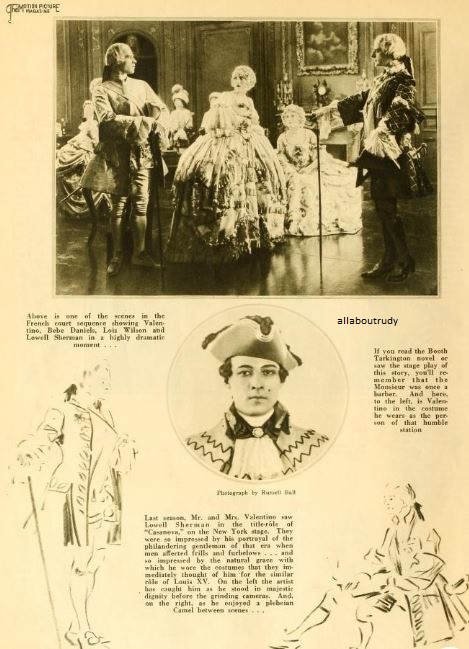
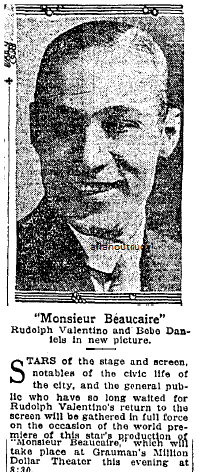
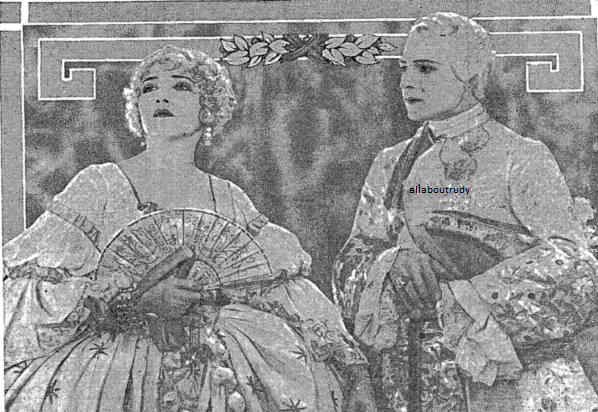
Clad in embroidered satin and costly laces, his glossy dark hair covered by a white wig. Rodolph Valentino, after an absence of two years has returned to the screen and is to be seen this week at the Mark Strand in the title rôle of the picturization of Booth Tarkington’s exquisite story, “Monsieur Beaucaire.” Gorgeous is a word we invariably dodge, but this pictorial effort is thoroughly deserving of such an adjective, as never such wondrous settings or beautiful costumes been seen in a photoplay.The cast of this production is an imposing one, as in it, besides Valentino, are Lowell Sherman, Bebe Daniels, Lois Wilson, Doris Kenyon, H. Cooper Cliffe and others. Every detail of their costumes is compelling, and the different scenes are always most interesting, from the sight of Louis XV. using the needle for embroidery to the time when the dénouement comes and Lady Mary Carlisle learns that the man she thought to be a barber is none other than the Due de Chartres. One scene shows the Versailles gardens, with water flooding a grand flight of steps. The King and Queen of France are, as usual, entertaining. It reminds one of a Carpaccio painting with its entrancing staging and the magnificence of every mortal. Sidney Olcott, who directed “Little Old New York,” “The Green Goddess” and other productions, is to be congratulated on this effort. There is a duel scene in which one sees only one character, the combatants being out of the picture, their blades being shown flashing back and forth. Those who do not know the story well will appreciate this picture more than persons who are quite familiar with it. Forrest Halsey, who wrote the screen version, appears to have lost himself in showmanship, and has therefore excluded some of the charm. There is a question whether it would not have been more advisable to begin the film with the same introduction Mr. Tarkington has in the narrative, as the novelist keeps the reader in the dark, while the picture producer permits the audience to know all about the identity of the hero. Mr. Tarkington played with the title, the Due de Chateaurien, but the editors of this picture have uncovered the wit in the title by explaining simultaneously that it might mean “Duke of Castle Nowhere. There are the usual movie scenes, most effective, it is true, but without the same plausibility the author put into his story. Mr. Tarkington has the Duke of Winterset’s minions attack Beaucaire when he is riding beside Lady Mary Carlisle’s carriage, whereas the scenario writer causes the attack to take place in a garden while Beaucaire is telling the Beauty of Bath of his admiration. The captions would lead one to suppose that in Bath people nonchalantly alluded to Lady Mary as the Beauty of Bath without ever thinking of mentioning her name. On the other hand, the excuse for the appearance of Beaucaire with the French Ambassador, Mirepoix, is brought out with excellent dramatic effect. He refuses to have Princess Henriette forced to wed him, and therefore at a banquet he leaves the King abruptly, lightly springing over the terrace wall. In the following sequence, calm and amused, he is depicted with the much distraught Mirepoix, insisting that as he had come to England in the Ambassador’s entourage as a barber, he must be seen shaving his master. The gambling scenes are a little too obvious. They are not as well pictured as one would expect from the first chapter of the book. The Duke of Winterset is seen hiding cards in his capacious sleeve while Beaucaire is out of the room, and afterward comes the discovery by the Frenchman that Winterest is cheating. Why, after Beaucaire has insisted on meeting the lovely Lady Mary, he should be conducted to her bed chamber, is a strange idea, as one would hardly expect that the Beauty of Bath would permit half a dozen men to come up to her and introduce the Frenchman. This portion is where the movie blazes forth, as it does in a number of other sequences. Mr. Valentino is sympathetic most of the time as Beaucaire. One of his weaknesses seems to be in speaking out of one side of his mouth. However, he is good-looking and an athletic Beaucaire, and has more of the character than that reflected in the spoken titles. He is agile in the fighting scenes, and exceptionally affectionate in the love sequences. He is a creature of impulse when he first meets Lady Mary, as he is not nearly as gradual in leading up to the affaire du coeur as Beaucaire was in the book. He really outdoes Booth Tarkingston’s character, who was content just to touch Lady Mary’s gloved hand. In the movie this is translated into a lengthy osculation. Lowell Sherman officiates as the King, and his characterization is superb. He is important, almost effeminate, always eager to have the adulation of his court. In the first chapter the Queen is late, which is a terrible offense when the King is waiting for the curtain to go up on his private theatricals.Lois Wilson is charming as the Queen. The heroine in the film version of the story is the French Princess, Henriette, played by Bebe Daniels, who is sweetly sympathetic. H. Cooper Cliffe figures as Beau Nash, and to us he is somewhat out of place in this rôle. Doris Kenyon is entrusted with the part of Lady Mary, which she fills capably. This is the finest production of its type we have seen, and it is a picture which should not be missed by anybody, as even those who are not in the habit of going to screen entertainments will enjoy almost every scene in this beautiful photoplay. A most interesting prologue, in which the figurantes wear some of the costumes worn in the picture, enhances the presentation of this film.
Categories: Uncategorized
Tags: Monsieur Beaucaire, Rudolph Valentino
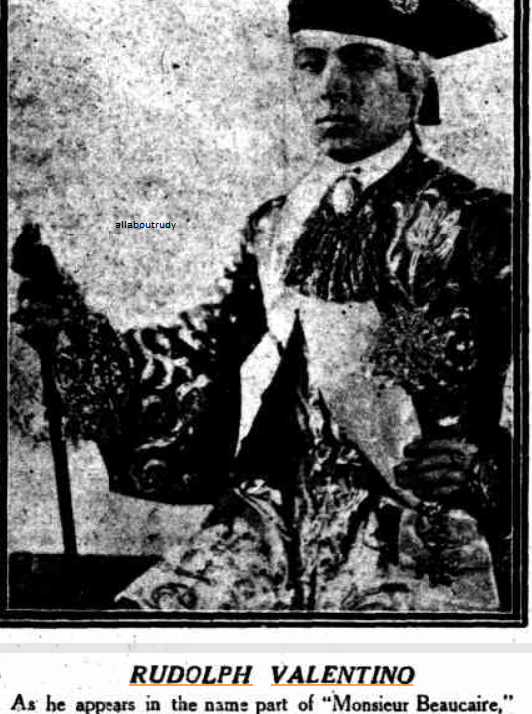
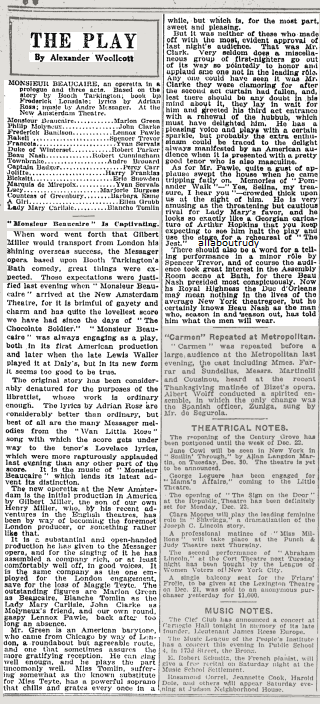
1922 – Famous Players-Lasky Long Island, NY
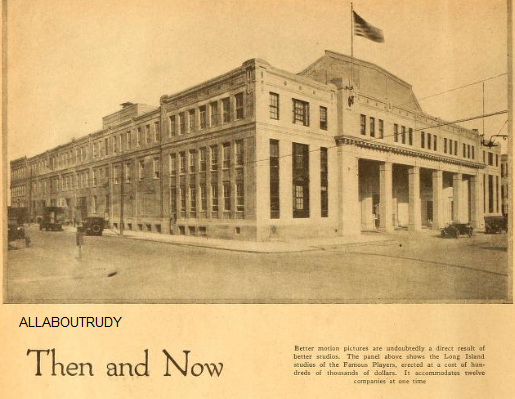
Famous Players Lasky Studios, Long Island, NY is where Rudolph Valentino filmed two movies there, one of which, “A Sainted Devil” (1924), was ostensibly set in South America but was shot in part in Farmingdale and “Monsieur Beaucaire,” a 1924 Rudolph Valentino movie shot in Queens, NY.
Categories: Uncategorized
Tags: A Sainted Devil, Famous Players-Lasky, Monsieur Beaucaire, Rudolph Valentino
1924 – Horgan Using Rudolph Valentino Photo
Categories: Uncategorized
Tags: Monsieur Beaucaire, Stephen Henry Horgan
1924 – Stephen Henry Horgan & Rudolph Valentino
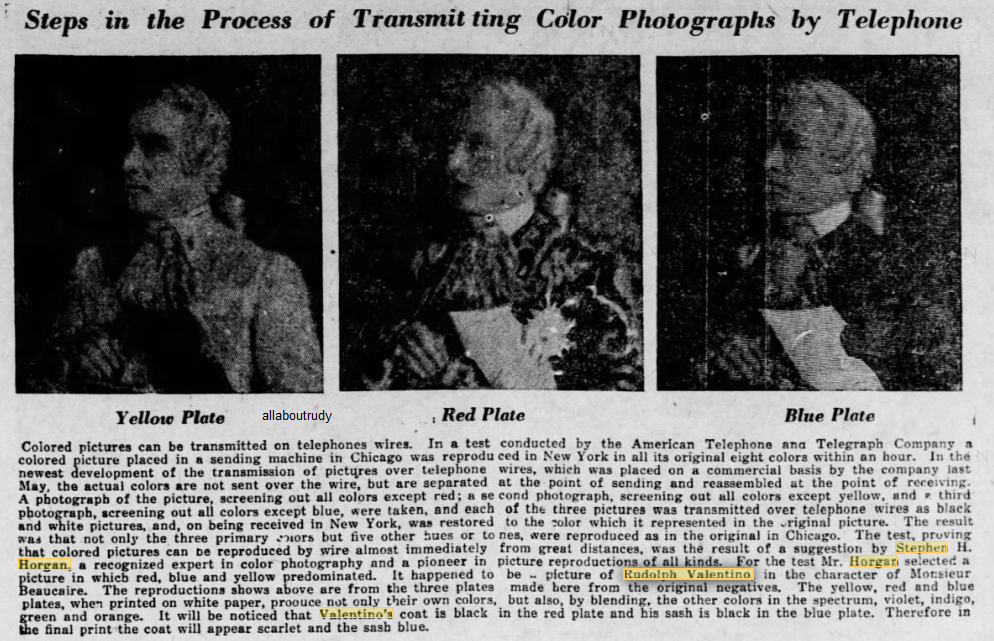
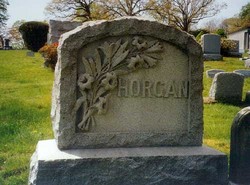
 On 2 Feb 1854, Stephen Henry Horgan, was born in Norfolk, Virginia went on to live a long life and distinguished career. In 1880, Horgan a photographer invented a process of reproducing the tones of a photograph by means of dotted or checkered spots. During the 1920’s, Stephen Henry Horgan, worked as a recording secretary, American Institute of Graphic Arts and during this time AIGA had great success in sending pictures over the wire. Horgan an inventor had an idea of transforming black and white pictures into color over the wire. In July 1924, Horgan made history, he took a portrait of Rudolph Valentino in costume as Monsieur Beaucaire used a process with three plate developed and inked in three separate colors blue, yellow, red and printed one on top of the other. The result was a color version sent by American Telephone & Telegraph Company wire from Chicago to New York. For his remarkable achievement in the field of photography, Horgan received the AIGA medal which is presented to individuals in recognition of their exceptional achievement. Horgan was a pioneer in the field of photomechanical reproduction and was connected in various capacities with many printing, publishing, and engraving concerns. In 1934, Horgan a widower of 14 years, married his long-time secretary, Della Van Houten, 74 years old at St Anne’s Catholic Church, Nyack, New York. On 30 Aug 1941, Horgan died at age 87 and is buried in Nyack, New York.
Categories: Uncategorized
Tags: Monsieur Beaucaire, Stephen Henry Horgan

16 May 1924 – Valentino in Miami Asks Chance to Rest
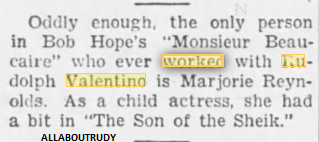
It must be different if Rudolph Valentino is in it, for he said so himself to the Miami News representative Friday when interviewed Friday. “Stop right there” pleaded the Sheik “only say I have been in Florida or Miami but please don’t tell where my cottage is. The interviewer tried to console the star with assurances the Florida Keys for which he sailed almost at dawn Saturday morning are an excellent place to get lost if he really wants to escape the maddening crowd. Still he said he did not want his name in the paper as he is here strictly to rest. But worse, than that he had an enormous police dog and a stern physical director at his cottage and both, less than one-half hour earlier, refused to let the reporter see Mr. Valentino. “Yes, we have no publicity today”. Was the sum and substance of the P.D.’s conversation after he called off the dog. The dog, which looks every inch a sheik of canines, however, refused to function in breaking up the interview when Valentino was caught sauntering around the old Lake Placid school grounds during the shooting of some scene’s for Betty Compton. In fact, the interviewer found much more satisfaction to pat said dog’s strong head than to twiddle a pencil with proverbial nervousness in the presence of a celebrity. It is only one week off, which Mr. Valentino claims between the completion of Monsieur Beaucaire and the start of his next picture to be set in South America. But this brings back a starting point, for Rudolph Valentino must have things different or not at all. At the first mention of sheiking, up went his finger and his quick, soft but positive voice was saying “Ah only once, why repeat”? Ask Mr. Valentino about the trend of modern movie pictures in theme, in setting, in cost, in acting and every time he says “it must be different” so Valentino fans need not expect to see him over and over again playing a type of role “they love to see him in.” Producers, said Mr. Valentino, are all watching for successes and then are repeating them. “The Sheik” was a success, bad as it was, and they copied it admits the star, “and if Beaucaire is a success they will all be wearing powdered wigs. Rex Beach put a revolution into the story of Valentino’s next picture and out it had to come, and now the star says the public can look forward to something different there in setting, theme, and action. In fact, he says his own part is to be “very heavy” which is one alibi for the present rest, which began on his arrival Thursday and he has now taken off fishing. When it comes to pleasing the public with something new Valentino is all for Douglas Fairbanks . There he says, is a man who can make a picture, and he calls Fairbanks instinct and ability as a director even more than his ability as an actor, the explanation of his success and Valentino’s eyes shine as he smiles with anticipation of what the public will think of the “Thief of Bagdad” as a fairytale for adults to enjoy. The question is will Valentino make a movie in Miami? Well, the next picture is of South America. The star says the interiors will be made in New York and he does not think the exteriors will be on the southern continent. Imagination at work on the statement says the exteriors will be artificial or on the islands or the only, real live groves of coconuts and royal palms in the United States will get into the movies again. Asked if he likes Miami? Mr. Valentino’s response was “oh, very much”. A bright yellow coat and bell-shaped trousers were the first impression that many received of the celebrity in their midst when he first appeared on the streets in – well, in Dade County. Yet his eyes do shine. His side whiskers> Well he does not look like his imitators. Maybe the powdered wig caused it, but those famous moments are trimmed quite a peak. He wears horn-rimmed glasses, Harold Lloyd might envy. No Mrs. Valentino was not with him. When she finishes with cutting the Beaucaire film in New York, maybe.
Categories: Uncategorized
Tags: Monsieur Beaucaire, Rudolph Valentino
Nov 1925 – Monsieur Beaucaire Rudolph Valentino Coming
Full of color and romance is “Monsieur Beaucaire” which will be screened at Wests on Saturday, with Rudolph Valentino and Bebe Daniels in the leading roles. It is an elaborate screen version of the popular play, which has been adhered to with remarkable fidelity. There is plenty of suspense in the picture, and an exciting combat between Valentino and six opponents. The Court of Louis, XV, forms a brilliant background for the action, and abounds in colorful scenes, depicting the mad, merry life in that famous court. Ordered to marry the Princess Bourboun-Conti, the Duc de Chartres, played by the star reuses. His efforts to resist the Kings guards provide some of the most thrilling moments that have graced the screen. Hugh sets were constructed for the picture, and the costuming and mounting throughout are on a lavish scale.
Categories: Uncategorized
Tags: Bebe Daniels, Monsieur Beaucaire, Rudolph Valentino
29 Mar 1924 – Even the Sheik Arises at 5’oClock for Studio Work
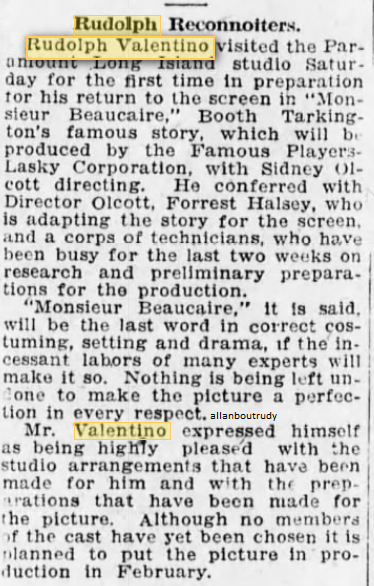
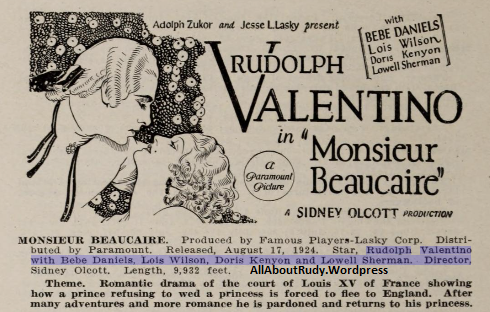
Rudolph Valentino arose at 5’oclock this morning, hurried into his clothes and dashed off to work. He is doing that every morning now for the sheik of the screen is taking his return to the movies seriously. At 7 o’clock every night Director Sidney Olcott tells him that will be about all for the day and that he can run along now but be sure to be on time in the morning. He has been saying the same thing for two months now and he probably will be saying it for a month longer until the picture “Monsieur Beaucaire” is completed. Then Rudy will have a whole week in which to rest before he plunges into the work of making his next picture. It is a strenuous life indeed that Rudolph is leading these days, but it certainly agrees with him. For all of which, he gives entire credit to two persons Mrs. Valentino who sees, that he eats only the right things and Chris Schnurrer his trainer who sees that he gets plenty of exercise. “My business is to see that the boss is kept al pepped up” said Chris as Rudolph bent low to touch with his lips the fingertips of the lovely Doris Kenyon, “look at him – ain’t he full of pep”? Rudy certainly did seem to be “full of pep” and yet Mrs. Valentino, gazing on the same scene didn’t seem to be a bit jealous. “Isn’t she sweet”? she asked. Mrs. Valentino wasn’t so hard to look at herself. The process of pepping starts at 5 o’clock every morning in a basement room of the Long Island studio which Chris has fitted into a gym. Here he gives Rudolph his daily fencing lessons to prepare him for one of the scenes in the pictures play that is still to be made. Afterwards the star has a busy half-hour with the pulley weights and then a vigorous rubdown at the hands of his trainer who boasts that he once performed a similar office for the Chicago Cubs. “What do I do next”? asked Rudy “I eat some breakfast” with the accent on the “some”. Actual work before the camera does not start until 9. But making up one of the principal actors in a costume play requires from an hour up to two hours. Adjustment of the wig alone consumes fully an hour. “It requires a world of patience to make a picture” remarked Valentino after the scene finally had been taken and retaken several more times and there was more standing around while waiting for the next scene. “But it is more fun than touring the country giving dancing exhibitions”.
Categories: Uncategorized
Tags: Monsieur Beaucaire, Mrs. Valentino, Rudolph Valentino
2013 – What Happened to Valentino’s “Ghost” Portrait
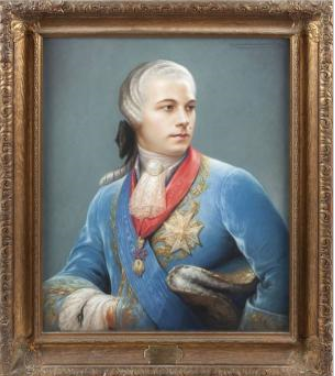
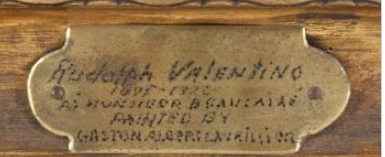
This portrait of Silent Film Star Rudolph Valentino was painted in costume from the movie Monsieur Beaucaire by Gaston Albert Lavrillier. The painting is in its original frame. In 1976, Ivan Dujan sold this painting at auction and was acquired by Billie Nelson Tyrell. This painting was again put up for auction in 2013….
Categories: Uncategorized
Tags: Monsieur Beaucaire, Rudolph Valentino
3 Sep 76 – Valentino’s “Ghost” Portrait
The cinema sheik, Rudolph Valentino died without ever seeing his famous “ghost portrait” and since that day a half century ago, the work has been viewed publicly only once. The portraits owner Ivan Dugan said he plans to commemorate the 50th anniversary of Mr. Valentino’s death by putting the work up for public auction. Mr. Dujan, who abandoned his career as a silent-film cameraman to turn artist, bought the 30×40 pastel from Gaston Albert Lavrillier the French artist a few years after the actor’s death. Since then, the work, “Rudolph Valentino In Role of Monsieur Beaucaire” has remained nestled in Mr. Dujan’s home its only other public outing a brief hanging 40 years ago at Grauman’s Chinese Theater. Mr. Dujan said that Mr. Valentino’s brother Alberto once came to view his brothers image. “He knelt in front of it and said ‘Rudy, why don’t you speak to me’?
Categories: Uncategorized
Tags: Monsieur Beaucaire, Rudolph Valentino
3 Sep 1924 – At the Quimby
The only reason we did not arise last night at the Quimby Theater where “Monsieur Beaucaire” starring Rudolph Valentino, was having its initial showing, and sing “Hail the Conquering Hero Comes” was because from the very first fade-in we were spellbound by the sheer grandeur of the production. Costumes, settings and locations are the acme of lavishness. It is undoubtedly one of the costliest pictures ever made and well worth it. Given an opportunity to display his real dramatic ability, Valentino presents a most vivid impressionable performance. His magnetic personality his fire and energy in his love scenes place him conspicuously in a rank by himself. The story by Booth Tarkington, from which Forrest Halsey made the screen adaptation, is known to most people but it has never been so well told or so grippingly portrayed as in this picture. An admirably selected supporting case interprets the various roles with amazing success.
Categories: Uncategorized
Tags: Monsieur Beaucaire, Rudolph Valentino
19 Feb 1924 – Rudolph’s Strenuous Life
Rudolph Valentino is leading quite a strenuous life these days. He arrives at Paramount Long Island Studio’s at 7 o’clock each day so that he can get in two hours of practice before the start of camera work. He is receiving instruction from Professor Martinez Castello of the NY Athletic Club, as his role in “Monsieur Beaucaire” requires that he become the best swordsman in all of France.
Categories: Uncategorized
Tags: Monsieur Beaucaire, Rudolph Valentino
17 Aug 1924 – Valentino Helps Quell the Fuss about the Star System in Pictures
What we had to say about the star system in these columns a couple of Sundays back was measurably vindicated by the mob reception of Rudolph Valentino in Monsieur Beaucaire at the Strand Theater in Manhattan last week. What does a film producer care about a star system or any kind of system when the exhibitors are packing them in ten deep back of the orchestra seats? And why should a star like Rudolph Valentino care by whom or in what he is being starred as long as he can keep them coming as they came to the Strand last week? Famous Players-Lasky know a good thing when they see it and as for Mr. Valentino he’d as soon lend his good-looking vaselined scalp to F.P.-L as to any of the other film producers in NY or Hollywood. So there rests the case of the screen star versus the manufacturers of the silent drama and there it will continue to rest until Valentino’s superiors, if there be any, insist that the do another picture like “The Young Rajah” which prompted the sheik to take his much discussed two-year vacation from the screen. The sleek-haired hero of a thousand beauty lotion ads and as many serial lessons in “How to Develop Masculine Charm” have nothing he can take exception to in the generous role of Beaucaire. He is called upon to appear in various multi-colored costumes ranging from the humble raiment of a barber to the more decorative haberdashery of a Bourbon prince. He is presented to advantage in a duel of rather one-sided proportions in which he disperses no less than ten assailants and is rescued by his lackeys only after both his arms had been rendered hors de combat. Then he is photographed in many angled silvery focuses, stripped to the waist the better to display the shoulder blades and biceps made famous by the covers of physical culture magazines. No Valentino can take exception to nothing in the scenario of Monsieur Beaucaire. Concerning those which Booth Tarkington may like to take is a different story. The script for the screen play has been written with but a single purpose in mind. It was prepared for the personal glorification of Rudolph Valentino from the introductory subtitle to the final fade-out arch of his good-looking left eyebrow. It leaves nothing undone to make Valentino’s characterization of Monsieur Beaucaire as much like an Elinor Glyn cavalier as possible. There is too much of the “super spectacle” in it and not enough Booth Tarkington. Those are our impression of Valentino’s first portrayal since his return to the screen and the scenarist’s treatment of what was considered a decidedly good book and a fairly good play. Concerning the direction of Sidney Olcott and the performances of Bebe Daniels, Lois Wilson, Ian MacLaren, Lowell Sherman, and others in the supporting cast we have only words of praise. Taking into consideration the fact that Mr. Olcott was called upon to dramatize a single screen personality rather than the book and play of a famous author. Monsieur Beaucaire reflects a doubly ingenuous direction. He has stitched in a fine thread of subtlety in those scenes in which the action might have been the most obvious. Olcott has eliminated the usual staginess of cinematic fancy dress balls and instead he has given us gorgeous canvases that are more than mere dabs of color. Though their roles are munificent by comparison to that of the star the performances of Miss Daniels, Mr. MacLaren and Sherman are no less impressionable. Monsieur Beaucaire is like the box score in the home team’s shut-out victory. Valentinos pitching wasn’t airtight, but he was given brilliant support.
Categories: Uncategorized
Tags: Monsieur Beaucaire, Rudolph Valentino, The Young Rajah
Leave a comment
24 Mar 1928 – Male Movie Stars more fussy about hair
A woman is fundamentally the same, whether she is a movie star or a Park Ave society bud the happiest moment in her life is when her hair turns out just right. But that does not mean that women have a corner in the personal vanity market. NO woman in the world could be more fussy about their hair than a male movie star. These are the deductions of an expert, Ferdinand Joseph Graf, for three years, the official hairdresser to moviedom who is now at Arnold Constables. Mr. Grafs first job with Famous Players was to prepare the wigs for Valentino in “Monsieur Beaucaire”. Natacha Rambova the stars wife, brought him out to the studio from the 5th Ave beauty parlor she patronized for that purpose. He liked the work so well and the stars apparently liked him so he well became the official hairdresser at the studio for three years.
 All About Rudolph Valentino
You must be logged in to post a comment.