
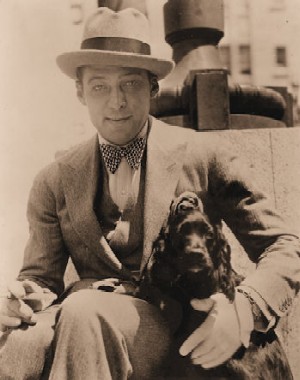
Posts Tagged With: Rudolph Valentino
21 Dec 1924 The Secrets of Valentino’s Life
In honor of the birthday of Rudolph Valentino, I will be publishing an article from 1924 about the secrets of Valentino’s life.
It is all very well, but there is just something special about Rudolph Valentino. Oh no, dear messieurs he is not effeminate, not a particle. Thus do you console yourselves upon an error, condone your envy and misjudge the ladies. None go quick as my sex to resent effeminacy in the male. Not thus can our enthusiastic admiration be aroused. There is no gainsaying that the gentleman has a compelling fascination for me, and should I say it in largely because of his agreeably self-confident masculinity, just as men adore agreeably self-confident femininity. My visit, coincided with the removal of the famous beard, and I met him direct from the hands of his barber. Alas I did not obtain a precious lock thereof. He oozed relief, that pesky beard, grown for the leading role of “The Red Power” had ruined his European vacation. Even a Valentino shudders to be seen in the unlovely early stages of chinful growth. He had the thing for four solid months. His wife had actually grown to like it. But today, Valentino was himself again. A very easy man to talk to is Valentino and to listen to. “Who really found you I asked?” “I have heard so many claimants.” “For seven long years, working hard, playing small parts in sometime atrocious pictures. I labored to be found,” he smiled. “But it was June Mathis who opened the door of opportunity for me. It was she who saw me for the part in the “Four Horsemen”. Ah yes, June Mathis. With Valentino speaking so gratefully of her I wanted to know how it happened that June Mathis had left his employ. Because you know directly he entered independent production he had hastened to attach June to his staff to write the scenario of his first picture. So he frowned unhappily. “I cannot tell you how sorry I was not to be able to accept her script. But it just would not do, and we were wasting too much time. So we just had to postpone that production. I shall make these modern picture Cobra sternly finely resisting Nita Naldi’s wiles. And we shall see him in ordinary modern clothes minus the allurement of the costume pictures. It is good to hear this man talking about his pictures. I too, had heard that Mrs. Valentino provided all the managing ability of the firm. But I don’t believe that now. You see, he met Natacha Rambova when he was earning only an uncertain and precarious $175.00 a week and she was getting $5000 a picture as an art director. Were he employing her now at that figure instead of being married to her he would be a foolish man not to give her full sway in her special department. And he has the shrewd business sense to do that now. “I made Monsieur Beaucaire without interference he said. And was allowed my own way in everything under my contract with Famous Players. But I did not cut the picture myself my wife did that. “She made an exquisite job of it.” I declared. And he accepted the compliment for both of them just as any producer would. “What sort of little boy were you”? “A very troublesome little boy, who occasioned his mother much sorrow, he admitted.” You would never, never, guess what kind of sorrow. His besetting sin, if you please, was falling in love with grown-up ladies as old as his own mamma. “You don’t mean that they fell in love with you that young, do you”? “No indeed, the ladies do not fall in love with me, he insisted modestly.” “That mountain of fan love letters, I reminded him.” Oh they are in love with the characters I play not with me the man.” That is why I do not like personal appearances. In Italy I felt I was in the soup or must fall out of the window, but I made it better by wearing my costume of the play, he explained. “he really managed to look thoroughly modest as he said this “Come tell me, what is your pet egotism’? I asked. “Oh, I have one. Very surely he admitted, laughing gaily, and affectionately stroking that recently revealed chin “and it is that my seven years of hard work and poor pay before June Mathis opened the door for me have been rewarded, that I have proved my ability that I can make good pictures, that I can act, and that I have some good artistic and business judgment are, I am not ashamed to show you my egotism he concluded. Well, maybe he was fascinating me, but he was wearing regular clothes and he says he isn’t fascinating in that way, but anyway I found myself agreeing with him. I think that is a pretty reasonable sort of egotism for him to indulge when he can do it as gracefully as he does. He sighed artfully at this point “Isn’t it dreadful to see those fine old trees being cut down in the street outside he said? Just to make a street wider and they take fifty years to grow to such beauty. Well I just felt as if I wanted to pet and comfort him about it. I asked him for an autograph and this is what he wrote on my picture. “Hoping to be kindly remembered.” Rudolph Valentino. Now wasn’t that modestly, artful and discreet and graceful bearing in mind that I am a newspaper woman.
“Just a packet …
“Just a packet of letters tied with a bit of blue. Just a packet of letters that once were read by you. To one who proved unworthy of the love inscribed within. The tiny packet of letters, a witness of my sin.”– Rudolph Valentino, 1924
2014 – Interview with Mr. Tracy Terhune
The blog is all about Rudolph Valentino his life, his family, those who were affected by him and those countless of people who loved him for his craft. Through research and reading there is still a lot of information out there that is still unknown. In this blog, I hope you the reader enjoy through discovery the new and interesting things about Rudolph Valentino.
As a noted book collector on Rudolph Valentino one of my favorite authors is Mr. Tracy Terhune, Producer, Collector, Valentino Memorial Committee Member, and Author I recently reached out to him and he kindly granted me a short interview for which I humbly thank him.
You are a noted Valentino collector, author and authority. What is your favorite item out of your collection and why?Since day one of collecting on Rudolph Valentino I have enjoyed collecting personal items that had a direct connection to him. He had such lavish exquisite taste in his cars and homes and furnishings within the home. I have several favorites but I will say that the ring he wore in The Eagle is my favorite. It was actually worn by him in three films (Sainted Devil, Cobra & The Eagle) However in The Eagle the ring played a minor part of the plot of the story. It was owned by Margaret Strong of the Strong Museum in New York. In the early 1980’s the Franklin Mint created a limited edition semi replica made out of black onyx and silver. Last year the Strong Museum which specializes in dolls decided to put it up for auction to fund their acquisition account. I am glad to say that I won the auction for it in Beverly Hills.
Rudolph Valentino had many films. Could you please tell us what is your favorite Rudolph Valentino film and why?
My favorite is Son of the Sheik. It’s his best in my opinion. But I also enjoy The Eagle, Beyond The Rocks, Camille and Moran of the Lady Letty. The Four Horseman is also another favorite.
Tracy you are very active in the planning process with the yearly Valentino Memorial. Every year it is a monumental success and a true tribute to Rudolph Valentino. What inspires you to continue? What will be in store for this year’s Valentino Memorial Service?
I am very proud of my involvement with the Valentino Memorial. It’s the oldest continuing annual event in Hollywood History. It has taken place every year since 1927, the first anniversary of his passing. This year will mark its 87th occurrence. The thing that inspires me to continue is to keep this charming yet quirky at times service going in a dignified and respectful manor. Yet, at the same time we want it to be fun and enjoyable. We always strive for the right mix. I have never had anyone who actually attended one of the Valentino Memorials ever complain that we did something in poor taste or disrespectful to Rudy. I am pleased that in recent years two members of the Valentino family accepted the offer to be our guest speaker. They openly expressed gratitude and their praise for the Valentino Memorial Service. That meant a lot to me on a personal level.
Tracey why are you such a fan of Rudolph Valentino?The reason I am a fan is that he deserves to be remembered. The fact he had great sadness over him and was so mis-used throughout his life. By studio chiefs, by his wives, business managers. The fact that he became a star in 1921 and by 1926 he was gone. Truly like a comet blazing across the cinema screen. All at 31. That’s why I like the slogan first used at the 1928 Valentino Memorial – “We Never Forget”
Tracey will you be writing any future books on Rudolph Valentino? Or any other projects you would like to share?
I have a couple of projects in the works, but mainly my goal this year is to get my website back up and running again. Its’ been down for a couple years and I’d like to get that done. I have also talked very briefly with Kevin Brownlow’s company about releasing The Eagle on Blu ray. The original camera negative survives and the print from it is razor sharp. It’s almost a crime that it sits unreleased due to the funding it would cost for a high resolution scan and the Carl Davis score.
I hope you enjoyed this interview folks. I am hoping to feature future interviews in this blog of other noted Valentino authors.
“I do not care …
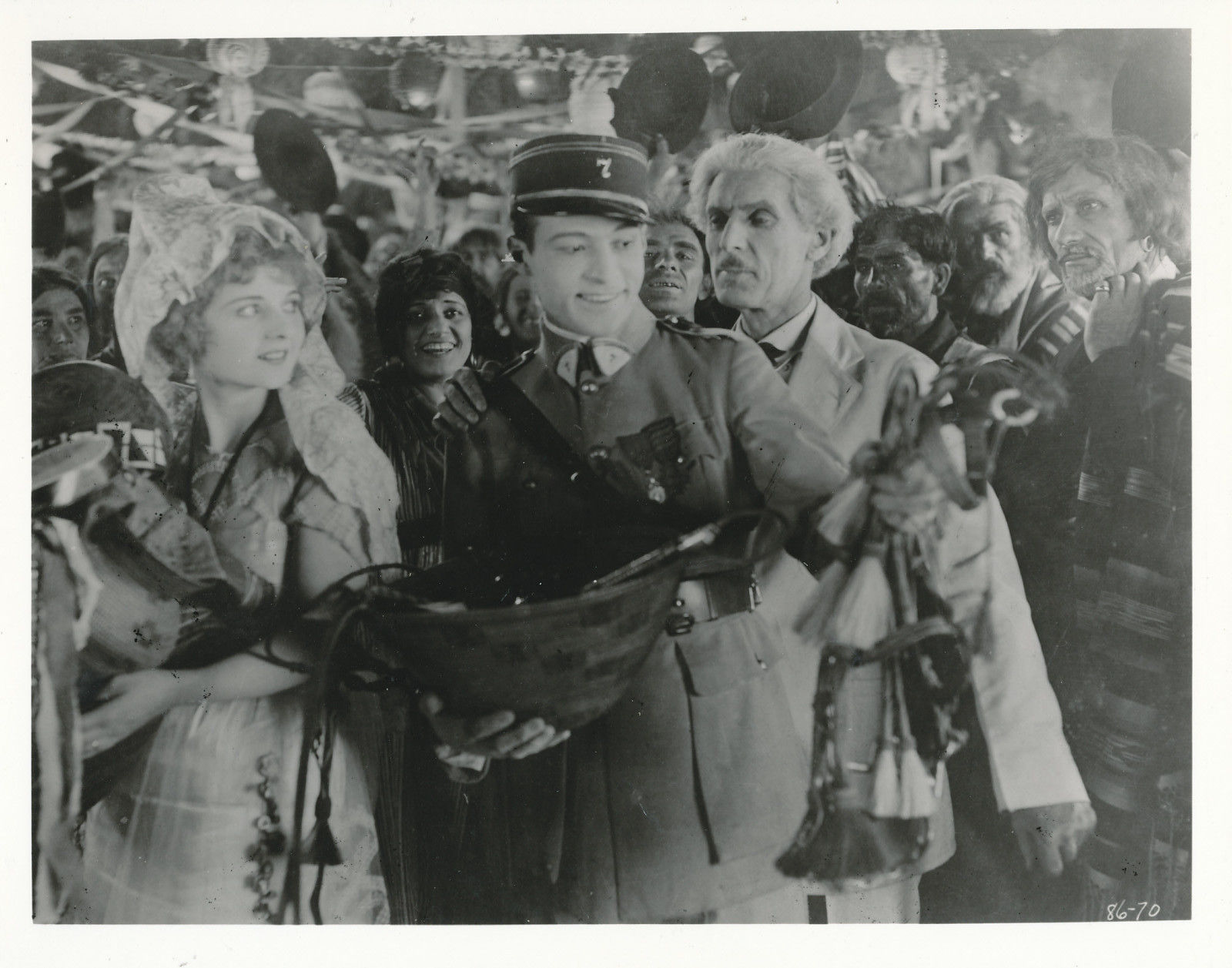
“I do not care for money made easily. It is not lasting I know. I do not care for friends made easily. They are not lasting I know. I do not care for anything that comes easily. It is never lasts I know. But I fell in love with you easily. But not lastingly you know.”–Rudolph Valentino , 14 Jan 1924
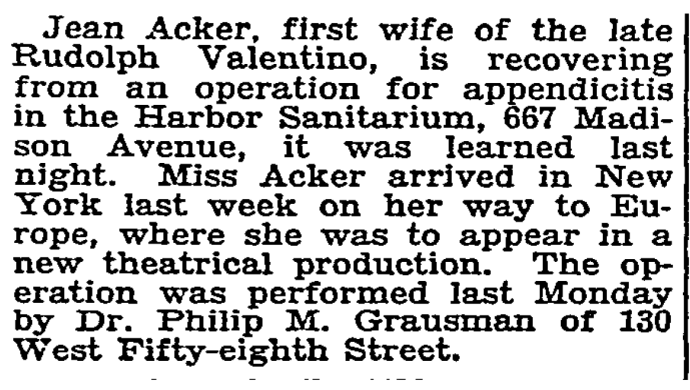
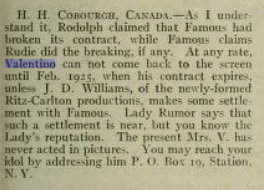
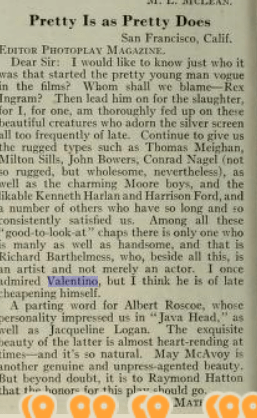
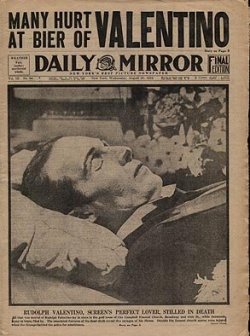
“When …
“When asked why she married Valentino, she replied, “It was simply a case of California, the glamour of the Southern moonlight and the fascinating love-making of the man.”–Jean Acker, Former Wife of Rudolph Valentino
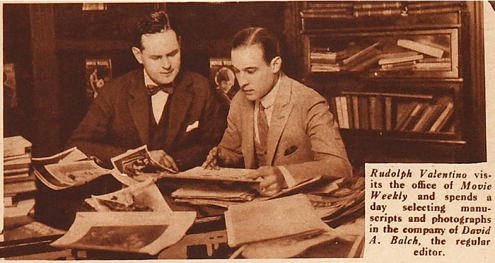
27 Aug 1930 – Rudolph Valentino owed some money
A minor Hollywood sensation has been caused by the suit which Alberto Guglielmi and Maria Strade brother and sister of the late Rudolph Valentino have filed against George Ullman. They charge Ullman with mismanagement of the estate and diverting large sums of money for his own use. Ullman, in the answer he has filed to the charges, says that, far from mismanaging the estate, he found it in a debt-ridden condition and spent years ironing it out. It was Valentino who wrecked his own estate, Ullman claims, for he died leaving debits of over $60,000 into a surplus of $100,000 to be distributed among the heirs. A court hearing will take place at the end of this month, and a decision reached as is whether Ullman shall be permitted to continue as manager and executor of the estate.
18 Jan 1933 – Miss Rambova Home Ransacked
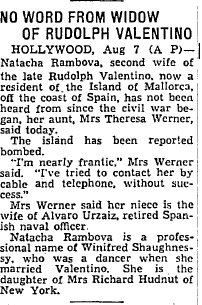
Thieves entered the Majorca home of Natacha Rambova, former wife of Rudolph Valentino and ransacked the establishment. They stole a revolver but did not steal any jewelry. Authorities investigated on the theory that the thieves were looking for papers. Miss Rambova would not comment.
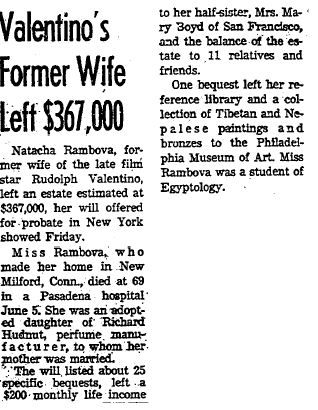
24 Oct 1926 – Valentino Manager Writes Valentino’s Story
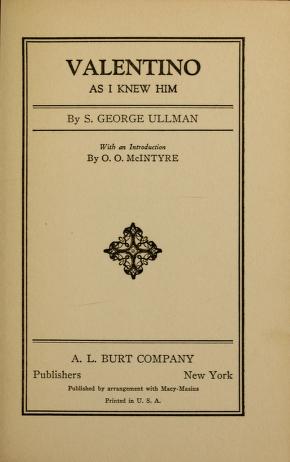
A book dealing with intimately with the late Rudolph Valentino was issued yesterday by Macy-Masius, publishers. The book by S.George Ullman, for many years the film star’s manager. It is called “Valentino as I knew him.” A preface has been written by O.O. McIntyre. Mr. Ullman traced Valentino’s career and devoted much space to explaining his last illness. On the question of whether Valentino was engaged to Pola Negri at the time of his death, Mr. Ullman said that “he never told me so, and I never asked him”. The author however, added that Valentino had vowed never to re-marry until he had finished his movie career.
“The biggest th…
“The biggest thing that Rudolph Valentino did was die”..–Alice Terry, Lead actress Four Horsemen of the Apocalypse on his death.
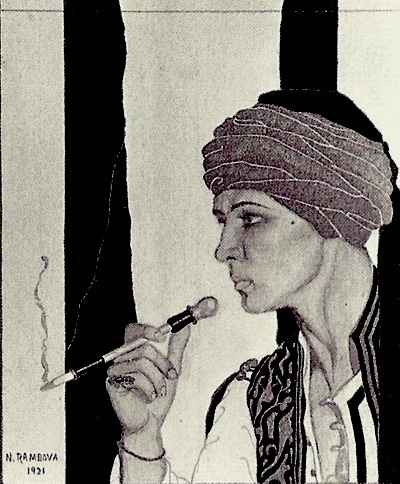
7 Feb 1948 Restauranteur Holds Valentino IOU
Manhattan restauranteur Sam Slavin still holds an IOU from Rudolph Valentino for $10.00. He lent Rudy money when the great silent film star worked in Slavin’s place for $12.00 a week. Valentino many times tried to buy it back, but Slavin always refused to sell. And its still there, framed, on the wall of the restaurant.
8 Oct 1927 – A New Valentino?
Rumors that Alberto Valentino is being groomed to succeed his late brother, Rudolph Valentino, on the screen have been received. It is stated that-Gugiielmi has submitted to vain operation of plastic surgery. Alberto Valentino’s face, it is said, has been re-modeled on lines resembling those of the late screen idol, his bold and belting nose being altered to a classical shape. Guglielmi came to the US a year ago to attend his brother’s funeral
23 Mar 1965 – Mae Murray Died
Mae Murray, the glamorous, famous, and beautiful Hollywood icon who told the press, “Once you become a star, you are always a star!” was found destitute at the age of 75, aimlessly wandering the streets of St Louis, Missouri.
Marie Adrienne Koenig was born of Austrian-Belgian parentage May 7, 1889, in Portsmouth, Virginia. Years later, she told everyone she was born Mae Murray, “On my father’s boat, whilst we were at sea.”
The imaginative and ethereal Mae also stated that a great-grandmother had raised her, placing her in several European convents. While in one of the churchyards, she told, she was punished for dancing in the gardens at night pretending to be a firefly and striking matches as she fluttered through the grounds.
In 1906, the stunning young performer made her Broadway debut in About Town. Murray then danced in three editions of the Ziegfeld Follies; in 1907 as the partner of the famous Vernon Castle, and alone in 1909 and 1915. The dazzling Murray also appeared in numerous other musical comedy roles and headlined performances in fashionable New York supper clubs.
Still in her teens, Mae married W.N. Shwenker Jr., the son of a millionaire. She got out of that marriage with some funds, and secured her second husband, producer Jay O’Brien, a stockbroker and Olympic bobsled champion known as the “Beau Brummel” of Broadway, and who proved to be helpful in Murray’s stage career.
Only days after their highly publicized wedding, and soon after her involvement with Rodolfo Guglielmi, a dancer billed as Signor Rodolfo who was later to become Rudolph Valentino, in the De Saules affair in New York in which Valentino’s socialite lover shot her husband to death for him, she dumped Jay and had the good fortune to marry Hollywood director Robert Z. Leonard. They lived in a beautiful apartment at 1 West 67th Street in New York. With this union she found her true destiny as a movie queen, and made her film debut in the east coast filmed To Have And To Hold (1916). Blonde and sensuous, standing five-foot-three with blue-gray eyes, the hideously arrogant Miss Murray was completely obsessed with her beauty.
She became famous for the extreme and unusual application of her lipstick, soon copied by millions of fans, and was widely known as “The Girl With The Bee-Stung Lips,” a title of which she tried to claim exclusive copyright. Often seen zipping through town in her custom-built Canary Yellow Pierce Arrow, the star was always opulently dressed and dripping in jewels. Once, reportedly, when purchasing some jewelry at Tiffany’s, she paid for it with tiny bags filled with gold dust.
In Hollywood, Murray’s films included The Right To Love (1920), The Gilded Lily (1921), The French Doll (1923), Jazzmania (1923), Circe The Enchantress (1924), and Fashions Row (1924). One critic wrote of her film Mademoiselle Midnight (1924) as “More of Mae Murray’s fuss and feathers thinly described as acting. This time Mae has her histrionic hysterics in Mexico. The general blurred impression given by the picture is this: Mae Murray-large mountains-Mae Murray-midnight love trysts-Mae Murray-a weird fandango by somebody described as a screen star-Mae Murray-cowboys having spasms-Mae Murray.”
The public loved her. The exquisite and elaborate costuming she insisted upon often brought her movies in way over their budget. Yet, Mae Murray danced her way to even greater heights of fame in Erich Von Stroheim’s The Merry Widow (1926). During the filming, their artistic differences and verbal brawls became an infamous Hollywood legend. She often referred to her director as “that dirty little Hun,” which she brazenly called him in front of a thousand extras magnificently dressed for a ballroom scene.
One day, her co-star John Gilbert walked off the set during one of his own disputes with Stroheim, and the tenuous Murray chased after him to the parking lot while wearing nothing at all but her shoes. Also during filming, the very young Joan Crawford often watched and studied Murray intently, learning how to be a star. The Merry Widow became MGM’s first big box office hit. The movie was extraordinary, with lavish production values and gorgeous photography. Mae Murray gave the best performance of her career, and then toured the nation holding lucrative performances of her Merry Widow Waltz. She followed this film success with Valencia (1926).
One of Murray’s glamorous screen rivals, Gloria Swanson, married the Marquis Henri de la Falaise de Coudray, and became royalty. This infuriated Murray, who wanted to become royalty too. Dumping her third husband, Murray found and married broke Ukrainian Prince David Mdivani in 1926. His royal status in his native Georgia was never truly established.
The headline producing ceremony included Rudolph Valentino, who died that same year, and his paramour, sultry star Pola Negri, Mae’s other screen rival, as matron of honor. Not to be outdone by Princess Mae, and not so long after the professed love of her life died, Negri married David’s equally broke brother Sergei in 1927 and became Princess Pola, as well as Princess Mae’s sister-in-law. The two Princesses were completely committed to the important cause of showing the world they were above mere mortals.
With Prince David, Murray had a son named Koran. Princess Mae was rarely photographed without her head swung way back, looking down her nose at her adoring husband and fans. She stated to the press, “I’ve always felt that my life touches another dimension.” When her marriage went bad, her doctor told her, “You live in a world of your own.”
Mae’s sweet Prince became her manager, took over her finances and insisted she walk out on her MGM contract to work independently. Soon, she found it difficult to get any roles at any studio. Sound film hit Hollywood. Her final movie was Bachelor Apartment (1931) with Irene Dunne, and the world was not pleased when it heard her voice.
By 1933, she was broke, ordered by the court to sell her opulent Playa del Rey estate to pay a judgement against her. Prince David now found her useless, and they soon divorced. In 1934, Murray declared bankruptcy. By September of 1936, she lost custody of Koran, and the former movie temptress was spending several nights sleeping on a park bench in New York, where she was arrested for vagrancy. The owners of the 67th Street residence where she resided luxuriously years before allowed her to live in the maid’s room of the building.
In 1950, back in California, Mae Murray was asked her opinion of the great film Sunset Boulevard, which starred her old rival from the silent film days, Gloria Swanson. Mae stated, “None of us floozies was ever that nuts.” Ironically, Mae was the nuttiest of them all. Walking down Sunset Boulevard with her head thrown back even further than she had done in her youth, Mae created a smoother jawline, watching the sky as she carelessly moved towards treacherous curbs and posts.
At the numerous charity balls she would attend, Mae Murray would ordain the orchestra to play the theme song from The Merry Widow soundtrack, waltzing to it by herself until all the elegant guests left the floor. In 1959, a biography of her life appeared, The Self Enchanted by Jane Ardmore, but the public was not interested. In 1961, she appeared on a television program where she stated that the only present day movie star who matched the talents of her time was the handsome Steve Reeves, famous for playing Hercules.
In 1964, living off charity and devoted friends, the poor deluded Murray continually traveled by transcontinental bus from coast to coast on a self promoted publicity tour, hoping for a comeback in movies. On the last of these excursions, she lost herself during a stopover in Kansas City, Missouri, and wandered to St. Louis. The Salvation Army found her and sent her back to her small Hollywood apartment near the Chinese Theatre, paid for by actor George Hamilton..
Mae Murray’s millions of dollars had been spent during a bitter life filled with lawsuits over salary agreements, damages, divorces, and bankruptcies. Some of Mae’s old friends made sure the still regally dressed and bejeweled star spent her last days in peace at the Motion Picture Country House where she often told the nurses, “I am Mae Murray, the Princess Mdivani,” and died in peace March 23, 1965.
During the height of the depression of the 1930’s, which had wiped away many fortunes, Mae Murray gave an interview, lucidly describing the Gods and Goddesses of her Hollywood days. “We were like dragonflies. We seemed to be suspended effortlessly in the air, but in reality our wings were beating very, very fast
Source:
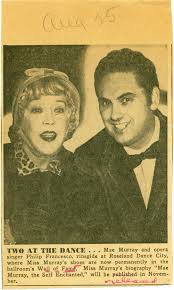
“Valentino said…
“Valentino said there’s nothing like tile for a tango!” — Norma Desmond to Joe Gillis in Sunset Boulevard (1950)
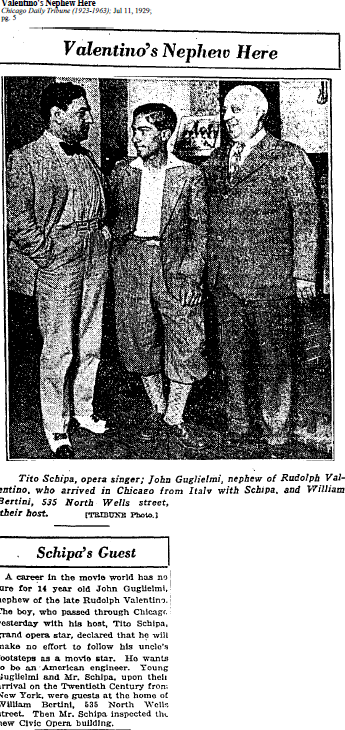
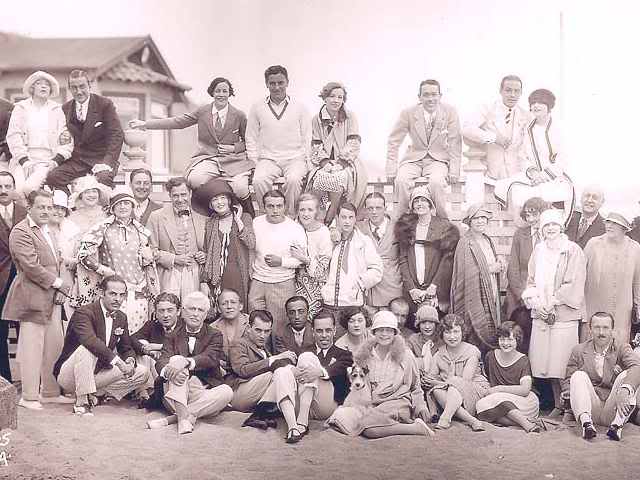
1918 – Synopsis of “The Married Virgin”
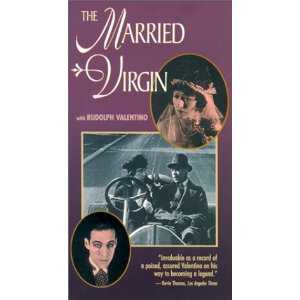
Mrs. John McMillan is having an affair, unknown to her husband and her stepdaughter Mary, with fortune hunter Count Roberto di San Fraccini. Overhearing a man threaten her husband with exposure for his connection with a murder unless he agrees to pay a huge sum of money, Mrs. McMillan conceives of a scheme with her lover the Count to acquire Mary’s dowry. Roberto informs Mary that in return for her hand in marriage, he will save her father from life in prison. Although desperately in love with Douglas, a young engineer, Mary agrees to the sacrifice, entering into a marriage in name only. Roberto continues his affair with Mrs. McMillan until, during an automobile ride, an accident occurs and she is killed. Roberto, fearing that he may be blamed, runs away. Mary then secures an annulment of her marriage to Roberto, thus freeing her to marry Douglas, the man she loves
The Married Virgin is an American film drama first released in 1918, directed by Joseph Maxwell. The film was scored by Brian Benison. It stars Vera Sisson, Rudolph Valentino, Frank Newburg, Kathleen Kirkham, Lillian Leighton, and Edward Jobson. It has also been released under the title: Frivolous Wives. It is a Maxwell Production, distributed by General Film Company. Film Length is 1 hour and 11 minutes.
.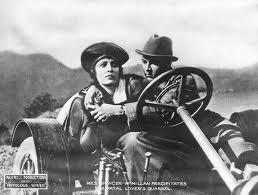
1918 The Cast of the “Married Virgin”
Director Joseph Maxwell, Fidelity Pictures
Screenplay/Story Hayden Talbot
Cast Vera Sisson, Rodolfo di Valentini, Frank Newburg, Kathleen Kirkham, Edward Jobson, Lillian Leighton
Plot – Rudolph Valentino’s first film as a leading man where he plays Count Roberto di Fraccini, a fortune hunter having an affair with the wife of a wealthy older businessman. In order to save her wealthy father from disgrace and a possible prison sentence, a daughter agrees to marry the gigolo who’s been blackmailing him. What the daughter doesn’t know, however, is that the gigolo is actually in cahoots with her father’s new wife, a conniving schemer who plans to fleece her new husband for everything he has, then flee the country with her lover.

1923 Paul Poiret Clothing Designer to Natacha Rambova
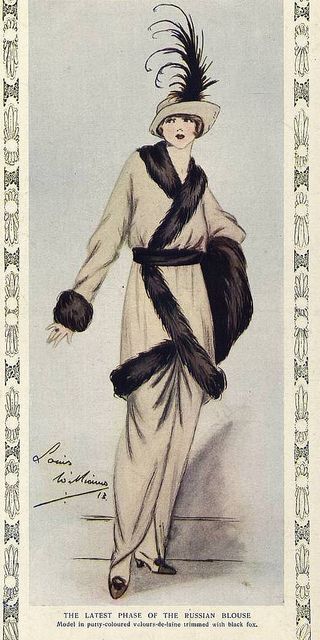
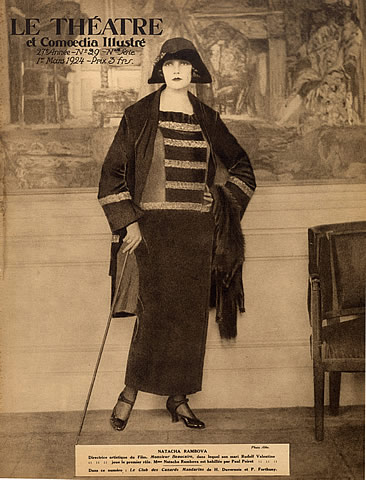
Paul Poiret was the favorite clothing designer of Natacha Rambova who felt he understood her as no one else did when it came to making clothes that favored her flamboyant personality.
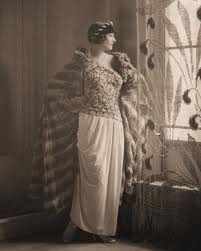
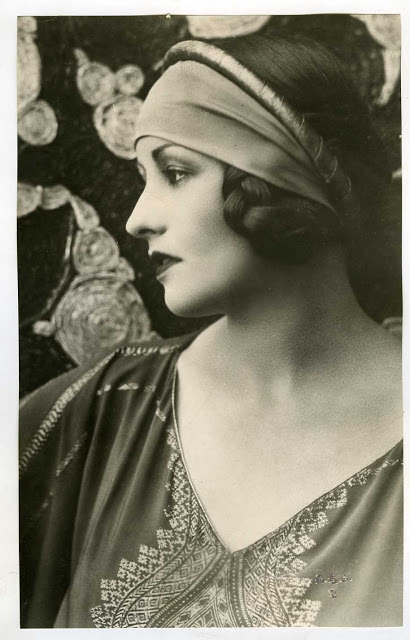
In 1879, Paul Poiret was born in Paris he interned at Jacques Doucet who was a famous couturier of the time. In 1901, he was hired by the famous Worth House of Design. In 1903, he set up his own Atelier of Poiret. In the early 1900’s which was considered one of Poirets influential periods in fashion he was interested in “The Orient” Russian and Cubism. Poiret claimed to have been a Persian prince in a previous life. Significantly, the first Asian-inspired piece he ever designed, while still at Worth, was controversial. A simple Chinese-style cloak called Confucius; it offended the occidental sensibilities of an important client, a Russian princess. To her grand eyes it seemed shockingly simple, the kind of thing a peasant might wear; when Poiret opened his own establishment such mandarin-robe-style cloaks would be best-sellers This had a great impact on Natacha’s own aesthetic which is what she became known for. In 1913, he came to NY and was a clothing designer to Cecille B. Demille. In 1923, Natacha first visited his Atelier which was documented in a Photoplay magazine article. His clothing displayed vibrant colors which managed to capture her personality. In Jan 1924, during another visit to his salon, Rudolph Valentino was quoted as saying that “he is the one costumier in Paris best suited to Natacha’s style, even temperament. We went to one or two other places and looked at their models, but for the most part they were wishy-washy things of pastel shades, with oddments of flowers here and there. Natacha cannot wear that sort of thing. She is not at all the type. She looks best in vivid colors, no one color over another, but all colors that are violent and definite. Scarlet’s, vermilions, strong blues, empathic greens, and loud voiced yellows”. Natacha’s next visit was Aug 1924; she came by his Atelier to pick up some dresses that she had ordered. In 1925, she staged a media event when she traveled from Los Angeles to Paris to pose for photographer James Abbe at famous clothing designer Paul Poiret’s salon. She modeled a pearl-embroidered white velvet gown and a chinchilla cloak, and declared Poiret her favorite couturier. In 1929, Poiret closed his Atelier because his aesthetics conflicted with modernism even though his designs back in the early 1900’s were advanced for the times. In 1944, Paul Poiret died in poverty virtually forgotten. However, through research a new generation has come to appreciate his genius in costume design. In 1927, when Natacha Rambova because a clothing designer in her own right, she did use Paul Poiret as an inspiration but with her own dramatic touch in the clothing that she designed.
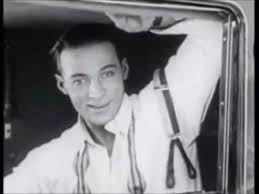
“But if ever my…
“But if ever my belief in myself should utterly fail me. If the day should come when my struggle for my individual Right should wear me threadbare of further effort, then I should come to a garden place where the sky would ever be blue above me, where my feet would press soil as vernal and virgin as I could find, where, below me, under white cliff’s, the sea could sing me its immemorial lullaby. I think, there must, at one time or another, have been sailors in my family. For the sea pounds in my veins with a tune I still remember and I know that I could not have remembered it in this life I have lived”.–Rudolph Valentino
11 Feb 1923 – Rudolph Valentino is not Handsome
Rudolph Valentino— than whom there is not one more soul stirring— is ‘not’ handsome in the strict sense of the word. The back of his head is too straight up and down, and unless the camera gets him at just the right angle, his nose is too, broad for beauty. Yet he is the screen. idol of the feminine world. Ask half a dozen women why they find Valentino charming, and you will receive half a dozen different answers. A prominent screen artist in Los Angeles recently said: ‘I think Valentino is perfectly fascinating.’ ‘He looks as if you couldn’t believe a word he said to you. ‘Those gorgeous eyes, ‘another will say ‘Dark and enigmatic, like dull coal smoldering, yet ready to leap suddenly into passionate flame. They are undoubtedly part of his lure.’ Sometimes he looks like a small boy who is being abused, so that every woman wants to pat his shiny head and comfort him. Still, she knows perfectly well that he is .not, a small boy, and that it would be rather like patting dynamite-which, of course, makes him very fascinating.
Aug 1923 – Deauville
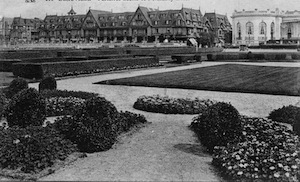
It’s late August 1923, Deauville, France and there is a huge excitement in the air regarding the arrival of Rudolph Valentino and his new bride Natacha Rambova. Seems that they are going to be stopping off in town for a quick visit and everyone is simply talking about them. It is a belated honeymoon they have already seen the sights in London and Paris. They will be arriving in three cars the first for the luggage, the second for secretaries and the last for the Valentino’s and their guests. They are staying in a villa rather than a hotel that is wise for privacy. That night the Valentino’s arrive at the Casino, take drinks, dinner, visit the baccarat rooms and watch the cabaret but are rather aloof and do not mingle much. Needless to say they cause a huge flutter. But gossip spreads like wild fire as usual. People are saying ‘they are in ill humour and not happy with the weather or their accommodation. They are also disappointed with the Casino, upset with the food and rather disdainful of all of us. Mrs. Valentino apparently has her nose stuck in the air and was heard to ask ‘where is the fashionable crowd?’ I can see no smart women and no smart men.’
“Auntie and my …
“Auntie and my sister have arranged to sit together in the back seat of the car so that they may not know the worst that the road (and again my driving!) has to hold for them. Natacha says that I am either neurotic about my prowess at the wheel, or else that I have a guilty conscience, else I would not dwell so constantly upon it. I tell her that my record speaks for me. I have nothing to say.” –Rudolph Valentino
“Valentino,” by H.L. Mencken
Unluckily, all this took place in the United States, where the word honor, save when it is applied to the structural integrity of women, has only a comic significance. When one hears of the honor of politicians, of bankers, of lawyers, of the United States itself, everyone naturally laughs. So New York laughed at Valentino. More, it ascribed his high dudgeon to mere publicity-seeking: he seemed a vulgar movie ham seeking space. The poor fellow, thus doubly beset, rose to dudgeons higher still. His Italian mind was simply unequal to the situation. So he sought counsel from the neutral, aloof, and seasoned. Unluckily, I could only name the disease, and confess frankly that there was no remedy – none, that is, known to any therapeutics within my ken. He should have passed over the gibe of the Chicago journalist, I suggested, with a lofty snort – perhaps, better still, with a counter gibe. He should have kept away from the reporters in New York. But now, alas, the mischief was done. He was both insulted and ridiculous, but there was nothing to do about it. I advised him to let the dreadful farce roll along to exhaustion. He protested that it was infamous. Infamous? Nothing, I argued, is infamous that is not true. A man still has his inner integrity. Can he still look into the shaving-glass of a morning? Then he is still on his two legs in this world, and ready even for the Devil. We sweated a great deal, discussing these lofty matters. We seemed to get nowhere.
Suddenly it dawned on me – I was too dull or it was too hot for me to see it sooner – that what we were talking about was really not what we were talking about at all. I began to observe Valentino more closely. A curiously naive and boyish young fellow, certainly not much beyond thirty, and with a disarming air of inexperience. To my eye, at least, not handsome, but nevertheless rather attractive. There was some obvious fineness in him; even his clothes were not precisely those of his horrible trade. He began talking of his home, his people, his early youth. His words were simple and yet somehow very eloquent. I could still see the mime before me, but now and then, briefly and darkly, there was a flash of something else. That something else, I concluded, was what is commonly called, for want of a better name, a gentleman. In brief, Valentino’s agony was the agony of a man of relatively civilized feelings thrown into a situation of intolerable vulgarity, destructive alike to his peace and to his dignity – nay, into a whole series of such situations.
It was not that trifling Chicago episode that was riding him; it was the whole grotesque futility of his life. Had he achieved, out of nothing, a vast and dizzy success? Then that success was hollow as well as vast – a colossal and preposterous nothing. Was he acclaimed by yelling multitudes? Then every time the multitudes yelled he felt himself blushing inside. The old story of Diego Valdez once more, but with a new poignancy in it. Valdez, at all events, was High Admiral of Spain. But Valentino, with his touch of fineness in him – he had his commonness, too, but there was that touch of fineness – Valentino was only the hero of the rabble. Imbeciles surrounded him in a dense herd. He was pursued by women – but what women! (Consider the sordid comedy of his two marriages – the brummagem, star-spangled passion that invaded his very death-bed!) The thing, at the start, must have only bewildered him. But in those last days, unless I am a worse psychologist than even the professors of psychology, it was revolting him. Worse, it was making him afraid.
I incline to think that the inscrutable gods, in taking him off so soon and at a moment of fiery revolt, were very kind to him. Living, he would have tried inevitably to change his fame – if such it is to be called – into something closer to his heart’s desire. That is to say, he would have gone the way of many another actor – the way of increasing pretension, of solemn artiness, of hollow hocus-pocus, deceptive only to himself. I believe he would have failed, for there was little sign of the genuine artist in him. He was essentially a highly respectable young man, which is the sort that never metamorphoses into an artist. But suppose he had succeeded? Then his tragedy, I believe, would have only become the more acrid and intolerable. For he would have discovered, after vast heavings and yearnings, that what he had come to was indistinguishable from what he had left. Was the fame of Beethoven any more caressing and splendid than the fame of Valentino? To you and me, of course, the question seems to answer itself. But what of Beethoven? He was heard upon the subject, viva voce, while he lived, and his answer survives, in all the freshness of its profane eloquence, in his music. Beethoven, too, knew what it meant to be applauded. Walking with Goethe, he heard something that was not unlike the murmur that reached Valentino through his hospital window. Beethoven walked away briskly. Valentino turned his face to the wall.
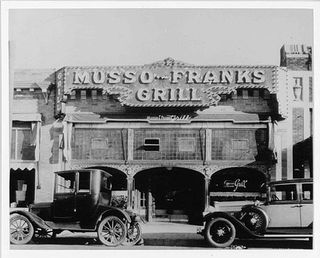
Legend has it that Charlie Chaplin, Rudolph Valentino and Douglas Fairbanks once raced each other down Hollywood Blvd, with the loser having to pick up the dinner tab at Musso and Frank’s
2012 – My Night with Rudolph Valentino
Years ago, after the closing night of a play I was appearing in, I decided to drive to Los Angeles to see a college friend. I rented a car and took the scenic route south, driving along State Route 1, a highway that rims the Pacific coast. It was a long and thrilling day trip, driving around the scenic mountain curves, ragged rocks, and through stretches of redwood forests. By the time I reached Hearst Castle and finished a tour in the late afternoon, I knew I would not complete the journey to Los Angeles that day, and was recommended a hotel further south in Santa Maria.
It was an old, historic inn located inland on the hot, dry stretch of a valley at the base of the Sierra Madres. The interior of the hotel lobby and meeting areas were decorated as if it were a pub in the English countryside, with dark wood paneling, somber rugs, oversized chairs, stained-glass windows and brass chandeliers. The management of the hotel had decided to play up its celebrity prestige—guests used to stop here en route to Hearst Castle from Los Angeles—and silent film movie-star memorabilia decorated the walls and the guest rooms were named after many who had stayed at the hotel: Charlie Chaplin, Marlene Dietrich, Jean Harlow and Douglas Fairbanks.
My room on the second floor, however, had been named after a local politician, with a window that opened out onto an interior courtyard that was shared by several rooms. As I drew the curtains closed, I noticed that the window was unlocked, and I bolted and tested it to make sure it was secure.
After a long shower and a change of clothes, I was hungry and headed downstairs to the hotel’s restaurant, but a wedding reception was in progress in one of the banquet rooms, so I settled in at the bar where it was quieter, ordered a drink and something to eat. From where I was seated I could see the other end of the bar and, as the summer daylight stretched its last breath out, the details of one of the customers seated alone near the door became more distinct. He was tall and slender, probably in his late twenties, and he had a sleek, elegant look about him—slicked-back black hair, a light stubble of beard, a strong sloping nose with flaring nostrils, and a prominent chin, and he was wearing a white shirt open at the collar with an unraveled bowtie draped around his neck. Because of his attire, I took him to be part of the wedding party. I shifted and squirmed on my bar stool, hoping he might notice me, but he seemed distracted and vacuous, intent on downing his drink, and I lost sight of him when a gentleman sat beside me at the bar and began to complain about the noise of the piano in the other room.
An hour later I stumbled up to my room, slipped out of my clothes and into a T-shirt and sweatpants. I considered watching television for a while, but I couldn’t find the remote control, so I flipped off the light and pulled back the curtains to look out at the courtyard.
It was empty and unused. The moon was high and strong and it gave my room an eerie blue glow and I drew the curtains together so only a small ray of light came into the room.
I was in a deep sleep when the knock at the door woke me. As I groggily got out of bed, I thought it might be the guy from the bar, come knocking for some companionship instead of handing out more complaints.
I flipped on the light and opened the door but no one was there. I was confused, bewildered and disappointed, the brighter light of the hall was exasperating, and I tried to brush the annoying disturbance away as the immature hijinks of one of the wedding guests. But as I moved to close the door I felt something move through me that felt like an ice-cold wind. A chill ran up my spine and along my arms.
The door closed and I turned back to the room and flipped off the overhead light. The moonbeam fell across the carpet again. That was when I saw him. The slick, black-haired handsome man I had seen earlier at the bar. He was substantive and real and I could not figure out how he had made it around me and into the room without my noticing him. He stood visible in the ray of moonlight and looked as if he were posing for a photograph, his nostrils slightly aflare. As my eyes moved from the window back to the man he began to dematerialize, as if he were on an episode of Star Trek and Scotty was beaming him to another place.
My heart was racing and I sat on the edge of the bed to gather my wits. What would the front desk think of me if I called them and told them I had just seen a ghost? Instead of reporting the incident, I drank a glass of water, checked that the window was secure and the courtyard was still empty, then went back to bed.
I spent the remainder of the night restless, tossing, sweating, fighting an erection as if someone had curled around me, locked me into a hold, and was trying to alternately smother or arouse me. There was a digital clock beside the bed that I watched change minute by minute. Sometime in the early morning I drifted off to sleep, because when I woke the sunlight striped the floor as it split between the curtains.
I rolled over and noticed the curtains were moving. The window was unlocked and opened and a breeze was coming into the room. I sat up in bed and looked quickly around the room to see if anything was missing. Nothing seemed disturbed—my wallet was in place, the car keys were where I left them. But in the center of the floor, exactly where I had seen the apparition the night before and where the ray of sunlight now hit the carpet, was a shiny silver object. I got out of bed and picked it up. It was a ring. Silver with a flat top and an engraved insignia. The sizing was small—it would only fit on my pinky finger. I didn’t immediately associate the ring with the ghostly vision I had seen the night before. At the time I found it, I was more concerned that I might have been robbed while I slept.
I slipped the ring into a small, top pocket of my knapsack I rarely opened, intending to hand it over to the front-desk clerk when I checked out. But that good intention slipped by me because I quickly forgot about it.
The ring stayed in the top pocket of my knapsack for years, forgotten, snug in its upper berth, traveling with me to London, Zurich, Tokyo and other not-so-far-off destinations. I only discovered it again when my boyfriend Kurt and I were in Fort Lauderdale and I was emptying the knapsack so that I could use it to carry a towel to the beach. Kurt looked at the ring, smirked and said, “What Cracker Jack box did this come from?”
I explained how I came to find the ring. Kurt thought my ghost sighting was hogwash. Kurt was all numbers; he managed a brokerage office and was also something of an elitist snob, but he could accurately assess the financial value of any item and he dismissed the pinky ring as cold, cheap steel. We were in the last throes of our relationship and to annoy him, I slipped the ring on my small finger and wore it for a few days, until we returned to New York and I noticed the metal had made my skin turn a sickly greenish-black. I placed the ring in a small ceramic bowl in the bedroom of my Chelsea apartment where I kept a set of formal cufflinks and shirt studs and only discovered it again one night when I was dressing for a formal-attire Halloween dinner party. I slipped on the pinky ring and during cocktails that evening, I told a small group of men my story of finding it only after witnessing a ghost the night before.
A young man said, “You might be the last person to boast that he slept with Rudolph Valentino.”
I laughed and replied that that was highly unlikely, but he reached into his pocket and pulled out his cellphone and took a picture of my hand with the pinky ring. I had never associated my ghost and cheap treasure with a celebrity phantom, but the young man said that Valentino had often been a guest at Hearst Castle and my description of the ghost seemed to match the actor’s. I found this young man charming and throughout the evening, in the various positions we found ourselves, he asked me in his most delightful bedroom voice about the name of the inn, the room number I had stayed in, what time of year I was visiting and on and on.
A week or so later, the young man emailed me evidence of Rudolph Valentino wearing the ring in several movie stills and publicity photos. I downloaded the pictures to my computer and saw it was a perfect match to the pinky ring I had in my possession. The engraving was unmistakable. Valentino is wearing the ring in photos with actresses Gloria Swanson and Agnes Ayres, in a portrait with his dog and beside a camel on the set of The Son of the Sheik, his final film. Valentino died at the age of 31, roughly the same age as the ghostly man I had seen. And the legendary actor in the photos looks exactly like the phantom I had seen in the bar and in my hotel room. The young man who had helped me discover this was a blogger and he said he wanted to write about my night with the ghost of Valentino. He contacted the owner of the hotel where I had stayed years before and discovered that several other guests had reported seeing a ghost in the room I had stayed in and that Valentino had been a frequent visitor to the inn. The blog post about the gay man who had slept with the ghost of Valentino went viral. I was more famous than I could possibly imagine, though I gratefully remained unnamed in the post.
Flash forward a few more years to when a reality TV producer contacted the blogger about Valentino’s ghost and the blogger gave the producer my name as the source of the haunting. When the producer called, I told her there wasn’t much to say about the ghost. I saw him; he disappeared. I shivered and sweated through a night with an erection that would not end. I could not even admit if Valentino—or his ghost—was a good kisser.
But the producer pressed on and asked if I would consider loaning the ring to film an episode of the TV show. I told her I no longer had it. And that was true. One morning not long ago I noticed it was gone—it wasn’t in the ceramic bowl. I remember looking around to see if anything else was missing from my apartment, but nothing was. Since I had last seen the ring I had had many visitors to my apartment: boyfriends, tricks, dates, even a hustler or two. Now, discovering and wearing the ring seems like a feverish dream I might have made up in my youth, and I wonder if my night with Valentino was something I had cooked up just to get attention. Only I am not that sort of guy. Instead, I imagine another man wearing that ring now—someone handsome, sleek, elegant, then one morning finding the ring cheap and tawdry and tossing it away. Something for the next man to find.
Source:
http://www.nextmagazine.com/content/my-night-rudolph-valentino
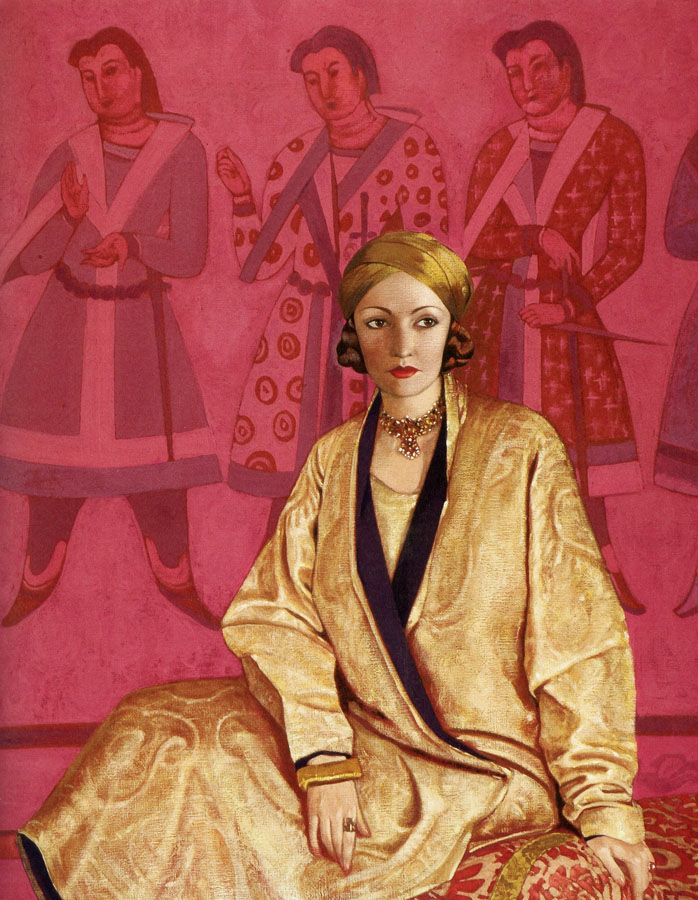
1931 – Natacha Rambova Painting by Svetoslav Roerich (Former Fiancee)
Categories: Uncategorized
Tags: Natacha Rambova, Rudolph Valentino, Svetoslav Roerich
Leave a comment
1917- 1939 The Romantic Life of Natacha Rambova
When conducting research for this article, I found there is still a great deal of undiscovered information that exists on Natacha Rambova. After all these years, there seems to be certain elements out there that do not want or like bringing things she has done in her past to light. Of course, this causes me to wonder what more intrigue is out there that she caused. Through reading what I can find on the Internet we all know she was not a people person. But a woman who knew what she wanted and went after it. One major discovery I noticed was Natacha was attracted to a certain type of man. Looking at pictures of Theodore Kosloff, Rudolph Valentino, Svetoslav Roerich, and Alvaro de Urzdiz all former lovers or husbands they all do seem to have similar features in face and temperament.
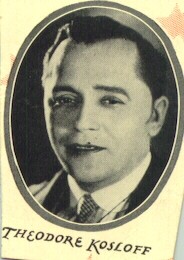
In 1917, the first relationship of Natacha Rambova was when she 18 years old. Natacha while studying ballet pursued her dance instructor. Theodore Kosloff, 32 years old, married and with a child. Eventually, she would discover that what started out as a grand passion one of mutual similarities the relationship was not what she thought it would be. Theodore Kosloff used Natacha’s talent as a designer and took credit for her designs. This was an abusive relationship from beginning to end.
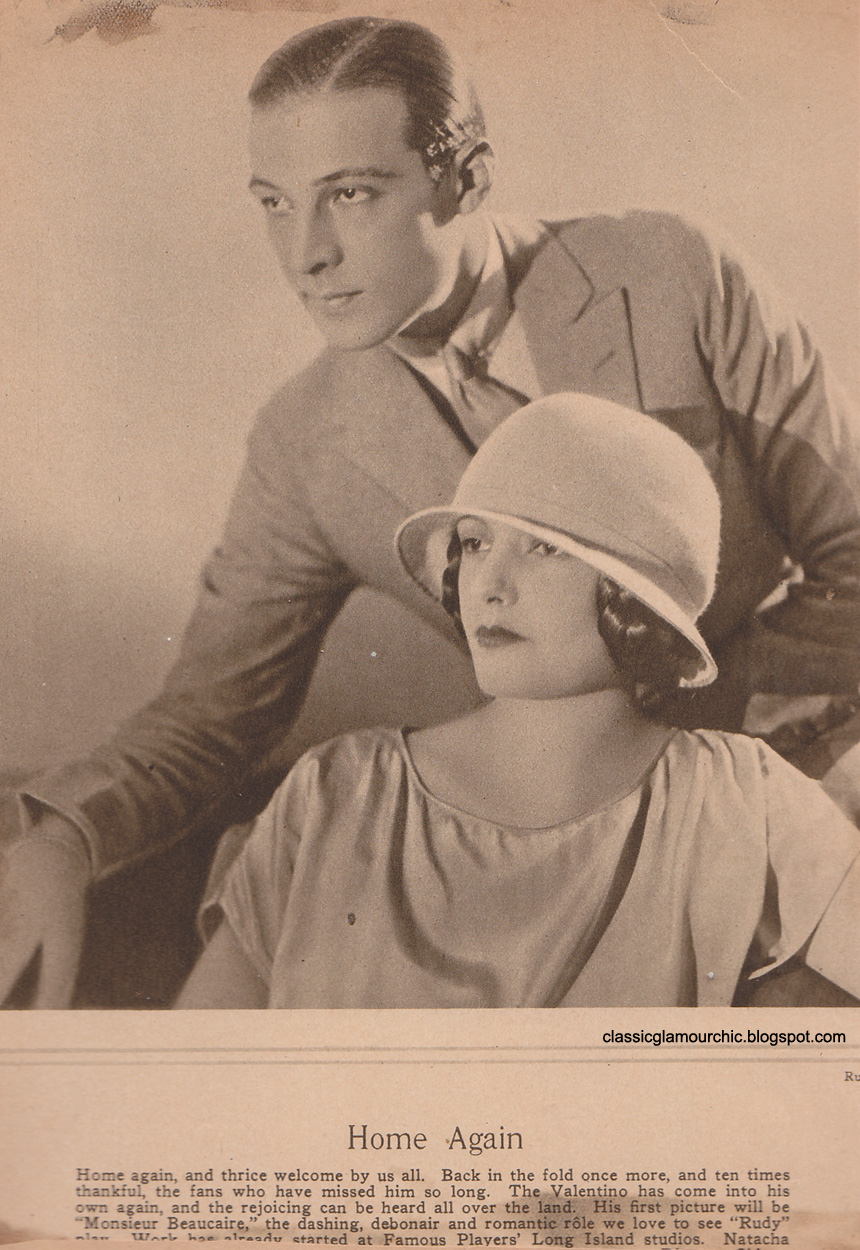
In 1921, Natacha met her next relationship Rudolph Valentino who eventually became her first husband while working on the movie set of Unchartered Seas. From the beginning of this relationship until the very end Natacha assumed the dominant role. This relationship was totally different from her previous one. What started out as a satisfactory and mutual relationship this was not one of an equal partnership. Natacha cheated on Rudolph with a cameraman from her movie set on What Price Beauty that she was producing. In 1926, this relationship ended sadly in a divorce.
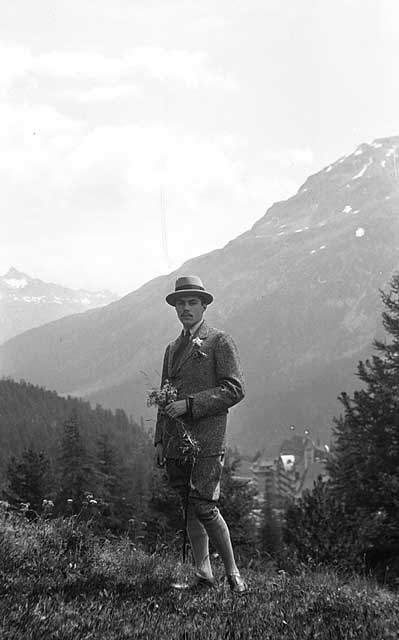
In 1928, Natacha Rambova met her next relationship; his name was Svetoslav Roerich in New York City. From research, they both lived in the same building, had close friends, some of whom also lived in the building. They share strong interests in esoteric teachings and even planned a school of esoteric teaching that was intended to teach all the important esoteric teachings of the world. They had a joint project with the organization of the Museum of religion and philosophy. Svetoslav Roerich was the President of this Museum and Natacha Rambova was Secretary-Treasurer. In 1929, I believe they became engaged to be married. In 1931, there was an upset to the engagement. Svetoslav was summed back to India by his father who did not want this marriage to take place. Natacha had threatened to sue Svetoslav for breach of promise. Svetoslav eventually married someone else.
In 1934, Natacha Rambova met her second husband his name was Alvaro de Urzaiz in Egypt. Alvaro was a British educated descendent of a noble Basque family from Spain. They were secretly married in a civil ceremony in Paris but in deference to the wishes of his family they were married in a Catholic ceremony at the Cathedral of San Francisco, Palma Majorca. This relationship had similarities to her previous ones. However, Natacha and her husband moved to Majorca where she had property. They lived here during the Spanish Civil War both Natacha and her second husband began a business of buying up old villas and modernizing them for tourists. This was financed from an inheritance she received from her step-father. Although there is not a lot of information about this relationship I did find out that Alvardo was on the pro-fascist side while Natacha was on the opposite side. Natacha fled to Nice, France where she suffered a heart attack at the age of 40 years. In 1939, she divorced her second husband.
In summary, Natacha Rambova was a modern woman who lived in a male chauvinistic world. Natacha lived her life on her own terms oftentimes selfish and self absorbing without regrets. However those choices that she made had some devastating effects on some people that she had relationships with.
Categories: Uncategorized
Tags: Natacha Rambova, Rudolph Valentino, Svetoslav Roerich, Theodore Kosloff
2 Comments
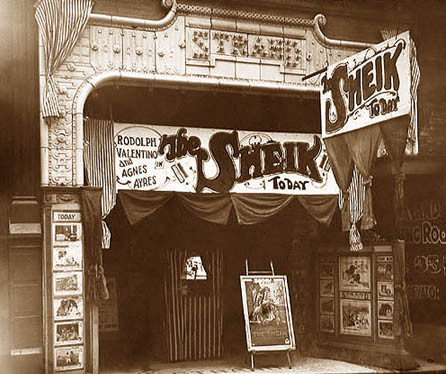
1921 – Silent Film Actress Claire Windsor talks about her one and only date with Rudolph Valentino
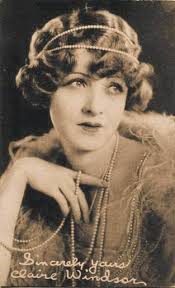
Silent Film Actress Claire Windsor gave an audio interview in which, she talked about a time where she had a date with a little known actor.
The year was 1921; and both were extras in the film industry. One night, Claire Windsor and her escort had a date for dinner and dancing at a popular night spot called the Running Country Club in Los Angeles. During that time period, this was where the rich and famous liked to dine. During the course of the evening, she made eye contact with a very dreamy handsome man whose name was Rudolph Valentino. Rudolph Valentino was on the dance floor dancing with an older woman while she was dining with her dinner date and yet he continued to maintain eye contact with her throughout his dance. Rudolph asked Claire out for a date. So for their date, they travelled by street car to a hotel restaurant downtown where they had dinner and went dancing. Claire noted he was a very good dancer. Rudolph evidently did not have enough money so they walked all the way to his place where they went to see his ‘etchings’. He lived in a one room apartment where they had to walk down 4 flights of stairs to get to. He must have thought she was not ignorant of what he meant by this invitation. Once they arrived he proceeded to chased her around the apartment which ended with her crying and asking for him to take her home in which he did. To listen to this great the link is referenced below in the source
Source:
http://www.frequency.com/video/claire-windsor-interview-claires-date/114425009
Defining the Latin Lover: Rudolph Valentino in The Sheik (1921)
Defining the Latin Lover: Rudolph Valentino in The Sheik (1921)
In Latin Lover: The Passionate South – one of the rare studies extensively dedicated to the subject— Gianni Malossi refers to a dictionary[2] in order to define the phenomenon of the Latin Lover: “passionate, but romantic, lover; it is believed, above all in Northern European countries, that they are men from Latin countries; heartbreaker, seducer” (Malossi 18-19). To provide a more elaborate, coherent definition of the phenomenon seems almost impossible as characteristics ascribed to the Latin Lover vary from his being “mute” (R. Rodriguez 107) to his ability to “use a lot of words” ( Malossi 30), from “a tendency to be short” ( Malossi 66) to his being “tall” (Limón 137), from his incarnation as “phantom, sheik or matador” (R. Rodriguez 107) to his fixed association with the cravat (Malossi 35) and the costume (Reich 35).
Opinions on the origins of the icon differ as well: whereas some consider the Latin Lover to be an archetypal figure (Thomas, 9) ranging back to Zeus (Malossi 64), Jacqueline Reich points at his historical and anthropological roots in Renaissance and Mediterranean culture (Reich 2-3). Others, such as Ramírez Berg (4), insist on his genesis in Northern conceptions of Latin otherness, which suggests an affinity with 19th-century debates on the differences between Anglo-Saxon and Latin “races” (Litvak). The one point all studies dealing with the Latin Lover have in common, however, is their abundant use of photographic materials, thereby revealing what goes almost unnoticed in the definitions: the profoundly visual nature of the stereotype. And though the pictures included show a certain disparity, limiting themselves either to actors performing roles connected to the [End Page 2] Latin Lover or expanding the notion to real-life examples such as Onassis (and even Che Guevara, to some), no disagreement exists regarding the name of the very first incarnation of the icon: Rudolph Valentino (1895-1926).[3]
This Italian immigrant to the United States, born under the name Rodolpho Guglielmi, first earned a living in the United States as a gigolo – a male dancing partner for wealthy women. However, he soon made his way to the hearts of millions of women by his dashing appearance in The Four Horsemen of the Apocalypse (1921), where he performed a seductive dance as an Argentinian tango-dancer.[4] The association between Latin Lovers and dance will become a fixed one in the following decades. It was The Sheik (1921) in which “he began to define a new kind of screen lover and an Other way of making screen love” (Ramírez Berg 115). In spite of the paradigmatic nature of this film, books on the Latin Lover limit themselves to brief mentions of its plot and instant success. The way in which the two terms united in the expression “Latin Lover” is inscribed in this movie has not yet been the object of more extensive commentary. This is all the more striking since, according to Ramírez Berg, this movie launched “the Latin Lover [as a] remarkably consistent screen figure, played by a number of Latin actors (…), all maintaining the erotic combination of characteristics instituted by Valentino” (115).[5]
When we take a look at this famous film, we notice that nothing in the movie – at least at first sight – sustains Rodriguez’s close association of Hispanicity and Latin Lovers: an Italian actor plays the role of the Arab sheik Ahmed (Rudolph Valentino) who falls in love with the British lady Diana Mayo (Agnes Ayres). However, the term “Latin” was used in those days in a broad sense, including all those who spoke a language derived from Latin (so also the French) and sometimes even the Greeks and all of the Mediterranean people (so also inhabitants of Arab countries).[6] In The Sheik, this broad sense of Latinness is defined by a first, major oppositional figure that establishes a difference between Northern and Southern countries as visually expressed by the two main characters: the fair-haired Anglo-Saxon young lady with the pale hands stands in opposition to the Arab sheik Ahmed with the very dark eyes. Besides this sharp contrast between North and South, there is a second one that concerns not racial features, but cultural values. On the one hand, Ahmed represents premodern patriarchal Arab values when he captures Diana during her trip through the desert in order to take her to his tent. As he explains to a friend: “When an Arab likes a woman he sees, he takes her.” On the other hand, there is a certain reticence in him because he refrains from taking Diana by force when he notices her despair at the situation she finds herself in: he has received part of his education in France and it is this European aspect in his upbringing which seems to account for a softer approach to the woman.[7] There is in fact a range of cultural differences varying from the complete Anglo-Saxon Northern values over the more mitigated European Latinity to the complete otherness of Arab Latinity. It is this “range” which grants the Sheik his erotically productive ambiguity, evoking both “suavity and sensuality, tenderness and sexual danger” (Ramírez Berg 115). In this combination, suavity and tenderness are evoked by European Latinity (France and Italy), whereas sensuality and sexual danger are projected onto the Arab world.[8]
If the tension between European and non-European Latinness, tenderness and sexual danger, is what grants the Sheik his erotic appeal throughout the movie, the film surprisingly resolves the antinomy between these opposed values in the end. The happy ending is indeed provided by a revelation concerning Ahmed’s true background: he was the [End Page 3] orphan of an English father and a Spanish mother found in the desert, after which he was adopted by an Arab sheik. This ending is doubly productive: it sanctifies the union between Ahmed and Diana as a repetition of a previous relationship between partners from the North and the South of Europe, and it clearly places Ahmed on the European side. To put it even more strongly, one could argue that Ahmed’s very ability to learn the European lessons in education and human rights is explicable by his innate European blood.[9] In a way, Ahmed is a true European, dressed up as an Arab. His clothing as a sheik is his costume. His Arab identity, his mask.
As a lover, Ahmed combines features of both forms of Latinity: he serenades Diana secretly below her window while she sleeps in the town of Biskra but he also abducts her against her will in order to possess her. He connotes softness and strength. This strength is what turns him into a dangerous man, who is able to frighten Diana and make her obey. On the other hand, it is also this capacity which turns him into her savior when she tries to escape through a desert storm, or falls into the hands of the Arab bandit Omair. Here, the sheik turns into the hero who saves the damsel in distress by plucking her from the ground and riding off with her on his horse in order to protect her.
Ahmed’s moral and physical strength functions as a token of his sexual superiority with respect to Diana as a woman. At the same time, it singles him out as “the other man” from a double perspective. First, his strength distinguishes him from the men in Diana’s own society, who appear to be too weak to control her strong character (e.g., she laughs at her brother when he tries to talk her out of her plan to travel to the desert). Second, as an Arab, he is not to be confused with other Arab men either, because he does not resort to clear violence against women, unlike the desert bandit Omair. The fact that he is neither identical with the British men – who all wear moustaches – nor the other Arabs – who all wear beards – is visually expressed by the many close-ups of his hairless face, accentuated by his turban.
Finally, the two terms under scrutiny – Latin and Lover – are of course intimately connected. What Diana is attracted by in Ahmed from the start is not only his strength, it is also his belonging to another culture: exoticism and eroticism go hand in hand. There is immediate attraction from the first time they see each other, in the town of Biskra, before Diana leaves for the desert. And when she is denied access to the Arab casino, she boldly decides to dress up as an Arab dancer, after having watched the sensuous moves of this Arab woman with fascination. She even insists on borrowing exactly the same clothes this dancer was wearing, thereby suggesting a desire to experience the Arab sensuality in person. As Said has explained, the Orient not only symbolized sexuality as such, but very often also the promise of a different kind of sexuality, generally projected onto the female body (Said 180). In The Sheik, this kind of sensuality is appropriated by Diana as she cross-dresses culturally and feels her senses aroused by the dancer. At the same time the movie performs a twist on the Orientalist discourse of its time by turning the male partner into an object of desire.
In all, the first Latin Lover can be described as a highly ambivalent figure who, in the end, reconciles the opposition between the North and the South by inscribing it into a shared feeling of Europeanness. Hispanicity here performs a syntactical gesture between North and South. In the words of Clara Rodríguez commenting upon Valentino and his imitators, “All of these stars conformed to European prototypes – perhaps to southern and eastern European prototypes, but clearly in the evolving fold of what it meant to be ‘white’ [End Page 4] (and upper class) in the United States at the time.” (C. Rodríguez 28) Latinness is therefore on the one hand the suggestion of Otherness, but at the same time based on the reassuring recognition that this Otherness is within the limits of the own identity.
Valentino’s appearances in movies such as The Sheik set in motion the so-called “Latin craze” (C. Rodríguez 28) that flourished in the Roaring Twenties. This period was characterized by major social changes brought about by World War I and the Russian Revolution, and economically beneficial to the United States until the Depression broke out. The social changes altered the position of woman and to some also implied “libertad en el amor” (Belluscio 13). Belluscio considers the Latin Lover as an expression of modernity as it manifested itself around 1900: “En esa zona del planeta [USA], los hábitos se modificaban con el automóvil, la radio en casa, la publicidad impresa, y las salas de cine simbolizaban el nuevo urbanismo yanqui. La difusión e influencia del séptimo arte creó una idolatría sin fronteras, engendrando psicosis colectivas (…) En ese momento singular, que ambulaba entre la añoranza y el futuro, el ‘latin lover’, macerado como una burbuja, surgía excitante, digno de la ostentación, el lujo y el donaire del ‘American way of life’” (13-14). At the same time, both Ahmed and Diana belong to the upper classes of their society, which might reflect the nostalgia for a vanishing aristocracy in that same period (13). This is also why other authors connect the Latin Lover to the expression of anti-modern values (Malossi 24; Reich 26). In a sense, he is both a symptom of modernity and a reaction to it. Once again, he turns out to be an ambivalent sign.
Source:
“In January 193…
“In January 1936, on my first trip to Egypt, I felt as if I had at last returned home. The first few days I was there I couldn’t stop the tears streaming from my eyes. It was not sadness, but some emotional impact from the past- a returning to a place once loved after too long a time.”–Natacha Rambova
16 Aug 1925 – Rudolph Valentino Joins UA
Rudolph Valentino has deserted all his former “loves” as far as producing pictures is concerned, and is now in close association with United Artists. His first picture under their flag is “The Hooded Falcon,” a colorful Moor- ish drama.
1922- Costume Designer for “The Young Rajah”
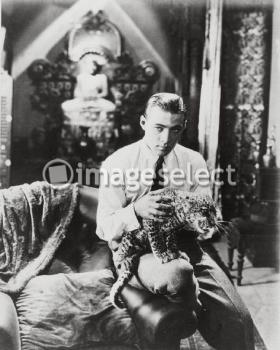
This blog already contains a post about Natacha Rambova as the wife of Rudolph Valentino. This one is about Natacha Rambova the costume designer.
In 1917, Natacha Rambova, started her brief career as a Hollywood costume and set designer for Cecil B. De Mille. Between 1917 and 1921, Rambova made four films for Cecil B. De Mille. As a set designer, Rambova’s works were a highly stylized version of Art Nouveau, infused with the minimalistic feel of Art Deco. She enjoyed employing the flower motifs and the circular ornamentation of Nouveau in all her designs. Her costume designs were bold, feminine and had a European flair that many Hollywood fashions at the time lacked, no doubt as a result of the complete artistic control she exercised over her work. For her costume work on The Young Rajah Natacha traveled to New York to work on the costumes. The film is perhaps best remembered today for its elaborate and suggestive costumes, which were designed by Valentino’s wife Natacha Rambova. Photographs of Valentino wearing these outfits, some of which left little to the imagination, are still widely circulated today.
“There are many…
“There are many roads — all lead to God”.–Amos Judd, “The Young Rajah”
1922 Phil Rosen, Director “The Young Rajah”
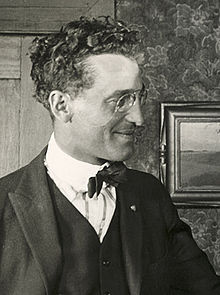
Lets now take a look at the director of Rudolph Valentino’s silent film “The Young Rajah”. Phil Rosen was born on 8 May 1888 and started out as a cinematographer for Thomas Edison. Rosen worked as a projectionist and lab technician before becoming an $18-a-week cinematographer in 1912. In 1918, he went to Los Angeles. During his career he directed 142 films between 1915 and 1949. Although he was never a actor like so many others he never truly enjoyed the success in talkies like he did with Silent Films.
“Cute, sassy, a…
“Cute, sassy, and can even ride a horse Wanda Hawley was one of my favorite actresses to work with.”–Tom Mix, Silent Film Star on his co-star Wanda Hawley
1895-1963 Wanda Hawley Co-Star “The Young Rajah”
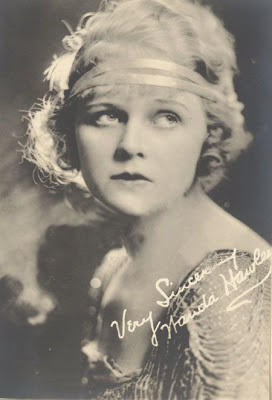
To wrap up our week, Wanda Hawley was a co-star of the movie “The Young Rajah” that starred Rudolph Valentino. But what do we really know about her? Wanda was born on 30 Jul 1895, in Scranton, PA. Her real name was Selma Wanda Pittach. Athough it is noted in Photoplay Magazine, circa 1918, her name was changed to Wanda Hawley. Wanda was a classically trained Opera Singer but found that acting paid better and felt that was more of her calling. It is claimed by Paramount Pictures Publicity Department that she was discovered by Cecil B. Demille. Wanda Hawley began her screen career years before meeting DeMille, and had appeared under the screen name Wanda Petit opposite both Tom Mix and William S. Hart, and played Douglas Fairbanks Jr.’s love interest in “Mr. Fix-It” in 1918. But DeMille made her a star in “Affairs of Anatol,” with Wallace Reid and Gloria (“I’m ready for my closeup, Mr. DeMille”) Swanson in 1921. It is noted, her best years were when she was under contract to Paramount Studios.
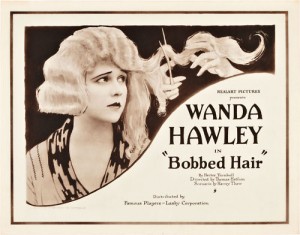
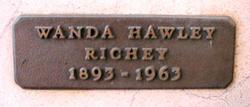
At the height of her career she received the same amount of mail as Gloria Swanson another famous silent film star who was Rudolph Valentino’s co-star in “Beyond the Rocks” She never made the transition to talking pictures. Falling on hard times, she reportedly worked as a call-girl in San Francisco during the Great Depression years of the early 1930s. She died in 1963 and is buried at Hollywood Forever Cemetery.
Feb 1923 Motion Picture Magazine – The Young Rajah starring Rudolph Valentino
Rodolph Valentino also came to the screen again this month. After witnessing “The Young Rajah,” in which he is starred, we begin to understand many things, principally among them why Mr. Valentino desired to select his own casts.And if it wasn’t that we remembered from our nursery days that “Two wrongs do not make a right,” we would be sorely tempted to applaud Rodolph Valentino for refusing to continue with his contract. At any rate, while we may still disapprove of him ethically, we sympathize with him emotionally. All of which has probably led you to believe that this is a pretty bad picture. It is. It is about as artistic and as satisfying as a cheap serial. As a matter of fact, it is the concentrated essence of those things which have composed serials since time immemorial. “The Young Rajah” is based on the novel, Amos Judd. It tells of Amos who has been reared in a provincial American town. Then there is the Far East with its rajahs and its maharajahs. Amos really belongs to the East. Furthermore, he belongs to a line of its rulers, and he has inherited the sixth sense bestowed by one of the Indian gods upon the sons of this noble family. It is this sixth sense which serves him well when the usurpers of this kingdom learn of his existence in America and threaten his life. Even The Valentino is somewhat submerged in the mediocrity of this production. Of the supporting cast Charles Ogle is the one member who stands forth with any degree of effectiveness
12 Nov 1922 – Young Rajah Screen Credits
This movie was based on a play/novel “Amos Judd” by John Ames Mitchell Directed by: Phil Rosen
Written by: June Mathis – screenplay
~Cast~
Rudolph Valentino … Amos Judd
Charles Ogle … Joshua Judd
Fanny Midgley … Sarah Judd
George Periolat … General Devi Das Gadi
George Field … Prince Rajanya Paikparra Munsingh
Bertram Grassby … Maharajah Ali Kahn
Josef Swickard … Narada – the Mystic
William Boyd … Stephen Van Kovert
Robert Ober … Horace Bennett
Jack Giddings … Austin Slade Jr.
Wanda Hawley … Molly Cabot
Edward Jobson … John Cabot
Farrell MacDonald … Amhad Beg – Prime Minister
Spottiswoode Aitken … Caleb (uncredited)
Joseph Harrington … Dr. Fettiplace (uncredited)
Julanne Johnston … Dancing Girl (uncredited)
Pat Moore … Amos as a Child (uncredited)
Maude Wayne … Miss Elsie Van Kovert (uncredited)
~Remaining Credits~
Production Company: Famous Players-Lasky Corporation
Released by: Paramount Pictures
Cinematography by: James Van Trees
Costumes by: Natacha Rambova
Presenter: Jesse L. Lasky
1909-1918 – Ames Mitchell, Author of Young Rajah

On April 13, 1909 The Times reported that Ames Mitchell had bought a “four-story dwelling at 41st East, 67th Street, New York City.” It was a time when the old brownstones had fallen out of fashion. Architects Denby & Nute instead stripped off the old façade and transformed the house to a five-story neo-Classical beauty. Mitchell had been educated as an architect at Harvard and later at the Ecole National Superieure des Beaux-Arts in Paris. But he was a man of many more talents. In 1883 he co-founded the humor magazine Life, the position for which he would be best remembered. He was also an artist, illustrator and author. Mitchell and his highly-popular magazine would introduce America to several new writers and artists—among them Charles Dana Gibson (famous for his Gibson Girls). He found the time to write over a dozen novels, one of which, “Amos Judd,” became the 1922 silent film The Young Rajah starring matinee idol Rudolph Valentino. The publisher-novelist-architect also spent time at the easel and several of his etchings were given honorable mention in the Paris Salon. He and his wife spent the summers in their country home in Ridgefield, Connecticut. Mitchell established the Life Fresh Air Camp in Branchville, which brought city kids to the country for many years. It was located where Branchville School is now. It was there, on June 29, 1918 he died. The New-York Tribune reported that “He suffered a stroke of apoplexy early in the day and his death followed a few hours later.” Mitchell was especially generous to his household staff in his will. His chauffeur received the same amount as did his own sister–$5,000 (about $50,000 today)—and the “servants in his employ all receive legacies of $500,” reported The Sun.
1 Jul 1922, Work on “Young Rajah” Started.
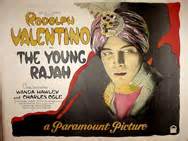
Philip E. Rosen and his megaphone rang the gong on Rudolph Valentino’s second Paramount starring production, “The Young Rajah.” June Mathis wrote the script from “Amos Judd” the novel by John Ames Mitchell. “The Young Rajah” is divided into two complete sequences, one East Indian and the other New England, each requiring an individual set of players. Hence, the supporting line-up is a long one, as well as a notable one. Wanda Hawley is the leading woman, with little Pat Moore, Bertram Grassby, Maud Wayne, J. Farrell McDonald, Bill Boyd, George Periolat, George Fields, G-wge Ober, Charles Ogle, Florence Hidglcy and Edward Jobson among those already signed.
“Men should be …
“Men should be judged not by the tint of their skin. The gods they serve, the vintage that they drink Nor by the way they fight, or love, or sin. But rather by the quality of thought they think.” -Intertitle from The Young Rajah, Paramount, 1922.
“(Valentino was…
“(Valentino was) what is commonly called for want of a better name, a gentleman. In brief, Valentino`s agony was the agony of a man of relatively civilized feelings thrown into a situation of intolerable vulgarity.” – H.L. Mencken
1921 – Patsy Ruth Miller A former co-star of Rudolph Valentino’s
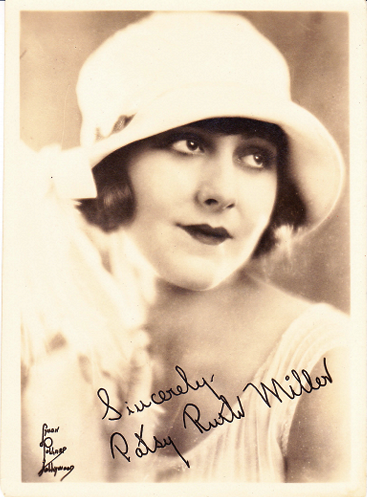
Patsy Ruth Miller (January 17, 1904 – July 16, 1995) was an American film actress who was discovered by the actress Alla Nazimova at a Hollywood party, Patsy Ruth Miller got her first break with a small role in Camille, which starred Rudolph Valentino. Miller’s first billed part was in Alla Nazimova’s “Camille” (1921). Prior to beginning work on the movie, she became close friends with Nazimova and spent quite a bit of time at her house. Valentino, prior to his sudden rise to stardom, was also to be in the picture and spent quite a bit of time there, too. Miller and Valentino spent many hours in Nazimova’s pool swimming, but nothing romantic ever developed between the two of them. Miller was 17, and Valentino was 26.
“One evening when Nazimova was entertaining for dinner, Valentino, Miller and several other guests were there. According to Miller, Valentino began a story that told “something about a ballerina, something about being left waiting at the boat. . .” However, before Valentino progressed very far into the story, Nazimova spoke to him in Italian. Valentino said, “Oh, scusi,” and the story came to an abrupt end. Miller felt the story had been halted due to her young age, and she protested to Nazimova but to no avail. Sometime after World War II, Miller said she assisted in carrying foodstuffs to Scotland where there was still a shortage of many food items. She was invited to tea by a friend, and they were served by the maid, “a gaunt, middle-aged woman who looked more Slavic than Scottish. . .”At one point when the maid left the room, the hostess asked Miller if she remembered a cinema star named Valentino. Without revealing her personal contact with Valentino in those early years, Miller simply replied, “Yes.” “Well,”the hostess said, “she knew him personally,” referring to the maid. When the hostess left the house for her weekly ration of gasoline, Miller said she commented to the somewhat unfriendly maid, “I understand you knew Rudolph Valentino.” At first, when Miller said she knew him, too, the maid appeared uninterested. However, Miller added that she had appeared in a movie with him once. At that point, the maid’s demeanor changed. She became more friendly toward Miller and confessed she had known Valentino once, too. When Miller asked the maid to tell her about it, she began her story. She was Polish, she said, and a great ballerina before the First World War. She studied in Russia and danced before many of the crowned heads of Europe. One of her admirers was a German prince for whom she became somewhat of a spy sending him information as she traveled the continent. When in Milano, Italy, she said she unexpectedly fell in love with a young student who was much younger than her. Although she was being unfaithful to her German Prince, although the affair had become a scandal, and although his family was terribly upset, she said they could not help their love. When she left Italy, the young man followed her. For six months they were together during which time she taught him to dance, very easily, by the way, since he was so talented. While in Paris, she received word from her German Prince that the French knew of her spying. She decided the safest place for her would be in America, so she obtained the necessary papers and sent her young lover on ahead to make sure all arrangements were made for their trip. Suddenly, all of her plans fell through. The police came and took her papers and passport away. It was only through the help of a former lover that she was able to escape to Spain. She had no way of contacting her young lover, and she said she somehow knew that he would go on to America without her and not miss this chance. During the war she had to sell all her valuables, but, nevertheless, she did survive with the help of an admiring Spaniard. Seven years later, the maid said, she saw her young lover on the screen and knew he had met with success. She said she never made any attempt to contact him”..
Reference:
My Hollywood, When Both Of Us Were Young, The Memories of Patsy Ruth Miller by Patsy Ruth Miller, O’Raghailligh Ltd., 1988
Natacha herself…
“She would see to it that she never had children”..Natacha Rambova, former wife of Rudolph Valentino
“With butlers, …
“With butlers, maids and the rest, what work is there for a housewife? I won’t be a parasite. I won’t sit home and twiddle my fingers, waiting for a husband who goes on the lot at five a.m. and gets home at midnight and receives mail from girls in Oshkosh and Kalamazoo” –Natacha Rambova, former wife of Rudolph Valentino on her breakup with Valentino
1924 – Rudolph Valentino Sports a Beard
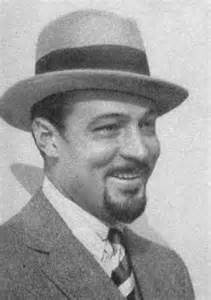
In the 1920’s, Rudolph Valentino was considered fashion forward. What he wore others would emulate him. This blog post is going to discuss the time when Rudolph Valentino sports a beard. In 1924, a new company called Ritz Carlton was formed to produce the next Valentino film. This unmade Valentino film would have been based off the story of El Cid. Set in 14th Century Spanish Court, Valentino would play a Moorish Nobleman and Warrior who falls in love with a Moorish Princess (most likely Nita Naldi). Having the right to select his own story, Valentino decided to make ‘The Hooded Falcon’. The script was written by Natacha Rambova. So Rudolph and Natacha went on a trip to Spain to purchase props, costumes and conduct extensive research for this movie. While in Spain, Rudolph grew a beard. In November the couple arrived back in New York to face a barrage of photographers and fans. Valentino was still wearing the beard he had grown in Spain. Rudolph Valentino’s beard caused such a sensation and the following announcement was to be issued by the Associated Master Barbers: ‘Our members are pledged not to attend a showing of Rudolph Valentino’s photoplays as long as he remains bewhiskered”. The male population is very likely to be guided by the famous actor to the extent of making beards fashionable again and such a fashion would not only work harmful injury to Barbers but would so utterly deface America as to make American citizens difficult to distinguish from Russians’. The threat by the Association of Master Barbers strike against Valentino’s films seems extreme.
“When asked why…
“When asked why she married Valentino, she replied, “It was simply a case of California, the glamour of the Southern moonlight and the fascinating love-making of the man.”–Jean Acker, Former Wife of Rudolph Valentino
1897-1966 Natacha Rambova, Rudolph Valentino’s Second Wife

This blog owner has been fascinated for years with the woman named Natacha Rambova who lived her life on her own terms. There will be many more posts on her as we continue the journey of “All About Rudolph Valentino.
Natacha Rambova lived in a time where women were still suppressed and misunderstood. Unless you personally knew her how could you possible understand what made her think or feel? The Internet has a lot of other websites and blogs about both her and her former husband Rudolph Valentino with some written in glowing terms about him and a lot in not so glowing terms about her. In 1991, Mr Michael Morris wrote a wonderful book about Natacha called “Madame Valentino”. For those that are reading this post and have not read his book, I would highly recommend doing so in order to have an understanding of the complexity that makes up this fascinating woman. Natacha Rambova a highly educated woman was first and foremost an artist who explored every artistic venue made available. This exploration was achieved through the study of ballet, costume design, mythology, contemporary culture, etc. As an artist Natacha wanted others to understand and appreciate the beauty of design whether it was as a costume or a set designer. Natacha was a perfectionist in everything she produced and the results were nothing less than fantastic. Art Deco and Oriental were the major factors in her designs and what she wore.


Although the 1920’s were considered a time where it was off with the old and on with the new modern ways and thinking. This was not necessarily true in everything. Women were still fighting for their rights and freedom they were still very much in the background. For someone like Natacha Rambova with her demanding personality and strong opinions this worked for her and against her. This was especially the case in her personal life, where her husband Rudolph Valentino was very much a traditionalist who liked nothing better than to come home from a hard day at the studio to be greeted by his wife and children and a home cooked meal. Natacha Rambova was a career woman who did not want a traditional role in a man’s life but one of an equal role. This is why I wrote earlier about her being born in the wrong time.
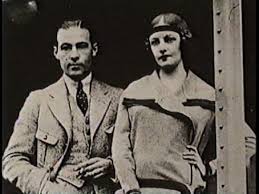
Natacha never achieved any sense of personal fulfillment in her personal life. But her professional life was one of achievement and influence which was achieved in various ways. One of them was a patent she received in 1926 through her design for a doll and matching coverlet, clothing designer, artist, researcher and writer on Islamic Art. Natacha was a very private person who did not feel comfortable sharing her world with others. While the rest of us may never understand what made her think and feel she was still a force to be reckoned with and you cannot deny the legacy she left for others to explore.
1922-1924 June Mathis and Ben-Hur
Little has been written about June Mathis, a successful screenwriter and production executive from 1915-1927. Mathis began her professional career in 1901 at the age of fourteen by going on the vaudeville originally a light song, derived from the drinking and love songs formerly attributed to Olivier Basselin and called Vau, or Vaux, de Vire. stage in San Francisco. By 1915, she had performed with a number of companies all over the country. Her most notable stint was with Julian Eltinge. After appearing in the Boston Cadets Revue at the age of ten in feminine garb, Eltinge garnered notice from other producers , the leading female impersonator of the times, and for whom Mathis spent four years as lead ingénue. After her stage career, Mathis turned to screenwriting. By 1918, she was the primary writer for Metro Studios, turning out scripts for their major stars such as Alla Nazimova, Francis X. Bushman, Beverly Bayne, and Viola Dana (Letter from Metro–1919). When Metro moved to Los Angeles. in 1919, so did Mathis–as head of their scenario department. Her first project, The Four Horsemen of the Apocalypse allegorical figures in the Book of Revelation in the Bible. The rider on the white horse has many interpretations—one is that he represents Christ; the rider on the red horse is (1921), would establish her status in the movie industry for the rest of her career (“June Mathis Confers”). Not only did Mathis write the script, but she staked her future on casting the little-known Rudolph Valentino in the lead. For the rest of their short lives, Mathis and Valentino were closely linked, both personally and professionally. She also selected Rex Ingram to direct (Ramsaye 799). In 1922 Mathis joined Goldwyn Studios and immediately gained responsibility for guiding to completion the highly anticipated motion picture version of Ben-Hur. The following year, she became general manager in charge of production. Her responsibilities included approving scripts; assigning the studio’s directors (e.g., King Vidor, Tod Browning, Marshall Nielan, and Victor Sjostrom) to projects; overseeing several productions, most prominently Erich von Stroheim’s Greed; and writing and contributing to several other scripts. But, during this time, her main responsibility, which also drew the most attention from the press and the public, was Ben-Hur. (2) From 1922 to 1924, besides working on the script, Mathis was also in charge of selecting the director and cast, and ordering the costumes, wigs, and beards. When the production subsequently fell apart and her script was rejected, an entirely new team assembled by the newly formed Metro-Goldwyn Studios completed the film. So why consider a rejected script? Mathis’s screenplay and her correspondence related to Ben-Hur demonstrate how the screenplay was part of a pattern of how she redefined masculinity and gender roles in relation to World War I, a pattern that began during the war years and continued through her scripts for Valentino. Latin; see example.] of how a highly successful woman executive’s ideas were dismissed and how she was brought low in part due to the politics to which Leab alluded. With the closing of her production and little attention to her scripts, her vision has been lost. I hope to recover that vision by examining well-established critical attitudes towards screenwriters and melodrama, and then explain Mathis’s ideas by analyzing how her script for Ben-Hur built on the spirituality inherent in the tale’s use of the Jesus story to more clearly assert the importance of spiritual values (Christian, Jewish, Muslim, and mystical) and art (especially that of the cinema) over the futility of Militarism
FROM NOVEL TO STAGE TO SCREEN
Lewis “Lew” Wallace wrote Ben-Hur while serving as governor of the territory of New Mexico. While Wallace presents a classically modeled male-centered tale focused on the wealthy and powerful, women, servants, and people of all races and faiths play positive and important roles. The United States is the world’s third largest country in population and the fourth largest country in area. struggling with the temptations of rampant capitalism and imperialism and the challenges of incorporating cultural diversity. Wallace defined Christianity as a religion with a primary message of love and acceptance set in contrast with Roman values of militarism and oppression. The novel achieved tremendous popularity, and, in 1899, Wallace gave approval to a stage adaptation, produced by Abraham Erlanger, who would later possess final script approval for the Goldwyn Studio effort. Featuring the great innovation of having two teams of horses racing on treadmills on stage, the play was a major success for more than 20 years. Australia, Holland, and road shows to both major cities and small towns throughout The United States and Canada share a unique legal relationship. U.S. law looks northward with a mixture of optimism and cooperation, viewing Canada as an integral part of U.S. economic and environmental policy. (“Experiences”). Efforts to produce a film of Ben-Hur began with the infamous 1907 Kalem version, a ten minute series of major scenes from the novel, each done in long shot from a stable camera, including the chariot race. But its low quality did not dampen public desires at all, especially after the 1912 release of the Italian biblical spectacle, Quo Vadis novel of Rome under Nero, describing the imprisonment, crucifixion, and burning of Christians. Negotiations for the rights to produce a new screen adaptation of Ben-Hur took place the following year. However, they were not actually purchased until 1921 by a partnership of Erlanger, Charles Dillingham, and Florence Ziegfeld (Brownlow, 388). June Mathis signed her first contract for working on Ben-Hur on 15 July 1922, Ben Hur wrongly accused of attempted murder. [Am. Lit.: Ben Hur, Hart, 72] See : Injustice Titles”). She remained involved until 22 July 1924, and she is credited on the film as the screenwriter due to her contract although none of her work was used for the completed production. Goldwyn, now headed by Joseph Godsol, used Mathis’s involvement for public relations, activities and policies used to create public interest in a person, idea, product, institution, or business establishment. By its nature, public relations is devoted to serving particular interests by presenting them to the public in the most purposes as much as possible, hyping the fact that her work was considered so valuable they had taken a one million dollar life insurance policy out on her (“Million-Dollar Girl”). Besides screenwriting, casting, choosing the director, possibly selecting locations, and having a say in costuming and make-up, at one point Mathis was even asked to oversee the sailing schedules to Italy. The record of her work evident through the script and other available documents shows foresight, a vision of what she hoped to achieve, and a skillful, but ultimately unsuccessful, attempt to conduct the necessary political manipulations for obtaining her goals. On Ben-Hur her duties were even greater than they had been on The Four Horsemen Name given by the sportswriter Grantland Rice to the backfield of the University of Notre Dame’s undefeated football team of 1924: quarterback Harry Stuhldreher, halfbacks Don Miller and Jim Crowley, and fullback Elmer Layden. . At the same time, she was assigning directors to other projects, writing other scripts such as The Day of Faith, In the Palace of the King, and The Spanish Cavalier, and keeping an eye on the development of Greed. All this at a time when the direction of the industry was towards a greater division of labor and specification of duties. As journalist Tamar Lane would write two years later, “Metro now has three men assigned to the tasks June used to do, and they have their hands full.” To afford the astounding one million dollars for the rights to Ben-Hur, Goldwyn Studios agreed to allow the men who controlled them, Erlanger and Dillingham, final script approval (Brownlow, 388-89). This agreement seems to have established a very cumbersome situation for Mathis, though she apparently believed she could use it to her advantage. Her “Cutting Notes on Ben-Hur” telegram of 26 January 1924 suggests Mathis thought that having Erlanger’s approval for the script would require director Charles Brabin to work towards achieving her vision on the film.
JUNE MATHIS’S APPROACH TO SCREENWRITING
It was within this context of having immense responsibilities for one of the most anticipated films ever, simultaneous involvement with several other productions, and working for a studio poorly prepared to keep up with a changing industry that June Mathis began her work on Ben-Hur. As with most of her screenplays, Mathis was working on an adaptation, and she draws heavily on the well-known novel, often noting that a setting should be constructed “as stated in the novel” (e.g., page 63; scene 217). On 15 April 1923, Mathis published an article in which she stated, “Personally I feel that when I am adapting a book or a play I am only a servant of the author” (“Scenario Writers”). It is not surprising, therefore, that Mathis follows Wallace’s narrative quite faithfully, but makes several purposeful changes. Some serve a practical function. For example, Mathis introduces the Hurs’ servant and custodian of their fortune, Simonides, at the Hur household at the beginning so that the audience gets to know him although Judah does not. Introducing Simonides early establishes his close relationship to the family. Similarly, Thord, the gladiator the intent being to give the dead man armed attendants in the next world. instructor, is introduced while training Judah during his years in the tribune Arrius’s household in Rome. Wallace does not introduce him until his description of the athletic competition just before the chariot race and after Judah left Rome. Mathis also has Judah learn about the chariot race and his enemy Messala’s participation in it from a poster he sees during his first visit with Simonides at his home in Athens. Wallace has him making all these decisions about participating in the race in a moment of inspiration just after saving the wise man Balthazar and his daughter Iras from Messala’s chariot in the Grove of Daphne. the action and help audiences identify characters, and also make Judah Ben-Hur a much more human and believable character, better able to use his intelligence rather than giving in a falling inwards; a collapse. See also: Giving to impulse. In her script, Mathis is clearly drawing on William Young’s popular stage version as well as the novel, which made great sense for commercial reasons. The play’s great success throughout the country over several years made its version of the story familiar to thousands of fans, (4) and Mathis wanted to include elements that made Ben-Hur popular in the theater. Young, for example, also introduces Simonides early in the story and ended the plot on Palm Sunday, in the Christian calendar, the Sunday before Easter, sixth and last Sunday in Lent, and the first day of Holy Week. It recalls the entry of Jesus into Jerusalem riding upon an ass, when his followers shouted “Hosanna” and scattered palms in his path. , as does Mathis. Wallace carries his narrative through the crucifixion and also includes an Epilogue. Mathis’s use of the stage version is also understandable since she was working closely with its producer, Abraham Erlanger, who claimed that she wrote the first draft completely under his supervision (Kleine, private memo). He also claimed credit for convincing Lew Wallace that Christ could be represented on stage by a beam of light (“Experiences”). Mathis frequently draws on the stage production to define the music for the film’s presentations in major houses: “During this time, when the production is made in the theatre, the music of the play and the words of the songs of Daphne will be played and sung, so that when the picture reaches the smaller houses this [a title with the lyrics] may be cut in” (p. 210; sc. 697). It is clear that Goldwyn and Mathis were considering the Ben-Hur that would play major houses as both an aural and visual spectacle. At various points, Mathis notes that the music or chorus will continue behind several scenes, rising and falling in relation to the action. The conclusion starts with “During this [scene] the music of the play starts with a low chant, and as the procession nears Jerusalem, in the various cuts which follow, the words ‘This is Jesus of Nazareth’ become audible, ending in a final outburst of Hosannas” (p. 495; sc. 1643). The final words of the script, again echoing the stage version, read, “the joyous music swells and the picture ends” (513). Erlanger’s contributions are occasionally evident as when Mathis notes, “This should be a man who is to be made up like the picture of Joseph in Mr. Erlanger’s book” (p, 39; sc. 139). She later writes, “Mr. Erlanger would like to have the sound of the real trumpet in this scene” (p. 87, sc. 297). These brief, specific references to Erlanger indicate that his contributions were brief and precise. Erlanger indicated June Mathis was in control when he suggested that spending $100,000 to have her go to New York. At one point, Mathis notes a change she has made from previous drafts of the script (p. 51; sc. 176), further indicating work which could not have been done entirely with Erlanger’s involvement, especially since she was on the West Coast while he was in New York. Mathis also may have sought input from others on the script, possibly from writing colleague Carey Wilson the screenwriter, cinematography Art and technology of motion-picture photography. It involves the composition of a scene, lighting of the set and actors, choice of cameras, camera angle, and integration of special , editing, lighting, and sets are clearly her own, as were the major decisions on casting, director, crew, and costuming. By the time she left for Italy in 1924, she knew exactly how she wanted the film to look. She told studio executives in a telegram shortly before sailing, “I have this picture cut in my head already” (“Cutting Notes”). In another not uncommon practice, Mathis draws on secondary sources, such as well-known works of art, to build her script and vision of the film. A shot of the wise men crossing the desert includes the note “(after the picture by Dore or Tisso)” (p. 33; sc. 116) and a shot shortly thereafter was to be a “LARGE VERY BEAUTIFUL ARTISTIC CLOSEUP OF MARY (after the paintings of the Madonnas)” (p. 35; sc. 122). Mathis indicates that the shot of the stable should be set “according to prep. 1. As stated or indicated by; on the authority of: according to historians. 2. In keeping with: according to instructions. 3. the famous paintings” with the figures arranged “according to the biblical paintings” (p. 39; sc. 137). The first shot of Pilate was also to show him on his throne “very similar to the famous painting of Pilate facing Christ at the momentous trial” (p. 407; sc. 1338). But Mathis uses these sources for practical purposes as well. For the shots of Christ’s Entry into Jerusalem first scene of Passion cycle in painting. [Art: Hall, 114] See : Passion of Christ , she writes, “(This should be worked as much as possible with curves and bends in the road, so that we do not need so many people to get over the effects of thousands. I have a valuable book of illustrations that will convey exactly what I mean.)”. These examples also lend credence to MGM in full Metro-Goldwyn-Mayer, Inc. U.S. corporation and film studio. It was formed when the film distributor Marcus Loew, who bought Metro Pictures in 1920, merged it with the Goldwyn production company in 1924 and with Louis B. Mayer Pictures in 1925. director Fred Niblo’s later question in a letter to .Louis B. Mayer as to whether or not he would have access to all of Mathis’s research (20 May 1924). Mathis’s use of research and attention to detail is clear in her description of a street scene in which she makes a note to herself about Egyptian costumes, carts, and water jars to “Look up this point. (Description in full to be written later.)” (p. 2; sc. 8). Furthermore, Mathis notes that “Throughout production all titles should be spoken in some foreign language, so that no English pronunciation is on the lips to destroy the illusion of biblical times” (p. 31; sc. 107).
JUNE MATHIS’S VISION FOR BEN-HUR
Even without its huge popularity, Ben-Hur would have been an attractive property to June Mathis in the early Twenties as a follow-up to The Four Horsemen and Blood and Sand. As in those works, Wallace’s tale provides the opportunities to produce spectacle along with a spiritual anti-war/antiviolence message. The lead was perfect for Rudolph Valentino, Mathis’s first choice, who, along with his frequent costar, Nita Naldi could be sold as any ethnicity. (5) Like Naldi, Valentino was generally cast as a racial “other,” but faced an advantage as a male because his smoldering looks. Often used in combination: fair-complexioned characters, could be used to support Judeo-Christian values of self-sacrifice and spiritual reward. His striking good looks and athleticism made him the perfect action hero, but one who could be transformed into a softer compassionate man. Furthermore, Ben-Hur requires its sensuous hero to ultimately resist seduction. This behavior was important to Valentino’s character throughout Blood and Sand (1921), another Mathis script. Due to contract difficulties, however, Valentino was unavailable (Leider, 237). As Jane Gaines states, in understanding filmmakers, scholars should pay as much attention to the use of genre as to biography (98). With Ben-Hur, Mathis was working in familiar melodramatic territory. To David Mayer, even Judah Ben-Hur is a typical melodramatic character, a mere shell to be manipulated according to the omniscient. Its spectacular plot includes characters who, though often missing and presumed dead, or having no knowledge of their past connections, and despite being separated by hundreds of miles at a time of poor transportation, keep meeting each other at exactly the right times in order to resolve their conflicts or achieve their goals. This world is one in which order exists; characters simply need to find it. The opening of Mathis’s Ben-Hur script is concerned with setting the stage for the film’s premiere as it refers to a “specially designed curtain disclosing a dark stage.” (6) Then, in a device that might typically be associated with the avant-garde, Mathis introduces her major motif through the projector’s beam, God-like and spiritual, enlightening stage and screen. This emphasis on light is present throughout the screenplay in scenes where Mathis makes a point of making sure that an image of the sun, moon, or stars are available in the shot. (7) In the final scene, the projector’s beam sent out onto the screen at the start of the performance is reversed and sent back towards the audience (p. 513; sc. 1722). Mathis writes, “Malluch [Simonides’s servant] arrives with Esther [Simonides’s daughter]. [Everyone] turn[s] and kneel[s] as the light, similar to the effect of the Star of Bethlehem, in the Gospels Star of Bethlehem, name given to the luminous celestial object rising in the sky that, as related in the Gospel of Matthew, led the Wise Men of the East to the manger in Bethlehem where Jesus was born. , moves towards the camera.” The importance of the light is developed in the opening scenes through angels and stars that appear to the wise men who will seek Jesus at his birth. Mathis begins by going back to the Old Testament with a scene of the prophet Isaiah on a mountain. The four best known in Christian tradition are Michael, Gabriel, Raphael, and Uriel. Michael appears to him in a ray of light that slowly shines down from heaven. Then, the angels Jophiel and Raphael show the wise men Balthazar and Melchior stars that first appear in the water below them and then rise into the sky. The angel Uriel, who appears to the wise man Caspar, holds a book which dissolves into a star. In each case, therefore, the angels and stars either literally or figuratively awaken men and lift their eyes to the heavens. The continual gaze towards the heavens and the lights in the sky signify an awakened people anticipating the light that will lift their oppression. Mathis associates the lights from above and below with Christ at the stable in Bethlehem (p. 39; sc. 137-39). She first describes a great rock that conceals the place with light coming from below (sc. 137). The light grows bright from above and comes to meet it. This creates a rainbow to be shown through double exposure over the cave, eliminating part of it and letting in the light from above. Appropriately, the following title quotes the Old Testament Book of Isaiah – an Old Testament book consisting of Isaiah’s prophecies Isaiah Old Testament – the collection of books comprising the sacred scripture of the Hebrews and recording their history as the chosen people; the first half of the Christian : “The people that walk in darkness the mist” darkly have seen a great light. They that dwell in the land of the Shadow of Death; upon them hath the light shined” (sc. 139). Mathis’s opening scenes thus reveal wise men leaving their old traditions in search of a new, and unifying, answer, an apt idea for the post-war era. Balthazar is introduced speaking to his Egyptian countrymen about monotheism religion, a belief in one personal god. In practice, monotheistic religion tends to stress the existence of one personal god that unifies the universe. . Feeling rejected, he walks to an ancient shrine created by the Pharaohs; a light that appears in the water surrounding the shrine forms into a star. Melchior is introduced in front of an ancient rock-hewn shrine built to the Hindu God Brahma, and Caspar is found asleep in front of a Greek temples differed from their Roman counterparts in that the colonnade formed a peristyle around the whole structure, rather than merely a porch at the front; and also in that the Greek temple was not raised above ground level on a high podium, but rather stairs on either end. after a pan down from Olympus. Mathis states the explicit meaning of this motif in her scene of the Palm Sunday marchers, “whose Leader put hope into the hearts of men as a new light to the world,” superceding all previous lights (p. 495; sc. 1642). In the following scene (p, 495; sc, 1643), this light is now originating from the center of the crowd rather than the sky. The film was to end, as stated, with the light encompassing the screen and beaming out towards the audience, thus completing the circular pattern initiated at the start of the script and representing perhaps the only example ever of the projector’s beam being incorporated into a film’s narrative. On another level, Mathis’s suggestion could be that the light that will unify the nations is not only a spiritual light, but the light of the cinema, for which her screenplay is a primary example. D. W. Griffith, among many others, possessed this kind of deep belief in the powers of the cinema at the time to show the truth and provide a new way of seeing. It does not seem like a great stretch to think that June Mathis would have shared such a belief. Beginning the narrative with the prophet Isaiah and ending on Palm Sunday rather than including the crucifixion and its aftermath fulfills several purposes for Mathis. It conforms to the narrative pattern of The Odyssey, emphasizing the long journey home of a young man torn away from his family, the challenges he must face along the way, and his eventual reunion with his loved ones, and it places greater emphasis on a new light to guide humanity rather than on the birth of Christianity. These were crucial post-war themes that Wallace’s work could be used to express. Wallace was mainly interested in asserting the superiority of Christianity and telling the unknown story of its creation from the birth of Christ through its establishment by its followers. Mathis was more interested in providing a reassuring message of order restored with the promise of a bright future through spiritual, non-violent values and the art of cinema. Mathis’s use of angels suggests both her research and an alternative vision of the work. Whether or not she specifically had this knowledge or how she came about it is unknown. But Jophiel and Uriel in particular are obscure figures and their similarity and relevance suggest they were not selected randomly, even though very few viewers would understand these associations. (8) But despite these references and the presence of events from the Bible in the life of Jesus, Mathis’s work provides evidence of a greater desire for religious tolerance and cooperation than promoting Christianity, which again would be an important unifying theme in a post-war world. Mathis’s works from the early Twenties, such as The Four Horsemen of the Apocalypse, Blood and Sand, The Young Rajah (1922), The Day of Faith (1923), A Trip to Paradise (1921), and Hearts are Trumps (1921), consistently used iconography from and references to Christianity, Hinduism, mythology, and mysticism to present themes of spiritual guidance. (9) The chariot race in Ben-Hur provided an opportunity for Mathis to include references to several spiritual traditions. Shots of the crowd show Arabs and Jews separately but united in their support for Ben-Hur and hatred of Rome. As Messala cheats by using his whip on Ben-Hur’s horses late in the race, their owner, Sheik Ilderim, cries from the stands, “May Allah strike thee as thou hast my desert beauties!” (p. 358; sc. 1160). Shortly thereafter, his prayer is answered as Messala experiences his crippling accident. At the same time, as Ben-Hur realizes his impending into his eyes. God has answered his prayer. His score is settled with his enemy” (p. 361; sc. 1173). Characteristically, Mathis follows the race with a title blending mythic determinism with these references to Islam and Judeo-Christianity: “The weaver sits weaving, and as the shuttle flies the cloth increases; the figure grows, and the dreams develop! Of such is the fabric of life” (p. 367; sc. 1196). Mathis’s screenplay unifies these spiritual themes through the motif of light which first comes from the projector and hits the screen at the beginning of the performance, gathers into the star of Bethlehem, and shines back out at the audience at the conclusion. Finally, Mathis’s work shows that she was not only seeking to enlighten her audience spiritually but also socially. When Mathis worked in vaudeville from 1901-1914, it was a haven for the homosexual community. (10) For her last four years on the stage, she was with the extremely popular (and gay) female impersonator Julian Eltinge. In her screenwriting career, she worked for several years with actress Alia Nazimova, who was very active in Hollywood’s lesbian society. Mathis was familiar with alternative lifestyles and worked depictions of sexual permissiveness and wanton behavior into many of her films. This material challenged contemporary social propriety and suggested another area for greater openness in the post-war era. (11) BenHur includes a scene of a Roman party prior to the chariot race that Mathis elaborated on beyond Lew Wallace’s version. Wallace’s passage stated, “from the floor where he had fallen, a youth was brought forward, so effeminately beautiful he might have passed for the drinking-god himself–only the crown would have dropped from his head, and the thyrsus from his hand” (235-36). Messala pays homage to the boy as a representative of Bacchus, and Wallace finishes the chapter with “There was a shout that set the floor to quaking, and the grim Atlantis . By contrast, Mathis’s version reads,
Just at this point a huge dark-skinned slave, bronzed all over to reflect the light and to make him a thing of beauty, enters, bearing upon his back a white boy, who has been painted silver. He is nude but for a jeweled clout, and wearing a wierd [sic] headdress, with cymbals in his hands; he is carried to the table where he starts to dance. This relieves the tenseness of the situation. The Romans sink back upon their couches, and start to sip their wine, and look toward the dancer with interest. Messala still sits, a trifle serious; and after a moment disperses the thought, and proceeds to join in the revelry. (p. 320; sc. 1023).
Mathis’s more specific description of male nudity and homoerotic elements suggests she intended these to be noticed, and she knew that not everyone in the audience would condemn these actions. MATHIS’S STRUGGLES AND THE COMPLETED FILM While my argument is that June Mathis’s work on Ben-Hur reveals her talent and knowledge of filmmaking, her vision for this film, and much about the filmmaking industry at the time, I am not asserting that her script represents a great piece of writing. I believe it does reveal that she was a skillful professional and helps explain why her influence in Hollywood was great throughout much of the Twenties. But, criticisms of her work are easy to find and have various degrees of merit. Sometimes, they may be more indicative of attitudes towards her as an influential woman struggling to achieve her goals within a male-dominated system than of the quality of what she actually wrote. Abraham Erlanger valued Mathis’s BenHur script, but others at the time did not. One of the first directors offered Ben-Hur was King Vidor, who turned it down after reading the script (although which draft is not known), which, he said, reminded him of the simple film version (apparently the Kalem) he had seen as a child (King Vidor Collection). But he also wrote that the final (MGM) production contained the same faults. Considering the outstanding quality of Vidor’s silent films (The Big Parade [1925], La Boheme [1926], The Crowd [1928]), his Ben-Hur may very well have been more creative than either the Mathis or the completed 1925 production. As for MGM director Fred Niblo, on 24 May 1924, he wrote to Louis B. Mayer that the script seems to not have paid attention to the opening and conclusion of Mathis’s script in comparison with the novel. The bulk of the screenplay follows the novel faithfully, and perhaps Niblo had little time to notice the differences in Mathis’s version as he rushed to rescue the floundering project. The final word on Mathis’s script had already been stated in the telegram from producer Joseph Schenck to Metro-Goldwyn-Mayer Chief Executive Officer. The highest individual in command of an organization. Typically the president of the company, the CEO reports to the Chairman of the Board Marcus Loew (May 7, 1870–September 5, 1927). He noted that Mathis had approved the script for Greed, which was far too long, as was her work on Ben-Hur. Loew followed Schenck’s advice and fired Mathis, director Charles Brabin, lead George Walsh (both selected by her), and many others who had been involved with the production. Niblo’s comments on Mathis’s script and the film he ultimately produced clearly show that the new production team had a much different vision of the project. But while Mathis’s script is lengthy, she had consciously constructed it that way in order to preserve her vision of the work and cut off any protests over how she wanted it shot. Thus, she was also anticipating saving time in the filming and editing. In her 26 January 1924, “Cutting Notes on Ben-Hur” telegram to Goldwyn Vice-President Abraham Lehr, Mathis wrote, “I did not attempt to cut on this until I had seen Mr. Erlanger as he had okayed the other continuity version, and I did not wish to have the Goldwyn people run into legal complications until I have seen him and discussed it, with the logical explanations, of which I think I can convince him.” Therefore, Mathis was already anticipating cutting the script “by at least 300 scenes,” as a telegram from Goldwyn Vice-President Edward Bowes (b. 14 June 1874, San Francisco; d. 14 June 1946, Rumson, New Jersey) was an American radio personality of the 1930s and 40s whose Major Bowes’ Amateur Hour was the best-known amateur talent show in radio during its eighteen-year (1934-1952) run on NBC and CBS. on 30 January promised (“Ben Hur’). But she also believed the length would give her some leverage through Erlanger over director Charles Brabin. She notes in her telegram:
This picture is heavily scene numbered, but I have played safe with numbers and scenes, knowing Mr. Brabin’s dislike to taking close-ups, and feeling that once the script is okayed by Mr. Erlanger, he will agree to take close-ups without discussion which would take up time, and of course time is the most important item I can name.The “scenes” by which silent film scripts were organized were very flexible. They could include as little as a shot or as much as a lengthy interaction between two or more characters. Mathis, therefore, could have made her script appear much shorter by combining a number of close-ups spread across several scenes into one scene. However, by not doing so, she believed that having Erlanger’s approval of the script would force Brabin to take the close-ups and thus keep the production moving. It would also give the film the quicker pace she wanted. Some of the cuts she was considering would have reflected her “Concern with too many CUs of long-robed men in early part dragging.” She then suggests to “Cut scenes 1080 to 1107 of this sequence after Grove of Daphne with chariot race–cutting a lot of action and footage, and getting straight to chariot race, utilizing one title in Simonides’ stall [his area for watching the race] that is in the previous sequence. This will eliminate big expense.” Mathis’s concerns for the pacing of the film and saving time and money during the production are evident again at the end of her telegram:
All these same close-ups and numbers will help us to eliminate footage later on, as they are written for cutting and not for directorial drama, … and with a picture of this character, one must stop long walks and slowness of movement, or else we will have a very slow moving thing. This can only be eliminated in photographing many scenes, so that action can be broken up in cutting. And when all is said and done, even though the tempo of the scene action may be slow, the picture will move and not be draggy. There are also many close-ups which may not be used in the final cutting, and of course, many of them will be taken all in one, without extra camera set-ups. This will take film but not extra time, and will form a sort of insurance.Mathis, therefore, shows that her lengthy script was not a result of merely following the novel as closely as possible, but of planning to obtain as many dose-ups as possible to save time during the filming and provide great flexibility during the editing. Mathis was to discover, however, that she had no leverage with her chosen director, Charles Brabin. He had sailed for Rome on 29 September 1923. When Mathis finally arrived the following February, “she was informed that under no circumstances would she be permitted to interfere with Mr. Brabin on the set” (Brownlow 393). Niblo states in a 21 July 1924 letter to Louis B. Mayer, “Brabin and Mathis got at swords points the moment they both arrived here, with the result there were two factions, the Brabin crowd and the Mathis crowd, pulling against each other. From what I hear they both ran wild in extravagance. They were weeks and weeks in North Africa making a few feet of desert stuff that took up thirty or forty reels of film that cannot be used.” Francis X. Bushman, who played Messala, later recalled, Charlie Brabin was a lovely fellow, and we were very dear friends…. He was the storyteller superb–he could describe the most marvelous picture in the most beautiful language, but he’d never do it. I was with him at Anzio for several days, and all the time he was telling stories and drinking wine. I didn’t realize that out on the beach he had hundreds of extras roasting and doing nothing. (Brownlow, 393). It’s no wonder that Brabin never got to the close-ups Mathis was counting on. During his time on the job, Brabin shot over 300,000 feet of film. But it was almost completely worthless. On 10 September 1924, Mayer cabled Niblo, “Saw Brabin stuff tonight certainly congratulate you on wisdom discarding every inch.” Making the film closer to Hollywood would have also helped control the project. Throughout the Teens, however, the idea that any film of Ben-Hur had to be made in Italy seemed to become almost a cultural imperative. (12) The successful production of The Eternal City in Italy at that time may have also motivated the idea of filming there. The Goldwyn company sent vice-presidents J. J. Cohn and Edward Bowes to Italy to decide on the practicability of the project. Ultimately, they decided on it and Erlanger agreed (“Ben-Hur”). Mathis may have also played an important role in this decision. But her script indicates a great amount of material that could have been filmed at the studio, and it is not hard to imagine that the entire production could have been planned for domestic completion right from the start. For example, for a scene in the galley, Mathis writes, “This is going to be very difficult to break up as shooting arrangement of the actual galley is somewhat different from the stage set” (p. 111; sc. 385). Later, for the start of the chariot race, she writes, “FADE IN FULL SHOT OF THE ARENA Shooting in the direction of the gateway, and taking in the area which is masked in the pillars, to form a composition which will give the effect of a huge arena, and yet at the same time not mean so much building” (p. 338; sc. 1080). For the first shot of the massive Joppa Gate, Mathis writes, “Worked if possible with glass or miniature top.” On 20 January 1923, Carey Wilson sent Mathis a memo about a possible location “thirty-seven miles from San Diego. Wilson also let her know where she could get further information and photos of the location. It seems, therefore, that Mathis was strongly considering filming in and near the studio, which would have been a very wise move. In other areas, such as obtaining costumes and wigs, Mathis’s work was not effective of Mathis’s casting. In his 20 May 1924 letter to Mayer, he states, “The cast to me, with perhaps one exception, is the most uninteresting and colorless that I have ever seen in a big picture. There is not one outstanding personality. They were all selected by Miss Mathis with the same judgment that she selected George Walsh. I believe Ben Hur should be recast almost entirely.” Niblo, however, did not get his wish. Three of Mathis’s choices for principal roles, Bushman, Nigel deBrulier (Simonides), and Carmel Myers (Iras), remained in the film. at his’s choice of George Walsh for Ben-Hur was the most controversial. The announcement of his selection was met with great indifference. Motion Picture Classic showed their ambivalence when they published the news on a single page featuring two pictures of Walsh in Roman costume and a brief paragraph in very small type which read, “What magic Miss Mathis used we do not know, but they finally decided to let George do it. Perhaps these poses helped their decision. He looks like Ben Hut anyway” (“Final Choice”). Whether or not Walsh could have carried the role with the help of a talented director and efficient production will never be known. He later said, “[June Mathis] just felt I was the ideal one. She had picked Valentino for The Four Horsemen, against the objections of a lot of big shots. But she was absolutely right on that one, and she figured she was the same with Ben-Hur” (Slide). But the MGM people did not care for him. A 23 September 1924 letter to Niblo from either Mayer or Irving Thalberg states, “As for George Walsh–well, the truth is, when I saw the reels, we were going to release it in bond, so that we would not have to pay the duty, but I felt it was too valuable a record to let it slip out of our hands, and we paid the duty and took it in” (Letter). This account conflicts with Walsh’s, who claimed to never have worked a minute on the film. He also claimed that MGM treated him terribly: “They had [Ramon] Novarro under contract, so they decided that he was their own boy…. I was the last to find it out. I was handled very, very cruel” Final responsibility for the disastrous Goldwyn production of Ben-Hur cannot be given to any individual. Similarly, the production of June Mathis’s script for Ben-Hur with George Walsh in the title role would not necessarily have been successful or notable. But it does seem that after two years of work, Mathis tried for as long as possible to have some influence over the film. On 21 July 1924, Bess Meredyth, Carey Wilson’s assistant on the MGM script, wrote to Louis B. Mayer from Rome, “Miss Mathis leaves tomorrow and we’ll all breathe more freely I think.” When she arrived home, Mathis told the New York Morning Telegraph may refer to:
The idea that June Mathis did have a specific vision of Ben-Hur, one which emphasized spiritual and anti-war values and the art of cinema as unifying forces, seems clear from comparing her script with the Lew Wallace novel and the 1925 MGM film. Carey Wilson’s script for the MGM production was greatly condensed from the Mathis version. The opening material including all of the angels, the emphasis on light including the projector’s beam, and the inclusion of various spiritual traditions during the chariot race are all missing. Wilson and Niblo substantially reduced the roles of most of the supporting characters such as Iras, the powerful Sheik Ilderim, Balthazar, the Roman Arrius, who adopts Ben-Hur, and the Hur servants Simonides and Amrah. By contrast, they introduce Esther much earlier than Mathis did and have the young Ben-Hur meet her right from the start. They also increase her importance by having her discover that Ben-Hur’s mother and sister, imprisoned by the Romans early in the film, are still alive at the end, but suffering from leprosy or Hansen’s disease (hăn`sənz), chronic, mildly infectious malady capable of producing, when untreated, various deformities and disfigurements. . It is she who goes to find them and bring them to Christ for healing rather than the servant Amrah, as in the novel and Mathis version. Esther’s searching for mother and Tirzah at the end, and then braving the crowd, which had every right to stone them, in order to bring them to Christ, makes her a stronger character than in Mathis’s version, where she only has to endure Judah’s infatuation with Iras until he finally comes to his senses. Mathis’s Esther conformed to the model of the melodramatic heroine who triumphed through suffering while the Wilson version takes a step towards the modern woman who goes after what she wants. Jesus is also much more important in the Wilson-Niblo version. In the second half of the film, after the chariot race, Wilson and Niblo draw heavily on Christ’s sayings in the New Testament for their intertitles and show him teaching and performing miracles. Ben-Hur continues ready to lead an army in revolt until almost the end of the film. As Jesus bears his cross to Calvary, Judah calls out, asking if he should lead his army forward. A voice comes to Ben-Hur saying that the Savior did not come to condemn but to bring peace. In spite of its reduced emphasis on Esther and Jesus, however, Mathis’s version places a far greater importance on the feminine Victorian values of spirituality than Wilson’s. The MGM film concludes with the crucifixion and the earthquake that the Bible says occurred when Christ died, causing the Temple to collapse and kill several people nearby. In the final shot, Ben-Hur stands on the patio of his palace, his mother and sister in his arms, filling his father’s lost place as lord of his estate. He tells them Jesus “is not dead. He will live forever in the hearts of men.” The crosses of Calvary, still visible in the background, might be seen as blessing this picture of restored patriarchy and material riches. After returning from Italy, June Mathis moved to First National Pictures, re-uniting with her former boss at Metro, Richard Rowland (“June Mathis Signs”). In December, she married a cameraman she had hired for Ben-Hur, Sylvano Balboni, and helped promote him to director in 1926 (St. Johns). In 1925, she helped Collen Moore who became Hollywood’s top female box-office attraction, writing for her the comedies Sally, The Desert flower may refer to:
Desert Flower and We Moderns. She also produced the screenplay for one of Corinne Griffith’s best films, the comedy Classified. In 1926, fans voted Mathis the third most influential woman in film history, finishing only behind Mary Pickford and Norma Talmadge (Spargo). That achievement is a testimony to the prominence of someone who was neither an actress nor a director and who, over the years, has had her memory erased from film histories. In this regard, Mathis shared the fate of many other talented women in American silent film who were almost completely forgotten for the next sixty years or more. Some, such as writer/directors Marion Fairfax, Ida May Park, and Julia Crawford Ivers have yet to receive any critical attention, (13) due in part to the patriarchal bias of the male film critics who dominated the field for most of the twentieth century. From the time of her death until the 1980s, Georges Sadoul’s erroneous comment that Mathis butchered Erich von Stroheim’s Greed (1925) was practically the only mention of her in film scholarship. In reality, Mathis strongly supported Stroheim and her editorial suggestions were minimal and precise. (14) But Sadoul’s remark is still having an impact even on a feminist scholar like Mahar, who repeats his charge. Part of the responsibility for the disappearance of women artists from silent film history, however, also comes from their own attitudes. Despite their professional success, their attacks on patriarchy in their works, and their depictions of strong and righteous women, they frequently saw themselves in supporting roles. Mathis herself published a piece in 1921, in which she argued that in the ideal filmmaking situation a male director works with a female writer, or a male writer with a feminine sensibility (“Harmony”). Male/female creative “teams” were prominent during the silent era. (15) But some men blatantly exploited their female partners. Anita Loos was an acclaimed American screenwriter, playwright and author. She is considered one of the most renowned screenwriters of her era alongside June Mathis and Frances Marion who wrote many Fairbanks scripts and the novel Gentlemen Prefer Blondes, spent most of her life dedicated to her husband and collaborator John Emerson who was the 17th Mayor of Calgary, Alberta. Her close niece Mary Anita Loos refers to Emerson as “[t]he man who had added his name to her work, had taken her wealth, and had in every way undermined her” (Beauchamp, 260). But when asked why she stood by him, she blamed her great success with Gentlemen Prefer Blondes for ruining him (Beauchamp, 182). Whatever the reasons for their obscurity, June Mathis and the other women writers of the silent film era need to have their work critically examined not simply to bring them recognition but also to produce a better understanding of women’s perspectives and our cultural heritage. June Mathis’s work on Ben-Hur, understood within the context of her oeuvre, reveals that she was a woman of talent and vision. Hers would have been a Ben-Hur that promoted enlightenment and female influence rather than violent spectacle and a restored patriarchy. These ideas are as valuable today as they were in her time.
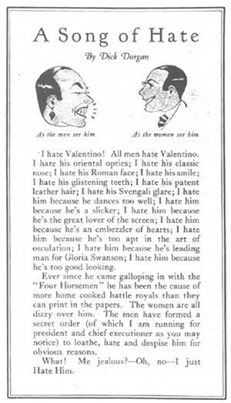
“Don’t worry ch…
“Don’t worry chief, it will be alright.”-Rudolph Valentino
1916-1926 Rudolph Valentino’s Friend Norm Kerry
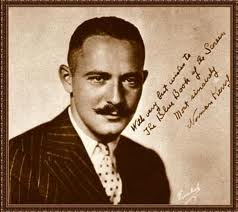
Born in 1889, in Rochester, NY. Norm Kerry was of German descent whose original name was Arnold Kaiser. Norm Kerry lived life to the fullest. Norm worked various trades such as a leather-good salesman, theatrical agent and eventually a silent film star. He was married four times; he was an adventurer, art collector, a heavy drinker and a popular leading man in silent films to famous leading ladies such as Mary Pickford, Lillian Gish, Marion Davies, Bebe Daniels, Mildred Harris, ZaSu Pitts and Corrine Griffith. Norm Kerry was never able to make the transition to sound films. It is noted that Norm Kerry was many things but one thing he is noted for was being a close friend to another equally famous silent film star Rudolph Valentino. In 1916, in New York, Norm Kerry met Rudolph Valentino while Rudolph was selling Liberty Bonds. In 1917, Norm Kerry ran into Rudolph Valentino while Norm was filming the movie “The Little Princess” with Mary Pickford in San Francisco while Rudolph was touring with the cast of the play “The Masked Model” which ran for two weeks at the Cort Theater. Norm convinced his friend to come with him to Los Angeles to try his luck in the film industry. So in the late fall of 1917, Norm Kerry and Rudolph Valentino boarded a train and traveled west to Los Angeles where Norm became both mentor and roommate. Initially, both Norm and Rudolph stayed at the Alexandria Hotel, Los Angeles, CA where Norm already had a room so it was convenient for both to become roommates while Rudolph Valentino tried his luck in motion pictures. Norm Kerry helped his friend out financially because that was the type of person Norm was. Little known fact is that both Rudolph Valentino and Norm Kerry attended flight school together. Natacha Rambova who was Rudolph Valentino’s second wife described Norm Kerry as her husband’s very good friend. Norm Kerry played an important role in his friend’s life and it was through his encouragement the world knows of the talent of his friend Rudolph Valentino. Norm Kerry died in Los Angeles from a liver ailment on 12 Jan 1956.
Source:
The life and Death of Rudolph Valentino: Dark Lover by Emily Leider
“Women are not …
“Women are not in love with me but with the picture of me on the screen. I am merely the canvas on which women paint their dreams.” – Rudolph Valentino
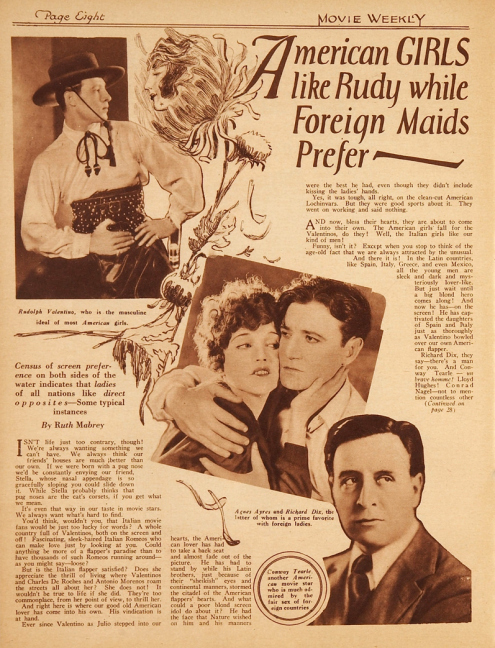
 All About Rudolph Valentino
You must be logged in to post a comment.