
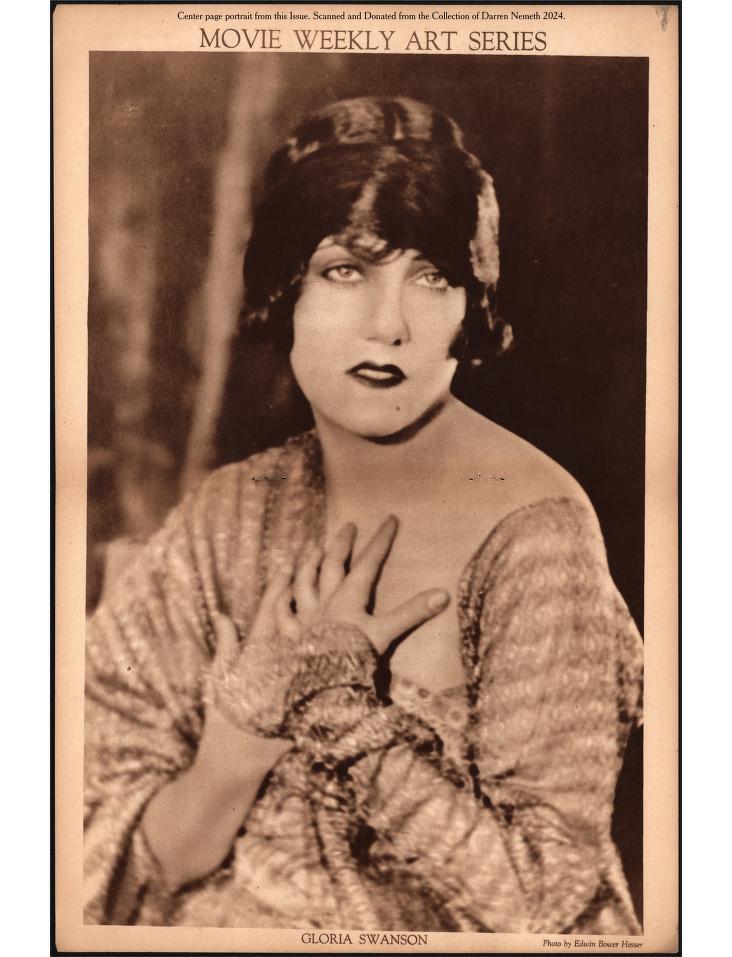
Posts Tagged With: Gloria Swanson
9 Sep 1951 – A Ukulele and a Memory
A vamp of the former silent movie days, who acted with Rudolph Valentino and also unleashed her feminine wiles in that mighty pictorial epic “Ben Hur” is now working as a television glamour girl. Because Carmel Myers has aged in appearance far less rapidly than the years have passed, she is able to compete in the charm sweepstakes on an equal basis with young newcomers, thus bolstering the vitality move men initiated by Gloria Swanson. One prop and one routine are the mainstay routines in Miss Myers television show a ukulele she has used since she was 13 years old. It was her ukulele that led her into television. At a party in New York, she was strumming and singing, and a friend told her she should be on television. Miss Myers took the suggestion seriously and looked up Robert Kintner President of ABC. He turned her over to the program department and they put her on the air. Movie fans who are acquainted with Miss Myers have noticed her hair colour is a radiant blond and she admits her natural hair colour is brunette. She further explains she looks much better with a lighter hair color in a television studio. Last week’s episode she recalled Charleston Contests held at the famed Coconut Grove a place talent scouts would gather. One night a scout told a young dance to report to a certain movie studio and the next day she did arrive, but nothing happened with her career until later after she did a name change to Joan Crawford. Miss Myers recalls working with Rudolph Valentino during one movie scene filmed in Santa Monica. He was supposed to rescue her but, in her version, she is the one to rescue him out of the water.
Categories: Uncategorized
Tags: Carmel Myers, Gloria Swanson, Rudolph Valentino
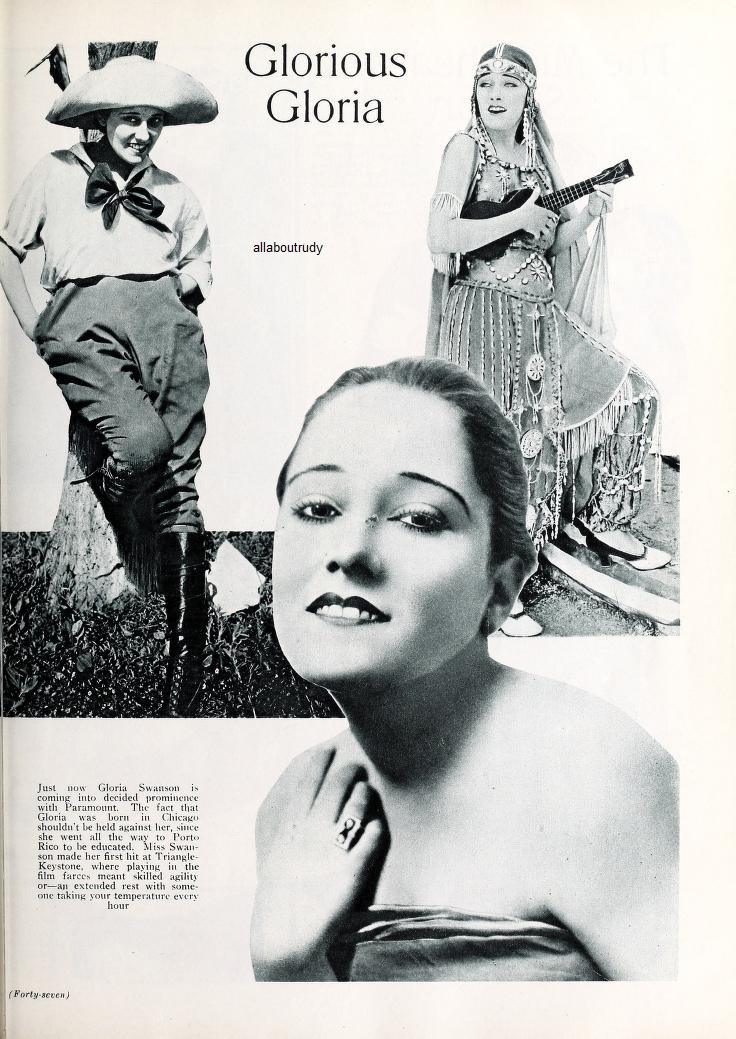
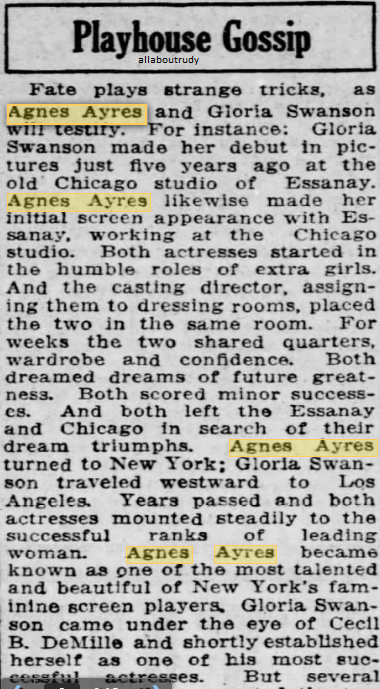
1924 – Movie Review of “A Sainted Devil”
This is a movie review by film critic Mordaunt Hall who went to see Rudolph Valentino’s latest movie “A Sainted Devil” that was screening during the 1924 Thanksgiving weekend.
Memories of brave little Cigarette in “Under Two Flags” came to our mind as we viewed the passing shadows unfolding the story of Gloria Swanson’s latest pictorial effort, “The Wages of Virtue,” which is adorning the Rivoli screen this week. With its background of the headquarters of a contingent of the Foreign Legion in Algiers, this photoplay unlocks a flood of thoughts regarding the blighted lives of many of the men in this heterogeneous mass of humanity, who are burying their identities under a French uniform in the blazing sun of Northern Africa. This idea has not been forgotten in this celluloid presentation, as one sees an east side New Yorker, an Italian strong man, an English crack shot, a Parisian Apache and an American college graduate among the men busy in the barracks. You see them polishing buttons and cartridge cases, cleaning their tunics and boots, it being set forth in the regulations (whether they be murderers, forgers, or only the victims of love affairs) that their accoutrements must be glistening and immaculate. Lithe and vivacious, with swiftly changing moods, Miss Swanson plays the part of Carmelita, the girl who mothers the regiment of gruff soldiers and in a dilettante, manner presides over a café, to which the nondescript volunteers come to forget their disappointments or misdeeds with a cheering glass of cheap wine. Carmelita is filled with the joie de vivre and is able even to get fun out of her sweeping and dusting. She performs her ablutions in a drinking fountain and looks forward to the hour when the thick voiced fighters are due to sit at the tables or stand in the bar of the café.
Marvin, whose sobriquet is Yankee Blue, one evening takes Carmelita in his arms, and misunderstanding her violent struggles, he snatches several kisses. Luigi (Ivan Linow), a brawny giant, who saved Carmelita from drowning, is a brute who pretends to be in love with Carmelita while he is flirting with the matronly cantinière. He lays in wait for Marvin (Ben Lyon), and after Marvin has been badly beaten, he is sent to the military jail, where in the scorching sun he is made to march with heavy packs.
Carmelita, in a huge sunbonnet under which is concealed a bottle of wine, goes forth to procure Marvin’s freedom. She is in love with the handsome American, and he reciprocates her affection. Miss Swanson is particularly good where she pretends to have fallen down a flight of steps in a faint, just as Marvin, after being freed, is entering her café. She takes her audience into her confidence by winking at them when Marvin is not looking and closing her eyes the instant, he lets his gaze fall upon her face.
This story was adapted from one written by Captain Percival Christopher Wren. It seems to us that the dénouement would have been stronger if Luigi were a better character. He saves the girl’s life, and yet she in the end plunges a knife into his back because he has beaten Marvin. The men of the Foreign Legion swear that they will not reveal the fact that Carmelita killed the giant, all agreeing to testify that he was slain by Arabs. It is a strange idea, first, to have Luigi a hero, when he saved Carmelita from a watery grave, and then to make him a murderer, by having him throw a little fiddler into the river, for suggesting to Carmelita that she and he go to Paris. Even after this one does not lose sympathy with Luigi, as he insists that the deed was done because of the musician’s poisonous ideas. It would have been more pleasing to have another villain and to make Luigi a good father, or guardian, to Carmelita. It is also problematical, especially in motion pictures, whether it is wise to have the heroine kill the villain, even under such conditions as Carmelita slew the strong man. Mr. Lyon is efficient in the role of the hero, and Mr. Linow is splendid as Luigi. Norman Trevor delivers a sympathetic performance as the English crack shot, known in the regiment as John Boule. Allan Dwan directed this picture, which, we must say, is just as interesting as “Manhandled,” his previous production with Miss Swanson.
During the silent film era, movie critics took their jobs very seriously when reviewing a new picture. They offered an honest unbiased opinion and wanted to give movie goers and fans thoughts on whether the movie was worth the price of admission.
Categories: Uncategorized
Tags: A Sainted Devil, Gloria Swanson, Rudolph Valentino
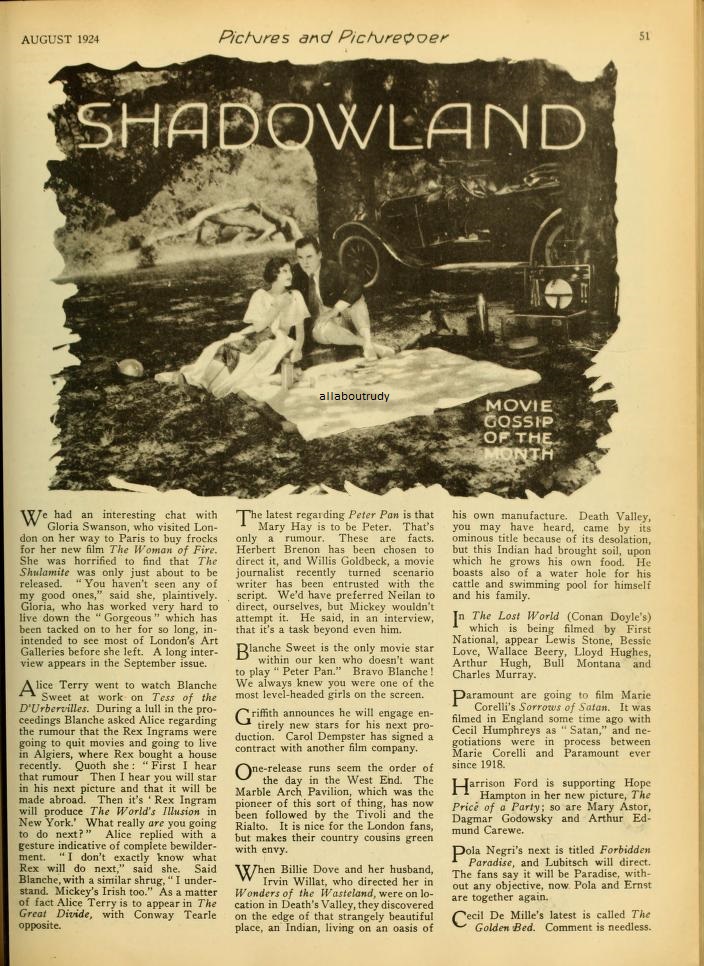
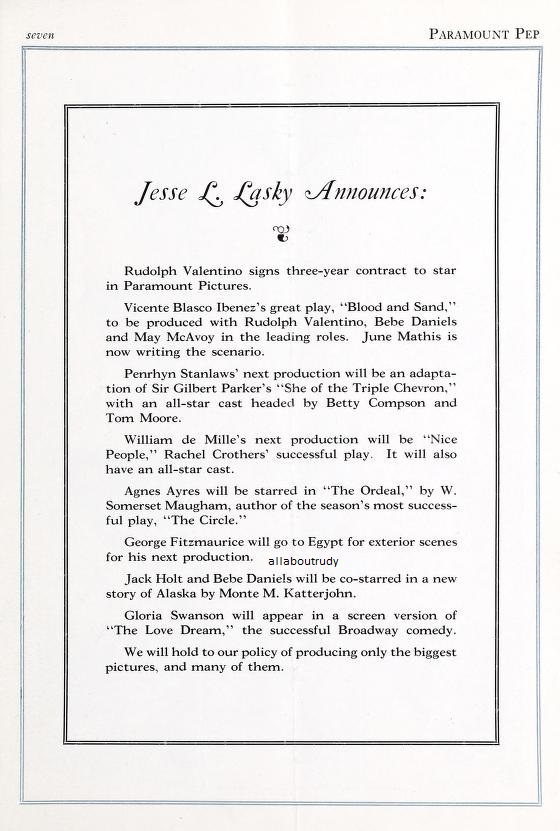
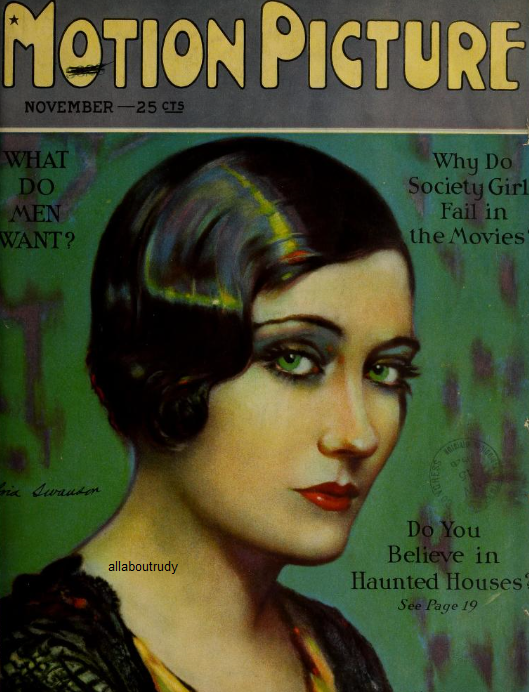
1926 – Price of Fame
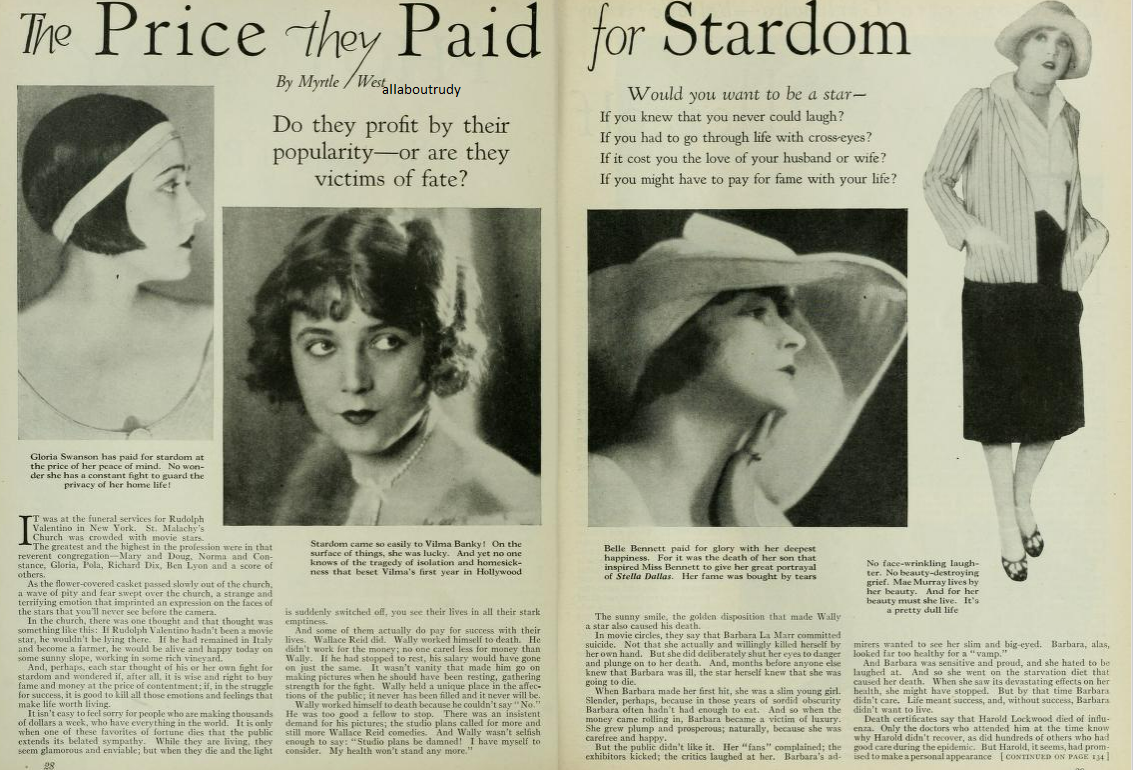
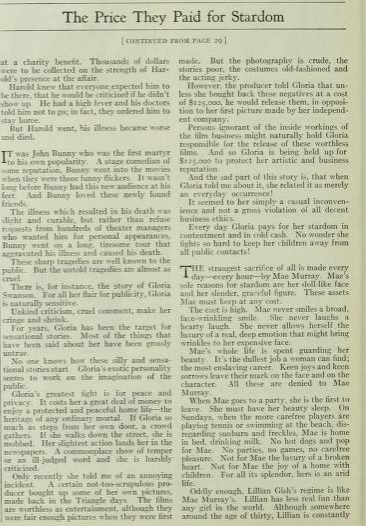
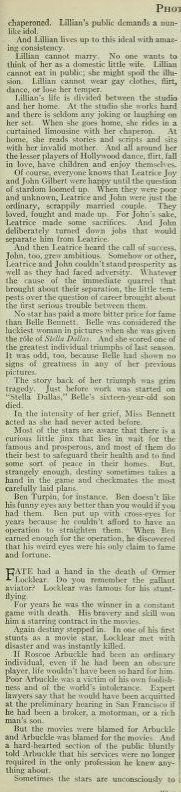
Categories: Uncategorized
Tags: Death of Rudolph Valentino, Gloria Swanson, Mae Murray, Vilma Banky
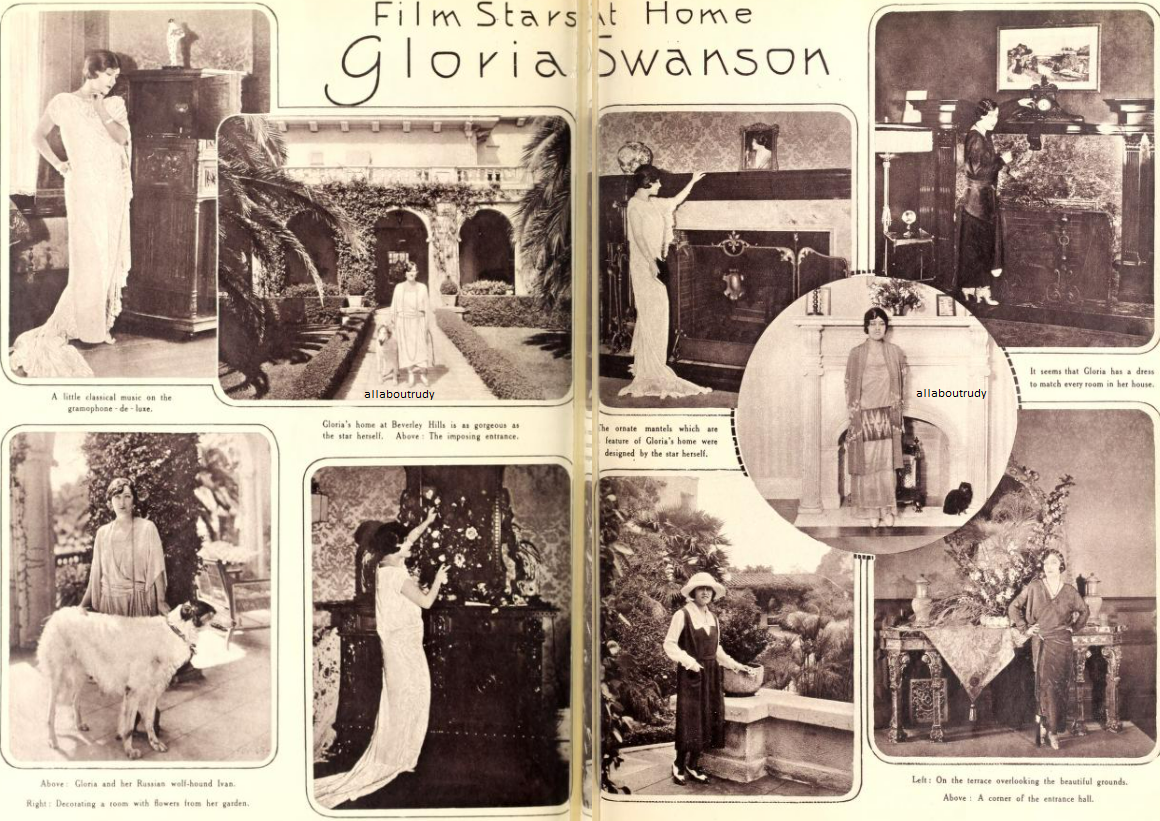
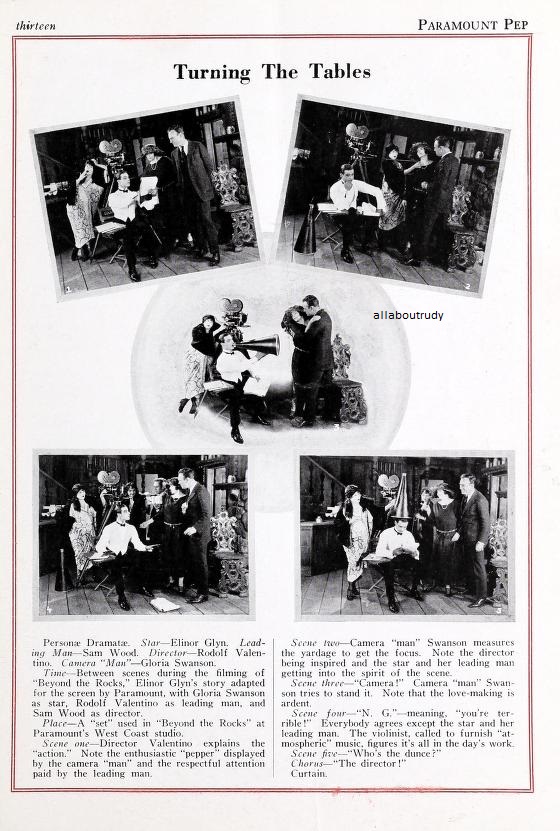
1920’s – Gloria Swanson Versus Pola Negri
“According to Irwin Zeltner (1971), Hollywood has had many famous feuds, but not cam compare with the feud between two 1920’s silent film stars Gloria Swanson and Pola Negri. At the time, both were two of the most exotic women this town had known and experienced. The battleground was Paramount Studio in which their movies were made. When I first met Gloria Swanson, I was a bit startled by her voice. It was anything but musical. She was charming, but I quickly noted she spoke with an unmistakable midwestern accent. My first impression of her was she appeared tiny. Reared in Chicago by her U.S. Army officer father, in her early teens she was employed as ribbon clerk in a store not far from the stockyards. Somehow, like so many other famous discoveries, she landed a job with Mack Sennett Studios. She was standing in the doorway of a shack on the Sennett lot one day, when the great star maker Cecil B. Demille chanced by. DeMille, as he told me later, did a double-take and his intuitive perception told him this young lady had personality, charm, and appearance wholly distinctive. In a short while Miss Swanson was before the DeMille camera clothed in costumes that then were a shock to Hollywood. Her hair was done up in bizarre styles, and in a few lessons, she was taught to gesture with an elongated cigarette holder. The soon-to become famous Miss Swanson was thus prepared for the roles she was assigned to, and these were mostly females of questionable morals. With everything against her, she somehow remembered her public-school motto “Perseverance Wins”. How well I remember how exciting my duties were in behalf of two of her productions “Feet of Clay” and “Madame Sans Gene” released a couple of years later. These activities brought me in close contact with Miss Swanson and during one of our frequent meetings I was astonished when she spoke out most critically of Pola Negri who had appeared on the Hollywood scene to challenge Gloria’s pre-eminence as “Queen of the Movies”. “Mr. Zeltner”, she said I am the topmost female star of our industry and I cannot seem to get our Paramount Studio to subdue that Pola Negri woman, that foreigner, that gypsy. I listened carefully, as Gloria after a moments rest continued her tirade. Her eyes glinted, and she was relentless and more sharply demanding than ever. It was not long in coming a showdown with Paramount Studio officials and Adolph Zukor a kingly little man who was President. In his effort to calm the tempestuous Miss Swanson, Zukor offered her a contract in which Paramount was to pay her upwards of one million dollars annually. But she would not give an inch. About this time, I had luncheon with Miss Swanson, and no sooner had sat down when I ventured to inquire about her latest Paramount offer. Her reply was quick “Mr. Zeltner I am forming my own production company. I am the reigning female star of the movie world and determined to remain as such”. I will make arrangements to release my pictures through an affiliation with United Artists. She would be joining Douglas Fairbanks, Mary Pickford, Charlie Chaplain, Harold Lloyd, Rudolph Valentino. It was not long, after Gloria now complete master of her fate, realized her star was glowing less brilliantly. Gloria carried her head high, persevered as was her wont and never for a moment allowed her battle with Pola Negri to lapse. Miss Negri kept up the challenge. However, it was now Hollywood History that Miss Swanson won that war, and for along time sustained her exalted position. It was producer Ernest Lubitsch, who brought the gifted Pola Negri to America and to the Paramount Studio. Here she immediately clashed with Gloria Swanson. I had the pleasure of meeting Miss Negri on the day of her arrival. This very exotic female was a genuine gypsy. Her father died in exile in Siberia after he had become involved in Poland’s fight for independence from Russia. Miss Negri in my opinion was a beautiful and talented woman. She achieved considerable success on the Warsaw stage. In Berlin, impresario Max Herinhardt directed her to state and screen stardom. Miss Negri was well-known on the European Continent as a dancer, having graduated from the Russian Imperial Ballet School. Her combined abilities were now being praised in movie and stage circles in America and juicy contracts were being offered to her. Somewhere in between Miss Negri married and then shelved a real count. The one thing, I keenly remember of Miss Negri on the day of her arrival was that she kept reminding all and sundry that she was a countess. It was only natural for Lubitsch, to star her in his epic “Gypsy Blood”. This of course, was produced by Paramount Studio. Her role was that of a sultry vamp, and the picture was a box-office success. Soon as the cameras started to grind on this picture, and all through production her famous clash with Gloria Swanson on the same lot flared and it forthwith, grew in intensity. The battle between them both was so bad Paramount officially shifted Gloria to the East Coast Studio. Later when they sent her to Paris, one of her first achievements was to acquire a titled husband a marquis. Now her fight with Miss Negri was really joined. While this was all going on, Miss Negri was succeeding in turning everyone in Hollywood against her. She held everyone and everything in contempt. She avoided all social contacts, remaining in solitude and her music and literature and an occasional visit from a European friend. Miss Negri found herself completely rejected and she took great comfort in the romance and love that quietly existed between her and Rudolph Valentino. Incidentally, I was one of only a few close friends of Rudy’s to know of this romance. When word came to Miss Negri in Hollywood the Latin Lover was on his deathbed, she made a transcontinental dash to be at his bedside. It is true among Valentino’s last words were “If she does not get here in time, tell her I love her”. This message which she received in Hollywood, gave her license to display great grief and some have said was laying it on too thick. About this time, her popularity started to rapidly decline, and Paramount Studios found it hard to sell her films. Heroic efforts were made to remold the temptress image, but everything fizzled. Abruptly she went back to Germany, where she was understood and admired. Again, she married to a fake Prince and I was not surprised by the news at all. I received a cable invitation to come to Germany. This and a later letter detailed her desire for American promotional campaigns for her pictures. She was frank enough to state our methods applied to her German Films would rebound in her favor in the U.S. and this she wanted more than anything else. Even though she was offering me an amount more than what I was currently earning I respectfully declined. My regard for Pola as an actress never wavered and nor my respect until one day, I received authentic information from a remarkably close friend in American news that Miss Negri was linked with Adolf Hitler. My friend queried her on this, and she never denied the association with the Fuhrer. Her only comment was that there had been many prominent men in her life, with Valentino heading the list.”
Categories: Uncategorized
Tags: Gloria Swanson, Pola Negri, Rudolph Valentino
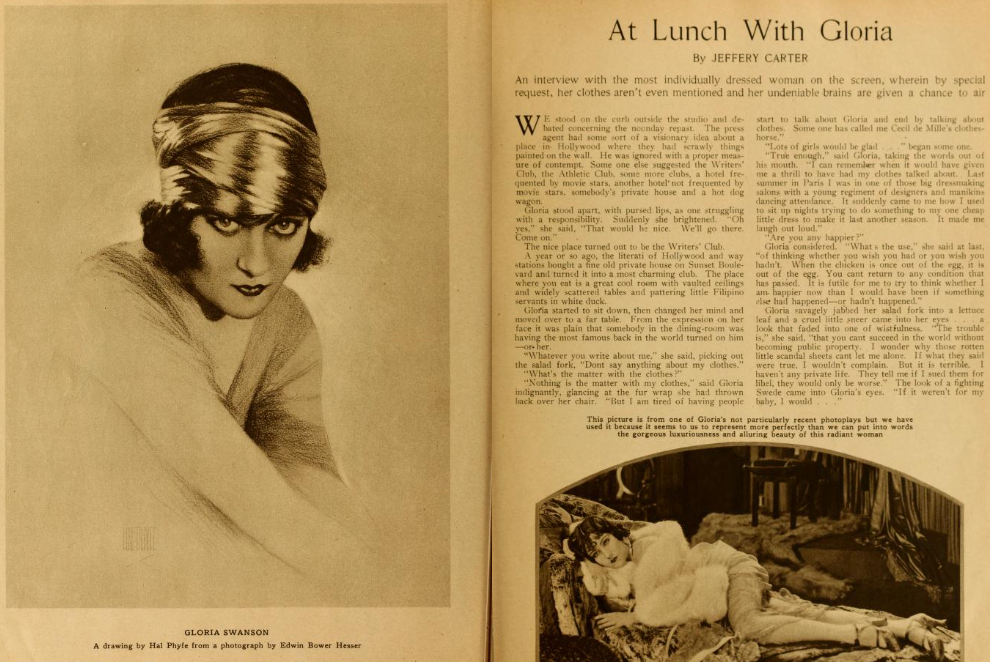

1981 – Gloria Swanson Receipe

Gloria Swanson’s Potassium Broth
Ingredients
- string beans, chopped
- outer green stalks of celery, chopped
- zucchini, chopped
- few leaves Swiss chard, chopped
- spring or mountain water
Directions
- Wash all the vegetables.
- Measure 1 cup chopped vegetables per 2 cups spring water. Do not use tap water!
- Cover, cook in glass pan or pressure cooker, simmering until the celery is tender.
- Allow the broth to cool to room temperature.
- Refrigerate in large screw-type glass jars.
“‘Drink the broth every few hours, hot or cold. It tastes sweet, as all the natural flavors of the food come out. It’s one of the best cleaners I know.”
Categories: Uncategorized
Tags: Gloria Swanson
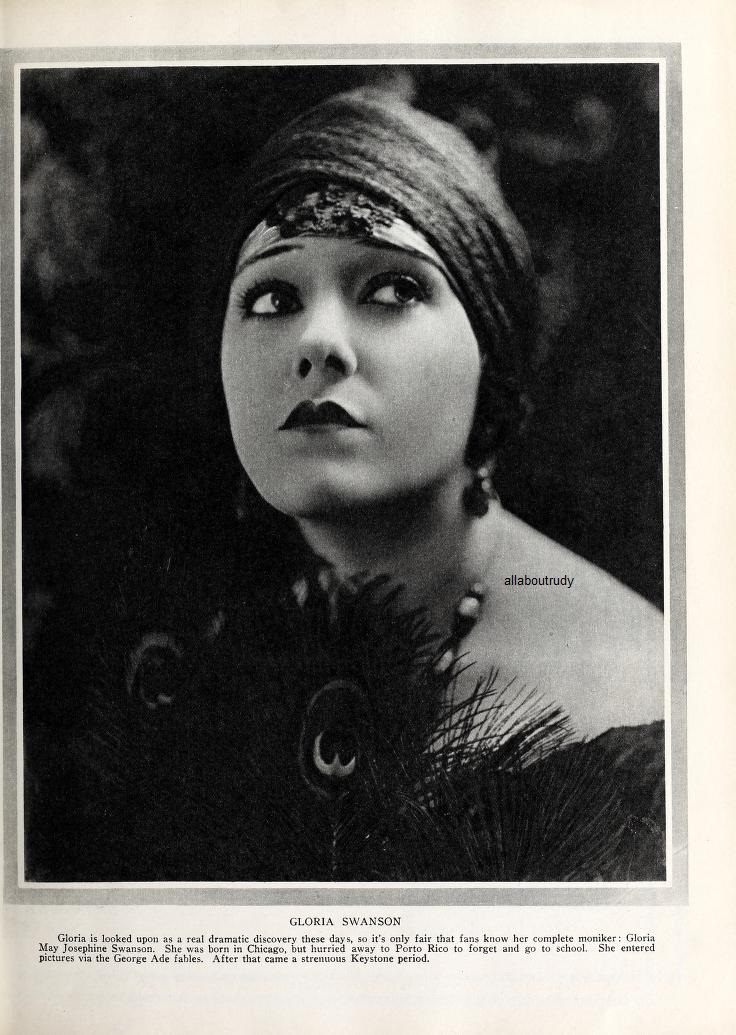
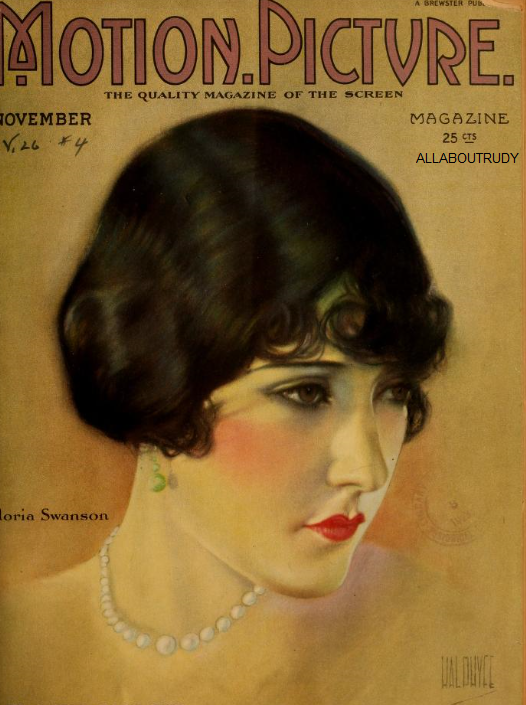
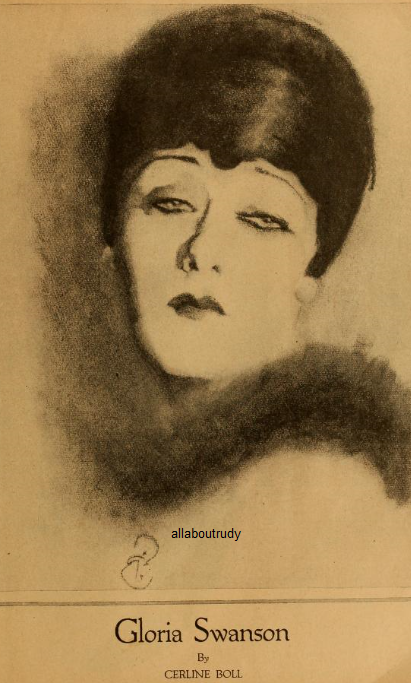
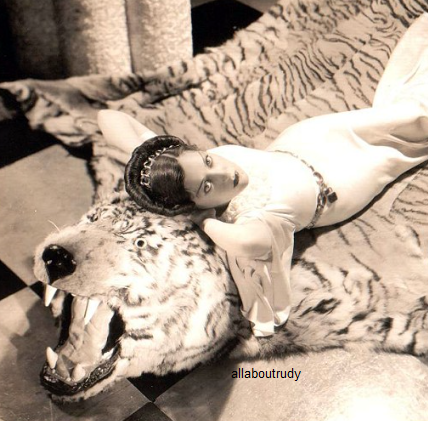

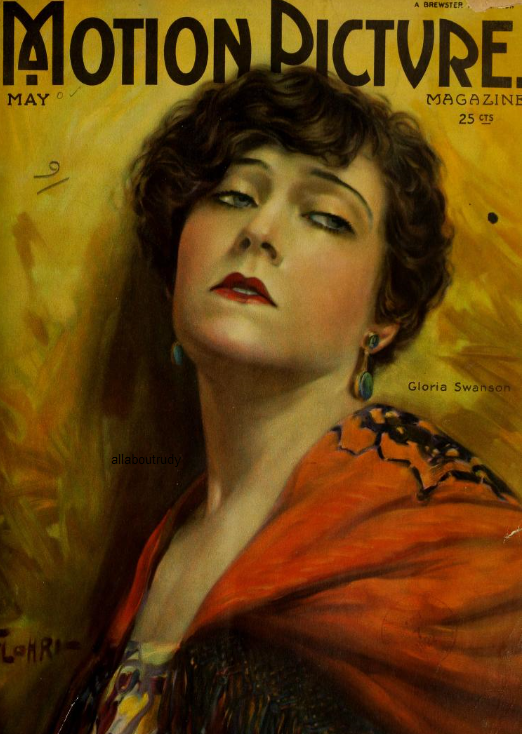

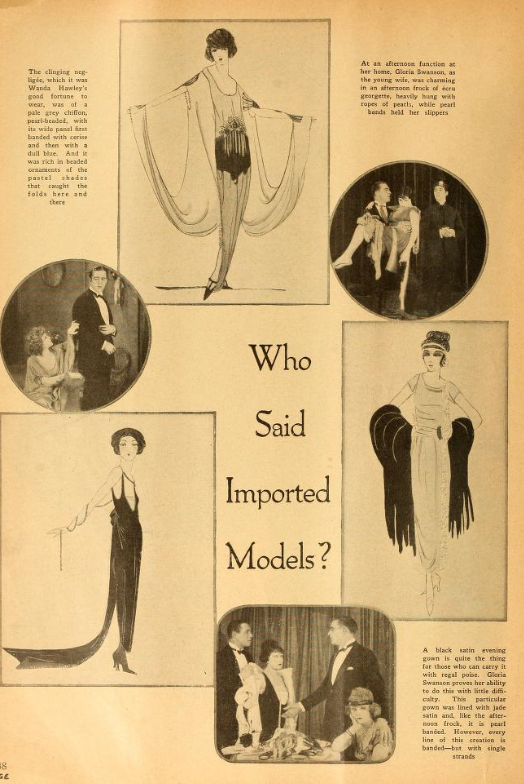
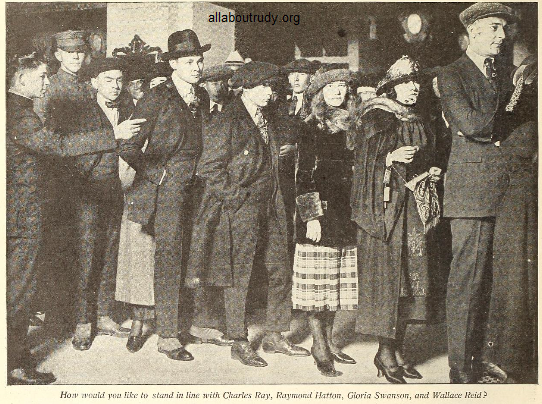
24 Nov 1924 – Movie Review “Sainted Devil”
|
Categories: Uncategorized
Tags: A Sainted Devil, Gloria Swanson, Rudolph Valentino
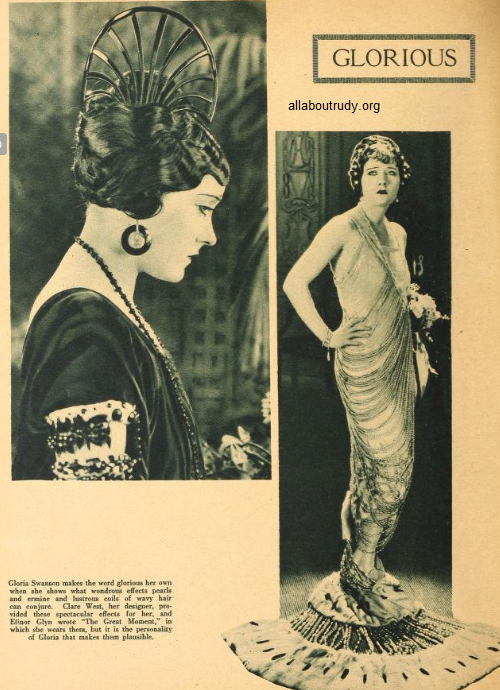
1981 – Cake Baking with Gloria Swanson
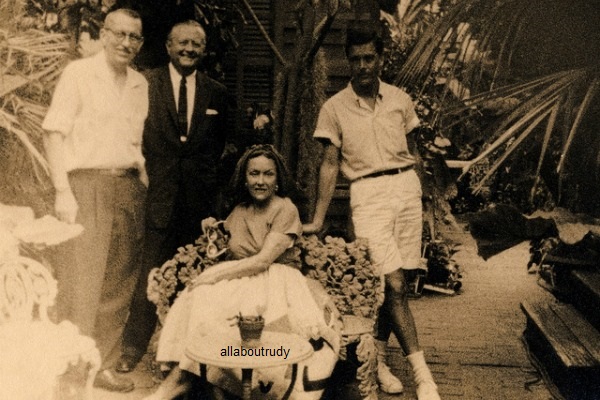
Gloria Swanson’s Butterless Devil’s Food Cake
Ingredients
5 cups unsweetened chocolate powder
1 cup milk
4 eggs, separated
1.5 cups flour
1 teaspoon baking powder
1.5 cups sugar
Icing or jam
Preheat oven to 350 degrees. Dissolve chocolate in the warmed milk and let cool. Beat egg yolks with sugar then add to the chocolate mixture. Mix flour and baking powder into a separate bowl and add gradually to the chocolate. Whip egg whites until stiff, and gently fold into the chocolate mixture. Divide between two cake pans and bake at 350 degrees for 45 minutes. Allow to cool slightly, then turn out onto cooling trays. When cake is cold, sandwich layers together with icing or jam.
Categories: Uncategorized
Tags: Gloria Swanson
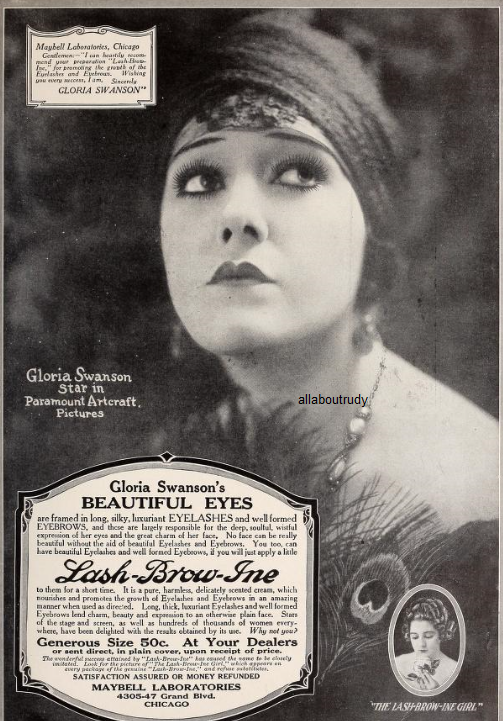
Mar 1920 – Gloria Swanson Maybelline Star
Categories: Uncategorized
Tags: Gloria Swanson, Maybelline
1920’s – Gloria Swanson Versus Pola Negri
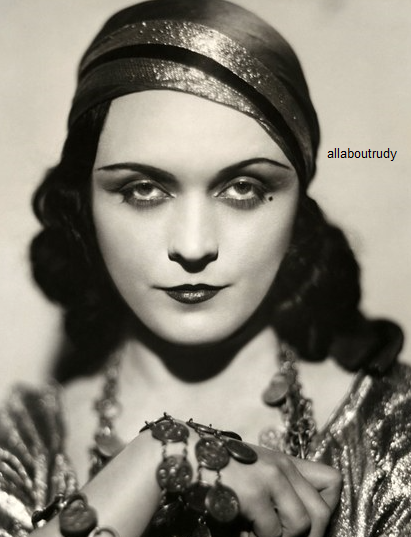
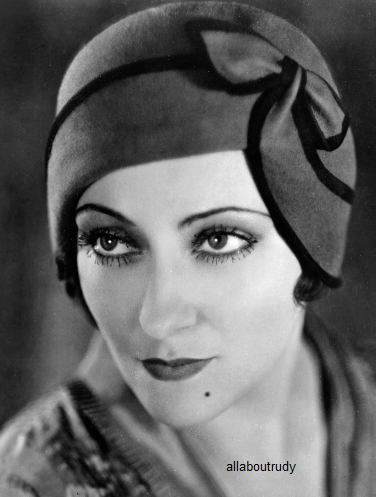
According to Irwin Zeltner (1971), “Hollywood has had many famous feuds, but cannot compare with the feud between two 1920’s silent film stars Gloria Swanson and Pola Negri. At the time, both were two of the most exotic women this town had known and experienced. The battleground was Paramount Studio in which their movies were made. When I first met Gloria Swanson, I was a bit startled by her voice. It was anything but musical. She was charming, but I quickly noted she spoke with an unmistakable midwestern accent. My first impression of her was she appeared tiny. Reared in Chicago by her U.S. Army officer father, in her early teens she was employed as ribbon clerk in a store not far from the stockyards. Somehow, like so many other famous discoveries, she landed a job with Mack Sennett Studios. She was standing in the doorway of a shack on the Sennett lot one day, when the great star maker Cecil B. Demille chanced by. DeMille, as he told me later, did a double-take and his intuitive perception told him this young lady had personality, charm, and appearance wholly distinctive. In a short while Miss Swanson was before the DeMille camera clothed in costumes that then were a shock to Hollywood. Her hair was done up in bizarre styles, and in a few lessons, she was taught to gesture with an elongated cigarette holder. The soon-to become famous Miss Swanson was thus prepared for the roles she was assigned to, and these were mostly females of questionable morals. With everything against her, she somehow remembered her public-school motto “Perseverance Wins”. How well I remember how exciting my duties were in behalf of two of her productions “Feet of Clay” and “Madame Sans Gene” released a couple of years later. These activities brought me in close contact with Miss Swanson and during one of our frequent meetings I was astonished when she spoke out most critically of Pola Negri who had appeared on the Hollywood scene to challenge Gloria’s pre-eminence as “Queen of the Movies”. “Mr. Zeltner”, she said I am the topmost female star of our industry and I cannot seem to get our Paramount Studio to subdue that Pola Negri woman, that foreigner, that gypsy. I listened carefully, as Gloria after a moments rest continued her tirade. Her eyes glinted, and she was relentless and more sharply demanding than ever. It was not long in coming a showdown with Paramount Studio officials and Adolph Zukor a kingly little man who was President. In his effort to calm the tempestuous Miss Swanson, Zukor offered her a contract in which Paramount was to pay her upwards of one million dollars annually. But she would not give an inch. About this time, I had luncheon with Miss Swanson, and no sooner had sat down when I ventured to inquire about her latest Paramount offer. Her reply was quick “Mr. Zeltner I am forming my own production company. I am the reigning female star of the movie world and determined to remain as such”. I will make arrangements to release my pictures through an affiliation with United Artists. She would be joining Douglas Fairbanks, Mary Pickford, Charlie Chaplain, Harold Lloyd, Rudolph Valentino. It was not long, after Gloria now complete master of her fate, realized her star was glowing less brilliantly. Gloria carried her head high, persevered as was her wont and never for a moment allowed her battle with Pola Negri to lapse. Miss Negri kept up the challenge. However, it was now Hollywood History that Miss Swanson won that war, and for along time sustained her exalted position. It was producer Ernest Lubitsch, who brought the gifted Pola Negri to America and to the Paramount Studio. Here she immediately clashed with Gloria Swanson. I had the pleasure of meeting Miss Negri on the day of her arrival. This very exotic female was a genuine gypsy. Her father died in exile in Siberia after he had become involved in Poland’s fight for independence from Russia. Miss Negri in my opinion was a beautiful and talented woman. She achieved considerable success on the Warsaw stage. In Berlin, impresario Max Herinhardt directed her to state and screen stardom. Miss Negri was well-known on the European Continent as a dancer, having graduated from the Russian Imperial Ballet School. Her combined abilities were now being praised in movie and stage circles in America and juicy contracts were being offered to her. Somewhere in between Miss Negri married and then shelved a real count. The one thing, I keenly remember of Miss Negri on the day of her arrival was that she kept reminding all and sundry that she was a countess. It was only natural for Lubitsch, to star her in his epic “Gypsy Blood”. This of course, was produced by Paramount Studio. Her role was that of a sultry vamp, and the picture was a box-office success. Soon as the cameras started to grind on this picture, and all through production her famous clash with Gloria Swanson on the same lot flared and it forthwith, grew in intensity. The battle between them both was so bad Paramount officially shifted Gloria to the East Coast Studio. Later when they sent her to Paris, one of her first achievements was to acquire a titled husband a marquis. Now her fight with Miss Negri was really joined. While this was all going on, Miss Negri was succeeding in turning everyone in Hollywood against her. She held everyone and everything in contempt. She avoided all social contacts, remaining in solitude and her music and literature and an occasional visit from a European friend. Miss Negri found herself completely rejected and she took great comfort in the romance and love that quietly existed between her and Rudolph Valentino. Incidentally, I was one of only a few close friends of Rudy’s to know of this romance. When word came to Miss Negri in Hollywood the Latin Lover was on his deathbed, she made a transcontinental dash to be at his bedside. It is true among Valentino’s last words were “If she does not get here in time, tell her I love her”. This message which she received in Hollywood, gave her license to display great grief and some have said was laying it on too thick. About this time, her popularity started to rapidly decline, and Paramount Studios found it hard to sell her films. Heroic efforts were made to remold the temptress image, but everything fizzled. Abruptly she went back to Germany, where she was understood and admired. Again, she married to a fake Prince and I was not surprised by the news at all. I received a cable invitation to come to Germany. This and a later letter detailed her desire for American promotional campaigns for her pictures. She was frank enough to state our methods applied to her German Films would rebound in her favor in the U.S. and this she wanted more than anything else. Even though she was offering me an amount more than what I was currently earning I respectfully declined. My regard for Pola as an actress never wavered and nor my respect until one day, I received authentic information from a remarkably close friend in American news that Miss Negri was linked with Adolf Hitler. My friend queried her on this, and she never denied the association with the Fuhrer. Her only comment was that there had been many prominent men in her life, with Valentino heading the list”.
Reference:
Zeltner, I. (1971). What the stars told me: Hollywood in its Heyday. Exposition Press.
Categories: Uncategorized
Tags: Gloria Swanson, Irwin Zeltner, Pola Negri, Rudolph Valentino
2 Apr 1922 – F. C. Parker to Invite Gloria Swanson and R. Valentino to Come Here
Categories: Uncategorized
Tags: Beyond the Rocks, Gloria Swanson, Rudolph Valentino
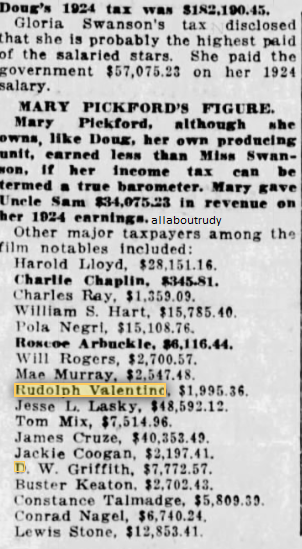
1950 – Did Valentino Prefer Tile to Tango On?
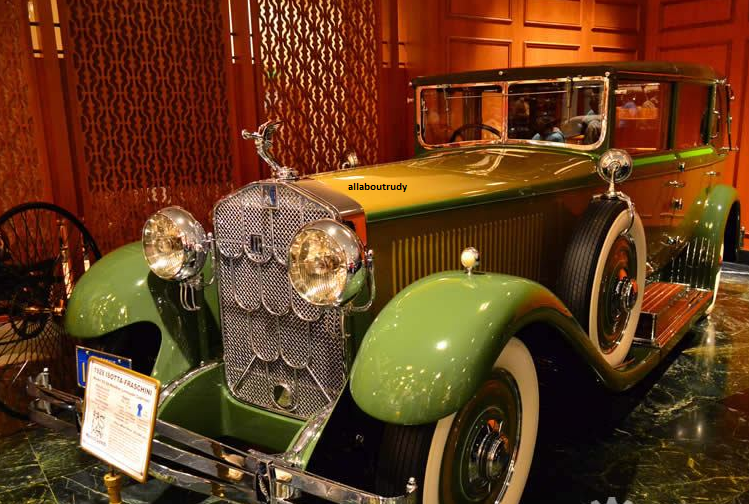
In 1950, Gloria Swanson, a former costar of Rudolph Valentino starred in the academy award nominated movie titled Sunset Boulevard about a faded silent film legend named Norma Desmond. Throughout the movie there are several scenes that refer to Valentino. The first is her 1929 Italian luxury automobile an Isotta-Fraschini 8A, for $28,000. This car symbolized luxury and elegance in the Silent Film world and Norma (Gloria) said this was the same type of car Valentino owned. The car used in Sunset Boulevard is now displayed in Museo Nazionale dell ‘Automobile in Turin.
The second is Norma and Joe (William Holden) dance the tango together. To shoot the tango, cinematographer John Seitz used a device called a Dance Dolly, which amounted to a sort of moveable platform on wheels. Nothing special there. But when you learn that Seitz first introduced the technique to shoot Valentino dancing the tango in The Four Horsemen of the Apocalypse, you might be more than a little impressed.
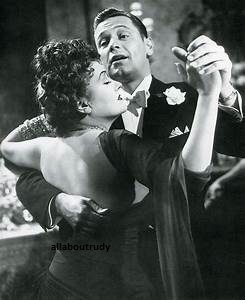
“Valentino said there’s nothing like tile for a tango!” — Norma Desmond to Joe Gillis in Sunset Boulevard (1950)…
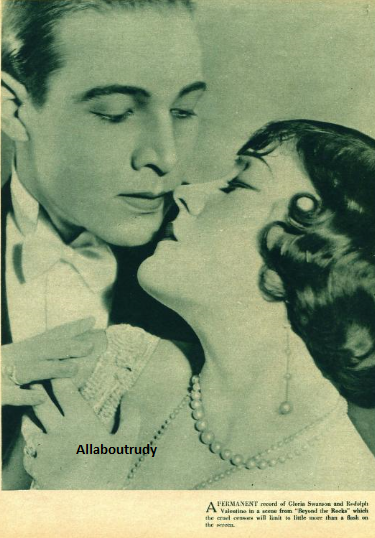
Research shows there is nothing that truly says Valentino preferred tile to tango. In 1922, Gloria Swanson and Rudolph Valentino did dance the tango together in the silent film “Beyond the Rocks”. So I would like to believe Valentino did prefer tile to tango on.
Categories: Uncategorized
Tags: Gloria Swanson, Rudolph Valentino, Sunset Boulevard
1919 – Rambova Costume Design
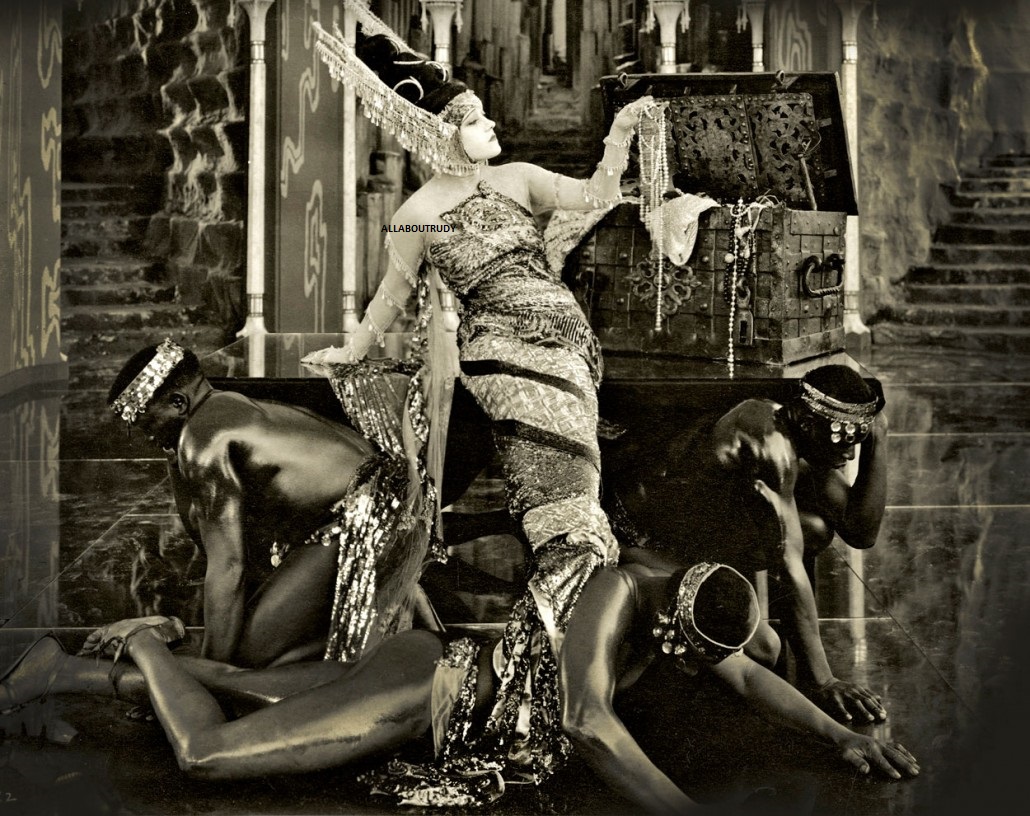
The costume designer is Natacha Rambova featuring one of her early designs and worn by Gloria Swanson in “Don’t Change Your Husband”.
Categories: Uncategorized
Tags: Gloria Swanson, Natacha Rambova
1924 – Superstitious Movie Folk
Agnes Ayres does not like to have anybody sing in her dressing room. But her chief faith in luck is bound up in a wonderful Columbia Clock which has been in her family for years. It is a marvelous mechanism, being made entirely of wood and although of a great age is still running. Miss Ayres firmly believes that her success depends upon the possession of this clock, and so carefully, does she guard the treasure she will not even allow it to be photographed. Her movie colleague, Rudolph Valentino has declared to friends he has no superstitions. But one might wonder why he waited until 14 March to be married to the delightful Natacha Rambova when he could of done so on the 13th as well. Perhaps the fascinating Mrs. Valentino objects to the fatal number. Who knows might be because his first wedding ceremony took place on 13 May. Douglas Fairbanks, Sr. has no faith in crystals or superstitions. Gloria Swanson loves black cats and so tender was her care of the original two pets of the Lasky Studio they sent for all their friends, in-laws, and descendants until 327 cats now live on the lot. This is lucky for the butcher and the cats. Theodore Kostloff treasures a pre-war ten rouble gold piece, now worth $2 million in paper money. Bebe Daniels grandmother has a wonderful collection of dolls and few people know this is a direct result of Bebes belief that good luck follows the purchase of a new doll. Lila Lee is very superstitious about the beginning day of a new film. If she leaves her home in the morning, forgetting something important, she will not turn back herself, but send a messenger after she reaches the studio.
Categories: Uncategorized
Tags: Bebe Daniels, Gloria Swanson, Lila Lee, Natacha Rambova, Rudolph Valentino, Theodore Kosloff
June 1923 – Commediane Has Never Seen Valentino
Categories: Uncategorized
Tags: Gloria Swanson, Rudolph Valentino

1919 – Gloria Swanson’s costume designed by Natacha Rambova.
Categories: Uncategorized
Tags: Gloria Swanson, Natacha Rambova
27 Mar 1953 – Gloria Swanson Renting Former Co-Star Home
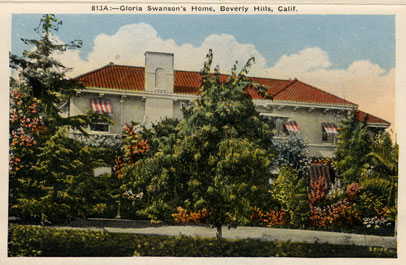
Gloria Swanson is living in Falcon Lair, the old Rudolph Valentino luxurious mansion while she forgets movies and takes up television. Miss Swanson was imported again to Hollywood, but this time to narrate and star in a Crown Theatre television film series for Bing Crosby Productions, and for her brief stay she rented the Valentino Home. In “Sunset Boulevard” the film that sparked her movie comeback, she played a one-time movie queen who lived in a fabulous home of the silent movie era. Thus, I drove up the hill to the Valentino mansion to see if real life was imitating the movies. the Italian-style Valentino house looks like a chateau from the bottom of the hill. But its actually a tidy nine-room house and there isn’t even a swimming pool for Bill Holden to float in, as in “Sunset Boulevard”. But there is an empty guest house, over the garage like in the movie. Miss Swanson wasn’t wearing dark glasses and a long cigarette holder, but a coat dress billowing with petticoats. “Yes, I’d love to do another beautiful picture, but it would just be compared to Sunset. “Three in Bedroom C” was and its like comparing soufflé to steak. I took “Sudden Fear” to Paramount and they turned it down, but well that’s past. “I’ll never do another play either and if its a failure its a waste of time and if its a success, your tied up for another year”. In her television movie, “My Last Duchess” she once again portrays a faded movie star. “This is the tenth actress I’ve played” she smiled. “I’m like the proverbial butler in the movies. I don’t know why people think of me as portraying actresses”. after the TV series, Miss Swanson will return to New York City to her dress business, which is branching into hats, hosiery, perfume and health bread. Also, she will write her autobiography from 1920-1930 “the rise and fall of a legend”. The Gloria Swanson the movie studios created is as amusing and startling to me as everyone else. “You know, the stories about my throwing cats over Pola Negri’s transom But those were exciting days, people had dreams and now the movies have been regimented. Nobody dreams anymore, said the lady of the Valentino house”. The last time, I visited this house, was to attend a séance by some fake mediums who put in a call to Valentino’s ghost and there was no answer. The next tenant, Miss Swanson said was heiress Doris Duke. Miss Duke promised parties not séances.
Categories: Uncategorized
Tags: Falcon Lair, Gloria Swanson
26 Nov 1922 – Best Seller
Gloria Swanson rivals Rudolph Valentino as a “Best Seller” when it comes to film popularity.
Categories: Uncategorized
Tags: Gloria Swanson, Rudolph Valentino
1926 Marriage Grows Cold Gossip
The papers leaped at the story which he gallant Rudy pulled as the cause of the separation which, by the time this appears, will have developed into a Parisian divorce decree. Natacha, he says, was not a home body. She didn’t want children. She would not cook the spaghetti. She was fond of dogs. She wanted to work. His reflected glory did not satisfy her. She wanted her own career. Bunk! Bunk served with piffle sauce. Publicity for Rudy. But old stuff. Do you remember the way Gloria Swanson set the dear old souls of Paris wild over her when she said she wanted five or six children? I believe she meant it, because I have seen her with her two children. She adores them. Her own baby, little Gloria, was not enough, and so she adopted a boy and named him Joseph Swanson, after her father. But I have never heard of Mr. Valentino hanging around an orphan asylum, and I cannot quite visualize the picture of the sheik walking the floor of a cold California night crooning the junior to sleep. It was not, in my opinion, playing the game to midst an effort for sympathy and publicity at the expense of the woman, even if it were true – which I doubt. And we must hand Mrs. Valentino credit for her attitude in the whole matter. She would not live with him and his friends, told him so, got out, leaving her belongings to him, and went on her way, avoiding any opportunity to publicise her- self at his expense. Divorce is no joking matter, but I cannot hold back a little snicker at Rudy crying on the shoulders of the public and yearning for kiddies. THERE is nothing vindictive or downright mean about Valentino. He’s a pleasant chap and a fine actor, whose delusion is that he is also a business man. Natacha has been criticized for managing his business affairs. But we have got to admit that in this case her management was much more commendable than his. To add to her troubles, the F. B. O. Company, for whom Miss Rambova made a picture because she needed the money, changed its name to “When Love Grows Cold” after it was finished, with the frank purpose of capitalizing her marital troubles. Miss Rambova protested that it would harm her and create the impression that she was the one who was profiting by deceiving the public into believing it was a screen revelation of their love wreck.
Categories: Uncategorized
Tags: Gloria Swanson, Mrs. Valentino, Natacha Rambova, Rudolph Valentino
Leave a comment
22 Mar 1953 – Valentinos Lair now Gloria Swansons
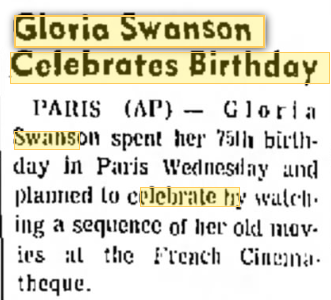
Gloria Swanson is living in Falcon’s Lair the old Rudolph Valentino mansion, while she forgets movies and takes up television. Miss Swanson was imported again to Hollywood, but this time to narrate and star in a Crown theater Television Film series for Bing Crosby Productions, and for her brief stay she rented the Valentino home. In “Sunset Boulevard” the film that sparked her movie comeback, she played a one-time movie queen who lived in a fabulous home of the silent film era. Thus I drove up the hill to the Valentino manse in Benedict Canyon to see if real life was imitating the movies. The Italian-style mansion looks like a chateau from the bottom of the hill, but its actually a tidy nine-room place. There isn’t even a swimming poll for Bill Holden to float in. But there’s an empty guest house over the garage like in the movie. Miss Swanson wasn’t wearing dark glasses and a long cigarette holder, but a coat dress billowing with petticoats. “Yes I’d love
to do another beautiful picture, but it would just be compared to Sunset Boulevard she said”. “Three in Bedroom C” was, and its like comparing soufflé to steak. I’ll never do another play either, if its a failure, its a waste of time and if its a success your tied up for a year. In her first TV movie, ‘My Last Duchess’, again she plays a faded movie star, “this is the tenth actress I’ve played she smiled”. I’m like the proverbial butler in the movies. I don’t know why people think of me as portraying actresses. After the TV series, Miss Swanson will return to NY to her dress business which is branching into hats, hosiery, perfume and health bread. She also will write the story of her life from 1920 to 1930, the rise and fall of a legend they said was me. The Gloria Swanson they created is as amusing and startling to me as everyone else she said. But those were exciting days. People had dreams in those days. Now the movies have been regimented. “Nobody
dreams anymore” said the lady of the Valentino house. “The last time I visited this mansion was to attend a séance’ by some mediums who put in a call to Valentino’s ghost. The next tenant, Miss Swanson said is heiress Doris Duke. Miss Duke promises parties not séances.
4 Jan 1925 Movie Starts placed in the One Hundred Percent Class
Fans and Exhibitors Agree that Gloria Swanson, Thomas Meighan and Rudolph Valentino are the biggest drawing cards in the industry and lead the “Regular Program Stars” in popularity. A “program star” is one who produces pictures at intervals of three or four months. The public in liking Thomas Meighan and Rudolph Valentino in the same breath, show two distinctly different sides. Thomas Meighan represents the red-blooded, two-fisted he man sort of person. The men like him because he lacks any sign of being effeminate or foppish. And the women like him because – oh, well, he’s just the kind of big, strong man women like. Valentino on the other hand, represents the great lover, the perfect escort. He dresses faultlessly, he dances divinely and makes love to perfection. He is the sort of man dreamt about by women with five children and a husband with the manners of a stevedore. He represents perfection of culture and refinement and it’s no wonder that women with a round of household duties think he’s simply grand. And flappers too, get their idea of the perfect man from the hair oil advertisements. The men don’t like Valentino so much. That is, they don’t “just adore” him. But they have to admit he’s a good actor and is there when it comes to the haberdashery. Gloria Swanson is popular with women because she represents what most women would like to be; she is the embodiment of al seductive, irresistible womanhood. She wears magnificent clothes and plays the wicked vamp. And has not almost every woman a secret desire to be exactly this? When they see Gloria beautifully gowned, faultlessly groomed, making one attractive man after another fall victim to her charms, does not Fanny Fox from Farmingdale see herself in Gloria’s place, the fascinating woman of the world, greatly desired, greatly loved? And of course the men like Gloria. She is so beautiful and so fascinating and seems to possess all the characteristics that men are attracted to – not necessarily the characteristics they look for in a wife and housekeeper, but, you know, the things that make them forget about what a sordid business life is. It was a movie magazine that first took up seriously the problem of finding out what actors and actresses were the most successful form a box office point of view. So they asked exhibitors to rate the various stars according to their ability to draw crowds. This result was rather a shock to movie fans, and many of them wrote in expressing resentment that their particular favourite was not in the ranks. So the magazine invited the fans to send in their own ratings on a chart and curiously enough the ratings were practically the same in most cases. But there were many others that fans indignantly demanded to be put at the top of the list. Many fans considered Pola Negri, Bebe Daniels, and Nita Naldi all had many strong defenders. In some other cases, the fans ratings were found to be considerably lower than the exhibitors. As we thought the fans were the enthusiastic ones, while the exhibitors were the cold, calculating ones that judge only from box office receipts. But it seems that there is a decided difference in the point of view, which makes the exhibitors seem more lenient. No player was rated at zero by an exhibitor because he judged the drawing power knowing nothing of the ones who stayed away. The fan, on the other hand, dragged down averages by giving zero to the other players whose presence in a picture would keep them away. Blanche Sweet was the only one on the fans list who received no zeros. Out of the hundred ratings compiled Barbara La Marr receiving many rating of 95 percent, but she also received many zeros.
Categories: Uncategorized
Tags: Bebe Daniels, Gloria Swanson, Nita Naldi, Pola Negri, Rudolph Valentino, Thomas Meighan
Leave a comment
6 May 1922 – Valentino’s Latest Picture
Gloria Swanson in “Beyond the Rocks” with Rudolph Valentino in the lead supporting role, will be the feature film in local theaters during the week beginning Sunday, May 7, 1922. “Beyond the Rocks” was written by Elinor Glyn, author of “Three Weeks” and was directed by Sam Wood. The new Paramount Picture is the first in which Miss Swanson and Valentino appear together, and, it is predicted, will be one of the greatest film successes of the year.
Categories: Uncategorized
Tags: Beyond the Rocks, Gloria Swanson, Rudolph Valentino, Sam Wood
1 Comment
2006 – Beyond the Rocks Review
Directed by Sam Wood; written by Jack Cunningham, based on the novel by Elinor Glyn; director of photography, Alfred Gilks; music and sound by Henny Vrienten; produced by Jesse L. Lasky; originally released in 1922 by Famous Players-Lasky and Paramount Pictures; Running time: 85 minutes. This film is not rated.
WITH: Gloria Swanson (Theodora Fitzgerald), Rudolph Valentino (Lord Bracondale), Edythe Chapman (Lady Bracondale), Alec B. Francis (Captain Fitzgerald), Robert Bolder (Josiah Brown) and Gertrude Astor (Morella Winmarleigh). Sam Woods directs Swanson and Valentino, two of the biggest stars of the era, with a light touch and keen attention to the audience’s pleasure. Swanson is a poor captain’s daughter betrothed to an unattractive older man, while Valentino is a dashing aristocrat who keeps showing up just when she needs to be saved from danger. The action moves from the rocky coast of England to the Swiss Alps on its way to the Sahara, for no reason beyond the sheer exhilaration of cinematic technique. The faces of the stars glow with life, which makes you all the more grateful that this, their only film together, has come back.
 All About Rudolph Valentino
You must be logged in to post a comment.