
Posts Tagged With: Rudolph Valentino
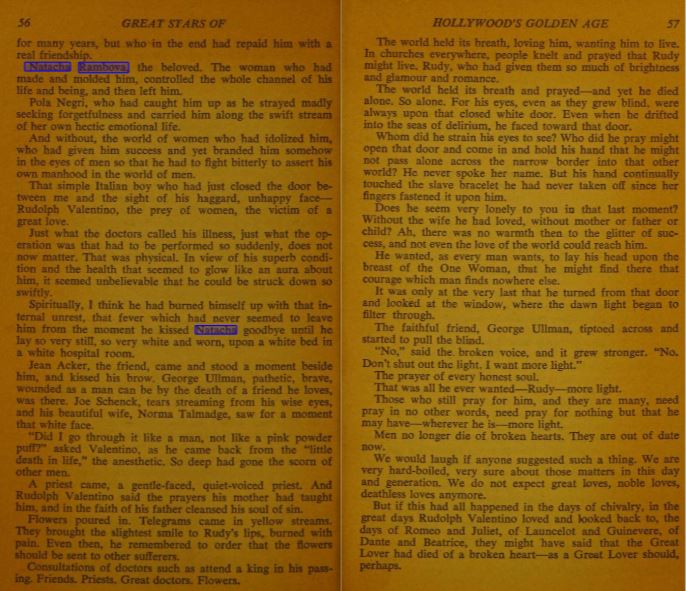
Great Stars of Hollywoods Golden Age (Natacha Rambova)
Categories: Uncategorized
Tags: Mrs. Rudolph Valentino, Natacha Rambova, Rudolph Valentino
17 Feb 1923 – An Analysis of the Stars
Beauty saith an ancient and as yet undiscovered proverb is the bunk. Rudolph Valentino than whom there is not one more soul-stirring, is not handsome in the strictest sense of the word. The back of his head is to straight up and down. Unless the camera gets him at just the right angle, his nose is too broad for beauty. Yet he is the idol of femine America. Ask a half dozen women why they find Valentino charming, and you will receive different responses. For example, one Los Angeles woman says “I think Valentino is perfectly fascinating. He looks as if you couldn’t believe a word he said to you”. “Those gorgeous eyes” another will say. Dark and enigmatic, like dull coals smouldering, yet ready to leap suddenly into passionate flame, they are undoubtedly part of his lure. His swash-buckling swagger and courtly bow so stiff and different from other American men, are other Valentino points. But probably his most potent charm, most responsible for his vogue, is his irresistable mingling of naivete and sophistication. Sometimes he looks exactly like a small boy who is being abused, so that every woman instinctively wants to pat his shiny black head and comfort him. Yet she knows perfectly well that he is not a small boy and that it would be rather like patting dynamite. Which of course, makes him very interesting.
Categories: Uncategorized
Tags: Rudolph Valentino
14 Feb 2026 – Your Virtual Dinners Date with Valentino
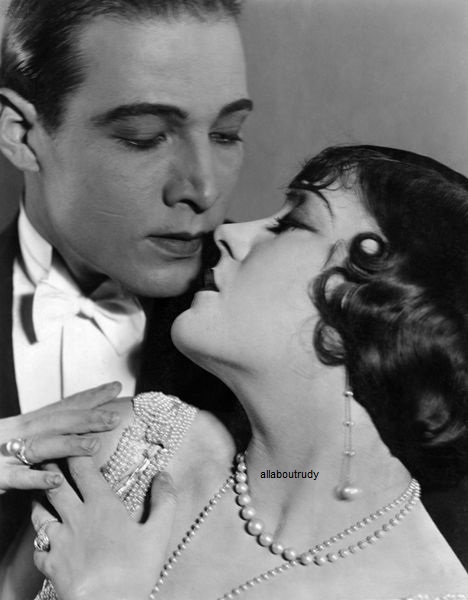
Tonight, you’re going on a virtual Valentines dinner date with the romantic and suave Rudolph Valentino. Valentine’s Day is dedicated to romance and love for friends, family, and sweethearts. It is creating special memories and showing loved ones you care with a thoughtful gesture or a kind word. A day that is more than just receiving a card, flowers, or candy. Rudolph Valentino was the ultimate romantic symbol in a time where woman wanted to be treasured and adored. He was well dressed, well spoken, and belonged to a bygone era and this evening he will be totally yours.
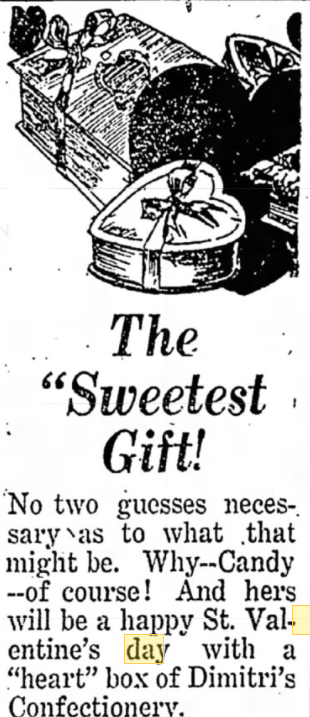
Valentine’s Day, starts early with being woke up by a doorbell ring and upon opening the door, standing right on the porch, you discover a simple bouquet of flowers in the most beautiful crystal vase with a small card tastefully inscribed with “Tonight I live for the moment, until then Happy Valentine’s Day, Rodolpho”, with a smile on your face, you take the flowers to the bedroom and put them in a place of honor. Throughout the day, were more memorable surprises, a beautiful box of chocolates and a personal chef and waiter that will prepare and serve the evening’s dinner. While evening approaches you realize how first, appearances are important, and you want to look your absolute best for Valentino. Time flies by and you decide on a vintage 1920’s outfit that shows your dinner date how much you are looking forward to a special evening of magic.
The evenings dinner setting is a living room, romantically lit by soft candlelight, surrounded by flowers and in the middle of the room was a rather large beautifully decorated antique table laden with the finest china, silverware, and crystal. Immediately you notice a place setting for one and the other place setting is a monitor mirroring the same table setting. The butler escorts you to the table, holds out your chair waiting for you to be seated and asks, “what would you like to drink”? Immediately you decide on a glass of vintage champagne and as the drink is poured you look at the screen which will soon feature the image of your dinner date. While waiting, you quickly glance down at your watch to look at the time. Suddenly you hear a noise on the screen in front of you and as you look up noticing a door open and before you in vintage dinner attire is Rudolph Valentino. He approaches his side of the table and elegantly bows low and tells you how much he is looking forward to the evening ahead. While he is being seated and starts to talk to his butler about his drink preference you realize how he is still everyone’s ideal secret lover and tonight belongs to you both. Valentino is a screen image to you, but he is very real. The meal starts out with your host asking general questions and the butler starts serving the first course. The evening progresses as each course is served. Both food and drink are perfection and so is the company. Throughout the meal, Valentino gives you his undivided attention and answers each question with true honestly. You realize how similar you both are in certain likes and dislikes bringing a smile to both of your faces. For example, you discover a love for tango music and Italian opera music. However, there was one question in the back of your mind you wanted to ask but did not know how it would be answered. So, you asked your host why a virtual dinner date versus in person? Valentino answers, for this evening, I am your reality and I wanted to create an atmosphere that surpasses any Valentine’s Day you ever experienced. His answer is something that you understand and while desert is being prepared and coffee is served you look around and feel it is all a beautiful dream and a sudden sadness appears knowing that he will soon be leaving. Valentino is in-tune to this emotion and understands more than you realize. The meal ends and the butler went over to a vintage phonograph and played slow romantic tango music. Valentino gets up out of his chair and walks over to the screen and extends his hand to you. The butler rushes over and as you get up out of your chair grab his hand and he pulls you into his side of the screen and you both slowly dance together. Yes, he feels very real to you and you can feel his well-built arms holding you close in his arms and realize there is no place you would rather be than right here in this moment in time. You slowly move as one and as the music ends you on your side of the screen once again. Valentino looks at you as though memorizing every detail of your face and says he must go. He bows low and thanks you for such a delightful evening and you thank him in return. As he starts to leave, you ask can you see him again? He responds “when you see me on the movie screen I am there or if you dream of me, I am there. But know that this evening was special for me as it was for you and if time were different then maybe things would have a different ending. But know that I treasured every minute spent with you”. Tears start to appear in your eyes, and he turned and exited through the same door he entered hours earlier. The butler gives you a handkerchief with his initials in the upper corner, and you wipe your eyes and feel sad. As magically as the evening began it ended and you slowly go back to your bedroom while everything was being taken away. While your evening ended the memories will always remain of a time spent with Rudolph Valentino.
Categories: Uncategorized
Tags: Rudolph Valentino, Virtual Valentino Dinner
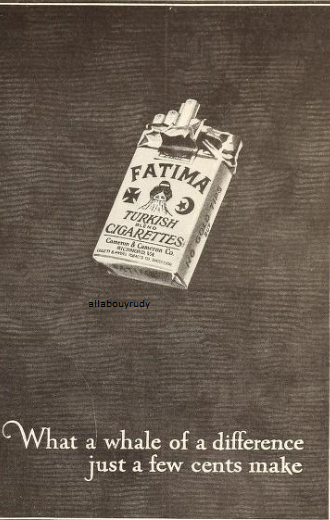
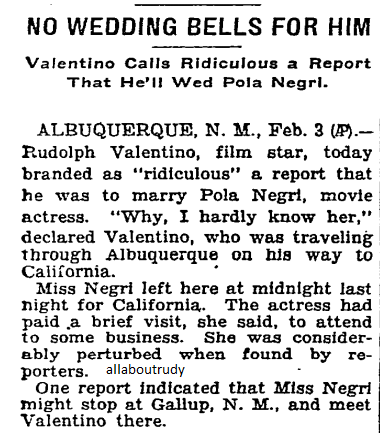
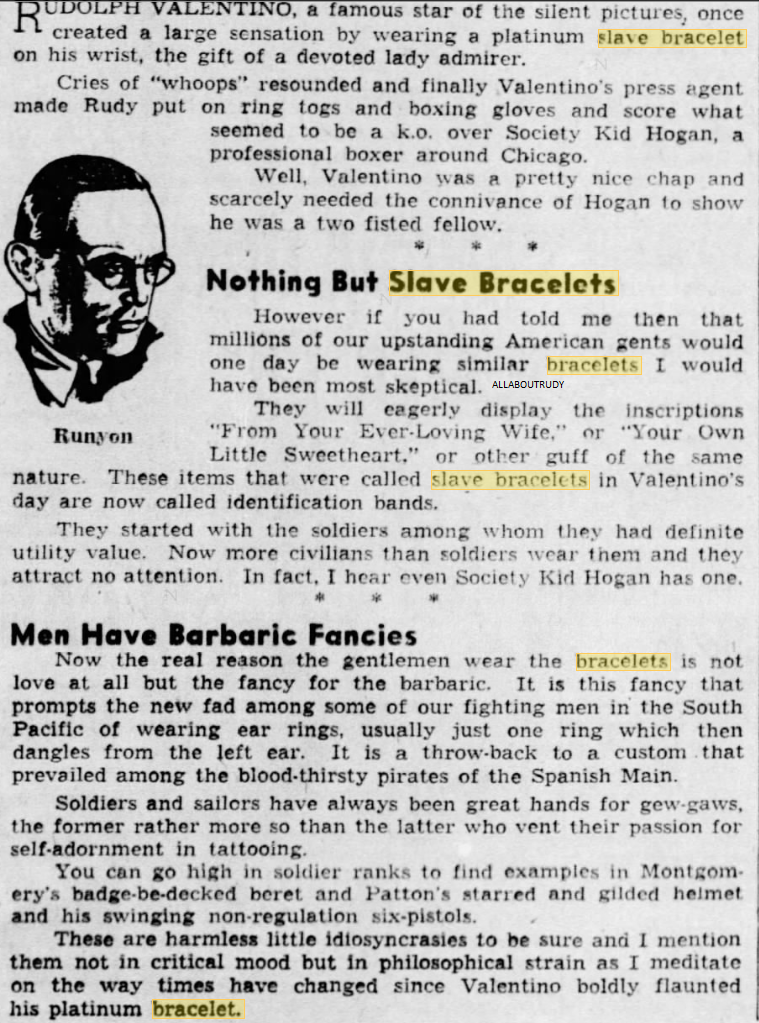
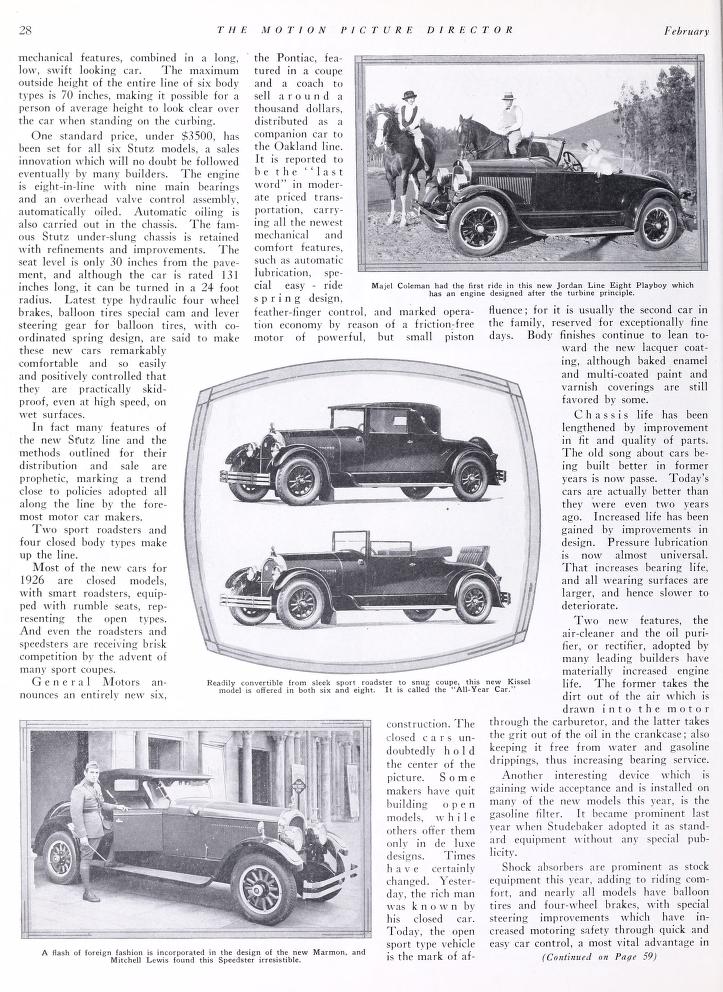
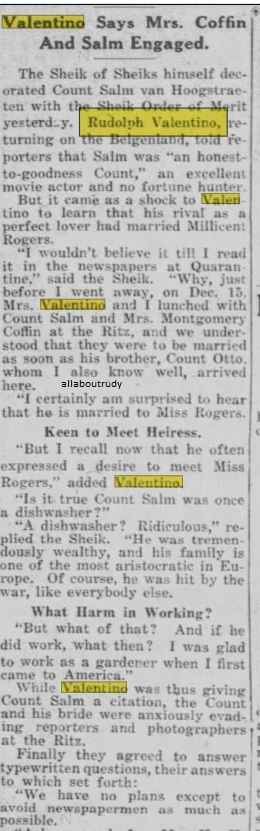
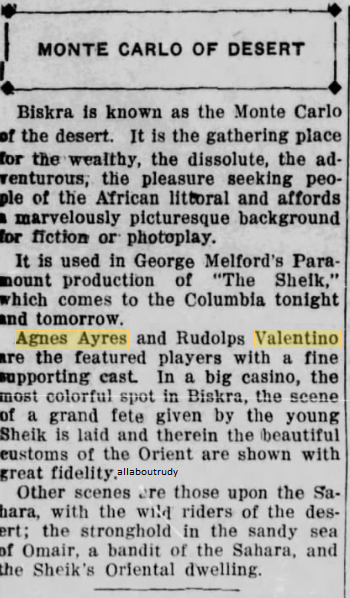
23 Jan 1922 – Monte Carlo of Desert
Categories: Uncategorized
Tags: "The Sheik", Agnes Ayres, George Melford, Rudolph Valentino
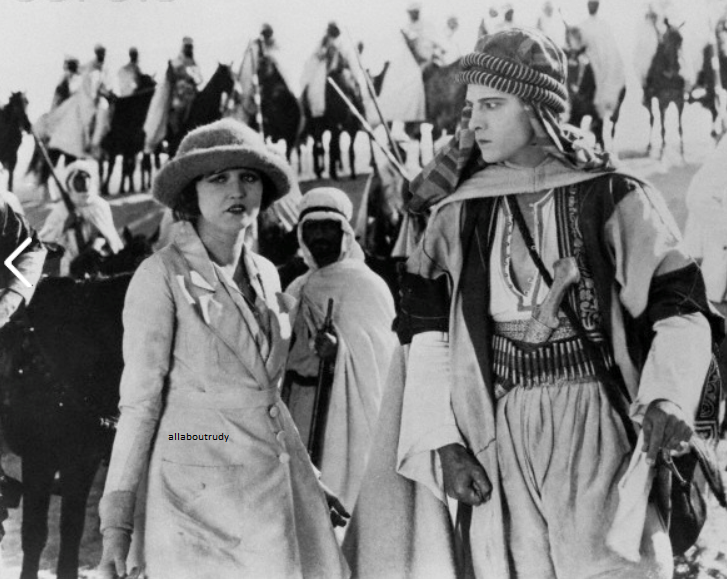
2026 – Rudolph Valentino Sites
The silent film era & it’s stars had legions of fans. Today, more are discovering the wonder of this fascinating time in Hollywood history. While this blog will be going away, I thought I would share other Rudolph Valentino sites available to fans.
YouTube @weneverforget (Rudolph Valentino)
Blog His Fame Still Lives
Facebook Groups His Fame Still Lives & We Never Forget Rudolph Valentino
Internet Archive.org
These are my personal recommendations. There are many more on Facebook.
Good Luck.
Categories: Uncategorized
Tags: Rudolph Valentino
1901 – Tango Music its Earliest Beginnings
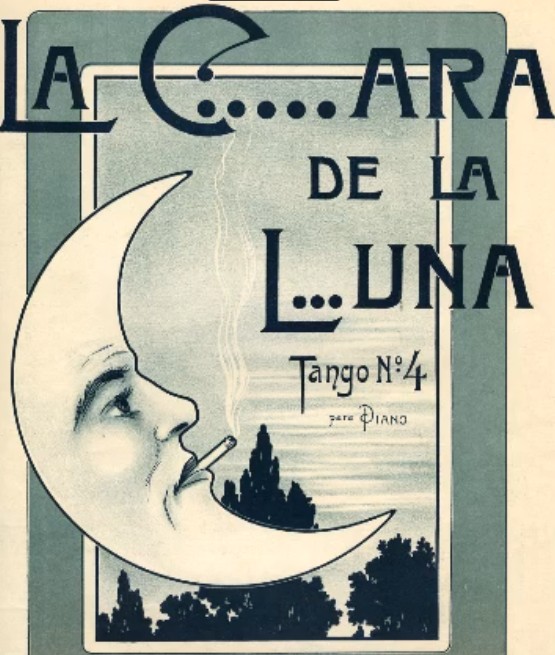
In 1901, tango was in its “infancy,” a period musicologists call the early Guardia Vieja (The Old Guard), which spanned from 1895 to 1910. During this year, the genre was transitioning from a marginalized street sound into a structured musical form. At this time, tango was primarily played by small improvised ensembles known as conjuntos. The typical trio consisted of a flute, violin, and guitar. The guitar provided the rhythmic foundation (often a habanera beat), while the flute and violin carried the melody. While the bandoneón (a German concertina) began arriving in the Río de la Plata region at the end of the 19th century, it was only just starting to replace the flute in these ensembles by 1901. Its inclusion gave tango the “dense and mournful” sound that would eventually define it. Tango was largely confined to the arrabales (slums) and conventillos (crowded tenement houses) of Buenos Aires and Montevideo. It was the music of the working class and immigrants—primarily Italian and Spanish. The Argentine upper class and the Catholic Church viewed tango as “vulgar” and “obscene” because of its association with brothels and dance halls frequented by the lower castes. he music was a raw blend of European styles (polka, mazurka), the Cuban habanera, and the Afro-Argentine candombe.
Categories: Uncategorized
Tags: Rudolph Valentino, Tango, Tango Music
1926 – Carl Raswan, Stunt Double for Rudolph Valentino Son of the Sheik
In 1893, Carl Raswan was born in Dresden. At the age of five, Carl Raswan started on a pony and through the years his interest in horses grew. In 1911, while on a trip to Greece he starts searching for the perfect horse by viewing art works and statuary. In 1921, he moves to Oakland California to make his living there. In 1926, The Kellogg-owned stallion Jadaan was ridden by Raswan in April when he served as a stunt double for Rudolph Valentino during shots requiring fast or dangerous riding in the film Son of the Sheik. In 1966, Carl Raswan died in Santa Barbara of silicosis. He was married twice and had one son and five daughters.
Categories: Uncategorized
Tags: Carl Raswan, Rudolph Valentino, Valentino Stunt Double
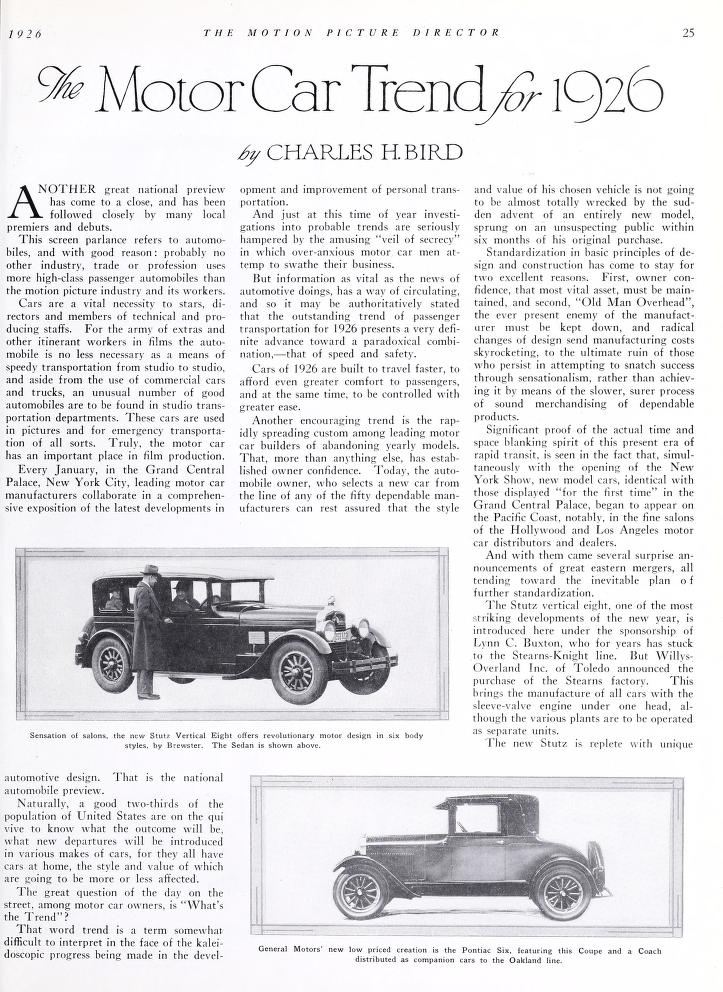

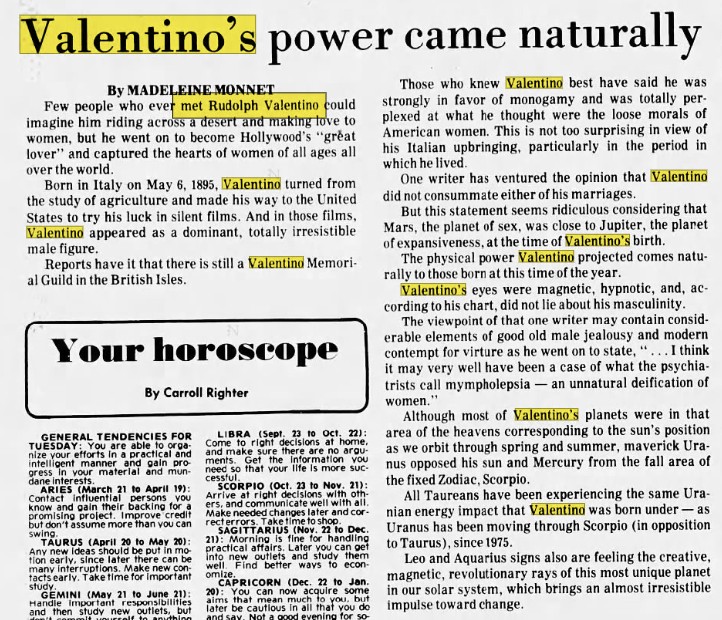
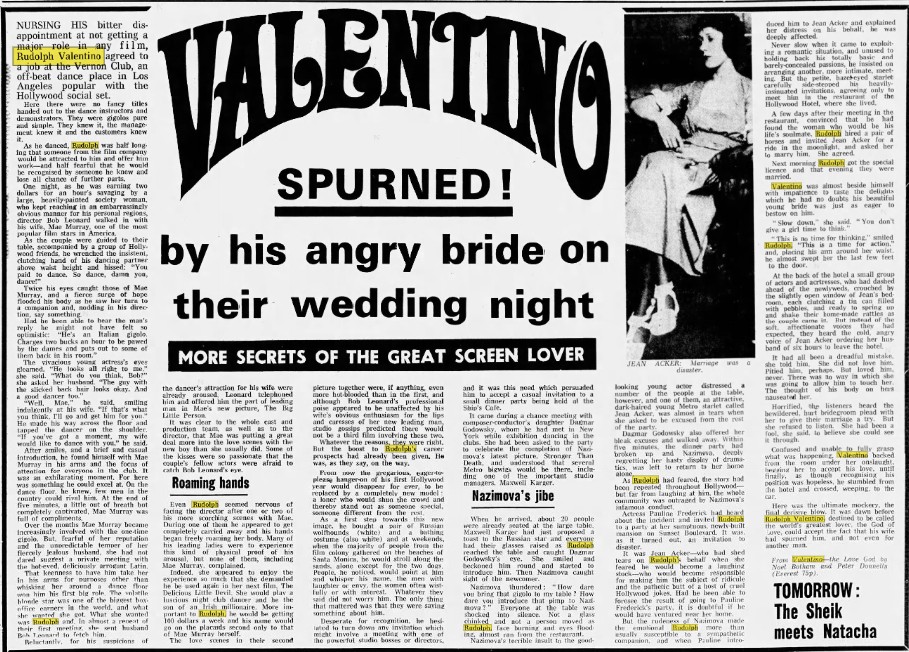

1920’s – Christmas Celebration Valentino Style
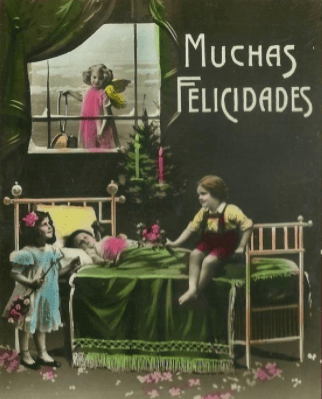
The 1920’s was a time where globally everyone was still recovering from a world war that took many lives and reeked devastation everywhere. Yet a new century was in full swing and it was still a time where the traditional family unit gathered around the table each night and observed the Sabbath each Sunday. Holidays were a time in life where relatives gathered together during the holiday season to remember and reflect on the true meaning of Christmas and celebrate together with joy. People from all walks of life coming as one upholding traditions passed down thru the generations.
Hollywood a community globally looked on with awe and the Christmas holidays, comes to a city filled with flaming red poinsettias, manicured green lawns, electric lighted Christmas trees. Beautifully decorated streetlamp posts with tinsel decorations and glitter festooned store fronts to let visitors and local citizens alike the holiday season has arrived. Major movie film studio cars, chauffeured town cars, and taxi cabs alike rushing around delivering flowers, baskets of food, beautifully wrapped packages from address to another. These same movie film studios are sending Christmas cards from their favourite star to the fans and newspaper writers who support the industry, all year long. Also, there are the industries workers to consider from the prop boy, hairdresser, tailor, secretaries, grip boys whose valuable contribution to the film making industry. Silent film stars like Lila Lee, Leatrice Joy, Nita Naldi, Buster Keaton, Monte Blue, Gloria Swanson, Mary Miles Minter, Ricardo Cortez, Harold Lloyd, Rudolph Valentino and his wife, Ramon Navarro, Lupe Velez, will gather with their respective family and friends to celebrate in a most festive way. Rudolph Valentino’s family and Natacha Rambova’s family are in Europe wrapped up cozy warm in front of the respective fires celebrating in their own ways. While our couple are remaining in California due to film commitments and a wave of homesickness in the air. They felt Christmas should traditionally be spent where they would put a fire in the fireplace to roast nuts and cook a meal together. Rudy would thoughtfully present Natacha with a new jewel or another dog to add to their growing menagerie. The day would end with them reading poetry to each other and discuss their plans for the upcoming year. However, Rudy would often think about his family back home and miss the wintry weather, mulled wine, and the rich dinner. This was a time of celebrating and the evening would see the churches packed with people looking forward to altars bathed in candlelight and voices joyously singing songs willed with meaning. Sometimes Rudy would take a drive down to Palm Springs dessert where the nights were genuinely like those near Bethlehem where once upon a time, three Wise Men would follow a star. On the other side of the world, Italians would celebrate the Christmas season starting with 8 December with the feast of Immaculate Conception and end on 6 January with the feast of Epiphany. Their trees would be quietly decorated with cherished ornaments passed down through the family and the base of the tree would feature a nativity scene. Italians are a traditional people, and their Christmas eve meal would not have meat and of course a lavish dessert of Christmas cake or Panettone is served. An old saying goes “Christmas with your family and Easter with anyone you wish.” The most characteristic Italian Christmas sound is the one of bagpipes, played by pipers called zampognari. Stockings would be filled with fruit and simply carved toys for children and the adults would exchange home-made gifts. Times with family had special meaning and there was a festive spirit that was in everyone. A courteous greeting was extended to all while the New Year was looked upon with a certain relief it was a simple time where family and friends were more important.
Categories: Uncategorized
Tags: Lupe Velez, Ramon Navarro, Rudolph Valentino

17 Dec 1925 – Natacha will marry again
Categories: Uncategorized
Tags: Natacha Rambova, Rudolph Valentino, Winifred Hudnut
6 Dec 1925 – Mae Murray date with Rudy
Categories: Uncategorized
Tags: Mae Murray, Mrs. Richard Hudnut, Mrs. Rudolph Valentino, Natacha Rambova, Rudolph Valentino, USS Leviathan
5 Dec 1923 – The Young Rajah Production
Categories: Uncategorized
Tags: Alice Terry, Rudolph Valentino, The Young Rajah
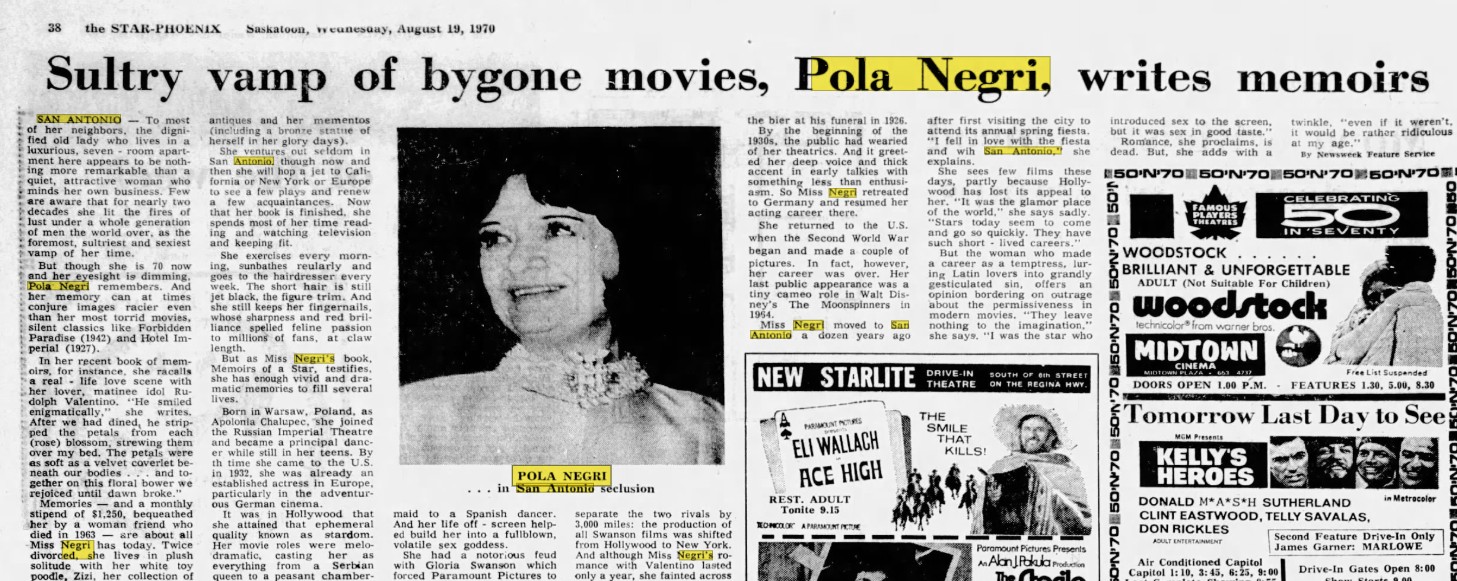
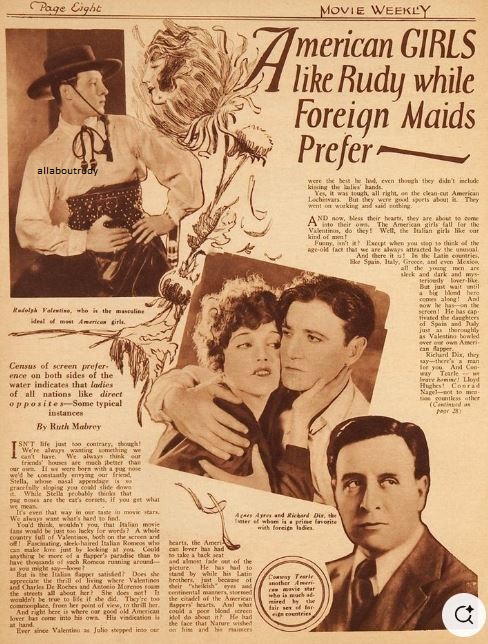
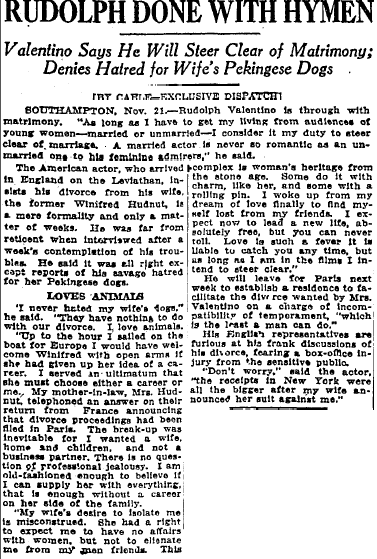
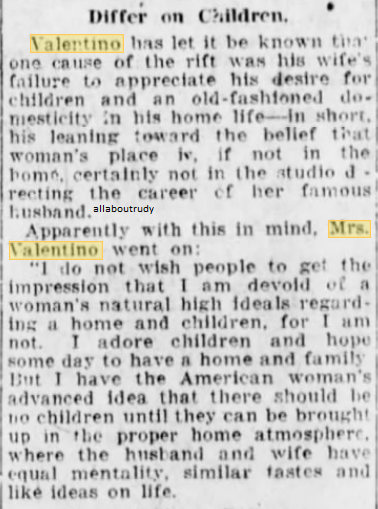
22 Nov 1925 – Valentino done with Marriage
Categories: Uncategorized
Tags: Natacha Rambova, Rudolph Valentino
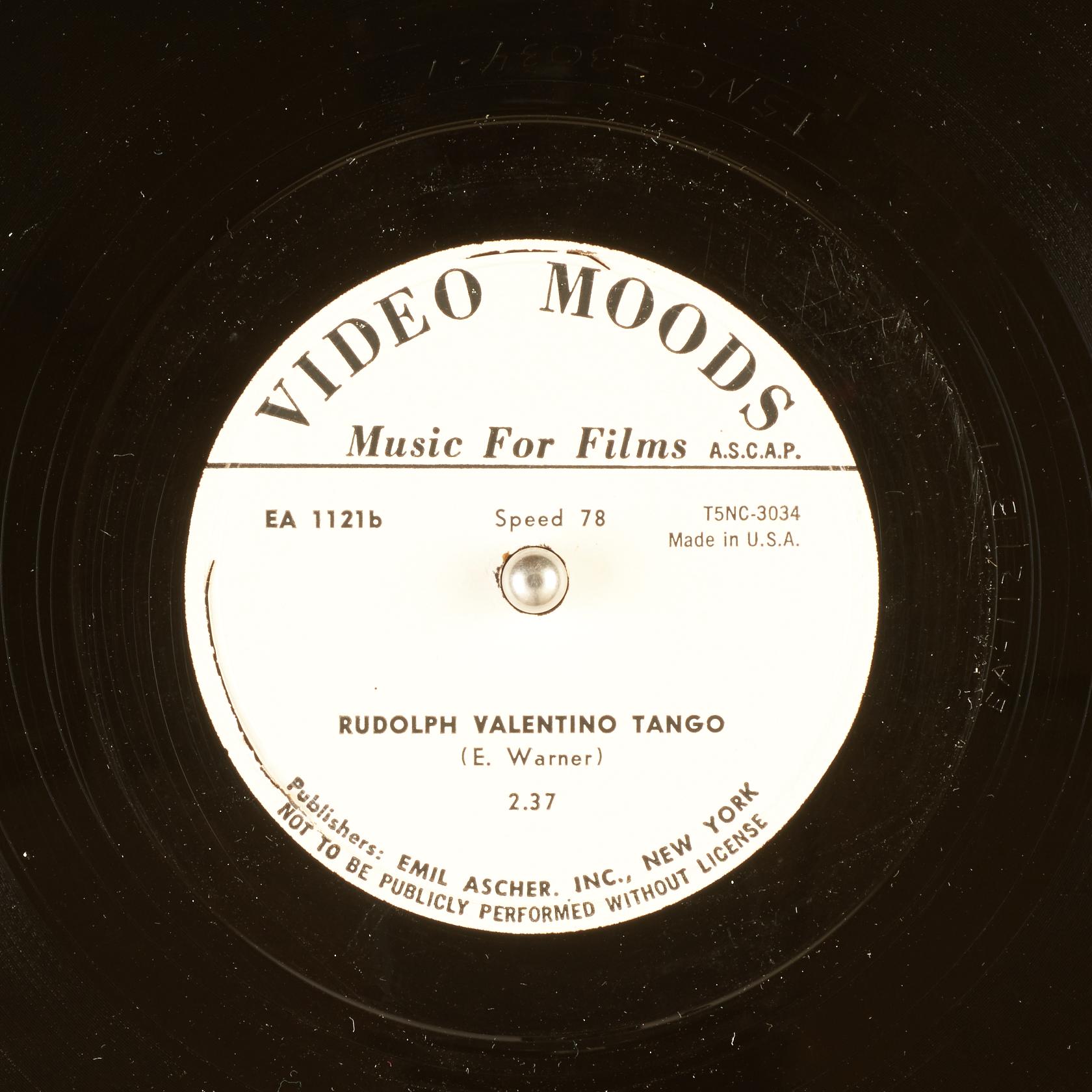
Rudolph Valentino Tango Music for Film
https://archive.org/details/78_rudolph-valentino-tango_e-warner_gbia3024008b
Categories: Uncategorized
Tags: Rudolph Valentino
9 Sep 1951 – A Ukulele and a Memory
A vamp of the former silent movie days, who acted with Rudolph Valentino and also unleashed her feminine wiles in that mighty pictorial epic “Ben Hur” is now working as a television glamour girl. Because Carmel Myers has aged in appearance far less rapidly than the years have passed, she is able to compete in the charm sweepstakes on an equal basis with young newcomers, thus bolstering the vitality move men initiated by Gloria Swanson. One prop and one routine are the mainstay routines in Miss Myers television show a ukulele she has used since she was 13 years old. It was her ukulele that led her into television. At a party in New York, she was strumming and singing, and a friend told her she should be on television. Miss Myers took the suggestion seriously and looked up Robert Kintner President of ABC. He turned her over to the program department and they put her on the air. Movie fans who are acquainted with Miss Myers have noticed her hair colour is a radiant blond and she admits her natural hair colour is brunette. She further explains she looks much better with a lighter hair color in a television studio. Last week’s episode she recalled Charleston Contests held at the famed Coconut Grove a place talent scouts would gather. One night a scout told a young dance to report to a certain movie studio and the next day she did arrive, but nothing happened with her career until later after she did a name change to Joan Crawford. Miss Myers recalls working with Rudolph Valentino during one movie scene filmed in Santa Monica. He was supposed to rescue her but, in her version, she is the one to rescue him out of the water.
Categories: Uncategorized
Tags: Carmel Myers, Gloria Swanson, Rudolph Valentino
8 Sep 1925 – HORSE INJURES VALENTINO.
Rudolph Valentino, silent-film actor, was scratched and bruised at Lankershim, near here, today when he was dragged some distance by a galloping horse. The scene which Valentino was making for the screen required him to halt a running horse. He grabbed the animal by the bridle, but the horse, entering the spirit of the act, kept going, bumping the actor along the road. Valentino must appear in Justice Court here Friday and stand trial on a speeding charge. Such was the response of Justice Joseph Marchetti yesterday to Valentino’s plea that he moves his court temporarily to his studio. Valentino had declared that if he should have to leave the studio and go to court the wheels of production would stop and much money would be lost while the cameras waited for his reappearance.
Categories: Uncategorized
Tags: LA Justice Judge Joseph Marchetti, Rudolph Valentino
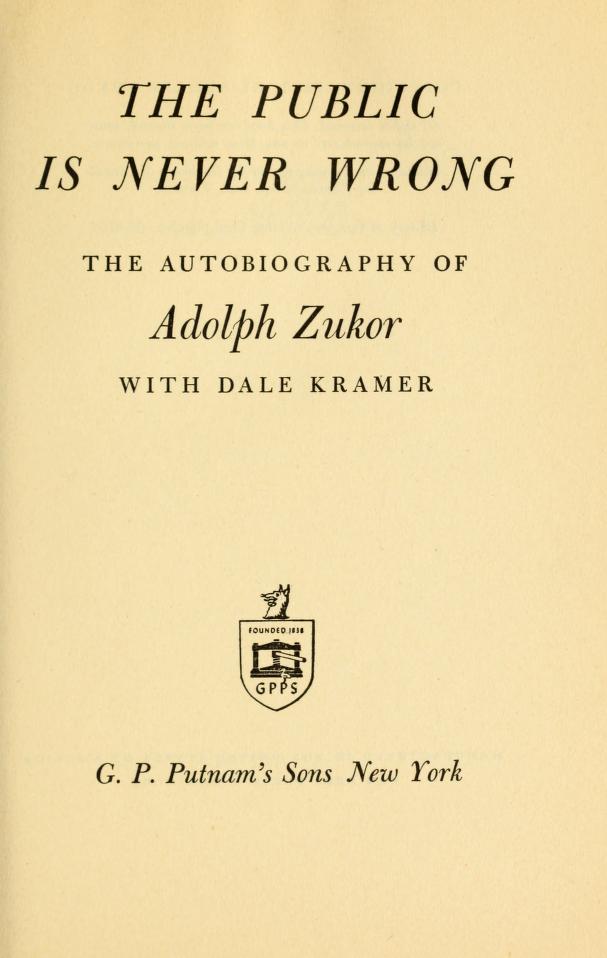
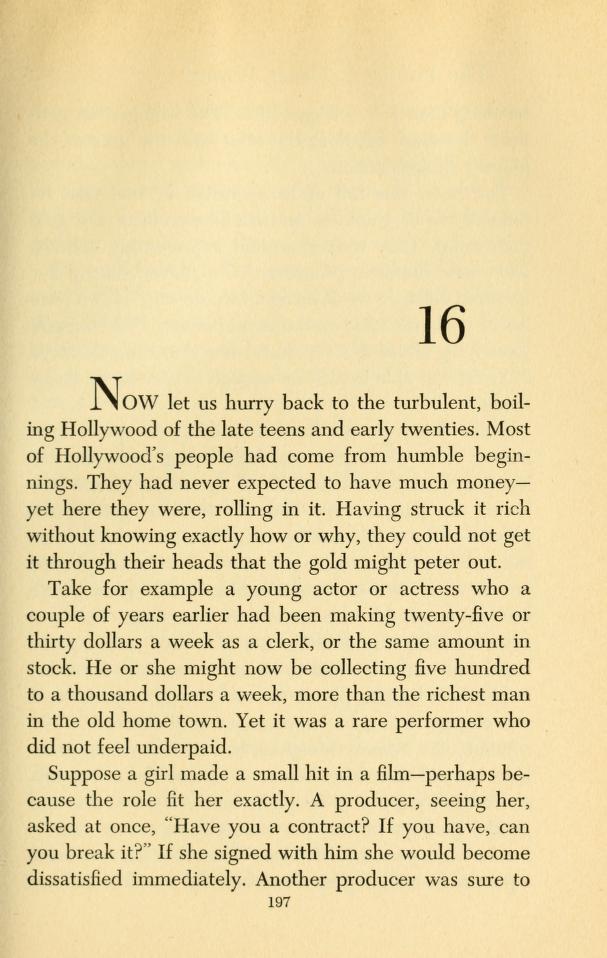
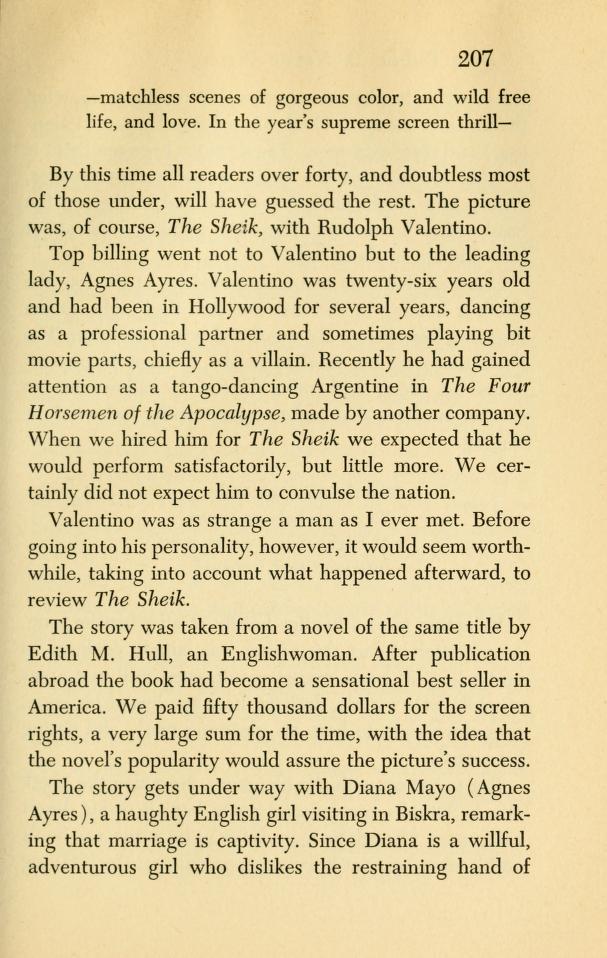
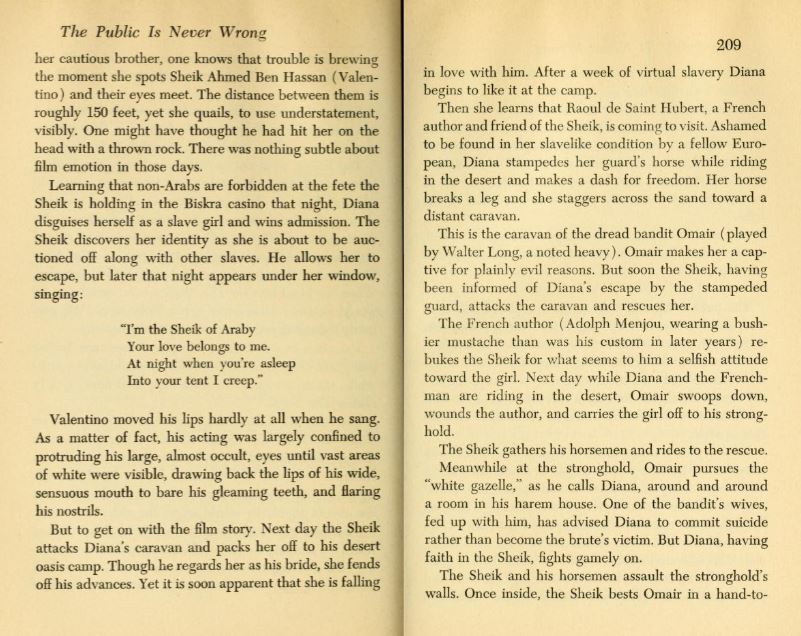
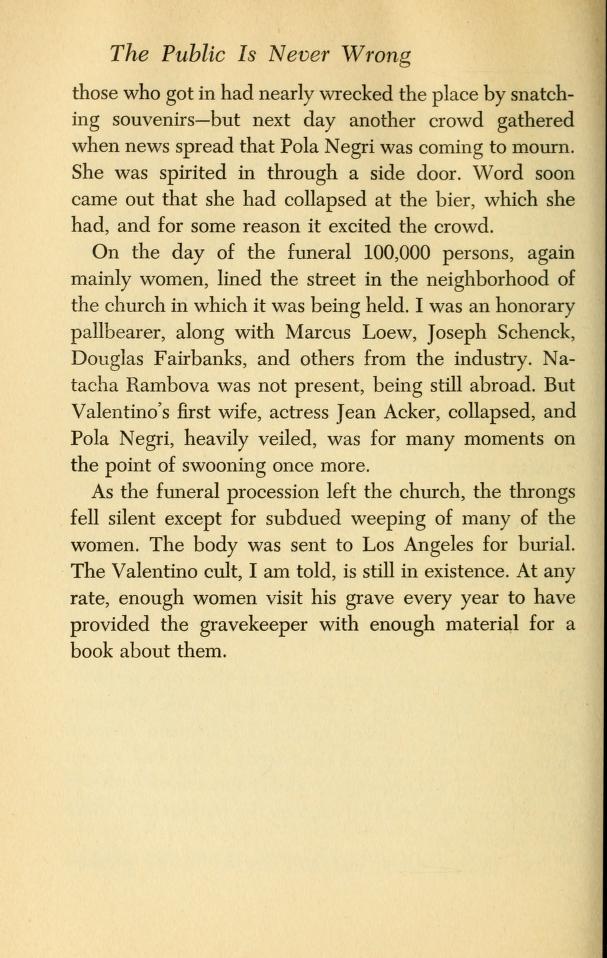
1953 – Director Adolph Zukor on Valentino

Categories: Uncategorized
Tags: Adolph Zukor, Natacha Rambova, Rudolph Valentino
2 Sep 1922 – Idol of Fans
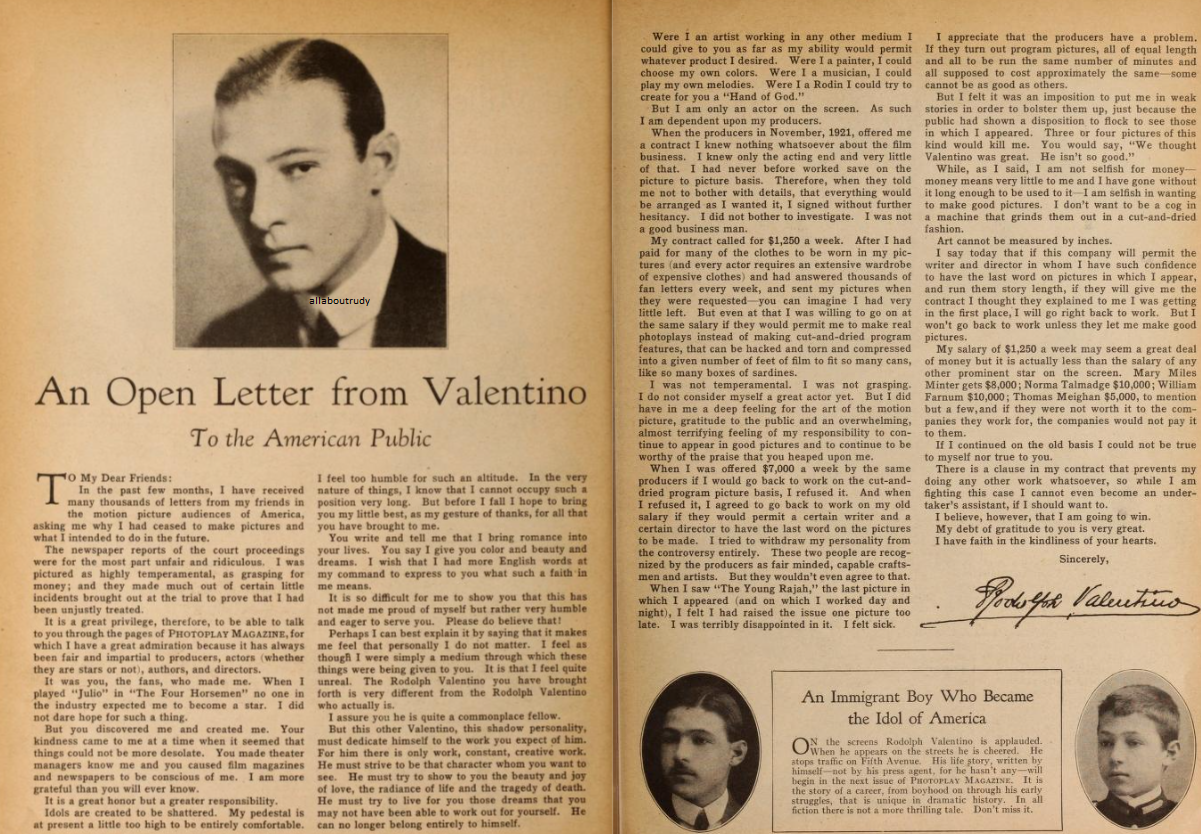
In an exclusive interview with a representative with the NY Times yesterday Valentino announced he will not return to Hollywood pending the outcome of his litigation with Famous Players-Laskey. Papers in the legal action will be filed early next week and yesterday the company retained Guggenheim, Untermyer and Marshall in an attempt to force Valentino to continue the program outlined in his long-term contract. All day yesterday, the idol of thousands of film enthusiasts sat in a rear room of the office of his counsel, Arthur Butler Graham, at 23 West, 43rd Street, New York City in preparation of Valentino. It is understood that Sim Untermyer will be arraigned by Graham in the courts. To prevent Valentino with another production Guggenheim, Untermyer appealed to Hays, High Chief of the affidavit stating the actor’s case will be forwarded today by Valentino’s counsel. Although the fact is generally known Valentino far less compensation the players of equal import pictures. His salary is to be $1200 a week. Valentino contends Paramount netted more than $1,000.00 in “The Sheik” his first star vehicle, and that “Blood and Sand” his current picture will nearly double that amount he says, is not commensurate with these profits and furthermore, he insists Famous Players-Lasky abrogated its part of the contract by failure to provide the publicity agreed upon. After Valentinos marked success in “Four Horsemen of the Apocalypse” Metros dramatization of the Ibanez novel he was called to NY by Famous Players-Lasky and offered a contract at a sum that to the theater gods and goddesses is nominal. He refused at first, but when the company agreed to augment the salary with extra publicity he signed for a period of several years. Sleek of hair as always and with a ring of beaten silver on earth has his little fingers Valentino smoked innumerable cigarettes as he discussed his case yesterday for the first time since his arrival in NY. For days, he has been incognito refusing interviews and remaining in complete obscurity. “I will not return to Hollywood at the present time: he said. The reports that I will desert America and return to Italy are ridiculous. I have made great success in America and shall remain here. “If I return to Italy it will be only for the purpose of visiting my parents whom I have not seen in 10 years. I have no plans for contracts with other companies. I do not intend to make any until this matter has been legally settled satisfactorily. I would like to have it understood, that I will stand by any contract I make, as long as the other party does likewise. He refused to discuss his private affairs and ignored mention of the name of “Miss Hudnut”, whom he married to in Mexico before the interlocutory degree from Jean Acker had become final. But from another and no less authoritative source the Times learned the Valentinos will not live under the same roof until Jean Acker has passed legally of Rudolph’s life forever. Along Broadway in the motion picture offices, Valentino is known as the “gold mine of the screen” according to his counsel. When his case is called Graham expects to introduce as witnesses the editors of film magazines, who will testify that 70 to 80% of the “fan letters” about screen players received by these publications concern Valentino. Since her marriage to Valentino and return to New York, Miss Hudnut has evaded reporters. She remained for several months at the Hudnut summer camp Foxlear, at North Creek, NY and at one time was said to have booked passage to Europe which for some unexplained reason was cancelled. No she has moved into the Biltmore Suite of her foster parents. She will not return this season to the employ of Nazimova, whose art director she was. Although the Valentinos are living apart, there has been no break in their happy relations. It was admitted yesterday they have been together frequently and will continue to see one another at intervals until the California law permits them to take up their life together.
Categories: Uncategorized
Tags: Rudolph Valentino
Aug 2025 – 98th Annual Valentino Memorial Service Review
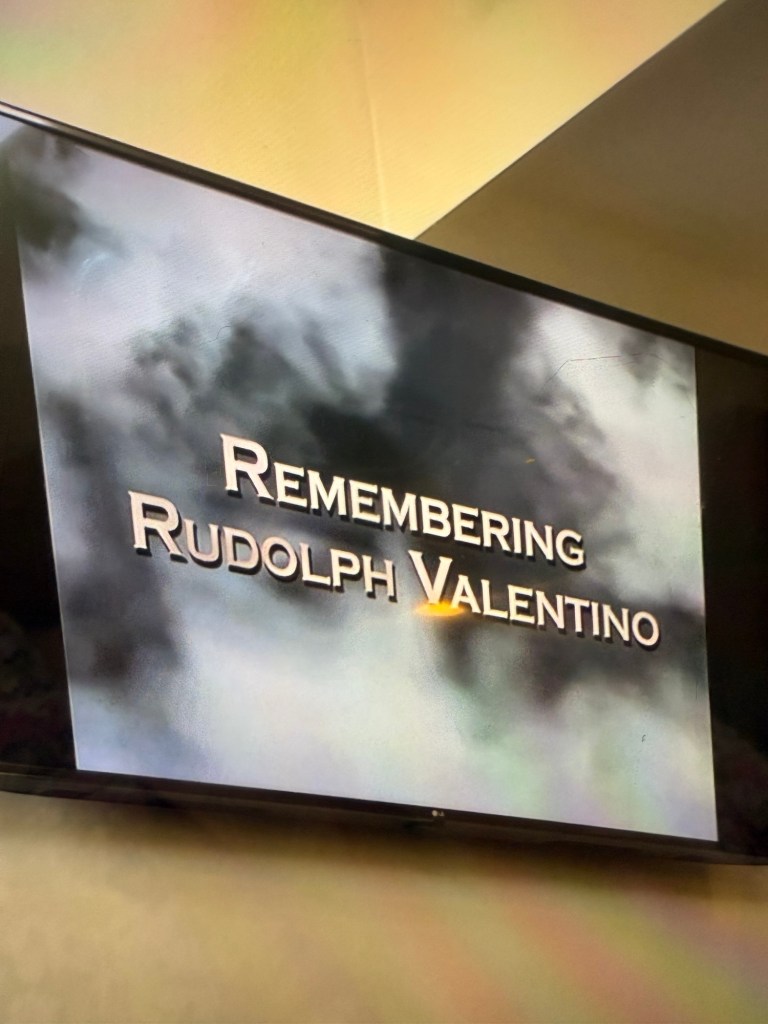
On every 23 August, 1210 hours, the Valentino Community comes together as one, in order to pay their solemn respects, in tribute to a great silent film actor, who still garners admirers and attention, in the 21st Century.
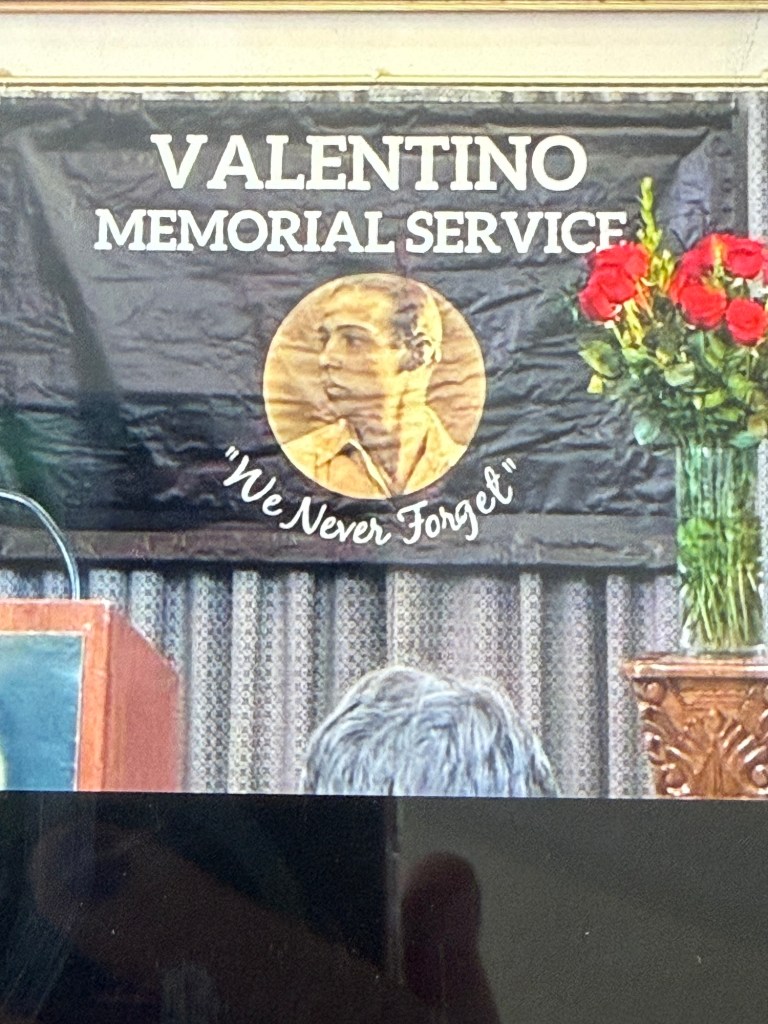
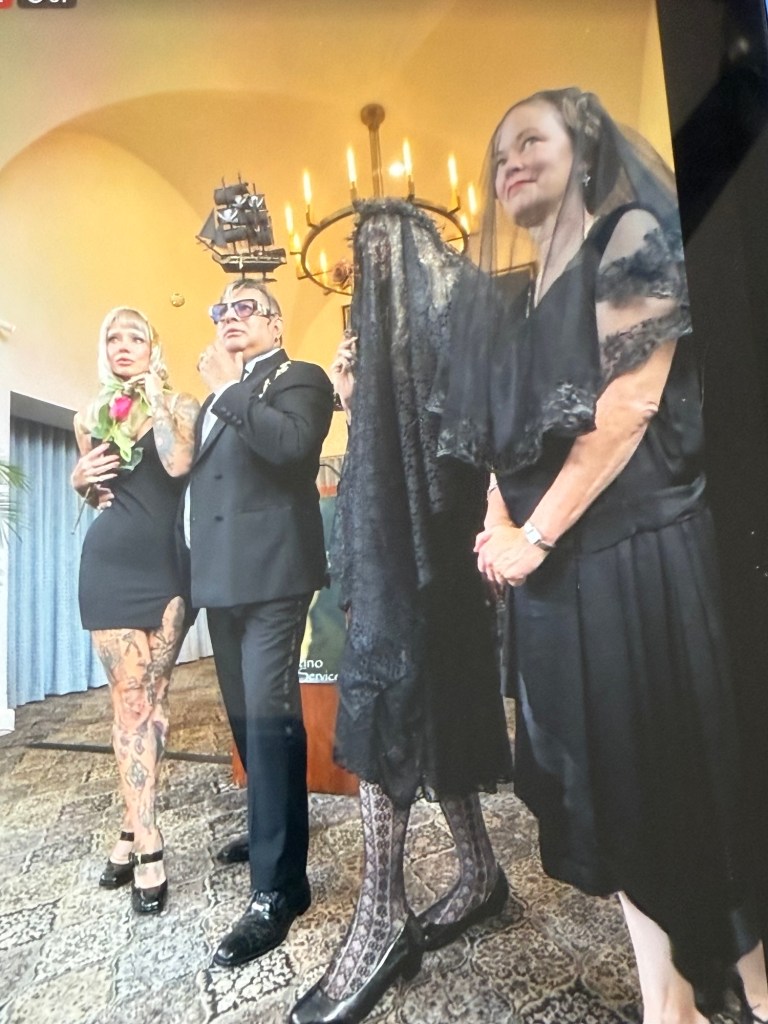
This year’s tribute program, was even more impressive than in years past. From the audio and visual tributes to the speakers, music selections, singing, to most of all a memorable salute to our beloved Donna Hill, everything was done reverently and beautifully.
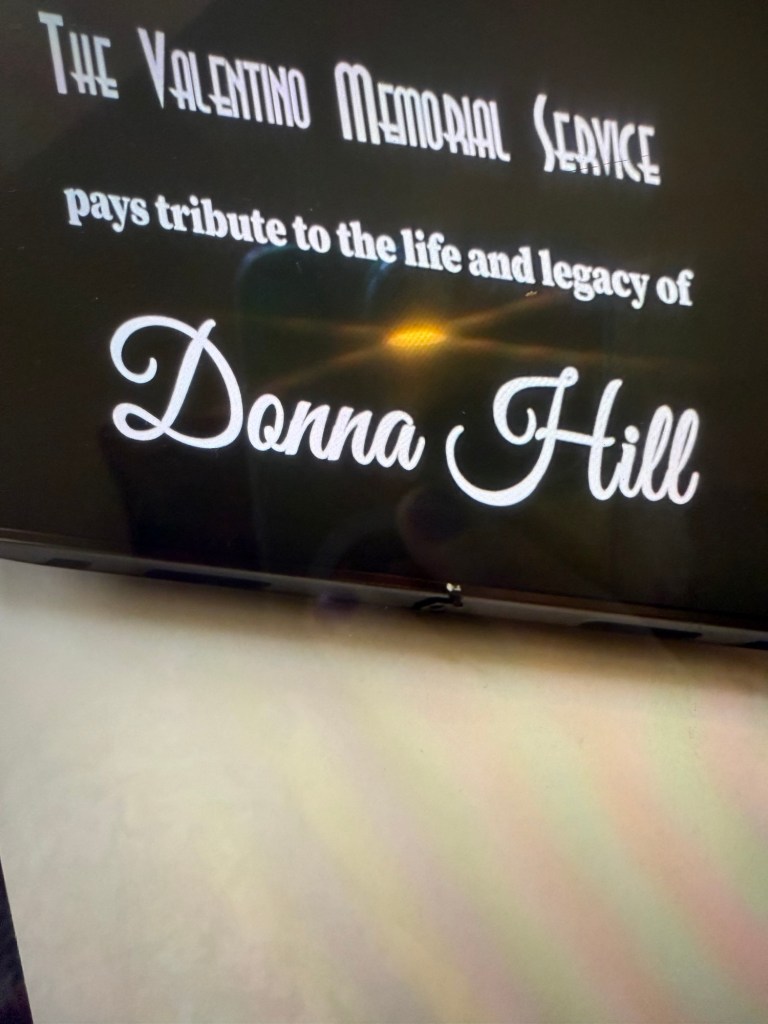
There was something poignant about knowing how much of a compassionate person Donna Hill was. While I did not personally know her. Everyone within the Valentino community, felt as though she was a friend, someone they could go to for questions about Valentino. Her legacy will be remembered for years to come.
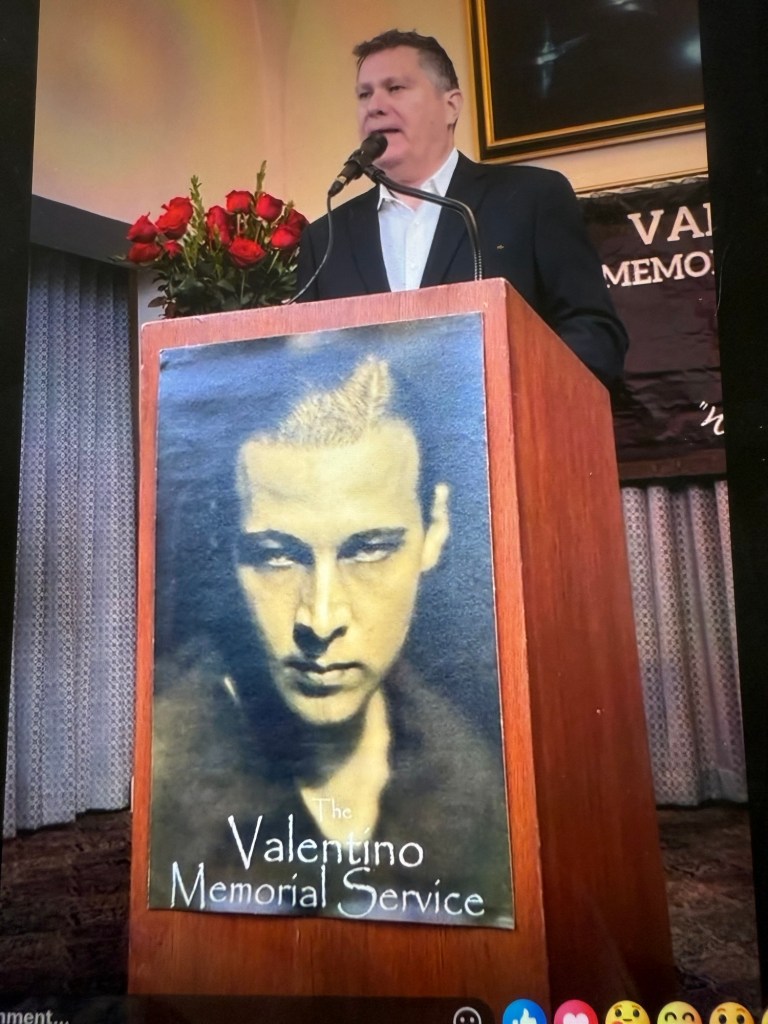
The music selection and the vocal talent of Ms. Katy Jane Harvey was once again, superb. I thoroughly enjoyed listening to my favourite “Ave Maria”.🎶🎤🎧🎼
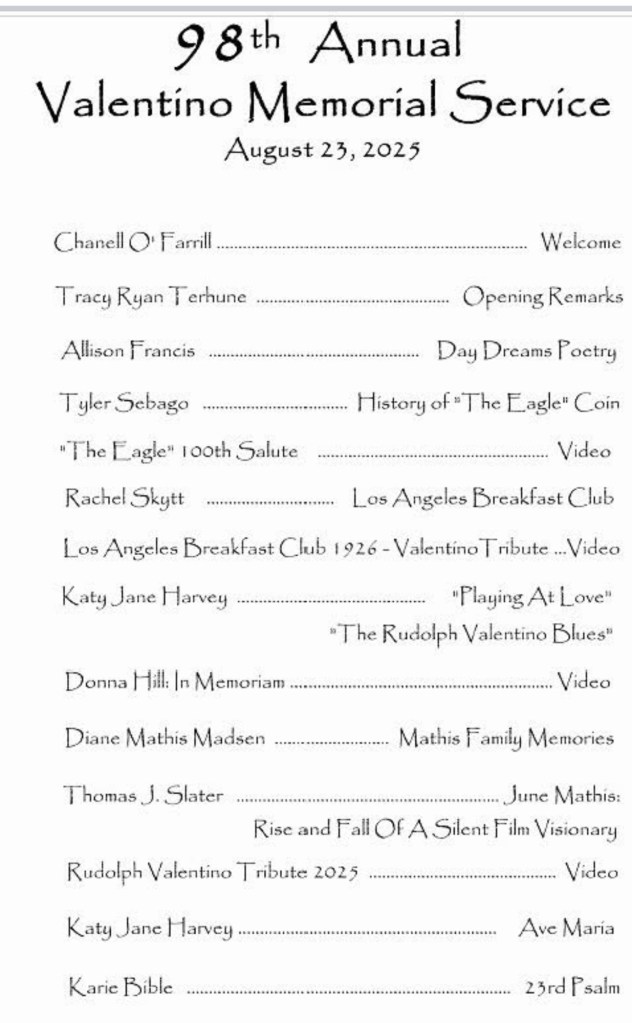
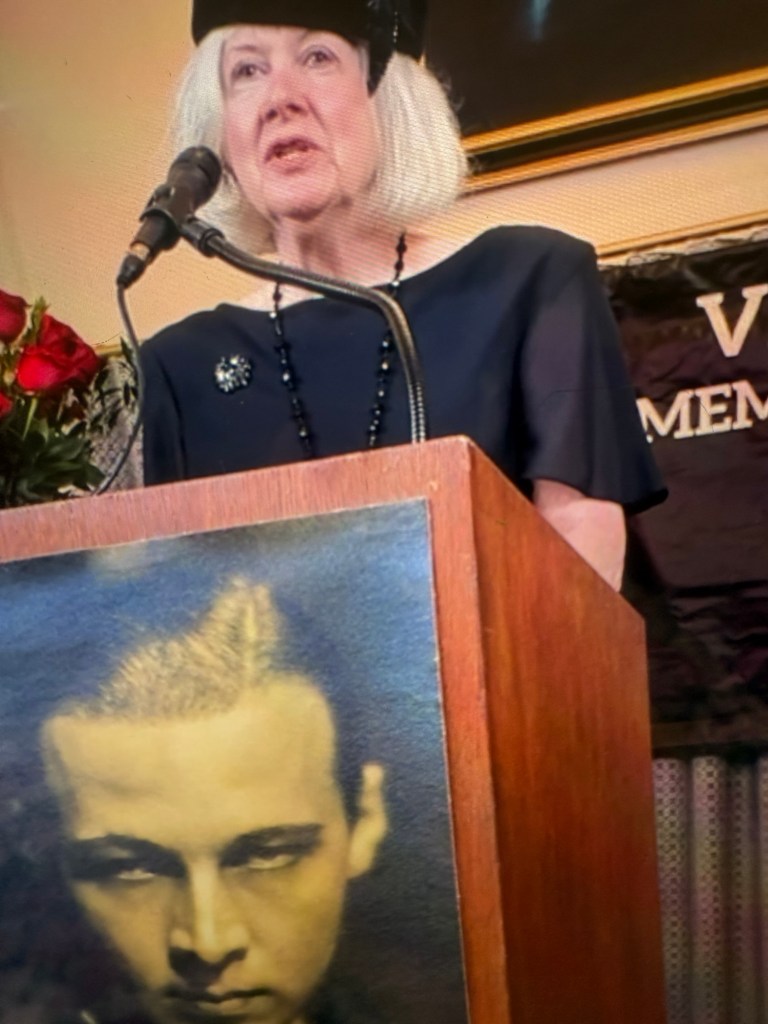
It’s always sad when the Memorial Service ends🥲. But next year, I will be there physically to embrace the memories and see familiar faces once again.
One more thing, a big thank😇you to Tracy Terhune and Zachary Jaydon.✌️
Until next year. 😍🎥🎞️🪦
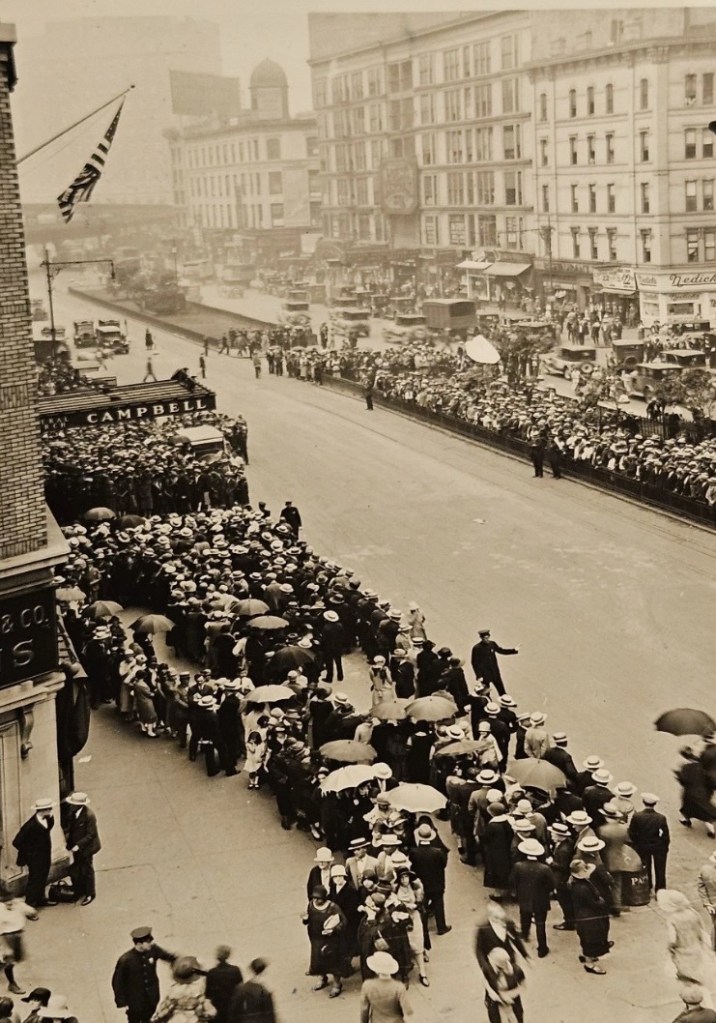
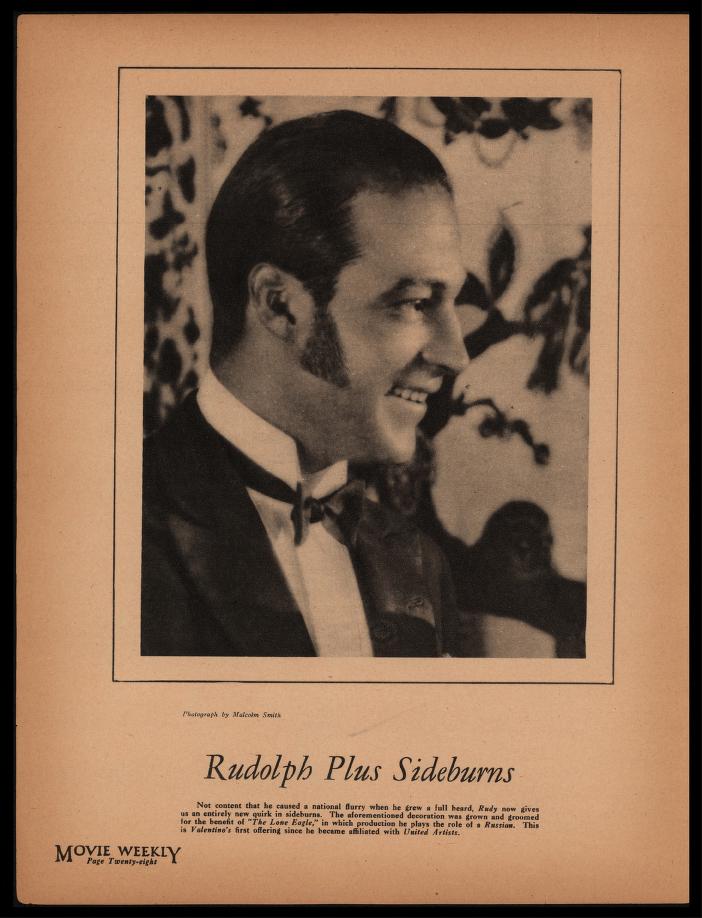
13 Aug 1925 – Rudolph Valentino Productions 7200 Santa Monica Blvd, Hollywood, CA
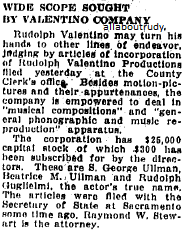
On 13 Aug 1925, Rudolph Valentino filed articles of incorporation at the Los Angeles County Clerk Office to form Rudolph Valentino Production, INC. of Los Angeles. At the time of filing, this was not considered national news since Valentino as company director signed article papers as Rudolph Guglielmi versus his on-screen name. Rudolph Valentino formed his own production company to give him creative control over any future motion pictures made. Besides motion pictures, personal appearances, musical compositions, general phonographic, music reproduction apparatus were added. The corporation has $25,000 of capital stock and out of this money $300 has been subscribed for by the directors.
Rudolph Valentino Productions was located at 7200 Santa Monica Blvd, Hollywood, CA. This address was where you could write to Rudolph Valentino. At one time, this location was home to Pickford-Fairbanks Studio, King Vidor Productions, United Artists, Norma Talmadge Productions. Two of his pictures were made under his production company and George Ullman was listed as both secretary and treasurer. In 1930, it showed they made $500,00 for the Valentino estate. In 1933, his production company was sued by the federal government for back taxes for years 1926, 1927, 1928. The amount totaling was $67, 500.
Categories: Uncategorized
Tags: Rudolph Valentino
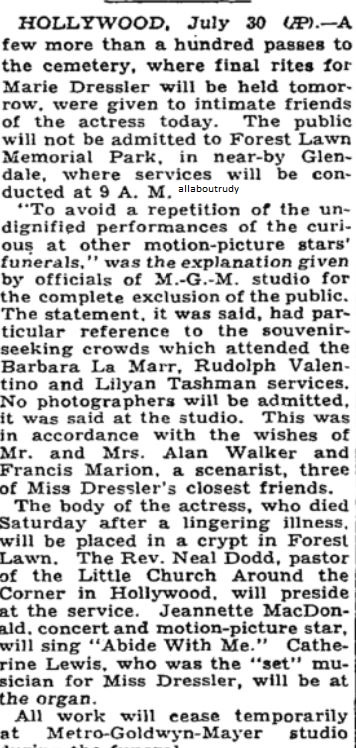
Categories: Uncategorized
Tags: Barbara LaMarr, Francis Marion, Jeannette McDonald, Marie Dressler, Rudolph Valentino
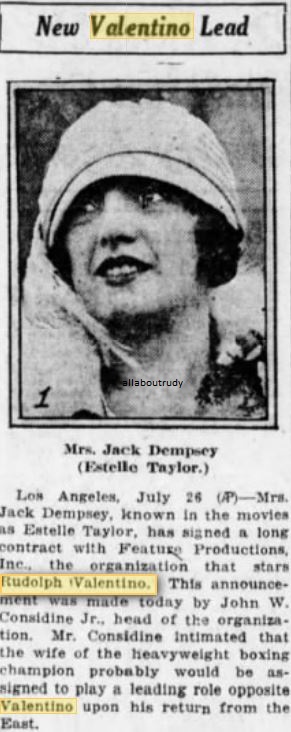
Categories: Uncategorized
Tags: Estelle Taylor, Feature Productions INC, Jack Dempsey, Rudolph Valentino
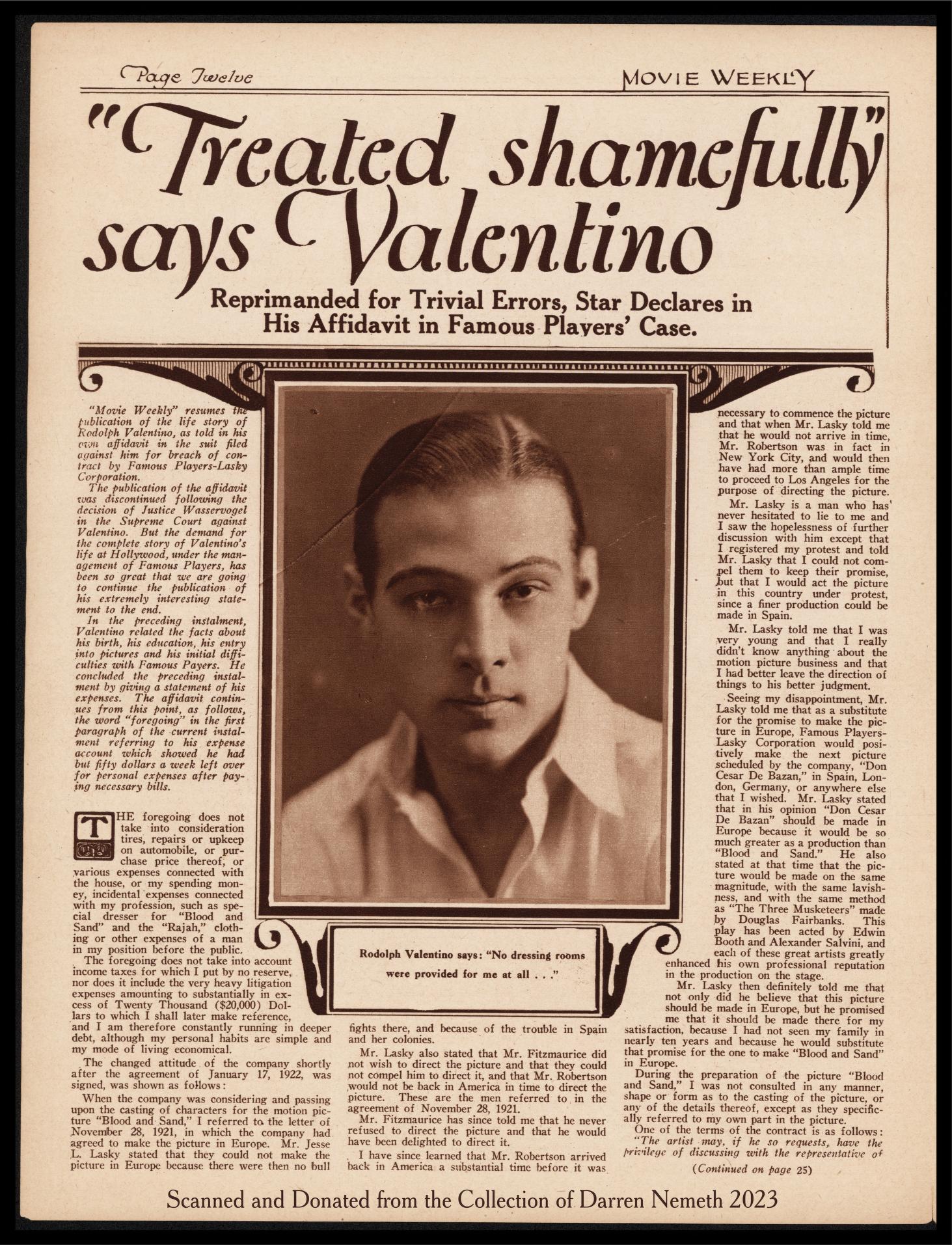
1920s – Frances Marion Interview
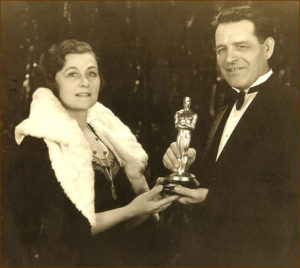
Here is the first exclusive article about Frances Marion and Rudolph Valentino
Born in 1888, Frances Marion like June Mathis is an Academy Award winning screen writer considered one of the most successful in the movie industry. Frances was noticed by Mary Pickford and became her official screen writer. Frances was briefly married to silent film Western star Fred Thomson and they had two children. Frances and her movie star husband like many others in the industry moved out of the area into the suburbs yet close enough to Metro Studio. Large estates began to proliferate around the Benedict Canyon area and Jack Gilberts new home was opposite Frances Marion and Rudolph Valentino. One night, Frances went outside to check on her nieces who were supposedly taking a late-night swim, but instead found them congregated around the telescope that was to be used for stargazing and instead was directed at the Gilbert home. The nieces were taking in every detail of the “uninhibited parties on his terrace”. The newest yet closest neighbor was more to their liking and that was Rudolph Valentino. Valentino often consulted with his neighbor on where to build a stable for his Arabian horses and once again the hillside sustained blasting to create flattened tiers. Rudy built his Falcon Lair by substantially adding on to the small house that was already on the land. Frances Marion first met Valentino through June Mathis, Metro Screen Writer who created a sensation by casting Valentino in “The Four Horsemen”. In contrast to the impression made by publicity about his fur lined bathrobes, his neighbors found him to be shy and modest, they became friends riding the hills together and joining him for homemade pasta. Frank Case noted author confirmed Frances Marion’s impressions of Valentino’s low self esteem after his daughter Margaret worked with Rudy on a Vanity Fair Magazine article and brought him to the Algonquin for lunch. The hotel dining room was more than use to having celebrities dine and the regulars prided themselves on ignoring them, yet “the buzz of excitement that ran through the room at the sight of Valentino, you could hear it vibrate from one of those ordinarily unimpressionable groups to the next”. When Margaret introduced Valentino to her father, Valentino quietly said “I am grateful to be here. I have often wanted to come, but I was told it was difficult to get a table unless you were a known”. After their initial shock, the Cases realized Valentino’s comments were without a hint of sarcasm; it was a genuinely modest statement from a truly modest man. In spite of the obvious excitement he created in public, Valentino could never bring himself to believe he was worthy of the attention. In less than five years, Valentino had been through a variety of studios, two marriages, bigamy charges, hits, and movie flops, but still his drawing power grew. Rudy and his second wife, Natacha Rambova separated after the financing for their increasingly lavish independent productions were pulled and Rudy was deeply in debt by the time his home Falcon Lair was completed. Valentino signed on with United Artists for $10,000 a week and a portion of the profits. He committed to make three films a year. Joe Schenck offered Frances Marion $30,000 to write a first script, and aside from the money she welcomed the opportunity to work with director George Fitzmaurice and the challenge of writing a part of substance for Rudy. He told her, he was tired of playing “mawkish leads” and would appreciate an offbeat role. He agreed with Frances and George on a romantic historical setting and she read through Gabriele D’Annunzio novels and plays to see what was appropriate and available for adaptation. The were setting on “The Flame of Love’ a vivid cruel revelation of D’Annunzio’s love affair with Eleonora Duse, Italy’s finest actress when Joe Schenck suddenly informed them the story search was over. Edith Maude Hull wrote a sequel to her popular novel “The Sheik” entitled enough “The Son of the Sheik” and the studio bought the rights sight unseen. Joe admitted and Frances agreed that “tripe” was a refined word but he told her he didn’t care if she adapted the material or wrote an original tale as long as the title was “The Son of the Sheik” dropping the plural to put the total focus on Valentino. Still, she found freedom frustrating and spent two weeks struggling to find new ways for a captive maiden to fend off a fate worse than death while creating opportunities for the very fate to occur. Frances decided to write an all0out farce of the original Sheik but when she gave the scenario to George Fitzmaurice, he brought her back to reality. “It is one of the most hilarious satires I’ve ever read, and I’d love to make it, but our hands are tied Vilma Banky has been signed to play the lead opposite Rudy. Frances respected Vilma’s acting talents and wanted to help Rudy so with George Fitzmaurice encouragement she begrudgingly rewrote the scenario in a more serious vein, trying to find a balance between drama and comedy. She remained far from pleased with her treatment and privately referred to the film as “The Son of a So and So” but turned it over, trusting George’s taste and judgement to make it work. Rudy quietly accepted the role, disappointed to be playing what they all considered to be a repeat performance and he spoke of making a “graceful exit” from films in a year or two. I am no fool, he told Fred and Frances, I knew from the beginning it could last forever. With the kind of stuff, I have been doing I am surprised my popularity has lasted this long. Frances thought he was too tired to fight and when she asked how he was feeling he mentioned having “severe headaches” and talked of taking a long vacation after filming. They tentatively planned a trip to Napa for the fall for Rudy to look for a new home in the wine country where he could rest and put his knowledge and love of all thing’s agriculture to good use. On 9 Jul 1926, “The Son of the Sheik” premiered in Los Angeles and Frances had to acknowledge the film turned out better than she dared hope. Once again, Rudy captivated women in the audience, even though Adela Rogers claimed his mesmerizing stare was direct result of myopia. “He didn’t want to sweep you into a mad embrace, he just wanted to know who you were”. A few days later, Rudy turned 31 left for New York, and everyone noticed he looked physically exhausted. Rudy’s moves were front page news and when they both heard reports of his hospitalization, they were shocked. When they next read the papers “The Sheik is Dead”. Frances was repulsed by the sideshow that followed his death. She was angered by studio bosses she knew had exploited him as well as the women who dressed in mourning and whose pictures appeared in every newspaper alongside details of fictionalized romances. She gave caustic credit to Pola Negri for being the best actress of the lot when it came to fake romances. Over 100,000 mourners walked past his casket in New York City and there were homages at every stop made by the train that brought his body back to Hollywood. The turnout for his California funeral was on a massive scale and the streets were blocked off and schools were closed. While Pola Negri made pronouncements of creating marble monuments to Rudy, he was laid to rest in a mausoleum at Hollywood Cemetery, provided by fellow screen writer June Mathis. United Artists publicity translated into economic windfalls for the studio as fans poured in when “The Son of the Sheik” was rushed into general release. Valentino’s death made everyone pause to reflect on the quality of their own lives.
Categories: Uncategorized
Tags: Frances Marion, Rudolph Valentino
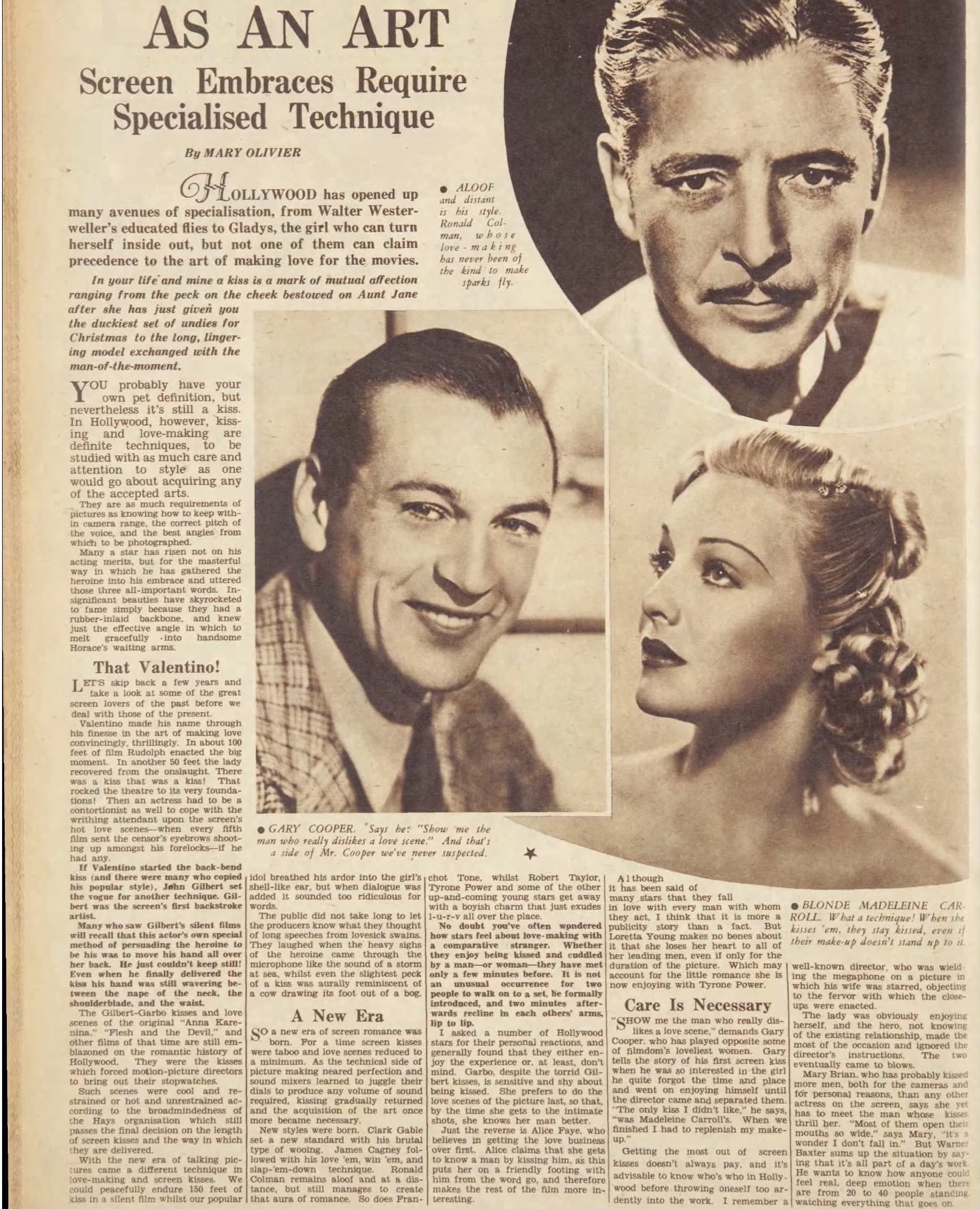
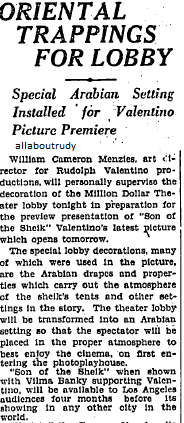
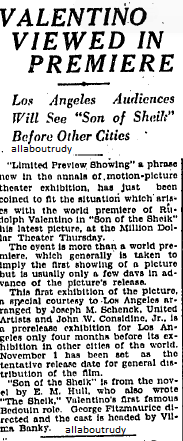
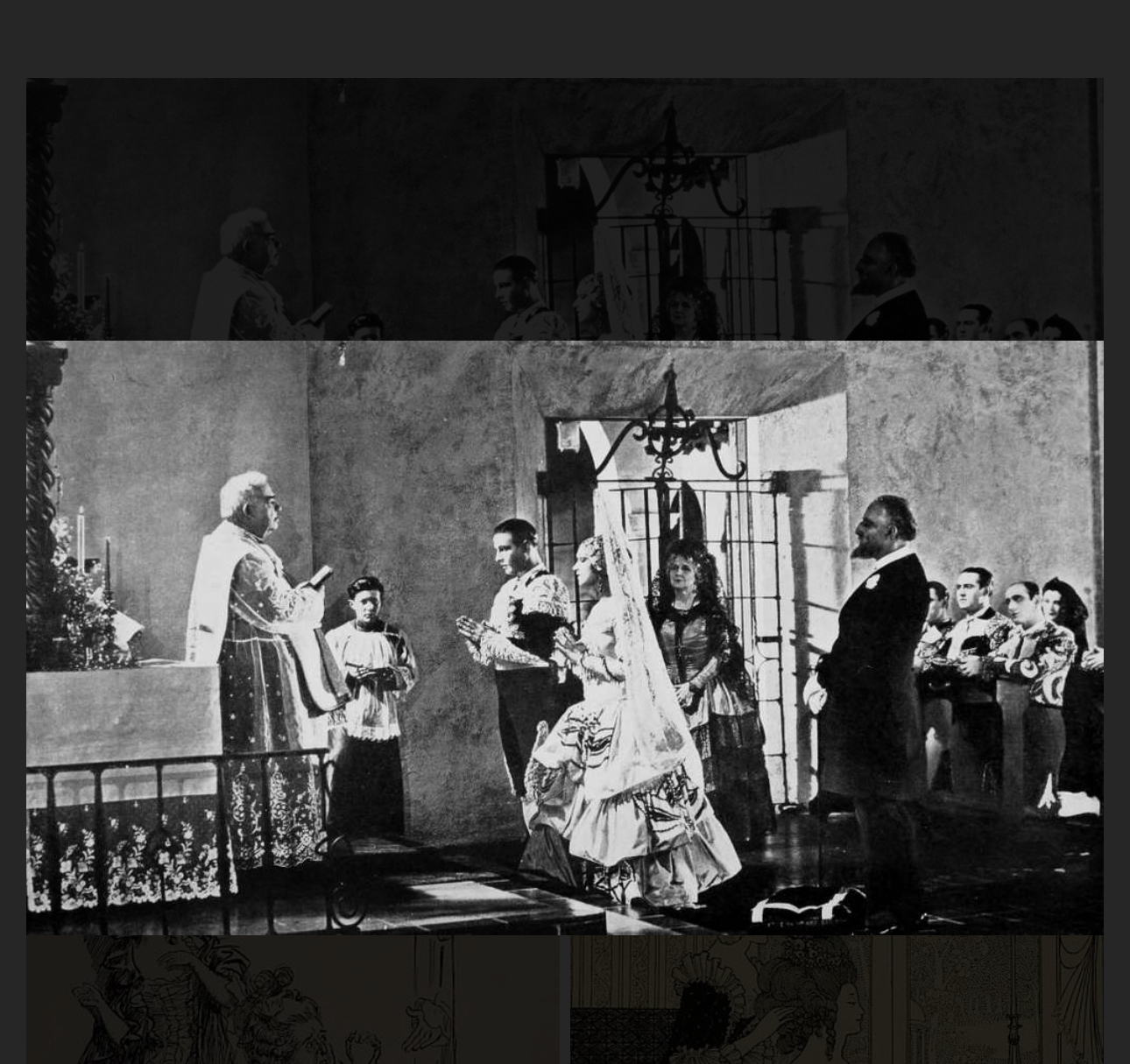
8 June 1966 – Natacha Rambova leaves $367,000
Natacha Rambova, former wife of Silent Film Star Rudolph Valentino died on 5 June 1966 in Pasadena, California. Today, her will went into probate in New York and her estate was valued at $367,000. Miss Rambova lived in New Milford Conneticut in her later years. However, her immediate family moved her out to California due to ill health. She was the adopted daughter of perfume mogul Richard Hudnut to whom her mother was married to. The will lists 25 specific bequests, left a $200 monthly lifetime pension to her half-sister Mrs. Mary Boyd, San Francisco and the balance of the estate went to 11 other relatives. One personal bequest left her entire library and collection of Tibetian and Nepalese Paintings and Bronzes to the Philadelphia Museum of Art.
Categories: Uncategorized
Tags: Natacha Rambova, Rudolph Valentino
“For praise is often destructive; while criticisms and truths are often helpful”
Rudolph Valentino to Katherine Elverson
Categories: Uncategorized
Tags: Rudolph Valentino
 All About Rudolph Valentino
You must be logged in to post a comment.