

1922 – There is still hope..
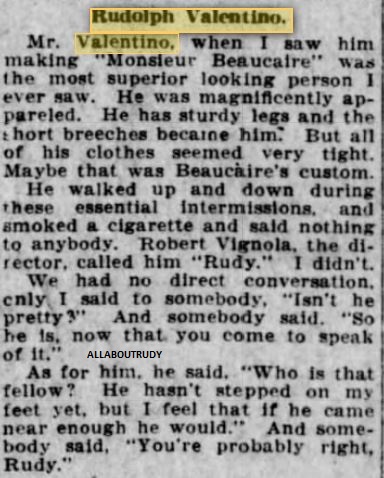
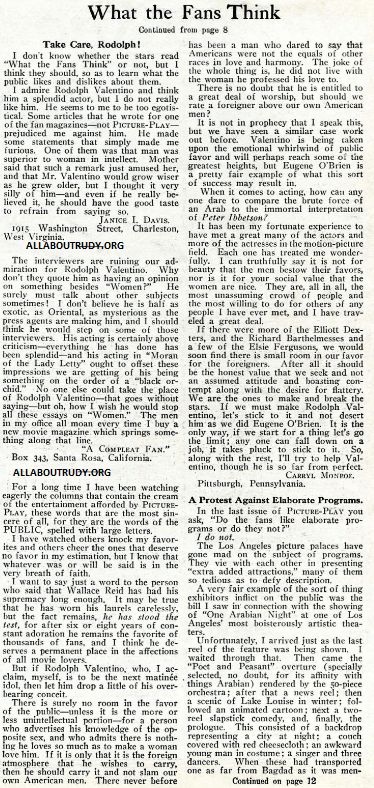
You know that every extra comprising that large mob hopes some day to attract the attention of the director and as in a fairy tale, win fame and wealth as a Valentino or in the case of many older men a Theodore Roberts. So, it goes, once in a while, as in the instance of Valentino himself, one of them does step out from the ranks. And that isolated instance feeds the hopes in the thousands of starved breasts. Extras seem to us symbolic of the human race, so hopeful, so brave in their individual ways, so utterly futile generally so full of dreams of the day their opportunity will come.
Categories: Uncategorized
Tags: Rudolph Valentino
1923 – Valentino Literary Hero
Valentino is more than the idol of the hour. He is a thinker who has the courage of his own convictions. He has recently written for the Rookman, a literary feat heretofore, unachieved by a cinema artist.
Categories: Uncategorized
Tags: Rudolph Valentino
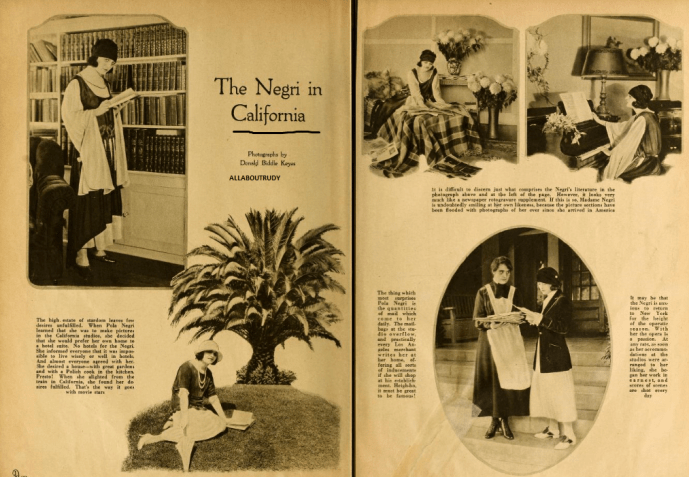
In 1923, Pola Negri was her own best publicity and her own worst nightmare. There is no denying her talent and there is only so far she could go. The reality in the acting profession is one day your on top of the world and another time your not. Being dramatic should be on the screen and not in real life. The truth is she was never good with money. This would become her downfall.
Categories: Uncategorized
Tags: Pola Negri
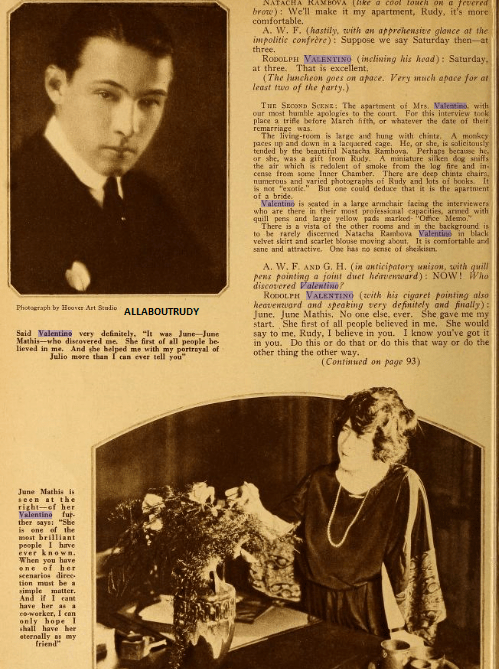


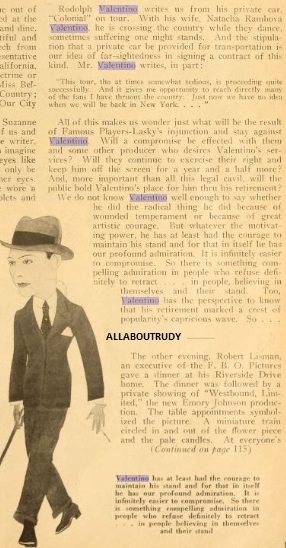
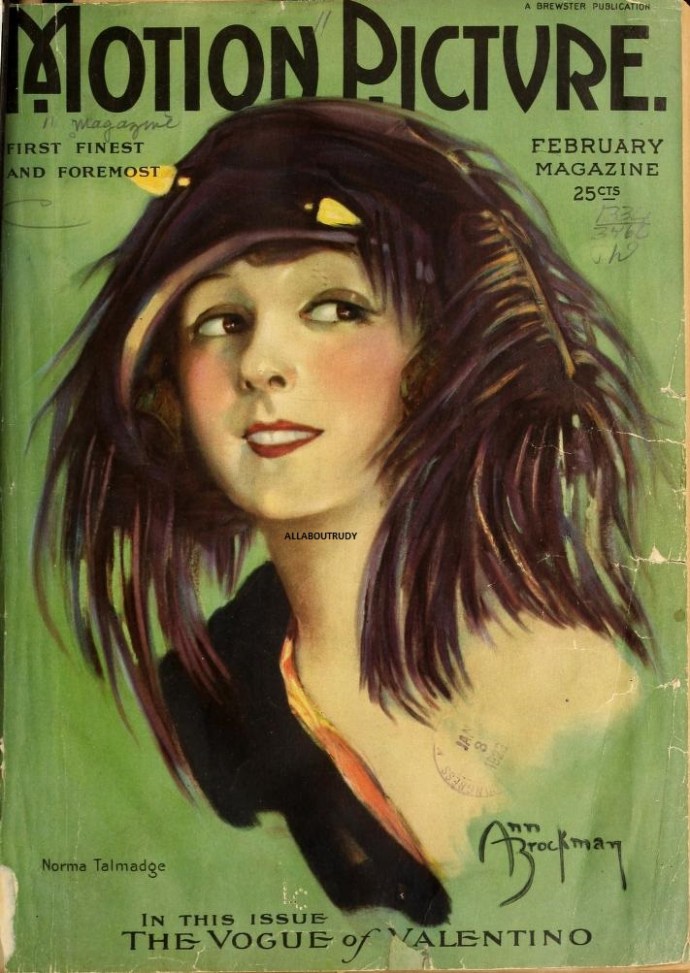

Jan 1923 – Good Luck Usually Makes The Star
No matter how talented a player is, it takes a little luck to bring big success to the door. Under favorable circumstances it is remarkable with what speed a hitherto obscure performer can be elevated to the top of the ladder. One of the amazing peculiarities of the flicker world is that it takes only one successful production to raise a camera actor or actress from the lowest rungs of the ladder to the brightest heights. And once on the top it takes a long series of poor vehicles to shake em’ off the perch. Look into the movie hall of records and what do we find? Valentino, best example of all, played in several pictures without getting a ripple of interest, then suddenly had the break of luck to get in “The Four Horsemen” and become a sensation overnight. Betty Compton, Pola Negri, Nita Naldi, May McAloy. Many of the players have never lived up to the promise they gave in the photoplay which put them over the top, but they continue to reap the benefit of their ten-strike, nevertheless, verify there are many players being buffeted about from studio to studio grasping eagerly at small parts, who have the potentialities of being as great favourites as those now at the top if they could only make the connection with that big part in the right production.
Categories: Uncategorized
Tags: Betty Compton, Nita Naldi, Pola Negri, Rudolph Valentino
Jan 1924 – A Poet
Rudolph Valentino, the cinema actor, is a poet. He. is publishing a collection of short poems in a volume entitled ‘Day Dreams.’ If Valentino’s verses are as ‘soulful’ as he endeavours to mmake his acting at timcis, his feminine admirers will experience further emotional thrills.
Categories: Uncategorized
Tags: Rudolph Valentino

22 Jan 1926 – Freedom
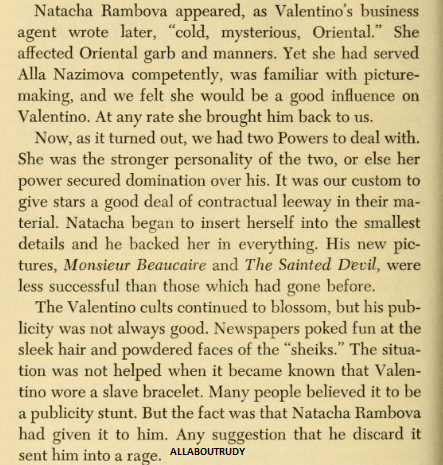
Winifred Valentino has been granted a divorce from Rudolph Valentino. Crowds of girls fare-welled Rudolph Valentino the film actor. He had difficulty in making his way to his train. He declared he was upset by his wife’s divorce proceedings but was necessary for him to return to Hollywood. He had received thousands of letters from girls anxious in making his acquaintance, and in addition, many from titled women. It became necessary to veil his movements and he was often obliged to remain indoor.s
Categories: Uncategorized
Tags: Rudolph Valentino
19 Jan 1923 – Rudolph Valentino Again in “Stolen Moments”
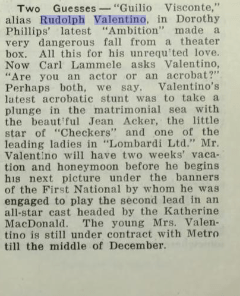
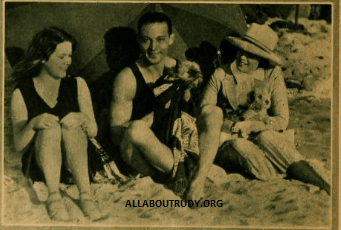
Once again, our favorite Silent Film Star Rudolph Valentino and Marguerite Namara, the famous and brilliant young American beauty who has won fame and fortune in two worlds by the voice and dramatic ability, has forsaken the operatic stage to conquer the world of the movies. Miss Namara will be seen at the Star Court Theatre in her big production, ‘Stolen Moments,” with Rudolph Valentino, of “The Sheik” fame, to-night. The management, of the Star Court Theatre, after much negotiation, secured this famous picture for a limited engagement, and consider it one. Of the events of the season. The story of the photoplay is from the prolific pen of IT. Thompson Rich, who has written many of the most successful plays of the past few seasons. He was commissioned at a high price to supply Madame Namara’s first, film vehicle, “and if the metropolitan critic know what they are talking about, his work ranks high among his notable achievements as a writer. One of the features of the production are the gowns worn by Miss Namara, which were designed by the famous Chicot, of Paris, and imported.to America especially for use in “Stolen Momenta.” Good, clever comedies are to-day as rare as philanthropists, and in “Just Out of College,” a master picture also shown here tonight, a Beanford in the comedy line is presented. Clean, fascinating, and clever, it exudes the spirit of adventuresome youth, and builds up in climaxes that astound us with their uniqueness and complexity. The plot is based on love and pickles, so that sounds good enough, but the film will prove to be amusing and gripping as the best; you’ve ever seen.
Categories: Uncategorized
Tags: Rudolph Valentino, Stolen Moments
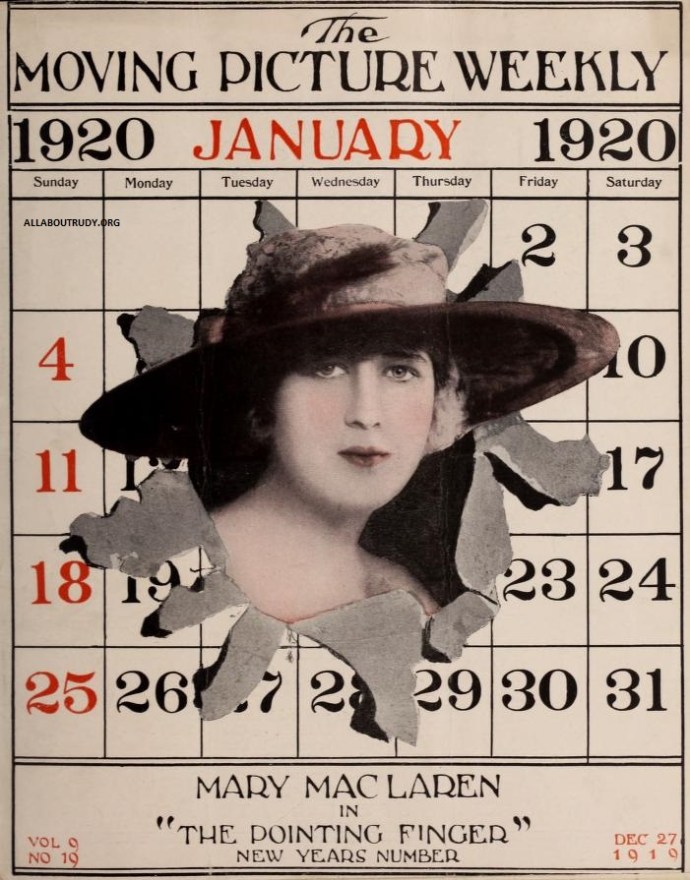
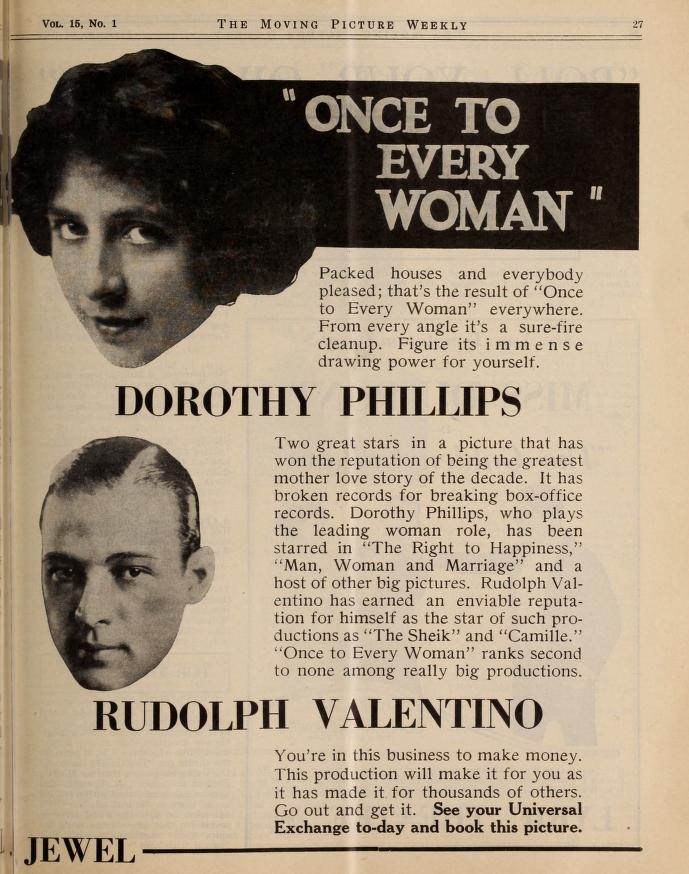
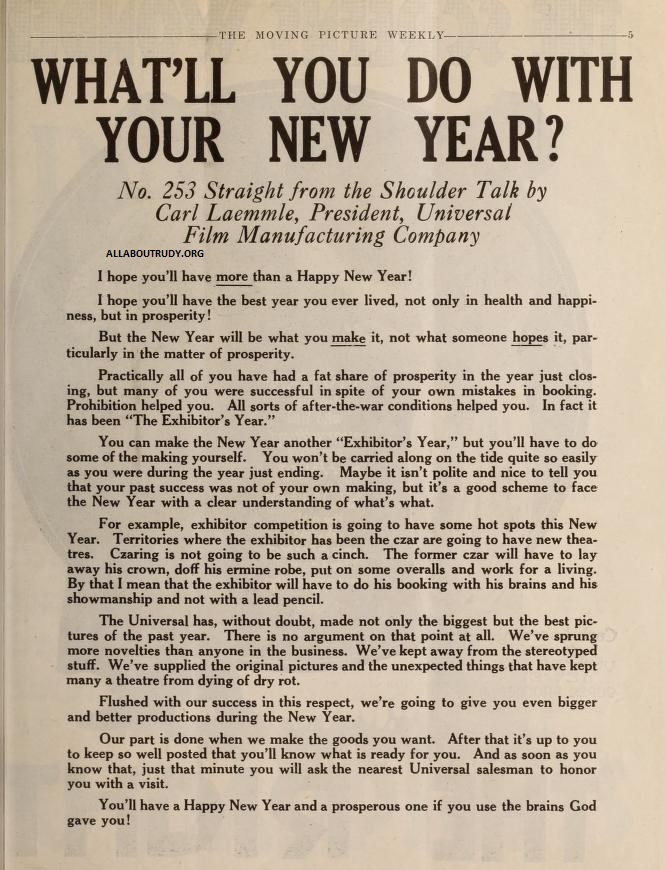


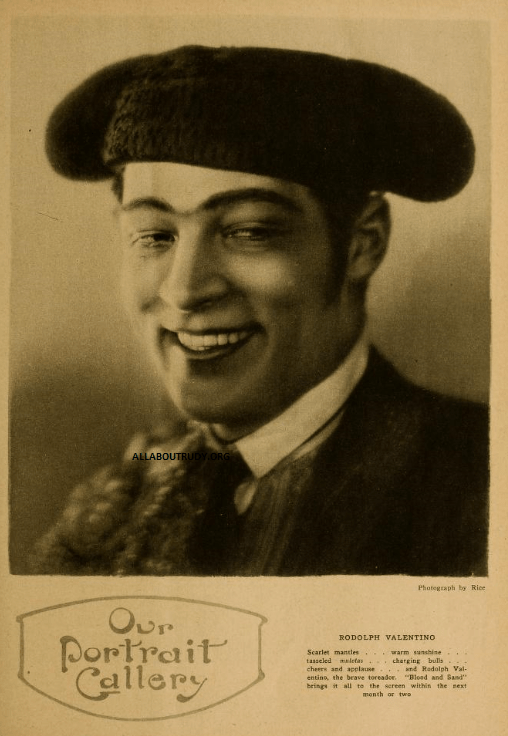
25 Nov 1922
Since their rather sensational wedding it is interesting to note that Natasha Rambova Valentino says “it was not love at first sight it was good comradship more than anything else”..
Categories: Uncategorized
Tags: Natacha Rambova
12 Jan 1926 – Valentino Sets the Record Straight on his Disasterous Marriage
I have been reluctant to write on this subject, but so many interviews, purporting to come from me, have been printed that I think it maybe best to put myself on record over my own signature. I shall have to disappoint the reader who expects something sensational. I did not beat Natacha Rambova my former wife. She did not throw flat-irons at me. Sorry, but we did not do those things. Nor did I object to her having a career her own career. Nor did I demand that she bear children. I wanted her to have what she wanted, in so far as I could get it for her. In other words, I wanted her to be happy, and tried as any man would, to make her so. There was never any issue about her staying at home and keeping my house. No woman that anyone knows stays at home and keeps house anymore. Los Angeles wives have their own cars, as a rule, and go and come as they please. Fortunately, I was able to free my former wife from housework and from all forms of drudgery. If she wanted to keep house I would have “fired” the servants and let her “express” herself in that way. If she wanted children I would have engaged nurses and urged her to “express” herself in that way. She did not want to do these things and frankly I did not give them any thought. Dissatisfaction in marriage as in other family life is apt to be cumulative. There is no sudden erratic or dramatic offense which determines one to “leave home” to be rid of the presence and influence of relatives and out of the environment at all cost. There is often a steady decline in mutuality of interest, in sympathy, in esteem. The child which leaves the home does so because of a long series of misunderstandings, or thwarted plans, which leads him to believe that he can best accomplish the thing he feels it in him to do if he is away from those who blindly or selfishly or arbitrarily “love” him. He suffers a loss of material things the safeguards and comforts of home goes hungry, or maybe or is undernourished over a period of years to enjoy a mental and spiritual freedom which seems to more than compensate for the lack of what his family considers “the real things”. So, it is apt to be with a young man who is too closely circumscribed by an ambitious girl. At first, she stimulates him to “bigger and better” things. She is indeed generous and helpful. He is touched and flattered by her consecration to his aims, her devotion to his interests. Eagerly they plan his career. He welcomes her counsel, and following it, finds it sound. Sound, because in the first flush of life, while she is much enamored of him, she is thinking with her heart, rather than her head, and intuitively arrives at correct conclusions. She has “guidance’s” and powers of divination which calculating women can never exercise for the man she seeks to promote for gain and self-aggrandizement only. They marry. She gives up her career, if she has one, to better and more completely aid him in his. Almost imperceptibly but slowly and surely her attitude changes. It gradually dawns on him that, while she has given up her career, she has not given up a career. She has started on a new one, which is to “manage” and make a success of him. Now, you will say, a man should be deeply grateful for that. Yes, and no. Wait a minute. In the friendship and courting period’s, she considered him, weighed and advised him with relation to his profession or art he was trying to master, with relation to the public or patrons he was trying to serve, to please, to win, to hold. She was anxious for him to do the finest and best thing it was in him to do; and at the same time, please or conciliate those with whom he had to deal promoters and make those little concessions to pride and vanity and even pocketbook, which would make for lasting success in the long run. She was disinterested, and able to see him at long range, and his true relation to others. With marriage and the needles and pins routing of everyday living servants, household budgets, clothes, his friends, her friends, his family, her family and the like she inevitably began to consider him, and then, also, with relation to herself and her relation to him. Would they interfere, would they presume to give advice or make plans without first consulting her? In other words, would they usurp her position as friend, guide and philosopher, would they jeopardize her place and power? Then there enters the ever-present question of money much money. Keeping up an establishment, entertaining, and all that, seems so necessary; and if one does not make money, more and more money, one falls behind the procession. And of course, once having got in the procession, there is nothing for it, it seems, but to stay in. There is the couple ahead, which would turn and stare, and the couple behind, which might titter, and the couples on either side who might exchange knowing looks, as if a pair fell out and walked along quietly by the side of the road. Acquaintances must be appraised according to their places in the procession. People must be cultivated or discarded in direct proportion as they might help or hinder one in “getting on” socially, professionally, or financially. Those lovable and improvident soul’s writers, artists, musicians who follow their own rather than publics tastes must not be “picked up”. They “aren’t” anybody, don’t know anyone of importance and are often a little “seedy” in appearance, and run down at the heel. The most charitable in the procession regard them as a lot of harmless nuts. The others are careful not to regard them at all. Were they alive, and living in Hollywood, Byron and Wilde would be very much in demand at smart affairs. The Browning’s would be sought after by a very small clique. Keats, Shelly and Burns would scarcely get a bid to dinner, no matter how badly they might need one, nor how much bright and beautiful conversation they might bring to a table. Now, I am being a Latin, am not what you Americans call “practical” by later. No Latin is, or can be, practical 24 hours a day. We maybe as mercenary, or more mercenary, than you in the barter of our wares, or talents; but we spend ourselves and our money in different ways. This is an experience which I believe I have in common with the American husband that after a few years of married life he finds only those of his friends of whom his wife approves, remaining; only those of his or her relatives of whom she approves, visiting; and all of her friends, whether or not they like him, or he them, invited to the house on each and every occasion. Well that happens when a man discovers he is being “managed” in every department of life life, those in which he may need direction, as well as those in which for the sake of his own development, he should be allowed volition and selection? The result is that all “management” becomes irksome to him. He suddenly becomes as assertive as he has been “easy”. He finds that he can hire a competent counselor and business advisor, and “live his own life” so to speak. What does the wife do when her husband’s career is taken away from her? She can go back to her own career, or take up a new one, or wash her hands of careers, and be just a wife; for after all a business manager has not tender womanly breast a tired actor may lay his head of an evening. If her love is greater than her pride, she will surrender gracefully, and make the adjustments which will enable them to start all over again on a new basis. If her pride is paramount, she will probably slap him across the face with a bill of divorcement. The world knows what happened in my case, and that is the answer. I have no regrets, no remorse. I enjoyed being married to Natacha and did my utmost to make her happy. Whatever she may say or think now, she too got a lot out of our life together both in material things and good times. She cannot tax me with the old “you have taken the best years of my life etc”. The best years of her life are yet before her. She is as ambitious as ever she was, as high-spirited, as bright and keen. She can still achieve anything within her logical range. I bear her no ill-will and wish her the best of success. Neither am I broken-hearted. Nor am I out of a home. I have a secretary, and I have a few dependable servants, so I am week taken care of. This summer I brought with me from Europe my brother and his wife. They supervise my household, and I may entertain whom I like, when I please; and have that “monarch of all I survey” feeling which is so nourishing to the male ego. Perhaps this account of my second wreck on the reefs of matrimony will give the lie to the line which has been tacked onto me. That I am “a great lover” both on and off the screen. I suppose it is intended for a compliment, but I do not relish it. I wish above everything to be known as a great artist and am working earnestly and steadily to that end. I hope eventually to be given a picture which will demand something more than a physical performance, and I want to be ready when the times comes. After all, a man gets tired of being talked about and written about as though he were a processional “handsome” man. For this reason, I need to concentrate on my work and plan for my future as never before. And what may happen is on the lap of God. However, I must admit that I am not insensible to the charms of the fair sex.
Categories: Uncategorized
Tags: Rudolph Valentino

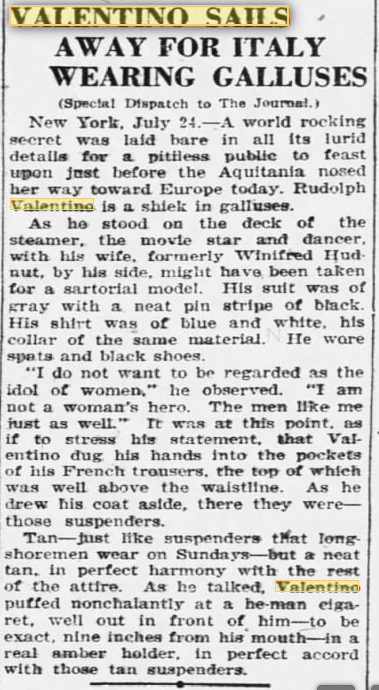
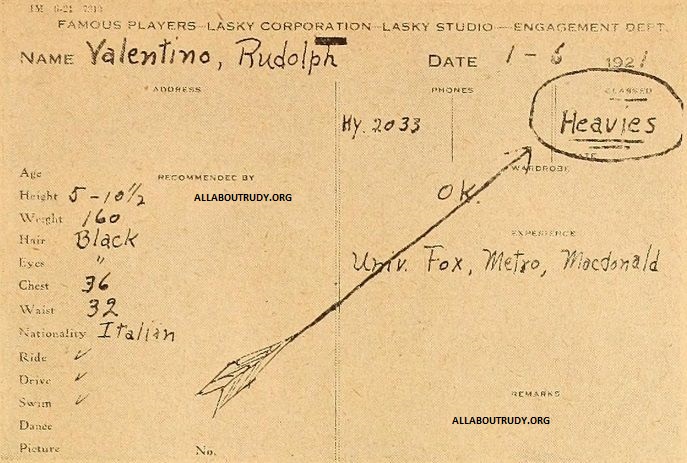
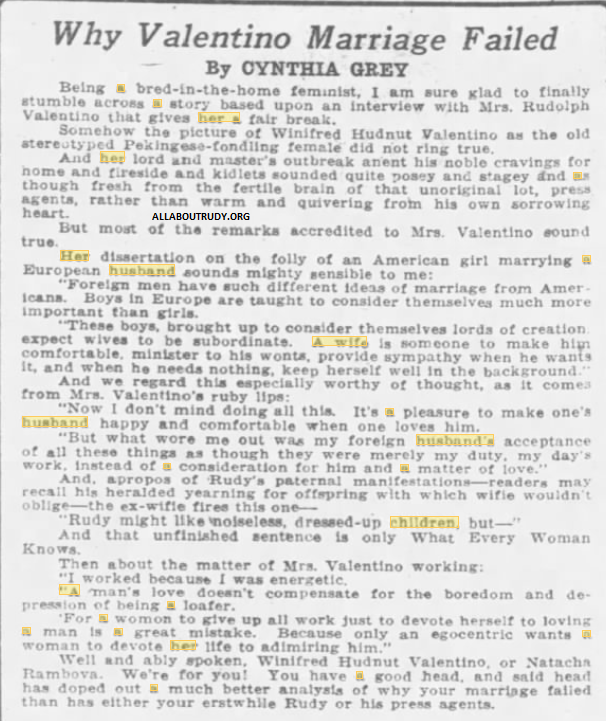
3 Jan 1926 – More Opinions Should a Wife Deny a Husband Children?
I am a man who firmly believes the wife does not have the right. Taking into consideration the wife is healthy, no home ought to be without children. It is a mans fondest dream to have little ones clustering around him and he gets married with that thought in mind. Rudolph Valentino is going through the same thing with a wife who has a liberal attitude and is denying her husband a right. Why did they get married in the first place? Did she promise one thing and when things did not go her way instead of being a woman and trying to keep the marriage she is selfish and leaves. However, I am not an advocate of large families. Three to four children are too much and keep the mother busy with attending their wants and needs which will take priority over the husband and then the husband feeling neglected will seek comfort elsewhere. Moreover, no woman that marries wishes to be childless. A woman to the other effect is not worthy of the name. When a man marries he tries to make his wife comfortable as his means allow. In return, she is expected to keep her home and children neat and clean. The woman was created for man and through her mankind has flourished. The laws of the universe have given power to woman, no one has taken it from and it stands to reason she still holds the place as “Mother of Men”. Besides the blessing of the home, a little child is the greatest link of the human heart and passions. It ties the heart strings of the mother and father in its tiny hands and coos the blessings of a great love upon them. The early years of care are more than repaid when the child has grown. No wife has the right to deny her husband children and no wife will deny them to her mate for it is her greatest and dearest wish to be deserving of the mother.
Categories: Uncategorized
Tags: Rudolph Valentino, Valentino Divorce
2 Jan 1926 – Viewers Opinion Has Wife Right To Deny Husband Children?
To the Marriage Editor,
A wife has the right to deny her husband if he’s a drunkard and a beast who does not have a job that is supportive to his family. Why bring a child in the world when they cannot afford to. I believe in years to come this will become something that will become more of an issue as basic cost of food and essentials continues to rise. Also, let me tell you this world, is past being old-fashioned and it will never be again. The boys and girls now marrying are not flappers that is so outdated. If a man loves a woman enough to marry her again, he needs to be able to afford it. I know not everyone loves kids but have a pity on the mother she is not a truck horse.
Happy in Buffalo
To the Marriage Editor,
Having been a long time reader I am very much interested in the Marriage Column, I wish to say a few things in regards to the new subject that is before the readers. I think probably in the beginning of the world God intended every woman to become a mother, but as the world stands today there is a limit even in motherhood. In the first place, no many has any business with a wife and prospective parent unless he is able to care for them in a comfortable way. Under circumstances a small family is an absolute necesssity in the cycle of life. I think three or four children born of healthy parents is perfectly fine. As long as the man is a provider and can well support, educate, feed and clothe all members in these times of high prices, and a mother should not be compelled to seek work outside of the home to help care for the family. If she overtaxes her strength mentally or physically by outside work. I may say if there is a loving kind husband and again, able to financially provide it is most assuredly a wifes duty to grant her husband the children if they so desire.
A Constant Reader.
Categories: Uncategorized
Tags: Rudolph Valentino, Valentino Divorce
1929 – Cooking with Cecil B. DeMille
Rudolph Valentino had great respect for others of his profession and his admiration for Mr. Cecil B. DeMille was profound. They both shared a love of movies and cooking. Here is a receipe that Mr. De Mille truly enjoyed. 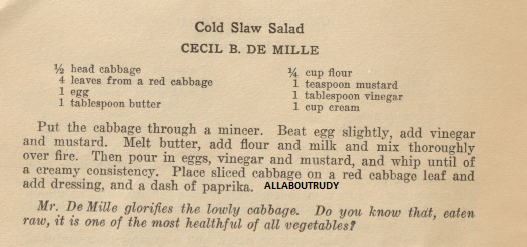
Categories: Uncategorized
Tags: Cecil B. De Mille, Rudolph Valentino
Jan 1926 – Children and Valentino Divorce Debate
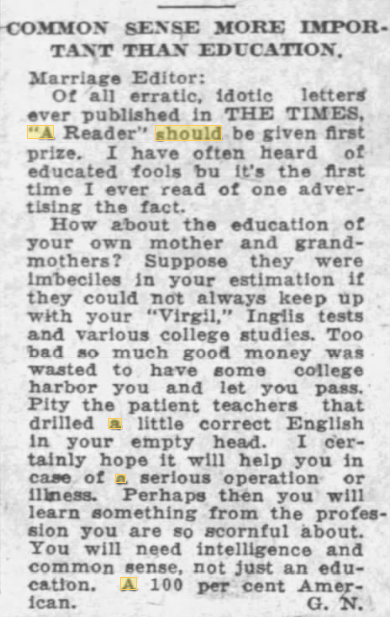
In the life events leading up to Valentino’s divorce, I found a newspaper contest which people provide an opinion on whether a wife has the right to deny her husband children. Valentino longed for the love of family that was not meant to be. In the 1920’s, there was published opinions by some with 21st Century attitudes about being able to afford a family and the defined roles of a nuclear family. Valentino and Rambova had their reasons for marriage and went into this with their own version of what this would look like. I see Rambova using her husband and his fame to further her own intentions. While Valentino used his wife as a means of furthering his own career. She had the inside connections and was knowledgeable on what it took to be a star. For someone who wanted so badly to succeed he did what it took to survive. Did they truly loved each other? I think they loved each other when they lived together in a bungalow on Sunset Blvd where happiness existed in the simple things in life and away from the bright lights of Hollywood. Then the lights were brighter and beckoned and life for both was never the same.
Categories: Uncategorized
Tags: Valentino Divorce
1 Jan 1922 – Most Popular
In a recent popularity contest in Tacoma, Washington Rudolph Valentino won the most popular leading man on the silver screen competition.
Categories: Uncategorized
Tags: Rudolph Valentino
31 Dec 2019 – All About Rudy Blog
I have always been fascinated when I find something new and interesting about Rudolph Valentino. My research has taken me to many places where the thrill of the hunt is always within reach. I feel news paper or magazine articles and pictures give viewers a first hand experience through a bygone era of what he was all about. I would love to see more viewers stroll through the archives in hopes they feel excited by what they read here. While there is still a long road ahead in the journey of discovery, on Rudolph Valentino, I hope to bring new material to light.
Happy New Year.
Chris R.
Categories: Uncategorized
29 Dec 1925 – Should a Wife Deny a Husband Children?
The question of a wife’s right to deny her husband children is raised again, in an article in Liberty this week. The recent pending divorce of Rudolph Valentino and his liberal wife as the basis for this discussion. This question is as old as the human race. It has caused more arguments and marital discord. Nations have been split by it and kingdoms almost rent in twain. Thrones have tottered and churches trembled in the balance. What do readers thing of it DOES A WIFE HAVE THE RIGHT TO DENY CHILDREN TO HER HUSBAND? The times will pay rewards of $3, $5, $7 for the best three letters on the subject.
Of this great question, Valentino in Liberty, “If Mrs. Valentino is through with me, I am through her and this marriage-until I can have children and give them the kind of care and love, I had as a boy”.
Then the wife known as Natacha Rambova is quoted “We were married four years ago, and it was an intense romantic love afair. Gradually we found out it was a mistakem and we separated a matrimonial vacation the newspapers called it. You cna’t blame us because we thought our marriage would be perfect. Young people havent much sense about love and no provision. Anway, we weren’t married with the cold-blooded idea in a few years we would get a divorce, amuse ourselves again with another marriage. I believe in divorce. Where two people are injuring each other by bad feeling they ought to be separated.”
Stay tuned to this blog for updates to this article.
Categories: Uncategorized
Tags: Natacha Rambova, Rudolph Valentino


1923 – Our First Married Christmas By Rudolph Valentino
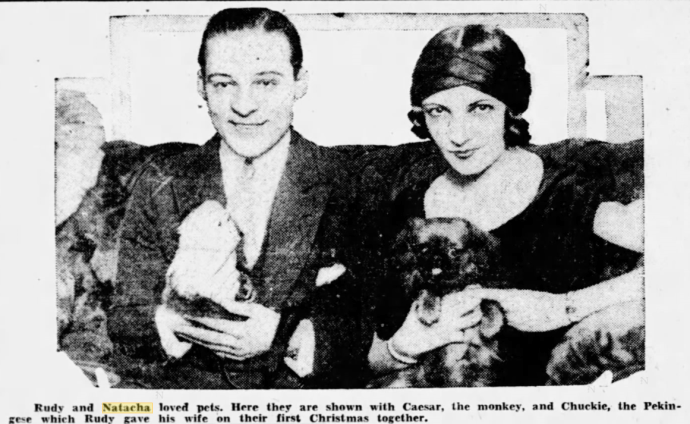
Finally, the Mineralava Dance Tour was over and we could settle down as a married couple. Our new home is perfect and I can imagine many happy years ahead. A home filled with light, love, laughter, pets and children. So, we take time to enjoy our first Christmas tree as a married couple. The lights on our tree were the most beautiful too me. My beloved wife by my side, in our new home with hardly any furniture. But it didn’t matter we had weathered worse situations before. I gave my wife a monkey and a pekinese. She was delighted like a child but it was the happiness in her eyes that made everything worthwhile. I adore her and feel whole when we are together.
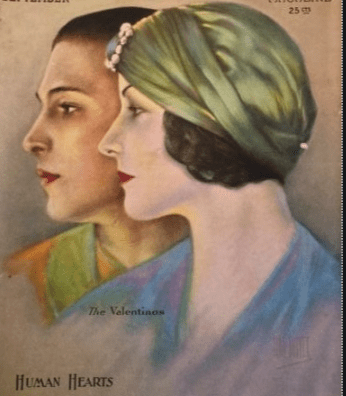
This time of the year, brings one of reflexions and looking forward to the future. We will continue to work together to achieve dreams and dream even bigger and better. To all of my fans I would like to wish you all a joyous holiday.
Categories: Uncategorized
Tags: Natacha Rambova, Rudolph Valentino

Dec 1925 – The Eagle Movie Review
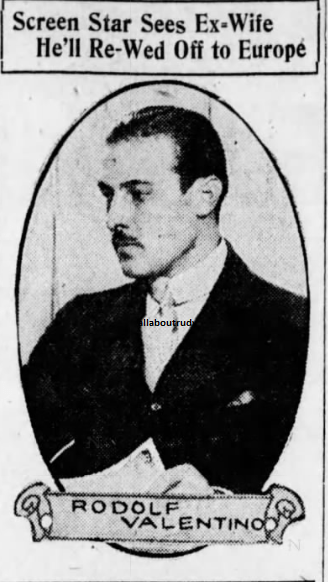
In the guise of a dandy Cossack Lieutenant, who becomes an artful, gallant and very lucky bandit, Rudolph Valentino’s shadow yesterday afternoon at the Mark Strand renewed its acquaintance with admiring throngs in a production entitled “The Eagle,” which is based on Alexander Pushkin’s novel “Dubrovsky.” Following the first presentation of the film Mr. Valentino himself took the stage and thanked the audience for its reception of the picture, adding that he felt sure that by it he would regain that popularity he enjoyed a few years ago. While he admitted that his preceding photoplay, “The Sainted Devil,” was a poor picture, he refrained from referring to the picturization of Martin Brown’s play “Cobra,” which he finished before starting work on the present offering, and which has not yet been released. The Mark Strand was packed, the police were kept busy at the theatre entrance holding back the crowd, and an enthusiastic collection of people after the first show pressed around the stage entrance, watching eagerly for the screen star’s appearance on the street. Through the introduction of Catherine of Russia, or a modern conception of that lady, the initial chapters of “The Eagle” are reminiscent of the picturization of “The Czarina,” which in film form was heralded as “Forbidden Paradise.” Although these sequences in the Valentino photoplay are undeniably entertaining, they by no means reach the artistic heights achieved by Ernst Lubitsch and Pola Negri in “Forbidden Paradise.” Mr. Valentino is indeed fortunate in having obtained the services of Vilma Banky from Samuel Goldwyn, for Miss Banky is so lovely to look upon that her beauty makes the hero’s gallantry all the more convincing. In this production, which might suit several male screen celebrities, including the agile Douglas Fairbanks. Mr. Valentino acquits himself with distinction. He appears, to have benefited by Clarence Brown’s direction and to have appreciated that Miss Banky was a valuable asset to his picture. It was an excellent idea also to have Hans Kraely, Mr. Lubitsch’s clever scenarist, handle the script for “The Eagle.” Mr. Valentino first is seen in the graceful costume of a Cossack officer, his astrachan headgear often placed at a most acute angle. Subsequently he rides to romantic fame as the Black Eagle, a bandit, whose chief exploits are bowing to the fair. His lieutenants kidnap Mascha Troekouroff, impersonated by Miss Banky, only to be told by their irate chief that he does not war with women. It happens that Mascha’s cowardly father is kept on tenterhooks by the Black Eagle, who binds and gags a French tutor being sent to the Troekouroff Castle to instruct Mascha, and then impersonates the tutor, coolly reporting to the girl’s parents, who had incidentally offered 5,000 rubies reward for the Black Eagle, dead or alive. One has the satisfaction of seeing the Black Eagle massaging old Kyrilla Troekouroff with amazing energy, and then seeing the hero turn his attention to Mascha in caressing fashion. Kyrilla receives notes from the Black Eagle under his plate, and his mind is always uneasy. He is a cruel old fool; who has a chained bear in his wine cellar, and he looks upon it as a pretty jest when he sends a victim down to get a bottle of the best wine. This happens to the Black Eagle, who kills the “jest” with a bullet. Before he took up the calling of bandit, the then respectable Lieutenant Vladimir Dubrovsky had been told in private audience by the Czarina: “You are the first Russian to see his Czarina weep.” Dubrovsky had been commanded to appear in the royal presence at 6 o’clock, and it is explained that 6 o’clock meant supper and not Siberia. The young lieutenant, always so courageous, had abandoned the Czarina when she was about to mount her favorite horse, because he observed two frightened horses dashing away with a vehicle in which sat an aunt, a Pekinese and the glorious Mascha. This is a satisfying picture in which Mr. Brown introduces some interesting touches. It is well equipped with scenery and the costumes of the players are capably designed. Mascha, at a banquet, adorns herself with a wealth of pearls, and the Czarina, played by Louise Dresser, arrays herself as Commander-in-Chief of the military forces. THE EAGLE, with Rudolph Valentino, Vilma Banky, Louise Dresser, Albert Conti, James Marcus, George Nichols and Carrie Clark Ward, adapted from the novel, “Dubrovsky,” by Alexander Pushkin; directed by Clarence Brown; overture, Tschaikowsky’s “1812”;
Categories: Uncategorized
Tags: "The Eagle", Rudolph Valentino
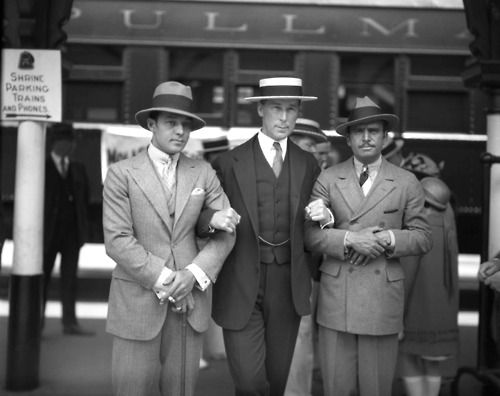
1925 – Shriner Welcome, Los Angeles
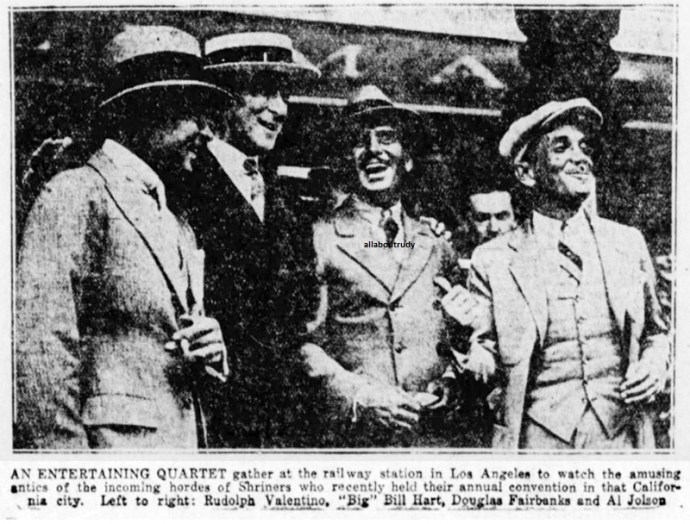
Categories: Uncategorized
Tags: Al Jolsen, Douglas Fairbanks, Rudolph Valentino, William S. Hart
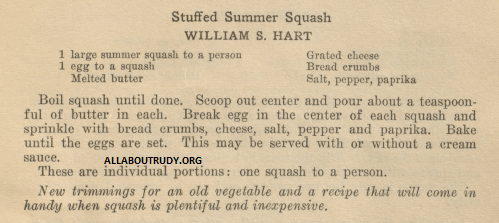
1925 -William S. Hart Receipe
Rudolph Valentino had many friends in the movie industry and one of them he admired about most was William S. Hart. Both men had much in common including a love for good food. Here is a receipe you might want to try:
Categories: Uncategorized
Tags: Rudolph Valentino, William S. Hart
1925 – Photoplay Movie Review Cobra
The original theme of Martin Brown’s Play, “Cobra,” having been written for a woman star, obviously puzzled the picture-makers in their efforts to twist it into a virile vehicle for Rudolph Valentino. Therefore, this main idea receives but scant attention in the screen version, the narrative of which, as it is unfurled, is moderately entertaining until the director and his henchmen decide to include a fang or two of the poisonous reptiles. It then becomes quite absurd and the accompanying captions assist in the general decline. Nita Naldi is supposed to officiate in the title rôle, but she is not called upon to appear until the story is well on its way. It is soon after her entrance that the real theme is attacked, the adapter having endeavored to shift the importance of the character from Elsie Van Zlla to Count Rodrigo Torriani, which results in the distressing consequences. Torriani, played by Mr. Valentino, is painted as a happy-go-lucky nobleman who finds any pair of feminine eyes enchanting. One might infer that he is sowing wild oats with a vengeance, as he is constantly discovering himself to be infatuated with some new fascinating creature. He has only to shake their hands, look into their eyes, and the wicked work is started. One of these charming young women happens to be Mary Drake, a stenographer, who is declared to be sweet and innocent, and is an inspiration to the Count to cause him to mend his ways. This good girl is an artist with paint and powder. Her lips are like cherries and her eyes are liberally outlined with mascara. Yet she is declared to be so serious in her attentions that one would expect her to shy at the sight of a lipstick. The Count falls in love with this Mary, but he cannot resist Elsie’s black eyes, even though she is wedded to his fast friend, Jack Dorning; and this brings about trouble. Elsie is burned to death in a hotel fire and Doming eventually learns of the Count’s conduct. So as to ingratiate the Count in the eyes of the spectators, the scenarist has him make a sacrifice. He insists to Mary that he is just as bad as ever, and the consequence is that she marries Doming. So, in this little tale Dorning has two wives, but the Count remains a bachelor. Mr. Valentine takes advantage of the opportunity to wear a variety of clothes. In one sequence he is seen as the Count’s seventeenth century ancestor. After that he wears golf clothes, lounge suits, white flannel trousers with a blue coat, white shoes with a blue suit, and when he dines alone, he is so punctilious that he appears in full evening dress. In one sub-title the Count is alluded to as an “indoor sheik,” and the fight that follows gives Valentino credit for a Firpo blow, while his opponent must have a cast-iron jaw. Casson Ferguson, who officiated as the villain in the film version of “Grumpy.” and recently was seen in a similar part in “The Road to Yesterday.” in this current feature fills the sympathetic role of Doming in a somewhat stereotyped fashion. Miss Naldi, whose eyes match Sir. Valentine’s makes the best of a bad bargain. Mr. Valentine’s acting is acceptable, but he is not indifferent to his much-exploited looks.
Categories: Uncategorized
Tags: "Cobra", Rudolph Valentino
16 Dec 1925 – The Hero Remains a Bachelor
|
Categories: Uncategorized
Tags: "Cobra", Rudolph Valentino
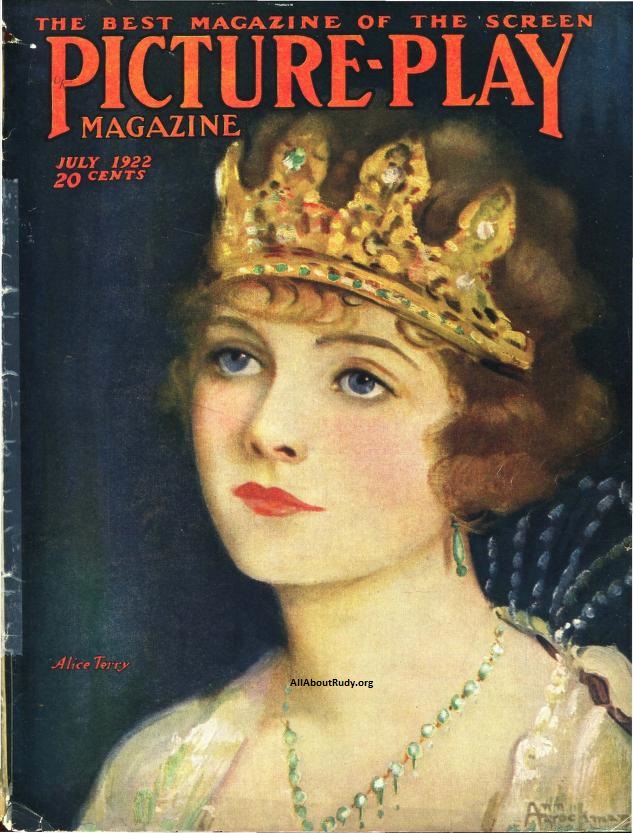


“Even stardom doesn’t make a girl immune to loneliness” – Agnes Ayres, 1922
Categories: Uncategorized
Tags: Agnes Ayres
Apr 1922 – Hollywood Boulevardier Chat
Alittle bit of gossip I picked up from friends say Rudolph Valentino’s new house with no bride apparent on Whitley Heights, Hollywood is the most sensatoinal and exotic piece of property in the movie colony. Nobody knows what he is going to do with it. Presumbly he bought it in a fit of exuberance on discovering he would not be paying alimony in connection from his divorce from Jean Acker
Categories: Uncategorized
Tags: Rudolph Valentino, Whitley Heights
9 Dec 1913 – Youthful Dreams Sails
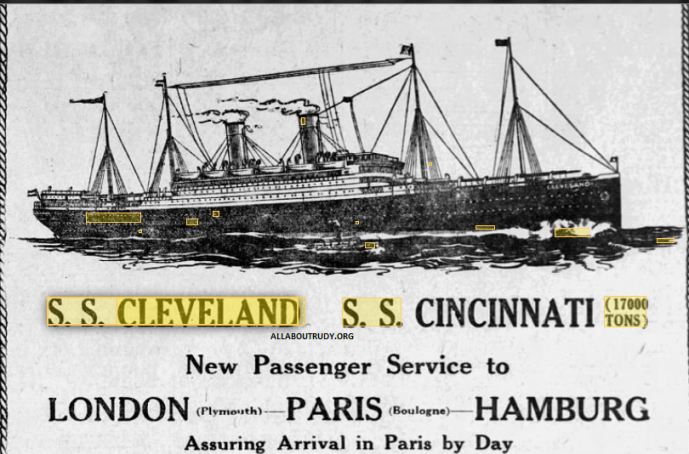
In 1913, on this day, an 18-year-old, Rudolph Valentino, with youthful dreams and ambitions leaves familiarity behind for an unknown. A passenger on the S.S. Cleveland, the ship will take him, and others like him to a better life in America. The S.S. Cleveland was a steam powered ship, operated by the Hamburg America Line, transporting both cargo and passenger. In the end, he was a survivor and achieved the American Dream.

Categories: Uncategorized
Tags: Rudolph Valentino, S.S. Cleveland
12 Oct 1923 – Sheik Swamped by Demand for a Hair Lock
Rudolph Valentino holidaying in London, has been inundated with requests from English flappers for locks of his hair. He would probably have been balder than Bob Fitzsimmons he had complied with every request.
Categories: Uncategorized
Tags: Rudolph Valentino
16 May 1924 – Valentino in Miami Asks Chance to Rest
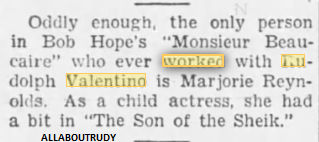
It must be different if Rudolph Valentino is in it, for he said so himself to the Miami News representative Friday when interviewed Friday. “Stop right there” pleaded the Sheik “only say I have been in Florida or Miami but please don’t tell where my cottage is. The interviewer tried to console the star with assurances the Florida Keys for which he sailed almost at dawn Saturday morning are an excellent place to get lost if he really wants to escape the maddening crowd. Still he said he did not want his name in the paper as he is here strictly to rest. But worse, than that he had an enormous police dog and a stern physical director at his cottage and both, less than one-half hour earlier, refused to let the reporter see Mr. Valentino. “Yes, we have no publicity today”. Was the sum and substance of the P.D.’s conversation after he called off the dog. The dog, which looks every inch a sheik of canines, however, refused to function in breaking up the interview when Valentino was caught sauntering around the old Lake Placid school grounds during the shooting of some scene’s for Betty Compton. In fact, the interviewer found much more satisfaction to pat said dog’s strong head than to twiddle a pencil with proverbial nervousness in the presence of a celebrity. It is only one week off, which Mr. Valentino claims between the completion of Monsieur Beaucaire and the start of his next picture to be set in South America. But this brings back a starting point, for Rudolph Valentino must have things different or not at all. At the first mention of sheiking, up went his finger and his quick, soft but positive voice was saying “Ah only once, why repeat”? Ask Mr. Valentino about the trend of modern movie pictures in theme, in setting, in cost, in acting and every time he says “it must be different” so Valentino fans need not expect to see him over and over again playing a type of role “they love to see him in.” Producers, said Mr. Valentino, are all watching for successes and then are repeating them. “The Sheik” was a success, bad as it was, and they copied it admits the star, “and if Beaucaire is a success they will all be wearing powdered wigs. Rex Beach put a revolution into the story of Valentino’s next picture and out it had to come, and now the star says the public can look forward to something different there in setting, theme, and action. In fact, he says his own part is to be “very heavy” which is one alibi for the present rest, which began on his arrival Thursday and he has now taken off fishing. When it comes to pleasing the public with something new Valentino is all for Douglas Fairbanks . There he says, is a man who can make a picture, and he calls Fairbanks instinct and ability as a director even more than his ability as an actor, the explanation of his success and Valentino’s eyes shine as he smiles with anticipation of what the public will think of the “Thief of Bagdad” as a fairytale for adults to enjoy. The question is will Valentino make a movie in Miami? Well, the next picture is of South America. The star says the interiors will be made in New York and he does not think the exteriors will be on the southern continent. Imagination at work on the statement says the exteriors will be artificial or on the islands or the only, real live groves of coconuts and royal palms in the United States will get into the movies again. Asked if he likes Miami? Mr. Valentino’s response was “oh, very much”. A bright yellow coat and bell-shaped trousers were the first impression that many received of the celebrity in their midst when he first appeared on the streets in – well, in Dade County. Yet his eyes do shine. His side whiskers> Well he does not look like his imitators. Maybe the powdered wig caused it, but those famous moments are trimmed quite a peak. He wears horn-rimmed glasses, Harold Lloyd might envy. No Mrs. Valentino was not with him. When she finishes with cutting the Beaucaire film in New York, maybe.
Categories: Uncategorized
Tags: Monsieur Beaucaire, Rudolph Valentino
17 Apr 1927 – Why Europe’s High Society Smashes Beauty’s Perfect Romance
An envied position as “Broadway Darling” a fiery romance with a brilliant young musician, contacts with continental diplomatic society and then the disillusionment of old world standards for a new world wife. These things brought silent film star Consuelo Flowerton, beauty, violinist, artist’s model, back to America from her adopted home in Europe back to more trials and tribulations and the harsh necessity of finding again the place she had surrendered such a light heart only a few months before. Europe, claim the gossips “high hatted” pretty Consuelo. Europe failed to take into consideration her remarkable gifts. Europe expected her this American girl accustomed to American modes of living to become continental over night; expected her to ‘learn the language’ and become one of them without preparation or acclimation. When she was unable to meet those foreignstandards he left her husband, the brilliant young orchestra conductor Dirk Foch, already a celebrity abroad as conductor of the Vienna Concert Society, and came back home, determined to resume her lofty position among the reigning beauties of A merican stage and screen. When Consuelo Flowerton left America she was celebrated beauty, a favourite along Broadway and those tributary rialtos in a half score cities in other parts of the country. Her name in Electric lights above the box office brought the crowds tumbling in. Money came easy then and fame was her middle name. These she put behind her, never dreaming her romance would come to naught and that sometime the fickle public might again, be asked to applaud her before the footlights. The plaudits Consuelo Flowerton received in the days before her marriage had not been confined to the auditorium of a theatre. A brilliant art model at a top-notch salary and a Ziegfeld follies girl. But it was the famous Navy Girl poster painted by the celebrated artist, Howard Chandler Christy, which made her face familiar to many thousands. She was on her way to the top to the place she had occupied before she fell in love with Dirk Foch. But let Consuelo tell of her collapse of her “perfect romance” as the marriage of this brilliant young star and her talented husband had been called. Let her give the strange reasons for their separation and the heart rending decision of the Dutch Courts, which makes it necessary for her to give up her baby for six months of each year to her husband, who has remained in Europe. “I met Dirk Foch at a symphony concert he conducted here in New York she explains. “During the concert, I admired his work. I considered him a genius. When the concert was over and I was introduced by a mutual friend it was love at first sight and in two months we were married. Then followed a honeymoon in Java. Dirk’s father was Governor General of the Dutch East Indies and we certainly had a wonderful time. We had wined, dined and feted in royal style with a future that seemed very rosy”. Then we started for our home in Europe. The prospect of living in Europe thrilled me beyond words. We traveled abroad from place to place, entertained and were entertained. Then Dirk obtained a conductor position of the Vienna Concert Society, one of the most celebrated of European musical organizations. It was a rare for so young a conductor to be selected. It was in Vienna that our marital troubles began. The principal cause was our lack of a home. We had to move from place to place. Always we were unsettled and generally broke. We had a positon to maintain that was out of proportion to Dirk’s income. Because of Dirk’s fathers position, people we associated with naturally assumed we had plenty of money. In reality we had very little. In spite of this we had to keep up the pretense, dining at expensive places associating with rich people like Fritz Kreisler the violinist, Maria Jeritz the blonde soprano. They entertained lavishly and we were naturally expected to do the same. When Winter came it found us high and dry financially. We moved from furnished flat to furnished flat and in desperation I decided to try house-keeping. That was terrible. Never had I done a thing of that kind. I was willing to learn, and certainly tried hard enough but it was impossible. I might have learned over here, but in Vienna Never. No woman who hasn’t kept house in Vienna can understand the difficulties had encountered. “I couldn’t speak German, and it was a disadvantage. It became known among other shopkeepers and others I was an American and when I went shopping they took advantage of my ignorance and vented their spleen against America by charging me double prices and giving me inferior goods. I would ask for one thing and got another. My neighbour hampered instead of helping me, and it became unbearable. The apartments were very old and rickety. It almost seemed as if they’d fall down on us. We did not ride in the elevators in crowds and we didn’t dare send our trunks up on the elevators. We had to have them carried up. The lifts would have collapsed if we had put that much weight on them. Furthermore, there was no delivery stem. If I had shopping I had to carry my own packages. When the servant shopped it seemed it cost so much more than it should I couldn’t trust her. Once in carrying packages my fingers were nearly frost bitten, and this condition remained until two months ago. All of this might seem trivial, but when these little irritations keep piling up they seem monstrous and ultimately sent this marriage on the rocks. My husband was a genius. I cared for him deeply and still do. But he is the type of man, that should never marry or at least, he should married a woman his own age. He needed a mother to take care of him and I couldn’t do it, because I couldn’t even take care of myself. It was during this time my little daughter Nina was born. My health was delicate and Dirk, I knew was unhappy under the yoke of this marriage. I do not say that he ever was anything but kind and considerable toward me but money problems, household worries got on his nerves and mine. Each year, for the three and a half years we were married, I decided I’d try it out a while longer. But finally, the strain became too great and divorced in Holland. Immediately after the divorce, I came to New York and tried to get work. I had decided to give up musical comedy and enter straight drama. After three months of walking from agency to agency, I finally landed a part in The Desperate Pilot. I was very happy, but lasted only one week. I’m not discouraged though. I’m going to keep right on trying. I’m happier than I’ve been in years. I feel free for the first time. I don’t think, I’ll ever marry again. A woman should try marriage once, I think, but if she’s not successful at it, she ought to take up a career”. She can only be happy when she’s free and independent. Just how Consuelo Flowerton will carry on with her independence here now that she found the producers guard their doors a bit more closely than in days gone by, what with beauty contest winners and the like lurking behind every pillar and post and her own reputation has been dissipated by the unkind years, time only can tell. Perhaps she will again turn to the movies for a contract. She starred in one picture with no less a cinema deity than with the late Rudolph Valentino who was fascinated by her charms.
Categories: Uncategorized
Tags: Consuelo Flowerton, Rudolph Valentino
18 Jul 1940 – Valentino Former In-law Donates Foxlair as a Fresh Air Camp
There was 166 New York City youngers arriving Tuesday night at Grand Central Station after spending 25 days as guests of the Police Athletic League at Fox Lair, the Police Athletic League Camp. Part of the inner city Fresh Air Camp which gets kids from low income families time to spend outside of the city to enjoy time hunting, fishing, and other holesome activities during summer months. The camp surroundied by the Adirondack State Park consists of a 1200 acre estate given to the Police Athletic League for Fresh Air Camps by Mrs. Winifred Hudnut, widow of Richard Hudnut. The entire expense of these vacations including transportation is borne by Police Athletic League and a generous donation by Mrs. Hudnut.
Categories: Uncategorized
Tags: Mrs. Richard Hudnut
10 Jul 1935 – From Tasmania Not forgotten
|
Categories: Uncategorized
Tags: Death of Rudolph Valentino
 All About Rudolph Valentino
You must be logged in to post a comment.