22 Apr 1982 – Valentino Shirt Sells in London for $673.00
A cream-colored silk shirt worn by screen idol Rudolph Valentino in his last movie, “Son of the Sheik,” was sold for $673 at Christie’s auction house in London on Tuesday. The trimmed shirt was among the memorabilia in a sale of clothing and relics belonging to stars of stage and screen. The shirt was bought by Ray Jackson, manager of a British magician known as “Zee” who intends to use it in his act. “He is doing a Valentino number and particularly wanted the shirt. He told me to pay up to 5,000 pounds ($8,850) so I didn’t do too badly,” Jackson told reporters. A Valentino ribbed silk sash also worn in “Son of the Sheik” was sold to an unidentified Englishwoman for $974 The film was made in 1926, the year of the actor’s death at age 31. The woman also purchased a black velvet casket belonging to Valentino and five letters written by the cult figure to Maria Elliot, British founder of the Rudolph Valentino Association. The 65 lots, originally owned by Miss Elliot, were bequeathed after her death to an Italian countess who in turn left them to the seller, an unidentified Englishman.
Categories: Uncategorized
Tags: Rudolph Valentino
1918 & 1922 – Hotel del Coronado
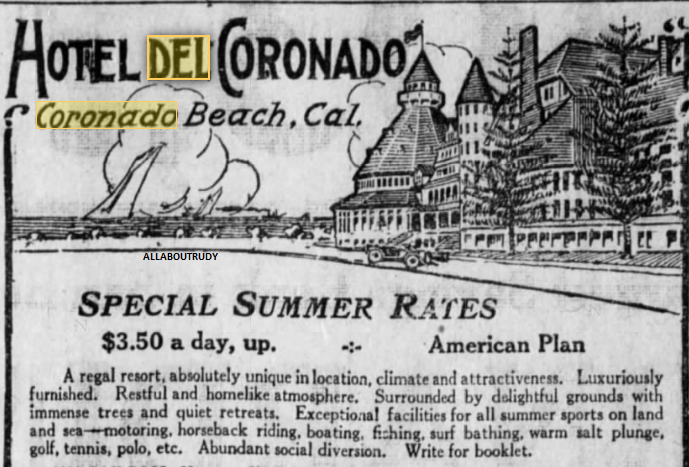
In February 1888, the Hotel del Coronado, brought luxury on a scale that could only be appreciated in Southern California with its warm and sunny climate. This Victorian style all wood material hotel and a ocean backdrop, held many firsts with the introduction of electricity and the first outdoor Christmas Tree. This hotel had 399 rooms, with tennis courts, yacht club, Olympic sized saltwater swimming pool. The hotel played host to the very rich and famous Lillie Langtry, Prince of Wales, Douglas Fairbanks, Charlie Chaplain, Mae Murray, Tom Mix, Gloria Swanson, Rudolph Valentino and many others past and present. The hotel was becoming famous as a film location in many silent films: Princess Virtue (1917), Married Virgin (1918), Beyond the Rocks (1922), My Husband’s Wives (1924), Flying Fleet (1929) and many others.
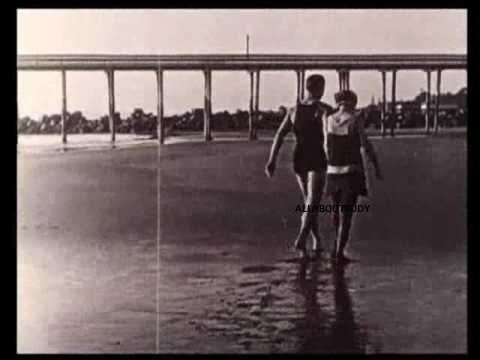
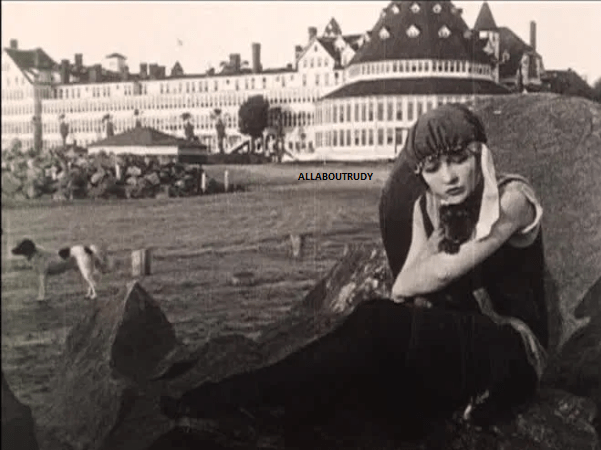
In 1918, Rudolph Valentino, Kathleen Kirkham, Edward Jobson starred in an independently produced movie directed by obscure neophyte Joel Maxwell. In 1920, this movie was in limited release by Fidelity Pictures with the title “Frivolous Wives”. During his time filming at the Hotel del Coronado, Valentino was deemed the hotels most popular guest. A favorite past time for single and married ladies was to lookout for where their movie star hero might be located on the hotel’s property. During each day, from the hotel’s ocean front veranda ladies were his most enthusiastic and appreciative audience. This was shown by a continued and hearty applause whenever they could grab a glimpse of their idol. During his time on set, Valentino took his acting role seriously. by isolating himself in order to prepare for the next day’s filming. Due to his immense popularity, there were many times he was called upon to dine with other famous guests or persons of influence. Although he would love to decline the many invitations he received it was understood as a rising film star, he could not afford to offend his fans and the various movie producers so he took it all in stride. However, truth be told Valentino did enjoy his hotel stay, whether it was fine dining in luxurious surroundings, motoring over scenic roads, a game of tennis, or enjoying a cold swim. Valentino truly loved his time at the hotel, that he came back a couple of years later to make another memorable film in 1922 Beyond the Rocks with Gloria Swanson. The hotel became famous as a vacation playground where Hollywood’s elite would come down for vacation stays.
Here is a YouTube 6.41 clip of Rudolph Valentino near the Hotel del Coronado.
Categories: Uncategorized
Tags: Beyond the Rocks, Hotel del Coronado, Mae Murray, Rudolph Valentino, The Married Virgin
1915-1962 The Barbara Worth Hotel, El Centro, CA
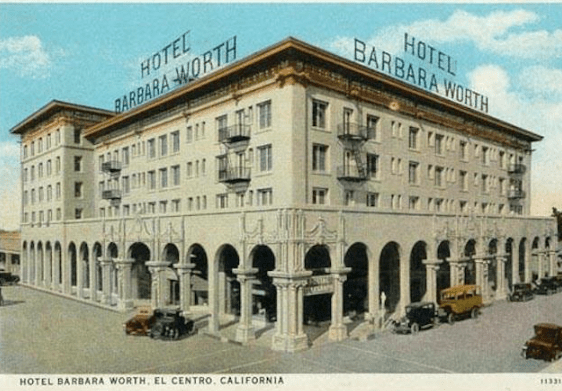
On 8 May 1915, the 4 story Barbara Worth hotel was open and located on the corner of seventh and main street in El Centro, CA. This hotel was built at a cost at a cost of $300,000. In 1917, it was expanded at an additional cost of $125,000 adding 42 luxury suites in a Spanish style design keeping with the current architecture. A patio and a fountain designed by Felix Peano were added from a quote in the novel “the desert waited, silent hot, and fierce in its desolation. Holding its treasures under the seal of death against the coming of the strong ones”.
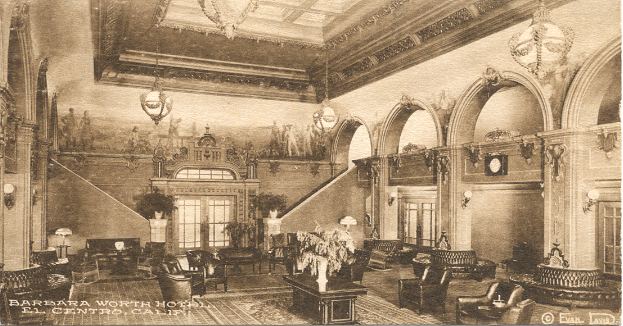
This hotel was named after a fictional character in a novel titled “The Winning of Barbara Worth” by writer Harold Bell Wright. The author dedicated the book to his friend W.P. Holt who returned the compliment and built the hotel. In 1926, Samuel Goldwin made a movie based on the novel that starred Ronald Coleman and Vilma Banky. The hotel has a spacious lobby and an artistic dining room with 4-star quality cuisine. Sixty feet below the oceans level in the heart of El Centro the building is a gem of old Spain that keeps alive the traditional hospitality.

Over the years, this hotel has suffered from allot of negative press. For example, 23 Jun 1915, the hotel collapsed in complete ruins from an earthquake. On 9 May 1916, the hotel’s manager shot and killed himself. His suicide note read “life became too lonely for him to live longer”. Some of the more famous guests were Natacha Rambova and Rudolph Valentino. In May 1922, while enroute, to Mexicali, Mexico to get married, both famous movie stars and other members of their first wedding party stayed there for two days enroute to Mexicali, Mexico. In 1962, the hotel burned down by a fire.
Categories: Uncategorized
Tags: Barbara Worth Hotel, Mrs. Rudolph Valentino, Natacha Rambova, Rudolph Valentino, Vilma Banky
1919 – Rambova Costume Design
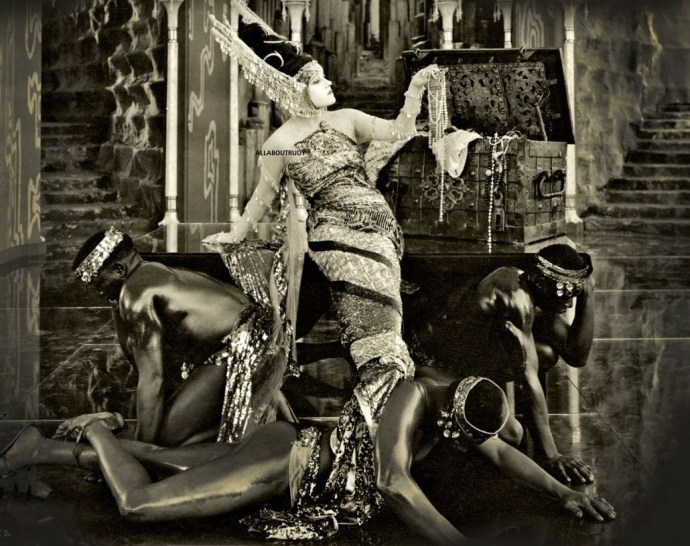
The costume designer is Natacha Rambova featuring one of her early designs and worn by Gloria Swanson in “Don’t Change Your Husband”.
Categories: Uncategorized
Tags: Gloria Swanson, Natacha Rambova

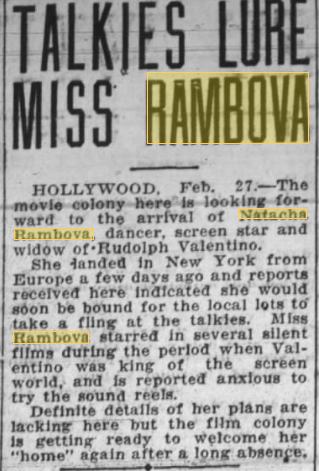
24 Jun 1973- Valentino not Dolls for this former child star
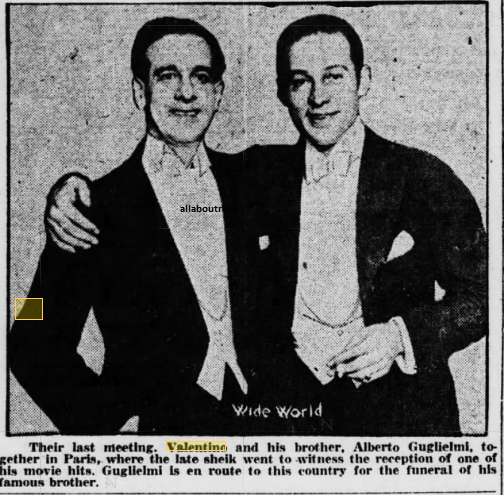
The memories for a former silent film movie child star are strong and one in particular is Rudolph Valentino was a frequent dinner guest. The uncle of Thelma Daniels was atage actor and when he got into movies he would take a six year old Thelma along for dancing and singing lessons. She started out in small minor rolls and grew from there. A semi-regular in the “Our Gang” reel comedies she played the snooty rich girl. Also, she starred in several Marx Brothers movies where she played the blonde that Harpo would always chase. Rudy would always come over to her uncles around dinner time on the pretense of teaching her to dance. He was very continental and charming to a little girl who idolized him. When he died it was a sad moment that I have never forgotten.
Categories: Uncategorized
Tags: Rudolph Valentino
1926 – Typical Movie Set Day
|
Categories: Uncategorized
Tags: Agnes Ayres, George Melford, Rudolph Valentino
1923 – Thomas Meighan Recipe
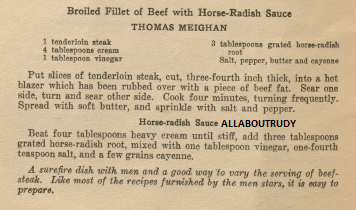
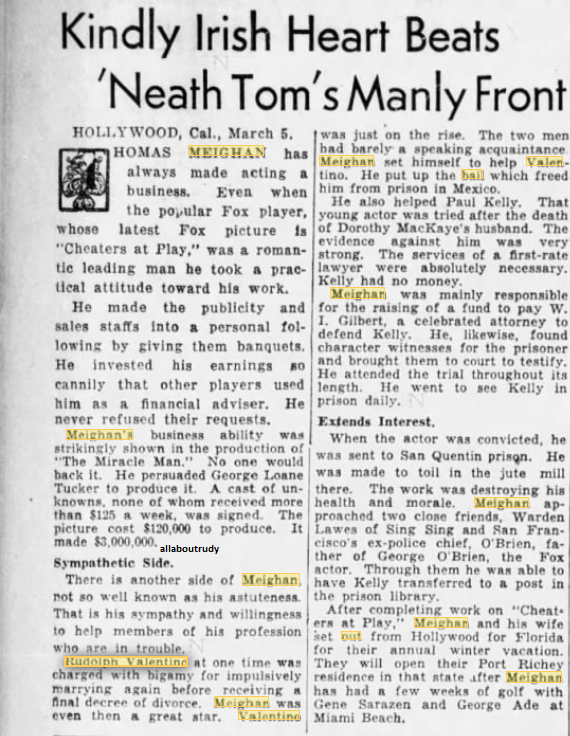
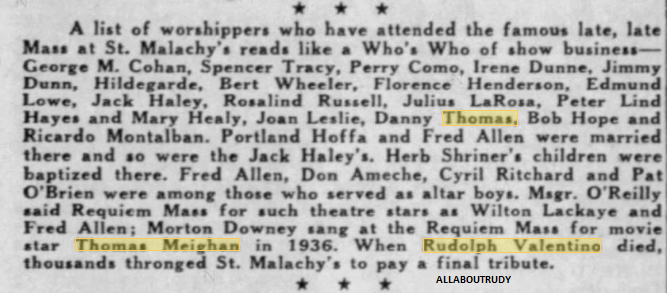
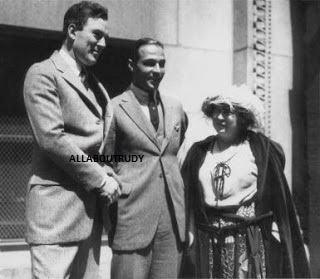
Thomas Meighan was a silent film actor, patriotic Irishman, and a extraordinary cook loved sharing recipes with others as well as enjoying home cooked meals versus dining out like other movie stars of the day did. In March 1923, Douglas Gerrard, in need of help bailing his friend and fellow actor Rudolph Valentino out of jail for bigamy, called up a fellow Irishman named Dan O’Brien who happened to be with Meighan at the time. Meighan barely knew Valentino, but put up a large chunk of the bail money with the help of June Mathis and George Melford, Rudolph Valentino was eventually freed on bail. Valentino never forgot the kind gesture of those who came to his defense when no one else would help in his time of need. They remained friends for the rest of Valentino’s life.
Categories: Uncategorized
Tags: Rudolph Valentino, Thomas Meighan


15 Feb 1926 – Natacha Gives Fashion Advice a Chance
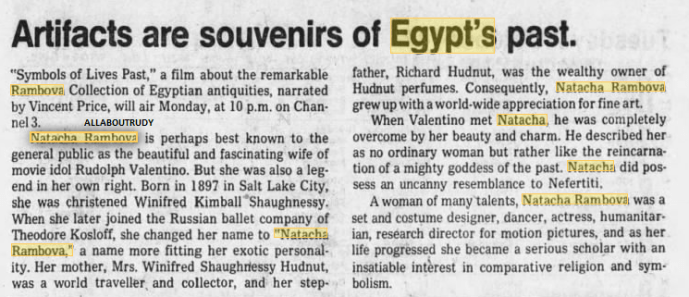
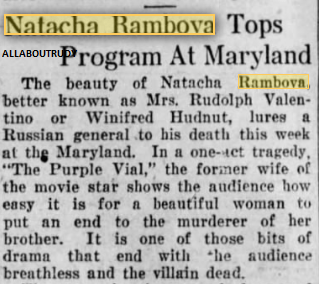
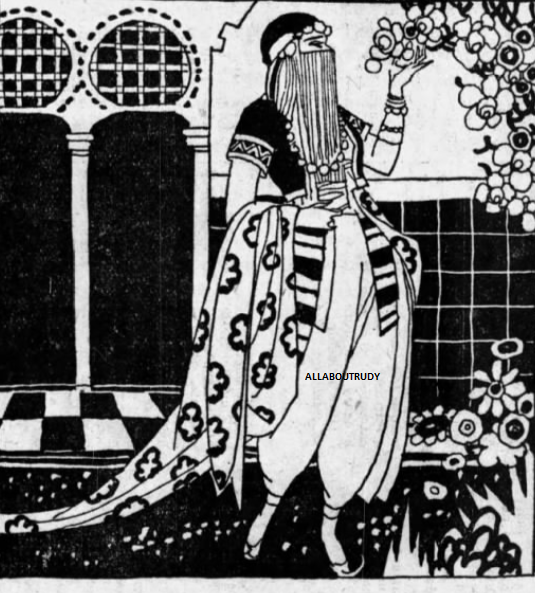
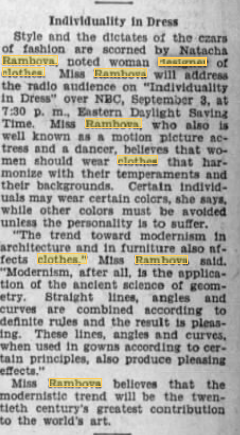
In the first place, I feel no need to apologize to humanity at large for making women’s clothes one of the major interests of my life. Instead, I believe, that the person who tries to lead women into cultivating beauty of color is doing as much for the world as any philosopher who ever tripped over the thong of his sandal. The student of dress, it seems to me helps women to polish the facets of their personalities, besides garnishing the urban scenery enough to make our cities most endurable. The truth of the matter is clothes are a creative. Women for some strange reason react mentally and spiritually to the fabric they place over their skins. It is the nature of women to try to live up or down to her clothes. Put a tired, kitchen-worn housewife into a perfect evening dress, groom her to a match, and watch her evolve a new personality in less time that it would take a brisk genie to crawl out of a bottle. Outside of the homes for mental cripples, there probably isn’t a woman in the compass of all the seven seas who doesn’t become more gracious and show a brighter mental luster when under the influences of a satisfactory gown. The great French shops are coming to specialize more and more in certain types of design, regardless of the aimless winds of style. Lanvin, for instance concentrates on long-skirted dresses of the 18th century mode on things for a woman who looks best against a background of porcelain shepardesses and tapestried views of idyllic gardens. Poiret likes to create gowns for the sim-tropical woman the sort who look as if she had a breath of Chinese incense in her soul, or had spent her last incarnation dustings jade flowers in a temple of Ceylon. Jenny’s special delight is making tight-bodice and full skirted gowns for the whipped cream variety of jejune file. The wise Parisians buys the same type of clothes year after year from the same designer, conforming to style in details but never in principle. Thus, the first thing that an American should do who wishes to be well-dressed is to turn to someone who can help. A woman who belongs to the petite doll-like species should never wander away from a childish outline. Her dresses should fall either in straight lines or in the fluffiness of floating tulle. She should be careful to keep away from dresses that are draped. Gowns that look as if a bolt of material had been thrown gracefully over the shoulder of the wearer belong solely to the blood relations of the Statue of Liberty. The small woman who wears them succeeds in resembling a dressed up pop bottle. She should pin her allegiance to sport clothes, straight simple little daytime frocks and to the afternoon and evening owns that billow like clouds on a windy day. Incidentally, the petite Dresden shepherdess is one of the very few who can wear very short skirts to the satisfaction of everyone concerned. If a woman decides she is essentially sweet and feminine, she should rally around a standard of filmy materials and delicate pastel shades. Floating panels and gossamer scarfs would help to give her the misty, ethereal quality that many men picture is their idealization of a woman. A person of this type should side-step severely tailored clothes. The quiet rather conservative woman who has a dignified charm and who wishes her intellect to be taken seriously should wear long and graceful looking simple gowns. Soft satins heavy crepe and soft wools make the best backdrops for poise and dignity and the authority of an assured position. Next comes the transplanted orchid type girl the sort that for want of a better word “exotic” artsy and burns incense in her boudoir. She has a dash of the orient in her, and likewise, runs riot among embroidered phoenixes from China, stiffed-necked lotuses from the Nile and brightly figurines that ride in endless procession around the borders of ancient Persian manuscripts. The woman needs to truly look at herself in a mirror and the picture tells if the shoulders are too broad, the woman who is examining herself should go at once to her closet and snip off every silk chrysanthemum that might be reposing above an armhole. Then raising her arm to the ceiling she should vow never again to buy a gown with a broad bateau neckline, confining herself exclusively to a v-neck or to such rounded incisions as terminate a long way from the shoulders. One point to remember is that the design on a gown should always be placed so as to draw the eye to one’s best lines and away from points that can’t stand publicity. Let’s talk about cheap stores that sell cheap gowns made out of boisterously patterned silk or trimmed with everything left over from Valentine’s Day. Therefore the girl who cannot afford expensive dresses should buy her clothes ready-made. She should select two or three designs that are most flattering to her figure and buy some good material from a reliable department store and have it made up by a neighborhood dressmaker. Good material whether silk or wool doesn’t stretch or sag or grown shiney after it acquires many service stripes. Besides, it can always be repurposed and used again when the wearer grows tired of this present design. In the end, regardless of how you see yourself take pride in your appearance. Do your homework on what materials and designs best suit you and your budget.
Categories: Uncategorized
Tags: Natacha Rambova
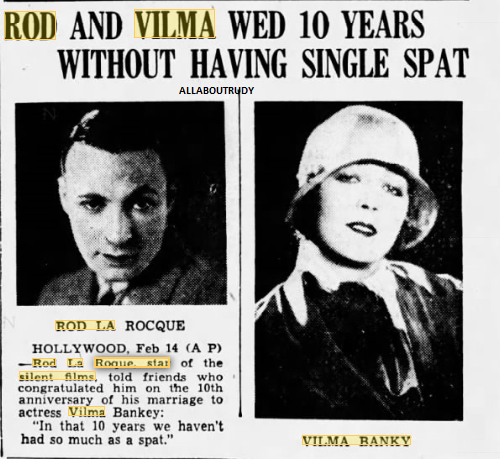
14 Feb 1936 – Rod & Vilma Perfect Valentines Marriage
Categories: Uncategorized
Tags: Rod La Rocque, Vilma Banky
13 Feb 1923 – New Hopes
Having finally despaired of getting Griffith to direct “Ben Hur” the Goldwyn Company has given the big job to Marshall Neilan. They hope to have Valentino to appear as Ben Hur.
Categories: Uncategorized
Tags: Rudolph Valentino
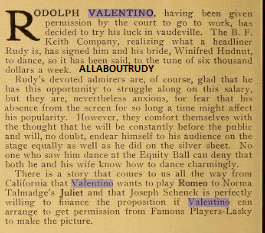

The above is a snip of Natacha Rambova’s NYC Phone number.
Categories: Uncategorized
Tags: Natacha Rambova

1922 – There is still hope..
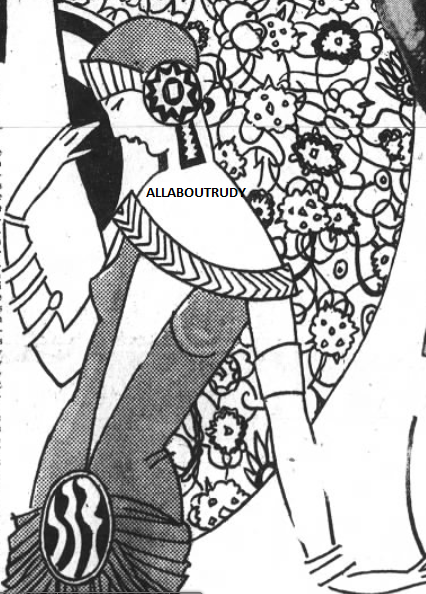
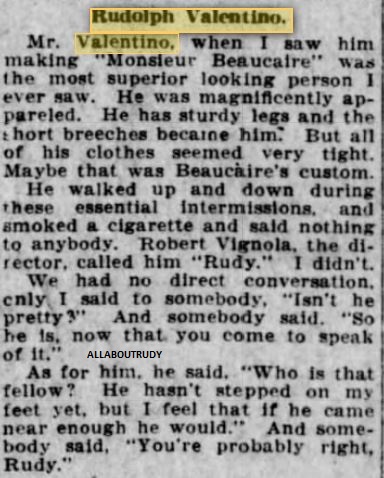
You know that every extra comprising that large mob hopes some day to attract the attention of the director and as in a fairy tale, win fame and wealth as a Valentino or in the case of many older men a Theodore Roberts. So, it goes, once in a while, as in the instance of Valentino himself, one of them does step out from the ranks. And that isolated instance feeds the hopes in the thousands of starved breasts. Extras seem to us symbolic of the human race, so hopeful, so brave in their individual ways, so utterly futile generally so full of dreams of the day their opportunity will come.
Categories: Uncategorized
Tags: Rudolph Valentino
1923 – Valentino Literary Hero
Valentino is more than the idol of the hour. He is a thinker who has the courage of his own convictions. He has recently written for the Rookman, a literary feat heretofore, unachieved by a cinema artist.
Categories: Uncategorized
Tags: Rudolph Valentino
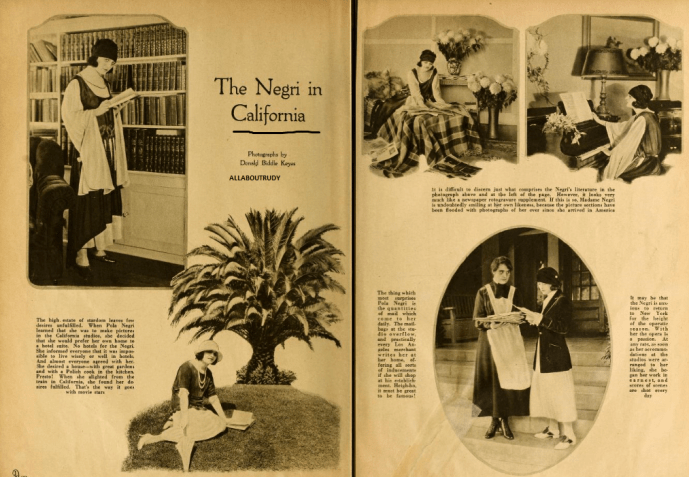
In 1923, Pola Negri was her own best publicity and her own worst nightmare. There is no denying her talent and there is only so far she could go. The reality in the acting profession is one day your on top of the world and another time your not. Being dramatic should be on the screen and not in real life. The truth is she was never good with money. This would become her downfall.
Categories: Uncategorized
Tags: Pola Negri



Jan 1923 – Good Luck Usually Makes The Star
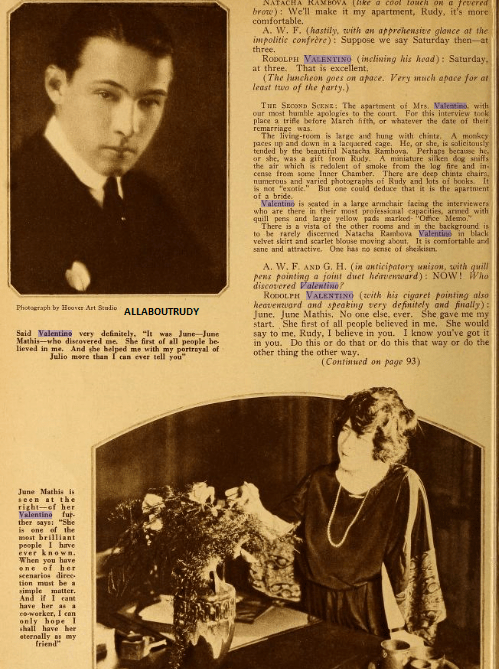
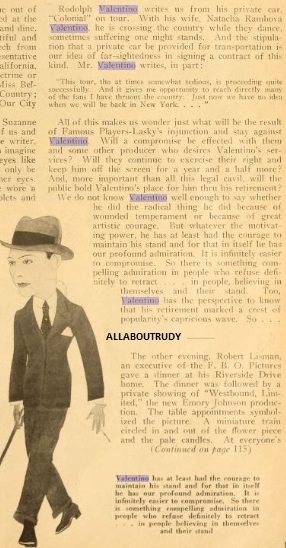
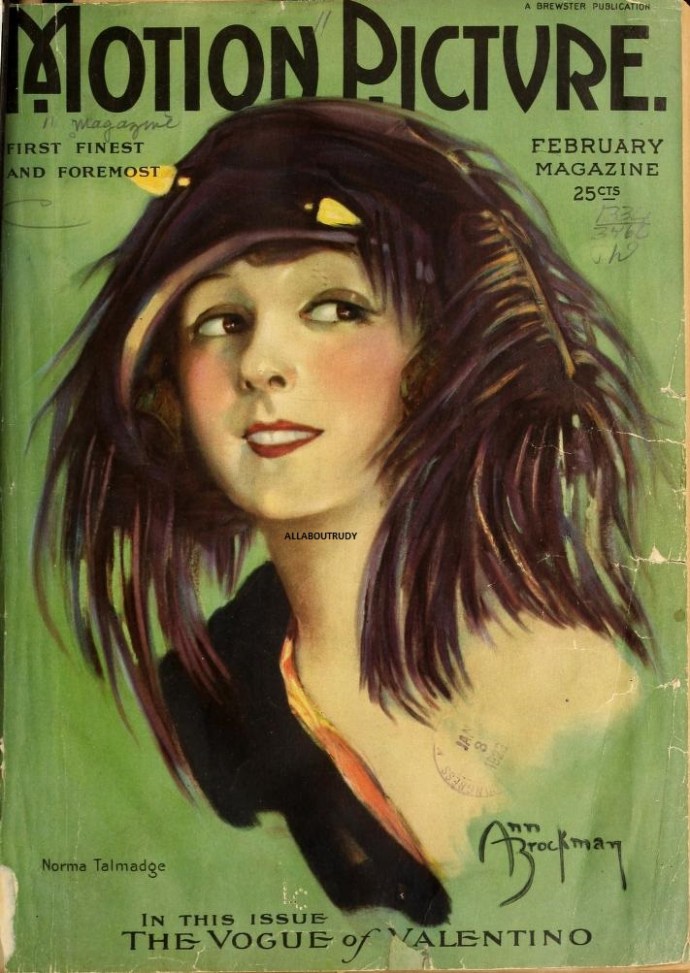
No matter how talented a player is, it takes a little luck to bring big success to the door. Under favorable circumstances it is remarkable with what speed a hitherto obscure performer can be elevated to the top of the ladder. One of the amazing peculiarities of the flicker world is that it takes only one successful production to raise a camera actor or actress from the lowest rungs of the ladder to the brightest heights. And once on the top it takes a long series of poor vehicles to shake em’ off the perch. Look into the movie hall of records and what do we find? Valentino, best example of all, played in several pictures without getting a ripple of interest, then suddenly had the break of luck to get in “The Four Horsemen” and become a sensation overnight. Betty Compton, Pola Negri, Nita Naldi, May McAloy. Many of the players have never lived up to the promise they gave in the photoplay which put them over the top, but they continue to reap the benefit of their ten-strike, nevertheless, verify there are many players being buffeted about from studio to studio grasping eagerly at small parts, who have the potentialities of being as great favourites as those now at the top if they could only make the connection with that big part in the right production.
Categories: Uncategorized
Tags: Betty Compton, Nita Naldi, Pola Negri, Rudolph Valentino
Jan 1924 – A Poet
Rudolph Valentino, the cinema actor, is a poet. He. is publishing a collection of short poems in a volume entitled ‘Day Dreams.’ If Valentino’s verses are as ‘soulful’ as he endeavours to mmake his acting at timcis, his feminine admirers will experience further emotional thrills.
Categories: Uncategorized
Tags: Rudolph Valentino

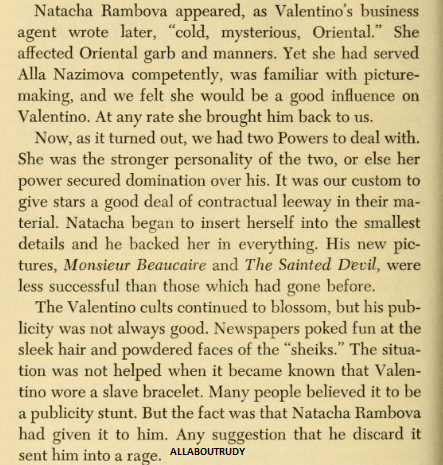
22 Jan 1926 – Freedom
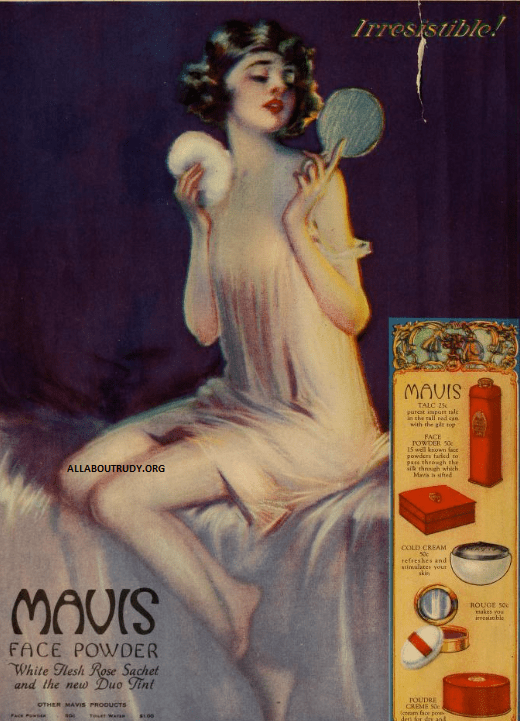
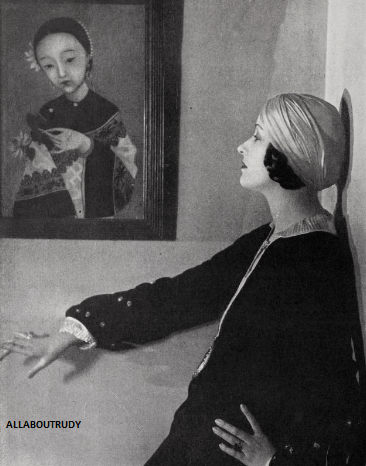
Winifred Valentino has been granted a divorce from Rudolph Valentino. Crowds of girls fare-welled Rudolph Valentino the film actor. He had difficulty in making his way to his train. He declared he was upset by his wife’s divorce proceedings but was necessary for him to return to Hollywood. He had received thousands of letters from girls anxious in making his acquaintance, and in addition, many from titled women. It became necessary to veil his movements and he was often obliged to remain indoor.s
Categories: Uncategorized
Tags: Rudolph Valentino
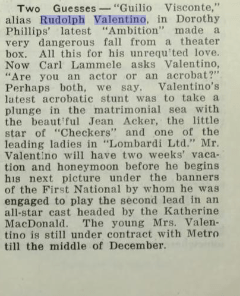
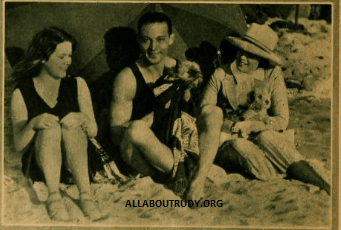
19 Jan 1923 – Rudolph Valentino Again in “Stolen Moments”
Once again, our favorite Silent Film Star Rudolph Valentino and Marguerite Namara, the famous and brilliant young American beauty who has won fame and fortune in two worlds by the voice and dramatic ability, has forsaken the operatic stage to conquer the world of the movies. Miss Namara will be seen at the Star Court Theatre in her big production, ‘Stolen Moments,” with Rudolph Valentino, of “The Sheik” fame, to-night. The management, of the Star Court Theatre, after much negotiation, secured this famous picture for a limited engagement, and consider it one. Of the events of the season. The story of the photoplay is from the prolific pen of IT. Thompson Rich, who has written many of the most successful plays of the past few seasons. He was commissioned at a high price to supply Madame Namara’s first, film vehicle, “and if the metropolitan critic know what they are talking about, his work ranks high among his notable achievements as a writer. One of the features of the production are the gowns worn by Miss Namara, which were designed by the famous Chicot, of Paris, and imported.to America especially for use in “Stolen Momenta.” Good, clever comedies are to-day as rare as philanthropists, and in “Just Out of College,” a master picture also shown here tonight, a Beanford in the comedy line is presented. Clean, fascinating, and clever, it exudes the spirit of adventuresome youth, and builds up in climaxes that astound us with their uniqueness and complexity. The plot is based on love and pickles, so that sounds good enough, but the film will prove to be amusing and gripping as the best; you’ve ever seen.
Categories: Uncategorized
Tags: Rudolph Valentino, Stolen Moments
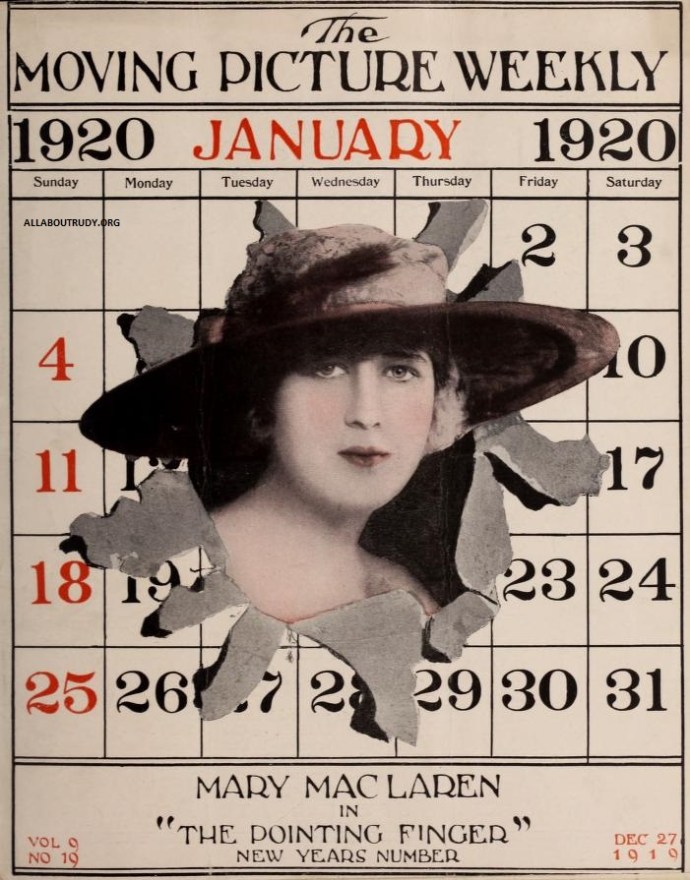
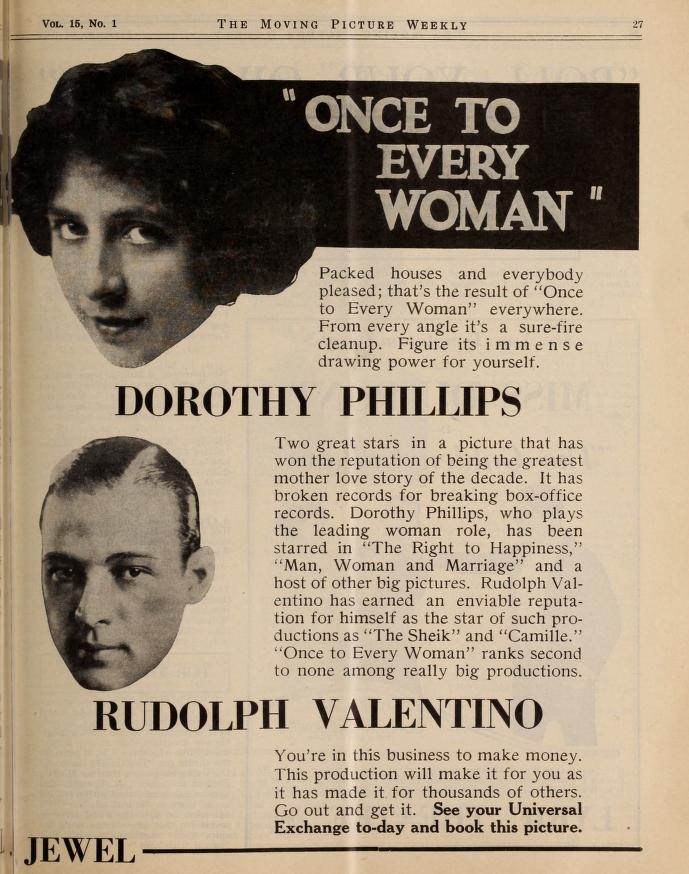
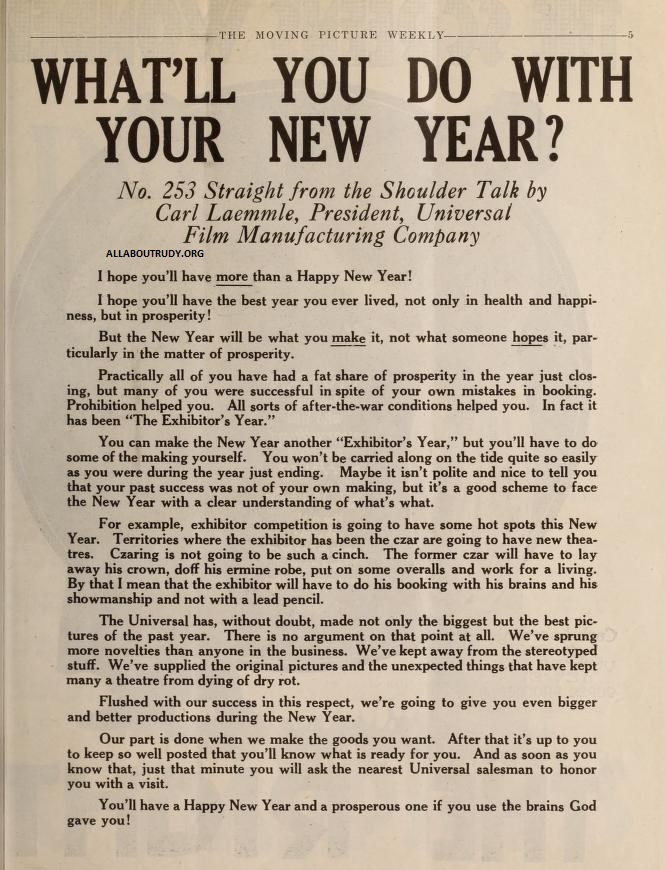


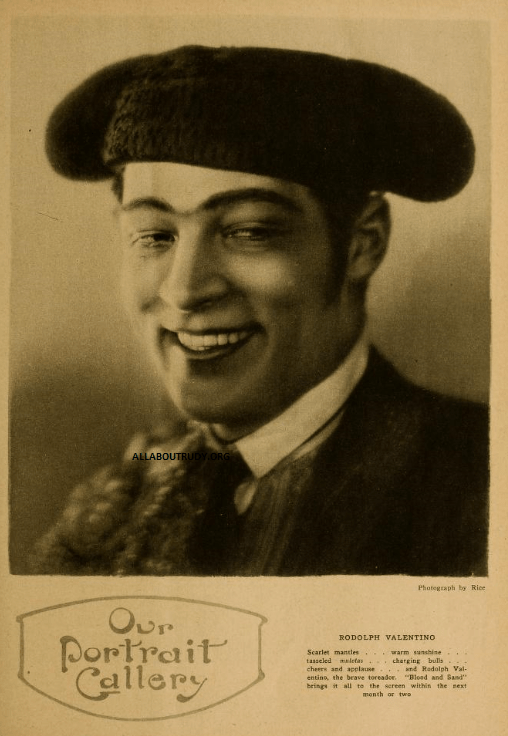
25 Nov 1922
Since their rather sensational wedding it is interesting to note that Natasha Rambova Valentino says “it was not love at first sight it was good comradship more than anything else”..
Categories: Uncategorized
Tags: Natacha Rambova
12 Jan 1926 – Valentino Sets the Record Straight on his Disasterous Marriage
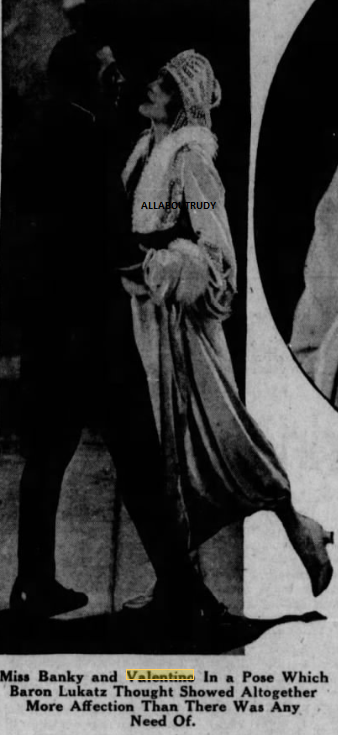
I have been reluctant to write on this subject, but so many interviews, purporting to come from me, have been printed that I think it maybe best to put myself on record over my own signature. I shall have to disappoint the reader who expects something sensational. I did not beat Natacha Rambova my former wife. She did not throw flat-irons at me. Sorry, but we did not do those things. Nor did I object to her having a career her own career. Nor did I demand that she bear children. I wanted her to have what she wanted, in so far as I could get it for her. In other words, I wanted her to be happy, and tried as any man would, to make her so. There was never any issue about her staying at home and keeping my house. No woman that anyone knows stays at home and keeps house anymore. Los Angeles wives have their own cars, as a rule, and go and come as they please. Fortunately, I was able to free my former wife from housework and from all forms of drudgery. If she wanted to keep house I would have “fired” the servants and let her “express” herself in that way. If she wanted children I would have engaged nurses and urged her to “express” herself in that way. She did not want to do these things and frankly I did not give them any thought. Dissatisfaction in marriage as in other family life is apt to be cumulative. There is no sudden erratic or dramatic offense which determines one to “leave home” to be rid of the presence and influence of relatives and out of the environment at all cost. There is often a steady decline in mutuality of interest, in sympathy, in esteem. The child which leaves the home does so because of a long series of misunderstandings, or thwarted plans, which leads him to believe that he can best accomplish the thing he feels it in him to do if he is away from those who blindly or selfishly or arbitrarily “love” him. He suffers a loss of material things the safeguards and comforts of home goes hungry, or maybe or is undernourished over a period of years to enjoy a mental and spiritual freedom which seems to more than compensate for the lack of what his family considers “the real things”. So, it is apt to be with a young man who is too closely circumscribed by an ambitious girl. At first, she stimulates him to “bigger and better” things. She is indeed generous and helpful. He is touched and flattered by her consecration to his aims, her devotion to his interests. Eagerly they plan his career. He welcomes her counsel, and following it, finds it sound. Sound, because in the first flush of life, while she is much enamored of him, she is thinking with her heart, rather than her head, and intuitively arrives at correct conclusions. She has “guidance’s” and powers of divination which calculating women can never exercise for the man she seeks to promote for gain and self-aggrandizement only. They marry. She gives up her career, if she has one, to better and more completely aid him in his. Almost imperceptibly but slowly and surely her attitude changes. It gradually dawns on him that, while she has given up her career, she has not given up a career. She has started on a new one, which is to “manage” and make a success of him. Now, you will say, a man should be deeply grateful for that. Yes, and no. Wait a minute. In the friendship and courting period’s, she considered him, weighed and advised him with relation to his profession or art he was trying to master, with relation to the public or patrons he was trying to serve, to please, to win, to hold. She was anxious for him to do the finest and best thing it was in him to do; and at the same time, please or conciliate those with whom he had to deal promoters and make those little concessions to pride and vanity and even pocketbook, which would make for lasting success in the long run. She was disinterested, and able to see him at long range, and his true relation to others. With marriage and the needles and pins routing of everyday living servants, household budgets, clothes, his friends, her friends, his family, her family and the like she inevitably began to consider him, and then, also, with relation to herself and her relation to him. Would they interfere, would they presume to give advice or make plans without first consulting her? In other words, would they usurp her position as friend, guide and philosopher, would they jeopardize her place and power? Then there enters the ever-present question of money much money. Keeping up an establishment, entertaining, and all that, seems so necessary; and if one does not make money, more and more money, one falls behind the procession. And of course, once having got in the procession, there is nothing for it, it seems, but to stay in. There is the couple ahead, which would turn and stare, and the couple behind, which might titter, and the couples on either side who might exchange knowing looks, as if a pair fell out and walked along quietly by the side of the road. Acquaintances must be appraised according to their places in the procession. People must be cultivated or discarded in direct proportion as they might help or hinder one in “getting on” socially, professionally, or financially. Those lovable and improvident soul’s writers, artists, musicians who follow their own rather than publics tastes must not be “picked up”. They “aren’t” anybody, don’t know anyone of importance and are often a little “seedy” in appearance, and run down at the heel. The most charitable in the procession regard them as a lot of harmless nuts. The others are careful not to regard them at all. Were they alive, and living in Hollywood, Byron and Wilde would be very much in demand at smart affairs. The Browning’s would be sought after by a very small clique. Keats, Shelly and Burns would scarcely get a bid to dinner, no matter how badly they might need one, nor how much bright and beautiful conversation they might bring to a table. Now, I am being a Latin, am not what you Americans call “practical” by later. No Latin is, or can be, practical 24 hours a day. We maybe as mercenary, or more mercenary, than you in the barter of our wares, or talents; but we spend ourselves and our money in different ways. This is an experience which I believe I have in common with the American husband that after a few years of married life he finds only those of his friends of whom his wife approves, remaining; only those of his or her relatives of whom she approves, visiting; and all of her friends, whether or not they like him, or he them, invited to the house on each and every occasion. Well that happens when a man discovers he is being “managed” in every department of life life, those in which he may need direction, as well as those in which for the sake of his own development, he should be allowed volition and selection? The result is that all “management” becomes irksome to him. He suddenly becomes as assertive as he has been “easy”. He finds that he can hire a competent counselor and business advisor, and “live his own life” so to speak. What does the wife do when her husband’s career is taken away from her? She can go back to her own career, or take up a new one, or wash her hands of careers, and be just a wife; for after all a business manager has not tender womanly breast a tired actor may lay his head of an evening. If her love is greater than her pride, she will surrender gracefully, and make the adjustments which will enable them to start all over again on a new basis. If her pride is paramount, she will probably slap him across the face with a bill of divorcement. The world knows what happened in my case, and that is the answer. I have no regrets, no remorse. I enjoyed being married to Natacha and did my utmost to make her happy. Whatever she may say or think now, she too got a lot out of our life together both in material things and good times. She cannot tax me with the old “you have taken the best years of my life etc”. The best years of her life are yet before her. She is as ambitious as ever she was, as high-spirited, as bright and keen. She can still achieve anything within her logical range. I bear her no ill-will and wish her the best of success. Neither am I broken-hearted. Nor am I out of a home. I have a secretary, and I have a few dependable servants, so I am week taken care of. This summer I brought with me from Europe my brother and his wife. They supervise my household, and I may entertain whom I like, when I please; and have that “monarch of all I survey” feeling which is so nourishing to the male ego. Perhaps this account of my second wreck on the reefs of matrimony will give the lie to the line which has been tacked onto me. That I am “a great lover” both on and off the screen. I suppose it is intended for a compliment, but I do not relish it. I wish above everything to be known as a great artist and am working earnestly and steadily to that end. I hope eventually to be given a picture which will demand something more than a physical performance, and I want to be ready when the times comes. After all, a man gets tired of being talked about and written about as though he were a processional “handsome” man. For this reason, I need to concentrate on my work and plan for my future as never before. And what may happen is on the lap of God. However, I must admit that I am not insensible to the charms of the fair sex.
Categories: Uncategorized
Tags: Rudolph Valentino

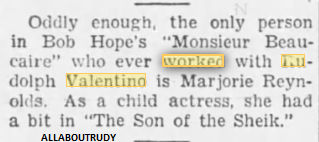
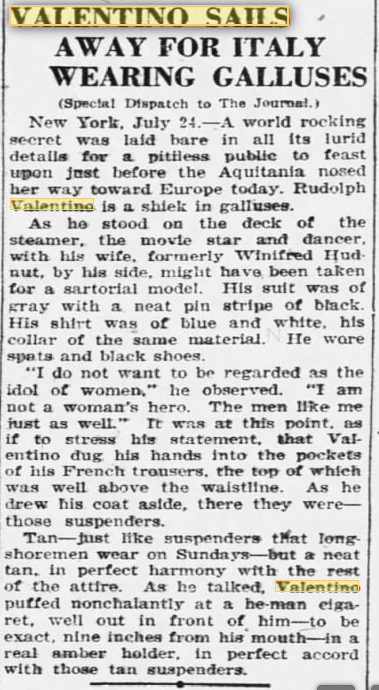
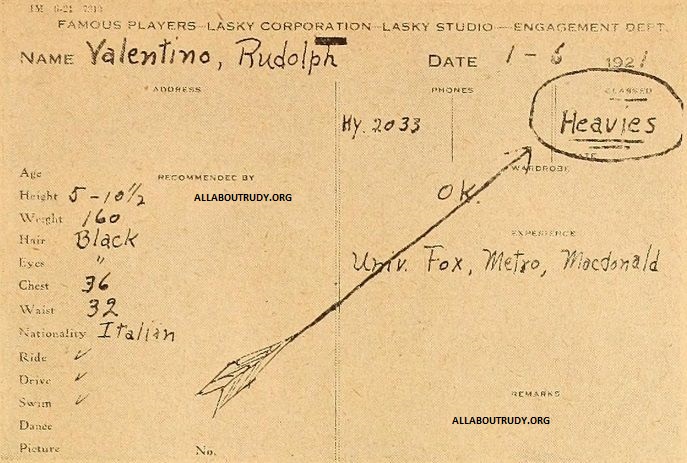
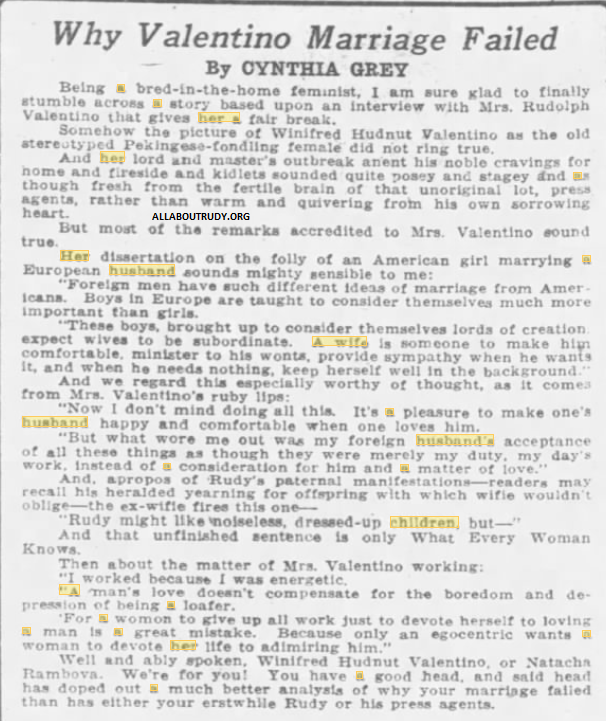
3 Jan 1926 – More Opinions Should a Wife Deny a Husband Children?
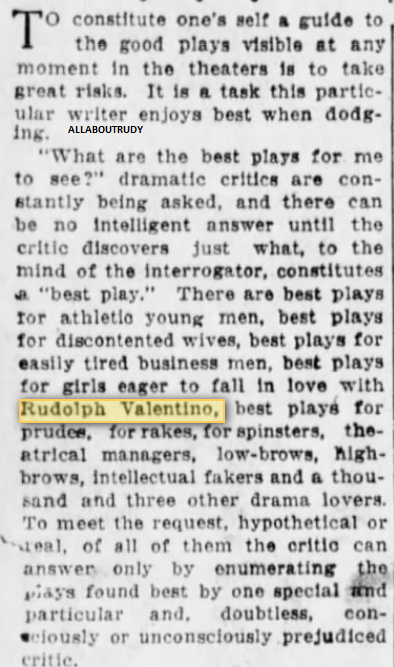
I am a man who firmly believes the wife does not have the right. Taking into consideration the wife is healthy, no home ought to be without children. It is a mans fondest dream to have little ones clustering around him and he gets married with that thought in mind. Rudolph Valentino is going through the same thing with a wife who has a liberal attitude and is denying her husband a right. Why did they get married in the first place? Did she promise one thing and when things did not go her way instead of being a woman and trying to keep the marriage she is selfish and leaves. However, I am not an advocate of large families. Three to four children are too much and keep the mother busy with attending their wants and needs which will take priority over the husband and then the husband feeling neglected will seek comfort elsewhere. Moreover, no woman that marries wishes to be childless. A woman to the other effect is not worthy of the name. When a man marries he tries to make his wife comfortable as his means allow. In return, she is expected to keep her home and children neat and clean. The woman was created for man and through her mankind has flourished. The laws of the universe have given power to woman, no one has taken it from and it stands to reason she still holds the place as “Mother of Men”. Besides the blessing of the home, a little child is the greatest link of the human heart and passions. It ties the heart strings of the mother and father in its tiny hands and coos the blessings of a great love upon them. The early years of care are more than repaid when the child has grown. No wife has the right to deny her husband children and no wife will deny them to her mate for it is her greatest and dearest wish to be deserving of the mother.
Categories: Uncategorized
Tags: Rudolph Valentino, Valentino Divorce


You must be logged in to post a comment.