
Portland Maine was the scene of a recent auction featuring a very famous ring by Silent Film Star Rudolph Valentino who has been dead for more than 40 years, but he has not been forgotten. Mrs. Homer Strong, Rochester, NY purchased the ring he wore in the movies for $1000. A clerk said the ring, containing a black intaglio of a man on horseback on a heavy hand hammered platinum mounting, would be worth about $250 without the Valentino connection.
21 Feb 1928 – June Mathis Mother Bobs Hair at 85
If allegations in litigation are correct. Mrs. Millie Hawkes of New York at 85 bobs and dyes her hair, has 50 pairs of shoes and five fur coats. She is the mother of the late June Mathis, scenario writer, and is suing for half of an estate of $50,000 under an undated will. Silvano Balboni, her son-in-law avers he is maintaining her in luxury. Mrs Hawkes says your never too old to continue looking your best.
Categories: Uncategorized
Tags: June Mathis, Mrs. Millie Hawkes, Silvano Balboni
10 Sep 1935 – Balboni Back to Stay
Following the death of his wife June Mathis, five years ago. Silvano Balboni returned to his native Italy to produce films. But he is back now to supervise the technical details of Edward Small’s picture “The Melody Lingers ON” which has an Italian locale, and he intends to remain. Balboni started photographing movies in 1910 – he is 40 now and later he directed several pictures here and in England. While working in London, he induced a young stock actor to try the films. The actor was Ronald Coleman, Miss Mathis was a noted scenarist and the discoverer of Rudolph Valentino.
Categories: Uncategorized
Tags: June Mathis, Rudolph Valentino, Silvano Balboni
14 Apr 1928 – Silvano Balboni Will Get Estate of June Mathis
The entire $100,000 estate of the late June Mathis, prominent scenarist, will go to her husband, Silvano Balboni, motion picture director, under a decision filed today in Judge Crail’s court. Balboni’s attorneys stated the director would care for Mrs. Millie Hawkes, 85 grandmother of Miss Mathis, who lost a life interest because she contested the will. Last year, Mrs. Hawkins sued the director in court for $50,000. The director in-turn told the court she already lives in luxury with five fur coats and 50 shoes. Also, discovered during the contest that the will bore a printed dateline and was therefore, not entirely in Miss Mathis’ hand. ON this ground the will was declared void and the husband was made sole beneficiary.
Categories: Uncategorized
Tags: June Mathis, Silvano Balboni
8 Nov 1925 – Pola Entertains
Pola Negri entertained in honor of Michael Arlen with a dinner dance at the Biltmore. As predicted this was the very beginning of emerald no to say very verdant social affairs in Cinema land, where charming people have gathered the past week and worn “green hats”. Miss Negri’s affair was distinguished and comme il faut as those of this delightful hostess always are. The Arlenesque motif was emphasized more than in the green hats in which green ice cream was served. In a gown of pale green duchess satin trimmed with rhinestones and black velvet wearing emeralds and diamonds as adorning jewels, the hostess received thirty guests in an embowered suite, the prevailing flowers being bronze and yellow chrysanthemums arranged with a profusion of maidenhair fern to give again the green motif. Training the cloth of the long table were thirty yards of ribbon made from saucy-faced pansies pale yellow roses and maidenhair. Green candles marked the table at intervals in jade and alabaster candlesticks. Dining and dancing were the order of the evening and among those who participated in the festivity in addition to the hosts and honor guest was Rudolph Valentino, Mr & Mrs. Charles Eyton, Mr. & Mrs. Frank Elliot, Mr & Mrs. Manuel Reachi, Mr. & Mrs. St Clair, MAJ Fullerton Weaver, Sid Grauman, M. Cimini, Mme Cimini, Ralph Block. Following the day of Miss Negri’s party, Mr. and Mrs. Frank Borzage were host and hostess at the usual Sunday morning bridle-path party. But this time the affair was in honor of the lion of Cinemaland, whose roar is assiduously sought. At least, until another lion comes this way. After a long cantor through Griffith Park bridle paths an outdoor buffet breakfast was served in the park. Glimpsed along the autumn paths in addition to Mr. Arlen and the hosts were Bebe Daniels, Mrs. Phyllis Daniels, Rudolph Valentino, Mr. and Mrs. Harold Lloyd, Ben White, Marie Mosquini, Mrs. Joseph Sanders, Ed Kane, Mr. and Mrs., William Howard, William Collier, Irving Thalberg, Mrs. H.G. Rogers, Kathleen Clifford, M.P. Illich, Ray Owens. Following the return canter the entire party gathered at the Borzage home where they were joined by Julia Faye, Mr. and Mrs. Dave Butler, Roy Stewart, Mr. Borzage’s brother William who contributed to the incidental musical entertainment featured throughout the day. Luncheon was served buffet.
Categories: Uncategorized
Tags: Pola Negri, Rudolph Valentino
31 Oct 1976 – In His Hometown Rudolph Valentino Still Is A Legend
Rudolph .Valentino dressed as an Argentine Gaucho cuts in on a couple on the danced floor, knocks the man down and sweeps the girl into his arms for a slow tango followed by a kiss. Later, as a sheik he wraps his arms around the woman he enslaved and carries her off to his tent in the desert. Only a few here still recall the scenes, but no matter Valentino was the most famous son of this town of 16,000 in southern Italy. Recently the locals got together in a movie theater to mark the anniversary of his death of 31 to see him again in “The Sheik” and “Blood and Sand” and to defend him against suggestions that the great lover was not really a great lover. The mayor, Gabriel Semeraro, announced a program of grants for students who want to help clear up any doubts about Valentino. He made it clear that people in Castellaneta were not too happy with some of the things being said about the local boy who made so good. “Some writers and others, are again casting aspersions and are trying to denigrate him by questioning his virility” said Michele Gravina, a city official”. “They won’t succeed. If people are still talking about Valentino 50 years after his death there has to be something to the myth”. It is difficult not to talk about Valentino here, even if his name is not a household word among the young. There is a ceramic statue of him, dressed as a sheik, that sits along the promenade; the Valentino Bar; the plaque on the house on Via Roma, where he was born; the Valentino laundry; the Rudy Bar; and the Valentino movie theater now showing an adults-only epic called “The Niece of the Priest”. Moreover, there is the couch in the apartment of Rita Maidarizzi. She is 72 and remembers when young Rudolph Guglielmi as he was known then, used to visit her family in the second floor apartment on Via Ospedale where she still lives. And she remembers a day in 1925, when he returned for a brief visit to sip some coffee, eat some biscuits, and talk about his success in the 12 years since he immigrated. “He used to drink out of these cups”, she said as she poured coffee for visitors. “He used to sleep in that bed over there, because he always had trouble with his father and liked to come over here. And he often sat on that couch. “When he died 50 years ago, women came from all over to sit on that couch and weep. Sometimes they went on like idiots”. Miss Maidarizzi, who keeps a file of newspaper clippings on Valentino said the number of tourists have declined over the years. Few come now and ask permission to go through her house. Mr. and Mrs. Vito Staffieri, who lived in the home in which Valentino was born, also are untroubled by visitors, despite the plaque outside. “We bought the house 15 years ago,” said Staffieri a farm worker. “An American knocked on the door a couple of years ago and asked to see Valentino’s bedroom. We let him in”.
Categories: Uncategorized
Medal for Acting
Rudolph Valentino announced yesterday he would present each year a handsome gold medal to the motion picture actor or actress who gives the best performance of the year.
Categories: Uncategorized
Tags: Rudolph Valentino
02 Nov 1959 Pseudo Valentino Son Mailed Obscene Letter to famous Actress
A 37 year old man who claims to be the son of the late movie idol Rudolph Valentino faced extradition to Florida today, where he allegedly mailed an obscene letter to actress Debbie Reynolds. But Tony Guglielmi, alias Anthony Williams, said he has no hard feelings towards Miss Reynolds despite the charge against him. “She’s not even a fan of mine” he said. Guglielmi, his Italian name was arraigned as Williams Thursday Before U.S. Commissioner Joe Huttstutler who set bond at $3000. The obscene letter was mailed from Miami, Florida on 3 Sep 1959, Federal Officers said. Gugliemi told Federal Marshals he was the son of Valentino.
Categories: Uncategorized
Tags: Debbie Reynolds, Rudolph Valentino
31 Oct 1976 In His Hometown Rudolph Valentino Still Is A Legend
Rudolph .Valentino dressed as an Argentine Gaucho cuts in on a couple on the dance floor, knocks the man down and sweeps the girl into his arms for a slow tango, followed by a kiss. Later, as a sheik he wraps his arms around the woman he enslaved and carries her off to his tent in the desert. Only a few here still recall the scenes, but no matter Valentino was the most famous son of this town of 16,000 in southern Italy. Recently the locals got together in a movie theater to mark the anniversary of his death of 31 to see him again in “The Sheik” and “Blood and Sand” and to defend him against suggestions that the great lover was not really a great lover. The mayor, Gabriel Semeraro, announced a program of grants for students who want to help clear up any doubts about Valentino. He made it clear that people in Castellaneta were not too happy with some of the things being said about the local boy who made so good. “Some writers and others, are again casting aspersions and are trying to denigrate him by questioning his virility” said Michele Gravina, a city official”. “They won’t succeed. If people are still talking about Valentino 50 years after his death there has to be something to the myth”. It is difficult not to talk about Valentino here, even if his name is not a household word among the young. There is a ceramic statue of him, dressed as a sheik, that sits along the promenade; the Valentino Bar; the plaque on the house on Via Roma, where he was born; the Valentino laundry; the Rudy Bar; and the Valentino movie theater now showing an adults-only epic called “The Niece of the Priest”. Moreover, there is the couch in the apartment of Rita Maidarizzi. She is 72 and remembers when young Rudolph Guglielmi as he was known then, used to visit her family in the second floor apartment on Via Ospedale where she still lives. And she remembers a day in 1925, when he returned for a brief visit to sip some coffee, eat some biscuits, and talk about his success in the 12 years since he immigrated. “He used to drink out of these cups”, she said as she poured coffee for visitors. “He used to sleep in that bed over there, because he always had trouble with his father and liked to come over here. And he often sat on that couch. “When he died 50 years ago, women came from all over to sit on that couch and weep. Sometimes they went on like idiots”. Miss Maidarizzi, who keeps a file of newspaper clippings on Valentino said the number of tourists have declined over the years. Few come now and ask permission to go through her house. Mr. and Mrs. Vito Staffieri, who lived in the home in which Valentino was orn, also are untroubled by visitors, despite the plaque outside. “We bought the house 15 years ago,” said Staffieri a farm worker. “An American knocked on the door a couple of years ago and asked to see Valentino’s bedroom. We let him in”.
Categories: Uncategorized
Tags: Rudolph Valentino
17 Oct 1930 – Natacha Rambova in Paris
Meanwhile, talking and walking we arrive at a French Restaurant and at a nearby table is the former wife of late film star Rudolph Valentino with her brunette tresses underneath a red turban. When her ex-husband died his brother Alberto Valentino was asked whom he wished to give the honor of pall-bearer. Alberto Valentino replied “The Italian Counsel of Hollywood Count Gardenico, Count Caraciccolo, Count Carminati; Charlie Chaplain, George Fitzmaurize, King Vidor”. They all were very special friends to my brother…
Categories: Uncategorized
Tags: Alberto Valentino, Natacha Rambova, Rudolph Valentino
19 Oct 1923 – Pola Negri Plans Fete to Polish General
Mme. Pola Negri will entertain 500 guests tomorrow evening at a brilliant function at the Biltmore Hotel in honor of Gen. Joseph Haller of the Polish Army, famous in the chronicles of Poland’s recent wars. Gen. Haller, who is in America as the representative of the Polish government, is the guest of the American Legion. During the three days he and his party will be in Los Angeles, they will be the house guests of his famous countrywoman Mme. Negri. The dinner will be followed by brief addresses by the hostess, Gen. Haller, and other distinguished guests, and the party will conclude with dancing, lasting until midnight. Gen Haller, will leave Monday for Washington, DC.
Categories: Uncategorized
Tags: GEN Joseph Haller, Pola Negri, Rudolph Valentino
2018 – Rudolph Valentino Calendar
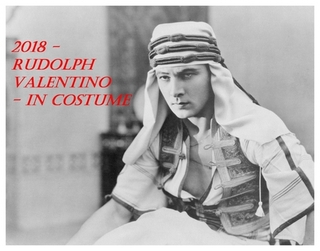
Ms. Donna Hill has just unveiled the 2018 edition of the annual Rudolph Valentino calendar. This edition depicts pictures on Valentino’s costume films. In his career he was more often an exotic Arab Sheik or Argentine Gaucho, in this calendar he can be seen and appreciated in many of his various roles. Ms. Hill does such a fabulous job every year and I always make sure to purchase a copy. The price is $15.00 and I highly encourage you to purchase early. They also make great Christmas gifts.
http://www.lulu.com/shop/donna-hill/rudolph-valentino-in-costume-2018/calendar/product-23377230.html
Categories: Uncategorized
Tags: Donna Hill, Rudolph Valentino
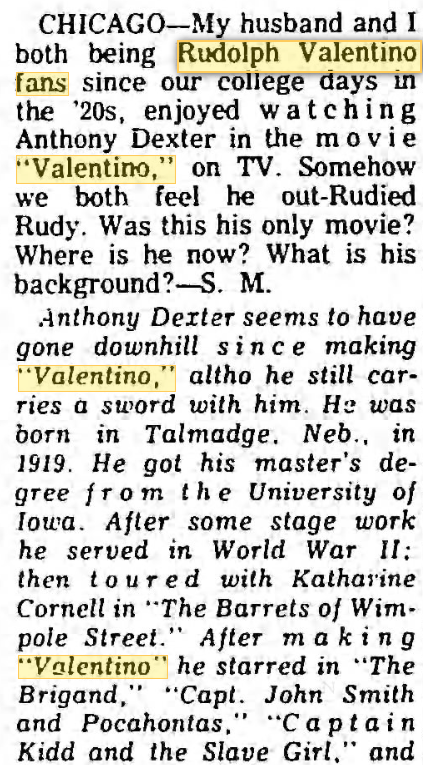
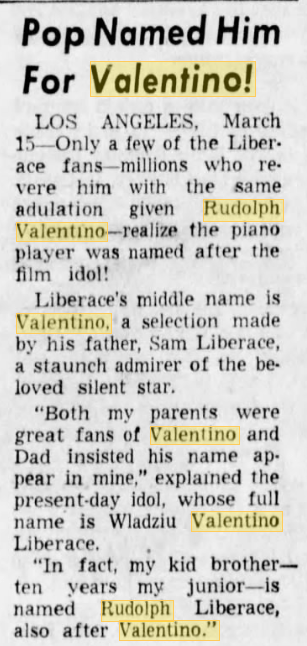
16 Oct 1953 – Easterner Named Rudolph Valentino Has His Troubles
Nobody will believe a handsome restaurant worker here when he tells them his name is Rudolph Valentino. “They think I am kidding”, he explained with an engaging smile. Actually, there is no relation between Rochester, NY’s Rudolph and the silent movies idolized lover of yesteryear with the same name. But enough years have passed to dim memories of the great Valentinos appearance, so there is quite a fuss whenever anyone discovers Rochester Rudolph’s full name. the second time someone meets me, the wisecracks start the local man points out. “Its come to a point where I don’t tell anyone my last name if I can help it”. When he was younger he felt his name gave him a psychological edge with the opposite sex. “It certainly never scared the girls away” he said. At the restaurant where Rudolph works, many bets have been made whether or not his name is real. The losers generally want to know how good a lover Rochester Rudy is. When he tried to enlist in the Marine Corps, the recruiter tore up his first application. Thought he was a wise guy. Rudolph got his name after a three-week argument between his mother and father following his birth in Radicena, Italy 35 years ago. Dad finally won out
Categories: Uncategorized
Tags: Rudolph Valentino
2 Oct 1923 – Will Rudolph Valentino play Romeo to the Juliet of Norma Talmadge?
Will Rudolph Valentino play Romeo to the Juliet of Norma Talmadge? That question has been buzzing along Broadway for several days with the sharps of the film world trying to find out just what a move of that sort would mean? The pair were voted the ideal could for the roles in the Shakespearian love tragedy in a voting contest held for motion pictures fans in a Chicago news paper which likewise held a contest in its New York pictorial adjunct at the same time. But because fans voted it thus doesn’t make it so. In connection with the general idea Joseph Schenck and J.D. Williams have been in conference, If the deal could be put together with the sanction of Adolph Zukor it would be a distinct feather in their caps, although the question as to who would have the distribution of the picture would be an interesting one. Norma Talmadge is a First National Picture star and it is hardly likely that organization which has the call on the product would stand for a picture co-starring her with Valentino going elsewhere. Valentino so the courts still hold that he is still under contract to Famous Players and could only appear over here with their consent.
Categories: Uncategorized
Tags: Norma Talmadge, Rudolph Valentino
7 Sep 1926 – Picture of Rudy Stolen
In Huntington Park thieves during the night made away with several large photographs of the late Rudolph Valentino which had been placed in one of the large photograph frames in the local theater, according to the manager of the theater.
Categories: Uncategorized
Tags: Rudolph Valentino
12 Oct 1930 – The Truth About Rudolph Valentino By Natacha Rambova
Startled as I was. I looked back at my cards and said in a low voice to the boys: “Don’t look up or appear to notice it, but someone is on the veranda; I just saw the screen door open a trifle”. Nonsense said Rudy. “It’s only the wind”. “But no wind is blowing it’s too sultry”. Then again, that ghostly opening of the door and back of it the outline of a man. So I said in a still lower voice “I see a man peering in. Uncle Dickies revolver is in his top bureau drawer. Gerry, you run up and get it and Rudy and I will keep on playing cards as though we had noticed nothing”. Gerry arose, saying nonchalantly, “It’s my turn to get the drinks tonight” and sauntered unconcernedly out of the room. Rudy and I sat there, not daring to look up lest we spoil the neat little game we had planned, waiting for Gerry to come back. But why didn’t he come? What had happened? We never suspected that revolver in hand, he had run quickly down the backstairs, out the back door, and tiptoed stealthily along the veranda to the front of the house. The first we heard was Gerry’s voice ringing out “Damm you! Hold up your hands or I will shoot”. He had taken the eavesdropper by surprise. Rudy and I stood spellbound during the scuffle in the dark that followed. It was punctuated by muttered growls, the thud of heavy bodies then a silence that seemed interminable, and at least three quick shots. Far out in the darkness an agonized scream. Then dead silence. We both rushed to the window shrieking, “Gerry, Gerry are you killed”? NO answer. Like a flash Rudy bounded up the stairs shouting, there’s a shotgun in your mother’s room. I flew after him at equal speed. Mother who had retired early was lying in the darkness when Rudy burst in shouting “Gerry’s been killed” where is the shotgun? While mother fumbled for candles we had no electricity at Foxlair Rudy seized the gun and was off. I was hanging on his coat tails. “Don’t do it Rudy”. I was screaming. “You’ll be disfigured for life. Remember you belong to the screen the public”. Followed another scuffle in the dark, this one between Rudy and me, which ended with both of us flying out the front door into the night. When some 10 minutes later we returned, mud-bedraggled still toting our gun, we found Gerry standing in the living room, so thoroughly drenched and mud-encrusted that only the whites of his eyes and his teeth shone through the clay mask to identify him. He was administering first aid to mother, who a moment earlier, had entered the living room with her candle and mistaking Gerry for the miscreant had screamed for help and fainted. And now the story came out as much of it as we ever learned. Gerry on the veranda, had seized picked himself up, ran after the man and shot at him blind three times just like that. The station master at North Creek told us, when we made an inquiry that a stranger had left by the early morning train, a man who was in evident pain and walked with two canes holding one foot from the ground. He was well dressed, tall, young and good looking. He had driven up in a Ford car with another stranger, bought a ticket for New York and boarded the train, while his companion drove quickly away. One heavenly summer morning we sorrowfully bade goodbye to the beautiful mountains of Fox Lair. The trouble awaited us in New York was far worse that we had feared. Rudy suddenly found himself involved in a colossal litigation against the wealthiest, most powerful organization in the motion picture industry. Its giant tentacles were so far ramifying, its influence so widespread that Rudy, in his efforts, to combat them, was helpless as a lone swimmer in mid-ocean with every current and wind against him. His fight made cinema history. Other screen actors since motion pictures began had their tiffs and bouts with producers. These were mere children’s quarrels in comparison, in which the children were spanked and made to behave. Rudolph Valentino was a world famous star, the popular idol of two continents, with a gigantic following of fans, enormous pulling power at the box office. All the facts involved were so startling, the punishment he had to take was so severe, that the case, at the time, blazed in newspapers over the entire world, in headlines line those a few years ago, had announced victory or defeat in a war zone. But this was back in 1922 and 1923 the world very quickly forgets. I will briefly review the highlights. As soon as we perceived that the case could not be dismissed in a day, or a month, or a year, we made the best arrangements we could for a protracted stay in New York. Since mother and Uncle Dicky (Richard Hudnut) could no longer postpone their trip to Europe, we wired my aunt, Mrs. Werner always out first aid in trouble, to come on from the coast to be our chaperon. Mother and Uncle Dickie sailed off on the Olympic one morning wishing us good luck, which we needed and early the same evening auntie arrived from the coast. I must tell you about my beloved aunt Mrs. Theresa Werner. The world is familiar with her name because Rudy remembered her in his will. He loved her as much as I did even more, he used to tell me. As no other woman in the world could have done, she took the place of his own mother. Her home was in Salt Lake City, Utah but she often visited us in California and was one of those rare people who could be the third in a household without having the other two cordially wish she wasn’t. Auntie was never there when we didn’t want her and always there when we did, the most tactful, kindest, and most thoroughly adorable woman who ever lived. And how delighted we both were to see her. Auntie and I setup housekeeping in an attractive apartment on West 67th Street, while Rudy moved to the Hotel des Artistes to share an apartment with his friend, Frank Menillo. Gerry, exhausted by his long-term of service as companion and ex-officio chaperon, had by this time fled back to Hollywood. Under these arrangements both Rudy and I could have a taste of home life and still comply with the rule for “separate residences”until the long year should pass and we could be remarried. The first part of our litigations with Famous Players was very unfortunate. Our case was inadequately handled painfully so, we learned by that time it was too late to make amends. The facts which had made the real breach between Rudy and his producers were not even mentioned in the affidavit which our lawyer drew up. Famous Players promised Rudy first, that if he would finish “The Young Rajah” in Hollywood even though I had to fly to New York, that he might make his other pictures in the east, where we could be together. Second, that he might have the privilege of choosing his own director, his own pictures, in the future. None of these promises had been kept, which constituted Rudy’s case against them. But these important facts were not mentioned in the papers our lawyer drew up. The only points stressed in the case he made were ridiculous, petty annoyances, and complaints that Rudy did not have a dressing room of his own and between shots he had to sit on a stump in the sun: that he bawled out before the extras and prop boys in the studios other things that belittled him in the eyes of the court and the public.. What man in his sanity would go to court for petty grievances like these? Why a so-called lawyer should be so little interested in winning his case was something neither Rudy nor I could understand until later. As a result, Famous Players-Laskey were granted a complete injunction against Rudy, one of the most paralyzing injunctions ever issued by an American court. It barred him from production of any kind, not only on the screen and stage but from any kind of work whereby he might earn a legitimate livelihood. By the terms of this injunction he couldn’t even sweep the streets for a dime, drive a taxicab, or pull weeds in anyones garden nothing whereby he might support himself. And our finances in their usual precarious condition. Of course, this violated the personal liberty of a citizen of the U.S. so it was quickly modified. Yet, even so, it was bad enough. I, myself could have supported us both quite easily by dancing in vaudeville. Many offers of this kind were made but always when I found came to accept them I found there suddenly and mysteriously withdrawn. We checked on every side. Fortunately, a friend in need, Joe Godsol, then president of Metro came to our rescue. What we would have done without is generosity and kindness, I scarcely dare think. The help he gave us was entirely free from any security on Rudy’s part indeed, we had none to offer. Joe did not even ask interest on his loan nor accept it when offered. This unselfish proof of friendship will never be forgotten. Although the monetary debt was paid immediately the injunction was modified to permit Rudy to work, yet there are some debts money cannot pay. Our debt to Joe is one of these. Rudy’s case against Famous Players-Lasky finally settled after long litigations was significant in this respect. Now everything became suddenly quite different. On the Famous Players-Lasky lot in Hollywood every star had his or her special dressing room; private bungalows sprung up like mushrooms everything was done to make their work agreeable as possible. This sudden right-about-face in this treatment of actors was very amusing to us who had a sense of humor likewise gratifying. This radical change in attitude extended to all other organizations in the industry. But all this is a little ahead of my story. In his litigation with Famous Players-Lasky things continued to go badly until Rudy and I changed lawyers and secured Max Steuer to handle our case.
Categories: Uncategorized
Tags: Natacha Rambova, Richard Hudnut, Rudolph Valentino, Theresa Werner
7 Oct 1971 – Little Known Fact
Veteran actor of yesteryear Joel McCrea ambition to succeed on the screen dates back to the time Rudolph Valentino engaged Joel to teach him the finer points of horseback riding. For days they rode around Hollywood together, becoming so well acquainted that Valentino confided his salary to McCrea. “That settled it” says Joel. “From that moment on, I knew I wanted to be a screen actor and I went right after my goal. Two years after his first screen portrayal, McCrea was playing leads. He has a keen eye for business and purchased a ranch 50 miles from Hollywood, where he raised horses. It seems that horses were interwoven in his scheme. First, the Valentino incident started him on his way; then he acquired a horse ranch. Valentino played an important role that Joel had never forgot.
Categories: Uncategorized
Tags: Joel McCrea, Rudolph Valentino
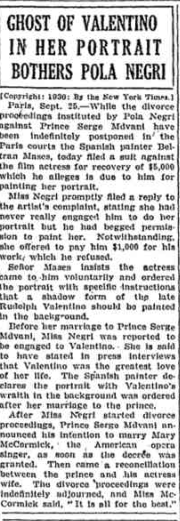
7 Sep 1926 – Officer leading Valentino Cortege Injured in Crash
Ill fate rode hard at the head of the Valentino funeral party yesterday. Motorcycle Officer Voy Apt was knocked unconscious when he and an automobile collided. At the White Memorial Hospital he was said to be suffering from a concussion, lacerated forehead and eyebrow, broken and dislocated right wrist, bruises on the right knee and other injuries all which make his condition serious. Apt was one of two motorcycle police officers leading the party that took the body of Rudolph Valentino off the train and to the mortuary. According to a police report, SE Funk 28 North Margarita Avenue was driving ahead of the procession near 810 Mission Road and suddenly swerved his car to turn around when Apt crashed into him. Funk was slated to appear in Police court to answer a charge of turning in the middle of a block and Apt was hurried off unconscious to Receiving Hospital where he was given first aid and then transferred to White Hospital. Apt is 29 years of age. He lives at 2731 North Normandie Avenue. Hospital attaches said he will probably recover. It does not appear they said that his skull was fractured.
Categories: Uncategorized
Tags: Death of Rudolph Valentino, Rudolph Valentino
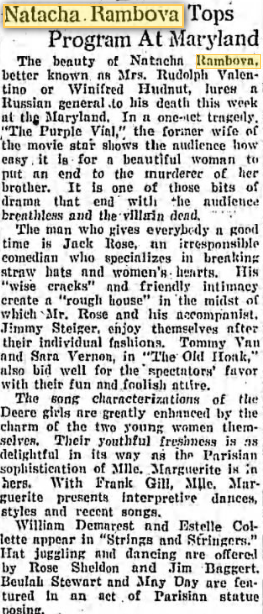
26 Jan 1926 – Natacha Rambova in Maryland
Categories: Uncategorized
Tags: Mrs. Rudolph Valentino, Natacha Rambova, Winifred Hudnut
23 Sep 1939 – Valentino Ring is Given Up to Chan
Thomas Chan 40 year old, Nicollet Avenue Jeweler and Art dealer in rare objects was in possession today of the Rudolph Valentino ring a 15 carat canary diamond ring was designed for the late film star. which brought about his arrest in New Orleans last March. Customs agents arrested Chan on smuggling charges, claiming he brought the rare ring, made for Valentino into this country from England. Chan paid $3,617 in penalties and $14,000 in other assessments before Uncle Sam would return the ring to him. He pleaded guilty to smuggling charges.
Categories: Uncategorized
Tags: Rudolph Valentino
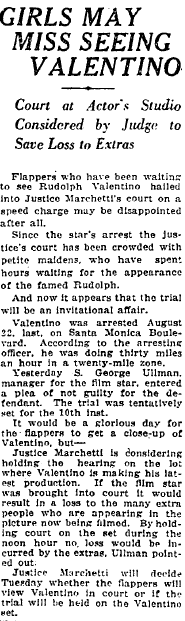
2 Oct 1923 – Will Rudolph Valentino play Romeo to the Juliet of Norma Talmadge?
Will Rudolph Valentino play Romeo to the Juliet of Norma Talmadge? That question has been buzzing along Broadway for several days with the sharps of the film world trying to find out just what a move of that sort would mean? The pair were voted the ideal could for the roles in the Shakespearian love tragedy in a voting contest held for motion pictures fans in a Chicago news paper which likewise held a contest in its New York pictorial adjunct at the same time. But because fans voted it thus doesn’t make it so. In connection with the general idea Joseph Schenck and J.D. Williams have been in conference, If the deal could be put together with the sanction of Adolph Zukor it would be a distinct feather in their caps, although the question as to who would have the distribution of the picture would be an interesting one. Norma Talmadge is a First National Picture star and it is hardly likely that organization which has the call on the product would stand for a picture co-starring her with Valentino going elsewhere. Valentino so the courts still hold that he is still under contract to Famous Players and could only appear over here with their consent.
Categories: Uncategorized
Tags: Norma Talmadge, Rudolph Valentino
14 Sep 1936 In Hollywood
Some months ago, when Central Casting Bureau staged a style parade to cut down its “dress extra” list and retain only the most eligible candidates, few recognized one smartly dressed blonde who stepped across the stage with the others and won, by judges verdict, the right to a place on the list. One reason so few identified her was that Jean Acker, in the days when she was screen and stage star was a brunette. But mainly was because the first Mrs. Rudolph Valentino had been in retirement, living on her income, for several years. The other day Jean Acker got the first “break” she has had in her comeback career. A Greta Garbo set was crowded with extras, ready for a big ballet scene in “Camille”. Leader of the ballet was Adrienne Matzenauer, daughter of the Operatic Prima Donna and then the word spread that Adrienne was ill. Director, George Cukor, with delay threatening a cost of thousands looked around the set and his eyes fell on a box peopled by dress extras. One of them was Jean Acker. Within an hour or so she had been rushed to “wardrobe” had done a hasty rehearsal, and they were shooting the scene. Mr. Cukor was grand to me she says and my gang they were wonderful, applauding after I’d finished. “My gang” referred to the other extras. Miss Acker is proud to be “starting again at the bottom”. Once she drew $3500 a week on the stage, after leaving films, and her salary in pictures was substantial. She retired with some $300,000 and then came 1929. “I had enough to live very conservatively, for a while” she says, “and then I had to go to work”. I didn’t want to intrude on my friends, or bother them. I had some nice clothes, so I turned to extra work. I hoped that if I was around, I would be seen. That’s better than waiting for something big to happen. “And I am happy, I have a little house, a garden, a little car, and work. I’d like to get back into bigger parts I think I could be a cross between Joan Blondell and a Genevieve Tobin, playing sophisticated but not hard characters”. But even if I keep on as I am, I’ll still be happy. I’m philosophical about things now. She can talk about her own misfortunes brightly, but she does not like to talk about Valentino. They say she is the only woman who still goes regularly to visit his tomb in the Hollywood cemetery, but she does not speak of that either, except to say that she is Irish and sentimental. Once she refused an offer of $25,000 for a story on the late great lover. She could use the money now, she says, but there still has been no authorized Valentino story with her byline.
Categories: Uncategorized
Tags: Jean Acker, Rudolph Valentino
8 Sep 1926
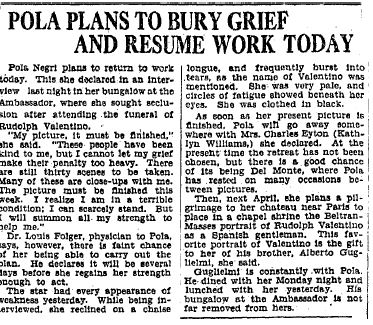
Categories: Uncategorized
Tags: Death of Rudolph Valentino, Pola Negri, Rudolph Valentino
1928 – Cult of Valentino Formed
Publication sometime ago in European papers of a story from Hollywood to the effect that the former impresario of Rudolph Valentino was making a collection for the purpose of providing a worthy resting place for the film star’s ashes has produced what German newspapers call “a peculiar echo” in Hungary. It is related that the attention of the Budapest police was drawn recently in the fact that a young man calling himself a moving picture director was organizing Rudolph Valentino Clubs in various parts of the country, with an initiation fee of 10 pengos ($1.75) and annual dues of 25 pengos. The announced object of these clubs was in “cherish the memory and promote the spirit of Rudolph Valentino”. One of the club by-laws read: “The members are obligated to think of Valentino at least once a day. In go to see all Valentino films and to agitate for the showing of more of his films in the kino houses. Furthermore, on the anniversary of the death of the film star, 23 Aug, each member is to send an annual gift to Hollywood so that the urn containing Valentino’s ashes maybe decorated with flowers”. Despite the fact that pengos do not grow on bushes in Hungary. It is averred in the report that several hundred Valentino admirers mostly young girls have already paid their dues by the time the police began their investigation. In return for their money the members receive Valentino badges entitling them to participate in the annual memorial services to be conducted at the expense of the society. Answering questions by the police, the young organizer insisted that he had forwarded all his receipts to Hollywood and that he was doing this work purely out of admiration for the departed artist. As no charges were lodged against him by any of the club members, the young man was not held under arrest, but was told that he would be kept under observation until information regarding his statements could be obtained from Hollywood. In the meantime, further investigation is said to have revealed the fact that some Valentino Clubs were composed largely of believers in spiritualism and that seances’, with the shade of the film star as the chief attraction, had been on the order of the day, or night, for several weeks. One young girl told police that Valentino’s spirit made frequent visits to his Budapest admirers. This girl, the daughter of a rich industrialist, said that Valentino’s shade complained bitterly at the shortness of human memory and at the failure of his one-time enthusiasts to erect a suitable monument to him. She considered it her special task to carry on a campaign with the object of calming Rudolph Valentino’s uneasy spirit.
Categories: Uncategorized
Tags: Death of Rudolph Valentino, Rudolph Valentino
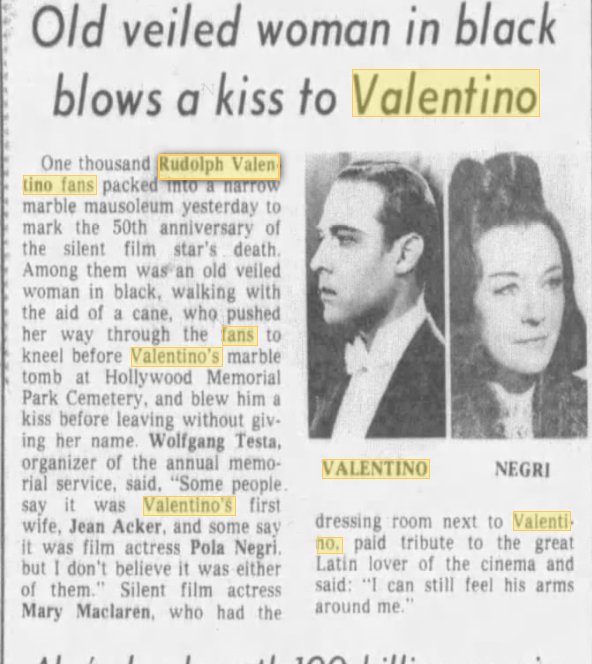
2 Sep 1930 – Rudolph Valentino’s Fans Still Care
Hundreds of letters which continue to pour in are from mature women who claim to be in touch with Rudolph Valentino says George Ullman, Former Valentino Business Manager. “Some claim he is their lover, and visits them regularly. Others assert he is trying in vain to get into communication with former friends on earth. They there are the persons who say is trying to relay messages through them about the disposition of his estate. Look at some of the letters which have been addressed on the general subject of Rudolph and his affairs.
From New York – “You might think that I am a sort of flapper, but I am a home girl. I wish you would come to New York and talk to dear Rudy with me. Oh, make haste, the time has come, make haste”.
From Douglas, AZ – “I have been spending the nights in the desert with Rudy and I am enclosing a message”. George, I am so lonesome. June Mathis is with me and she, too is lonesome. It is dark out here and we are afraid. Please George, get in touch with me through this medium Black Feather asks it also”.
From Oneida, NY – “I am told by Rudy that I am the only spirit he cares about. I could never give you an idea of how very romantic Rudy really is..I think he loves me”.
From St Louis, MO – “You should get in touch with Mr. Valentino at once. He is indeed very lonesome and blue. He misses the attention that was showered upon him on earth. He believes that if he is in touch with you conditions will change”.
Hundreds and hundreds of letters like that, but none is answered. The letters which have to do with Spiritism are few indeed compared to the thousands of admirers who write to Ullman for a word of Rudy and now and then comes a pathetic letter from some person in a far-away place who has just learned of his death.
Categories: Uncategorized
Tags: Death, George Ullman, Rudolph Valentino
23 Aug 1927 – One year later

Categories: Uncategorized
Tags: Death of Rudolph Valentino, Rudolph Valentino
24 Aug 1950 – Rudolph Valentino’s Fans Do Not Never Forget
Rudolph Valentino’s fans have not forgotten the screen’s greatest lover. On the 24th anniversary of his death a group led by Ditra Flame, “The Lady in Black” paid homage to Valentino yesterday. They laid sprays of flowers on his crypt. After a moment of prayer the fans mostly middle-aged women left. “I know he is still alive and he is not to be relegated to man’s musty pages by his physical demise. He still lives in our hearts ” said Miss Flame
Categories: Uncategorized
Tags: Death of Rudolph Valentino, Ditra Flame, Rudolph Valentino
27 Aug 1926- Rudolph Valentino Body Lying in State Uncontrollable Mobs
Guarded by police and black-shirted Facists because of the unprecedented and uncontrollable mobs that thronged to view it resulting in scores of injuries the both of Rudolph Valentino, the cinema star was on view to the public again Wednesday and Thursday. Pola Negri who left Hollywood on Wednesday in the hope of arriving for the funeral services on Monday. The place of burial will be decided on the arrival of the brother who sailed from France on Wednesday. No disorders occurred on Wednesday, although nearly 200 policemen were engaged in the seemingly endless line of mourners through the room where the body reposes at the rate of 60 a minute. The remains will lie in state till Sunday night. Tentative plans indicate that he funeral will take place on Monday morning with a processional to St Malachi’s Church and the Requiem and High Mass.
Categories: Uncategorized
Tags: Death of Rudolph Valentino, Rudolph Valentino
26 Aug 1926 – Lincoln Cab Mechanic Claims to be Brother of Rudolph Valentino
Did Rudolph Valentino have brother in Lincoln? Frank Fisher, 38 years 1145 L Street says he is the famous movie star’s next to oldest brother. He had been estranged from Rudolph, he said. Fisher has lived in Lincoln for five years, he said Tuesday afternoon, and he is employed now as a mechanic at the Yellow Cab Company. Fisher was located on the second floor of the cab company garage by a Journal Reporter late Tuesday afternoon. The man, whose resemblance to photos of the former celebrity is striking, was at work on a cab. He was clad in grease stained coveralls. “I don’t want to say anything about it”, he declared with a strong Italian accent, when asked about his mooted relationship to Valentino. “He was my younger brother. I packed my things Monday to go to New York when word came he was dead then a telegram came from mother at Hollywood telling me to stay here, that Rudolph’s body would be sent back to Hollywood. “I don’t want to make any fuss about it”. Fisher continued when drawn on by questions, much against his will. “Rudolph and I have been practically strangers since I saw him last in 1915 when he worked in a golf ball factory in Chicago. Three years ago, he wanted me to come to Chicago and he said would apologize to me. Then this divorce business came up and spoiled it all for I was thinking some of meeting him”. Fisher did not say what caused the contention between himself and the alleged brother, but left it to be gathered that it was personal and entirely within the family. He intimated that treatment accorded the mother by Rudolph turned him against the famous one. “I don’t want to say anything about it”, Fisher repeated. “Mother said she would wire me very soon and if she thinks it’s all right I will not object to some publicity. But it’s all up to her. She’s the only woman in the world I would trust”. Further information about the relationship between the Lincoln mechanic and the idol of the movies whose death has shaken the movie world, was drawn from Fisher by close questioning and is largely contained in the following: There were three boys and two girls in the family by the name of Gugliemo. The Americanized form is Glacier. Fisher’s alleged name is Francisco Fisheer Gugliemo, but he contracted it to Frank Fisher Glacier. Rudolph middle name was Valentino and his last name Glacier, it was alleged. Fisher was born in New York, he said, and after that his parents went back to Italy where Rudolph was born. The latter was quite young when he immigrated to this country. The father died about ten years ago, Fisher said, and the mother had lived in Omaha for several years, but recently went to Hollywood. R.D.S. Bennett, manager of the Yellow Cab Company in Lincoln declared Tuesday evening that he believed Fisher is telling the truth when he said he is Valentino’s older brother. “Frank has worked for me two years, and he has confided more or less in me. However, I wouldn’t break his confidence by snitching. He doesn’t like to talk about Valentino.” Bill Tierman, proprietor of another garage where Fisher worked from last January until last Sunday night, going back to the Yellow Cab Company doubts the two are brothers. “I heard alittle about it here in the garage and I think Fisher maybe a relative in some degree, but not a brother.” Fisher was divorced from his wife a short time ago. Attorney Maggi served him. It appears that they reunited for when sought by a reporter at his boarding place, neighbors said that Fisher had gone out walking with his ex-wife. “They knew nothing of his claim to brotherhood with the famous Rudolph”. Fisher was found Tuesday after more than an hour’s tracing of a rumor. Walter Eaton, policeman remarked that Valentino had a brother in Lincoln. Given the “horse laugh” Eaton was anxious to vindicate his statement and he called the friend who had told him. Next came the friends sister, sister’s friend, and friends friend. Finally, the reporter inquired at the taxi company and gained audience with Fisher who declared simply that he was Rudolph’s brother. Biographical sketches of Valentino mentioned a brother and sister in Italy, but none in America. Leased wire dispatches Tuesday indicate that Valentino’s mother died several years ago and is buried in France.
Categories: Uncategorized
Tags: Death of Rudolph Valentino, Rudolph Valentino
25 Aug 1926 – Valentino Fan Commentary
It was with boiling indignation that I read the letter “Disgusted. It was full of disrespect to the late Rudolph Valentino yet your correspondent stated, “Far be it from me to say anything disrespectful of one who has passed through the great divide”. We women know what was at the bottom of the letter – pure jealousy,, then he states that the flapper must save some excitement. Let me tell him that if his life has been as clean as was that of Valentino then he has something to be proud of.
Marie Crossett, Adelaide, Australia
Categories: Uncategorized
Tags: Death of Rudolph Valentino, Rudolph Valentino
23 Aug 17 – 90th Anniversary of Rudolph Valentino Memorial Service
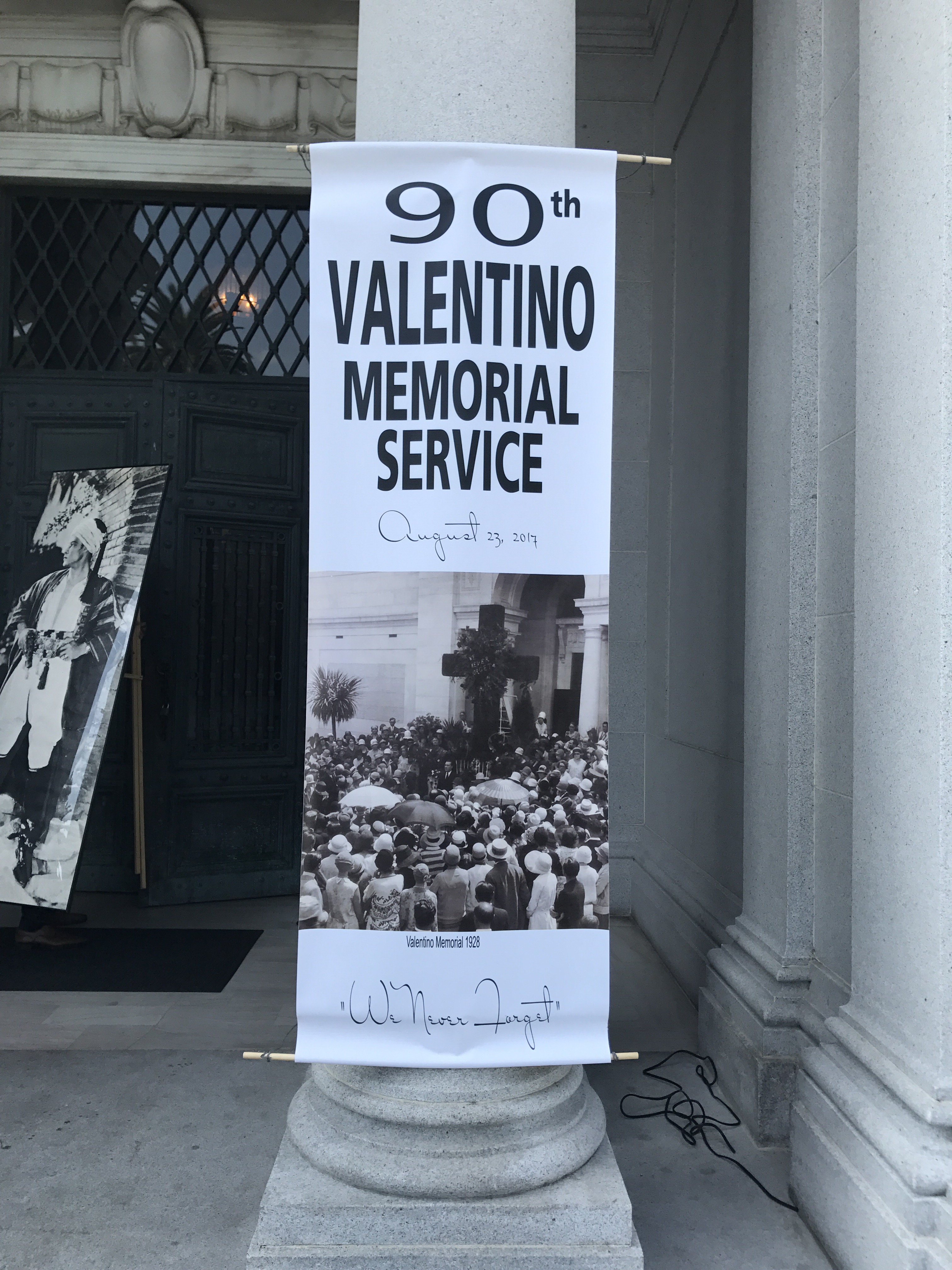
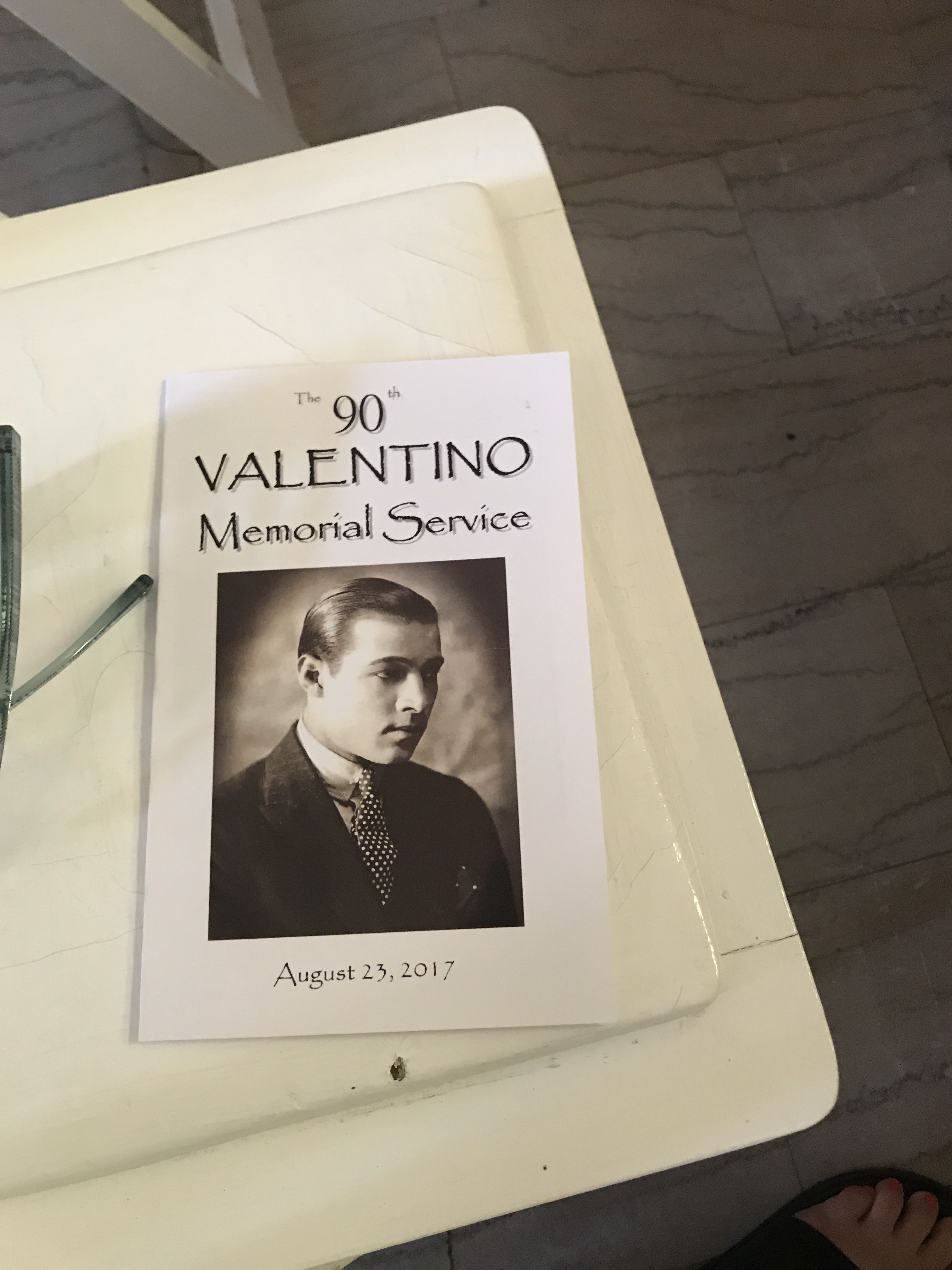
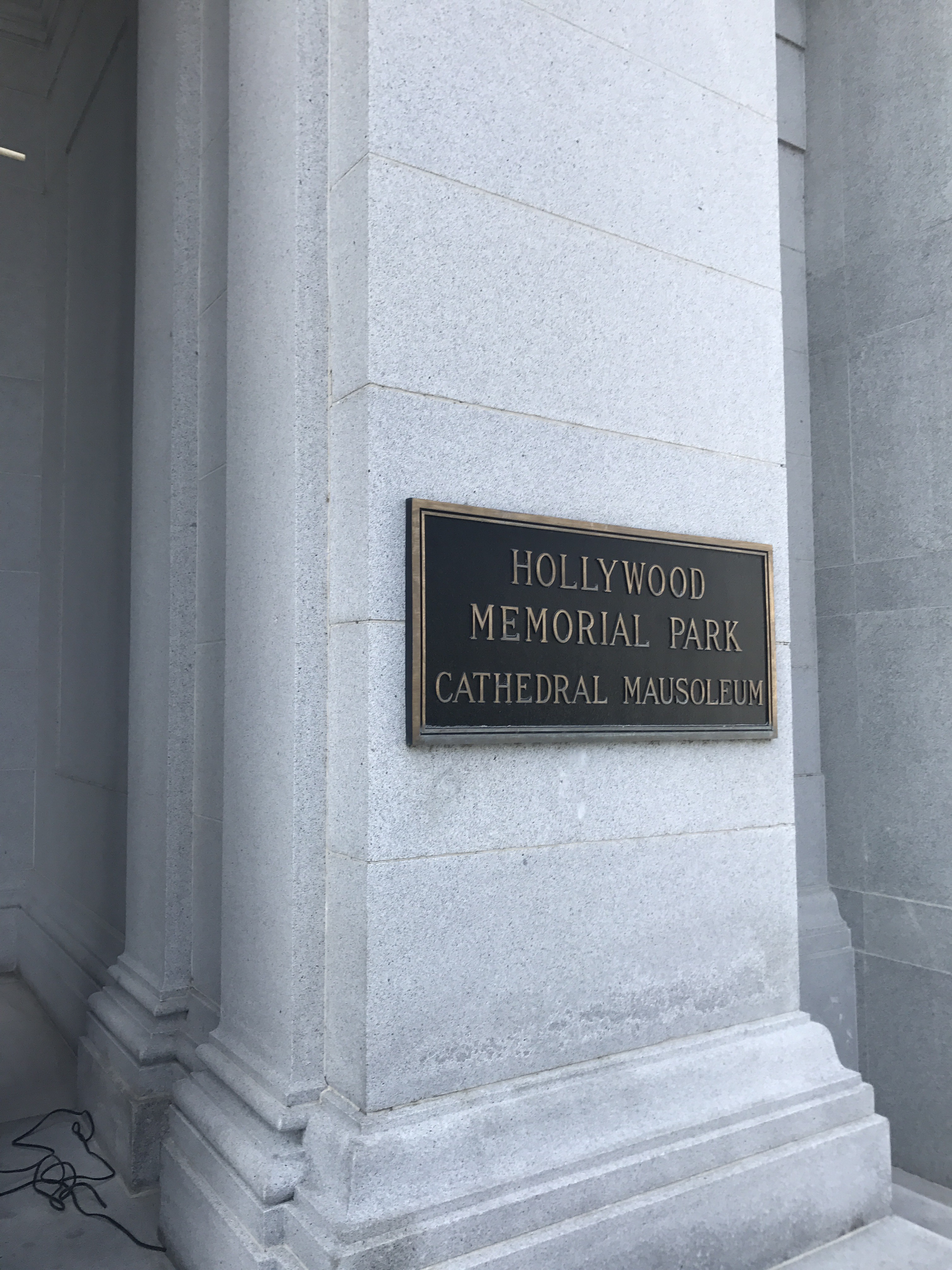 I attended the 90th Anniversary of the Memorial Service for Rudolph Valentino, Hollywood Forever Cemetery. This year as in the previous years, I always look forward to coming to LA its like coming home seeing Tracy, Stella G, Pam C, Karie Bible who looked amazing. This year, Tracy made a couple of changes bringing a more modern approach. The memorial service was broadcasted via Facebook live offering members of the “We Never Forget Rudolph Valentino” Facebook group a chance to be apart of the virtual audience. The line-up for the memorial service was STELLAR. As always my favorite is the singing…Ms Terry Moore’s god daughter was amazing singing “Ave Maria” as well as Ms. Terry Moore herself, the ever gracious Ms. Sylvia Valentino-Huber, Ms Joan Craig, and others. When the service ends it always brings a sadness because it seems to go by so quickly. Well there will be next year, I wanted to add I finally got to meet Mr. Donald Gardner who is a noted videographer and Allen Ellenberger a noted author who I am a true fan of his books. A special thank you again to Tracy and Stella…See you all next year.
Categories: Uncategorized
Tags: Death of Rudolph Valentino, Rudolph Valentino, Tracy Terhune, Valentino Memorial Service
23 Aug 1926 – Death comes to Rudolph Valentino
As it must to all men, death came to Rudolph Valentino, sheik. Sitting in his apartment at the Hotel Ambassador, Manhattan last week, he suddenly clapped a hand to his side, fainted. Taken to the Polyclinic Hospital, he was operated on for appendicitis gastric ulcers. Over the wires of the world buzzed the news. At the hospital door bushels of flowers arrived. Two extra operators were detailed to the telephone switchboard to answer calls concerning Mr. Valentino (when a rumor that he was dead circulated, the calls came at the rate of 2,000 an hour). A maid delivered an Irish linen bed spread and pillow case marked “Rudy” with a card from Jean Acker. From Paris, came a message “Pray God night and day for your recovery”signed Winifred Hudnut. “This is Pola Negri in California said a brittle voice on the telephone, “How is Mr. Valentino”? Thousands, hundreds of thousands of women everywhere were asking “How is Mr. Valentino”? Mr. Valentino developed pleurisy. He was worse, said one of the telephone girls. Then a blood transfusion was performed. He was resting, sleeping. As dawn came, he awoke seemed restless. At last a scrawled note was laid before the switchboard operators. One Lucy Vanderbilt broke down sobbing into her instrument “he’s dead, Rudy’s dead”. Traffic was choked with thousands as his body was taken to the undertakers. The corpse of Rudolph Valentino adequately educated, never actually in want, he roved from one occupation to another until fame and wealth came to him as Julio of “The Four Horsemen” When he died he was insured in favor of his producer Mr. Joseph Schenck for $1,000,000.
Categories: Uncategorized
Tags: Death of Rudolph Valentino, Rudolph Valentino
23 Aug 1926 – Commentary
The death of Rudolph Valentino is one of the greatest tragedies that has occurred in the history of the motion picture industry. As an actor he achieved fame & distinction; as a friend he commanded love and admiration. We of the film industry, through his death, lose a very dear friend, a man of great charm and kindliness.
Categories: Uncategorized
Tags: Death of Rudolph Valentino, Rudolph Valentino
1952 – Valentino Fan Note
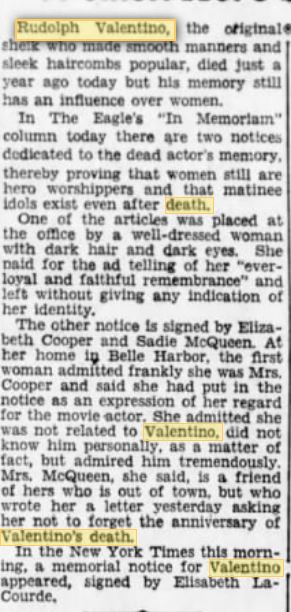
Note from a 20 year old Rudolph Valentino fan: You’ve got a bawling-out coming for your item about “The Eagle” being so bad. It being old is true but that doesn’t make it bad. “Did you ever see such acting? You could tell what he was suppose to be saying by the expressions on his face and brother, what a face!
Categories: Uncategorized
Tags: Rudolph Valentino
17 Aug 1979 – Alberto Valentino Asks?
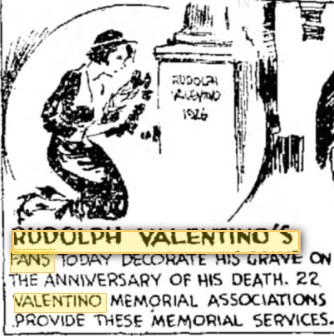
Question, I recently talked with Alberto Valentino, brother to Rudolph Valentino lives in Los Angeles and sounds hale and hearty at 82 years of age. In view of the 50th Anniversary of Rudolph Valentino’s death in 1976 we talked of Rudolph Valentino Fan Clubs, Alberto asked if any fan clubs are active in the U.S. or other countries. –M.G.I. Philadelphia, PA
Answer, there are millions of Valentino fans throughout the world almost as many as during the Roaring Twenties when he was, at the same time, the super movie star and the world’s greatest lover. In addition, the number of people who collect Valentino films, books, and momentos is in the hundreds of thousands. But, according to the Academy of Motion Picture Arts and Sciences library, there are only two recognized fan clubs, one is in Los Angeles and one in London, neither of which is active. In “The Sheik” (1921) he is credited with ‘revolutionizing’ the art of making love. A still photograph from “The Sheik” shows him looking at a girl as though he were about to steal the maraschino from her fudge sundae. You became a fan as a small boy in 1926 when Valentino died at age 30.
Categories: Uncategorized
Tags: Alberto Valentino, Death of Rudolph Valentino, Rudolph Valentino
24 Apr 1929 – Makes you Wonder?

Categories: Uncategorized
Tags: Death of Rudolph Valentino, George Ullman, Rudolph Valentino
1924 – All the Girls in Sweden Love Him
I am a Swedish Valentino Fan. I will tell you that in Europe Rudolph Valentino is the most popular of all the American movie stars. John Gilbert and Navarro are not so popular as Valentino. Here in Sweden all the girls love Valentino and we now anxiously await his next picture. “Monsieur Beaucaire” was a wonderful picture and so was “A Sainted Devil”. I wish he will dance in all of his pictures.
Sincerely,
I Hermon, Stockholm, Sweden
Categories: Uncategorized
Tags: Rudolph Valentino
10 Aug 1924 Date line Hollywood
Vamp Valentino Dagmar Godowsky will vamp Rudolph Valentino in his final Paramount movie taking the place of Jetta Goudal, who has been transferred to Paul Bern’s “Open All Night
Categories: Uncategorized
Tags: Dagmar Godowsky, Rudolph Valentino
10 NOV 1925 – Petrova Must Pay $7,500 As Pirate Despite Valentino Testifying
William H. Roberts, Naval Officer today, was awarded $7,500 damages against Olga Petrova, Russian actress, for plagiarism from his play “The Red Wig” in production of “The White Peacock”. Roberts had brought suit for $35,000 royalties, claiming the actress appropriated the plot and dialog of his play. The jury had heard testimony for four days and deliberated for an hour and a half. Justice O’Malloy gave both sides ten days in which to file briefs on the motion of Nash Rockwood, counsel for Olga Petrova to have the verdict set aside. Rudolph Valentino, of film fame, who playing the leading role in “Blood and Sand”, which had been mentioned during the trial as containing many similarities to “The Red Wig” was the last witness called by Mme. Petrova in closing her defense. The ace of sheiks was dressed in gray tweeds and reddish tan shoes with gray suede tops. He wore a gold “slave bracelet” on his right wrist. Rudy was a bit late getting to court and nearly lost the opportunity of testifying, as the defense already had rested, but Justice O’Malley allowed them to put him on the stand. Col William Rand, counsel for the plaintiff, seemed entirely satisfied with Valentino’s testimony and declined to interrogate him. When Valentino entered the court room, followed by a bevy of flappers and youthful sheiks, he went immediately to Mme. Petrova at the counsel table. Making a courtly bow from the waist, “Rudy” kissed Mme. Petrova’s hand in the most gallant Valentino fashion. Referring to the theme of “Blood and Sand”, Valentino said” “It is a vivid story of passionate and lustful Spanish life. The male character becomes famous because of his ability as a bull fighter. He is a man of low birth. A lady of wealth becomes infatuated with him and they a liaison. “The main theme of ‘Blood and Sand’ is propaganda against bull fighting in Spain”. When Valentino made that statement COL Rand seemed pleased, as previous testimony had been that the theme of both “The Red Wig” and “The White Peacock” promulgated the economic independence of women and the defense had introduced testimony that “Blood and Sand” and “The Red Wig” were similar. At the conclusion of Valentino’s testimony a short recess was taken while both sides prepared to start their summation to the jury. During this recess Mme. Petrova and Valentino posed together for the newspaper photographers. Mme. Petrova appeared in court yesterday gowned in another charming creation. During the four days the trial has been in session she has appeared in a new and startling Parisian creation each day. Yesterday, she wore a black velvet turban, with a black ostrich plume drooping over her right shoulder. Her costume was set-off with a shimmering silver cloth blouse and a string of pearls. When recalled to the stand she testified that she had named her play “The White Peacock” due to reference in the dialog to the “proud peacock” which denoted the pride and bearing of the leading woman character. Roberts, the plantiff was recalled the brief testimony in rebuttal. Prior to writing “The Red Wig” in 1918, he declared he never had seen, heard of or read either the book or play of “Blood and Sand”. Regarding a similarity in the description of bull fights in his play and “Blood and Sand” he could offer no explanation, but averred he had seen at least 20 bull fights and in writing his play gave his own impressions.
Categories: Uncategorized
Tags: Olga Petrova, Rudolph Valentino

8 Aug 1936 Silence Stirs Anxiety for Miss Rambova
Anxiety over the safety of Natacha Rambova former dancer and wife of the late Rudolph Valentino, who is a resident on the island of Mallorca off the coast of Spain, was expressed yesterday by her aunt, Mrs. Teresa Werner. According to Miss Werner, she has not heard from her niece directly since the beginning of the present civil war in Spain. However, Miss Werner said she received a cable yesterday from friends saying that Miss Rambova was unharmed. Her niece, is now the wife of Alvaro Urzaiz, retired Spanish Naval officer.
Categories: Uncategorized
Tags: Natacha Rambova, Rudolph Valentino
2 Aug 1934 – Egotism of Stars
The late Harry Reichenbach, an American publicity agent, revealed in his book “Phantom Fame” some of his most interesting experiences with movie stars. “”I first met Rudolph Valentino in the tearoom of the Alexander Hotel, Los Angeles” he wrote. “He functioned as a dancing partner for girl patrons of the hotel, a hanger-on one of the myriad of hopefuls that dreamed of being an extra to the movie lots close by. I noticed him, and he came over to greet me. It happened that Clara Kimball Young needed a handsome, young, straight man in “Eyes of Youth” a sort of gigolo, and I told Herbert Sanborn, her manager, to come and have a look at Valentino. At first Herb, turned Rudolph down flat, for his left ear; but after I convinced him that Rudolph didn’t have to be photographed with a left profile, he agreed to take him on. Valentino never photographed with a left profile throughout his entire career on the screen. A few months later Reichenbach met Valentino again, and the latter, who had not been able to get a footing in the movie world early accepted an offer of twelve dollars to go round Los Angeles posting up notices of the actors strike. “When I saw him again he was a star,” wrote Mr. Reichenbach. “He had appeared in “The Four Horsemen” in 1919, and had galloped in first. In 1925, I was placed in charge of his pictures at the Paramount office. I know first-hand, for my publicity work played an important part in the life of Rudolph
Categories: Uncategorized
Tags: Clara Kimball Young, Rudolph Valentino
29 Jul 1924 – The Mischievousness of Mae Murray
In this same eventful year the Lasky Company engaged another actress whose name is now familiar to the motion picture population of the world. The Ziegfeld Follies of 1915 contained for the first time a screen episode introduced for presentation of an auto race. From the moment when I saw Miss Murray romp across this incidental screen I saw her possibilities. When I got in touch with her, however, I discovered that several other producers had been inspired by the same belief. That our organization was the lucky competitor was due to a very advantageous connection which the Lasky Company had formed sometime previously. The chief concern of both Mr. Zukor and the organization was to get big stories, big plays and to this end Mr. Zukor and I engaged in a memorable skirmish over David Belasco. It is apparent of course, at first glance why the production of this most eminent producer of the spoken drama should have assumed such importance in our eyes. Both of us felt that if we could only have the screen rights to the Belasco pays we should be placed in an invulnerable position. In our rival efforts Mr. Zukor had the first advantage, for he had earlier formed a connection with Daniel Frohman, and through this alliance he was enabled to get into direct touch with Mr. Belasco. I, on the other contrary, made all overtures through the great producers business manager. In spite of Mr. Zukor’s lead, the result hung in the balance for many days. At last, when I was beginning to despair, Mr.Belasco announced that he would see me. How well I remember that day with a beating heart I sat in the producers office awaiting the decisions so vital to my organization. It seemed an eternity that I listened for the opening of a door, and when at last I heard it. Mr. Belasco’s entrance was as dramatic as that of a hero in one of his own plays. The majestic head with its mop of white hair sunk a trifle forward, the one hand carried inside of his coat I can see now this picture of him as slowly, without a word, he descended the stair to greet me. After I had gathered together my courage I began to talk to him about DeMille and Lasky and our organization, and he seemed impressed from the first by my enthusiasm. I think he liked the fact that we were all such young men. Indeed, he said so, and it was this, I am sure, which influenced his decision. He made it that very day, and when I went out of his door my head was swimming with my triumph. Mr. Belasco had promised the Lasky Company the “screen rights to all his plays. For these rights, I may mention, we promised him $25,000 advance against 50 percent of the profits. I saw my esteemed but defeated rival at lunch on this very same day and when I told him the news his face grew white. It was, indeed, a terrific blow. But a reversed decision would have meant even more to me. For such plays as “The Girl of the Golden West” and “Rose of the Rancho” merely helped to offset our leading competitors tremendous advantage in the possession of such stars as Mary Pickford and Marguerite Clark. The promise of the Belasco plays influenced many a screen actor of the time, and it was, in fact, my assurance to Mae Murray that she should play “Sweet Kitty Belair” which weighed against more dazzling offers from other studios. Before Mae departed for California she came to me with trouble clouding her brown. “I can’t do it” she said. “Can’t do what?” I enquired apprehensively. “Why, this contract you’ve made with me”. It says that I get $100 a week and the company buys my clothes. Now I can’t trust anybody to pick out what I wear. Clothes are part of my personality and I’d much rather have more salary and have the privilege of buying my own wardrobe”. I yielded the point and allowed her an extra $100 per week to cover this expenditure. Incidentally, I may remark that Mae could not have saved many nickels from her allowance. There is a tradition that one evening at the Hollywood Hotel the charming little actress changed her evening wrap four times. I cannot verify this legend, but I can say that Mae never changes from bad to worse. She is regarded as one of the most beautifully dressed women of the screen. The clothes-cloud was dispelled from Mae’s horizon. Unfortunately, however, more severe storms awaited her in California. First of all, she was rented by the commands of a director whose conception of her talents had nothing in common with Mae’s own. “Be dignified, remember you are a lady, not a hoyden”. This was the spirit if not the substance of guidance. At some such suggestion Mae would protest angrily. “But I am a dancer that’s the reason I was engaged. And now you want to turn me into something different. I tell you I’ll be an utter failure if you go on like this. Mae’s anger was, of course, perfectly justifiable. Her subsequent successes have verified this fact. Without the infectious mad-cap gaiety which she herself appraised so correctly from the first we should have never have had George Fitzmaurice’s great success, “On With the Dance” or “Peacock Alley”. Miss Murray found another obstacle to overcome during those first days. Fresh with a different medium she knew nothing of the workings of the camera. This knowledge so important in assuming the pose most beneficial to oneself, was gradually imparted by a young chap in the cast of her play. “Say”, said he, “that guy’s giving you the raw deal. He’s trying to get his friend on the set right and you can take what’s left of the camera”. “But what shall I do? Asked she helplessly. “I don’t know how to stand or look”? “You watch me”, rejoined the good Samaritan. “I’ll put you wise”. Right then and there he arranged a code by which to defeat the operations of a cameraman who according to report, did not administer his lens with impartial fervor. If he put his finger to his left cheek it meant “turn to the left” to the right and the gesture was equally logical. From the point onward the system progressed to all the most minute provisions for securing some of the coveted attention. How to engross the most of the camera! I regret to say that here on the roof that ambition has been wrecked many a lofty nature. The public does not realize as it watches the beautiful feminine star look up at the handsome male star over the moonlit stile the warfare that may possibly have occurred as to which should get the more advantageous focusing. Nor does it interpret the moving subtitle “Promise me you’ll leave me a little of the camera”. I have known sweethearts strangely impervious to the higher point of view when it came to this test. And I shall tell presently of a husband who skirmished fiercely with his famous wife on this particular point. Mae’s case was far from indicative of such unappeasable appetite. Her struggle was only for a just share of the camera. Indeed, she has too much respect for a good story ever to offend by insistence on an individual prominence, which often destroys the story. She did insist on another director and on claiming my promise of “Sweet Kitty Bellairs”. Both wishes were gratified. But perhaps, in spite of her avowed admiration for the workmanship of Jimmie Young, no director ever really took with her until she met Bobby Leonard. “Girls, girls” she cried on the evening of the day after she had first worked under Bobby. “I’ve got a great director at last”. She was radiant. She tripped across the lot to her dressing room her blue eyes danced exactly like those of the little girl who has finally drawn the gold ring at the merry-go-round. I have told of Mae’s early struggles with objective light-heartedness. She herself recounts them today with a full appreciation of their humor. But there is another more vital approach to the subject. You must consider that every picture is tremendously significant to the screen actor involved. If it succeeds well and good. If it is a “flop” the proportionate damage to the actor’s reputation is infinitely greater. I think I am safe in saying that if even such emphatic successes such as Mary Pickford, Douglas Fairbanks, or DW Griffith were to make two or three successive failures they would find the coming back somewhat difficult. In fact, I have often heard Mr. Griffith remark “I simply cannot afford to make a failure”. In the light of such knowledge the heartaches of Mae’s first weeks on the Lasky Lot are instantly apparent. Here she was, fully conscious of what that first picture meant in her career. And here at every step she was met by circumstances pointing to failure. And such heartaches, such beating of wings against barriers of prejudice and misunderstanding and actual hostility those palpitate through many of the disputes recorded in this volume.
Categories: Uncategorized
Tags: Mae Murray
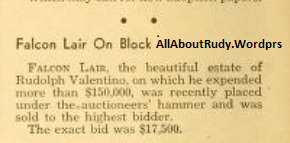
26 Jul 1938 – Capitol Names Prize Winners
The recent letter writing contest on “Why I want to see Rudolph Valentino” has met some unusual responses and printed here are two prize winning letters that will receive cash awards if the parties please call the Capitol Theater Office.
First Prize – “I want to see Rudolph Valentino because when I was a small girl, in boarding school, my mother came after me for a holiday weekend. We ate in cafes, shopped and went to see Rudolph Valentino in Son of the Sheik at the Queen Theater, Houston, Texas. My mother’s birthday is 31 Jul and I want to give her a holiday and myself a memory trip by taking her to see the movie idol of her time again at the Capitol Theater 31 Jul”. Signed: Mrs. L.E.J East 10th Street.
Second Prize – Mr. Rudolph Valentino fourteen years ago when I saw you in Son of the Sheik played at the Woodlawn Theater, Chicago, Illinois. I went because friends and salespeople exclaimed of my resemblance to you. I could double as your sister. I wonder if you were here today, would your mirror reflect the same changes as mine does? Although I have run true to form, by being “fair, fat, and fortish” the similarity in features remain. My reason for seeing Son of the Sheik now is for the memories brought back from that time, are nice to remember as the picture again unfolds before me. Your most ardent admirer: Mrs. D.R. NW 3rd.
Everyone is invited to send in their letters this week before the picture comes to Amarillo on “Why I want to see Rudolph Valentino”. You may win a cash prize and a guest ticket to see Son of the Sheik.
Categories: Uncategorized
Tags: Rudolph Valentino
28 Oct 1929 – Roerich’s Shrine
On Manhattan’s socially outworn Riverside Drive, a skyscraper-Museum, dedicated to one man, was formally opened last week. The man was Professor Nicholas Constantinovich Roerich, famed Russian painter-writer-explorer-philosopher. The brick skyscraper, designed by Architect Harvey Wiley Corbett, uniquely graduated in tone from deep purple at the base to white at the top, symbolizes “growth,” houses more than 1,000 of Professor Roerich’s exotic paintings, is dedicated to international culture, world peace. Present at the dedication was the Professor himself and his two apple-cheeked sons. His audience wandered through the museum, marveled at the “Hall of the East” in which 100 ritual lights burned before a Tibetan shrine. The audience included turbaned Indians, grave Chinese, eager U. S. intellectuals, a brown woman with gems fastened in her nose, a plump white woman wearing a jingling Colombian Indian costume. Kermit Roosevelt dropped his eyes against curious stares. Natacha Rambova, white turbaned and weighted with gold invited the avid to her studio. Esoteric prattlers shook the Professor’s hands and looked for cheese wafers to nibble. There were no refreshments.
Categories: Uncategorized
Tags: Natacha Rambova, Nicolas Roerich
17 Apr 1935 – ZUNILDA MANCINI, Respondent, v. S. GEORGE ULLMAN, Appellant.
Mancini v. Ullman [Civ. No. 10065. Second Appellate District, Division One. April 17, 1935.]
COUNSEL Arthur C. Fisher for Appellant. Herman Tepp, Ivan L. Hiler and Jay J. Stein for Respondent.
.
OPINION Conrey, P. J. Appellant having filed his opening brief, respondent now moves to dismiss the appeal of defendant, or affirm the judgment, upon the ground that the questions upon which the decision depends are so unsubstantial as not to require argument. The record is presented in a printed transcript which contains the judgment roll, together with a bill of exceptions in which there are no specifications of insufficiency of the evidence to sustain the findings.
[1] On several dates (January 23, 1928, April 12, 1929, and April 28, 1930), respondent, who resided in the city of New York, paid to appellant sums of money, in all amounting to $6,900, all solicited and received as part of a fund to be used for the construction of a monument in the city of Los Angeles, to commemorate the name of Rudolph Valentino. Appellant actually used for that purpose, only $2,000. The court found that his representations to respondent, by means of which he obtained the money, were knowingly false. The transcript begins with an amended complaint, and does not show the date of commencement of this action. However, we accept as presumably correct the statement of counsel in his brief, that the action was not commenced until October 23, 1933. But the facts shown by the findings are sufficient to excuse the failure of respondent to discover the fraud until May, 1933, when she promptly employed an attorney, and demanded repayment of the money sued for in this action, and then filed her complaint. [6 Cal. App. 2d 224] There is, therefore, no merit whatever in appellant’s contention that the plaintiff’s right of action is barred by the provisions of sections 338 and 339 of the Code of Civil Procedure; nor in the further defense based on the ground of laches of the plaintiff in delaying the commencement of her action.
[2] There is no substantial basis for the claim of appellant that the court erred in allowing plaintiff to amend her amended complaint to conform to the proof. Appellant argues that the points of amendment did not conform to the proof. But the trial court thought differently, and in the light of the findings we must assume that the court’s ruling on this matter was supported by the evidence. There was no miscarriage of justice in the rendition of judgment against appellant.
The judgment is affirmed.
Categories: Uncategorized
Tags: George Ullman, Rudolph Valentino
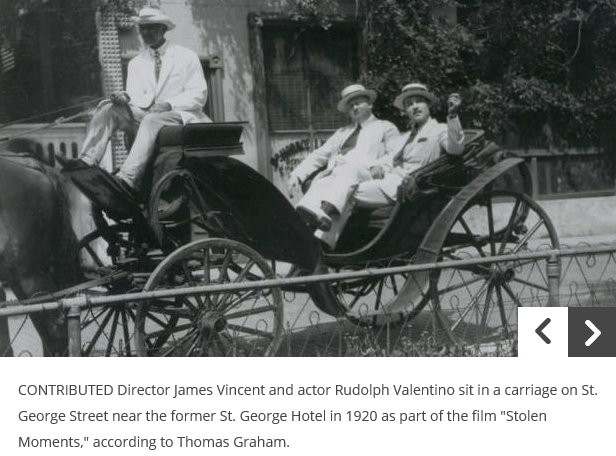
1920 – Stolen Moments St Augustine, FL
Categories: Uncategorized
Tags: Rudolph Valentino, Stolen Moments
8 Mar 1925 – Where Rudolph was when the lights went out
While on the subject of temperaments have you heard the news of Rudolph Valentino’s tiff with Ritz-Carlton Pictures? Well it seems that Rudy was right in the midst of making “The Hooded Falcon” making it just as he jolly well pleased and under the supervision of his own hand-picked director, when J.D. Williams, president of Ritz-Carlton, thought he ought to have something to say regarding the expenditure of something like $500,000 of his own hard cash. First of all he requested that Mrs. Valentino hie herself to the sidelines and confiner her helpful operations to merely looking on and keeping quiet. When Mr. Williams took exception to Rudy’s choice of Alan Hale as the director he declared that Mr. Hale was not experienced enough to look after the destinies of a film which was estimated to cost it producers half a million dollars. So the Valentinos walked off the set in a huff. According to the latest reports they are passing the time in luxurious
idleness at Palm Springs. They are not going back to Hollywood until some spirit greater and more omnipotent than J.D. Williams moves them. In the meantime, Adolph Zukor and Famous Players Lasky who have contracted for hte release of Valentin’s pictures, are pacing the rugs in their majogany paneled executive chambers, wondering if ever there had been a spoiled child more incorrible than this boy Rudolph.
Categories: Uncategorized
Tags: Mrs. Valentino, Ritz Carlton Pictures, Rudolph Valentino
24 Apr 1988 Secret to Manhood May Lie in Rudolph Valentino’s Ring
Franklin Mint is selling the secret to manhood. Or at least copies because the original stays where it is. The secret to manhood as implied by its ads is a ring worn by Silent Film Star Rudolph Valentino. The mint a mail-order firm in Franklin Center, PA is selling copies of the ring for $295.00. “Rudolph Valentino” one magazine ad reads “His name is synonymous with self-assured style”. Off and on the screen. And his taste in jewelry reflected an undeniable confidence in his own masculinity. “Now, for the first time, the ring that he actually wore has been recreated from the original now in the permanent collection of the prestigious Margaret Woodbury Strong Museum, Rochester, NY. In 1967, the ring was purchased for $1000, in an auction in Portland, Maine, and the museum will not say what the piece is worth now. In any case, the ring has never been displayed though in might be included in a 1990 exhibit on American Heros of Pop Culture. The ring is made of hammered platinum with an oval setting of black star sapphire, which has an intaglio of two Greek warriors, one standing and one on a horse It is a huge affair more than 1 inch from front to back, more than 1 inch from side to side, and close to an inch from top to bottom. The copy replaces the platinum with silver and the sapphire with black hermatite. But at least you can get your own copy in any size you want. Museum records say the ring was made in Italy in 1925. Valentino bought it that year and reportedly wore it in three movies “A Sainted Devil” “Cobra” and “The Eagle”. He died in 1926 and the ring was bought by James Perkins a Portland Sea Captain. Strong bought it from Perkins estate which was auctioned when his widow died. In 1967, Margaret Strong bought the ring to go with her Rudolph Valentino Doll.
Categories: Uncategorized
Tags: Rudolph Valentino
27 Jun 1948
Natacha Rambova was reported the first woman to wear turbans on American streets. Now that it is a popular thing La Rambova goes bareheaded.
Categories: Uncategorized
Tags: Natacha Rambova
4 Feb 1922 – Four Horsemen at the Capital
With the coming of the “Four Horsemen of the Apocalypse” to the Capitol next week, Rex Ingram will have two pictures running simultaneously on Broadway. In creating this stupendous production, this young director has made one of the great classics of the screen. The picture, adapted by June Mathis from the novel of Vincente Ibanez, is not a war play, except as the war serves as a background for the story teeming with dramatic passion. The director has succeeded in concentrating the great struggle in a series of unforgettable pictures that flash out the quintessence of life. Through it all is the deeply human, deeply moving spectacle of intensely real people in their baffled attempts to readjust themselves to the demands of the war days. In the cast of 50 principles and 2500 extras are included a score of well-known screen stars. They are Rudolph Valentino, Alice Terry, Pomeroy Cannon, Joseph Swickard, Brinsley Shaw, Alan Hale, Bridgetta Clark, Mabel Van Buren, John Sainpolis, Nigel de Brulier, Virginia Warwick, Derek Ghent, Stuart Holmes and Edward Connelly. SL Rothafel and his staff are at work on the details of a presentation in keeping with the production.
Categories: Uncategorized
Tags: "Four Horsemen", Rudolph Valentino
24 Mar 1928 – Male Movie Stars More Fussy about their hair
A woman is fundamentally the same, whether she is a movie star or a Park Avenue society but the happiest moment in her life is when her hair turns out just right. That does not mean that women have a corner in the personal vanity market. NO woman in the world could be more fussy about their hair than a male movie star. These are the deductions of an expert, Ferdinand Joseph Graf, for three years, the official hairdresser to moviedom who is now at Arnold Constables. Mr. Grafs first job with Famous Players was to prepare the wigs for Valentino in “Monsieur Beaucaire”. Natacha Rambova the stars former wife, brought him out to the studio from the 5th Avenue beauty parlor she patronized for that purpose. He liked the work so well and the stars apparently liked him so he well became the official hairdresser at the studio for three years.
Categories: Uncategorized
Tags: Ferdinand Joseph Graf, Natacha Rambova, Rudolph Valentino
18 Jun 1922 – Scientists interests in Movie’s Happy Endings
Distinguished French psychologist Pierre Delenne, declared the other day his belief that much acting in the emotional dramas of the films may easily unfit men and women for meeting successfully the problems of reality which they have to face in every-day life. According to his theory, they can become so accustomed to the romantic, rose-colored glamour which the movies throw about everything that when they come into the harsh glare of actuality they are likely to be hopelessly blinded or to see things in such a distorted way that they make the saddest kind of mistakes. The movies are capable of more harm in this respect than the speaking stage, he thinks. While on the speaking stage an actor may play the same part for a year or longer, in the movies he crowds into the same space of time a great many different roles. Working at this continual high pressure in the world of make-believe, the movie actor may easily become obsessed, Professor Delenne thinks with the idea that everything must have a happy ending, particularly where love is concerned. That the swift triumph of true love over all sorts of obstacles is inevitable is the very breath of life of most of the great film successes. The scenario writers, directors, and continuity men hammer away at this false notion so persistently and elaborate it in so many ingenious ways that it is no wonder the actor should often get to taking it for the solemn truth. The awakening from his blissful dream that love is a n irresistible force comes when he runs against the stern realities of civilization’s laws and social conventions things which in the world where he has been living have been overcome with greatest ease. All this is extremely interesting to us here in America, where the movies had their birth and have reached their greatest development. Everybody will at once think that very possibly this theory maybe the true explanation of the extraordinary series of scandals in the motion picture world, which former Postmaster General Will Hays is now doing his best to bring to an end. Certainly it would seem that some such theory as Professor Delenne’s offers the only plausible excuse for the desperate changes which Rodolph Valentino, the famous heartbreaker o the films, has lately taken with his love. Unless he were obsessed with the idea that love must inevitably have its way and that there is bound to be a happy ending to every heart-burning romance, what could have possessed him to risk a prison term in order to possess the woman he loved, a few short weeks before the law said he should? In the movies, Rudolph Valentino ran to Mexico with the beauty for whom he “just couldn’t wait any longer” would have been quite all right. Such trivialities as the laws of the State of California would have been cast lightly aside or else bent in a way that would have served the scenario writers purpose just as well. And the final close-up of Rodolph and his perfume heiress would have shown them clinging to one another, approved of by everybody and tasting the first of an ever-lasting bliss. But, as Rodolph Valentino and Miss Hudnut have learned to their sorrow, the laws on the subject of bigamy are not the negligible things the scenario writers and movie directors would have us believe. What they planned to be the most fascinating of romantic dramas gives promise of winding up in a dismal tragedy just the sort of an unhappy last reel which no popular motion picture would tolerate for a minute. Instead of possessing the bride for whom he yearned with all the fire that has made him one of the most famous of screen lovers Rodolph Valentino is separated from her by width of a continent. In her home in the East she hides, distracted by anxiety over her lover’s predicament and by the pitiless publicity that has been thrust upon her. Out in California, alone and broken hearted, he impatiently awaits trial on a charge that may land him inside the gray walls of a state prison. “But even the fear of a prison term could not dim the flame of love that blazed so hotly in their hearts. Captions like this are of frequent occurrence in the films. Evidently Rodolph Valentino thought the sentiment they express founded on a truth which could be turned to the advantage of his love hungry heart. But now he and his perfume heiress know that only in the make-believe world of the films is love able to defy the law in such high-handed fashion. Bigamy is not so lightly regarded in real life, and for those suspected of it there are troublesome sheriffs and prosecuting attorneys, stern judges, and juries to be reckoned with. According to Professor’s Delenne’s theory many movie actors are in a condition quite similar to that of an unfortunate shimmy dancer who cannot keep from shimmying. They have loved so often and with such made impetuosity on the screen, and all their dreams have so invariably come true, that they have become carried away with the idea that such things are as easily possible in real life. So it was, it seems, with Rodolph Valentino. In the “Four Horsemen of the Apocalypse” “The Sheik” and countless other film successes he was always the all-conquering lover. He loved with an intensity that acknowledge no obstacles, brooked no delay. And just like this should it known in the California film world as Natacha Rambova. He had only recently received an interlocutory decree of divorce from Miss Jean Acker, the screen actress, and until the final decree was granted he had no legal right to marry again. But Valentino, with all the impetuosity that has made him famous as a screen lover fled across the Mexican border with his sweetheart and they were married. The close-up that followed was a grim contrast to the happy endings which are the delight of the movie goers.
Categories: Uncategorized
Tags: Natacha Rambova, Rudolph Valentino
24 Feb 1927 – “Forget the Past” Says Second Wife of Late Rudolph Valentino
“I want the public to forget that I was ever Mrs. Rudolph Valentino” says Natacha Rambova alias Winifred Hudnut. “But privately that is another matter, for he is still with me talking from the other world”. The former wife of the late screen star, who is now starring in a mystery play, explained that she was “tired of being called Mrs. Valentino because some people seem to think that I am attempting to capitalize on the late Mr. Valentino’s popularity.
Categories: Uncategorized
Tags: Mrs. Valentino, Rudolph Valentino
 All About Rudolph Valentino
You must be logged in to post a comment.