
A dinner at the home of Pola Negri, in Beverly Hills, was held in honor of Rudolph Valentino’s birthday. On being questioned as to what birthday it would be Rudy sagely remarked that he would be just one year older than he was last year, and it is not a matter to be laughed about. Pola has not yet left for that love test separation, her last reason being that the rate of exchange abroad, or her health, or the health of Madame Eleanora Chalupez, Pola’s mother had suddenly determined the actress to cancel her sailing arrangements a week ago. Rudy meanwhile, is staying up nights reading stories to find one for his next picture. He is considering a Spanish story.
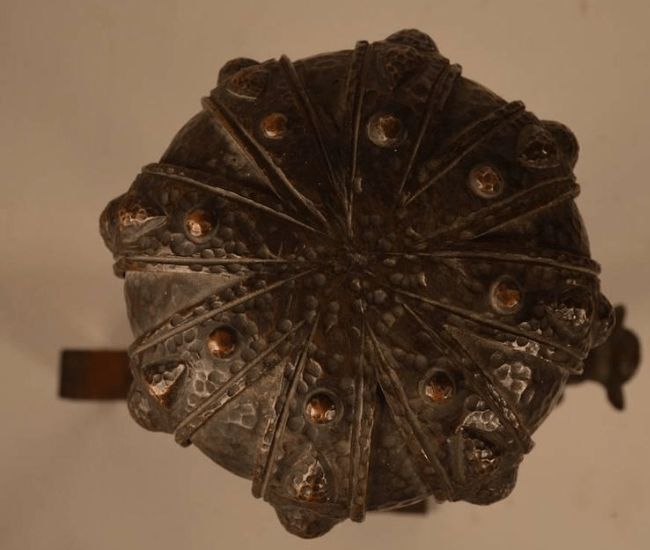
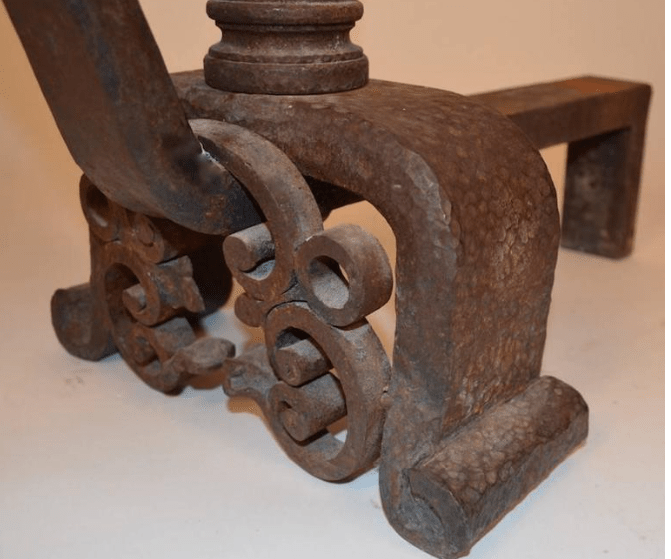
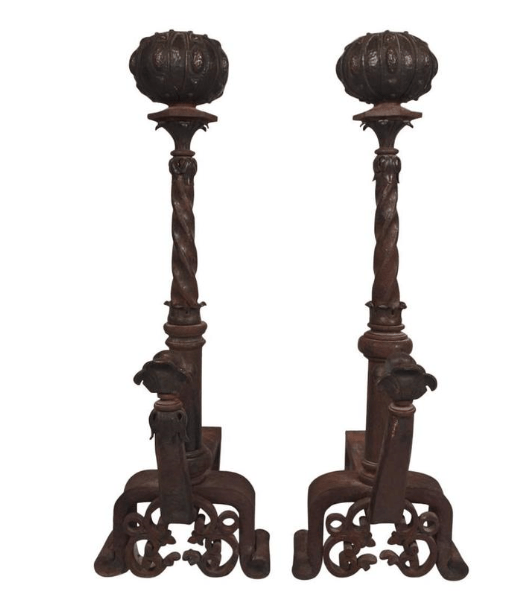
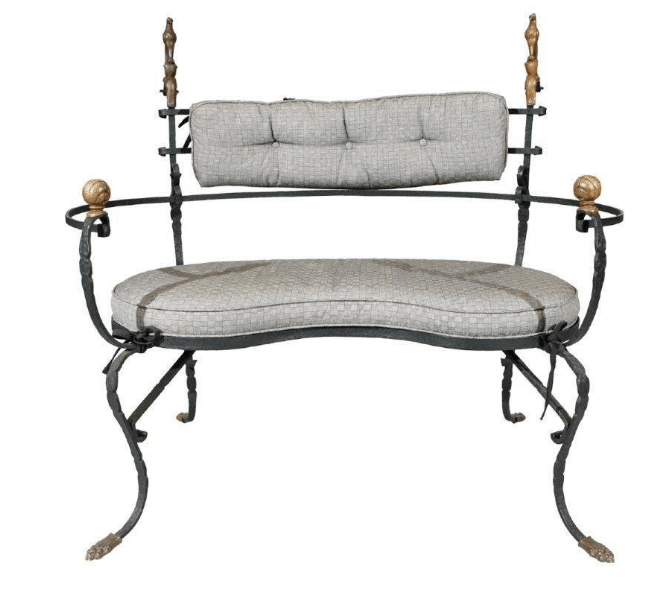
Falcon Lair Furniture – 19th Century Italian Iron & Bronze Items Adirons
Categories: Uncategorized
Tags: Falcon Lair, Rudolph Valentino
Falcon Lair Furniture
Iron & Bronze settee designed in hammered iron with RV initials. This exquisite piece belonged to Rudolph Valentino. Upon his death, it was owned by Doris Duke, and then purchased by Rock Hudson’s designer for the late actor’s home.
Categories: Uncategorized
Tags: Doris Duke, Falcon Lair, Rock Hudson, Rudolph Valentino
01 May 1947 – Current Teen-ager is Valentino Fan
Gay Nelson, 18 year old beauty is now making her film debut has become a Rudolph Valentino fan, for she thinks he was swoonier than Frank Sinatra is. Gay, who is playing the ingénue lead at Columbia Pictures in “Millies Daughter” recently picked up a phonograph record at second hand shop of Valentino singing “The Kashmiri Love Song”. Now Gay and her debutante friends are trying their best to meet someone who owns a print of “The Sheik” in order to see what their hero looked like in action.
Categories: Uncategorized
Tags: Rudolph Valentino
16 Aug 1923 – Valentino on Vacation
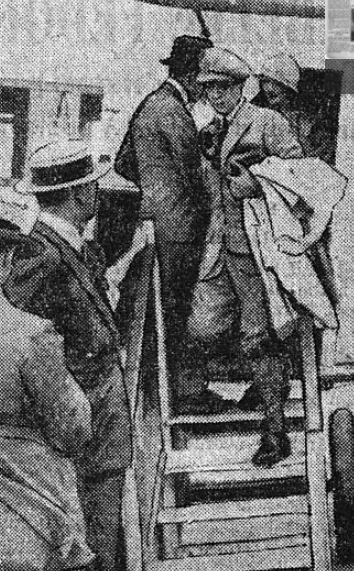
The foreign stars of the cinema, one after the other, come to France. Douglas Fairbanks and his wife Mary Pickford, and for ‘England the blonde’ Pearl White have already come smiling in the flesh to the enthusiasm of the crowds – under the Parisian sky. Yesterday, in its turn, a new star descended from the clouds, Rudolph Valentino, Prince Charming of the cinema and his charming wife Natacha Rambova. All of the famous silent film stars are in Paris. Mr. Valentino is having some rest before going back to New York to finish filming and judging an American Beauty Contest. The adoring crowds designated him as the most handsome man, was celebrating with his equally famous friends. The evening, in fact, a grand-banquet was setup for his party in the hotel. An international star, much more than American, Rudolpho Gugliemi was born in Castellaneta, and is actually called Rudolph Valentino. Eight years he went to America, started living a real movie; episodes by turns dramatic or triumphant. Dancer, then screen artist, he knows about Americans – and especially American cars – a vogue almost eclipses that of trolleys. Thus, after very romantic difficulties, he married, two years ago, the daughter of the perfume king, Mr. Richard Hudnut who goes by the name of Natacha Rambova. The photo taken shows Valentino, followed by his wife getting off the plane, at, Bourget. The arriving party will be going to Paris. Mr. Jacques Hébertot, Director theater of the Champs-Elysées, which is in Paris, France, in charge of his interests, has engaged him.
Categories: Uncategorized
Tags: Andre Davin, Douglas Fairbanks, Natacha Rambova, Rudolph Valentino
10 Sep 1924 – Valentino on Vacation
Rudolph Valentino will come to make his own pictures. In the meantime, a copy of the first cut print of “A Sainted Devil” made for Paramount, will be forwarded to Rudolph Valentino at Juan Les Pins, Antibes, France. Mr. Valentino sailed the day following completion of his work in the production at the Paramount Long Island Studio, has not seen the completed picture which was filmed under the direction of Joseph Henabery. The picture is now being cut and edited under the supervision of director and E. Lloyd Sheldon a supervising editor, and when the work is finished at the end of week, a print of the completed film will be forwarded to France where the star is spending a short vacation.
Categories: Uncategorized
Tags: Rudolph Valentino
21 Aug 1925 – Mash Notes to Sheik Cause Wife to Leave
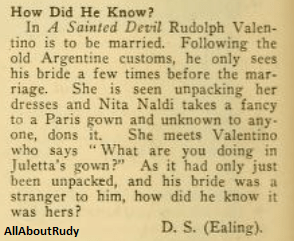
This author is not buying the excuse, Mrs. Rudolph Valentino is giving the press these days. “I won’t sit waiting for a husband who goes on lot at 5:00 a.m. and gets home at midnight and gets mails from girls in Oshkosh and Kalamazoo” and trying to look disappointed, reproachful and hurt while giving a press statement. Seems Mrs. Valentino is not good at fibbing and confessed the marital vacation is in reality a separation. George Ullman, Mrs. Valentino’s personal representative was with her today in charge of negotiations. He is not, her lawyer, and she could not conveniently remember her lawyers address. Ullman admitted he was open to the charge of alienating Mrs. Valentino’s artistic affections.
Categories: Uncategorized
Tags: George Ullman, Natacha Rambova, Rudolph Valentino
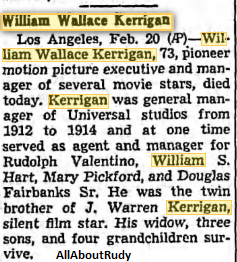
21 Feb 1953 – Rudy’s Manager Died
Categories: Uncategorized
Tags: Rudolph Valentino, William Wallace Kerrigan
1927 – The Truth on Valentino Insurance Policy at the time of his death
The late movie star and originator of the screen “Sheik” Rudolph Valentino was insured with the Missouri State Life for $200,000.00 by his producing company, Feature Production Incorporated. It is the belief this represents the entire amount of insurance carried on his life for the benefit of his movie producers. The report which gained circulation at the time of Valentino’s death that he carried $1,000,000 of insurance was erroneous. Valentino’s application dated 9 May 1925, was written by our Los Angeles branch. In signing his application he used his full name of Rudolph Valentino Gugliemi. Valentino was 31 years of age at the time of his death on 26 Aug 1926, 1210 p.m. The company’s check for $200,000.00 was made out to Feature Productions, Inc
Categories: Uncategorized
Tags: Death of Rudolph Valentino
15 Oct 1934 – Royalties Still Paid on Films of Valentino
Heirs of Rudolph Valentino are still collecting royalties from his pictures more than eight years after his death it was revealed in court today. Two of the late actors greatest films “Son of the Sheik” and “The Eagle” are still shown in theatres throughout the world, the administrator of his estate informed Probate Judge Walton Wood. The court was asked to approve a compromise settlement of $6,093.75 with Art Cinema corporation as royalties due to the estate. The court concurred.
Categories: Uncategorized
Tags: Death of Rudolph Valentino

11 Feb 1945 Red Banker Tells How Valentino his boss, had to ‘fight’ girls too
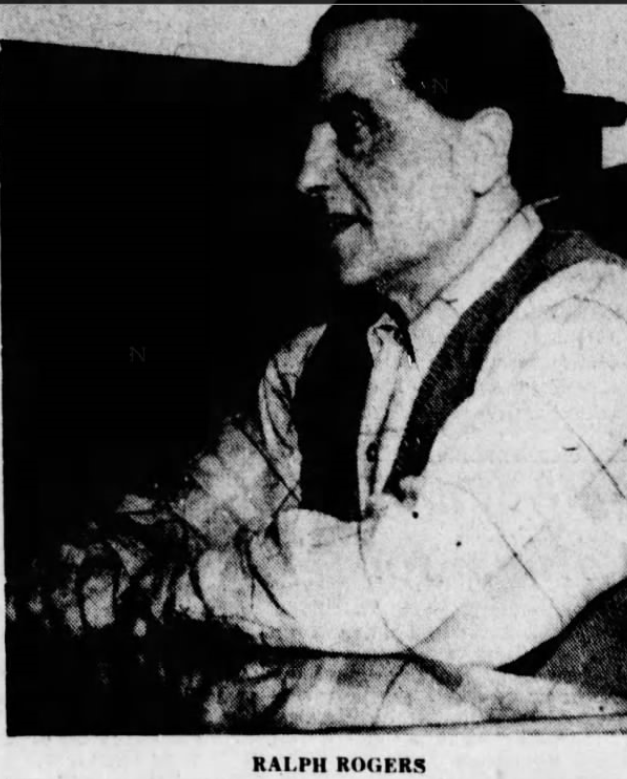
Ralph Rogers, is a dark, florid man of 45 behind whose quiet, brown eyes are the memories of two decades ago when he led a more colorful life as body-guard, valet, chauffeur for the late Rudolph Valentino. He was the late film lover’s companion the night Valentino won 450,000 francs and broke the bank at Monte Carlo. He was with him in an automobile crash near Hollywood when those who rushed to the scene stole bits of the shattered Valentino car as souvenirs, forgetting the begrimed, bleeding victims of the crash. He was aboard ship with him when Benito Mussolini warned the late Rudy by wireless not to put foot on Italian soil with immediate induction in the army as an alternative. He spent three hectic years trying to save his boss from girls and women who besieged him for autographs, sometimes tearing at his clothes, even snipping hairs from his dog for mementos. One night while enroute from Europe to America aboard the Vaterland, later the Leviathan, women banged on the doors of once was the Kaisers Suite demanding the public appearance of Valentino who wanted only to be left alone to sleep. In some European Capitals the besieged Valentino had to employ the utmost diplomacy to shoo away an occasional princess, baroness, or countess. All this, and more besides are among the memories of Ralph Rogers, 110 Monmouth Street here when he is not engaged in the operation of his small Italian restaurant on Broad Street, Shrewsbury. His getting the job as Valentino’s man Friday was by accident. Rogers was employed in the main showrooms of the Isotta-Frachini Company, New York City. His boss was a chap named D’Annunzio son of the famous Italian poet and patriot. Valentino drove an Isotta and had dropped in wit the problem of getting a man to go to Europe with him to drive the car. D’Annunzio suggested Ralph Rogers. Rogers accepted but in the back of his mind he figured he might get the chance to visit his relatives in Sorento. “We toured Europe the days and nights were always exciting and interested. But Valentino was never interested too greatly in women perhaps they annoyed him too much. In Europe it was very bad the way they kept after him. During the years from 1923-1026 when I was with him, I know of only one woman Valentino seemed to care anything about and that was Pola Negri. In my humble opinion she was the only girl Valentino seemed to really care for. The night Valentino broke the bank at Monte Carlo I was beside him most of the evening. I say it was 450,000 francs he won it may have been 500,000 or 550.000. I can only remember that I had to carry the money out in a bag to the car and that the place closed down tight, turning all the guests away. It was very bad night for the old gambling house. Papers all over the world were full of the story the next day. “While we were in France, I mentioned to Valentino I had relatives in Sorrento. He told me to take his car and drive there and to spend as much time as I liked. He was a wonderfully democratic fellow, very generous and very understanding. He was what you might say a ‘swell guy’ all around”. When we arrived back in New York disembarking from the Vaterland Valentino told me he would like to keep me and asked would I be willing to be employed by him instead of going back to my old job. He said we got along so well he would not like to see me go. I decided I would remain with him. “Out around the Pacific coast when women couldn’t get close enough to Valentino in his car they would actually shinny up to the roof of the car and peer in at him. He had his troubles with the women. Ralph Rogers never saw Valentino when thougsands streamed into Campbell Funeral Parlor to view the late film idols body. “Just as in life” Rogers says, the crush of women was too great. I stood outside and looked. I saw those women lineup for blocks. I shook my head with the memory of a real fine fellow I would never see again. Up to a year ago, Ralph Rogers was still wearing pajamas Valentino had given him. He Loved fine pajamas said Ralph. He had them by the dozen and they were made of the finest materials, personally made for him to last a life time. They did for him, and lasted another 20 years for me. The last pair I abandoned just about a year ago.
Categories: Uncategorized
Tags: Pola Negri, Ralph Rogers, Rudolph Valentino
1 Mar 1926 – Costume Party
Rudolph Valentino, Manuel Reachi and Pola Negri at a costume party. 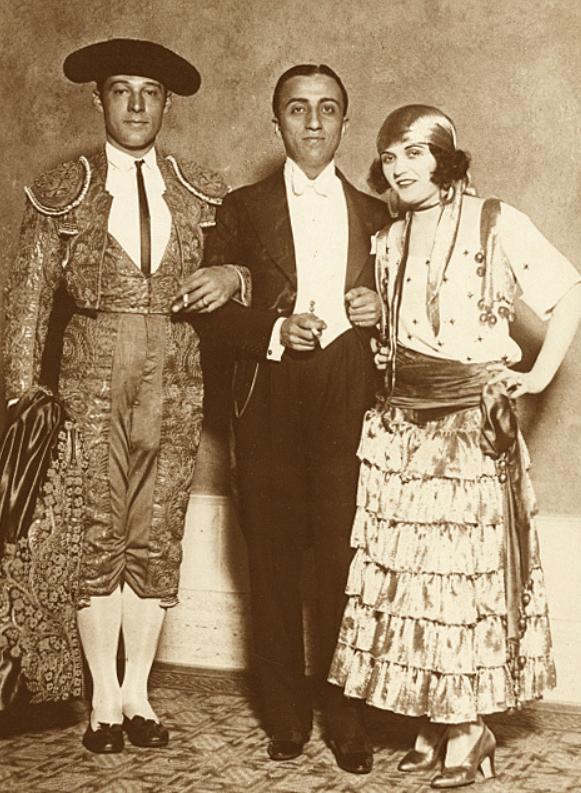
Categories: Uncategorized
Tags: Manual Reachi, Pola Negri, Rudolph Valentino
1945 – Back in the Day
Joe Hess, of the crew of the departing Folies Bergere Revue, revealed the other night the late Rudolph Valentino went right to the coast from Pittsburgh in 1917. He was playing in a John Cort Show “The Masked Model” at the Dugquesne when the producer decided to transfer the production immediately to San Francisco. The troupe was stranded there and Valentino caught the eye of an influential woman who was instrumental in placing him on the screen.
Categories: Uncategorized
Tags: Rudolph Valentino
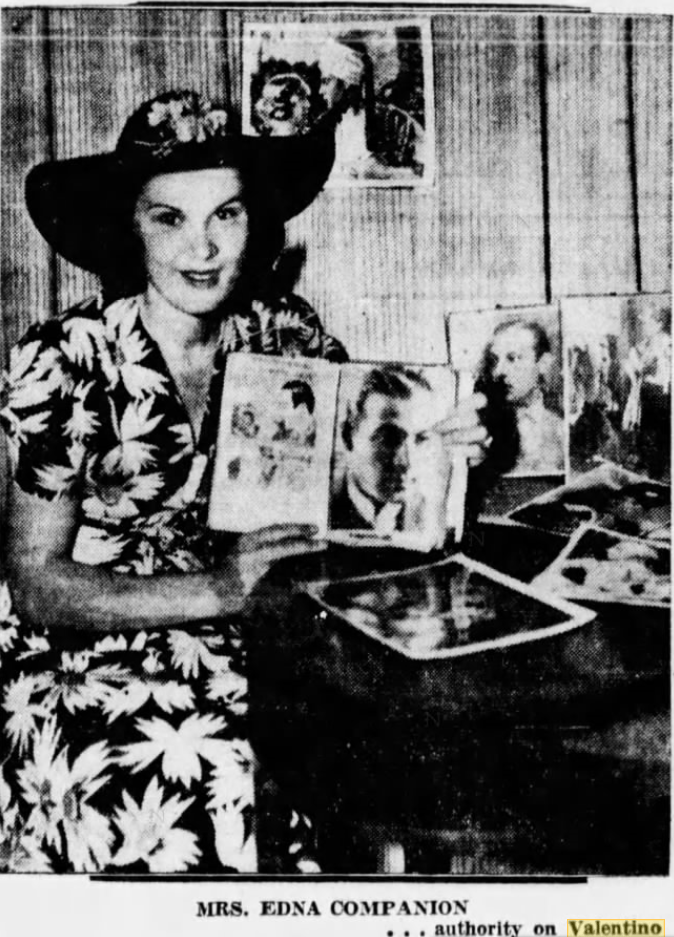
28 May 1998 – Paintings, valuables stolen from Valentino’s grandson
Thieves ransacked the home of Rudolph Valentino’s grandson and took paintings and other valuables police said. Losses and damage from the break-in over the long Memorial Day weekend were estimated at $100,000. The grandson, also named Rudolph Valentino, returned Tuesday to find that someone had smashed as rear window.
Categories: Uncategorized
22 Mar 1940 Valentino’s Horse Dies at a Ripe Old Age
Rudolph Valentino’s horse died today in Rockleigh, New Jersey. An uncommon old horse was “Anna” who before she reached a ripe old 39 had played such stellar roles as a walk-on part in “Aida” at the Metropolitan Opera and hostess at a “horse party” while wearing a Lilly Dache hat. Anna lived out her last years in pasture at the Douglas Hertz farm.
Categories: Uncategorized
Tags: Rudolph Valentino
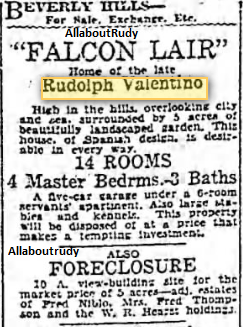
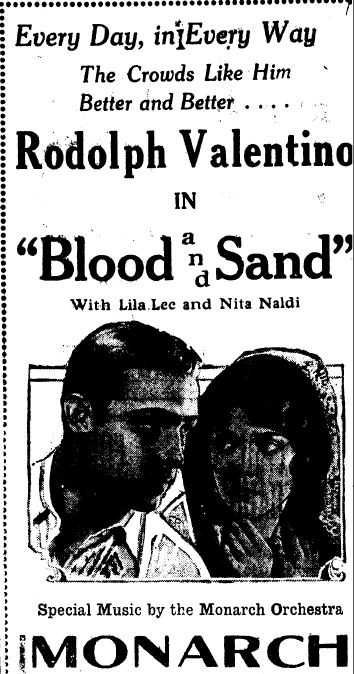
07 Jan 1923 – Almost like but not
Orlando Cortez was a contestant in a dancing contest held at Los Angeles a week or so ago. Charles Chaplain and Jesse Laskey were acting as judges in the contest, and now Mr. Cortez holds a 5 year contract as a member of the Paramount Stock Company. The young man is a good looking and graceful dancer as Rudolph Valentino.
Categories: Uncategorized
Tags: Rudolph Valentino
17 Dec 1922 – Valentino May Make Records
Valentino rumors may come and go, but Rudy himself is the authority for the statement that a big company is now being organized to put a stock of toilet preparations on the market bearing his charmed name. This it seems, cannot be prohibited by the injunction preventing him from working. Rudy’s attorney is considering several offers from a phonograph concern, said company wanting the romantic Italian to do some records. Whether or not the injunction prevents this will remain seen. There is no truth to the report that Valentino and his wife Natacha Rambova are going to England to appear in one of the Charles Cochran revues at a salary of $3500 a week or any salary.
Categories: Uncategorized
Tags: Natacha Rambova, Rudolph Valentino
1920’s – Jean Rhys and the Hudnut’s
Jean Rhys was a novelist who became famous in her later years. However, it was interesting to note that she had a connection with Richard Hudnut and his second wife Winifred.
In 1890, Jean Rhys was born Ella Gwendolen Rees Williams on the island of Dominica to a Welsh father and white Creole mother. From an early age, Jean wrote stories however, it was when destitute and living in Paris she began writing again. It was also during this time she met literary giant Ford Madox Ford who kick-started her writing career. Ford Madox Ford was born Ford Madox Hueffer in Merton, Surrey Novelist, poet, literary critic, editor, one of the founding fathers of English Modernism. It was through him that she changed her name and his advice to use her tortured life experiences and transform them in to literary form. Also, I was through him that she met Richard Hudnut and his second wife Winifred. In Jul 1925, Jean Rhys took a train to Juan-Les-Pins to meet with Mrs. Hudnut who wanted her to ghost-write a book on Reincarnation and Furniture. However, this was not a subject she was an expert on let alone undertake. However, according to limited research on this subject Jean stayed at the Chateau for a couple of months. But it seems that Ford had received a letter from Jean stating that Mrs. Hudnut wanted her to write an additional book as well. This led to Ford writing Mrs. Hudnut angrily saying she was trying to exploit her and underpay Jean for her writing services. Needless to say Mr. and Mrs. Hudnut were angry about the whole situation and cabled Ford that Jean would be on a train back to Paris the next day. However, it seemed that a story was going around that about Jean and Mr. Hudnut. It seems Mr. Hudnut had been seen kissing Jean when he took her to the Casino at Monte Carlo ‘Nearly every Sunday’. This was also verified by the chauffeur who was watching them in the mirror. It seems that Winifred and Jean ‘reconciled their differences’ and took the train from Juan-Les-Pins to the Garc de Lyons where Ford met them both there. Winifred did not seem to be impressed when she met Ford she walked away with a porter and her luggage. Did Richard Hudnut fool around with Jean Rhys? There is really nothing to prove this story? There are no known news articles except what Jean has written. Given that Richard Hudnut was a wealthy man I imagine he paid afew people off to insure this little dalliance never seen daylight.
Source Used:
Ford Madox Ford: A Dual Life, Vol II The After-War World. By Max Saunders.
Categories: Uncategorized
Tags: Jean Rhys, Richard Hudnut, Winifred Hudnut

18 Feb 1922 – Four Horsemen at the Capitol
With the coming of the “Four Horsemen of the Apocalypse” to the Capitol next week, Rex Ingram will have two pictures running simultaneously on Broadway. In creating this stupendous production, this young director has made one the great classics of the screen. The picture, adapted by June Mathis from the novel of Vicente Ibanez, is not a war play, except as the war serves as a background for the story teeming with dramatic passion. The director has succeeded in concentrating the great struggle in a series of unforgettable pictures that flash out the quintessence of life. Through it all is the deeply human, deeply moving spectacle of intensely real people in their baffled attempts to readjust themselves to the demands of the war days. In the cast of 50 principles and 2500 extras are included a score of well-known screen stars. They are Rudolph Valentino, Alice Terry, Pomeroy Cannon, Joseph Swickard, Brinsley Shaw, Alan Hale, Bridgetta Clark, Mabel Van Buren, John Sainpolis, Nigel de Brulier, Virginia Warwick, Derek Ghent, Stuart Holmes and Edward Connelly. SL Rothafel and his staff are at work on the details of a presentation in keeping with the production.
Categories: Uncategorized
Tags: "Four Horsemen", Rudolph Valentino
14 Feb 1925 Valentino Romantic
A romantic day for the world’s leading romantic man Rudolph Valentino admits he is a romantic in his own temperament as well as in the parts he takes place before the camera. He loves his wife in spite of the interviews each of them has given to the papers, but the girl of his dreams still is to be discovered. He intends to cherish this dream without becoming cynical about it whether he ever finds her or not.
Categories: Uncategorized
Tags: Rudolph Valentino
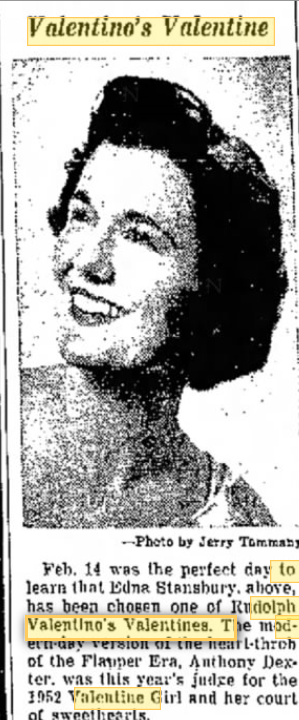
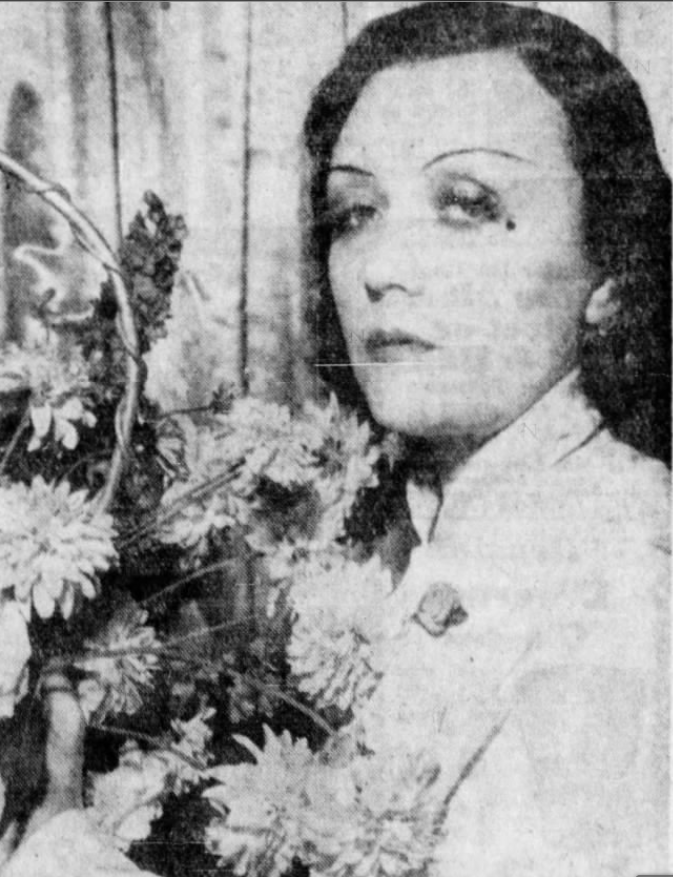
“A gentleman must be a gentleman even to his wife” – Rudolph Valentino, 11 Nov 1925
Categories: Uncategorized
Tags: Rudolph Valentino
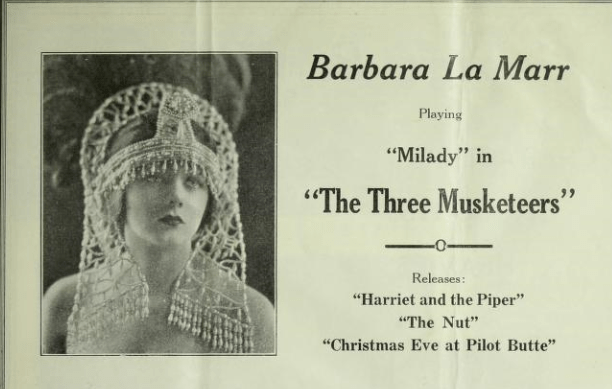
Whatever Happened to Valentino’s Yacht

Rudolph Valentino enjoyed the finer things in life and one of them was sailing. Rudy was a member of the Catalina Island Yacht Club and decided to have a yacht build especially for him. He commissioned Wilmington boat builder Fellows & Stewart to build it. The yacht was 32 feet outfitted with rose-shaped lamps, mohair-velvet cushions with teak-and-holly- floors, sleeping 8 persons. The Joe Fellows Boat Shop was established in 1896 by English immigrant Joe Fellows, his business manager, Victor Stewart, and the well-known naval architect Joseph Pugh. In 1917, the Terminal Island-based establishment at Pier 206 was incorporated as Fellows & Stewart, Inc. In 1926 when completed he named his boat the “Charade” that was also called “Phoenix”. He only used the boat 3 times prior to his death. In December 1926, Harvey Priester a well-known millionaire purchased the yacht for $2300. At that time the initial sale was revoked because 25 percent of the bid was not deposited. In 1930, his boat sold for $3000 cash in San Pedro Harbor. As of Apr 1970, Valentino’s boat was now owned by his former stand-in docked in Marina Del Rey. In 1975, it was advertised for $28,000 but it is unknown who was the purchaser. In 1976, it was advertised again for $20,000. In 1977, Valentino’s yacht was bought by banker Tom Gray and in 1981 he was selling for $47,000. Since that time, there has been nothing found as to whatever happened to his yacht. Remains a mystery…
Categories: Uncategorized
Tags: Rudolph Valentino
10 Nov 1945 – Valentino Secret Wife

Categories: Uncategorized
Tags: Death of Rudolph Valentino, Marion Benda, Rudolph Valentino

7 Feb 1923 – Flappers Idol Flops, Detroit Dance Hall Manager Says
Rudolph Valentino the idol of all Flapperdom and Carl Fischer, manager of the Majestic Ballroom where the “perfect lover” is doing his show two days this week are on the outs. Fischer is on the warpath because he says he was hoodwinked into signing a contract on which he expected to lose $15,000 because the reputed snobbishness of Valentino has proven to be practically all as far as Detroit is concerned. Fischer agrees with Detroit, and says that Detroiters used good judgement in deciding that Valentino is a “foul ball” from an artistic standpoint.
Categories: Uncategorized
Tags: Mineralava Dance Tour, Rudolph Valentino

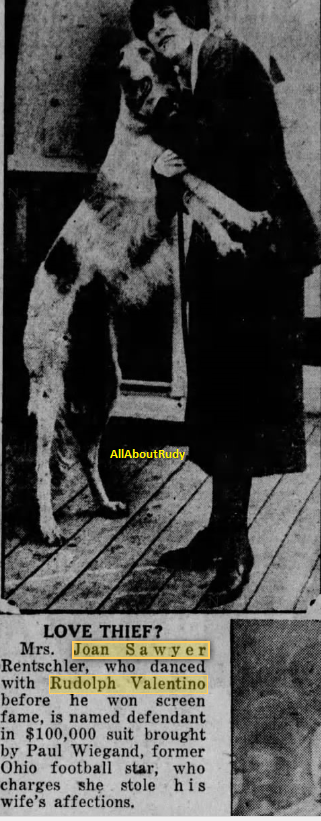
26 Jan 1926
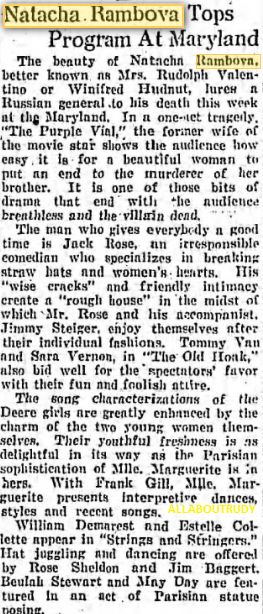
Categories: Uncategorized
Tags: Mrs. Rudolph Valentino, Natacha Rambova, Rudolph Valentino
26 Jan 1926 Nita Reduced Well
When Nita Naldi contracted to appear opposite Rudolph Valentino in “Cobra” the star agreed to reduce her weight. She managed to train from 143 to 124 without any ill effects. There was a clause in her contract with Valentino requiring her to keep her weight under 130.
Categories: Uncategorized
Tags: "Cobra", Nita Naldi, Rudolph Valentino
“A love affair with a stupid woman, is like a cold cup of coffee”.. – Rudolph Valentino
Categories: Uncategorized
Tags: Rudolph Valentino
1924 – The American Woman
When I am interviewed one of the questions, I am almost always asked is about women. My opinions as to the modern woman, my ideas on beauty, my preferences in type, my comparative ideas as to the beauty of Italian women versus American women. I respond that comparisons regarding women are odious. How can one make comparisons? After all, beauty is to be found everywhere, and if one is more beautiful than another, it has little to do with a country and all to do with the individual. However, I do feel the American girl leads the way in beauty, all things duly considered. I may, perhaps, be prejudiced because, I married an American girl. But I honestly do not think so. Because America is the great melting pot, of beauty. Or because the beauty of all countries and all races has filtered into America and has made the American woman a gorgeous composite of all other beauties. But I certainly have observed that American girls all have something of beauty. They may not be a classic type but almost everyone of them has a chic, a smartness, a knack of wearing clothes, some outstanding mark of loveliness that commends her to the eye.
Categories: Uncategorized
Tags: Rudolph Valentino
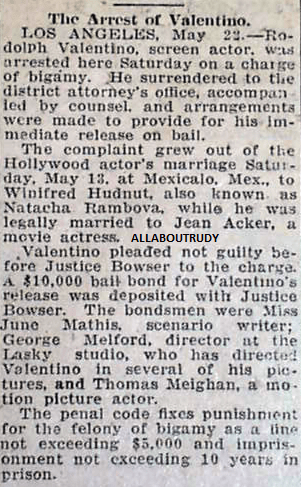
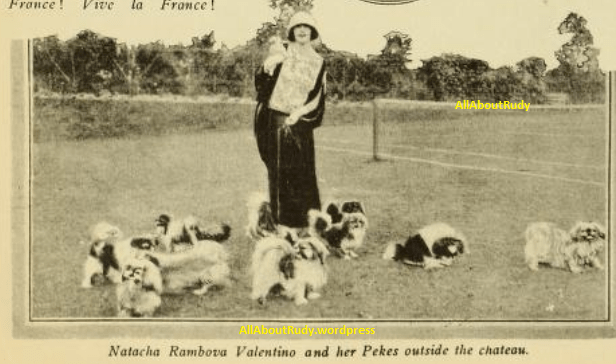
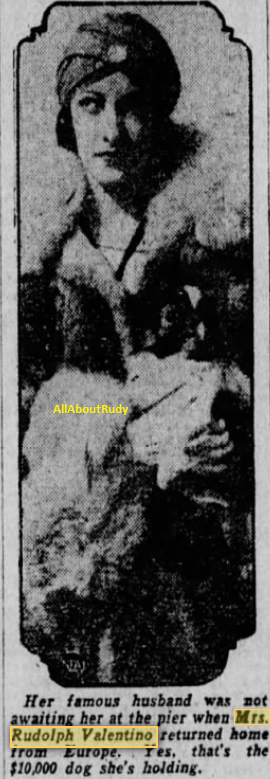
03 Jun 1922- She answers one question
At the time, Mrs.Valentino was in Mexico to be married. Before entering the courthouse, she hesitated long enough to answer a bold reporters question. “Do you love Valentino”? the reporter asked. The answer was “Forever” breathed the bride. Whereupon she disappeared into the silence away from the glare of publicity.
Categories: Uncategorized
Tags: Mrs. Rudolph Valentino, Natacha Rambova, Rudolph Valentino
Last Dance with Valentino Book
This book is by author Daisy Waugh published in 2011. Available in hard print only.
When Rudolph Valentino died, tens of thousands of people trampled one another in a desperate bid to view his body. They were as smitten with him in death as they had been in life – perhaps even more so due to the tragic nature of his passing. On his deathbed he cried out for one person; not his wife, Natacha Rambova, but an unknown “Jenny”. While his wife protested that Jenny was the name of Valentino’s spiritual guide, many were sceptical. It is this mystery which is the inspiration for the fictional Last Dance with Valentino.
In 1916, Jennifer Doyle arrives in America and falls irrevocably in love with Mr Rodolfo Guglielmi. In 1926, Lola Nightingale sits alone in her hotel room as Rudolph Valentino lies gravely ill behind impenetrable hospital doors. The decade that separates these two scenes is filled with dreams and loss, yet doesn’t alter the fact that both Jennifer and Lola, and Rodolfo and Rudolph, are one and the same.
“I shall do what I always do in times of confusion, disorder, disarray, complete and utter madness…” writes Jenny, “I shall scribble it down on paper.” The resulting “scribbles” are a record of the lives of Jennifer and her contemporaries as they weather a barrage of trials and tribulations – many of them apparently self-inflicted. Her life in America begins as a nanny (or rather general dogsbody) at “The Box”, home to the wealthy De Saulles couple, their son Jack, a menagerie of servants and hordes of temporary guests.
Almost by chance Jenny finds herself in conversation with Rodolfo (Rudy) Guglielmi, Mrs de Saulles’s dancing instructor (and, in the opinions of various observers, “not-quite gentleman” and even “repulsive little gigolo”) – a conversation that is to be the first of many. Unfortunately for them, however, the lady of the house has already earmarked Rudy for her own purposes – the main one being to testify against her husband so that she will be able to divorce him and keep custody of little Jack. Divorce him she does, yet with shocking consequences that are to haunt Jennifer for the rest of her life: “There’s barely a day goes by I don’t think of her, of the part I played or didn’t play, of what I saw and said, and didn’t see and should have said…”
Jennifer’s idle father has launched his own campaign of adoration at Mrs de Saulles, only to be rebuffed – suffering a personal failure that seems to affect him far beyond the many professional failures already trailing in his wake. As Jenny remains bound to the De Saulles household, Marcus Doyle turns to drink to fill the void.
Jennifer and Rudy find themselves forced to snatch moments at the most inopportune times, yet managing to create a bond and memories that sustain their love even when they find themselves apart. When Jenny finds herself “liberated” from her employment, she turns to Hollywood in the hope of finding Rudy again, only to discover a version of the American dream even more tarnished than the one she has already experienced. She also discovers the charms of alcohol and casual relationships: “The advantage of being so horribly, entirely smashed (is) that nothing hurts any more… I lost myself. Thought of no one and nothing. And what could be better than that.”
Life continues in that nature, interspersed with ever-more-determined attempts at writing photoplays, until Jenny becomes Lola – once childhood nickname, now the latest protegee of the famed Frances Marion. It seems that Jenny has found both her chance to be a writer and her long-lost lover; but it seems, yet again, that fate is to intervene with its former cruelty. With an endearing self-deprecation, Jenny braces herself for the news that is inevitable and unthinkable.
Last Dance with Valentino is a deeply satisfying book spanning the divide between ordinary and celebrity. The voice of Jennifer is, as the narrator, both mature and vulnerable; her observations both tragic and humorous in their stark honesty. This tale of the mysterious “Jennifer No-one from Nowhere” is an acutely touching work written with flawless style. – Lara Sadler
Resource:
Categories: Uncategorized
Tags: Last Dance with Valentino Book, Rudolph Valentino

1955 – Rex Ingram Director
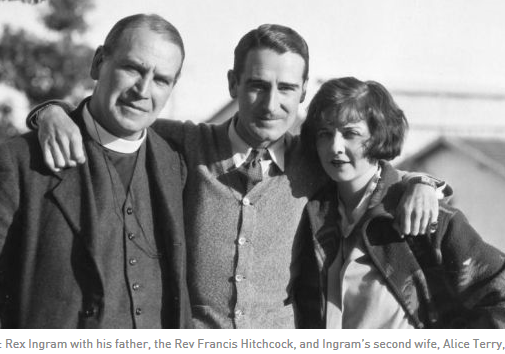
On the evening of March 6th, 1921, the auditorium at the Lyric Theatre in New York was full. The newest film from Metro Studios, The Four Horsemen of the Apocalypse, was about to receive its premiere. A figure dressed as John the Baptist stepped into the spotlight and explained the film’s religious references. As he turned, the screening began. The silent film took its viewers from the Argentinian pampas to the salons of Paris, introducing them to a beautiful young actor whom they would soon know as Rudolph Valentino. His performance of the tango was just one of the film’s show-stoppers. In Paris a crazed Russian looked to the skies and predicted the coming of a terrible war, heralded by the four horsemen. Valentino’s character Julio
Desnoyers danced on, uncaring. At the end of the intermission an onscreen drummer played the haunting sounds of the military burial salute. Offstage a musician dressed as Death picked up the rhythm and slowly advanced in front of the screen. As he passed across the stage the orchestra took up the beat and the screening recommenced. When the Marseillaise broke out a soprano was heard offscreen singing the words. War had come and even Julio could no longer ignore it. After nearly three hours the performance came to its conclusion. Applause filled the auditorium. The audience, many of them celebrity guests and critics, filed out; several stopped to congratulate the director. “Kinda young to turn out a big trick like this,” the Film Daily observed. “Modest too. His appreciation shows in his handclasp.”
Director
The director’s name was Rex Ingram and he was born Reginald Ingram Montgomery Hitchcock, on January 18th, 1893, in Rathmines in Dublin. If there was one family member whom Ingram might have wanted at his side that night, it would probably have been his only brother, Frances Hitchcock who was recovering from being gassed in the trenches. The two Irish Hitchcock brothers were to leave behind them two different legacies, one as a film director, the other as a chronicler of the first World War.
As the children of a Church of Ireland rector a Trinity classics scholar and boxing enthusiast – Rex and Frank moved from rectory to rectory before the family settled in Kinnitty, in Co Offaly. Their mother, Kathleen, died in 1908 after failing to recover from an operation. Propelled by the loss of his mother and by his inability to pass the entrance examinations to Trinity College Dublin, Rex emigrated to the United States in 1911, aged 18.
Frank was devastated by his brother’s departure. His father remarried the following August, but Frank never took to his stepmother, and shortly afterwards he escaped the difficult atmosphere at home by enrolling as a boarder at Campbell College in Belfast. Two years later he began his army career as a cadet at Royal Military Academy Sandhurst.
After a short spell of manual labour at the New Haven dockyard, Rex secured a place at Yale to study sculpture. But a chance visit to the Edison family set him on another path, and the following year he dropped out of college and joined the brazen new world of moving pictures, based at that time in New York.
The outbreak of the first World War saw one brother hustling for work in whatever capacity he could – actor, writer, stuntman – while the other was stationed as a junior officer in the Leinster Regiment at Victoria Barracks in Cork. In May 1915 Frank received orders for the front. Two weeks later the 19-year-old was at Armentières, commanding a platoon. Next up came Ypres. The dirt, the fatigue, the filthy, lice-infested men in the front line were all recorded in Hitchcock’s trench diary, which he kept in great detail throughout the war and skilfully illustrated with maps and sketches.
Rex, also keen to join, applied to train as a pilot with the Signal Corps. By now he had also taken his mother’s name and was known as Rex Ingram. This would later cause confusion thanks to the American actor of the same name. The family were also no relation to any other film director named Hitchcock.
Starlet
Rex married a young starlet, Doris Pawn. He discovered that he had never fully completed his citizenship application, and to enlist in the Signal Corps one had to be a full citizen. The alternative was to join Britain’s newly formed Royal Flying Corps Canada (RFC Canada). In March 1918 Rex started life as a cadet in the RFC. He wrote to his brother and asked him to get a pair of riding breeches and a pair of Fox’s puttees – leggings – from the Kinnitty tailor Joe Molloy. A photograph from the time shows him standing on the wing of a plane, his goggles perched on his forehead, his leather coat tightly belted. He smiles with a faint air of self-consciousness.
While working as an instructor to the Officers’ Cadet Battalion at Fermoy Barracks, Frank met Elisabeth Brazier, who was running a voluntary canteen for the soldiers, and a year later they were married. In Canada Rex struggled with pilot training. He was prone to dreaminess, and once up in the air the words of his instructor faded into oblivion.
“In a few seconds I had forgotten him and his advice,” he wrote in his unpublished memoirs, which are held by Trinity College Dublin. “I was in an airplane, alone, the sky above us, resplendent now with the crimson of sunset. A good omen! For some reason – later I realised it was not enough right rudder – the machine began to describe a circle. Instead of heeding instructions, I gritted my teeth and opened the throttle full. With a roar the machine and I left the ground in something approaching a flat turn and rose with the wind instead of against it.”
Ingram roared high above the aerodrome and out of sight, and, 45 minutes later, he crash-landed his Curtis Jenny, taking out another stationary plane as he hit the aerodrome. Perhaps fortunately, as he readied himself to travel to Europe, the news came through: war was over.
Frank had returned to the Western Front in August 1918 and was involved in the triumphal march into Germany. Despite poor health he soldiered on with the Leinsters in India, until the regiment was disbanded in 1922 with the coming of Irish independence. He spent several years in a sanatorium in Switzerland, and it was there that the brothers were to meet again after 15 years.
Blockbuster
Rex Ingram’s active service may have been undistinguished, but The Four Horsemen of the Apocalypse is one of the great anti-war films, a blockbuster for its times. Its profits saved Metro Pictures from certain bankruptcy. An obstinate perfectionist, Ingram fell out with Louis B. Mayer at MGM, but the studio agreed to set him up in southern France. It was here that he made another first World War epic, Mare Nostrum, written by the author of the original novel of The Four Horsemen, Vicente Blasco Ibáñez. Rex’s marriage to Doris Pawn had ended as easily as it began; his second wife, silent film actress a former co-star of Rudolph Valentino who starred in Mare Nostrum. She played Freya, an Austrian spy who seduces a sea captain (played by Antonio Moreno) to win his loyalty to the enemy side. The action spanned three countries, included a magnificent set-piece submarine attack, and was visually stunning. He would continue to make films out of Nice until the arrival of the talkies, at which point he retired from film-making, converted to Islam and travelled around north Africa, gathering stories about its people.
Categories: Uncategorized
Tags: Alice Terry, Rex Ingram, Rudolph Valentino
1953 – Valentino Chapter The Public is Never Wrong
Late in 1921, our advertising copywriters took off their gloves, spit on their hands and hammered out some remarkable advice to the public. By this time all readers over forty, and doubtless most of those under, will have guessed the rest. The picture was, of course, The Sheik, with Rudolph Valentino. Top billing went not to Valentino but to the leading lady, Agnes Ayres. Valentino was twenty-six years old and had been in Hollywood for several years, dancing as a professional partner and sometimes playing bit movie parts, chiefly as a villain. Recently he had gained attention as a tango-dancing Argentine in The Four Horsemen of the Apocalypse, made by another company. When we hired him for The Sheik we expected that he would perform satisfactorily, but little more. We certainly did not expect him to convulse the nation. Valentino was as strange a man as I ever met. Before going into his personality, however, it would seem worthwhile, taking into account what happened afterward, to review The Sheik. The story was taken from a novel of the same title by Edith M. Hull, an Englishwoman. After publication abroad the book became a sensational best seller in America. We paid $50,000 for the screen rights, a very large sum for the time, with the idea that the novel’s popularity would assure the picture’s success. The story gets underway with Diana Mayo (Agnes Ayres), a haughty English girl visiting in Biskra, remarking that marriage is captivity. Since Diana is a willful adventurous girl who dislikes the restraining hand of her cautious brother, one knows that trouble is brewing the moment she spots Sheik Ahmed Ben Hassan (Rudolph Valentino) and their eyes meet. The distance between them is roughly 150 feet, yet she quails, to use understatement, visibly. One might have thought he had hit her on the head with a thrown rock. There was nothing subtle about film emotion in those days. Learning that non-Arabs are forbidden at the fete the Sheik is holding in the Biskra Casino that night, Diana disguises herself as a slave girl and wins admission. The Sheik discovers her identity as she is about to be auctioned off along with other slaves. He allows her to escape, but later that night appears under her window singing “I’m the Sheik of Araby, Your love belongs to me. At night when you’re asleep into your tent I creep. Valentino moved his lips hardly at all when he sang. As a matter of fact his acting was largely confined to protruding his large, almost occult eyes until vast areas of white were visible, drawing back the lips of his wide sensuous mouth to bare his gleaming teeth, and flaring nostrils. But to get back to the film story. Next day, the Sheik attacks Diana’s caravan and packs her off to the desert oasis camp. Though he regards her as his bride, she fends off his advances. Yet it is soon apparent that she is falling in love with him. After a week of virtual slavery Diana begins to like it at the camp. Then she learns that Raoul de Saint Hubert, a French author and friend of the Sheik is coming to visit. Ashamed to be found in her slave like condition by a fellow European, Diana stampedes her guard’s horse while riding in the desert and makes a dash for freedom. Her horse breaks a leg and she staggers across the sand toward a distant caravan. This is the caravan of the dread bandit Omair (Walter Long). Omair makes her a captive for plainly evil reasons. But soon the Sheik having been informed of Diana’s escape by the stampeded guard, attaches the caravan and rescues her. The French author (Adolph Menjou) rebukes the Sheik for what seems to him a selfish attitude toward the girl. Next day while Diana and the Frenchman are riding in the desert, Omair swoops down, wounds the author, and carries the girl off to his strong-hold. The Sheik gathers his horsemen and rides to the rescue. Meanwhile at the strong-hold, Omair pursues the “white gazelle” as he calls Diana, around and around a room in his harem house. One of the bandit’s wives is fed up with him, has advised Diana to commit suicide rather than become the brute’s victim. But Diana, having faith in the Sheik, fights gamely The Sheik and his horsemen assault the strong-hold’s walls. Once inside, the Sheik bests Omair in a hand-to-hand struggle. But at the moment of victory, a huge slave hits him a terrible blow on the head. For some day’s he lies at deaths door. Now the Frenchman tells Diana the true story of the Sheik. He is no Arab at all, but of English and Spanish descent. When a baby he was abandoned in the desert. An old sheik found him, reared him, had him educated in France, and eventually left him in command of the tribe. And so the story draws to a happy ending. The Sheik recovers and the two lovers set off for civilization and marriage. The public, especially the women, mobbed the theaters, and it was not very long before the psychologists were busying themselves with explanations. The simplest, I gathered, was that a surprisingly large number of American women wanted a mounted Sheik to carry them into the desert. Doubtless, for only a short stay, as in the case of Diana, after which they would be returned to civilization in style. Adult males were inclined to regard The Sheik with some levity. But the youths began to model themselves on Valentino, especially after he had appeared in Blood and Sand for us. In the latter picture, playing a Spanish bullfighter, he affected sideburns, sleek hair, and wide bottomed trousers. Soon thousands of boys and young men had cultivated sideburns, allowing their hair to grow long, plastered it down, and were wearing bell-bottomed pants. Lads in this getup were called “sheiks”. Thus two of Valentino’s roles were combined to get a modern sheik. As audience today viewing The Sheik laughs at the melodramatic story, the exaggerated gestures, and Valentino’s wild-eyed stares and heaving panting while demonstrating his affection for Diana. Yet some of the impact of his personality remains. He created an atmosphere of otherworldliness. And with reason, for there was much of it about him. Valentino born Rodolph Guguliemi in the village of Castellaneta in southern Italy of a French mother and an Italian father. When 18 he went to Paris and a year later migrated to New York City. It is known that he worked as a dishwasher, landscape gardener, paid dancing partner or gigolo. After a couple of years, he secured occasional vaudeville work as a partner of female dancers of more reputation than his own. Improvident by nature with expensive tastes, Valentino lived from day to day as best he could. All his life he was in debt, from $1. To $100,000, according to his status. Being fully convinced that a supernatural “Power” watched over him he did not worry. Mortal men found this power of Valentino’s hard to deal with. We raised his salary far above the terms of his contract. That seemingly only whetted the power’s appetite. It became downright unreasonable after Blood and Sand, with the lads of America imitating Valentino and women organizing worshipful cults. Evidently the power had mistakenly got the notion that we had agreed to make Blood and Sand in Spain any rate the idea crept into Valentino’s head. He became dissatisfied with his dressing quarters, wishing to be surrounded, apparently in the splendor of a powerful sheik of the dessert. Valentino rarely smiled on the screen and off, and I cannot recall ever having seen him laugh. It is true he could be charming when he wished. In dealing with a lady interviewer for example, he would give her a sort of look as if aware of something quite special in her, and treat her in an aloof but nevertheless cordial manner. On the other hand, he could be extremely temperamental. Harry Reichenbach, the public relations genius who had reversed Sam Goldwyn’s buzzer system, was now working for us. One day he called at Valentino’s dressing room to discuss publicity matters. “Does he know you”? a valet inquired. “Well”, Reichenbach replied “he used to borrow two or three dollars at a time from me and always knew to whom to bring it back”. The valet went away but soon returned with a word that his master was resting. It was my custom, as it had been in the old Twenty-sixth Street Studio, to go out on the sets every morning when in Hollywood. This provided an opportunity to get better acquainted with the players and technicians. Besides putting me closer to production, I hoped that such visits would make everybody feel that the business office was more than a place where we made contracts and counted money. The fact was that we kept as close tabs on the human element as on box-office receipts. Also, I was secretly envious of those who had an intimate hand in production, and, making myself inconspicuous, often watched activities. One day, I was privileged to see a Valentino exhibition such as I had been hearing about. He was arguing with an assistant director what about I did not know, and did not inquire. His face grew pale with fury, his eyes protruded in a wilder stare than any he had managed on the screen, and his whole body commenced to quiver. He was obviously in or near, a state of hysteria. I departed as quietly as I had come. The situation grew worse instead of better, and finally Valentino departed from the studios, making it plain that he had no intention of returning. We secured an injunction preventing him from appearing on the screen for anybody else. This did not bother him very much. He went on a lucrative dancing tour and was able to borrow all the money he needed. Valentino was married but the relationship had not lasted long, although it was still in technical force. Now he was in love with a beautiful girl named Winifred O’Shaughnessy. Her mother married Richard Hudnut, cosmetics manufacturer, and Winifred sometimes used his surname. She preferred, however, to be known as Natacha Rambova, a name of her own choosing. She was art director for Alla Nazimova, the celebrated Russian actress who was one of our stars. Like Valentino, Natacha believed herself to be guided by a supernatural power. They were married before Valentino’s divorce decree was final, and he was arrested in Los Angeles for bigamy. He got out of that by convincing authorities that the marriage was never consummated, and the ceremony was repeated as soon as legal obstacles were cleared away. Natacha Rambova appeared, as Valentino’s business agent wrote later, “cold, mysterious, oriental.” She affected Oriental garb and manners. Yet she had served Alla Nazimova competently, was familiar with picture making, and we felt she would be a good influence on Valentino. At any rate she brought him back to us. Now, as it turned out, we had two powers to deal with. She was the stronger personality of the two, or else her power secured domination over his. It was our custom to give stars a good deal of contractual leeway in their material. Natacha began to insert herself into the smallest details and he backed her in everything. His new pictures, Monsieur Beaucaire and The Sainted Devil, were less successful than those which had gone before. The Valentino cults continued to blossom, but his publicity was not always good. Newspapers poked fun at the sleek hair and powered faces of the “sheiks”. The situation was not helped when it became known that Valentino wore a slave bracelet. Many people believed it to be a publicity stunt. But the fact was that Natacha Rambova had given it to him. Any suggestion that he discard it sent him into a rage. A book he published, titled Day Dreams caused raised eyebrows. Both he and his Natacha believed in automatic writing and it seems that the real author was his power, or the combined powers, working through him. An item titled “Your Kiss” is a good sample.
Your kiss A flame Of Passions fire, The sensitive Seal Of love In the desire, The Fragrance of Your Caress; Alas At times I find Exquisite bitterness in Your kiss.
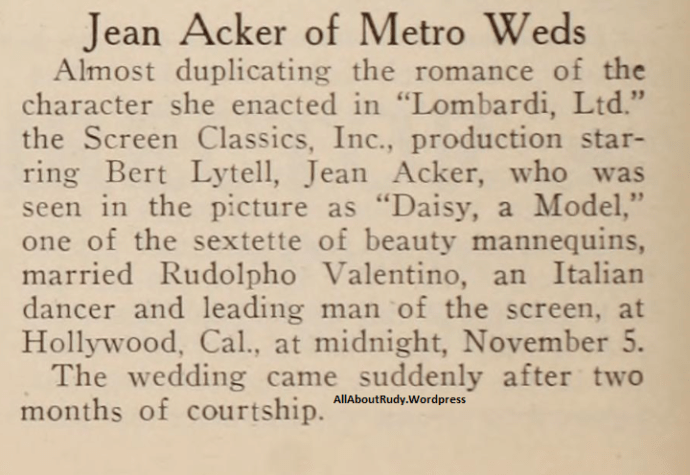
We did not care to renew Valentino’s contract, particularly since he and his wife wanted even more control over his pictures. He made arrangements with a new company, founded for the purpose, and work was begun on a film titled variously The Scarlet Power and The Hooded Falcon, dealing with the Moors in early Spain. Author of this story was Natacha Rambova. After the two had spent 80,000 traveling in Europe for background material and exotic props, the story was put aside. Another Cobra, was substituted with Natacha in full charge. It did poorly and the venture with the new company was at an end. Joseph Schenck was now handling the business affairs of United Artists, and he took a chance with Valentino being careful to draw the papers in a manner keeping decisions out of the hands of either Valentino or Natacha. Valentino accepted the terms, though reluctantly. Not long afterward the couple separated and Natacha sued for divorce. United Artists filmed The Son of the Sheik, which as it turned out, was the celebrated lover’s final picture. Valentino’s publicity became increasingly less favorable. He called his Hollywood home Falcon Lair, which opened him to some ridicule. The fun poked at the “sheiks” increased as the title of his new picture became known. He was in Chicago when the Chicago Tribune carried an editorial headed “The Pink Powder Puffs”. One of the editorial writers, it seems, had visited the men’s rest room of a popular dance emporium and there was a coin device containing face powder. Many of the young men carried their own powder puffs, and the could hold it under the machine and by inserting a coin get a sprinkle of powder. The editorial, taking this situation as its theme, viewed the younger male generation with alarm. Most of the blame was placed on “Rudy” the beautiful gardener’s boy, and sorrow was expressed that he had not been drowned long ago. IN an earlier editorial the Tribune made fun of his slave bracelet. Valentino’s “face paled, his eyes blazed, and his muscles stiffened” when he saw it according to the later account of his business manager. Seizing a pen, Valentino addressed an open letter “To the Man (?) Who Wrote the Editorial Headed “The Pink Powder Puffs” he handed it to a rival newspaper. “I call you a contemptible coward” Valentino had flung at the editorial writer, inviting him to come out from behind his anonymity for either a boxing or wrestling contest. After expressing hope that “I will have an opportunity to demonstrate to you that the wrist under the slave bracelet may snap a real fist into your sagging jaw,” he closed with “Utter Contempt”. That was in Aug 1925 Valentino came on to New York, and I was surprised to receive a telephone call from him inviting me to lunch. “It is only that I would like to see you” Valentino said “No business”. I would have agreed in any circumstance, but I was sure that he was telling the truth about not coming with a business proposition, since he was well set with United Artists. “Certainly, I answered where”? “The Colony” I had already guessed his choice since The Colony was probably New York’s most expensive restaurant. He liked the best. We set the time. Valentino and I had barely reached The Colony when it became apparent that every woman in the place having the slightest acquaintance with me felt an irresistible urge to rush to my table with greetings. Though overwhelmed, I remained in sufficient command of my senses to observe the amenities by introducing each to Valentino. He was 31 at this time, apparently in the best of physical condition, and, in this atmosphere at least was relaxed. I do not know whether his divorce decree was yet final, but Natacha Rambova was in Paris. Recently, Valentino’s name had been linked with that of Pola Negri one of our major stars. “I only wanted to tell you,” Valentino said after things had quieted down, “that I’m sorry about the trouble I made – my strike against the studio and all that. I was wrong and now I want to get it off my conscience by saying so”. I shrugged, “It’s water over the dam. In this business if we can’t disagree, sometimes violently, and then forget about it we’ll never get anywhere. You’re young. Many good years are ahead of you.” And so we dropped that line of talk. Valentino truly loved artistic things. He spoke of his ambition, when the time of his romantic roles was over, to direct pictures. I had the feeling that here was a young man to whom fame and of a rather odd sort had come too rapidly upon the heels of lean years, and he hadn’t known the best way to deal with it. “Telephone me any time”, I said as we parted, and we’ll do this again. I enjoyed myself”. And I had. A day or two later I picked up a newspaper with headlines that Valentino had been stricken with appendicitis. At first it was believed that he was in no danger. But he took a turn for the worse, Joseph Schenck and his wife Norma Talmadge came to our home to wait out the crisis. Schenck was bringing encouraging reports from the hospital, when suddenly there was a relapse. Valentino died half an hour past noon on August 23, 1925. It was a week to the minute since our meeting for lunch. I, for one, was stunned by the hysteria which followed Valentino’s death. In London, a female dancer committed suicide. In New York, a woman shot herself on a heap of Valentino’s photographs. A call came through to me from Hollywood “Pola Negri is overwrought, and she’s heading to New York for the funeral”. “Put a nurse, and a publicity man on the train,” I said, and “ask Pola to guard her statements to the press”. After Pola’s arrival, my wife and I called at her hotel to offer condolences. Though very much upset, she intended to remain in seclusion as much as possible. Valentino’s body was laid in state at Campbell’s Funeral Home at Broadway and 66th Street, with the announcement that the public would be allowed to view it. Immediately, a crowd of 36,000 mostly women gathered. Rioting described as the worst in the city’s history began as police tried to form orderly lines. Windows were smashed. A dozen mounted policemen charged into the crowd time and time again. After one retreat of the crowd, 28 women’s shows were gathered up. Women then rubbed soap on the pavement to make the horses slip. The funeral home was now barred to the public. Those who got in had nearly wrecked the place by snatching souvenirs but next day another crowd gathered when news spread Pola Negri was coming to mourn. She was spirited in through a side door. Word came out that she had collapsed at the bier, which she had and for some reason it excited the crowd. On the day of the funeral 100,000 persons, again mainly women lined the street in the neighborhood of the church in which it was being held. I was an honorary pallbearer, along with Marcus Loew, Joseph Schenck, Douglas Fairbanks, and others from the industry. Natacha Rambova was not present, being still abroad. But Valentino’s first wife Jean Acker, collapsed, and Pola Negri heavily veiled, was for many moments on the point of swooning once more. As the funeral procession left the church, the throngs fell silent except for subdued weeping of many of the women. The body was sent to Los Angeles for burial. The Valentino Cult, I am told, is still in existence. At any rate, enough women visit his grave every year to have provided the grave keeper with enough material for a book about them.
Resource
Adolph Zukor (1953). The Public is Never Wrong, Chapter 17, Putnam Publishers, New York.
Categories: Uncategorized
Tags: Adolph Zukor, Death of Rudolph Valentino, Natacha Rambova, Pola Negri, Rudolph Valentino
24 Dec – Our First Christmas
One thing we determined was we should have our first Christmas dinner and celebration together in our new home we recently purchased in Whitley Heights. The little furniture I had at the bungalow on Sunset Boulevard was carted up the hill and I finally moved into the new abode two days before Christmas. It was dreadful no hot water and no gas, but we were so excited to be in our own real home that nothing else mattered. The only furniture in the living room was a Christmas tree and one chair. But was a good time we had decorating that tree. It was the first either of us had for quite a few years. There was also a bulgy stocking for each of us tacked on to the fireplace mantle. Wreathes were hung in all the windows and red bells and a Santa Claus made up for the lack of other furnishings. The Christmas dinner was cooked entirely on a little electric stove. But at that moment we thought it was the best we had ever eaten. At midnight, we were to open our presents. We lit the candles on the tree and were just about to begin untying the packages when Rudy suddenly grabbed me by the army and dragged me upstairs. I was pushed into my bedroom and told not to dare to move until he called me down. Next, I heard him racing out of the house and down the hill. I couldn’t imagine what had happened. After 10 long minutes he returned. The outside door banged and I heard him rush downstairs. This was more than my curiosity could stand. I opened the door and called down, asking if I might now descend. No answer. Silence. Then a tiny muffled bark and I too ran downstairs. The head of a Pekinese puppy with two little paws were just visible peering out over the top of my stocking. Rudy stood beside it was waiting in childish expectation to see my surprise . I screamed with delight. I had been longing for another peke, having lost my last one the year before. We opened the rest of our packages, laughed cried and played with the puppy until the candles on the tree burned out. Rudy left and went to his apartment down the hill. Such was our first and happiest Christmas together in our first little home. After the holidays preparations would begin for his next picture “Blood and Sand”. But for this Christmas was one that I would remember with fondness and sadness.
Categories: Uncategorized
Tags: Natacha Rambova, Rudolph Valentino
20 Dec 1921 – Review of “The Sheik”
The 7,984,521 odd people who are scheduled to pay admissions to the theatres where “The Sheik” is playing will have the disappointment of their lives if they think that this movie will afford them any of the adolescent thrills that were provided in such abundance by the book. For “The Sheik” in film form is as clean as the virgin sands of the Sahara. Although it follows the plot of the novel fairly closely, the sting has been removed with great care and precision. The affair between Lady Diana and the handsome Arab has been placed upon the same plane of purity as Ivory Soap. In other respects, however, “The Sheik” is worth-while entertainment. The desert scenes are well staged and beautifully photographed, and there is some good action when the forces of the Sheik do battle with the henchmen of the bandit, Omair. Rudolph Valentino, in the lead role, strengthens the conviction that he is one of the few fine actors of the screen. He lacks variety of expression, but he possesses a sense of restraint, and he is graceful and well poised to a remarkable degree. His only real fault is that he uses too much shoe polish on his hair. As a moving picture, “The Sheik” is no world-beater. But even the most confirmed deprecator of the dumb drama can not say that it is as bad from an artistic or literary standpoint –as the book.
Categories: Uncategorized
Tags: "The Sheik", Rudolph Valentino
15 Dec 1925 – Rudolph Valentino at the Gladmer Theater
When Rudolph Valentino became an independent producing star, he set out to surround himself with the finest technical staff possible to assist him in making his pictures. Joseph Henabery, who knows and understands Valentino was selected to direct the star. Henabery started with DW Griffith and has made many successful photoplays. Anothy Coldewey wrote the scenario as his 400th script.
Categories: Uncategorized

13 Dec 1918 – Joe Maxwell Makes Film
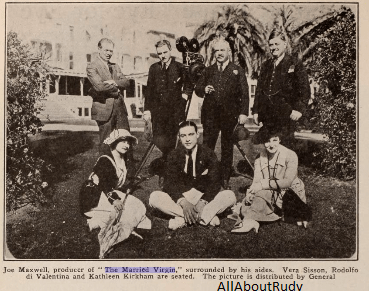
Joe Maxwell known in theatrical circles as a prolific author of vaudeville sketches has turned photoplay producer and is launching his first picture under the brand Maxwell Productions. He has staged a story by Hayden Talbot, which may be described as a society thriller and which is said to contain a unique domestic plot. The title “The Married Virgin” applies to a complication which by an odd twist develops a happy ending for the drama. Mr. Maxwell made the picture in Los Angeles and believes he has a very fine production. A quintet of screen favorites take the principal characters. They are Kathleen Kirkham, Vera Sisson, Rudolpho di Valentina, Edward Jobson and Frank Newkirk. “The Married Virgin” is seven reels will be released through General Film Company.
Categories: Uncategorized
Tags: Rudolph Valentino, Rudolpho de Valentina, The Married Virgin
11 Dec 1926 – Properties go to Auction
Old Bill McGuire of the range, who was groom for Rudolph Valentino’s horses for years, today stood before the empty stalls in the stable adjoining Falcon Lair in Beverly Hills, home of the late silent film star and mourned for his departed pets. In the first stall “Firefly” magnificent Arabian steed once pawed and whinnied. In those other stalls Yacqui, Haroun, and Ramadan all geldings once dwelt in horsely splendor so to speak. And today they were gone to new masters and new homes. Firefly that once carried the dashing Valentino across the desert sand in “The Son of the Sheik” was bought for $1225 by J. Moran. Cy Clegg horseman of Culver City bought the other three for $1000. Valentino had valued his horses at more than $5000. “Now that their gone I don’t know what to do”? said old Bill McGuire. “Guess I’ll go back to the range no use staying round here. There are too many memories”. Before the horses were placed on the auction block the Valentino home of sixteen rooms and eight acres of ground was sold for $145,000 to Jules Howard, NYC Jeweler, who sent his offer by telegraph from the east. Seven acres of hill-top property and Valentino’s three cars were also sold. “Shaitain and “Sheila” a pair of Italian Mastiff’s brought from Italy and raised by the late star went for $58. And $60. Two western bridles and martingale went for $64. The first pretentious home Valentino built is Hollywood after rise to fame and fortune will be sold at auction this afternoon.
Categories: Uncategorized
Tags: Falcon Lair, Haroun, Ramadan, Rudolph Valentino, Yacqui
2017 – Lover for eternity
I discovered someone wrote a fiction article containing 23,500 words about Rudolph Valentino. I thoroughly enjoyed reading this very much and would love to tell the author “LadyLetty” thank you for writing this…
http://archiveofourown.org/works/10356555?view_full_work=true
Categories: Uncategorized
Tags: Rudolph Valentino
15 Mar 1922 – My thoughts on Women By Rudolph Valentino, Photoplay Magazine
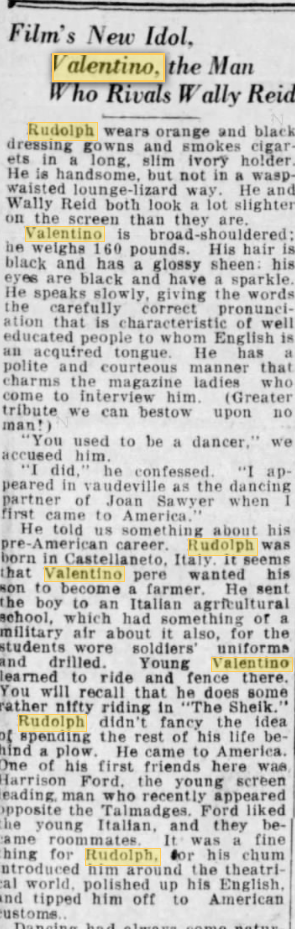
All women are divided into two classes in the mind of a man. Often they are so mixed up that you do not know which is which until you go down very deep. Then it does not matter, for in an affair of amour a counterfeit is often better than the real thing. In my poor English, let me say that there are what I would call joy-women and duty-women. Now understand, the joy woman may be very good and the duty woman might even be bad. That is just their relation to man. The first kind are the kind that you want to take with you on your joyful carefree wanderings into life’s highways and byways. The other are the women who are possibilities to share the principal things of life – home, family, and children. For a wife, a man should pick out a woman who is pretty, has a good disposition, and is domestically inclined. They are very rare now, I admit. One is too apt to be deceived by their easy method of comradeship. Let her be your inferior, if possible. Then she will be happy with you. It is much more essential to marriage that a woman be happy in it than a man. I do not mean a butterfly that flits from beauty parlor to beauty parlor. But a good woman who has the old-fashioned virtues. We Europeans do not expect too much of one woman. The difficulty with love and marriage in this country is that the man has let the game get out of his hand. A woman can never have a happy love affair with a man unless he is her superior. It just can’t be done. The love affair where the woman is the stronger in mind and knowledge is always a tragedy or a farce. I do not like women who know too much. Remember, it was from the serpent that Eve was given that apple from the Tree of Knowledge. Just so I would make the Tree of Knowledge of Life today – forbidden to women. If they must eat of it, let them do so in secret and burn the core. Do not misunderstand this that I say. I do not mean this in regards to intelligence, to education, even to position. The more cultured and accomplished a woman is, the more exquisite she is to love, the more like gold that is soft to touch and handle. With her, all is delicate and attractive, all is beautiful and fine, her mind is attuned to beauty – and beauty is of itself a religion. No, when I speak thus of an inferior – a superior – I mean in experience of life, in power to do, in ways to love. The man may be a digger in the ditch, and the woman a teacher in the school, but he is the master of her if he knows more of the world than she does. It is not becoming that a woman should know the world. It is not proper that a lady should of to places or to things where she acquires this knowledge. If she knows these things, she must be clever enough to conceal her knowledge, like the girl who can swim a mile, yet with much grace and helplessness she allows me to teach her swimming. How completely the modern woman in America tries to destroy romance. How ugly and cut-and-dry is has become – love. Either it must be marriage or it must be ugly scandal. The brilliant, absorbing, delightful, dangerous, innocent – sometimes – sport of life, how it goes. She knows too much about life and too little about emotion. She knows all of the bad and none of the good about passion. She has seen everything, felt nothing. She arouses in me disgust.Sometimes a man may feel that he would rather a woman had done many, many bad things – read bad things – and yet been delicate, and quiet and dignified, than to see her common. If the bloom has been rubbed from the peach, let her paint it back on with an artistic hand. Should I try again to find me a wife, I say, let me find one who wishes to have children and who when she has had them, wishes to take care of them. That is the proper test for a good woman who is to share the side of your life. No other woman can ever mean to a man what his children’s mother means to him – if she does not lot herself get fat and ugly and old. No man can love a woman who lets herself get fat, and careless and unpleasant. He must constantly make comparisons of her with the beautiful young girls about. A wife’s first duty is to keep her husband from making comparisons. Of all the women I have known, the Frenchwomen are the most nearly perfect. No matter what their age or class may be, they have that touch of domesticity, that sweet and gentle something that lends a delicacy even to the wildness of the senses. Thy know how to amuse, how to touch the heart, they have the sixth sense of pleasing a man with their perfection. And they are so very well dressed. All of them. American women are terribly pretty. Even when they are quite ugly, they are pretty. They are always rather well dressed. And they always behave as though they were beautiful. Which gives them great poise. But they lack softness, they lack feminine charm and sweetness. You cannot imagine them doing their bits of sewing, washing, mending, and what not. They dazzle but they do not warm. They are magnificent when they are dressed up, but I never have seen one who was likewise at ease and delicious and feminine in the kitchen or the nursery. They are so restless, too. Nothing interferes with romance like restlessness. It destroys those subtle shadings that are the very breath of its life. I do not blame the women for all this. I blame the American man. He cannot hold a woman, dominate and rule her. Naturally things have come to a pretty pass. He is impossible as a lover. He cares nothing for pleasing the woman. He is not master in his own house. He picks and nags about little things, and then falls down in big ones. I love the dainty, little woman, who plays seriously at being domestic. She fascinates me. Everything womanly, distinctly feminine, in a woman, appeals to me. I adore her bird-like ways, her sweet pretenses, her delicious prettiness. I love her almost as one loves a cunning child, and when to this is added the filipe of sex, she becomes perfect. I do not like in her flippant, cold-blooded little tricks, but those soft, lovable ways of a little woman, those melting, helpless little ways of hers — that bring tears to your eyes and fire to your lips. Then there is the silent, mysterious woman who fences divinely. Who knows silently and secretly the secrets of the couquette — that last art of woman, in always leaving herself an opportunity to retreat. Who has always at hand that last weapon of woman — surrender. The greatest asset to a woman is dignity. It is her shield. With it, she may commit indiscretions that a vulgar puritan could never attempt. Dignity in a woman always puzzles a man. He likes it. He admires it. He feels confidence in the woman who displays it. He knows that she will never make a fool of herself or of him.
Categories: Uncategorized
Tags: Rudolph Valentino
16 April 1922 – Has Chuletas
Chuletas? Yep Rudolph Valentino’s got em. There not a new variety of smallpox or anything contagious. However, just very fancy sideburns that are a feature of the stars get-up as the bull-fight hero of “Blood and Sand”. They’re super-sideburns one might say, swooping almost half an inch below the bottom of the ear, They are a sign distinguishing the champion matador from the less notable of the bull-fighting clan. For where a banderilla or a picador is allowed sideburns that slip gingerly halfway down to the ear it is the matador alone who may indulge in the luxury of a hirasute adornment covering a good portion of each side of the face. While they are a valuable and finishing touch-up to his makeup as the main character. Valentino is not in favor of “chuletas” as a regular thing. His favorite safety is all set to do telling damage when the end of the picture allows a return to the normalcy of a clean shave
Categories: Uncategorized
Tags: Blood and Sand, Rudolph Valentino
6 Nov 1921 Dancing Idol from Italy
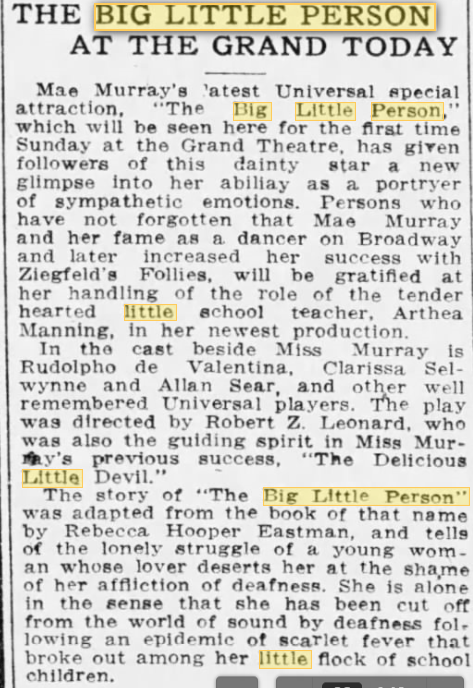
Rudolph Valentino the celebrated young dancer who has the leading male role in “The Four Horsemen of the Apocalypse and in “The Conquering Power” Rex Ingram’s productions, found his way to fame and fortune through his nimble feet. Things happened swiftly for him in New York. Soon he was busy teaching Broadway’s regulars his graceful steps. He appeared at Rector’s as a dancing partner of Bonnie Glass. Following this engagement with one in the Winter Garden and a long term contract in Vaudeville. Valentino’s first picture appearance was with Mae Murry in “The Big Little Person” and “The Delicious Little Devil”. He appeared in numerous other pictures including “Eyes of Youth”, “Man-Woman Marriage. When Rex Ingram began casting for a suitable player to enact the difficult role of Julio of “The Four Horsemen” he immediately sought Valentino. His splendid portrayal of the part, caused him to be selected by Madame Nazimova to support her in the product of “Camille” in which he appears in the role of Armand. In “The Conquering Power” which was adapted by June Mathis from Balzac’s “Eugenie Grandet” Valentino portrayed the dandified hero, Charles Grandet.
Categories: Uncategorized
Tags: "Conquering Power", Rudolph Valentino
15 Nov 1925 Pola Negri Beauty Recipe
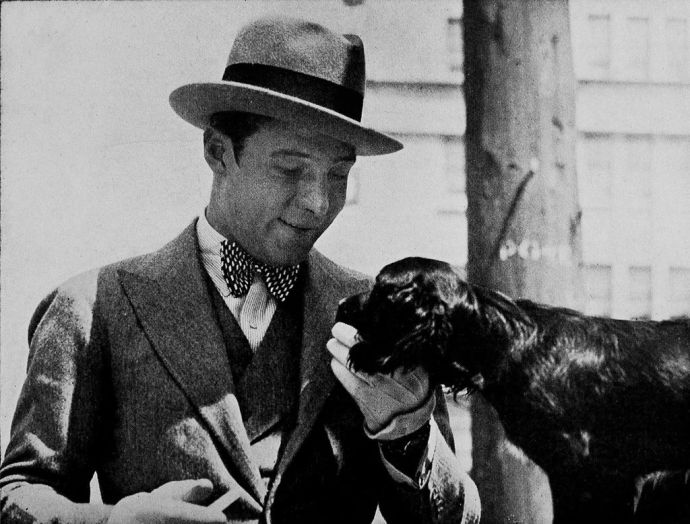
Pola Negri tells me her keeping young recipe includes an early to bed program, lots of fresh air imbibed in the pursuit of tennis, horseback riding and swimming. NO candy and no smoking. She does not smoke because she believes it will spoil the complexion and teeth. Bodily and facial massage twice a week is on her program. For the benefit of those correspondents who deluge Pola Negri with queries about where and how she had her plastic surgery done, she begs publicity be given the fact that her face never has been skinned, lifted or otherwise surgically treated. Her nose, too, has been carefully guarded from any surgical knife. Not all the Hollywood colony, would make such declamatory remarks about face lifting. One learns the work has become profitable here. One learns the names of the surgeons, but they won’t tell on their patients. If the patients confide to anyone it must be to their father confessors.
Categories: Uncategorized
Tags: Pola Negri, Rudolph Valentino
 All About Rudolph Valentino
You must be logged in to post a comment.