
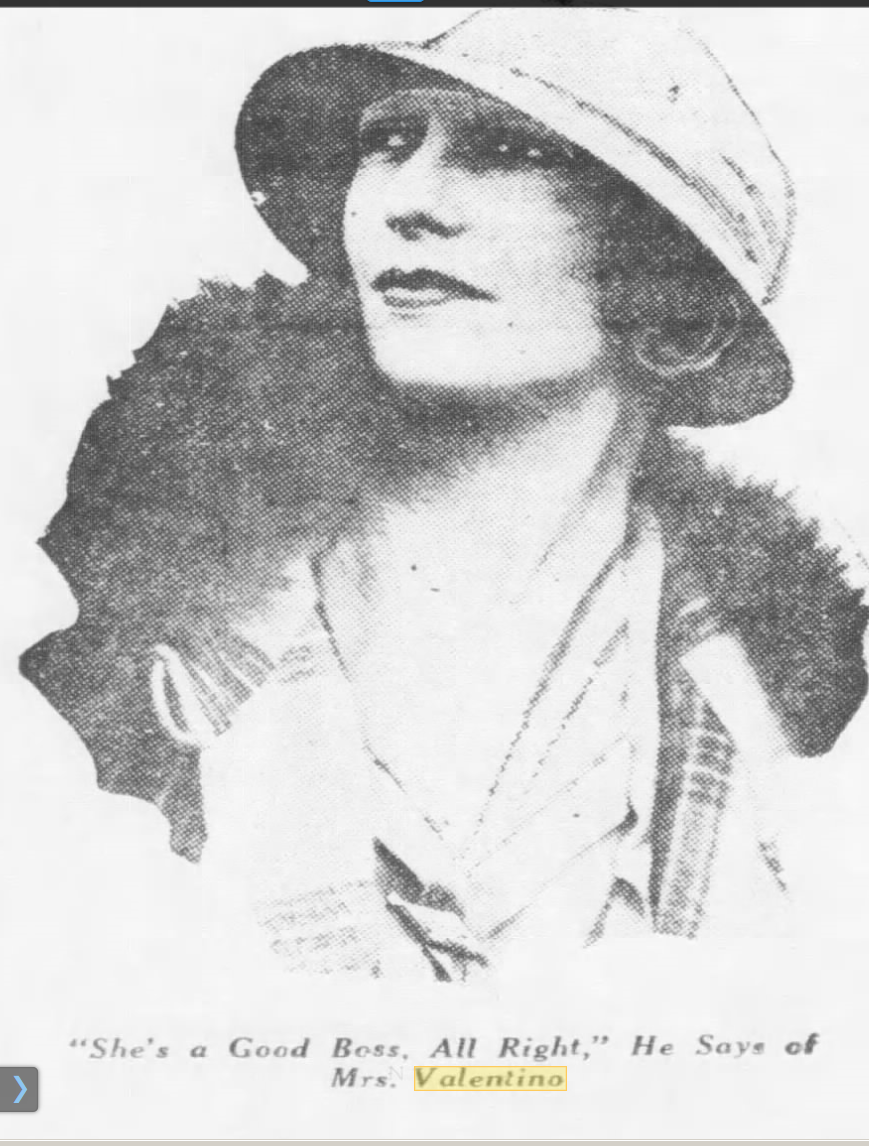
Ethan Allen Weinberg, ex-convict and leading quick change artist has now added S. George Ullman, business representative of the late Rudolph Valentino to his long list of dupes. Mr Ullman believing Weinberg’s statement that he is both an M.D. and a member of the NY Bar, has permitted Weinberg to represent him at the offices of the Manhattan District Attorney where this Baron Munchausen of Brooklyn spent an hour yesterday discussing the demands of the anti-Fascist element for an autopsy on Valentino’s body. As one of Weinberg’s dupes Ullman is in excellent company. When not hob-knobbing with the representatives of the District Attorney’s Office the last few days, Weinberg has been issuing statements to the press explaining that he has been in charge of Pola Negri’s hysterics and denying that she and Rudy were affianced. A letter bearing the imprint of S. George Ullman and signed with his name in ink, reached the newspaper offices yesterday. Mr. Ullman thanked the press for its co-operation and asked that the diagnosis of Valentino’s preoperative condition made by Dr. Harold D. Meeker, be given publicity. This was made to offset the cause of death had been foul play of some sort. The letter was dated 23 Aug and apparently dictated by Ullman before he left for Hollywood. At the bottom of the letter was written, above Mr. Ullman’s initials: “This report was concurred in by three reputable surgeons who were consulted this a.m. together with the legal aspects by Sterling C. Wyman, medico-legal expert who was a dear friend of Valentino”. The last straw to break the camel’s back of “Dr.” Wyman’s identity was furnished by the man himself. His suspicion aroused by questions the writer had addressed to him over the telephone early yesterday, Wyman-Weinberg called up the office of “The Eagle” sometime later to assure the City Editor that really everything was quite as it should be. Of course, he said, he was a doctor, he was a lawyer also, and he combined the two professions by engaging in the legal or judicial aspects of medicine. But he certainly was a doctor, with a degree. Why, he was on staff of the Flower Hospital, Manhattan, from which he was telephoning at that very moment. No, he added, he would not remain at the hospital very long. He was going out of town would leave in a few minutes. Whereupon the hospital officials were questioned about him. Over the telephone, a minor clerk said, yes, there was a Dr. Wyman on the hospital staff, and only a few minutes ago he had left word he was going out of town and would not be back until Wednesday. But a personal inquiry at the hospital on E. 64th Street considerably modified this first bit of information. Hospital officials looked up their records and found no Wyman or Weinberg on their list of doctors. “He comes here frequently to visit with one of our interns” she explained. “Everybody knows him as Dr. Wyman and I suppose that’s why whoever answered the telephone was under the impression that he was on our staff. But he’s not on the staff. “Would you”, she was asked, “recognize him from a picture”? She thought she could and a photograph of Stephen Weinberg as he looked when convicted in the Brooklyn Federal Court for impersonating a Naval Officer was shown her. “That’s he”, she said. That’s Dr. Wyman. At 556 Crown Street, a 32 family apartment house a block from the Carson C. Peck Memorial Hospital, “Wyman” has been a man of mystery for the past two and a half years. He is known as Sterling Clifford Wyman to tenants of the house, but there are many residents of the section who recall him as the Ethan Allen Weinberg, whose gigantic hoaxes have kept him before the public ever since his peculiar abilities manifested themselves years ago. The man who has been so many times in the toils of the law is even buffaloing the Police Department at present. Posing as a physician and getting the necessary letters of introduction, he boasts a police card which permits him to sail past traffic signals in his three motor cars, when the coveted P.D. sign is attached. According to neighbors in the house ‘Wyman” advertised last autumn for a chauffeur, and engaged one only after he had kept 40 applicants for the job waiting all day in the lobby and on the sidewalk. “He went to the Valentino funeral looking like a million dollars” said one neighbor. “He hired a Rolls Royce for the occasion and was gotten up in the most expensive funeral attire he could secure”. This was done to impress Joseph Schenck, Ullman, Norma Talmadge, Douglas Fairbanks, Richard Dix, and all the other celebrities who gathered at the Actors Chapel St Malachy for the funeral services of Weinberg’s “dear friend” Valentino. The fact that Brooklyn’s indefatigable Baron Munchausen has popped up again in the self-styled role of dear friend of Valentino in the not to be wondered at. According to physicians, who have examined Weinberg on the many occasions of his clashes with the police, has “ideas of a grandiose nature” whenever a celebrity bobs into the limelight also. When the venerable Austrian surgeon Dr. Lorenz, came to NY Weinberg called on him, represented himself as Dr. Clifford Wyman, and said he called as the personal representative of Health Commissioner Copeland and wanted to co-operate at the clinics. Lorenz offered him a salary as his secretary. Acting as go-between in the clinic waiting room. It was an easy matter to extract a $5 dollar bill from a mother eager to get place and preferment for her crippled child. Copeland exposed the imposter and “Wyman” dropped out of sight. Calling at the Waldorf with his accustomed savoir faire, he presented himself as Lt. Com. Ethan Allen Weinberg to the Princess Fatima of Afghanistan. The lady with the emerald coquettishly set in her nose was delighted with the persuasive man in naval uniform. He offered her what appeared a perfectly good letter of introduction and said he could get her an audience with President Harding. If her credentials were satisfactory. In a flutter the lady offered them, as well as an expense account, to the ingratiating officer of gallant address. He actually introduced her to the President at a private three minute audience. As Weinberg was leaving the White House, however, he was nabbed by Secret Service Agents impersonating ordinary individuals may not be a jail offense if no fraud, larceny or forgery results, but impersonating an officer is a very different matter. Weinberg got 15 months in Atlanta Penitentiary and was released Feb 1924. One of is most amusing pranks with the press was when the Harold McCormickes returned from Europe a few weeks before they were divorced in Chicago. Weinberg got a pass for the revenue cutter which went down the bay, telling the ship news men he was attached to the McCormick retinue. This time he again used the first name of Sterling, dropped the last name of Weinberg and was Capt Sterling Wyman he was using with George Ullman. He told the ships newsmen he could officially deny the rumored McCormick divorce and was sure it would never take place. He told the McCormick’s he was a reporter. At the Manhattan Hotel where Harold McCormick stayed for 24 hours the Brooklyn fraud managed to stay for 24 hours before McCormick booted him out. Representatives of the Kings County Medical Society, reading in Manhattan newspapers of a “Dr. Sterling C. Wyman, of 553 Crown Street, who had been in constant attendance” on Pola Negri declared yesterday there is no physician by that name. In the telephone book Wyman fails to use his alleged medical title. Weinberg in duping his victims uses a long list of aliases. When he was sentenced in an Atlanta Prison for 18 months in 1922 for impersonating a naval officer he was charged by the Federal judge in Washington D.C. as Stephen Weinberg, alias Stephen Wyman, alias Ethan Allen Wyman, alias Clifford G. Wyman, alias Sterling Wyman. It was as Dr. Sterling C. Wyman, that he duped Ullman. It was as Capt. Sterling Wyman that he once rode for 24 hours in the rolls royce of Harold McCormick. Posing alternately as lawyer, physician, or officer of the Navy or Army this chameleon of Brooklyn has now gotten into the limelight again. His methods never vary. He is always interviewed by the press and enjoys for a time all the éclat of the limelight which his victims enjoy. Then he is discovered, he disappears and bobs up six months later under a change of alias, smiling and debonair, suave in a way really likeable. His nerve is truly great. “He has ideas of a grandiose nature” said the physician. This accounts for the fact that Weinberg never tricks anyone except a celebrity, swaggers up to reporters and gives out interviews which are sure to reveal his identity to anyone familiar with his case and maintains placidity when he is thrown out, only to bob up later in the society of some other notable. He remained in Dannemora from Oct 1917 to April 1919, having been sent there from Blackwell’s Island, to which he was committed on the charge of forging the name of Senator William Calder to a bank recommendation. Asked yesterday, if he were any connection of the man of the many aliases, Dr Sterling Wyman indignantly replied he was a Brooklyn M.D. in good standing and the author of “Wyman on Medical Jurisprudence”. At Kings County Medical Society, however, he stated that he certainly is nothing of the sort and that his name fails to appear in the directory of the American Medical Association as a doctor in good standing anywhere in the United States. Weinberg appears happy only when he is near the great. He forges and impersonates apparently for this reason only. He is in his own way a genius. He got himself before the Republican National Convention with a letter expressing the hope that his “efforts would meet with unrivaled victory” and he got a letter from Senator Pat Harrison which carried him before the Democratic National Committee. He knows nothing whatever about medicine. But he once convinced the Foundation Underpinning Co. that he did, and on his forged credentials that sent him to Peru where for three months he practiced medicine on the employees of the company before his deception was discovered. Weinberg was born in Brooklyn in 1893, the eldest of six children. He graduated from P.S. 18 and from Eastern District High School, from which he was graduated with honors in 1903. Somewhere he has acquired the Phi Beta Kappa Key sign of the honor of the fraternity to which only a few brilliant scholars are eligible. In November, of the same year Francis Cushman whose term expired in May 1903, appointed the young man as his personal page in the House of Representatives. Returning to Brooklyn, Weinberg blossomed forth as an orator in the cause of woman suffrage. He was made secretary of the Brooklyn Organization and was the only male delegate to the National Council of the American Woman Suffrage Association in 1909. At this time, he resided at 71-a Maurer Street and his mother was proud of him. The following year he was appointed Consular Agent to Port de Aubres, in Northern Africa, by the U.S. Minister to Morocco, who became acquainted with Weinberg when he was a page in the House. But Weinberg never got to Morocco, instead, at eh earnest request of his father, he was sent to Bellevue Hospital for observation. Employed as a demonstrator for airships in a Manhattan Department Store, living in a comfortable home, he had for some inexplicable reason taken a camera and flash powder from the store. From this time on Weinberg never again ran straight. In 1913, he was arrested for posing as “Lt Com Ethan Allen Weinberg, King’s Guard Consul General for Romania. In this capacity he tendered a dinner at the Hotel Astor to Dr. Alfonso Quinores, Vice President of San Salvador, and was arrested the next day for violating his parole from Elmira Reformatory, to which the man of many parts had been sent at earnest behest of his distracted parents. His next offense was the forging of former Senator Caider’s name. No man living has gotten away with the grand gesture more often than Weinberg, who in his way, is an artist. Impossible to cross his vivid trail again and again and no take off one’s hat to the man’s persistent nerve, audacity and aplomb. It is doubtful if there is anyone who under certain circumstances would not “fall” for the persuasive address of the man who in his own novel way is one of the famous personages of this borough.
5 Sep 1926 – Dupe Shows Up Again – Acts as Manager for S. George Ullman, Former Manager of the Late Rudolph Valentino
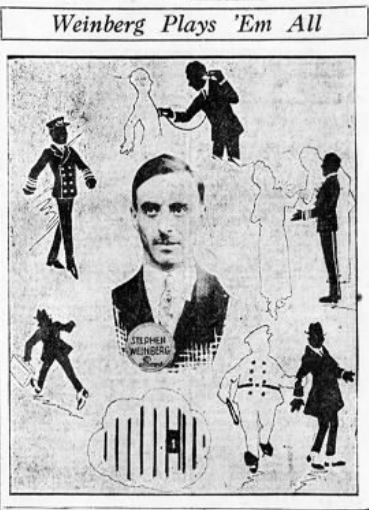
New Yorks Greatest Imposter
Stephen Jacob Weinberg, otherwise known as S. Clifford Weinberg, Ethan Allen Weinberg, Rodney S. Wyman, Sterling C. Wyman, Stanley Clifford Weyman, Allen Stanley Weyman, C. Sterling Weinberg, and Royal St. Cyr, was the greatest impostor of the age. His feats seem breathtaking even today, and he became a true popular hero, the darling of the multitudes. Anyone who questions the extent of his fame can only reflect that a new feat of Weinberg’s got more space in the New York press of the day than the funeral ceremonies of Rudolf Valentino. Each article that will be posted here reveals a piece of his life. By the time, your finished reading all you will be amazed by how much he truly got away with.
.
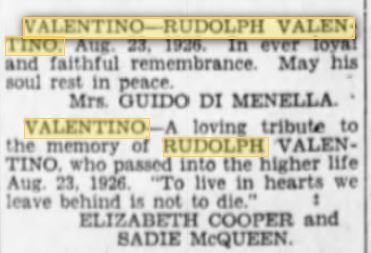
August 2015
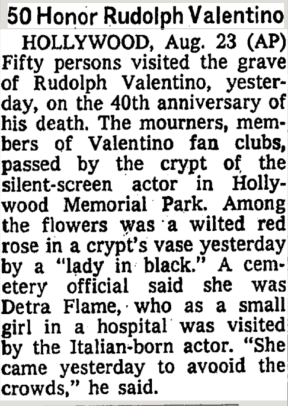
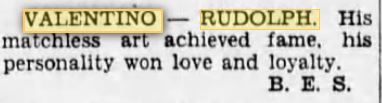
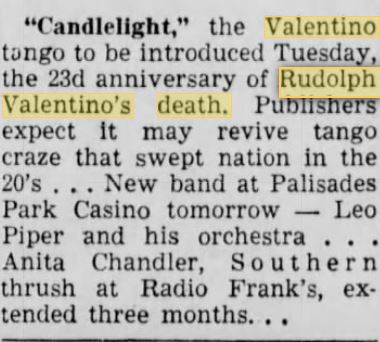
The month of August will be dedicated to the passing of Rudolph Valentino.
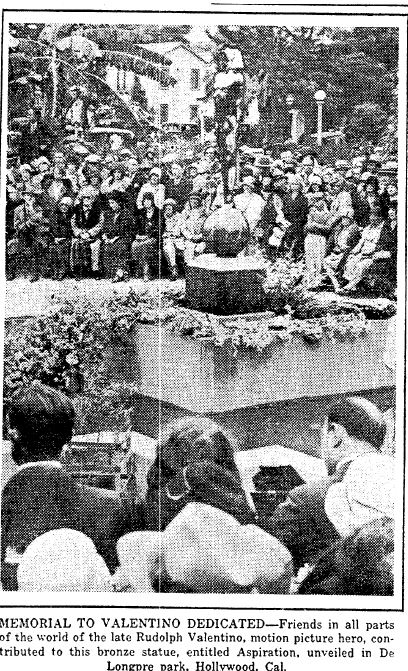
Our month is going to start off with a series of articles that have to do with an imposter who portrayed himself as a friend/personal physician of Rudolph Valentino at the time of his death. The articles are going to start from 1910 and onward to show how this person used deception as an advantage to fool Rudolph Valentino, Pola Negri, Douglas Fairbanks, Norma Talmadge, George Ullman, Presidents, Princesses and more. Also, there will be articles from the various annual memorial services held over the years, and in memoriums dedicated to Valentino from his fans that were posted in their local newspapers from 1926 and on.
Later on in the month, I will be back in Los Angeles to attend the Valentino Memorial Service and write about my personal experience while there. I am thrilled to be going again because last years service was very moving and I was able to meet some truly wonderful people who I have the hope and privilege of seeing during my time back west.
9 Nov 1925 – Valentino Said….
” I am just beginning to feel that I was as well off single as I am married.” A more tempered expression could not have come from any married clergyman in America.
2015 – Annual Valentino Memorial Service, Hollywood Forever Cemetery
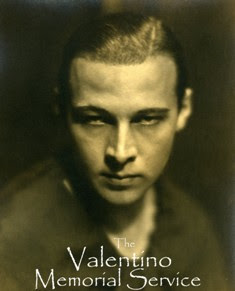
This year, marks the 90th Anniversary of Rudolph Valentinos silent movie “The Eagle”. There will be a special tribute during this year’s memorial service.
Tracy Terhune is the host for this annual memorial service and as he does every year will have a wonderful service that pays true homage to Valentino’s life. The Valentino Memorial Service started in 1927 and continues to this day. A moving tribute to one of the Silent Screens greatest actors. The annual service will be Sunday, 23 August 2015, 12:10 p.m. at Hollywood Forever Cemetery, Los Angeles, CA. Admission is free for this event.
“Real love, the kind that lasts and brings companionship and happiness to one’s old age, must be founded on mutual respect and trust – a sort of glorified friendship. Some of the finest love matches which I have seen among my married friends have begun as friendships and ripened into a truly beautiful love.” Alice Terry, 1924
13 Aug 1924 – The Story of Alice Terry
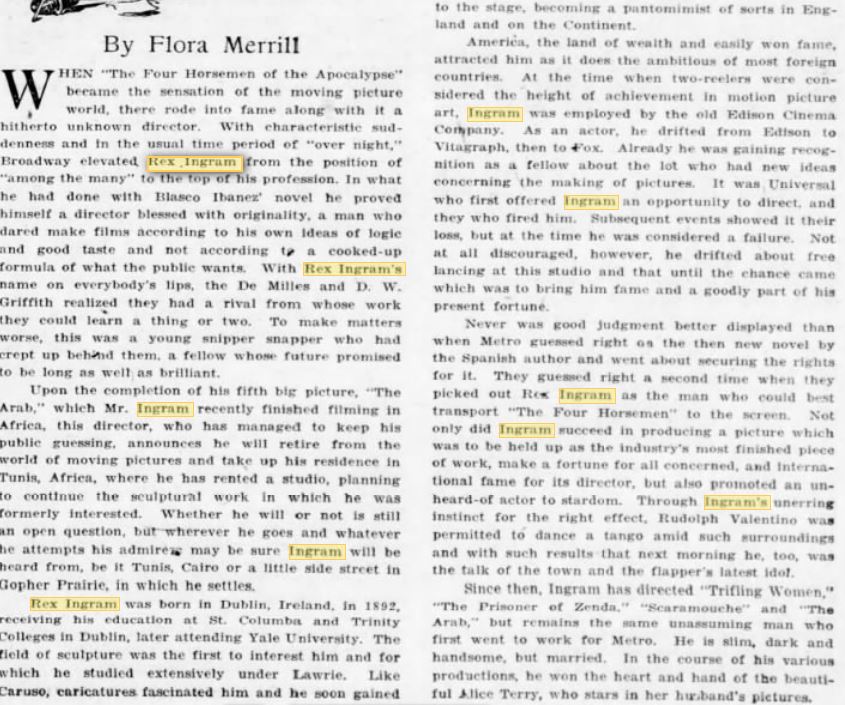
The story of Alice Terry has the same fairy tale quality as Valentino’s own. Like him, who had worked hard as an extra for many years and the hard work had resulted in little recognition. However, discouraging as had been her experience, it was not without results. For Rex Ingram happened to see her in NY when, as a girl, still in her mid-teens, she played with Bessie Barriscale in “Not My Little Sister”. The promise which she gave impressed the young director almost immediately. When indeed, he moved from NY to the coast, he welcomed the fact that she, too, had shifted from East to West. Had it not been for the war, in fact, Alice Terry would probably have been his leading lady some years before. When Ingram on his return from overseas service finally located the job which put a roof once more over his head and civilian clothes again upon his back, he was to resume his slight acquaintance with Miss Terry. For she came to his office then applied for a position as script girl, the functionary who, working on the set, chalks off the scenes as they are made and notes the new ones extemporized. He looked at her in amazement. “What”, cried he, “you don’t mean to say that you’ve given up acting do you?” She looked at him somewhat sadly, “Oh dear, yes,” she replied, “I did that sometime ago. It was too discouraging I wasn’t getting any place, you see. No matter how hard I worked nothing seemed to come of it. And of course being an extra or getting some bit now and then does not keep you. So I decided I’d just get a regular job.” “And what have you been doing since”? Inquired Ingram. “I’ve been working in the cutting room,” replied she, “and that was fine I mean it. Knowing just what you were going to get each week. But the ether commenced to get into my lungs that’s why I’m looking around for something else.” Ingram promised to give her the desired position in the picture following “Shore Acres”. However, something changed his plans and instead he case her for a wild and wooly Drury Lane melodrama called “Hearts are Trumps”. To his surprise she seemed loath to accept this chance of returning to the movie screen. “Oh no, I don’t want to try I’ve give it all up you see” she kept protesting in a way that showed how completely previous discouragements had shattered her self-confidence. But he finally succeeded in overcoming her fears, and since then she has been his leading lady in every story except “Piffling Women”. It was not, however, until the appearance of “The Four Horsemen” that Alice Terry, the girl who, heartsick from her discouragements on the set, had wanted to retire to the comparative obscurity of script work, won the wide recognition her beauty and her screen personality had so long deserved. All this I have just related I heard from Miss Terry now Mrs. Rex Ingram, on the same evening when Ingram told me of his experience working with Valentino. On this same occasion she and her husband mentioned that her next appearance will be in John Russell’s “Passion Vine”. In this her support will be Ramon Navarro, another dancer from whom Ingram predicts a success which may even duplicate that of Valentino. Both Valentino and Navarro, Ingram made an interesting observation. “A good dancer” he said, “frequently makes a good screen actor”. Why? Because he has both poise and repose, and I don’t know any better start than these. In this connection.
1942 – Camera Wise Is Baldy, 35
They led Baldy off the set and back to the ranch the other day, his chores ended in “George Washington Slept Here” the latest role in the more than 1,000 he has to his movie credit. Baldy is a horse, 35 years old, and as camera-wise as many of the human actors who surrounded him. Rudolph Valentino once rode him, and so have many other stars. His salary ranges from $25.00 a day upward, depending upon how many tricks he’s called upon to perform. In “George Washington Slept Here” Baldy wanders through the ancient house in the country which Ann Sheridan and Jack Benny have just purchased, adding to their misery. That role was easy for Baldy, so he worked for his minimum.
6 May 1922 – Valentino’s Latest Picture
Gloria Swanson in “Beyond the Rocks” with Rudolph Valentino in the lead supporting role, will be the feature film in local theaters during the week beginning Sunday, May 7, 1922. “Beyond the Rocks” was written by Elinor Glyn, author of “Three Weeks” and was directed by Sam Wood. The new Paramount Picture is the first in which Miss Swanson and Valentino appear together, and, it is predicted, will be one of the greatest film successes of the year.
“In the beginning, all of the fuss sadden me. But later I realized they were snatching not at me but at their dreams”. Rudolph Valentino at the NYC Premiere of his movie “The Eagle”…
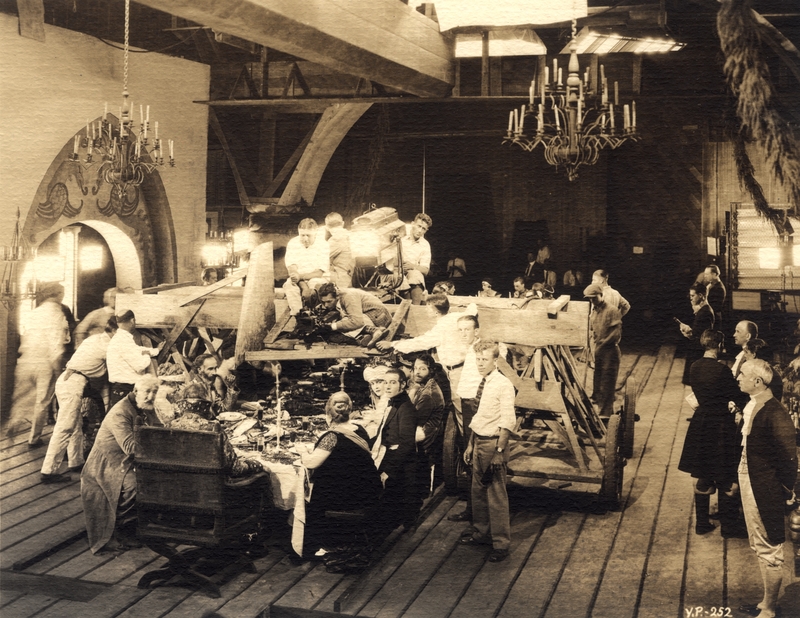
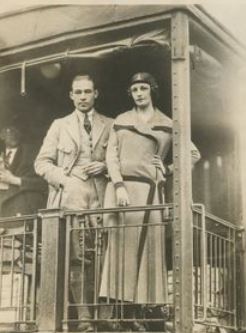
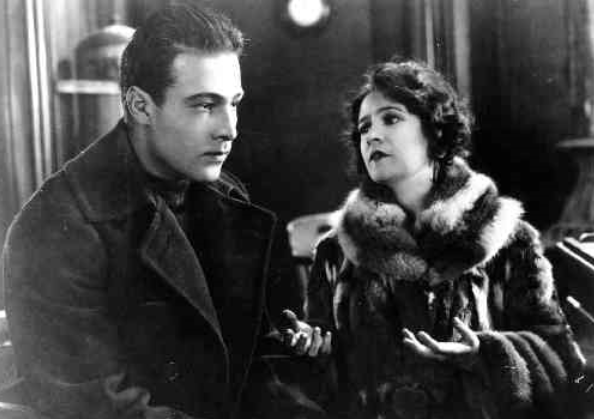
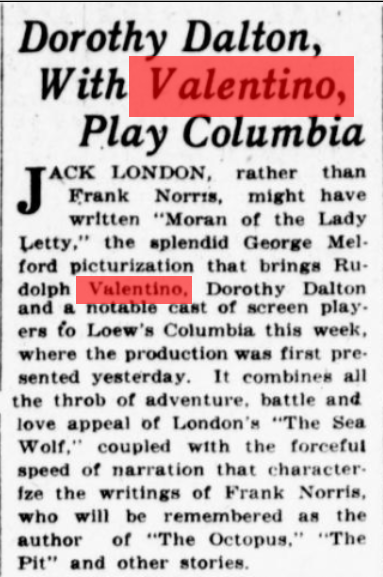
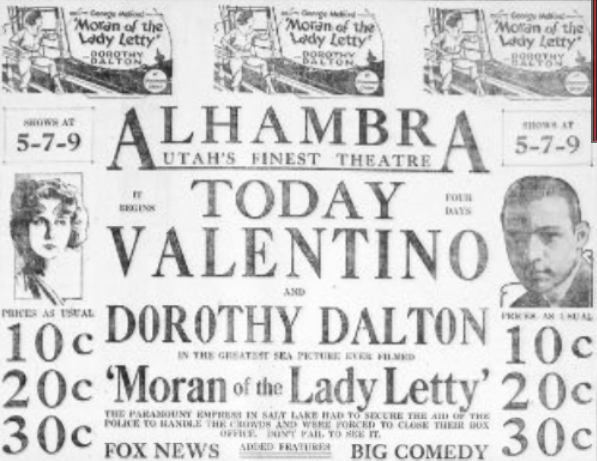
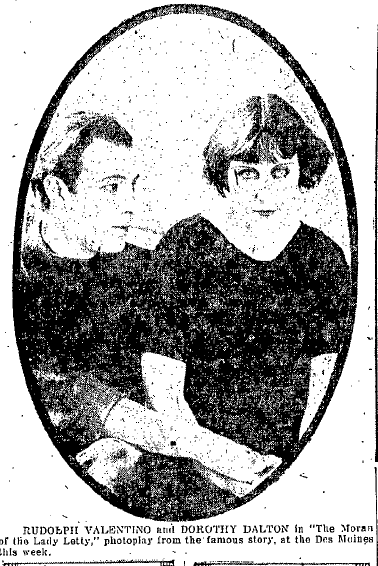
In 1864, Anaheim Landing was founded. Located in Orange County, California it was the first port and Los Angeles areas first beach. In 1921, it was here that famous Silent Film Star Rudolph Valentiono graced the wharves of Anaheim Landing for the shooting of his silent film “The Moran of the Lady Letty”…..
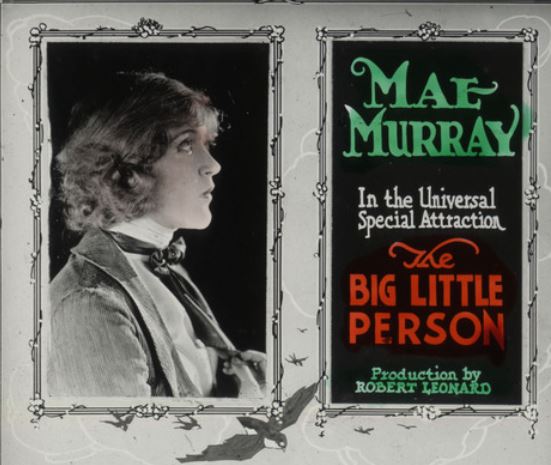
“The best way to forget your troubles is to be constantly on the go. Keep on the crest of the wave all the time and never give yourself the time to think when things are bothering you”..Mae Murray, 1926
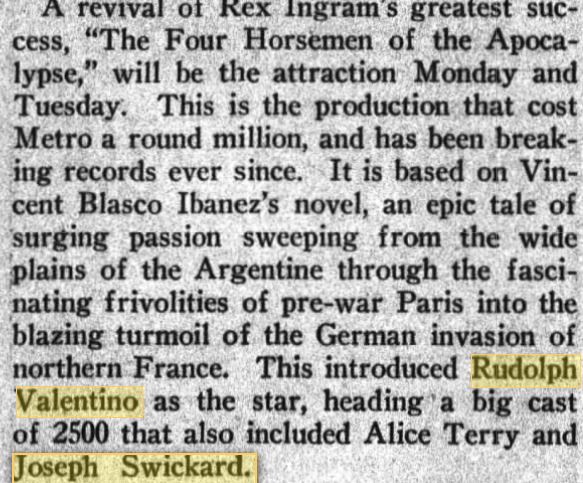
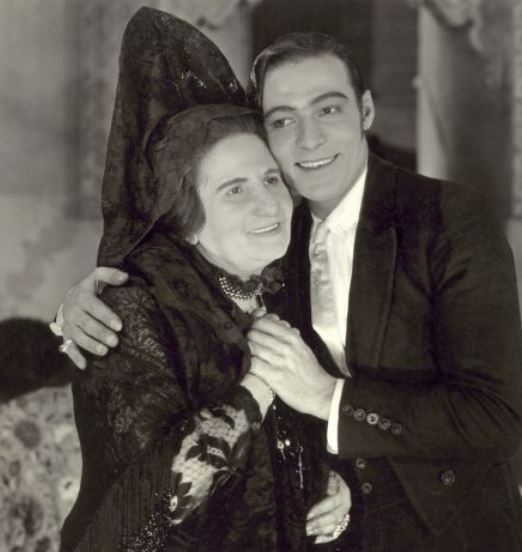
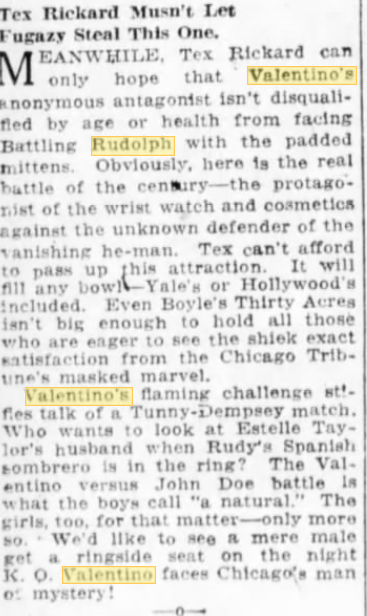
11 Apr 1923 – Rudy gives Trianon a financial success
Andrew Karzas, manager of Trianon, world’s biggest dancing palace, which is a financial success under his guidance, is after Irene Castle and Florence Walton for appearances at the dancing center, where Rudolph Valentino had his first successful appearance In this line of endeavor. The business at Trianon has been ranging from $10,000 to $15,000 a week. It hit $33,000 with Valentino, which set
Karzas after other dancing names.
7 Jul 1926 – Sheik Injured
Valentino was injured during this evening’s limited run of the “Son of Sheik Premiere” at the Million Dollar Theater in downtown Los Angeles. A large vase falls on the head of the star of the film.
24 Aug 1919 -Nobody Home
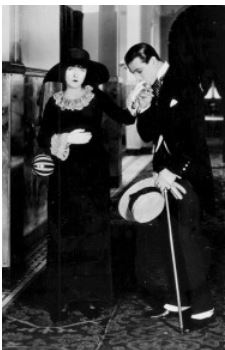
In 1919, the silent movie “Nobody Home” starring Dorothy Gish, Rudolph Valentino, Ralph Graves, Raymond Cannon, Vera McGinnis, George Fawcett, Emily Chichester, Norman McNeil, Kate Toncray, Porter Strong, and Vivian Montrose was directed by Elmer Clifton, the screenplay was written by Lois Zellner, cinematography was by Lee Garnes and John Leezer and released by Famous Players-Lasky Corporation. Portions of this movie were shot on location at Castle Green, Pasadena, CA. The movie is about a superstitious young woman who is wooed by two men one was a villain and other virtuous. Every decision Frances makes is based on the stars, or cards. Let’s take a look at the history of where this movie was filmed.
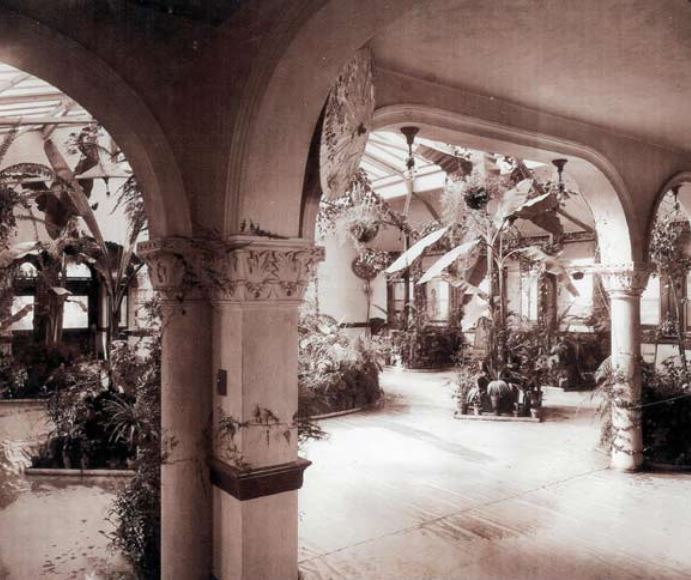
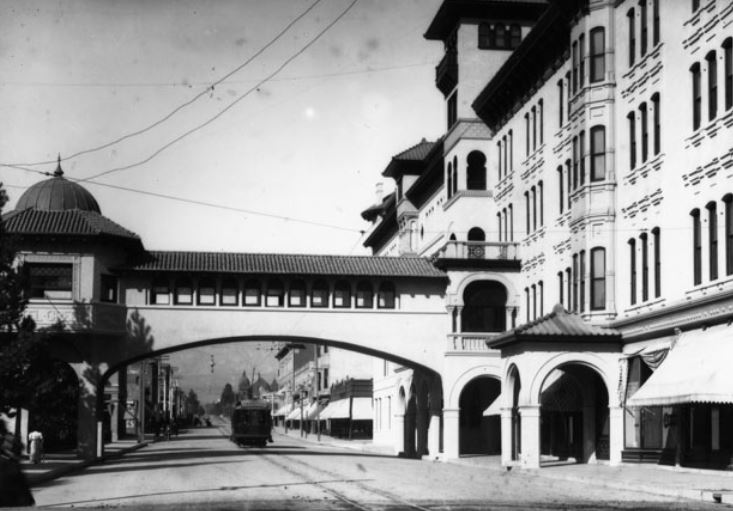
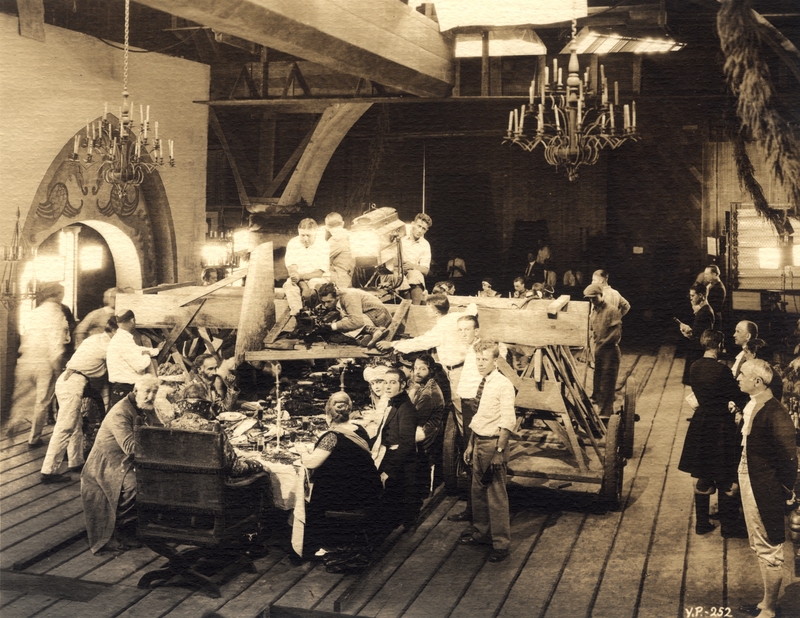
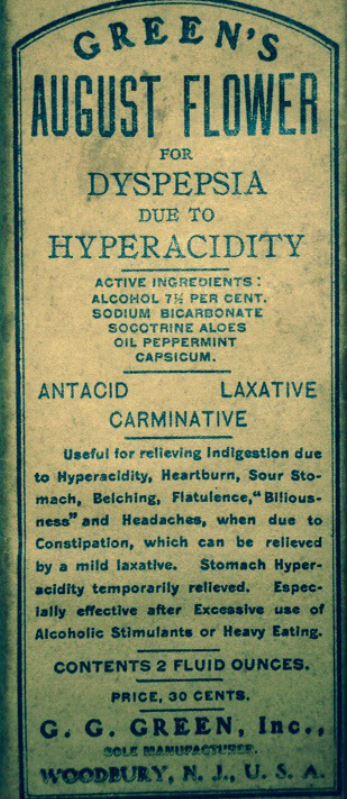
In 1887, businessman Edward Webster financed a passenger station that linked the Intercontinental Santa Fe Railroad line in downtown Pasadena. Next to the passenger station he attempted to build a small hotel. The hotel project was financed by COL George Gil Green. Although the hotel started out small Edward Webster became too ambitious that met with disastrous financial results. In 1893, unable to pay his loan to COL Green the two stories unfinished hotel acquired a new owner. COL George Gil Green a native of New Jersey, military veteran of the Civil War, a patent medicine entrepreneur was a wealthy man from the creation and sales of L.M. Green’s August Flower and Dr. Boschee’s German Syrup.
In 1894, the Castle designed by Frederick Roehrig and built in a Spanish-Moorish Colonial style was opened for business. In 1899, after numerous expansions, Castle Green re-opened and was an even greater financial success under the management of COL Bowler. The hotel was the sight of cotillions, card parties and banquets with settings of glittering crystal candelabras. Guests would stay the entire winter season. In 1903, the demand was so great that the hotel was expanded further. The rich and famous of the day stayed there such as the Rockefellers, Vanderbilt’s, Roosevelt’s, etc. In 1905, COL Green had a float which was an oversized carriage with a picture of his hotel on the side it in the Tournament of Roses Parade. In 1916, COL Green leased the property to Daniel M. Linnard. The property was split in two — the original building was to be turned into a “medium priced hotel,” while Castle Green would cater to upper class guests. In 1919, Famous Players-Laskey Corporation filmed on location scenes of their movie titled Nobody Home. The hotel’s ballroom was where Dorothy Gish and Rudolph Valentino once danced the night away. On 26 February 1926, COL George Gill Green died in Woodbury, New Jersey. COL Green’s son George Gill Green II who was born on 17 Jan 1883 died January 1971.
A lot of the information for this article came from http://friendsofthecastlegreen.org/
“I regret at not playing in stock. I would have received a fine training there, I am sure”..Rudolph Valentino 1923
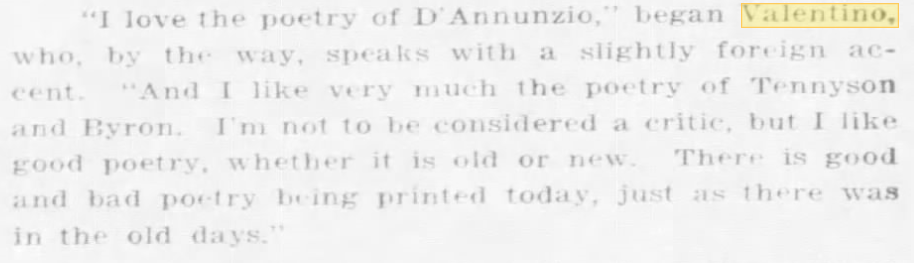
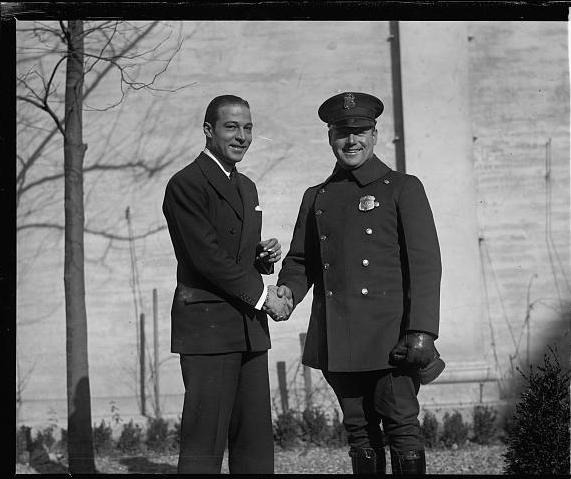
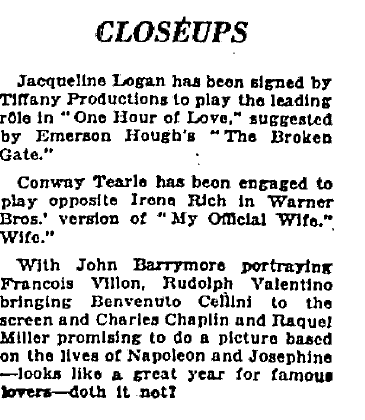
“Once you become a star, you are always a star.” – Mae Murray, protesting when the studio wanted to re-release Delicious Little Devil to cash-in on Rudolph Valentino’s popularity. Mae Murray demanded to retain her star billing.
1924 – HOW I WON THE Mineralava-Valentino Beauty Contest
We asked Miss Norma Niblock what was the secret of her recent success. Here is her reply:
“Last winter after I was chosen winner at the Arena, I started using Mineralava and I found that after a few applications it kept my skin so clear and full of natural colour that I did not have to use cosmetics and they say that was largely why I won. I use Mineralava regularly now of course I find it keeps the pores wonderfully healthy and clean and makes my skin softer and more radiant than it has ever been before”.
The above glowing tribute adds still another name to the many beautiful women who owe so much to Mineralava. Mineralava in a bottle containing eighteen treatments for $2.00, a trial tube for 50 cents and the Mineralava Face Finish is $ 1.50 a bottle, for sale at all Drug and Department Stores with cur positive money-back guarantee,
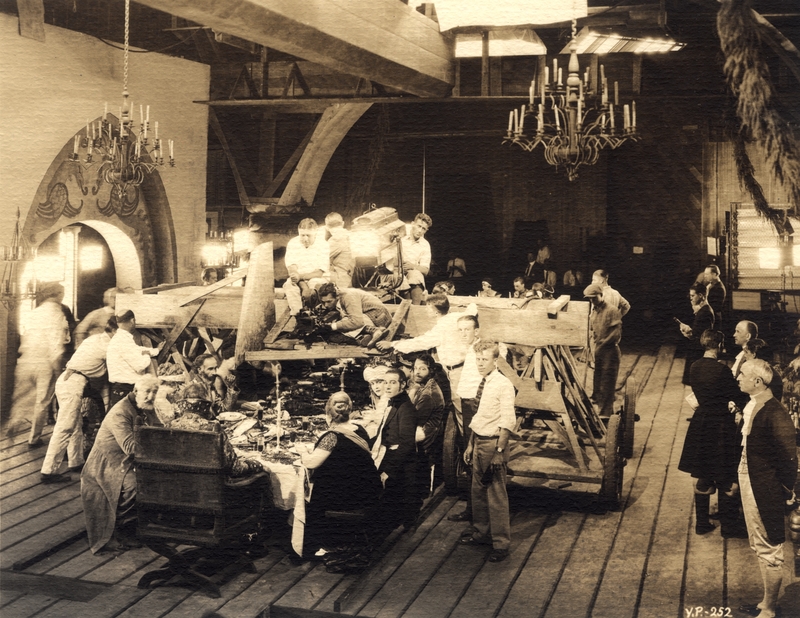
3 Oct 1945 – Clarence Brown Director of “The Eagle” gets a divorce
Clarence Brown, famous silent film producer-director obtained a divorce today from his wife Alice Joyce, star of the silent movie screen. She testified “He wouldn’t talk with me for weeks at a time.” Miss Joyce and Mr. Brown were married in 1933 in Virginia City, Nev., and separated in 1942. Mr Brown started out in Silent Films directing famous silent film stars of the day such as Rudolph Valentino.
1925 – Clarence Brown Director of “The Eagle” on set

2006 – Beyond the Rocks Review
Directed by Sam Wood; written by Jack Cunningham, based on the novel by Elinor Glyn; director of photography, Alfred Gilks; music and sound by Henny Vrienten; produced by Jesse L. Lasky; originally released in 1922 by Famous Players-Lasky and Paramount Pictures; Running time: 85 minutes. This film is not rated.
WITH: Gloria Swanson (Theodora Fitzgerald), Rudolph Valentino (Lord Bracondale), Edythe Chapman (Lady Bracondale), Alec B. Francis (Captain Fitzgerald), Robert Bolder (Josiah Brown) and Gertrude Astor (Morella Winmarleigh). Sam Woods directs Swanson and Valentino, two of the biggest stars of the era, with a light touch and keen attention to the audience’s pleasure. Swanson is a poor captain’s daughter betrothed to an unattractive older man, while Valentino is a dashing aristocrat who keeps showing up just when she needs to be saved from danger. The action moves from the rocky coast of England to the Swiss Alps on its way to the Sahara, for no reason beyond the sheer exhilaration of cinematic technique. The faces of the stars glow with life, which makes you all the more grateful that this, their only film together, has come back.
6 May 1945 – Rudolph Valentino 50th Birthday “He Still Wows Them”
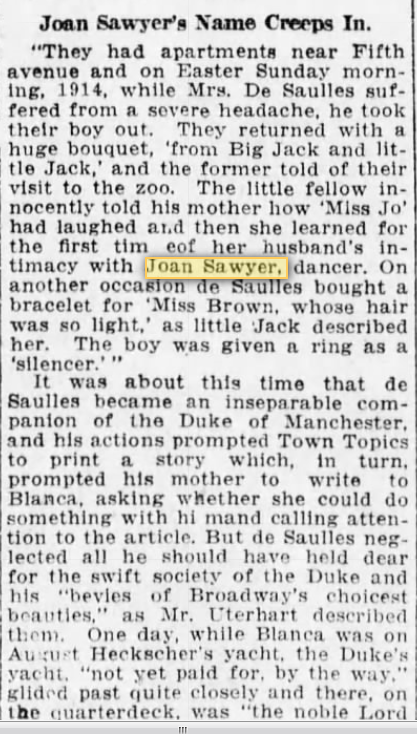
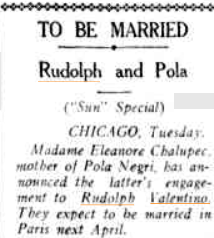
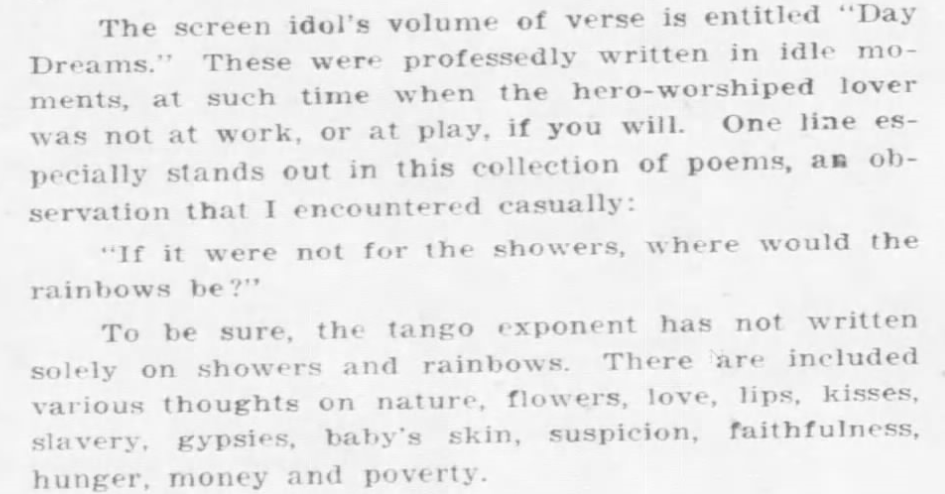
Today is Rudolph Valentinos 50th birthday. Two decades ago, this silent Sinatra of the 1920’s was sweeping the flappers and their mothers and their maiden aunts into wild frenzies of rapture. And he is not doing so badly today. Leaving NY Museum of Modern Art after one of its Valentino revivals not long ago a middle-aged woman noticed behind her in the crowd was a young girl with stars in her eyes. Smiling the woman asked “How did you like him”? “He’s out of this world!” moaned the girl rapturously. Hadn’t you seen him before? No, I replied I came here to laugh, but she shook her head baffled. “He sends me – he simply sends me”. With young girls of the 1960’s and 1970’s fall under the sway of any movie idol of the 1940’s as they came under Valentino’s way? Sinatra and Van Johnson fan clubs are many today. Although careful to state that “we most emphatically do not consider Valentino a saint”, a group of women in London founded on 23 Aug 1927, a Valentino Association “to perpetuate the memory of a great film artist in a worthy and dignified manner”. The association has members all over the world, and its activities are devoted to good works and the occasional revivals of Valentino films. A revival organization, the Valentino Memorial Guild, also of London likewise has a world membership. The guild, which invariably refers to Valentino as “Rudy”, sends a wreath to his grave annually, buys his photographs, sponsors revivals of his films and gives parties in his honor at which Guild members recite poems from his book, “Day Dreams” or sing “Kashmir Love Song” and indulge in other appropriate activities. These are the only two of the Valentino Organizations which appear to flourish in many parts of the world. One founded, in Budapest “to cherish the memory and promote the spirit of Rudolph Valentino” announced as its first rule “members are obligated to think of Valentino at least once a day”. Until gasoline rationing cut mileage, the Hollywood Cemetery reported that hundreds visited his grave every 23 Aug and that number increased yearly. The caretaker reports that cars from the Lone star state seemed to be in the majority. What this proves about the deep heart of Texas heretofore always considered lustily masculine he did not state. Valentino was not, like Van Gogh and the poet Homer appreciated only after he died. His short life was gay and romantically adventurous, the last five years of it crowned with adulation as is given few mortals. At the age of 17, with an “agriculture diploma” Valentino left his small home town to spend on the French Riviera and at Monte Carlo his share of his father’s estate. When his legacy was exhausted he set his course westward with a trunk full of clothes from Paris and several thousands of dollars. He arrived in New York late 1913. He could speak almost no English and was unfamiliar with the customs of the country. But in any language he was a romantic adventurer and it was not long before his nest egg was gone and all he had to show for it was his development into a fine dancer. This was the great period of Irene and Vernon Castle and the dancing craze that swept the country. Valentino fitted into it perfectly. When his money was gone he went on dancing professionally although he did make a short miserable try as a gardener. But dancing was more congenial and more lucrative. He became a café dancer and was the dancing partner of Bonnie Glass then Joan Sawyer. Later he went on the road in a small part in musical comedy and by degrees made his way out west first to San Francisco and then to Hollywood. There he found a few jobs as an extra in the films and after a dancing engagement in a Pasadena Hotel he began to receive bit parts. He played opposite Mae Murray, Carmel Myers but gained little attention except from one woman the famous scenarist June Mathis. About that time, Miss Mathis was turning the celebrated Blasco Ibanez novel “Four Horsemen of the Apocalypse” into a picture and the rest was true cinematic history. Valentino was an instant success, not only with the public but even with the movie critics. He made several good pictures, two or three excellent ones and two that could not have been worse or more popular. But to those who remember or have recently seen revivals of “Four Horsemen” “Monsieur Beaucaire” or “Blood and Sand” Valentinos claim to subtle and effective pantomime seems justified There are a few lapses into crudity in his first movie. Psychologically the answer to the Valentino riddle is utterly simple: Valentino believed as genuinely and as unreservedly in romance as did any and all of his followers. Not as a Cellini, a Don Juan or a Casanova, but with a simple-hearted faith that made him consider romance with all its trappings the most important business of life. In all sincerity he made such statements as “In my country men are the masters and I believe that women are happier so. It is the way it should be”. Psychiatrists speak of Sinatra as a phenomenon of the love hunger of women whose men are at war. Twelve million able-bodied men were not out of the country when Valentino became first in the hearts of his adopted country-women. It is doubtful that he could have become an idol during a period like the present. He was never a substitute or reminder of another man. By some strange alchemy of trans-identification, he became the man himself. Through the years hundreds of poems published particularly in pulp magazines, have been dedicated to the memory of Rudolph Valentino born 6 May 1895, in the little town of Castelianeta, Italy. Perhaps one, written ten years after his death, gives the flavor of all:
To Valentino in Spirit Land
Gold shot with fire, Song of love on a silver lyre, gone! But the thread of remembered delight weaves through the dull stuff of day and night. My pattern of bright embroidery! That is what Valentino meant to millions of women and perhaps millions yet to come. Not just the perfect lover the perpetual lover
“He was a hard, honest and sincere worker in his profession, and, as I happen to know personally, a clean living man. He gave the best that was in him to his work and appreciated fully the responsibility which went with the high esteem in which he was held by the movie public. He will long be remembered and respected for the high standards which he set in his chosen profession.” Major Edward Bowes, Vice President of Metro-Goldwyn Studios
19 Nov 1922 – The Lucky One Talks About Rudy
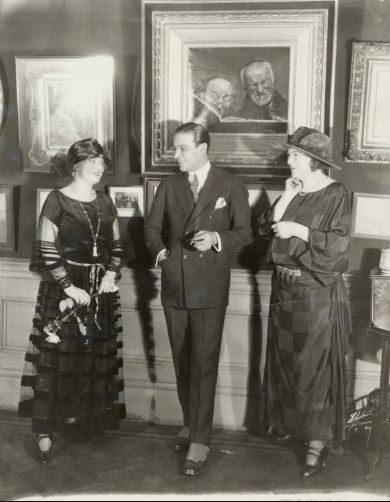
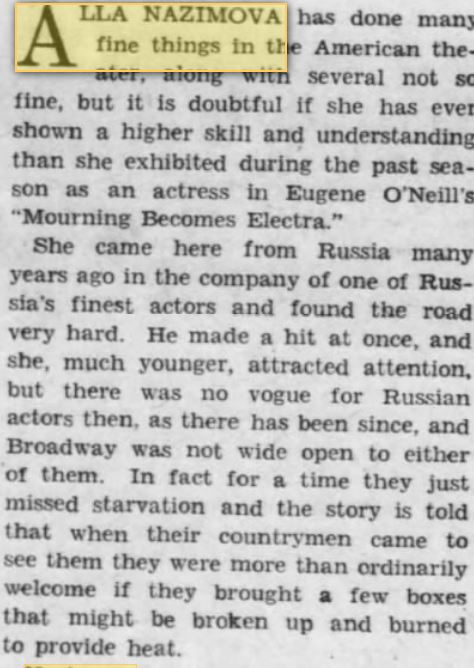
Whether to call myself Winifred Hudnut or Natacha Rambova or Mrs Rudolph Valentino I don’t know, says Rudolph’s wife in an interview in the December issue of Photoplay Magazine. “Natacha Rambova seems to belong most to me, the individual I think I am, but, of course, I wasn’t born that way. When I went into the Russian Ballet, thought, I had to have a Russian name. That way just after my course at art school in Paris, and I was 17, and I have been using that name ever since. I speak Russian and all that is Russian appeals to me, and moreover, that is what Rudy calls me”. Her eyes soften when she speaks of him, and yet refuses to be romantic about it. “It wasn’t love at first sight,” she says. I think it was good comradeship more than anything else. We were both very lonely, but we had known each other more than six months before we became at all interested in each other. I was working for Nazimova and Rudy was working on “The Four Horsemen” I saw him occasionally and felt a bit sorry for him, because he seemed always to be apart by himself. “You don’t know Rudy when he works. He sees nothing and things nothing and does nothing but live the character he is portraying. As the first of his work in the “Four Horsemen” was finished and the officials saw it, his name began to mean something. They began to talk about him and tell weird stories about his fascination for women and perhaps that was what piqued my interest. What I could figure out was, how anyone could be the villainous person he was reputed to be and yet be home in a tiny room every night about 9:00 pm and on the lot each morning all ready for work before anyone else had even arrived. Still, I never really talked to him until we began to work on ’Camille’. Then his work begun to interest me. There is really nothing sophisticated or seductive about Rudy whatsoever. Its like my drawings. I am perfectly willing to admit they are morbid, yet I am the most prosaic of human beings. “Now Rudy has a personality that comes out on the screen which is entirely different from the Rudy I know. Yet, I believe it is part of him as the exotic quality in my sketches is part of me. But basically he is just a little boy. Things hurt him as they would hurt a child and he is quite as emotional. Also, he is just as spontaneous and trustful, yet with all that there is a remarkable matter-of-factness about him and sincerity. He is the most sincere person I have ever known”. Natacha was trying very hard to be coldly analytical about this young lover of hers. But she wasn’t succeeding very well. Every time she spoke of him the color rose in her white cheeks delightfully. “When we did discover we were in love, she confessed, we had it all planned that we would wait a year until Rudy’s divorce was final. But I knew nothing about divorces and neither did he. They are so different everywhere and we really thought he was divorced and that he received his decree or whatever it was, and thought it was only some state law that kept us from marrying. So on 14 May 1922, we went to Palm Springs on a party. It was fearfully respectable. Everyone we knew was there and we had no thought of being married at that time. “But someone, I don’t remember who, suggested that we go over to Mexico and be married. Several couples we knew had done the samething before under similar circumstances but we had to be the ones who did it once too often. If Rudy hadn’t been Rudy they wouldn’t have jumped on us. Fame is like a giant x-ray. Once you are exposed beneath it the very beatings of your heart are sown to a gaping world. I’ll confess it is rather fun being courted by your own husband. We go out for dinner and the theater together nearly every evening and then he brings me back to my hotel and down in the lobby he bows formally over my hand and I, equally proper bid him good night and stand to watch him until he disappears out of sight on his way back to his hotel.
4 Mar 1922 – Success of Favorite Movie Stars Explained in their Handwriting

Fame has many fans. To be famous signifies the recognition of some sort of success achieved. And no surer fashion of determine the essential elements which make for high popular acclaim can be found than that which an individual exhibits in handwriting. It is the intimate link between the nerve-action of the hand and the mind. So when you regard the signatures of screen stars, you are looking squarely at the high or low lights switched on by the electrical currents of their personalities. The power underneath you feel even if you do not know the cause. For this reason, if for no other, there is a wide demand for the personally-written signatures of men and women prominent in this expression of the drama. Handwriting is the natural private gesture of each person’s whole makeup, and you will see that it only requires the eye and mind working together to form a fair judgment.
Rodolph Valentino
In the same health atmosphere travels R. Valentino, whose even well-poised fist moves ambitiously upwards, gesturing with his rather flamboyant capitals, exclamatory of his intense vitality and the conscious belief in himself. Each carefully-connected stroke invites you to look into his active mind, teeming with an intense desire to make good. In each curve lurks a laugh. In the straight base-line, strengthen by the long, underscoring sweep, he assures you frankly that he has a great deal of nerve and will never be satisfied until you meet him frequently. That bold hood on the end of his “t” shows his grit, his clinching hold on every detail in order to produce in a versatile manner with artistic finesse. The way he gathers his letter together a clutch-denotes his practical side. Once attempt to worst him by any ill-treatment and his whole temperament will arise with an adequate come-back. It would surprise you, as he is tactful and pleasing in manner. By nature vitally living. Yet, pressure being even, he understands the art of self-dominance. By this his advance along the stellar way can be measured by the height of his signature. Very high.

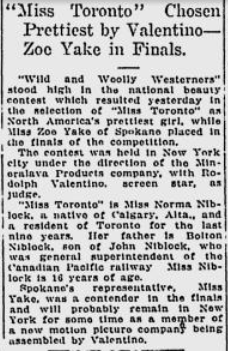

15 Dec 1923- ‘Pretty Girl’ Prize Winner Not Wise Yet
Norma Niblock, the Toronto girl who won the Mineralava-Valentino Beauty Contest in New York, has made an amazingly bad break. Although she’s Sweet Sixteen, Norma broadcasts the information that she won without using rouge or powder! Is Miss Nlblock trying to “crab” future “Pretty Girl” exhibitions, or what? Doesn’t she know that in these advanced days, Beauty is only skin deep? Sixteen! And not aware that a “Beauty Show” is merely a test of the relative merits of certain cosmetics, for which the faces of the young ladles provide pleasing backgrounds! Tho New York judges certainly slipped up badly on the job when they crowned the Toronto queen. Instead of awarding the palm to some snappy soubrette who knows all about lipsticks, eyebrow pencils, cold creams, clay packs, lotions, eyelash tweezers, nose powder, beauty patches, hair gloss, massage pastes, electric vibrators and tooth shine. The manufacturers of these commodities are always willing even eager to pay fabulous prices for testimonials from Beauty Queens. Here is opportunity knocking at Miss Niblock’s door and here Is Miss Niblock “knocking” opportunity by saying she doesn’t rouge or powder! ! ! Next thing we know Norma will stand right up in meeting ‘ and declare she has no intention of going into the movies. But fortunately, there is still hope. The public has a short memory. Nobody will remember Miss Niblock’s “No – powder, no rouge” error of judgment after a few days. Such being tbe case, her face may be her fortune. Watch for it in magazine advertisements, telling the world how Norma put it all over the other flappers by using BOOULE’S BLOOM OF BEAUTY three times a day on sale at all drug stores.
Dec 1923 – Madison Square Garden Beauty Show Contest Gives Crown to Canada
The Mineralava-Valentino beauty contest, which was a year in preparation, was finally staged last Wednesday night, at the Madison Square Garden with 88 beauties contesting for the honor of the sheik crowning her the chief beauty which carried with it a film contract and other material benefits. After passing the buck to the 100 Judges, Valentino placed though small crown on Norma Niblocks raven tresses, which signified to all who were interested that this Toronto gal took first honors. Eugenia Gilbert of Los Angeles, the popular favorite, only succeeded in placing second , and the following beauties took third, fourth and fifth respectively : Reba Owen of New York, Mildred Adam of Baltimore, and Gloria Heller of Wichita . The latter is in Kansas for anybodies specific information. At any rate, the town owes Miss Heller something for placing it on the map. The newspapermen generally leaned toward the Baltimore gal and a beauty from Butte, Montana, Marlon Fogerty was deemed likely by others. Withal, the selected winner was by no means a popular choice, although the lass were distinguishing for her unassuming naiveté in posing and parading around the rostrum ln a natural and easy manner. An inside explanation of the Toronto choice has lt that Canada is still virgin territory for the Mineralava beauty clay product. The choice of a native daughter is believed to be a good selling angle, but it is only a report. Five girls, of which Miss Nlblock is not one, have been signed for a Broadway production, although the Toronto beauty may have foregone any stage alliances -through the picture contract she inherited with the first prize capture. The second choice, Miss Gilbert, Clipper mans favorite, a dazzling beauty to considerable personality and charm that fairly radiated to every corner to the Garden. Not Slow Business As an amusement venture, Mineralava, should have stuck to the beauty clay. The Broadway managers may not allege to give one so much show but they start at 8:30 when advertised. Mineralava stressed the eight o’clock opening even on the admission tickets but didn’t start things until 70 minutes thereafter. It was an ordeal up to midnight. The show was unduly padded with the march of the beauty in ensemble and also divided into six groups with two semi-final parading and finally the winning selections. Paul Whiteman’s orchestra, a misleading announcement , since it was only a 41-piece Whiteman unit, tried to plug the waits interestingly but their lack of sufficient volume through absence of the necessary brass did not make them particularly fetching. Reinald Werrenrath, a concert baritone, managed fairly well but he clicks better in less spacious quarters. Petroushka and Ensemble, a 14-people mixed Russian act, was a colorful interlude of no particular merit. Their stuff has been done much better in small time vaudeville. The act features harmony singing, later doing song and dance specialties, one gal shimmying for her contribution. In between the acts, Mr. Graham, the announcer, read a statement for H. Z. Pokress, the Mineralava president, that E. F. Albee would engage the 16 winners for the new Keith Hippodrome opening Dec. 17. A number of sidelights on the contest were much more interesting than the show itself. Several groups took the Thanksgiving Eve occasion to celebrate liquidly. It was a question what one Indulgent Was cheering when he exclaimed Hooray for though Scotch as one of the beauty in a Scotch paid get-up made her appearance. Others insisted that the loving cups be filled up. These were the consolation prizes to the runners-up, though sizes being graduated down from second to fifth place. At any rate, Mineralava spent much money advertising its product and the five-eighths of the Garden s capacity attendance couldn’t mistake that a certain beauty clay one product was somewhere importantly mixed up in the entire affair.

8 Nov 1925 – With Producers & Players
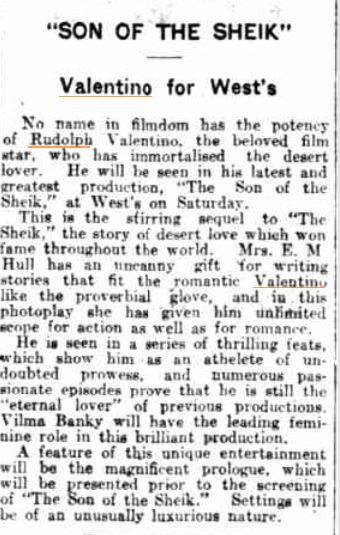
RUDOLPH VALENTINO’S new offering, “The Eagle,” is the film feature at the Mark Strand this week. Mr. Valentino intends to be present at the opening performance at 2 o’clock today. Vilma Banky, Samuel Goldwyn’s discovery, who made her screen bow in George Fitzmaurice’s picture “The Dark Angel,” figures in the feminine lead figures in the femine lead. Louise Dresser, who gave a remarkable film performance in “The Goose Woman” portrays the role of the Czarina. The photoplay is based on “:Dubrovsky” a Russian novel by Alexander Pushkin. I was adapted by Hans Kraely who has written a good deal for Ernest Lubitsch. The picture is described as a romantic comedy drama, the action taking place in Russia before the revolution. Mr. Valentino appears in three different guises, first as a Cossack officer, the Eagle, and a French tutor
 All About Rudolph Valentino
You must be logged in to post a comment.