
Anxiety over the safety of Natacha Rambova former dancer and wife of the late Rudolph Valentino, who is a resident on the island of Mallorca off the coast of Spain, was expressed yesterday by her aunt, Mrs. Teresa Werner. According to Miss Werner, she has not heard from her niece directly since the beginning of the present civil war in Spain. However, Miss Werner said she received a cable yesterday from friends saying that Miss Rambova was unharmed. Her niece, is now the wife of Alvaro Urzaiz, retired Spanish Naval officer.
Posts Tagged With: Rudolph Valentino
8 Aug 1936 Silence Stirs Anxiety for Miss Rambova
Categories: Uncategorized
Tags: Natacha Rambova, Rudolph Valentino
2 Aug 1934 – Egotism of Stars
The late Harry Reichenbach, an American publicity agent, revealed in his book “Phantom Fame” some of his most interesting experiences with movie stars. “”I first met Rudolph Valentino in the tearoom of the Alexander Hotel, Los Angeles” he wrote. “He functioned as a dancing partner for girl patrons of the hotel, a hanger-on one of the myriad of hopefuls that dreamed of being an extra to the movie lots close by. I noticed him, and he came over to greet me. It happened that Clara Kimball Young needed a handsome, young, straight man in “Eyes of Youth” a sort of gigolo, and I told Herbert Sanborn, her manager, to come and have a look at Valentino. At first Herb, turned Rudolph down flat, for his left ear; but after I convinced him that Rudolph didn’t have to be photographed with a left profile, he agreed to take him on. Valentino never photographed with a left profile throughout his entire career on the screen. A few months later Reichenbach met Valentino again, and the latter, who had not been able to get a footing in the movie world early accepted an offer of twelve dollars to go round Los Angeles posting up notices of the actors strike. “When I saw him again he was a star,” wrote Mr. Reichenbach. “He had appeared in “The Four Horsemen” in 1919, and had galloped in first. In 1925, I was placed in charge of his pictures at the Paramount office. I know first-hand, for my publicity work played an important part in the life of Rudolph
Categories: Uncategorized
Tags: Clara Kimball Young, Rudolph Valentino
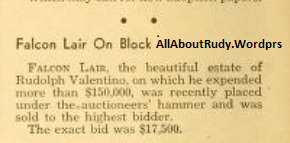
26 Jul 1938 – Capitol Names Prize Winners
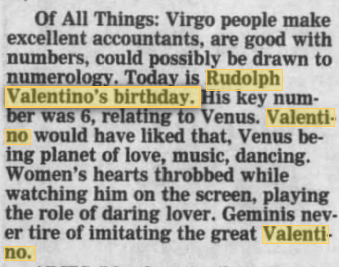
The recent letter writing contest on “Why I want to see Rudolph Valentino” has met some unusual responses and printed here are two prize winning letters that will receive cash awards if the parties please call the Capitol Theater Office.
First Prize – “I want to see Rudolph Valentino because when I was a small girl, in boarding school, my mother came after me for a holiday weekend. We ate in cafes, shopped and went to see Rudolph Valentino in Son of the Sheik at the Queen Theater, Houston, Texas. My mother’s birthday is 31 Jul and I want to give her a holiday and myself a memory trip by taking her to see the movie idol of her time again at the Capitol Theater 31 Jul”. Signed: Mrs. L.E.J East 10th Street.
Second Prize – Mr. Rudolph Valentino fourteen years ago when I saw you in Son of the Sheik played at the Woodlawn Theater, Chicago, Illinois. I went because friends and salespeople exclaimed of my resemblance to you. I could double as your sister. I wonder if you were here today, would your mirror reflect the same changes as mine does? Although I have run true to form, by being “fair, fat, and fortish” the similarity in features remain. My reason for seeing Son of the Sheik now is for the memories brought back from that time, are nice to remember as the picture again unfolds before me. Your most ardent admirer: Mrs. D.R. NW 3rd.
Everyone is invited to send in their letters this week before the picture comes to Amarillo on “Why I want to see Rudolph Valentino”. You may win a cash prize and a guest ticket to see Son of the Sheik.
Categories: Uncategorized
Tags: Rudolph Valentino
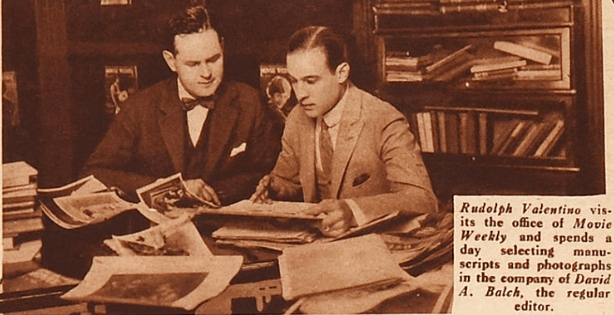
17 Apr 1935 – ZUNILDA MANCINI, Respondent, v. S. GEORGE ULLMAN, Appellant.
Mancini v. Ullman [Civ. No. 10065. Second Appellate District, Division One. April 17, 1935.]
COUNSEL Arthur C. Fisher for Appellant. Herman Tepp, Ivan L. Hiler and Jay J. Stein for Respondent.
.
OPINION Conrey, P. J. Appellant having filed his opening brief, respondent now moves to dismiss the appeal of defendant, or affirm the judgment, upon the ground that the questions upon which the decision depends are so unsubstantial as not to require argument. The record is presented in a printed transcript which contains the judgment roll, together with a bill of exceptions in which there are no specifications of insufficiency of the evidence to sustain the findings.
[1] On several dates (January 23, 1928, April 12, 1929, and April 28, 1930), respondent, who resided in the city of New York, paid to appellant sums of money, in all amounting to $6,900, all solicited and received as part of a fund to be used for the construction of a monument in the city of Los Angeles, to commemorate the name of Rudolph Valentino. Appellant actually used for that purpose, only $2,000. The court found that his representations to respondent, by means of which he obtained the money, were knowingly false. The transcript begins with an amended complaint, and does not show the date of commencement of this action. However, we accept as presumably correct the statement of counsel in his brief, that the action was not commenced until October 23, 1933. But the facts shown by the findings are sufficient to excuse the failure of respondent to discover the fraud until May, 1933, when she promptly employed an attorney, and demanded repayment of the money sued for in this action, and then filed her complaint. [6 Cal. App. 2d 224] There is, therefore, no merit whatever in appellant’s contention that the plaintiff’s right of action is barred by the provisions of sections 338 and 339 of the Code of Civil Procedure; nor in the further defense based on the ground of laches of the plaintiff in delaying the commencement of her action.
[2] There is no substantial basis for the claim of appellant that the court erred in allowing plaintiff to amend her amended complaint to conform to the proof. Appellant argues that the points of amendment did not conform to the proof. But the trial court thought differently, and in the light of the findings we must assume that the court’s ruling on this matter was supported by the evidence. There was no miscarriage of justice in the rendition of judgment against appellant.
The judgment is affirmed.
Categories: Uncategorized
Tags: George Ullman, Rudolph Valentino
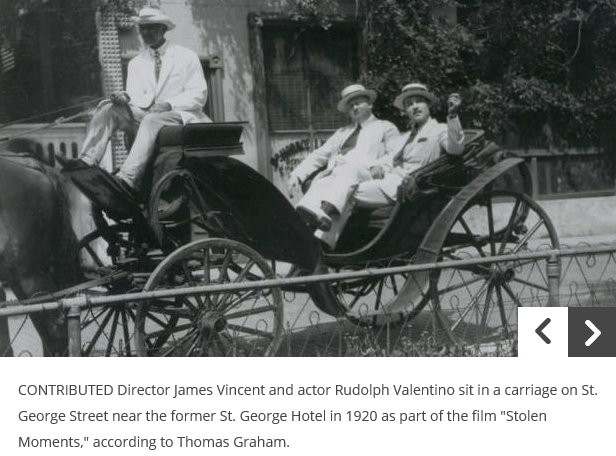
1920 – Stolen Moments St Augustine, FL
Categories: Uncategorized
Tags: Rudolph Valentino, Stolen Moments
8 Mar 1925 – Where Rudolph was when the lights went out
While on the subject of temperaments have you heard the news of Rudolph Valentino’s tiff with Ritz-Carlton Pictures? Well it seems that Rudy was right in the midst of making “The Hooded Falcon” making it just as he jolly well pleased and under the supervision of his own hand-picked director, when J.D. Williams, president of Ritz-Carlton, thought he ought to have something to say regarding the expenditure of something like $500,000 of his own hard cash. First of all he requested that Mrs. Valentino hie herself to the sidelines and confiner her helpful operations to merely looking on and keeping quiet. When Mr. Williams took exception to Rudy’s choice of Alan Hale as the director he declared that Mr. Hale was not experienced enough to look after the destinies of a film which was estimated to cost it producers half a million dollars. So the Valentinos walked off the set in a huff. According to the latest reports they are passing the time in luxurious
idleness at Palm Springs. They are not going back to Hollywood until some spirit greater and more omnipotent than J.D. Williams moves them. In the meantime, Adolph Zukor and Famous Players Lasky who have contracted for hte release of Valentin’s pictures, are pacing the rugs in their majogany paneled executive chambers, wondering if ever there had been a spoiled child more incorrible than this boy Rudolph.
Categories: Uncategorized
Tags: Mrs. Valentino, Ritz Carlton Pictures, Rudolph Valentino
24 Apr 1988 Secret to Manhood May Lie in Rudolph Valentino’s Ring
Franklin Mint is selling the secret to manhood. Or at least copies because the original stays where it is. The secret to manhood as implied by its ads is a ring worn by Silent Film Star Rudolph Valentino. The mint a mail-order firm in Franklin Center, PA is selling copies of the ring for $295.00. “Rudolph Valentino” one magazine ad reads “His name is synonymous with self-assured style”. Off and on the screen. And his taste in jewelry reflected an undeniable confidence in his own masculinity. “Now, for the first time, the ring that he actually wore has been recreated from the original now in the permanent collection of the prestigious Margaret Woodbury Strong Museum, Rochester, NY. In 1967, the ring was purchased for $1000, in an auction in Portland, Maine, and the museum will not say what the piece is worth now. In any case, the ring has never been displayed though in might be included in a 1990 exhibit on American Heros of Pop Culture. The ring is made of hammered platinum with an oval setting of black star sapphire, which has an intaglio of two Greek warriors, one standing and one on a horse It is a huge affair more than 1 inch from front to back, more than 1 inch from side to side, and close to an inch from top to bottom. The copy replaces the platinum with silver and the sapphire with black hermatite. But at least you can get your own copy in any size you want. Museum records say the ring was made in Italy in 1925. Valentino bought it that year and reportedly wore it in three movies “A Sainted Devil” “Cobra” and “The Eagle”. He died in 1926 and the ring was bought by James Perkins a Portland Sea Captain. Strong bought it from Perkins estate which was auctioned when his widow died. In 1967, Margaret Strong bought the ring to go with her Rudolph Valentino Doll.
Categories: Uncategorized
Tags: Rudolph Valentino
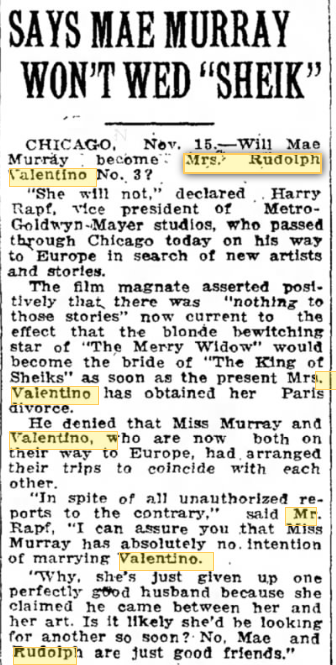
4 Feb 1922 – Four Horsemen at the Capital
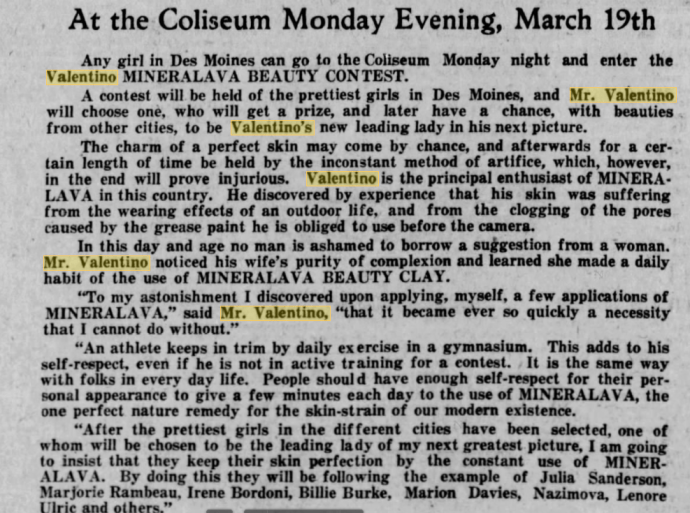
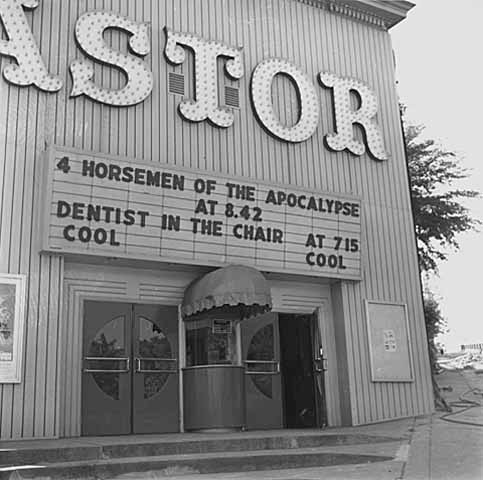
With the coming of the “Four Horsemen of the Apocalypse” to the Capitol next week, Rex Ingram will have two pictures running simultaneously on Broadway. In creating this stupendous production, this young director has made one of the great classics of the screen. The picture, adapted by June Mathis from the novel of Vincente Ibanez, is not a war play, except as the war serves as a background for the story teeming with dramatic passion. The director has succeeded in concentrating the great struggle in a series of unforgettable pictures that flash out the quintessence of life. Through it all is the deeply human, deeply moving spectacle of intensely real people in their baffled attempts to readjust themselves to the demands of the war days. In the cast of 50 principles and 2500 extras are included a score of well-known screen stars. They are Rudolph Valentino, Alice Terry, Pomeroy Cannon, Joseph Swickard, Brinsley Shaw, Alan Hale, Bridgetta Clark, Mabel Van Buren, John Sainpolis, Nigel de Brulier, Virginia Warwick, Derek Ghent, Stuart Holmes and Edward Connelly. SL Rothafel and his staff are at work on the details of a presentation in keeping with the production.
Categories: Uncategorized
Tags: "Four Horsemen", Rudolph Valentino
24 Mar 1928 – Male Movie Stars More Fussy about their hair
A woman is fundamentally the same, whether she is a movie star or a Park Avenue society but the happiest moment in her life is when her hair turns out just right. That does not mean that women have a corner in the personal vanity market. NO woman in the world could be more fussy about their hair than a male movie star. These are the deductions of an expert, Ferdinand Joseph Graf, for three years, the official hairdresser to moviedom who is now at Arnold Constables. Mr. Grafs first job with Famous Players was to prepare the wigs for Valentino in “Monsieur Beaucaire”. Natacha Rambova the stars former wife, brought him out to the studio from the 5th Avenue beauty parlor she patronized for that purpose. He liked the work so well and the stars apparently liked him so he well became the official hairdresser at the studio for three years.
Categories: Uncategorized
Tags: Ferdinand Joseph Graf, Natacha Rambova, Rudolph Valentino
18 Jun 1922 – Scientists interests in Movie’s Happy Endings
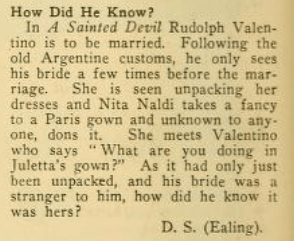
Distinguished French psychologist Pierre Delenne, declared the other day his belief that much acting in the emotional dramas of the films may easily unfit men and women for meeting successfully the problems of reality which they have to face in every-day life. According to his theory, they can become so accustomed to the romantic, rose-colored glamour which the movies throw about everything that when they come into the harsh glare of actuality they are likely to be hopelessly blinded or to see things in such a distorted way that they make the saddest kind of mistakes. The movies are capable of more harm in this respect than the speaking stage, he thinks. While on the speaking stage an actor may play the same part for a year or longer, in the movies he crowds into the same space of time a great many different roles. Working at this continual high pressure in the world of make-believe, the movie actor may easily become obsessed, Professor Delenne thinks with the idea that everything must have a happy ending, particularly where love is concerned. That the swift triumph of true love over all sorts of obstacles is inevitable is the very breath of life of most of the great film successes. The scenario writers, directors, and continuity men hammer away at this false notion so persistently and elaborate it in so many ingenious ways that it is no wonder the actor should often get to taking it for the solemn truth. The awakening from his blissful dream that love is a n irresistible force comes when he runs against the stern realities of civilization’s laws and social conventions things which in the world where he has been living have been overcome with greatest ease. All this is extremely interesting to us here in America, where the movies had their birth and have reached their greatest development. Everybody will at once think that very possibly this theory maybe the true explanation of the extraordinary series of scandals in the motion picture world, which former Postmaster General Will Hays is now doing his best to bring to an end. Certainly it would seem that some such theory as Professor Delenne’s offers the only plausible excuse for the desperate changes which Rodolph Valentino, the famous heartbreaker o the films, has lately taken with his love. Unless he were obsessed with the idea that love must inevitably have its way and that there is bound to be a happy ending to every heart-burning romance, what could have possessed him to risk a prison term in order to possess the woman he loved, a few short weeks before the law said he should? In the movies, Rudolph Valentino ran to Mexico with the beauty for whom he “just couldn’t wait any longer” would have been quite all right. Such trivialities as the laws of the State of California would have been cast lightly aside or else bent in a way that would have served the scenario writers purpose just as well. And the final close-up of Rodolph and his perfume heiress would have shown them clinging to one another, approved of by everybody and tasting the first of an ever-lasting bliss. But, as Rodolph Valentino and Miss Hudnut have learned to their sorrow, the laws on the subject of bigamy are not the negligible things the scenario writers and movie directors would have us believe. What they planned to be the most fascinating of romantic dramas gives promise of winding up in a dismal tragedy just the sort of an unhappy last reel which no popular motion picture would tolerate for a minute. Instead of possessing the bride for whom he yearned with all the fire that has made him one of the most famous of screen lovers Rodolph Valentino is separated from her by width of a continent. In her home in the East she hides, distracted by anxiety over her lover’s predicament and by the pitiless publicity that has been thrust upon her. Out in California, alone and broken hearted, he impatiently awaits trial on a charge that may land him inside the gray walls of a state prison. “But even the fear of a prison term could not dim the flame of love that blazed so hotly in their hearts. Captions like this are of frequent occurrence in the films. Evidently Rodolph Valentino thought the sentiment they express founded on a truth which could be turned to the advantage of his love hungry heart. But now he and his perfume heiress know that only in the make-believe world of the films is love able to defy the law in such high-handed fashion. Bigamy is not so lightly regarded in real life, and for those suspected of it there are troublesome sheriffs and prosecuting attorneys, stern judges, and juries to be reckoned with. According to Professor’s Delenne’s theory many movie actors are in a condition quite similar to that of an unfortunate shimmy dancer who cannot keep from shimmying. They have loved so often and with such made impetuosity on the screen, and all their dreams have so invariably come true, that they have become carried away with the idea that such things are as easily possible in real life. So it was, it seems, with Rodolph Valentino. In the “Four Horsemen of the Apocalypse” “The Sheik” and countless other film successes he was always the all-conquering lover. He loved with an intensity that acknowledge no obstacles, brooked no delay. And just like this should it known in the California film world as Natacha Rambova. He had only recently received an interlocutory decree of divorce from Miss Jean Acker, the screen actress, and until the final decree was granted he had no legal right to marry again. But Valentino, with all the impetuosity that has made him famous as a screen lover fled across the Mexican border with his sweetheart and they were married. The close-up that followed was a grim contrast to the happy endings which are the delight of the movie goers.
Categories: Uncategorized
Tags: Natacha Rambova, Rudolph Valentino
24 Feb 1927 – “Forget the Past” Says Second Wife of Late Rudolph Valentino
“I want the public to forget that I was ever Mrs. Rudolph Valentino” says Natacha Rambova alias Winifred Hudnut. “But privately that is another matter, for he is still with me talking from the other world”. The former wife of the late screen star, who is now starring in a mystery play, explained that she was “tired of being called Mrs. Valentino because some people seem to think that I am attempting to capitalize on the late Mr. Valentino’s popularity.
Categories: Uncategorized
Tags: Mrs. Valentino, Rudolph Valentino
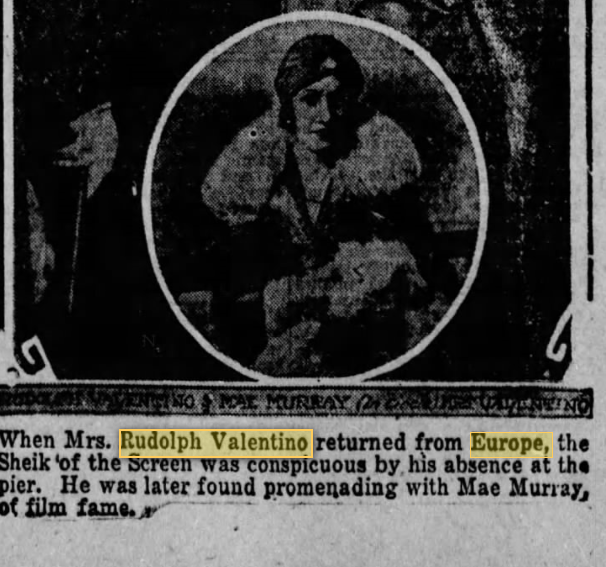
14 Nov 1925 – Well Well
Categories: Uncategorized
Tags: Mae Murray, Mrs. Rudolph Valentino, Rudolph Valentino
10 Nov 1925 – Petrova Must Pay $7,500 As Pirate Despite Valentino Testifying
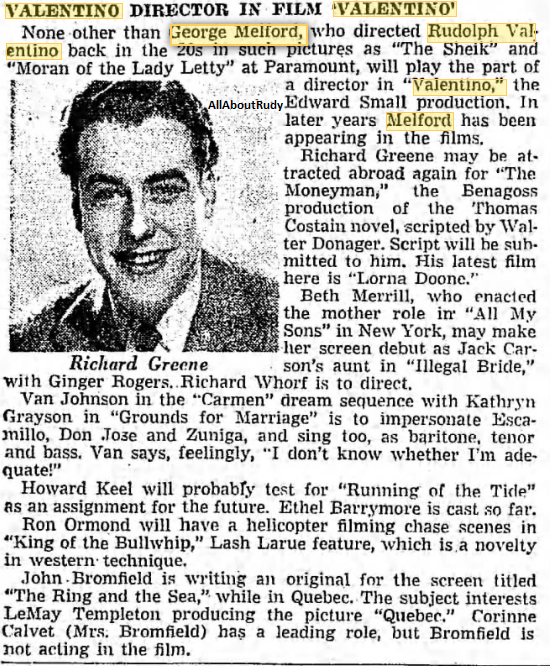
William H. Roberts, Naval Officer today, was awarded $7,500 damages against Olga Petrova, Russian actress, for plagiarism from his play “The Red Wig” in production of “The White Peacock”. Roberts had brought suit for $35,000 royalties, claiming the actress appropriated the plot and dialog of his play. The jury had heard testimony for four days and deliberated for an hour and a half. Justice O’Malloy gave both sides ten days in which to file briefs on the motion of Nash Rockwood, counsel for Olga Petrova to have the verdict set aside. Rudolph Valentino, of film fame, who playing the leading role in “Blood and Sand”, which had been mentioned during the trial as containing many similarities to “The Red Wig” was the last witness called by Mme. Petrova in closing her defense. The ace of sheiks was dressed in gray tweeds and reddish tan shoes with gray suede tops. He wore a gold “slave bracelet” on his right wrist. Rudy was a bit late getting to court and nearly lost the opportunity of testifying, as the defense already had rested, but Justice O’Malley allowed them to put him on the stand. Col William Rand, counsel for the plaintiff, seemed entirely satisfied with Valentino’s testimony and declined to interrogate him. When Valentino entered the court room, followed by a bevy of flappers and youthful sheiks, he went immediately to Mme. Petrova at the counsel table. Making a courtly bow from the waist, “Rudy” kissed Mme. Petrova’s hand in the most gallant Valentino fashion. Referring to the theme of “Blood and Sand”, Valentino said” “It is a vivid story of passionate and lustful Spanish life. The male character becomes famous because of his ability as a bull fighter. He is a man of low birth. A lady of wealth becomes infatuated with him and they a liaison. “The main theme of ‘Blood and Sand’ is propaganda against bull fighting in Spain”. When Valentino made that statement COL Rand seemed pleased, as previous testimony had been that the theme of both “The Red Wig” and “The White Peacock” promulgated the economic independence of women and the defense had introduced testimony that “Blood and Sand” and “The Red Wig” were similar. At the conclusion of Valentino’s testimony a short recess was taken while both sides prepared to start their summation to the jury. During this recess Mme. Petrova and Valentino posed together for the newspaper photographers. Mme. Petrova appeared in court yesterday gowned in another charming creation. During the four days the trial has been in session she has appeared in a new and startling Parisian creation each day. Yesterday, she wore a black velvet turban, with a black ostrich plume drooping over her right shoulder. Her costume was set-off with a shimmering silver cloth blouse and a string of pearls. When recalled to the stand she testified that she had named her play “The White Peacock” due to reference in the dialog to the “proud peacock” which denoted the pride and bearing of the leading woman character. Roberts, the plantiff was recalled the brief testimony in rebuttal. Prior to writing “The Red Wig” in 1918, he declared he never had seen, heard of or read either the book or play of “Blood and Sand”. Regarding a similarity in the description of bull fights in his play and “Blood and Sand” he could offer no explanation, but averred he had seen at least 20 bull fights and in writing his play gave his own impressions.
Categories: Uncategorized
Tags: Olga Petrova, Rudolph Valentino
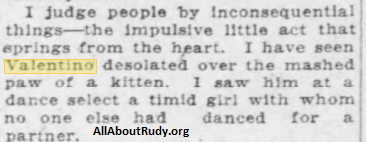
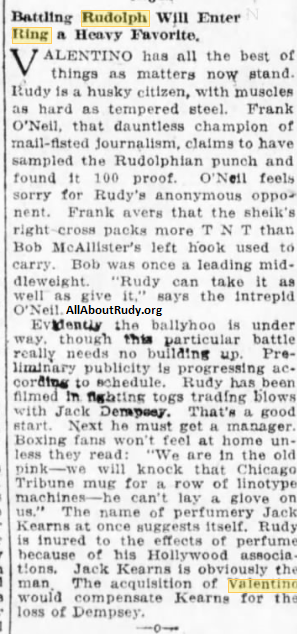
14 May 1976 Makeup Artist Keeps Dynasty Alive
Dynasties don’t last very long in Hollywood. The House of Westmore lasted longer than most 58 years of makeup wizardry and one remnant remains. He is Frank Westmore still practicing the family trade. Frank remembered when George and sons Mont, Pere, Ern and Wally branched out to all categories of film beauty male and female. Mont provided Rudolph Valentino with his famous latin look. First washing the actor’s hair and slicking it down with Vaseline. Frank remembers his brother modified the heavy penciling of Rudy’s eyebrows by plucking them and reshaping them to an arch over his heavy eyelids thereby making his eyes look larger. He lightly shadowed Rudy’s jawline giving it a more defined ascetic look. Mont reduced the heavy eye makeup, lightened the lip color, and added Vaseline to make the lips shine. Result instant sex symbol.
Categories: Uncategorized
Tags: Frank Westmore, Rudolph Valentino
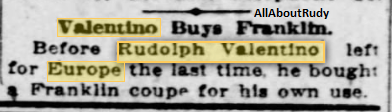
May 1923 – Mineralava Dance Tour Stop Seattle, WA
During his 1923 Seattle visit, Rudolph Valentino was in the midst of a dispute with his studio, Lasky-Paramount. Battles over power and control were being waged behind-the-scenes, but publicly the actor claimed to be protesting the cheap program films to which he had been assigned, as well as the practice of block booking. In an era when popular movie stars routinely appeared in three or four new film releases a year, Valentino resisted the studio’s demand that he work. (Block booking was an early distribution practice whereby a studio would tie the releases of major stars to less ambitious efforts. Exhibitors wishing to screen “marquee” pictures had to sign exclusive agreements that forced them to also show the studio’s third-rate potboilers. Exhibitors strongly protested this arrangement. For failure to work, Lasky-Paramount eventually suspended Rudolph Valentino, and went as far as to obtain a court injunction preventing the actor from appearing onscreen until after his Paramount contract expired on February 7, 1924. The studio felt they had called Valentino’s bluff, since he and second wife, Natacha Rambova (formerly Winifred Kimball Shaughnessy) were heavily in debt. But the pair countered by mounting a personal appearance tour organized by George Ullman (later Valentino’s business manager), and sponsored by Mineralava, a beauty clay company. For 17 weeks, the couple gave dance exhibitions across the United States for a reported $7,000 per week, keeping Rudolph Valentino in the public eye and, based on their commercial pitches for Mineralava, providing the company with valuable exposure. The tour began in the spring of 1923 in Wichita, Kansas, where public schools closed on the day of his appearance. Despite the excitement that Rudolph Valentino brought to almost every stop on his itinerary, the star’s arrival in Seattle was relatively low-key. The Valentino’s were expected at 9:40 in the evening on May 30, 1923, traveling from Spokane in the star’s private rail car. From the train station, they were to be whisked to the Hippodrome at 5th Avenue and University Street, where Valentino was slated to help judge a combination dance contest/beauty pageant at 10:00 p.m. According to publicity for the event, the pageant served as a national search to help find the star’s next leading lady (a role which eventually went to veteran Paramount actress Bebe Daniels. Unfortunately, their train arrived much later than expected, and the Valentino’s entered the Hippodrome well after the dancing competition. The actor then sat with other judges behind a curtain for the remainder of the beauty pageant, which concealed him from the audience, most of whom had come solely for the opportunity to see the motion picture star in person. When all was said and done, Rudolph Valentino personally selected Katherine Cuddy, a local stenographer, as the beauty contest winner, turning down the half-hearted challenge of Seattle Mayor and fellow judge Edwin J. Brown (1864-1941) on behalf of another contestant. It is hoped that Brown’s candidate did not know that the Mayor was championing her cause, for the next day it was widely reported that Valentino rejected her for having bad teeth. (Ironically, Brown — who was a prominent Seattle dentist as well as a doctor, lawyer, and politician — did not notice this defect. The Valentino’s followed the beauty judging with an electrifying demonstration of their famous Argentine tango, recreating the dance scene from The Four Horsemen of the Apocalypse. Both were dressed for the part; as one account put it:
“It is in Rodolph’s [sic] blood to wear black velvet pantaloons and stamp his black patent leather boots and click castanets. His manner was quite Argentine; his hair quite brilliantine” (Dean). Natasha Rambova was also clad in black velvet, offset with a red Carmen like shawl. “[She] is very brave to put on a ten dollar pair of black silk stockings so close to her partner’s three inch silver spurs, noted Times reporter Dora Dean. The Private Valentino Dean managed to sneak backstage after the exhibition and take a spot in Rudolph Valentino’s dressing room, where she found the actor quite blunt about all the attention his appearances had been garnering. The moment he arrived at the Hippodrome, for instance, a large crowd of girls — “starving for romance,” the actor noted with some disdain — surged toward the stage. Adoration of this sort wore on Valentino, for it overshadowed his attempts to be taken seriously as a performer. “`From persons who saw the Four Horsemen I have received intelligent letters of appreciation,’ [Valentino] said. `I like them better than the adoring notes from little girls who want me for their sheik.’ `But what are you going to do, when all those darling girls want to see you ride [in] the desert and gnash your teeth?’ he was asked. “`Ah, they should stay at home with their husbands,’ said the slick-haired actor” (Dean). Wanda Von Kettler, writing for the Star, also managed to get herself into Rudolph Valentino’s dressing room at the Hippodrome. It must have been a crowded place: Mayor Brown and Washington’s Lieutenant Governor William Jennings “Wee” Coyle (1888-1977) also fought for space amongst a crowd of reporters and fans. According to Kettler: “Beside Rodolph Valentino sat Mrs. Valentino, his tall and slender brown-eyed wife, in her Argentine dancing costume. “He surveyed his guests. Then told them that he wasn’t a `sheik.’ “`Of course,’ he declared, with a somewhat resigned laugh, `I’ve gotten considerable publicity because of the name. But I don’t know if it’s been the right kind of publicity. The very sentimental girls think I’m all right. They like me. But what about the intelligent women – and the men? Don’t they think I’m a mollycoddle? They do. When I go back in pictures, after the fight with the movie concern is over, I’m going to prove that I’m not the type they think I am …’ “Valentino plans to write a book. He confided so to some of us Wednesday night. “`It’s going to be a book on the tango,’ he declared. `I’m going to teach all America to dance that dance. Everybody seems to like it, so why not help them learn it.’ “‘Dancing,’ he added, `is the greatest stimulant of the day, and is more and more being recognized as such. Since the event of prohibition it has increased 50 per cent.’ “Valentino doesn’t `mind’ the letters he receives from admiring ladies. “`I’m very glad to know,’ he explained Wednesday night, `that I’m being appreciated. I like to hear the opinion of the public, whether it’s for or against me. But I know the ladies aren’t `in love’ with me. They’re in love with an `ideal’ and they sometimes write to me as a result.’ “As for Mrs. Valentino – being a sheik’s wife doesn’t bother her at all. When asked about her stand on the matter, she laughed and replied, `I want him to be popular. The more popular he is, the better I like it'” (Kettler). Following the Hippodrome appearance, the Valentino’s traveled northward for scheduled engagements in Vancouver, British Columbia. They returned to Seattle on June 1, 1923, for a visit to Children’s Orthopedic Hospital, where they were guests of honor at the institution’s Pound Party. An annual charity event, the benefit took its name directly from its open request: In lieu of donations, the Hospital accepted a pound of anything — food, clothing, etc. — which could be used to help those in need. The Valentino’s were the hit of the function, which a spokesman later declared the most successful in the history of Children’s Orthopedic. In total, the event netted a record amount of food and clothing and almost $400 in donations, $10 of which came from the actor himself. Credit for the success was given solely to Rudolph Valentino’s appearance, which garnered much more public interest than past charity drives. It also attracted hundreds of fans to the front lawn of the Hospital, mostly young women hoping to catch a glimpse of the actor as he came and went from the gathering. Thankfully, the throng outside conducted itself in an orderly fashion and the party went off without a hitch. After partaking in an afternoon tea and reception, the Valentino’s went from bed to bed throughout the Hospital, visiting nearly every child and showing a sincere concern for their well-being. “A few of the sheik’s queries concerning child culture demonstrated a decided lack of knowledge on the subject but a willingness to learn,” the Post-Intelligencer got several nurses to admit afterward. “He was quite exercised over the lack of teeth in the mouth of one baby, age eight days” (Seattle Post-Intelligencer, June 2, 1923). After the Pound Party concluded, the Valentino’s slipped quietly out of the city, making their way first to Tacoma, then back down the coast toward Hollywood. The last word on Rudolph Valentino’s 1923 Seattle appearance fell to the Star, which produced a column entitled “Letters from Chief Seattle” after the city’s Indian namesake:
“Dear Rudy:
“I have met many movie stars, and most of them were painfully conceited. I am glad to see that egotism plays but little part in your character. It is more or less evident that you have been grossly caricatured by envious persons. Come back to Seattle soon and stay longer.”.
CHIEF SEATTLE” (“Letters to Chief Seattle”).
Categories: Uncategorized
Tags: Mineralava Dance Tour, Natacha Rambova, Rudolph Valentino
29 Mar 1924 – Even the Sheik Arises at 5’oClock for Studio Work
Rudolph Valentino arose at 5’oclock this morning, hurried into his clothes and dashed off to work. He is doing that every morning now for the sheik of the screen is taking his return to the movies seriously. At 7 o’clock every night Director Sidney Olcott tells him that will be about all for the day and that he can run along now but be sure to be on time in the morning. He has been saying the same thing for two months now and he probably will be saying it for a month longer until the picture “Monsieur Beaucaire” is completed. Then Rudy will have a whole week in which to rest before he plunges into the work of making his next picture. It is a strenuous life indeed that Rudolph is leading these days, but it certainly agrees with him. For all of which, he gives entire credit to two persons Mrs. Valentino who sees, that he eats only the right things and Chris Schnurrer his trainer who sees that he gets plenty of exercise. “My business is to see that the boss is kept al pepped up” said Chris as Rudolph bent low to touch with his lips the fingertips of the lovely Doris Kenyon, “look at him – ain’t he full of pep”? Rudy certainly did seem to be “full of pep” and yet Mrs. Valentino, gazing on the same scene didn’t seem to be a bit jealous. “Isn’t she sweet”? she asked. Mrs. Valentino wasn’t so hard to look at herself. The process of pepping starts at 5 o’clock every morning in a basement room of the Long Island studio which Chris has fitted into a gym. Here he gives Rudolph his daily fencing lessons to prepare him for one of the scenes in the pictures play that is still to be made. Afterwards the star has a busy half-hour with the pulley weights and then a vigorous rubdown at the hands of his trainer who boasts that he once performed a similar office for the Chicago Cubs. “What do I do next”? asked Rudy “I eat some breakfast” with the accent on the “some”. Actual work before the camera does not start until 9. But making up one of the principal actors in a costume play requires from an hour up to two hours. Adjustment of the wig alone consumes fully an hour. “It requires a world of patience to make a picture” remarked Valentino after the scene finally had been taken and retaken several more times and there was more standing around while waiting for the next scene. “But it is more fun than touring the country giving dancing exhibitions”.
Categories: Uncategorized
Tags: Monsieur Beaucaire, Mrs. Valentino, Rudolph Valentino
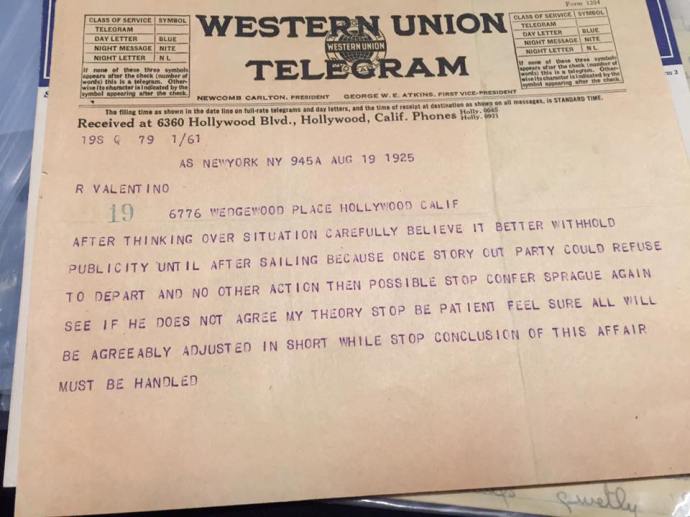
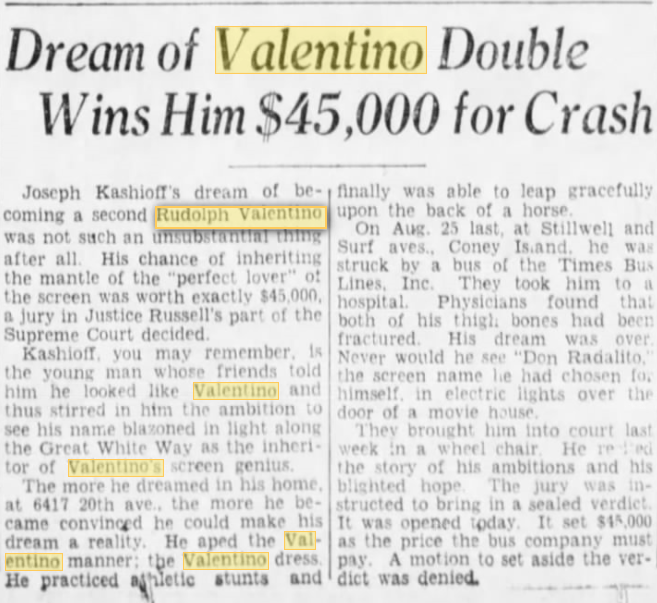
2 May 1926 Valentino has a Cold
On account of the cold with which Rudolph Valentino has been suffering for the last few weeks, he has hardly been able to talk and has practically had to halt work on his new picture “The Son of the Sheik”.
Categories: Uncategorized
Tags: Rudolph Valentino, Son of the Sheik
28 Jan 1926 – Cynthia Grey Tells Why Marriage of Rudolph Valentino’s Failed.
Being a bred-in-the-bone feminist, I am sure glad to finally stumble across a story based upon an interview with Mrs. Rudolph Valentino that gives her a fair break. Somehow the picture of Winifred Hudnut Valentino as the old-fashioned typed Pekingese fondling female did not ring true. And her lord and masters outbreak anent his noble craving for home and fireside and kidlets sounds quite posey and stagey and as though fresh from the fertile brain of that unoriginal lot, press agents, rather than warm and quivering from his own sorrowing heart. But most of the remarks accredited to Mrs. Valentino sound true. Her dissertation on the folly of an American girl marrying a European husband sounds mighty sensible to me. “Foreign men have such different ideas of marriage from Americans. Boys in Europe are taught to consider themselves much more important than girls. These boys, brought up to consider themselves lords of creation, expect wives to be subordinate. A wife is someone to make him comfortable, minister to his wants, provide sympathy when he needs nothing, keep herself well in the background”. And we regard this especially worthy of thought as it comes from Mrs. Valentino’s ruby lips. “Now I don’t mind doing all this. It’s a pleasure to make one’s husband happy and comfortable when one loves him. But what wore me out was my foreign husband’s acceptance of all these things as though they were merely my duty, my day’s work, instead of a consideration for him and a matter of love”. And, apropos of Rudy’s paternal manifestations readers may recall his heralded yearning for offspring with which his wife wouldn’t oblige the ex-wife fires one like this. “Rudy might like noiseless, dressed up children, but – “. And that unfinished sentence is only What Every Woman Knows. Then about the matter of Mrs. Valentino working. “I work because I was energetic. A man’s love doesn’t compensate for the boredom and depression of being a loafer. For a woman to give up all work just to devote herself to loving a man is a great mistake. Because only an egocentric wants a woman to devote her life to admiring him”. Well and ably spoken Winifred Hudnut Valentino or Natacha Rambova. We’re for you. You have a good head and said head has doped out a much better analysis of why your marriage failed than has either your erstwhile Rudy or his press agent.
Categories: Uncategorized
Tags: Mrs. Rudolph Valentino, Natacha Rambova, Rudolph Valentino
24 Feb 1932 – Loses Valentino Box
Howard Kemp, Justice of the Peace, in this Gretna Green woods adds this one to the ‘meanest thieves list’. Of the thousands of boxes that contained wedding rings of couples he married, the miscreant who entered this place made off with only one the box in which Rudolph Valentino purchased the ring he gave Natacha Rambova when the justice married them a number of years ago.
Categories: Uncategorized
Tags: Natacha Rambova, Rudolph Valentino
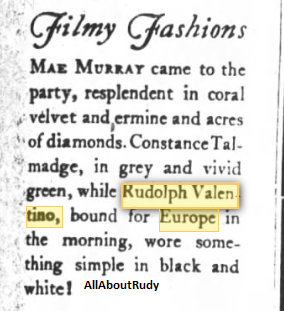
8 Jan 1926 – Shipboard Fashion
Categories: Uncategorized
Tags: Constance Talmadge, Mae Murray, Rudolph Valentino
Did you- know that Rudolph Valentino spends most of his time arranging the chairs-The Deck Steward, SS Leviathan 1925
Categories: Uncategorized
Tags: Rudolph Valentino
2013 – What Happened to Valentino’s “Ghost” Portrait
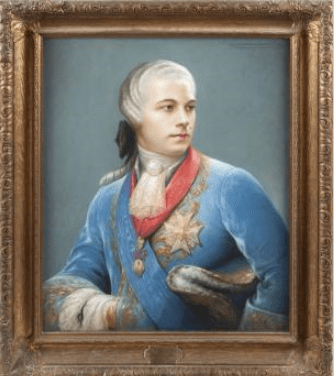
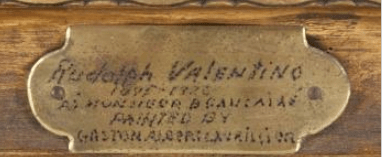
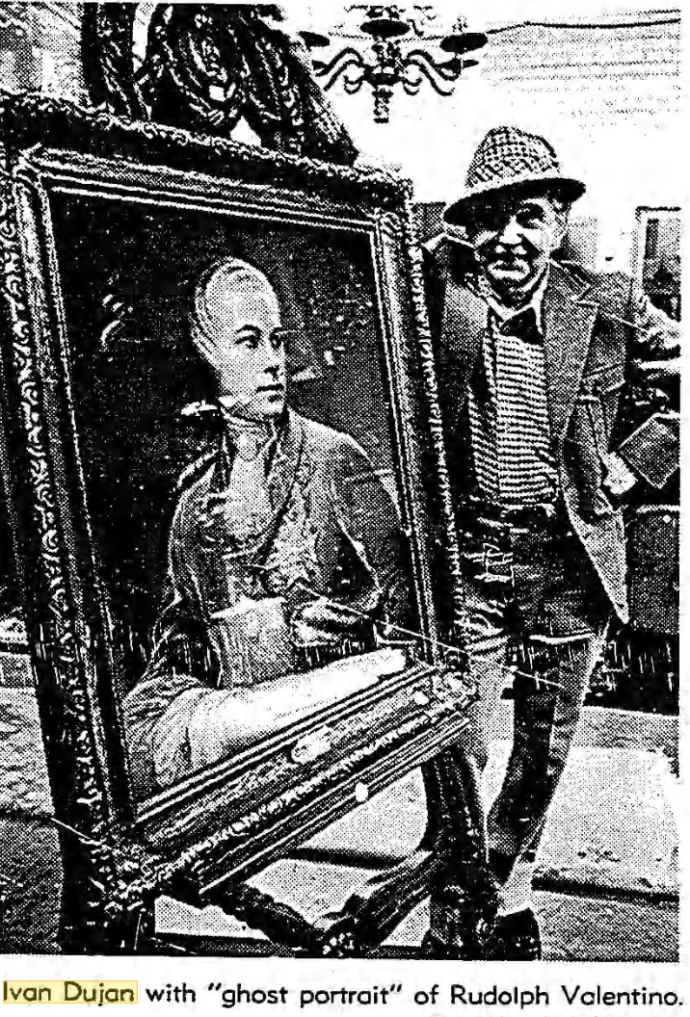
This portrait of Silent Film Star Rudolph Valentino was painted in costume from the movie Monsieur Beaucaire by Gaston Albert Lavrillier. The painting is in its original frame. In 1976, Ivan Dujan sold this painting at auction and was acquired by Billie Nelson Tyrell. This painting was again put up for auction in 2013….
Categories: Uncategorized
Tags: Monsieur Beaucaire, Rudolph Valentino
12 Sep 1976 – Valentino “Ghost Portrait” For Sale
“
Categories: Uncategorized
Tags: Rudolph Valentino
3 Sep 76 – Valentino’s “Ghost” Portrait
The cinema sheik, Rudolph Valentino died without ever seeing his famous “ghost portrait” and since that day a half century ago, the work has been viewed publicly only once. The portraits owner Ivan Dugan said he plans to commemorate the 50th anniversary of Mr. Valentino’s death by putting the work up for public auction. Mr. Dujan, who abandoned his career as a silent-film cameraman to turn artist, bought the 30×40 pastel from Gaston Albert Lavrillier the French artist a few years after the actor’s death. Since then, the work, “Rudolph Valentino In Role of Monsieur Beaucaire” has remained nestled in Mr. Dujan’s home its only other public outing a brief hanging 40 years ago at Grauman’s Chinese Theater. Mr. Dujan said that Mr. Valentino’s brother Alberto once came to view his brothers image. “He knelt in front of it and said ‘Rudy, why don’t you speak to me’?
Categories: Uncategorized
Tags: Monsieur Beaucaire, Rudolph Valentino
06 May 1925 Star Ships Autos To and From Here
The highest paid Hollywood movie picture star Rudolph Valentino never seems to forget economy, as is evidenced by his Italian made car, a $14,000 Isotta Fraschini limousine, that recently arrived here in an Auto Club forwarding car from New York City and other friends of his have followed suit such as Nita Naldi sent her made in France car a Ovion-Voisin to New York, also by the carload method of the club forward agency. Gloria Swanson, Mary PIckford, and Mme. Nazimova are following and have used the forwarding service
Categories: Uncategorized
Tags: Nita Naldi, Rudolph Valentino
1922 – Valentino’s Thoughts about Women
The greatest asset a woman has is her dignity.
One can always be kind of a woman one cares nothing about.
A love affair with a stupid woman is like a cold cup of coffee.
I do not like women who know too much.
I have been won always by the woman who has great ability to feel.
Categories: Uncategorized
Tags: Rudolph Valentino
22 Aug 1938 Valentino’s Favourite Dinner
Spaghetti and love have a historical tie-up. The revival of Rudolph Valentino’s “Son of the Sheik” and “The Eagle” plus his good friend Beulah Livingstone who wrote a book about him shares another recipe and a memory.
Rudy was a good cook who often made his own meals and loved to entertain his friends with a good home cooked meal. Rudy before he made it big in Hollywood would often make simple meals first he would make a novel salad of a huge bowl of lettuce in which he’d cut up fresh figs and tomatoes and add cream cheese. Then he would cook the main dish lovingly. A typical dinner menu would often be Spaghetti Rudolph Valentino, Italian Bread, salad with fresh lettuce, figs, tomatoes, herbs, cream cheese and French dressing – fresh plum tarts, coffee, milk. Rudy loved to share his recipe for Spaghetti. One package (8 ounces) spaghetti, 2 tablespoons, olive oil, 2 large onions, 2 green peppers, 1 pound ground round steak, 1-2 pounds of grated Parmesan or American Cheese, 1-2 cans tomato soup, salt, pepper, paprika, and a dash of cayenne. Plunge spaghetti into a large kettle of rapidly boiling salted water. Cook until tender. Drain at once. Heat olive oil in a large frying pan. Chop onions and green peppers. Fry in oil until well browned. Remove. Fry ground round steak, stirring frequently until thoroughly brown. Then return onions, peppers to pan and stir in the tomato soup. Mix well, season and simmer for 15 minutes. Use large baking dish. Rub it thoroughly with garlic, then butter evenly. Combine spaghetti and sauce and turn into baking dish. Sprinkle cheese over the top. Bake in moderately slow oven (325) for 1 hour. Rudy insisted the long, slow baking made the difference.
Categories: Uncategorized
Tags: Rudolph Valentino
1939 – Valentino’s Recipe for Italian Meatballs
Valentino loved cooking his beloved Italian Food. Also, he enjoyed exchanging and sharing some of his famous recipes. Here is one to try out.
One quarter pound of ground beef, 3-4 pounds of ground pork, 3 eggs unbeaten, 1 cup of grated Parmesan cheese, 1 finely chopped clove of garlic, 1-2 teaspoons of salt, 1-2 teaspoons of black pepper, combine these ingredients, into a large bowl and shape into meat balls. Put the meat balls in a large frying pan with a little olive oil. Leave them in the frying pan until they are thoroughly browned. Once they are done set them aside until slightly cooled. Rudy would serve them as a separate dish or include them in various meals he cooked.
Categories: Uncategorized
Tags: Rudolph Valentino
1938 – Eggs Pola-Naise
Beulah Livingstone, an old friend of the late great Silent film star Rudolph Valentino who has just written a book about him, tells me about his love for Pola Negri. He liked to cook for her, and Miss Livingstone recalls the special dish Rudy would make for Pola, calling it humorously Eggs Pola-naise.
Ten eggs, 1 cup of fresh corn cut from cob, 1 onion, 1 can tomato soup, 1 green pepper, 1/2 clove garlic, and 1 tablespoon of butter. Heat butter, fry chopped onion, pepper and garlic until only slightly brown. Stir in tomato soup, add corn, and seasoning. Simmer for 1/2 hour. Remove from heat. Cool. Break eggs in bowl and beat only slightly. Combine with cooled sauce. Turn into buttered egg pan and scramble eggs until soft and smooth. Serve with large piece of Italian Bread. Serves 6.
Categories: Uncategorized
Tags: Beulah Livingstone, Pola Negri, Rudolph Valentino
15 Apr 1951 – Descendent of one of Rudolph Valentino’s Horses
Hailed as one of the most remarkable performances every seen on the movie screen by a horse is the equine role played by the horse Chieftain a direct descendent of Rudolph Valentino’s famous white horse Chief in the thrilling action adventure picture “The Fighting Stallion”.
Categories: Uncategorized
Tags: "Chieftain", Rudolph Valentino
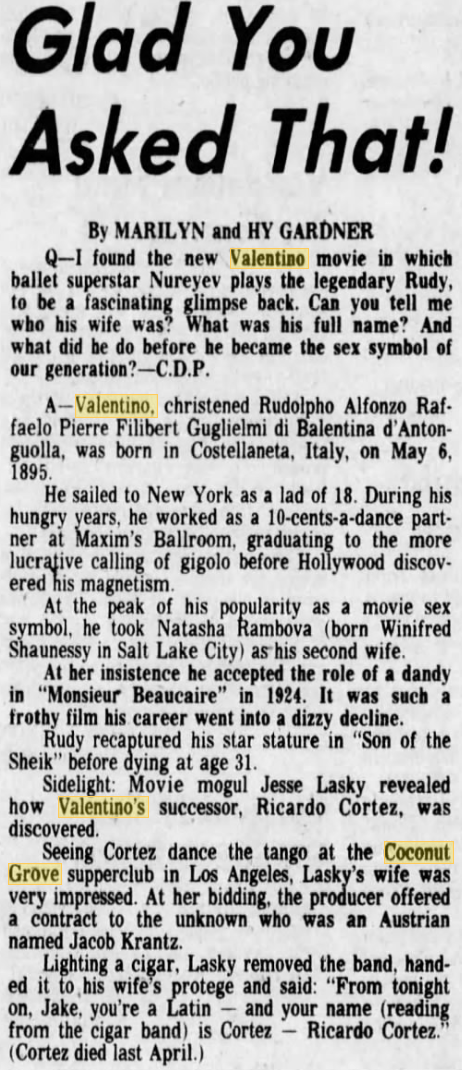
15 Oct 1977 – Glad You Asked That
Categories: Uncategorized
Tags: Natacha Rambova, Rudolph Valentino
1920 – An Adventuress
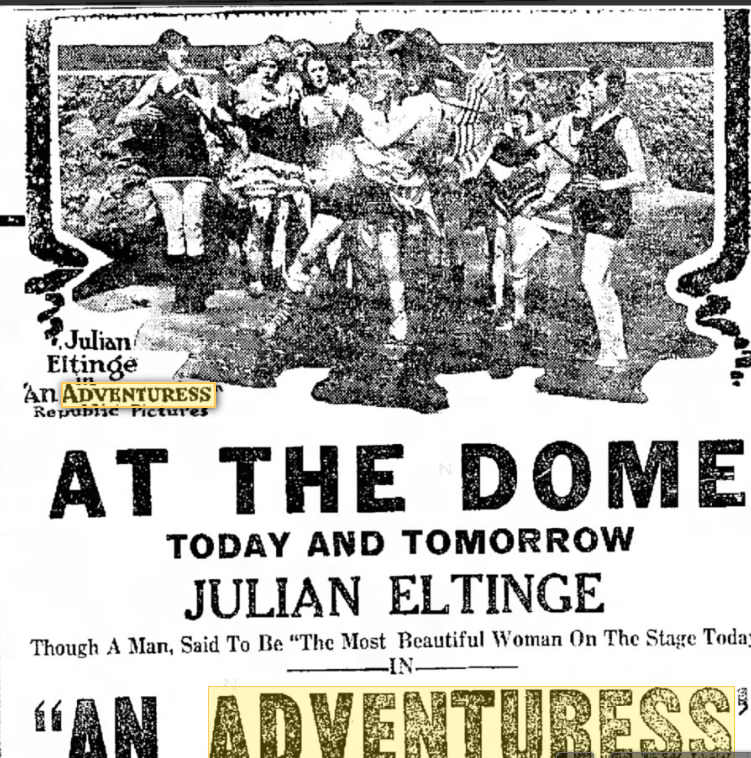
Made by Republic Pictures, directed by Fred Balshofer, and starring Julian Eltinge, Virginia Rappe, R.de Valentina (Rudolph Valentino), Leo White and a cast of others in a movie that is both delightful and funny. The background of this movie is the Balsatian sea where 3 young men take it upon themselves to save the republic of Alpania from conspirators.
Categories: Uncategorized
Tags: Julian Eltinge, Rudolph Valentino, Virginia Rappe
April 1920 – Passions Playground
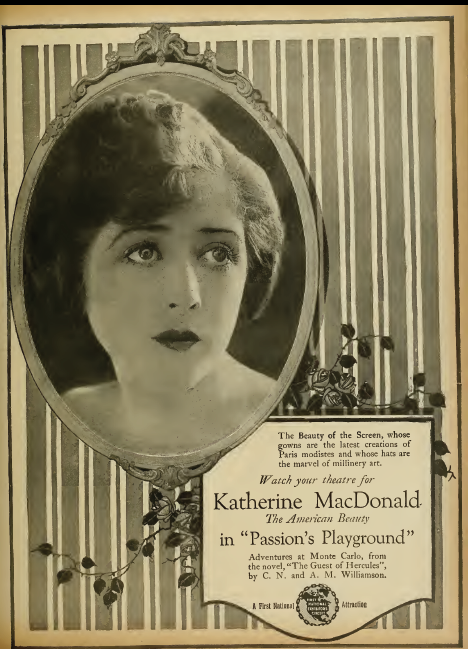
A 1920 silent film produced by Katherine MacDonald Productions, distributed by First National Exhibitors and adapted from a novel and written for the screen by Charles and Alice Williamson. This movie at the box office made $1 million. With a story, star and production that bid fair to set the pace for screen attractions for months. he background for this film was Monte Carlo the playground of the rich and famous where nobility and the like gather in Casino’s to try their luck. Mary Grant an orphan who has the blood of her gambler-father in her veins leaves an Italian Convent for Monte Carlo where she tries her luck and ends of breaking the bank. Mary was young and unworldly became famous because of her newly found fortune found that type of money attracted the wrong sort of people. One of those persons was a man named Lord Dauntrey and several others were plotting to try and steal her money. Mary found that money doesn’t guarantee you friends or entry with the rich and famous. One of the rich who did not find immediate favor with her was the sophisticated Prince Angelo Della Robbia (Rudolph Valentino). The Prince seemed to always be around when Mary needed rescuing from the unscrupulous. Eventually, Mary ends up under the protection of the Prince who fell in love. But that did not stop those from trying to ensure that the Prince and Mary did not end up together. The wife of his brother Prince Vanno Della Robbia (Norm Kerry) visits her and finds out that a former student from the same convent several years earlier had eloped with a man who then deserted her. When a former sweetheart of her husband accuses her of the deed, she places the blame on Mary. Mary flees to an old chateau located in the mountains where she is drugged by Lord Dauntrey and his men who were plotting to steal her money. The Prince, after learning the truth of the matter, comes to her rescue, and a happy ending. Katherine MacDonald in the role of the beautiful but tragic heroine with Rudolph Valentino in his supporting role of the hero Prince a picture that will make you gasp at its splendor, its intrigues and it’s romance.
Categories: Uncategorized
Tags: "Passions Playground", Katherin MacDonald, Rudolph Valentino
09 Jan 1976 – Former Motion Picture Executive Misses Silent Movie Star
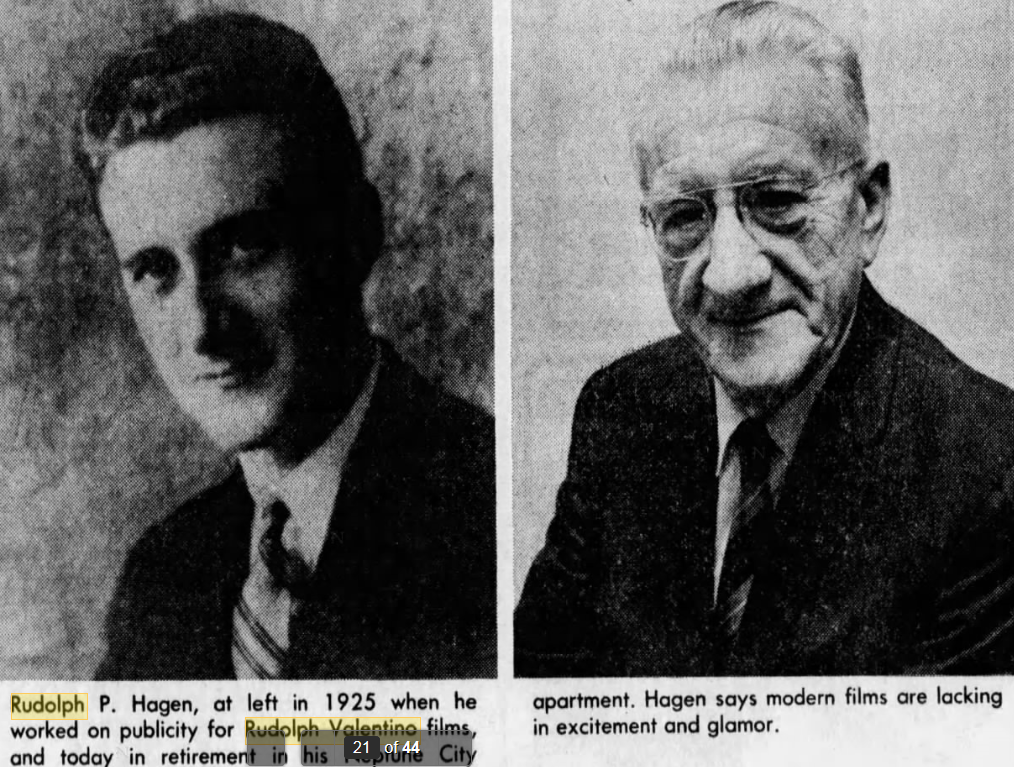
If you happen to possess a “personally autographed” photo of screen actor Rudolph Valentino, chances are that it was actually signed by another Rudolph. Rudolph Hagen, Neptune City who is now 75 spent nearly 40 years in the motion picture industry, behind the scenes in production and distribution of silent and sound movies. In 1925, Hagen was in charge of accounting for Ritz Carlton Pictures in Hollywood was temporarily recruited to sign several hundred photographs of Valentino to fill the requests by his adoring fans. “I studied Valentino’s signature and remember that it was very unique with the letters d and a being different. After some practice, I was able to duplicate it almost exactly” he recalled. Valentino was under contract with Ritz Carlton at the time starring in its first production “Cobra” with Nita Naldi, a well-known vamp of the day. Mr. Hagen saw a great deal of Valentino at the studio and was impressed by his friendly manner. “He was very nice to everyone and very much the gentleman. He spoke with a slight Italian accent which women found charming” Mr. Hagen explained. Throughout the four months it took to film “Cobra”. Hagen remembers, Valentino followed a strict program of exercise. “Valentino had a very trim athletic physique which he maintained through a vigorous exercise regimen. He encouraged all of us at the studio to exercise to keep fit. He was an excellent dancer and horseman as well. At the age of 30, Valentino appeared to be in the best of health. Following completion of “Cobra” Valentino was to star in “The Hooded Falcon” for Ritz Carlton a film written by his controversial wife Natacha Rambova. “We obtain a vicious wild falcon for the movie and had to hire a bird trainer to care for it. The studio spent approximately $50,000 in preparation for production”. Because of the constant demands and interference on the part of Valentino’s wife who wanted control over every phase of production, and the projected $900,000 cost of the film, “The Hooded Falcon” never materialized. Following the cancellation of Valentino’s contract. It was Hagens responsibility to tie-up the loose ends of the production giving the studio staff its final paychecks, taking inventory of the wardrobe, and returning all props, including the wild falcon. “Cobra” was Valentino’s last completed picture for the studio. He died suddenly in 1926. “It was sadly ironic that a man who was so devoted to physical fitness should die at such an early age. His life style was incredibly luxurious with rich food and drink every day. He crowded 70 years of living into a mere 36”. After the bankruptcy of Ritz Carlton, Hagen declined an offer from studio boss J.D. Williams to join him in England where he was starting a new production company, British National Pictures. However, Williams gave him letters of introduction to several motion picture executives. One letter led to Harry Warner, President of Warner Bros. who offered him a job that was to last 32 years. In the same year, Hagen met his first wife Irene Hussey whom he married in 1927. Hagen’s rise in the motion picture industry was a far cry from his humble beginnings when his first job in 1928 was in bookkeeping for First National Pictures, which distributed silent films. There he became associated with one of the founders at First National and later Ritz Carlton. When asked to assess the changes in movies over the years Hagen said “I miss the glamour of the old films they had star value. I’m nostalgic for the movies of Rudolph Valentino, James Cagney, Barrymore etc. They lack the important ingredient and that is star quality.
Categories: Uncategorized
Tags: Natacha Rambova, Nita Naldi, Ritz Carlton Pictures, Rudolph Valentino
18 Feb 1929 Dorothy Rides Rudy’s Horse
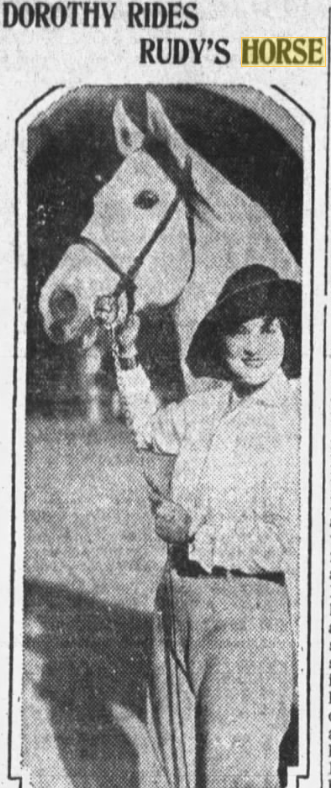
Rudolph Valentino’s famous horse that he rode in his movie “The Sheik” was picked as Dorothy Dwan’s mount in the Los Angeles Horse Show parade. Miss Dwan is an expert horsewoman having been leading lady with Tom Mix, the cowboy star for two years.
Categories: Uncategorized
Tags: Jadaan, Rudolph Valentino
28 Mar 1953 Hungarian Silent Screen Actress Rudolph Valentino Once Screen Lovers
Vilma Banky whose torrid love scenes with Rudolph Valentino scorched the silent screen said Saturday she was content to sit back and watch the Hollywood parade go by. The woman whose passionate embraces with Valentino in “The Eagle” and “Son of the Sheik” were the envy of millions of American women lives comfortably in her furnished Beverly Hills Mansion with her husband, former silent screen actor Rod La Rocque. They have been married for 25 years. But the movie goers of the golden age will never forget La Banky who was brought to America by Sam Goldwyn in 1925. Vilma 51 sat in her cozy living room trim and lovely in a dark dress trimmed in a white Peter-Pan collar and cuffs. She declared she has no regrets for the glorious past, but she had that faraway look when she talked of Valentino. She recalled her love scenes with Valentino in “The Son of the Sheik” saying “they say our love scenes made it one of the great romantic epics. Who can gainsay that my handsome leading man was very colorful. He was colorful in fact, that I believe he would have held his own even in talking pictures”. The Hungarian actress could not speak a word of English when she was performing the sizzling scenes with Valentino. We had to have an interpreter she laughed adding I’ve had my fling. Some people are stage-struck their entire lives. But I happen to be one of those people who knew when to quit. Although her last film was made more than 20 years ago, the former actress toured the U.S. in Anita Loos play “Cherries Are Ripe”, during the 1929-1930 season. Her leading man was husband Rod La Rocque. “I had never been in a play before” but after this one I had enough of the theatre. The one week stands were too much for me. Photography is really my great passion Rod admitted “Next to Vilma of course”. Vilma won lasting glory through her screen performances but she made a total of 10 films and towards the last was making only two pictures a year. Her first film was with Ronald Coleman in “The Dark Angel”. It was after this she was chosen by “The Sheik” to play opposite him in “The Eagle”. She was co-starring with Coleman again in “The Winning of Barbara Worth”. The last film she made was “They knew what they wanted” with Edward G. Robinson. It was produced in the late 1920’s and it was made both in English and German. The foreign film market was much better then Vilma pointed out. After jilting a well-publicized Hungarian nobleman, who had pursued her to this country, the famous glamour girl of the 20’s married Rod La Rocque and with the arrival of the talkies retired to housewifely duties. Although not a slender wisp of a girl whom thousands remember and revere, Vilma Banky is still a very attractive woman with dark blonde hair, a good figure and a quiet assured manner. She plays a championship golf game and has won many prizes. “She is so good” said hubby Rod, that I don’t dare play with her anymore.
Categories: Uncategorized
Tags: Rod La Rocque, Rudolph Valentino, Vilma Banky
25 Mar 1928 – Male Movie Stars more fussy about hair
A woman is fundamentally the same, whether she is a movie star or a Park Ave society bud the happiest moment in her life is when her hair turns out just right. But that does not mean that women have a corner in the personal vanity market. NO woman in the world could be more fussy about their hair than a male movie star. These are the deductions of an expert, Ferdinand Joseph Graf, for three years, the official hairdresser to moviedom who is now at Arnold Constables. Mr. Grafs first job with Famous Players was to prepare the wigs for Valentino in “Monsieru Beaucaire”. Natacha Rambova the stars wife, brought him out to the studio from the 5th Ave beauty parlor she patronized for that purpose. He liked the work so well and the stars apparently liked him so he well became the official hairdresser at the studio for three years.
Categories: Uncategorized
Tags: Natacha Rambova, Rudolph Valentino
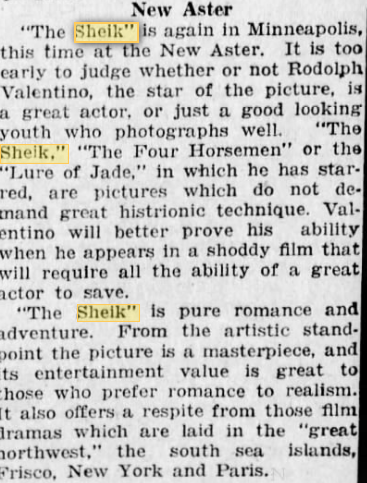
1920’s – Rudolph Valentino’s Favorite Clothier J. Dege & Sons, LTD London
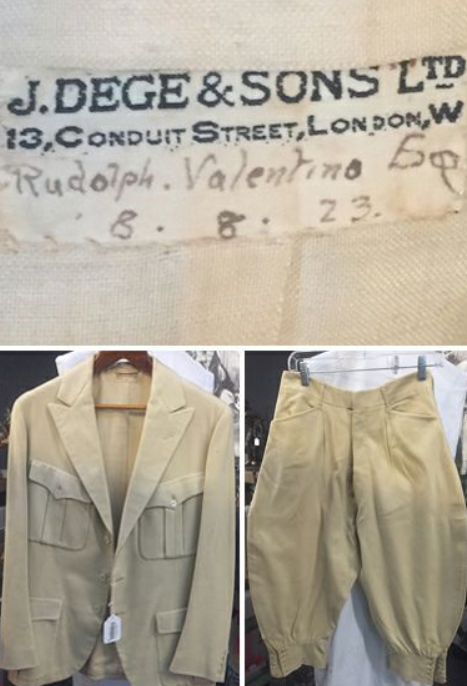
Rudolph Valentino was a stylish man about town who enjoyed his movie star success and living the American dream. It is well documented he enjoyed the finer things in life that his hard-earned salary could buy. The newspapers would write articles dedicated to Rudolph Valentino about how immaculately well-dressed he was. Rudy would often travel to Europe to purchase antiques, fine art and clothes. One of his favorite destinations was London specifically to buy specifically tailored suits and his go to store for most of his suits was J. Dege & Sons, LTD, London. This company is world famous for its military tailoring and every suit is made by hand. Founded in 1865, Arthur Dege initially operated a tailoring business at 13 Conduit Street, known as J. Dege & Sons. The original owners Arthur Dege and William Skinner met at merchant Taylor’s school in 1880. Before setting up shop together at the turn of 20th Century as Dege & Skinner. In 1912, tragedy struck when William Skinner died in a riding accident. Jacob Dege who was the son of Arthur Dege was forced to resign because of anti-german sentiment from WWI. Tim Skinner who was the son of William Skinner was placed in charge of the company. Last year, Bonhams, New York held an auction called Lights, Camera, Auction. One of Rudolph Valentino’s suits a cream wool made at the companies location at 13 Conduit Street bought during his honeymoon in 1923 was sold at the auction for $20,000. J.Dege still exists today as one of the premier tailors on Savile Row, London.
Categories: Uncategorized
Tags: Rudolph Valentino
3 Sep 1924 – At the Quimby
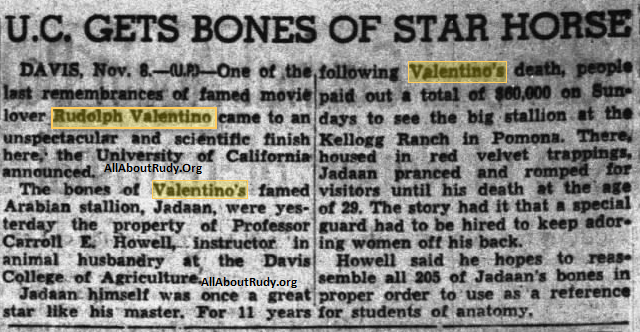
The only reason we did not arise last night at the Quimby Theater where “Monsieur Beaucaire” starring Rudolph Valentino, was having its initial showing, and sing “Hail the Conquering Hero Comes” was because from the very first fade-in we were spellbound by the sheer grandeur of the production. Costumes, settings and locations are the acme of lavishness. It is undoubtedly one of the costliest pictures ever made and well worth it. Given an opportunity to display his real dramatic ability, Valentino presents a most vivid impressionable performance. His magnetic personality his fire and energy in his love scenes place him conspicuously in a rank by himself. The story by Booth Tarkington, from which Forrest Halsey made the screen adaptation, is known to most people but it has never been so well told or so grippingly portrayed as in this picture. An admirably selected supporting case interprets the various roles with amazing success.
Categories: Uncategorized
Tags: Monsieur Beaucaire, Rudolph Valentino
17 Mar 1923 – Valentino and Wife to Appear in Dallas Next Week
Rudolph Valentino and his wife will appear in Dallas on 24 March. They with the ten-piece Coleman’s Band from the Montmarte, New York City, are touring the country, traveling on the “Mayflower” the private car of Ex-President Wilson. Since Valentino is prohibited from appearing in any theatre, he is following his old vocation, that of dancing and as a dancer he will appear at Gardner Park Auditorium in a very unique program. The band will play one hour for the general public to dance, followed by a dancing contest. Mr. Valentino presenting the prize to the winner. After this Rudolph will give his famous dance of “The Four Horsemen” followed with the Argentinian Tango with Mrs. Valentino as his partner.
Categories: Uncategorized
Tags: Mineralava Dance Tour, Natacha Rambova, Rudolph Valentino
22 Jul 1925 Valentino’s Problem
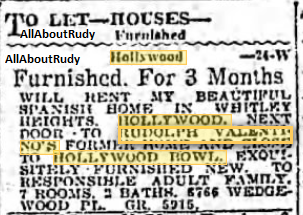
Rudolph Valentino’s future has been a matter of furious debate. It has been a question as to whether he should continue to be a sheik and a lady-killer, or whether he should abruptly abandon the whole he-vamp idea and undertake an entirely different line of stories. That was really the question between the two stories that were debated. Had he gone through the plan to make “The Bronze Collar” he would have been seen with a dirty face, but an honest soul. After much mental travail, this project was abandoned. “The Black Eagle” which he is making now, will show him once again as a squire of dames.
Categories: Uncategorized
Tags: Rudolph Valentino
1951 Real Rudolph Valentino As His Close Friends Knew Him
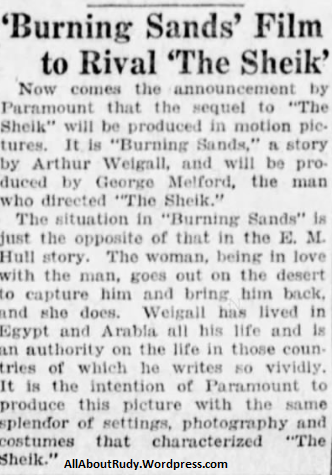
He was nice enough to the people he knew and liked, but when he didn’t like someone watch out. For example, one of those he didn’t like was noted press agent, Harry Reichenbach a dynamic man who was doing some special publicity work on Valentino. Once the actor was making up for a scene. As usual, his valet, Chris, knelt before him with the makeup kit open. Reichenbach bustled up, placed his hand on Valentino’s shoulder and started talking. “Screen me in”, Valentino ordered to Chris. Reichenbach watched open-mouthed as the valet placed a screen around the disdainful Valentino. “He wasn’t a woman chaser” said Dev Jennings who photographed Valentino in “The Cobra”. And is still a cameraman at Paramount. “When I knew him he was very much in love with his wife Natacha Rambova and was very jealous of her. “Rudy lived very quietly and did not get involved with the wild Hollywood crowd. He would have just a few friends up to his home in the Hollywood Hills. He seldom went to big parties. “He had a great love of Italian cooking and loved garlic. He used to have Italian food in his dressing room at lunch time. That was hard on his leading ladies, and Nita Naldi said she was going to chew garlic for revenge”. “Rudy’s hobbies were riding, fencing, and boxing. Another Valentino hobby was hunting, and he often went on mountain trips with fellow star Stuart Holmes. Holmes now a movie bit player, declares that “whatever he did, he did with all his heart”. He added that Valentino had a passion for foreign cars, but was a conservative spender. “He was always sincere in his work” Holmes said. He remembered once when Valentino wanted to wear a grey derby in a movie scene, but the director said no. the star held up the picture until he got his way. Concerning Valentino’s romantic abilities, Holmes commented, “I never saw him break his neck over any woman”. But the legend of Valentino the lover still prevails after 25 years and will no doubt grow in the next 25.
Categories: Uncategorized
Tags: Nita Naldi, Rudolph Valentino
19 Feb 1924 – Rudolph’s Strenuous Life
Rudolph Valentino is leading quite a strenuous life these days. He arrives at Paramount Long Island Studio’s at 7 o’clock each day so that he can get in two hours of practice before the start of camera work. He is receiving instruction from Professor Martinez Castello of the NY Athletic Club, as his role in “Monsieur Beaucaire” requires that he become the best swordsman in all of France.
Categories: Uncategorized
Tags: Monsieur Beaucaire, Rudolph Valentino
2 Mar 1926 – Here and There
“The Servant Problem” seems to becoming a vital one in Hollywood. First, Alma Ruebans cook is said to have eaten up the duck especially prepared for Ricardo Cortez, and then Rudolph Valentino’s cook, after having been discharged, came back, armed with a pair of evil-looking shears, and prepared to take out her revenge on the new cook Mrs. Ralph Rogers, and the chauffeur, it is asserted. The rejected culinary queen let herself into Valentino’s Beverly Hills Home, and proceeded to use her scissors on the uniform of the chauffeur, it is said. Valentino came in just about that time, and the woman was taken into custody by the Beverly Hills Police. All of which goes right back to the servant problem.
Categories: Uncategorized
Tags: Mrs. Ralph Rogers, Rudolph Valentino
2 Nov 1925 – Pola Entertains
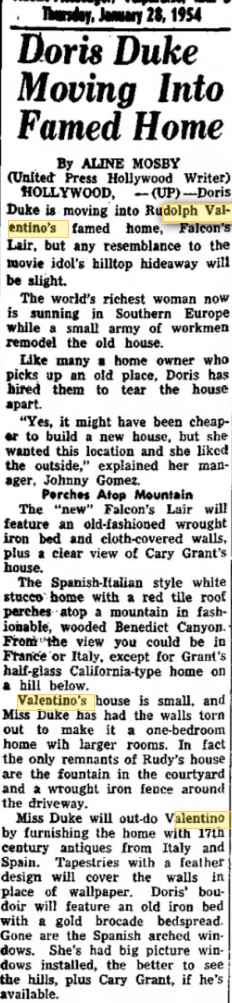
Pola Negri entertained in honor of Michael Arlen with a dinner dance at the Biltmore. As predicted this was the very beginning of emerald no to say very verdant social affairs in Cinema land, where charming people have gathered the past week and worn “green hats”. Miss Negri’s affair was distinguished and comme il faut as those of this delightful hostess always are. The Arlenesque motif was emphasized more than in the green hats in which green ice cream was served. In a gown of pale green duchess satin trimmed with rhinestones and black velvet wearing emeralds and diamonds as adorning jewels, the hostess received thirty guests in an embowered suite, the prevailing flowers being bronze and yellow chrysanthemums arranged with a profusion of maidenhair fern to give again the green motif. Training the cloth of the long table were thirty yards of ribbon made from saucy-faced pansies pale yellow roses and maidenhair. Green candles marked the table at intervals in jade and alabaster candlesticks. Dining and dancing were the order of the evening and among those who participated in the festivity in addition to the hosts and honor guest was Rudolph Valentino, Mr & Mrs. Charles Eyton, Mr. & Mrs. Frank Elliot, Mr & Mrs. Manuel Reachi, Mr. & Mrs. St Clair, MAJ Fullerton Weaver, Sid Grauman, M. Cimini, Mme Cimini, Ralph Block. Following the day of Miss Negri’s party, Mr. and Mrs. Frank Borzage were host and hostess at the usual Sunday morning bridle-path party. But this time the affair was in honor of the lion of Cinemaland, whose roar is assiduously sought. At least, until another lion comes this way. After a long cantor through Griffith Park bridle paths an outdoor buffet breakfast was served in the park. Glimpsed along the autumn paths in addition to Mr. Arlen and the hosts were Bebe Daniels, Mrs. Phyllis Daniels, Rudolph Valentino, Mr. and Mrs. Harold Lloyd, Ben White, Marie Mosquini, Mrs. Joseph Sanders, Ed Kane, Mr. and Mrs., William Howard, William Collier, Irving Thalberg, Mrs. H.G. Rogers, Kathleen Clifford, M.P. Illich, Ray Owens. Following the return canter the entire party gathered at the Borzage home where they were joined by Julia Faye, Mr. and Mrs. Dave Butler, Roy Stewart, Mr. Borzage’s brother William who contributed to the incidental musical entertainment featured throughout the day. Luncheon was served buffet.
Categories: Uncategorized
Tags: Pola Negri, Rudolph Valentino
19 Apr 1923 – Valentino Statement
Rudolph Valentino former motion picture star, now touring the country dancing, was criticized for his alleged statement that motion pictures today have little consideration for morality. Jacob Silverman of Altoons opposed Sunday opening of film houses, saying the only ones who benefit by Sunday movie shows are the picture producers, and that everyone is entitled to 52 holidays a year.
Categories: Uncategorized
Tags: Rudolph Valentino
20 Feb 1964 Cugat Cites Valentino
Xavier Cugat says that Rudolph Valentino gave him the impetus to change from being a newspaper artist to a band leader. Cugat started out as a concert violinist. At 12 years of age, he was concert master in Havana, Cuba and told himself that if he wasn’t the world’s greatest violinist by the time he was 25, he would quit. He wasn’t, and so he did. Cugat took up cartooning. He was a staff artist on a Los Angeles paper, and one of his assignments was to sketch Valentino. The actor liked Cugat’s cartoon and they became friends. “Valentino danced the tango”, Cugat says, in “The Four Horsemen of the Apocalypse”. It was a silent movie, and it became popular. “So he suggested that I start a tango orchestra”. I did, and our first engagement was the Coconut Grove. “Valentino came into dance, and so did Joan Crawford. We were an immediate hit. “It got so the establishment had to have mounted policemen outside to hold the crowds back”. That Cugat says, is the genuine truth about how he became a band leader.
Categories: Uncategorized
Tags: Rudolph Valentino, Xavier Cugat

17 Feb 1922 Valentino’s Make-up Deceptive
Rudolph Valentino reputed to be one of the screen’s handsomest actors can look hard-boiled enough when the occasion demands. Valentino was in San Francisco playing the leading male role in exterior scenes of George Melford’s Paramount Picture “Moran of the Lady Letty” featuring Dorothy Dalton, showing at the Imperial Theater today and tomorrow. Starting for his room in one of the Bay Area’s most palatial hotel after a hard day’s work in his rough sailor attire, he was stopped by an elevator starter. “Here you” said the man, “do you stay at this hotel”? “Why yes,” smiled Valentino “why do you ask”? “You look like a smuggler” replied the starter. “Thank you for the compliment” returned the actor. “That’s just what I want to look like. My make-up must be very realistic”. It certainly is said the elevator man, who had discerned the grease paint on Valentino’s face, and recognized him.
Categories: Uncategorized
Tags: George Melford, Moran of the Lady Letty, Rudolph Valentino
14 Feb 1952 Valentino’s Valentine
14 Feb was the perfect day to learn that Edna Stansbury, has been chosen one of Rudolph Valentino’s Valentines. The modern version of the heart-throb of the Flapper Era, Anthony Dexter, was this year’s judge for the 1952 Valentine Girl and her court of sweethearts. Candidates for the honors numbered 760 representatives of Beta Sigma Phi sororities throughout the U.S. and Canada. Dexter chose Mrs. Pat Lawrence a member of California Kappa Nii Chapter at Gendale, as Valentine Girl. Miss Stanbury, named one of the 5th Valentines and her portrait published in the Torch of Beta Sigma Phi. She was also offered a job as a sorority organizer for Nu Phi Mu. The younger group of business women. Had she been able to accept the work she would have toured the United States and Canada helping form Nu Phi Mu chapters. Miss Stansbury was chosen by Theta Chapter of Greely to represent her group but only for her beauty but sparking personality and service to the sorority. She is the daughter of Mr and Mrs. J.W. Stansbury and works for a Fruit and Vegetable Inspection Service.
Categories: Uncategorized
Tags: Rudolph Valentino
 All About Rudolph Valentino
You must be logged in to post a comment.