
Posts Tagged With: Death of Rudolph Valentino
10 Nov 1945 – Valentino Secret Wife

Categories: Uncategorized
Tags: Death of Rudolph Valentino, Marion Benda, Rudolph Valentino
1953 – Valentino Chapter The Public is Never Wrong
Late in 1921, our advertising copywriters took off their gloves, spit on their hands and hammered out some remarkable advice to the public. By this time all readers over forty, and doubtless most of those under, will have guessed the rest. The picture was, of course, The Sheik, with Rudolph Valentino. Top billing went not to Valentino but to the leading lady, Agnes Ayres. Valentino was twenty-six years old and had been in Hollywood for several years, dancing as a professional partner and sometimes playing bit movie parts, chiefly as a villain. Recently he had gained attention as a tango-dancing Argentine in The Four Horsemen of the Apocalypse, made by another company. When we hired him for The Sheik we expected that he would perform satisfactorily, but little more. We certainly did not expect him to convulse the nation. Valentino was as strange a man as I ever met. Before going into his personality, however, it would seem worthwhile, taking into account what happened afterward, to review The Sheik. The story was taken from a novel of the same title by Edith M. Hull, an Englishwoman. After publication abroad the book became a sensational best seller in America. We paid $50,000 for the screen rights, a very large sum for the time, with the idea that the novel’s popularity would assure the picture’s success. The story gets underway with Diana Mayo (Agnes Ayres), a haughty English girl visiting in Biskra, remarking that marriage is captivity. Since Diana is a willful adventurous girl who dislikes the restraining hand of her cautious brother, one knows that trouble is brewing the moment she spots Sheik Ahmed Ben Hassan (Rudolph Valentino) and their eyes meet. The distance between them is roughly 150 feet, yet she quails, to use understatement, visibly. One might have thought he had hit her on the head with a thrown rock. There was nothing subtle about film emotion in those days. Learning that non-Arabs are forbidden at the fete the Sheik is holding in the Biskra Casino that night, Diana disguises herself as a slave girl and wins admission. The Sheik discovers her identity as she is about to be auctioned off along with other slaves. He allows her to escape, but later that night appears under her window singing “I’m the Sheik of Araby, Your love belongs to me. At night when you’re asleep into your tent I creep. Valentino moved his lips hardly at all when he sang. As a matter of fact his acting was largely confined to protruding his large, almost occult eyes until vast areas of white were visible, drawing back the lips of his wide sensuous mouth to bare his gleaming teeth, and flaring nostrils. But to get back to the film story. Next day, the Sheik attacks Diana’s caravan and packs her off to the desert oasis camp. Though he regards her as his bride, she fends off his advances. Yet it is soon apparent that she is falling in love with him. After a week of virtual slavery Diana begins to like it at the camp. Then she learns that Raoul de Saint Hubert, a French author and friend of the Sheik is coming to visit. Ashamed to be found in her slave like condition by a fellow European, Diana stampedes her guard’s horse while riding in the desert and makes a dash for freedom. Her horse breaks a leg and she staggers across the sand toward a distant caravan. This is the caravan of the dread bandit Omair (Walter Long). Omair makes her a captive for plainly evil reasons. But soon the Sheik having been informed of Diana’s escape by the stampeded guard, attaches the caravan and rescues her. The French author (Adolph Menjou) rebukes the Sheik for what seems to him a selfish attitude toward the girl. Next day while Diana and the Frenchman are riding in the desert, Omair swoops down, wounds the author, and carries the girl off to his strong-hold. The Sheik gathers his horsemen and rides to the rescue. Meanwhile at the strong-hold, Omair pursues the “white gazelle” as he calls Diana, around and around a room in his harem house. One of the bandit’s wives is fed up with him, has advised Diana to commit suicide rather than become the brute’s victim. But Diana, having faith in the Sheik, fights gamely The Sheik and his horsemen assault the strong-hold’s walls. Once inside, the Sheik bests Omair in a hand-to-hand struggle. But at the moment of victory, a huge slave hits him a terrible blow on the head. For some day’s he lies at deaths door. Now the Frenchman tells Diana the true story of the Sheik. He is no Arab at all, but of English and Spanish descent. When a baby he was abandoned in the desert. An old sheik found him, reared him, had him educated in France, and eventually left him in command of the tribe. And so the story draws to a happy ending. The Sheik recovers and the two lovers set off for civilization and marriage. The public, especially the women, mobbed the theaters, and it was not very long before the psychologists were busying themselves with explanations. The simplest, I gathered, was that a surprisingly large number of American women wanted a mounted Sheik to carry them into the desert. Doubtless, for only a short stay, as in the case of Diana, after which they would be returned to civilization in style. Adult males were inclined to regard The Sheik with some levity. But the youths began to model themselves on Valentino, especially after he had appeared in Blood and Sand for us. In the latter picture, playing a Spanish bullfighter, he affected sideburns, sleek hair, and wide bottomed trousers. Soon thousands of boys and young men had cultivated sideburns, allowing their hair to grow long, plastered it down, and were wearing bell-bottomed pants. Lads in this getup were called “sheiks”. Thus two of Valentino’s roles were combined to get a modern sheik. As audience today viewing The Sheik laughs at the melodramatic story, the exaggerated gestures, and Valentino’s wild-eyed stares and heaving panting while demonstrating his affection for Diana. Yet some of the impact of his personality remains. He created an atmosphere of otherworldliness. And with reason, for there was much of it about him. Valentino born Rodolph Guguliemi in the village of Castellaneta in southern Italy of a French mother and an Italian father. When 18 he went to Paris and a year later migrated to New York City. It is known that he worked as a dishwasher, landscape gardener, paid dancing partner or gigolo. After a couple of years, he secured occasional vaudeville work as a partner of female dancers of more reputation than his own. Improvident by nature with expensive tastes, Valentino lived from day to day as best he could. All his life he was in debt, from $1. To $100,000, according to his status. Being fully convinced that a supernatural “Power” watched over him he did not worry. Mortal men found this power of Valentino’s hard to deal with. We raised his salary far above the terms of his contract. That seemingly only whetted the power’s appetite. It became downright unreasonable after Blood and Sand, with the lads of America imitating Valentino and women organizing worshipful cults. Evidently the power had mistakenly got the notion that we had agreed to make Blood and Sand in Spain any rate the idea crept into Valentino’s head. He became dissatisfied with his dressing quarters, wishing to be surrounded, apparently in the splendor of a powerful sheik of the dessert. Valentino rarely smiled on the screen and off, and I cannot recall ever having seen him laugh. It is true he could be charming when he wished. In dealing with a lady interviewer for example, he would give her a sort of look as if aware of something quite special in her, and treat her in an aloof but nevertheless cordial manner. On the other hand, he could be extremely temperamental. Harry Reichenbach, the public relations genius who had reversed Sam Goldwyn’s buzzer system, was now working for us. One day he called at Valentino’s dressing room to discuss publicity matters. “Does he know you”? a valet inquired. “Well”, Reichenbach replied “he used to borrow two or three dollars at a time from me and always knew to whom to bring it back”. The valet went away but soon returned with a word that his master was resting. It was my custom, as it had been in the old Twenty-sixth Street Studio, to go out on the sets every morning when in Hollywood. This provided an opportunity to get better acquainted with the players and technicians. Besides putting me closer to production, I hoped that such visits would make everybody feel that the business office was more than a place where we made contracts and counted money. The fact was that we kept as close tabs on the human element as on box-office receipts. Also, I was secretly envious of those who had an intimate hand in production, and, making myself inconspicuous, often watched activities. One day, I was privileged to see a Valentino exhibition such as I had been hearing about. He was arguing with an assistant director what about I did not know, and did not inquire. His face grew pale with fury, his eyes protruded in a wilder stare than any he had managed on the screen, and his whole body commenced to quiver. He was obviously in or near, a state of hysteria. I departed as quietly as I had come. The situation grew worse instead of better, and finally Valentino departed from the studios, making it plain that he had no intention of returning. We secured an injunction preventing him from appearing on the screen for anybody else. This did not bother him very much. He went on a lucrative dancing tour and was able to borrow all the money he needed. Valentino was married but the relationship had not lasted long, although it was still in technical force. Now he was in love with a beautiful girl named Winifred O’Shaughnessy. Her mother married Richard Hudnut, cosmetics manufacturer, and Winifred sometimes used his surname. She preferred, however, to be known as Natacha Rambova, a name of her own choosing. She was art director for Alla Nazimova, the celebrated Russian actress who was one of our stars. Like Valentino, Natacha believed herself to be guided by a supernatural power. They were married before Valentino’s divorce decree was final, and he was arrested in Los Angeles for bigamy. He got out of that by convincing authorities that the marriage was never consummated, and the ceremony was repeated as soon as legal obstacles were cleared away. Natacha Rambova appeared, as Valentino’s business agent wrote later, “cold, mysterious, oriental.” She affected Oriental garb and manners. Yet she had served Alla Nazimova competently, was familiar with picture making, and we felt she would be a good influence on Valentino. At any rate she brought him back to us. Now, as it turned out, we had two powers to deal with. She was the stronger personality of the two, or else her power secured domination over his. It was our custom to give stars a good deal of contractual leeway in their material. Natacha began to insert herself into the smallest details and he backed her in everything. His new pictures, Monsieur Beaucaire and The Sainted Devil, were less successful than those which had gone before. The Valentino cults continued to blossom, but his publicity was not always good. Newspapers poked fun at the sleek hair and powered faces of the “sheiks”. The situation was not helped when it became known that Valentino wore a slave bracelet. Many people believed it to be a publicity stunt. But the fact was that Natacha Rambova had given it to him. Any suggestion that he discard it sent him into a rage. A book he published, titled Day Dreams caused raised eyebrows. Both he and his Natacha believed in automatic writing and it seems that the real author was his power, or the combined powers, working through him. An item titled “Your Kiss” is a good sample.
Your kiss A flame Of Passions fire, The sensitive Seal Of love In the desire, The Fragrance of Your Caress; Alas At times I find Exquisite bitterness in Your kiss.
We did not care to renew Valentino’s contract, particularly since he and his wife wanted even more control over his pictures. He made arrangements with a new company, founded for the purpose, and work was begun on a film titled variously The Scarlet Power and The Hooded Falcon, dealing with the Moors in early Spain. Author of this story was Natacha Rambova. After the two had spent 80,000 traveling in Europe for background material and exotic props, the story was put aside. Another Cobra, was substituted with Natacha in full charge. It did poorly and the venture with the new company was at an end. Joseph Schenck was now handling the business affairs of United Artists, and he took a chance with Valentino being careful to draw the papers in a manner keeping decisions out of the hands of either Valentino or Natacha. Valentino accepted the terms, though reluctantly. Not long afterward the couple separated and Natacha sued for divorce. United Artists filmed The Son of the Sheik, which as it turned out, was the celebrated lover’s final picture. Valentino’s publicity became increasingly less favorable. He called his Hollywood home Falcon Lair, which opened him to some ridicule. The fun poked at the “sheiks” increased as the title of his new picture became known. He was in Chicago when the Chicago Tribune carried an editorial headed “The Pink Powder Puffs”. One of the editorial writers, it seems, had visited the men’s rest room of a popular dance emporium and there was a coin device containing face powder. Many of the young men carried their own powder puffs, and the could hold it under the machine and by inserting a coin get a sprinkle of powder. The editorial, taking this situation as its theme, viewed the younger male generation with alarm. Most of the blame was placed on “Rudy” the beautiful gardener’s boy, and sorrow was expressed that he had not been drowned long ago. IN an earlier editorial the Tribune made fun of his slave bracelet. Valentino’s “face paled, his eyes blazed, and his muscles stiffened” when he saw it according to the later account of his business manager. Seizing a pen, Valentino addressed an open letter “To the Man (?) Who Wrote the Editorial Headed “The Pink Powder Puffs” he handed it to a rival newspaper. “I call you a contemptible coward” Valentino had flung at the editorial writer, inviting him to come out from behind his anonymity for either a boxing or wrestling contest. After expressing hope that “I will have an opportunity to demonstrate to you that the wrist under the slave bracelet may snap a real fist into your sagging jaw,” he closed with “Utter Contempt”. That was in Aug 1925 Valentino came on to New York, and I was surprised to receive a telephone call from him inviting me to lunch. “It is only that I would like to see you” Valentino said “No business”. I would have agreed in any circumstance, but I was sure that he was telling the truth about not coming with a business proposition, since he was well set with United Artists. “Certainly, I answered where”? “The Colony” I had already guessed his choice since The Colony was probably New York’s most expensive restaurant. He liked the best. We set the time. Valentino and I had barely reached The Colony when it became apparent that every woman in the place having the slightest acquaintance with me felt an irresistible urge to rush to my table with greetings. Though overwhelmed, I remained in sufficient command of my senses to observe the amenities by introducing each to Valentino. He was 31 at this time, apparently in the best of physical condition, and, in this atmosphere at least was relaxed. I do not know whether his divorce decree was yet final, but Natacha Rambova was in Paris. Recently, Valentino’s name had been linked with that of Pola Negri one of our major stars. “I only wanted to tell you,” Valentino said after things had quieted down, “that I’m sorry about the trouble I made – my strike against the studio and all that. I was wrong and now I want to get it off my conscience by saying so”. I shrugged, “It’s water over the dam. In this business if we can’t disagree, sometimes violently, and then forget about it we’ll never get anywhere. You’re young. Many good years are ahead of you.” And so we dropped that line of talk. Valentino truly loved artistic things. He spoke of his ambition, when the time of his romantic roles was over, to direct pictures. I had the feeling that here was a young man to whom fame and of a rather odd sort had come too rapidly upon the heels of lean years, and he hadn’t known the best way to deal with it. “Telephone me any time”, I said as we parted, and we’ll do this again. I enjoyed myself”. And I had. A day or two later I picked up a newspaper with headlines that Valentino had been stricken with appendicitis. At first it was believed that he was in no danger. But he took a turn for the worse, Joseph Schenck and his wife Norma Talmadge came to our home to wait out the crisis. Schenck was bringing encouraging reports from the hospital, when suddenly there was a relapse. Valentino died half an hour past noon on August 23, 1925. It was a week to the minute since our meeting for lunch. I, for one, was stunned by the hysteria which followed Valentino’s death. In London, a female dancer committed suicide. In New York, a woman shot herself on a heap of Valentino’s photographs. A call came through to me from Hollywood “Pola Negri is overwrought, and she’s heading to New York for the funeral”. “Put a nurse, and a publicity man on the train,” I said, and “ask Pola to guard her statements to the press”. After Pola’s arrival, my wife and I called at her hotel to offer condolences. Though very much upset, she intended to remain in seclusion as much as possible. Valentino’s body was laid in state at Campbell’s Funeral Home at Broadway and 66th Street, with the announcement that the public would be allowed to view it. Immediately, a crowd of 36,000 mostly women gathered. Rioting described as the worst in the city’s history began as police tried to form orderly lines. Windows were smashed. A dozen mounted policemen charged into the crowd time and time again. After one retreat of the crowd, 28 women’s shows were gathered up. Women then rubbed soap on the pavement to make the horses slip. The funeral home was now barred to the public. Those who got in had nearly wrecked the place by snatching souvenirs but next day another crowd gathered when news spread Pola Negri was coming to mourn. She was spirited in through a side door. Word came out that she had collapsed at the bier, which she had and for some reason it excited the crowd. On the day of the funeral 100,000 persons, again mainly women lined the street in the neighborhood of the church in which it was being held. I was an honorary pallbearer, along with Marcus Loew, Joseph Schenck, Douglas Fairbanks, and others from the industry. Natacha Rambova was not present, being still abroad. But Valentino’s first wife Jean Acker, collapsed, and Pola Negri heavily veiled, was for many moments on the point of swooning once more. As the funeral procession left the church, the throngs fell silent except for subdued weeping of many of the women. The body was sent to Los Angeles for burial. The Valentino Cult, I am told, is still in existence. At any rate, enough women visit his grave every year to have provided the grave keeper with enough material for a book about them.
Resource
Adolph Zukor (1953). The Public is Never Wrong, Chapter 17, Putnam Publishers, New York.
Categories: Uncategorized
Tags: Adolph Zukor, Death of Rudolph Valentino, Natacha Rambova, Pola Negri, Rudolph Valentino
7 Sep 1926 – Officer leading Valentino Cortege Injured in Crash
Ill fate rode hard at the head of the Valentino funeral party yesterday. Motorcycle Officer Voy Apt was knocked unconscious when he and an automobile collided. At the White Memorial Hospital he was said to be suffering from a concussion, lacerated forehead and eyebrow, broken and dislocated right wrist, bruises on the right knee and other injuries all which make his condition serious. Apt was one of two motorcycle police officers leading the party that took the body of Rudolph Valentino off the train and to the mortuary. According to a police report, SE Funk 28 North Margarita Avenue was driving ahead of the procession near 810 Mission Road and suddenly swerved his car to turn around when Apt crashed into him. Funk was slated to appear in Police court to answer a charge of turning in the middle of a block and Apt was hurried off unconscious to Receiving Hospital where he was given first aid and then transferred to White Hospital. Apt is 29 years of age. He lives at 2731 North Normandie Avenue. Hospital attaches said he will probably recover. It does not appear they said that his skull was fractured.
Categories: Uncategorized
Tags: Death of Rudolph Valentino, Rudolph Valentino
8 Sep 1926
Categories: Uncategorized
Tags: Death of Rudolph Valentino, Pola Negri, Rudolph Valentino
1928 – Cult of Valentino Formed
Publication sometime ago in European papers of a story from Hollywood to the effect that the former impresario of Rudolph Valentino was making a collection for the purpose of providing a worthy resting place for the film star’s ashes has produced what German newspapers call “a peculiar echo” in Hungary. It is related that the attention of the Budapest police was drawn recently in the fact that a young man calling himself a moving picture director was organizing Rudolph Valentino Clubs in various parts of the country, with an initiation fee of 10 pengos ($1.75) and annual dues of 25 pengos. The announced object of these clubs was in “cherish the memory and promote the spirit of Rudolph Valentino”. One of the club by-laws read: “The members are obligated to think of Valentino at least once a day. In go to see all Valentino films and to agitate for the showing of more of his films in the kino houses. Furthermore, on the anniversary of the death of the film star, 23 Aug, each member is to send an annual gift to Hollywood so that the urn containing Valentino’s ashes maybe decorated with flowers”. Despite the fact that pengos do not grow on bushes in Hungary. It is averred in the report that several hundred Valentino admirers mostly young girls have already paid their dues by the time the police began their investigation. In return for their money the members receive Valentino badges entitling them to participate in the annual memorial services to be conducted at the expense of the society. Answering questions by the police, the young organizer insisted that he had forwarded all his receipts to Hollywood and that he was doing this work purely out of admiration for the departed artist. As no charges were lodged against him by any of the club members, the young man was not held under arrest, but was told that he would be kept under observation until information regarding his statements could be obtained from Hollywood. In the meantime, further investigation is said to have revealed the fact that some Valentino Clubs were composed largely of believers in spiritualism and that seances’, with the shade of the film star as the chief attraction, had been on the order of the day, or night, for several weeks. One young girl told police that Valentino’s spirit made frequent visits to his Budapest admirers. This girl, the daughter of a rich industrialist, said that Valentino’s shade complained bitterly at the shortness of human memory and at the failure of his one-time enthusiasts to erect a suitable monument to him. She considered it her special task to carry on a campaign with the object of calming Rudolph Valentino’s uneasy spirit.
Categories: Uncategorized
Tags: Death of Rudolph Valentino, Rudolph Valentino
23 Aug 1927 – One year later

Categories: Uncategorized
Tags: Death of Rudolph Valentino, Rudolph Valentino
24 Aug 1950 – Rudolph Valentino’s Fans Do Not Never Forget
Rudolph Valentino’s fans have not forgotten the screen’s greatest lover. On the 24th anniversary of his death a group led by Ditra Flame, “The Lady in Black” paid homage to Valentino yesterday. They laid sprays of flowers on his crypt. After a moment of prayer the fans mostly middle-aged women left. “I know he is still alive and he is not to be relegated to man’s musty pages by his physical demise. He still lives in our hearts ” said Miss Flame
Categories: Uncategorized
Tags: Death of Rudolph Valentino, Ditra Flame, Rudolph Valentino
27 Aug 1926- Rudolph Valentino Body Lying in State Uncontrollable Mobs
Guarded by police and black-shirted Facists because of the unprecedented and uncontrollable mobs that thronged to view it resulting in scores of injuries the both of Rudolph Valentino, the cinema star was on view to the public again Wednesday and Thursday. Pola Negri who left Hollywood on Wednesday in the hope of arriving for the funeral services on Monday. The place of burial will be decided on the arrival of the brother who sailed from France on Wednesday. No disorders occurred on Wednesday, although nearly 200 policemen were engaged in the seemingly endless line of mourners through the room where the body reposes at the rate of 60 a minute. The remains will lie in state till Sunday night. Tentative plans indicate that he funeral will take place on Monday morning with a processional to St Malachi’s Church and the Requiem and High Mass.
Categories: Uncategorized
Tags: Death of Rudolph Valentino, Rudolph Valentino
26 Aug 1926 – Lincoln Cab Mechanic Claims to be Brother of Rudolph Valentino
Did Rudolph Valentino have brother in Lincoln? Frank Fisher, 38 years 1145 L Street says he is the famous movie star’s next to oldest brother. He had been estranged from Rudolph, he said. Fisher has lived in Lincoln for five years, he said Tuesday afternoon, and he is employed now as a mechanic at the Yellow Cab Company. Fisher was located on the second floor of the cab company garage by a Journal Reporter late Tuesday afternoon. The man, whose resemblance to photos of the former celebrity is striking, was at work on a cab. He was clad in grease stained coveralls. “I don’t want to say anything about it”, he declared with a strong Italian accent, when asked about his mooted relationship to Valentino. “He was my younger brother. I packed my things Monday to go to New York when word came he was dead then a telegram came from mother at Hollywood telling me to stay here, that Rudolph’s body would be sent back to Hollywood. “I don’t want to make any fuss about it”. Fisher continued when drawn on by questions, much against his will. “Rudolph and I have been practically strangers since I saw him last in 1915 when he worked in a golf ball factory in Chicago. Three years ago, he wanted me to come to Chicago and he said would apologize to me. Then this divorce business came up and spoiled it all for I was thinking some of meeting him”. Fisher did not say what caused the contention between himself and the alleged brother, but left it to be gathered that it was personal and entirely within the family. He intimated that treatment accorded the mother by Rudolph turned him against the famous one. “I don’t want to say anything about it”, Fisher repeated. “Mother said she would wire me very soon and if she thinks it’s all right I will not object to some publicity. But it’s all up to her. She’s the only woman in the world I would trust”. Further information about the relationship between the Lincoln mechanic and the idol of the movies whose death has shaken the movie world, was drawn from Fisher by close questioning and is largely contained in the following: There were three boys and two girls in the family by the name of Gugliemo. The Americanized form is Glacier. Fisher’s alleged name is Francisco Fisheer Gugliemo, but he contracted it to Frank Fisher Glacier. Rudolph middle name was Valentino and his last name Glacier, it was alleged. Fisher was born in New York, he said, and after that his parents went back to Italy where Rudolph was born. The latter was quite young when he immigrated to this country. The father died about ten years ago, Fisher said, and the mother had lived in Omaha for several years, but recently went to Hollywood. R.D.S. Bennett, manager of the Yellow Cab Company in Lincoln declared Tuesday evening that he believed Fisher is telling the truth when he said he is Valentino’s older brother. “Frank has worked for me two years, and he has confided more or less in me. However, I wouldn’t break his confidence by snitching. He doesn’t like to talk about Valentino.” Bill Tierman, proprietor of another garage where Fisher worked from last January until last Sunday night, going back to the Yellow Cab Company doubts the two are brothers. “I heard alittle about it here in the garage and I think Fisher maybe a relative in some degree, but not a brother.” Fisher was divorced from his wife a short time ago. Attorney Maggi served him. It appears that they reunited for when sought by a reporter at his boarding place, neighbors said that Fisher had gone out walking with his ex-wife. “They knew nothing of his claim to brotherhood with the famous Rudolph”. Fisher was found Tuesday after more than an hour’s tracing of a rumor. Walter Eaton, policeman remarked that Valentino had a brother in Lincoln. Given the “horse laugh” Eaton was anxious to vindicate his statement and he called the friend who had told him. Next came the friends sister, sister’s friend, and friends friend. Finally, the reporter inquired at the taxi company and gained audience with Fisher who declared simply that he was Rudolph’s brother. Biographical sketches of Valentino mentioned a brother and sister in Italy, but none in America. Leased wire dispatches Tuesday indicate that Valentino’s mother died several years ago and is buried in France.
Categories: Uncategorized
Tags: Death of Rudolph Valentino, Rudolph Valentino
25 Aug 1926 – Valentino Fan Commentary
It was with boiling indignation that I read the letter “Disgusted. It was full of disrespect to the late Rudolph Valentino yet your correspondent stated, “Far be it from me to say anything disrespectful of one who has passed through the great divide”. We women know what was at the bottom of the letter – pure jealousy,, then he states that the flapper must save some excitement. Let me tell him that if his life has been as clean as was that of Valentino then he has something to be proud of.
Marie Crossett, Adelaide, Australia
Categories: Uncategorized
Tags: Death of Rudolph Valentino, Rudolph Valentino
23 Aug 17 – 90th Anniversary of Rudolph Valentino Memorial Service
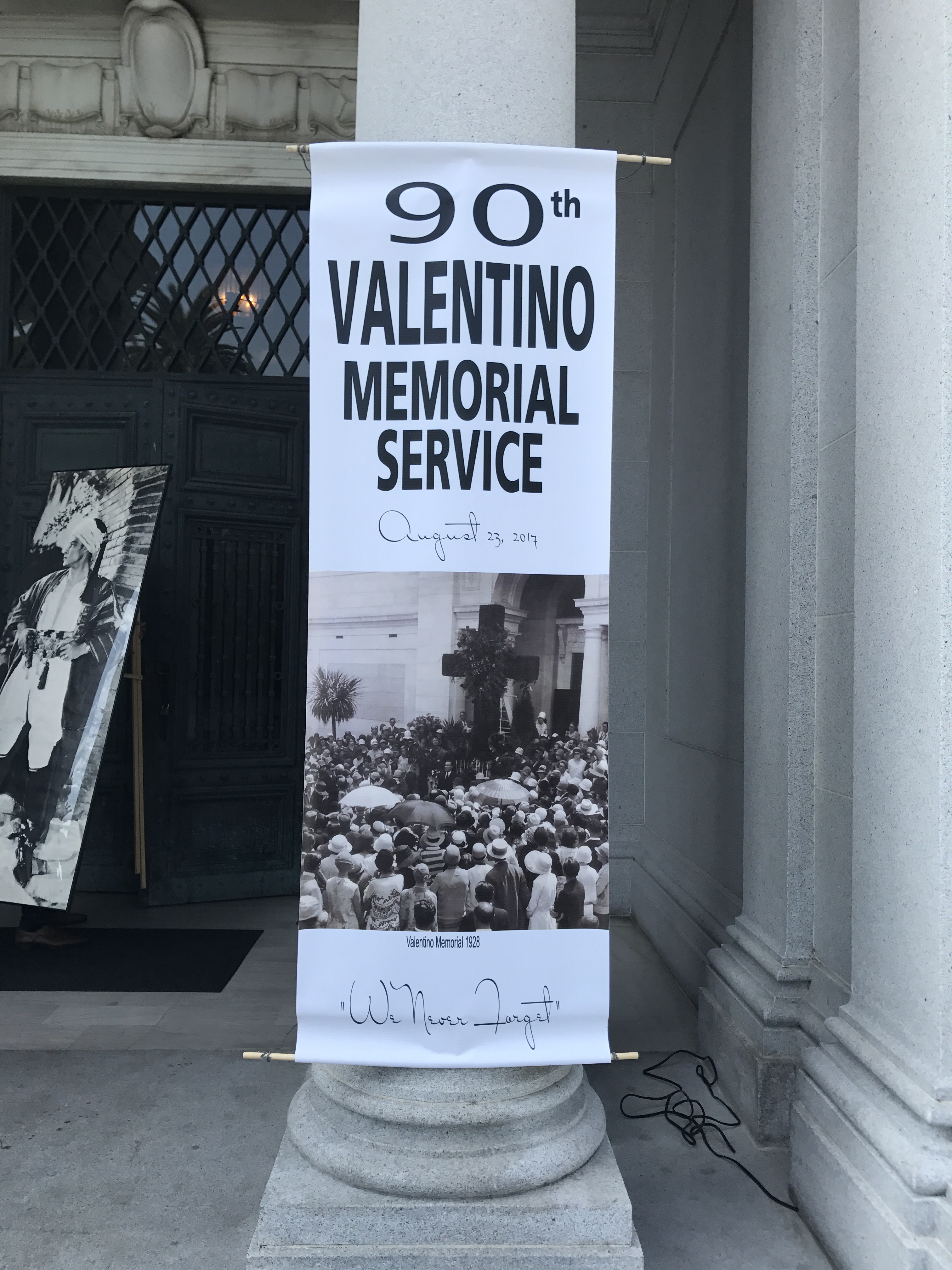
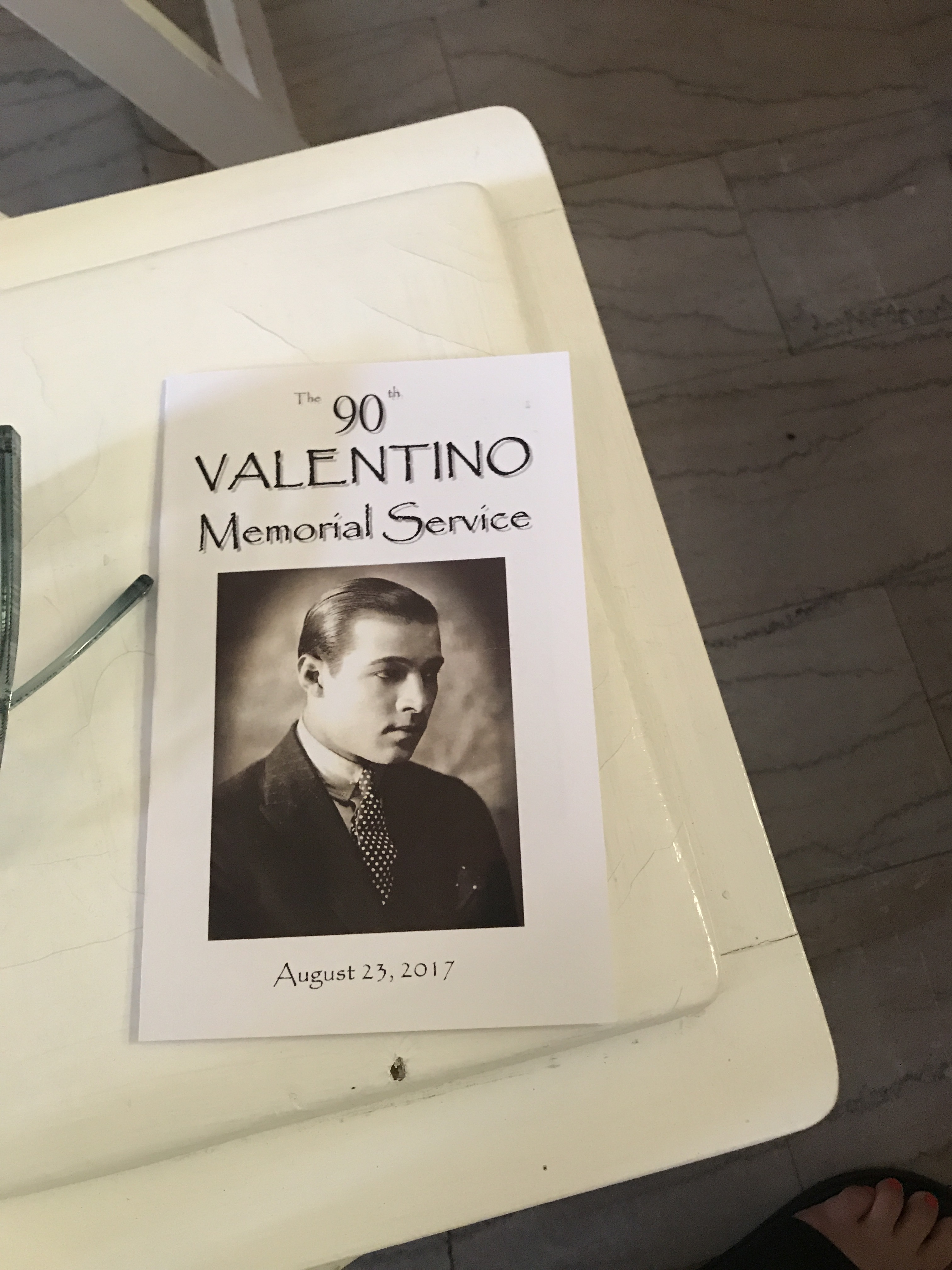
 I attended the 90th Anniversary of the Memorial Service for Rudolph Valentino, Hollywood Forever Cemetery. This year as in the previous years, I always look forward to coming to LA its like coming home seeing Tracy, Stella G, Pam C, Karie Bible who looked amazing. This year, Tracy made a couple of changes bringing a more modern approach. The memorial service was broadcasted via Facebook live offering members of the “We Never Forget Rudolph Valentino” Facebook group a chance to be apart of the virtual audience. The line-up for the memorial service was STELLAR. As always my favorite is the singing…Ms Terry Moore’s god daughter was amazing singing “Ave Maria” as well as Ms. Terry Moore herself, the ever gracious Ms. Sylvia Valentino-Huber, Ms Joan Craig, and others. When the service ends it always brings a sadness because it seems to go by so quickly. Well there will be next year, I wanted to add I finally got to meet Mr. Donald Gardner who is a noted videographer and Allen Ellenberger a noted author who I am a true fan of his books. A special thank you again to Tracy and Stella…See you all next year.
Categories: Uncategorized
Tags: Death of Rudolph Valentino, Rudolph Valentino, Tracy Terhune, Valentino Memorial Service
23 Aug 1926 – Death comes to Rudolph Valentino
As it must to all men, death came to Rudolph Valentino, sheik. Sitting in his apartment at the Hotel Ambassador, Manhattan last week, he suddenly clapped a hand to his side, fainted. Taken to the Polyclinic Hospital, he was operated on for appendicitis gastric ulcers. Over the wires of the world buzzed the news. At the hospital door bushels of flowers arrived. Two extra operators were detailed to the telephone switchboard to answer calls concerning Mr. Valentino (when a rumor that he was dead circulated, the calls came at the rate of 2,000 an hour). A maid delivered an Irish linen bed spread and pillow case marked “Rudy” with a card from Jean Acker. From Paris, came a message “Pray God night and day for your recovery”signed Winifred Hudnut. “This is Pola Negri in California said a brittle voice on the telephone, “How is Mr. Valentino”? Thousands, hundreds of thousands of women everywhere were asking “How is Mr. Valentino”? Mr. Valentino developed pleurisy. He was worse, said one of the telephone girls. Then a blood transfusion was performed. He was resting, sleeping. As dawn came, he awoke seemed restless. At last a scrawled note was laid before the switchboard operators. One Lucy Vanderbilt broke down sobbing into her instrument “he’s dead, Rudy’s dead”. Traffic was choked with thousands as his body was taken to the undertakers. The corpse of Rudolph Valentino adequately educated, never actually in want, he roved from one occupation to another until fame and wealth came to him as Julio of “The Four Horsemen” When he died he was insured in favor of his producer Mr. Joseph Schenck for $1,000,000.
Categories: Uncategorized
Tags: Death of Rudolph Valentino, Rudolph Valentino
23 Aug 1926 – Commentary
The death of Rudolph Valentino is one of the greatest tragedies that has occurred in the history of the motion picture industry. As an actor he achieved fame & distinction; as a friend he commanded love and admiration. We of the film industry, through his death, lose a very dear friend, a man of great charm and kindliness.
Categories: Uncategorized
Tags: Death of Rudolph Valentino, Rudolph Valentino
17 Aug 1979 – Alberto Valentino Asks?
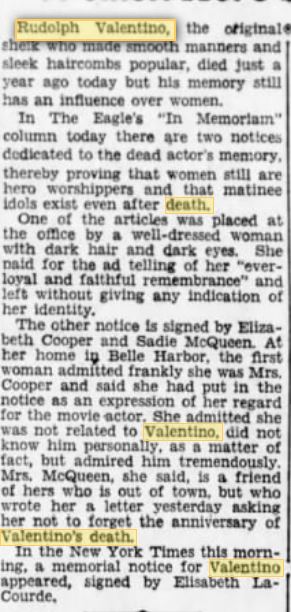
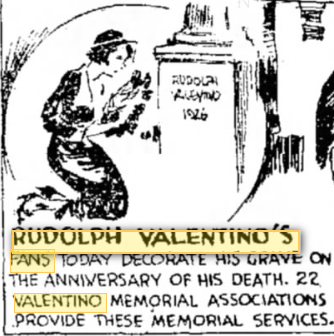
Question, I recently talked with Alberto Valentino, brother to Rudolph Valentino lives in Los Angeles and sounds hale and hearty at 82 years of age. In view of the 50th Anniversary of Rudolph Valentino’s death in 1976 we talked of Rudolph Valentino Fan Clubs, Alberto asked if any fan clubs are active in the U.S. or other countries. –M.G.I. Philadelphia, PA
Answer, there are millions of Valentino fans throughout the world almost as many as during the Roaring Twenties when he was, at the same time, the super movie star and the world’s greatest lover. In addition, the number of people who collect Valentino films, books, and momentos is in the hundreds of thousands. But, according to the Academy of Motion Picture Arts and Sciences library, there are only two recognized fan clubs, one is in Los Angeles and one in London, neither of which is active. In “The Sheik” (1921) he is credited with ‘revolutionizing’ the art of making love. A still photograph from “The Sheik” shows him looking at a girl as though he were about to steal the maraschino from her fudge sundae. You became a fan as a small boy in 1926 when Valentino died at age 30.
Categories: Uncategorized
Tags: Alberto Valentino, Death of Rudolph Valentino, Rudolph Valentino
24 Apr 1929 – Makes you Wonder?

Categories: Uncategorized
Tags: Death of Rudolph Valentino, George Ullman, Rudolph Valentino

25 Aug 1926 – Spent Money as fast as he could make it
Rudolph Valentino earned approximately $2,000,000 during his brief film career, he was usually without money. Joseph Schenck, executive director of United Artists Corporation for which Valentino made pictures said today. The potential earning power of the man who thrilled the romantic imagination of screen fans was easily a million dollars a year. Mr. Schenck asserted, but his net estate, so far is known, does not exceed $75,000. Valentino was just beginning to realize large earnings in the last two years Mr. Schenck said, “I should say that in the last year and a quarter he made between $900,000 and a million dollars in pictures. He made perhaps two million dollars during his entire screen career. “Rudy made no investments. He lived well, spending freely, and was exceedingly generous with his friends”. I know he never had any money, regardless of his earnings. He didn’t know its value. Valentino had taken out a personal insurance policy for $50,000, Mr. Schenck said, with is brother and sister as beneficiaries. United Artists Corporation had insured him for $200,000 Valentino had made a will, which is now in Hollywood, according to George Ullman, the late actor’s manager.
Categories: Uncategorized
Tags: Death of Rudolph Valentino, Joseph Schenck, Rudolph Valentino
22 May 1928 – In Memory of Valentino
Three hundred women and girls. In deep mourning, attended a special mass at St. Jervais Church in Paris yesterday in memory of Rudolph Valentino. Scores of girls waited outside the church. The Mass was arranged by a mysterious woman. reputed to be immensely wealthy, who is frequently seen at the church. She does not reveal her name, but often goes to the church to request a Mass for the repose of the soul of Valentino.
Categories: Uncategorized
Tags: Death of Rudolph Valentino, Rudolph Valentino
23 Aug 1934 – After 8 years, Rudy on the Silver Screen
This year and it is with pardonable pride that Movie Classic Magazine presents this exclusive scoop story upon the occasion of the commemoration of the 8th anniversary of Rudolph Valentino’s death. How can his memory be honored more fittingly than by the announcement that you may see him on the screen again? There has never been a autobiography of a motion picture personality before. Can it be that Rudy sensed his destiny as an immortal? Could he have felt that his admirers would remain faithful All these years? Did he recognize the demands of his public to see him after death and therefore provided an undying memorial? These are questions to which you and I will never know The answers. We can only guess. Amateur photography was one of Rudy’s hobbies. As a large number of star’s today are devotees of the amateur or 16mm camera, so did he experiment With standard-size moving pictures. In a particularly gay mood, it was his pleasure to send for a studio cameraman to film little impromptu plays that he enacted for his own guests amusements. This private film was later screen at other parties. In rummaging through some of Rudy’s effects his brother uncovered reels and reels of it. The reason this film was not discovered sooner that the cans containing it were thought to be merely discarded screen tests. It must be remembered that Alberto saw very little of Rudolph in the latter span of his life. The brothers were separated by half the world one in Italy the other in Hollywood. From time to time, there had been talk of a long-lost private Valentino film. Pola Negri once told me of it. Regretting its loss. Now it has been found. I have seen several reels in a projection room. Even in uncut un-chronological form, the film is tremendously impressive. Imagine if you can, a smiling, laughing Rudolph Valentino, a care-free vital fellow at play a tender lover. It is a far more revealing portrait of the actual person than was ever discovered. In a compromising situation by his wife and Rudy. His wife takes Alberto away by the ear and Rudy proceeds to spank Pola. There are many informal pictures posed in the swimming pool. Once Pola is seated astride a rubber sea horse waving at the camera, when Rudy suddenly dives to upset her for a ducking. Several other times there are evidences of his fondness for practical joking. With Natacha Rambova he is more sedate, the nearest approach to a playful mood being a romp with his dogs on the lawn of his Whitley Heights home. Jean Acker his first wife, appears only one time and never with Rudy. The identity of some of the other ladies who play with Rudy in this, his greatest film may never be known except to themselves. Others, of course, are well remembered actresses of the day Agnes Ayres, Nita Naldi, Alice Terry. The wedding of Mae Murray to fake prince David M’Divani consumes nearly a reel. The reception held at Valentino’s home is peopled with famous guests. Contrasting With such intimate scenes is the large amount of scenic footage taken with Rudy as the cameraman. His devotion to beauty and appreciation of it could have no more convincing proof than the pictures of his beloved Italy. He achieved startling and breath-taking pictures of imposing cathedrals and quaint little churches. He realized fully the art of the motion picture camera and made use of it with the masterful Hand of a true artist. The camera was an important part of his luggage when he made his last trip to his native land. He must have spent days traveling about, photographing things that caught his fancy Preserving bits of beauty in celloid that he might again enjoy them upon his return to America and work. There are several dozen views of the exquisite bay of Naples. Scenic Italy has been the subject of many Screen travelogues. But you have never seen it as Valentino photographed it the man was homesick and his nostalgia is evident by his almost reverent presentation of his beautiful homeland. Thousands of writers Have penned great epitaphs for Rudolph Valentino. Yet he unconsciously wrote a greater one for himself I loved beauty. Rudy also photographed the magnificent castle on the Hudnut estate. It is Believed that he took them after his separation from Natacha Rambova the girl he married under her screen name and continued to love until his death. Only once did Valentino take his camera with him to the studio and then solely for the purpose of filming his blooded Arabian horse in action. Is Alberto’s possession more than a reel of film taken at Rudy’s funeral in New York and Hollywood. Thousands of people can be seen lining the streets of both cities. Movie celebrities by the score came to bid a final farewell Charlie Chaplain, Mary Pickford, Douglas Fairbanks Sr, Harold Lloyd, The Talmadge’s Joseph Schenck and hosts of others attended the services It comprises an imposing climax for the screen’s first autobiography.
1934 – Rudy Lives
Rudolph Valentino lives again on the screen! A film record of his most intimate private life has been recently discovered by Alberto Valentino the late film star’s brother. It is possible that the memoirs of the movies greatest lover may be released to the public within the next few months.
Categories: Uncategorized
Tags: Alberto Valentino, Death of Rudolph Valentino, Rudolph Valentino
Leave a comment
Categories: Uncategorized
Tags: Death of Rudolph Valentino, Falcon Lair, Rudolph Valentino
Leave a comment
1926 – Peddled Valentino “Life Book” Upon Arrival of Body on Coast
The body of Rudolph Valentino arrived here Monday from the East Coast and immediately taken to the Church of the Good Shepard, Beverly Hills in a special car. Coincident with the arrival of the body a paper-covered book of 133 pages entitled “The Romantic Life of Rudolph Valentino” published by a Hollywood Concern and retailing for 25 cents made its appearance all over town. In the presence of 500 who met the body when it was removed at a secret railroad crossing the books were peddled. The studios were practically inactive during the funeral services.
1926 – Did Rudy die because of a fall?
June Knight said dancing led to my future work and my first tragedy. I was only twelve when I started to work in a prologue at the Million Dollar Theater, Los Angeles. I’ll never forget that Engagement because Rudolph Valentino was appearing there in connection with his picture “Son of the Sheik”. It was there that he had an accident that many claim was really responsible for His death. We were all on the stage, and Valentino started to go down the narrow stairs at the Edge of the stage. He lost his balance, half-turned, and fell into the
orchestra, right on top of the Big bass violin. I was one of the first to reach him. The sharp top of the big violin had
pierced his Side. I helped pick him up and he quietly thanked me for my assistance. But I could tell that he still did not feel right and I quietly suggested he go to see a local doctor. But, Mr. Valentino was adamant he was fine.
Categories: Uncategorized
Tags: Death of Rudolph Valentino, Rudolph Valentino, Son of the Sheik
Leave a comment
1927 – Natacha not popular with fans of Rudy
It appears that marriage appeared to hampered the career of the late silent film star Rudolph Valentino. I happen to know that photographs of Rudy with Natacha were most unpopular with film fans. Thousands of angered, protesting
letters were written to Rudy whenever a lay-out of pictures That included his wife graced a magazine page. I doubt that a single movie fan, today treasures a picture in which Natacha appears at Rudy’s side. Rudy was eager to have his wife share his fame.
Categories: Uncategorized
Tags: Death of Rudolph Valentino, Natacha Rambova, Rudolph Valentino
Leave a comment
25 Aug 1926 With Regrets….
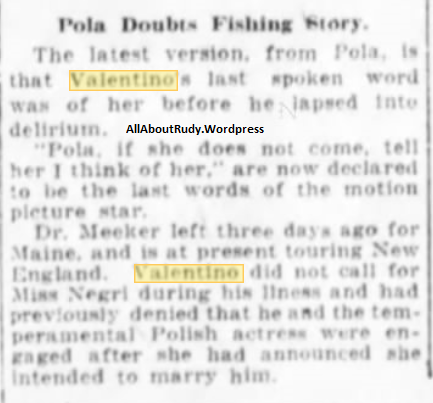
Arthur Brisbane in his column today, in the American says “Millions all over the world as far as moving pictures spread learn with deep regret of the death of Rudolph Valentino who had made so important a place for himself in a great art. A very young man with intense feeling and earnestness Valentino held his place without a rival in the field. His life was too short but it was not wasted”..
27 Aug 26 Valentino Partially Insured by M.P. Capital
The life of Rudolph Valentino was insured for a sum ranging between $150,000 and 200,000 by the Cinema Finance Corp of Los Angeles which is completely owned by M.P. Capital Corp. The Cost company participated in the financing of several of Valentino’s films. Collateral Was supplied in the form of this interest in the two pictures he made for Ritz Carlton and Famous Players-Lasky and by real estate. Considerable additional insurance was carried.
Categories: Uncategorized
Tags: Death of Rudolph Valentino, Pola Negri, Rudolph Valentino
Leave a comment
1928 -Valentino Cult Formed
Publication sometime ago in European papers of a story from Hollywood to the effect that the former impresario of Rudolph Valentino was making a collection for the purpose of providing a worthy resting place for the film star’s ashes has produced what German newspapers call “a peculiar echo” in Hungary. It is related that the attention of the Budapest police was drawn recently in the fact that a young man calling himself a moving picture director was organizing Rudolph Valentino Clubs in various parts of the country, with an inituation fee of 10 pengos ($1.75) and annual dues of 25 pengos. The announced object of these clubs was in “cherish the memory and promote the spirit of Rudolph Valentino”. One of the club by-laws read: “The members are obligated to think of Valentino at least once a day. In go to see all Valentino films and to agitate for the showing of more of his films in the kino houses. Furthermore, on the anniversary of the death of the film star, 23 Aug, each member is to send an annual gift to Hollywood so tha the urn containing Valentino’s ashes maybe decorated with flowers”. Despite the fact that pengos do not grow on bushes in Hungary. It is averred in the report that several hundred Valentino admirers mostly young girls have already paid their dues by the time the police began their investigation. In return for their moey the members receive Valetnio bades entitling them to participate in the annual memorial serbvices to be conducted at the expense of the society. Answering questions by the police, the young organizer insisted that he had forwarded all his receipts to Hollywood and that he was doing this work purely out of admiration for the departed artist. As no charges were lodged against him by any of the club members, the young man was not held under arrest, but was told that he would be kept under observaton until informaton regarding his statements could be obtained from Hollywood. In the meantime, further investigation is said to have revealed the fact that some Valentino Clubs were composed laregely of believers in spiritualism and that seances, with the shade of the fiom star as the chief attraction, had been on the order of the day, or night, for several weeks. One young girl told police that Valentino’s spirit made frequent visits to his Budapest admirers. This gir, the daugher of a rich industrialist, said that Valentino’s shade complained bitterly at the shortness of human memory and at the failure of his one-time enthusiasts to erct a suitable monument to him. She considered it her special task to carry on a campaign wit hthe object of calming Rudolph Valentino’s uneasy spirit.
29 Aug 1926 – Did you know?
Sometimes Edward Montaigne, head scenario writer at Universal Studios admits the astonishing ideas that are presented to him. One time there was a spiritualist lady who is in constant communication with Rudolph Valentino. In the spirit world, she writes, Rudy has met Edith Cavell who insists that he must make one more picture on earth. For a consideration she will sell Valentino’s services to Universal to write and direct a movie.
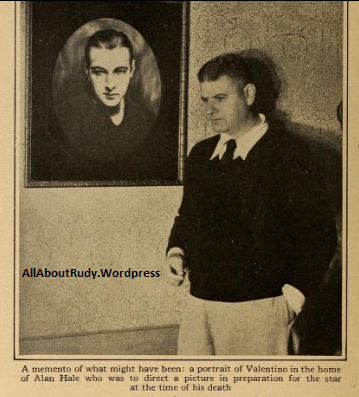
Categories: Uncategorized
Tags: Alan Hale Sr, Death of Rudolph Valentino, Rudolph Valentino
Leave a comment
The death of Rudolph Valentino is one of the greatest tragedies that has occurred in the history of the motion-picture industry. As an actor he achieved fame & distinction; as a friend he commanded love and admiration. We of the film industry, through his death, lose a very dear friend, a man of great charm and kindliness – Aug 1926 Charlie Chaplain
Categories: Uncategorized
Tags: Charlie Chaplain, Death of Rudolph Valentino, Rudolph Valentino
Leave a comment
24 Aug 1926 – Death of Rudolph Valentino Hero of American girls | Emotional scenes in New York
An Exchange telegram from New York says Mr. Rudolph Valentino died yesterday. Death followed an unavailing blood transfusion. An X-ray examination has revealed that pleurisy affected the walls of the heart. No monarch or war hero ever aroused more sympathetic public interest anywhere than Valentino during the illness which ended fatally to-day. From the day last week when he was taken to a nursing home all sources of public information were sought for news of his condition, and when the word “relapse” spread in New York yesterday crowds gathered about the nursing home and practically besieged the telephone companies and newspapers. Women by hundreds brought flowers and prayed on the steps of the building where the patient was lying. Because America is the chief motion picture manufacturer and Valentino was the most romantic star of this new form of entertainment, he was to American flappers generally almost what the Prince of Wales is to the English. Recently, when the Chicago “Tribune” charged Valentino with effeminizing American manhood by his influence, and Valentino challenged the editor to a duel with boxing gloves, a wave of indignation in his favour rushed from millions of American women.
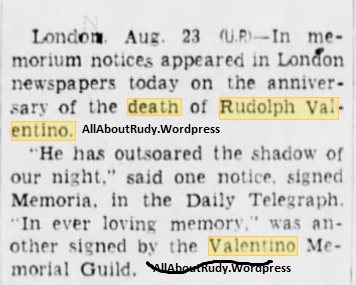
30 Aug 1926 – Cashing in on Death of Valentino
Desirous of meeting the public’s insistent demand for Valentino Pictures, while United Artists reported and appreciable increase of bookings on “The Eagle” which preceded “The Son of the Sheik” the late star’s last picture. In many sections of New York, exhibitors who have deemed it good showmanship to make these bookings are telling the world about it in no uncertain terms through the mediums of special marquee banners. The usual theater mailing lists are being worked plentifully in an effort to cash in on Valentino’s death.
Categories: Uncategorized
Tags: "The Eagle", Death of Rudolph Valentino, Rudolph Valentino
Leave a comment
“A great tragedy says Sam Goldwyn. It will be felt wherever he is known”..
Categories: Uncategorized
Tags: Death of Rudolph Valentino, Rudolph Valentino, Sam Goldwyn
Leave a comment
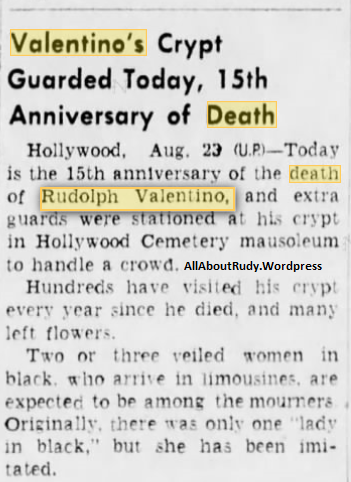
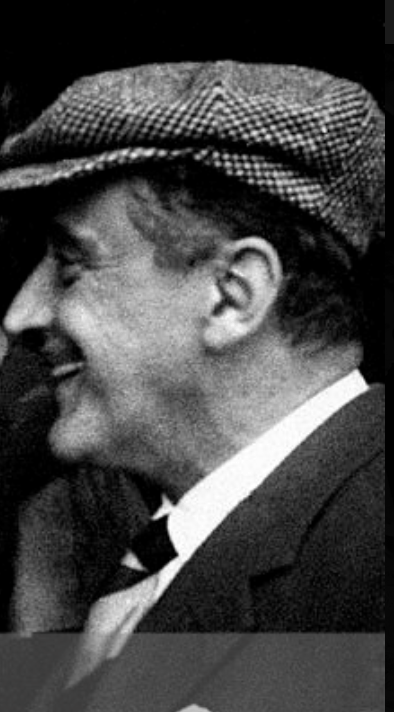
“Rudolph Valentino was an artist whose place will be impossible to fill, just as it will be impossible to fill the empty place in our hearts, caused by his death. I am deeply grieved.” Silvano Balboni, husband of June Mathis
Categories: Uncategorized
Tags: Death of Rudolph Valentino, June Mathis, Rudolph Valentino, Silvano Balboni
Leave a comment
Sep 1926 – Did you Know?
And how many of you children know that it was Peter Dixons story of the passing of Silent Film Star Rudolph Valentino that was the first to go over the wire? All’s fair in getting a store out first, and even Peter’s father admits that there was dirty doing’s at the time. Newspapermen were 30 feet deep around the door of the late star’s hospital room, waiting for the end. When it came Peter Dixon was well outside the last line, and his henchmen whom he planted their passed him the signal and threw the other news hounds into a scrambled heap. Last week, by the way, there was a dinner in Manhattan for the reporters and press photographers who covered Valentino’s funeral. The dinner is an annual affair and the host is Campbell’s Funeral Home the undertaker. We hope the advertisers did their stuff.

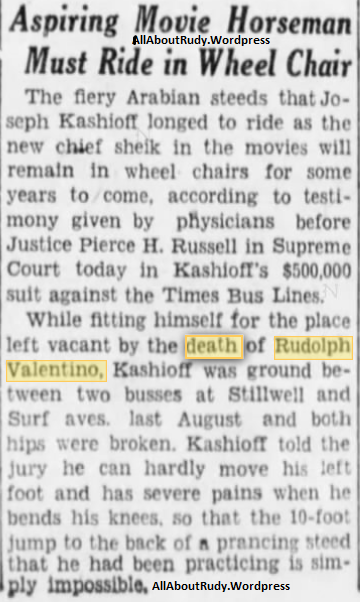
Nov 1926 – Changes at United Artists
The death of Rudolph Valentino has disarranged the production schedule of the United Artists, making it necessary for Mary Pickford and Douglas Fairbanks to abandon their contemplated Oriental Tour. Neither knows, however, what the next production will be.
Categories: Uncategorized
Tags: Death of Rudolph Valentino, Douglas Fairbanks, Mary Pickford, Rudolph Valentino
Leave a comment
1954 – They Remembered Rudolph
New York was in no sense the boundary of the irrepressible grief for Rudolph Valentino wherever the train that carried his body stopped on its long journey west more ‘unseen friends’ gathered, heads bared, cheeks sometimes wet with tears and among them some knelt to pray. In the towns and hamlets of many other countries this grief had innumerable counterparts. No one had expected so young a man to die and Valentino had meant so much to an international following. In the first shock of losing a loved one, the heart and its senses combine. Human sorrow found its more sensational expressions in New York, London, Paris, Berlin but in lesser places sorrow was as heartfelt, though evidence of it was not so spectacular. Untouched by the world outside, grief grew intensely personal and expressible only in poetry. So numerous where the poetic tributes to Rudolph Valentino that a volume of specialized verse could easily be assembled. No less a poet that the late Humbert Wolfe contributed to the London Observer a poem in remembrance of a dear friend. The Chicago Tribune the newspaper which had fired frequent broadsides at his national esteem wrote after his death “The death of Rudolph Valentino is a deep personal loss to most of us. We loved him because he was a weaver of dreams. Because he brought colour, romance, thrill into our daily lives. He embroidered drab moments, he smiled into our eyes and for a little while we too became story-book people and everyday worries were things that were very far away”.
In distance hamlets, stony-walled, where ends
Civilization in a sea bird’s cry, You made rough
Lovers, horny-handed friends, and ruddy cheeks
Are wet because you die. How many a reaper
With a muffled pain lashes her harvest where a
Red sun sets, into that heart you brought a dream
Of Spain, a scent of flowers, a sound of castanets.
And shapeless women working for mean pay
Remember, jogging on the laden carts O perfect
Lover, how you cast away money and roses and
Those bleeding hearts. Safe in the cottage shrine
Tonight you stand, some sun-baked yokel weeding
On his knees thinks of a duel for a lady’s hand, and
Hears a tango under orange trees. Rest people’s
Hero. Time can never take your gallant image from
The common breast; a chorus girl cries out her heart
Must break and it maybe you fed her need. So rest
This anonymous poem was discovered in a private collection of Valentino mementos.
Aug 1926 – Passing of Valentino. Impressive scenes of funeral of famous Film Star
M/S of Rudolph Valentino’s embalmed body lying in state. M/S of procession of men (including Douglas Fairbanks) coming out of building, they are followed by pall bearers carrying Valentino’s coffin. M/S of woman in black veil getting into a car. She weeps melodramatically, a man and a woman support each of her arms as she walks. The woman is probably Pola Negri, ex-fiancee of Valentino. Several press photographers take pictures. Various high angled L/Ss of the funeral cortege driving through New York streets, crowds line the way. L/S of entrance to church, tilt down to show coffin being carried from hearse to entrance. M/S of Valentino dressed as Sheikh emerging through curtain, he talks to a woman sitting on cushions on foreground (Vilma Banky). C/U of Valentino.
Categories: Uncategorized
Tags: British Pathe, Death of Rudolph Valentino, Pola Negri, Rudolph Valentino
Leave a comment

Categories: Uncategorized
Tags: Death of Rudolph Valentino, Lady in Black, Rudolph Valentino
Leave a comment
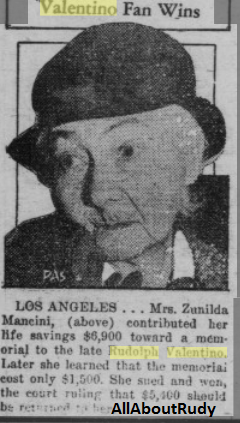
1926 High Prices Brought By Valentino Effects
Gold Cloth Owned by Star Sells for $2,965 After Spirited Bidding Los Angeles, Dec. 14, UP).- Spirited bidding by hundreds of persons who thronged the hall of arts today seeking possession of personal effects of the late film-star, Rudolph Valentino, was in sharp contrast to the lack of enthusiasm displayed last week when the two estates of the screen lover were put up for auction sale. A golden cloth cassimere shawl sold for $2,966, considerably more than IU original cost; $2,200 worth of stock in the Hollywood Music Box Revue brought $500; an Italian drawer chest, $810, and an Italian piano, $2,100. But three motion picture players wore recognized in the crowd – Eleanor Boardman, Raymond Griffith, and Adolph Menjou. Menjou bid in a Goethe cabinet for $390. ■Pola Negri was not present, nor did she, buy anything far as could be determined, have a representative at the sale.
Categories: Uncategorized
Tags: Adolph Menjou, Death of Rudolph Valentino, Rudolph Valentino
Leave a comment
3 Jan 1928 – Rudolph Valentino Was he Poisoned?
Was Rudolph Valentino poisoned by a jealous woman whose advances he rejected? According to messages from the “Seccolo,” of Milan, private detectives in New York are working on a clue which may lead to a solution of the numerous rumors surrounding the death of the famous film star. According to one report, a detective and his wife were the witnesses in a Broadway night club of an incident which, it is alleged may afford an explanation of Valentino’s illness and death. Valentino, it is stated, was approached by a woman who was apparently in love with him. Valentino turned his back on her and entered into conversation with another woman. With anger the spurned woman is said to have made a sign to two men. A lady detective says she overheard one of them say, “The Indian method is infallible. One can mix diamond dust with a drink, and it will cause death by internal perforation. Doctors will say death was due to an incurable malady or attributed to appendicitis.
1926 – Dick Lawrence Review – The Death of Valentino
https://archive.org/details/DickLawrenceReview-TheDeathOfValentino
I found this interesting clip that radio personality Dick Lawrence, host of the weekly Dick Lawrence Revue on Saturday nights on WNIB and WNIZ in Zion, talked about the death of Rudolph Valentino. Dick Lawrence had the ability to provide a vintage perspective that is long lost in today’s modern world.Series of broadcasts from WNIB, Chicago, about history, stories, music and popular culture from America’s past. Produced and narrated by historian and radio-personality Dick Lawrence


You must be logged in to post a comment.