
Dr. Crandon well known spiritualist says spirit messages from Houdini the magician and Valentino the actor are fakes. “A person must be dead four or five years before he can communicate with us. We learn this from spirits with whom we have been in touch”. Physicists wonder where those spirits are when they talk. It they are on one of the distant stars, light with travels 186,000 miles a second would take a million years to get here; and sound, as we know travels more slowly than light, 331 meters a second against 186.000 miles a second. If Houdini and Valentino, on some distant star, began talking loud enough for their voices to reach us, their words wouldn’t reach the earth in time to be heard by our descendants 500,000,000 years from now.
Posts Tagged With: Rudolph Valentino
2 May 1921 Ingram Proves Story’s the Thing in Motion Pictures
The story’s the thing. That’s an old saw, but it gains emphasis in the presentation of “The Four Horsemen of the Apocalypse” on the screen. The book has sold beyond its 150th edition. Some reviewers say the spectacle follows the story of Ibanez’s novel with unfaltering fidelity. Others see variations from the book action. But all agree director Rex Ingram has created a film epic. This was done without the talent of one “star”. Rudolph Valentino little known before his advent in the picture, is the hero. He was educated in Italy to be a scientific farmer. Alice Terry was born in Vincennes, Indiana 19 years ago. She was employed as an extra when she visited a studio with a friend and says she had no ambition to be a movie actress. The sum of her screen experience before Ingram selected her for his spectacle was three months as a extra and two months as a juvenile lead and the leading role in one production of an indifferent quality. The picture also brings prominence is June Mathis who visualized the story and prepared the scenario. The novel has been widely read. The story is too complicated to be condensed in a few lines. Apocalypse means revelation and the four horsemen are war, famine, pestilence, and death. The story deals with the horrors of war and the reality is this happened in previous wars and wars yet to come.
21 Mar 1923 -Mineralava Dance Tour Begins.
Rudolph Valentino the much admired, in search of a beauty! Finally, the whole country will see the famous silent-film star and dancer accompanied by his charming wife who will also be his dance partner in what will be a memory that will never be forgotten. A combination dance tour and beauty contest on a grand scale sponsored by the Mineralava Beauty Clay Company. Rudolph Valentino will forsake active work in the motion picture studios and will be on this wonderful tour of cities across this country in search of a typical American Beauty, who may, if the fates are propitious, be the leading woman of his next super picture when he returns to the screen. The rise of this magnetic young screen star has been meteoric! It is doubtful whether any other individual of the screen has so captured the hears and imaginations of the American public. Two of the most notable productions ever made own no little of their vast popularity and appeal to Rudolph Valentino’s personality, to his skill in pantomime and his sympathetic interpretation of emotions both hectic and subdued. His brilliant work in “The Four Horsemen” made him at once the foremost screen figure and following this his wonderfully passionate interpretation of the central character in “The Sheik” won for him a popularity that has made him a household name. Wherever, he goes on his present tour the cities turn out to greet him as if he were a national hero. In each city, He and his wife will give a public exhibition of graceful dancing, and then, from a bevy of beauties previously selected by a special committee Mr. Valentino himself will present the trophy and a dance.
1922 – Rudolph Valentino & Natacha Rambova first marital attempt
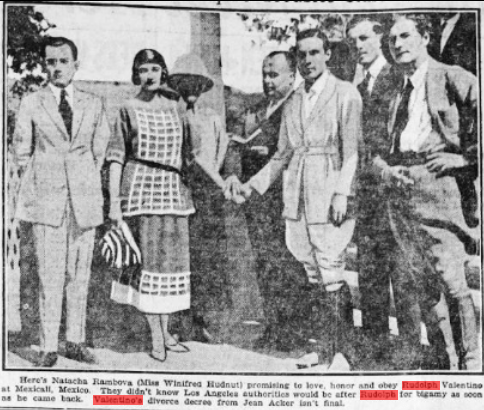
13 Mar 1923 – Rudolph Valentino Married in Crown Point
The Crown Point marriage mill cut another notch in the hall of public fame on Wednesday afternoon when Rudolph Valentino and Miss Winifred De Wolfe, with a party of friends from New York and Chicago journeyed to the famous “Gretna Green” and were married by Justice of the Peace Howard Kemp. After securing the necessary license at the county clerk’s office, in which Valentino gave his name as Rudolph Gugliemi, aged 28, and his bride as Winifred De Wolfe, aged 26. the couple went immediately to the office of Judge Kemp and the ring ceremony was performed which made them man and wife. Several witnesses were present at the marriage ceremony and those signing their marriage certificate were Attorney Michael Romona, of Chicago, Mr. and Mrs. Arthur Butler Graham, of New York, and Mrs. Welner, of Salt Lake City, Utah. Judge Theodore Klotz, of Hammond, a friend of the party accompanied them to Crown Point. When it became noised about that the famous screen artists were in the city, a crowd quickly gathered curious to see Valentino and his bride and they were given an impromptu ovation and showered with congratulations as the party started Chicago-ward after the ceremony. Following the marriage, the news was flashed to the press of the world and once again Crown Point gets into the limelight as being the scene of the marriage of famous folk. Valentino, while going through the ceremony appeared as nervous as any country swain that ever took the important step and there was nothing about his appearance during the ceremony that bore out world-wide reputation of being the cool, calm deliberate and “perfect lover” of screen fame.
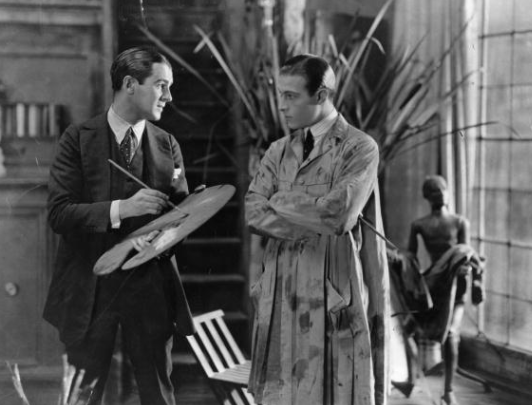
20 Nov 1921 – Wonderful Photography Makes Picture Among Greatest Screened
No small part of the success of the photoplay production is due to the resourcefulness and inventive genius of the camera man. This fact demonstrated itself during the filming of “The Four Horsemen” when John Seitz, chief cameraman of the Rex Ingram Unit resorted to unusual and entirely original means to obtain desired screen illusions. Many specially perfected photographic devices were utilized and again Mr. Seitz has brought them into exclusive use for Metro’s latest Ingram directed special “The Conquering Power”. In addition, a new method of registering vison scenes where ghostly or transparent figures are required, was perfected and which revolutionizes the filming of those episodes to a point of effectiveness never before attained. The cruder, methods of double exposure, often more or less bungling until retaken again and again have been eliminated. One scene in “The Conquering Power” where imprisoned miserly Grandet is visited by spirit forms of those whom he wrong, borders on the uncanny and intensified a hundredfold by this new camera device. It is innovations of this kind that help to make big pictures and “The Conquering Power” is in every sense of the term ‘a big picture’. Reviewers are wont to say that Rex Ingram has given to the motion picture world a real rival to “The Four Horsemen” from the standpoint of impressive character portrayals. Artistic treatment and scenic investiture.
1952 – Walter Huntley Long
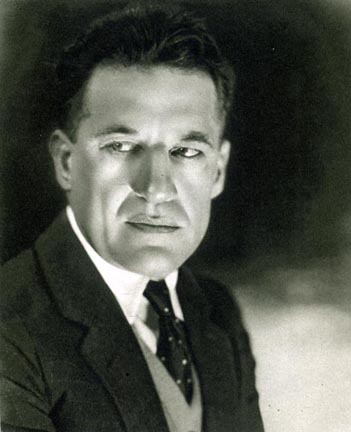
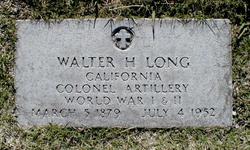
Walter Huntley was born 04 Mar 1879, in Milford, New Hampshire. Walter Long’s experience on the theater stage helped him transition to the motion picture field, where he was type-casted as a character actor. Walter’s talent was for “hard-guy” movie parts in over 200 movies and television to his credit. Walter Long was 5’11 inches tall, 175 lbs, brown hair, with gray eyes. Despite his mean looking persona, he was considered a very nice guy. He married to Luray Huntley, actress worked for D.W. Griffith until her death in 1918 from influenza. Walter served state-side during World War I and II and was honorably discharged. He worked in 4 films with Rudolph Valentino “The Sheik” “Son of the Sheik” ”Blood and Sand” and “Moran of the Lady Letty”. Walter died on 4 Jul 1952, at the LA Coliseum. He is buried at Hollywood Forever Cemetery, Garden of Memory, Lot 527.
4 Mar 1930 – Rudy and Jean Acker Wed on Wild Impulse At a Giddy Party and Separate at the End of the Dance.
The legendary Rudy who fed on mash notes, the lounge lizard, the sheik, with only a gross sensory appeal was no more the real Valentino than black is white says Natacha Rambova. He was a great artist, she says, be he wasn’t given the credit for the real art he had. His unusual abilities were neglected to emphasize the grosser side. This forced him into a role he hated to play. He was not a great actor in the sense of Bernhardt or Booth were. Bernhardt studied a role until her brain dictated the emotions. Rudy absorbed his role emotionally and played it intuitively. Natacha Rambova met Rudy in a movie office in Hollywood she recalls. Rudy and I wanted to be married, but we couldn’t because of Jean Acker and she was making it difficult as possible for him to get his divorce. It was during the film of “The Sheik” that divorce proceedings were started and reached their peak of difficulties; so it was a trying time for us both. This early marriage took place shortly after Rudy came to Hollywood just as a lark at a party. From the first, it was a mistake but all Hollywood, of course was crazy mad. People act on impulse and have regrets later. Rudy and Jean Acker scarcely knew each other. They had met one evening at Pauline Fredericks planned a horseback ride together and during that ride became engaged. A few hours later Rudy sauntered into the Hollywood Hotel, where he chanced to meet May Allison and Mr. and Mrs. Maxwell Garger. In the exuberance of a man in love he confessed to them he was going to be married. Mr. and Mrs. Garger were planning a party next evening as a farewell to Richard Rowland, President of Metro. As a sort of fillip to the event, they suggested he get a marriage license immediately and turn their party into a wedding. Rudy, impractical and careless agreed. After the ceremony and supper, they danced until 2:00 a.m. when the bride unceremoniously left him. Jean at that time, was working with Fatty Arbuckle in “The Round Up” and when the disillusioned bride groom sought her out on location the next morning he found she had skipped to Los Angeles. He followed her there only to be told she could never return to him. Rudy left at one for New York to make tests for “The Four Horsemen” and Jean asked for an annulment. They didn’t see each other again for four months. The success from this movie turned Rudy from a penniless nobody to a genuine movie star and Miss Acker changed her demands from annulment to divorce with alimony. Rudy fought this and asked for a divorce in the meantime. He continued to pay dearly for this mistake of his youth even after the divorce was granted. Jean Acker continued to use this to her financial advantage. For example, she went on a vaudeville tour using the last name of Valentino. She started insisting people call her Mrs. Valentino. She was never a real wife but she certainly did what she could to look like she was the one that was wrong when in reality the injured party was Rudy.
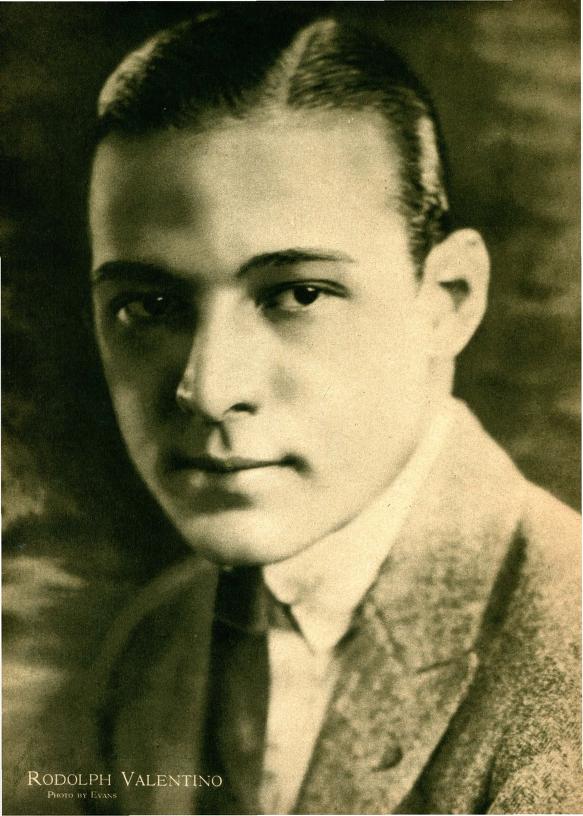
02 Mar 26 Love Sick Baron picks fight with Sheik
WHAM! A fist shot out and Rudolph Valentino, sheik of the movies, threw up a protecting army and ducked his head. This occurred in the lobby of the Mogador Theatre in Paris, the other day, when The great picture favorite graced the first showing of his own new feature picture with his presence. Those of the audience who had observed Mr. Valentino in the flesh, Sitting quietly in one of the boxes, looked at him with reverent awe. Just as the film was coming to an end he excused himself from his party saying that he would step across the theatre And kiss the hand of the Countess d’Uzes, who was waving at him. He passed up the side aisle and started through the lobby, those by met making way for him as though for royalty. One Man however, did not act that way at all. There were tears in this man’s eyes, a handkerchief in his hand and his nose was red. Mr. Valentino noticed this person, not only because his clothes And manner showed him to be a man of some consequence, but it because it is a triumph for a picture to make a man cry. When the weeper turned his moist eyes on Valentino he jumped as though he seen a ghost. Then he shot out a sentence, in German so hysterically that the actor did not understand it. But when the man’s fist swung viciously at Rudolph’s nose, he understood that gesture, ducked and, with his right, gave the stranger something to cry about. The man went to the floor and arose, but before he could resume the battle, friends of both parties rushed between, cards were exchanged and Mr. Valentino found that he was dated up for a sword duel to be fought at the wretched hour of sunrise. “Who is this fellow and what does he want to fight with me about?” asked Rudolph, with pardonable curiosity. “It is the Baron Imre Lukatz and he says you have been hugging and kissing and stealing his fiancée and all that while he was away” replied Frederico Beltran Masses, a well-known Spanish painter, who had taken charge of Valentino’s interests in this fracas. “But I never saw him before., nor his finance. There is some mistake.” “Possibly”, agreed Masses, “but he demands satisfaction on the field of honor and you see everyone is looking at you, and the Barons face shows that someone has wronged him. I am afraid that you will have to go through with it”. Before the war, Baron Lukatz, who now thirsted for Valentino’s blood was a wealthy Austrian nobleman engaged to marry the very youthful Vilma Banky, daughter of one of the richest families of Budapest and already celebrated as a young beauty. The Baron was a happy and much envied man and then, just as they were about to name the wedding day, the great war came along and postposed everything. The wedding was put off until the triumph of the Central Powers, which was estimated as a matter of 3 to 6 months. When the agony went on, from year to year, the Baron was able to get home from the front just often enough to keep the fires of unsatisfied love aflame. At last the final crash came, and the love-sick nobleman had only one consolation, he was now free to return to marry his beloved. Vilma was apparently as much in love as ever, but suddenly a disagreeable question intruded itself between them like a horrid chaperone. What were they going to marry on? The fortunes of the Baron and the Banky family were invested in securities payable in German marks. They were still technically millionaires, but in reality the mark had been made so worthless that their wealth was about equivalent to a trunk full of cigar coupons. Again the happy day was postponed, while the Baron cast an aristocratic eye around for a job. For every position from head-waiter up, he found several needy Grand Dukes ahead of him. The future looked dark for the love smitten Baron. Just then a ray of light, light for Vilma but not necessarily for the man who had waited so long to marry her. An American moving-picture director saw sufficient promise in Vilma’s beauty and culture to invite her to sign an 2 picture contract and pay her expenses in Hollywood. The girl jumped at the chance and it was all settled when the jobless fiancée returned from a fruitless trip to Paris. The Baron was dismayed at the prospect of parting from the girl he loved for there was nothing in the contract about his expenses. However, he could not stand in the way of a likelihood of such big money, so with a heavy heart, he agreed. But fate had put him off so often that this time he protested. He thought it was only that before rushing to America she should marry him. Miss Banky was inclined to agree, but the hard-boiled director did not want any strings tied to his new piece of property and talked her out of it. He said: “For an artistic career, a husband is a millstone. Wait until you are an established star and then maybe you will be strong enough to swim with one around your neck. And besides you may fall in love with some of the American millionaires that are always hanging around the studios and then what? Vilma thought this was perfectly silly advice, but she took it just the same, the amorous Baron found himself procrastinated with the promise that she would hurry her two pictures through and then come right back and marry him. When Vilma sailed the Baron felt as lonesome as a lost dog, but distracted his mind by writing a daily letter to his girl, always cautioning her to beware of wicked but fascinating actors. After a while Vilma’s letters grew very vague and infrequent. The Baron became anxious. What did this mean? What was going on? What had happened to his innocent Vilma in wicked America. He had about made up his mind to scrape together funds enough to rush across and rescue her, if it was not too late, when a letter came saying that her first film would soon be released in Europe and shown in Paris. One glance at her face on the screen would surely tell him if drugs, drink, and worse had touched her. Baron Lukatz was the first man in when the doors of thetheatre opened, the long wait and the orchestra strained his nerves to the last notch of suspense. What was he going to see? At last he beheld a close-up of one of the prettiest faces on the screen and, to him, the dearest in the world. “She’s all right. There’s nothing the matter with her!” he cried out in joy and relief at seeing the beautiful expression he knew and loved so well. “Yes, quite all right said an Englishman who sat beside him and looked the Baron over coldly through a monocle, “but why have a fit about it”? The Baron apologized for speaking out and explained Vilma was his fiancée. The Englishman gave him a new and more careful scrutiny. “Extraordinary” he remarked, “most extraordinary” and aimed his monocle back at the screen. The Baron did not care what the Englishman thought, he was happy and a great care was off his mind, but not for long. The other actors seemed clear eyed and decent except those that he knew were made up to look vile. She seemed to be in pretty good company. He got a momentary thrill of indignation when the villains desecrating hands were laid upon his wife to be and broke the strap of her gown. This made the fight for her good name against this husky villain still more unequal, because she now had to hold up her bodice with one hand and fight him off with the other. Still he knew, like everyone else in the movie house, that the forces of law and order and censorship would save the girl somehow and they did. The male star arrived somewhat overdue, but with a good excuse and gave the villain the beating which he had been earning all through the picture. It was a good job, and when the miscreant had been pounded to a pulp the Baron felt a sense of personal gratitude. He imagined Vilma thanking the young man and saying she wanted him to meet her future husband, the Baron Imre Lukatz, who would also wish to thank him. What the Baron beheld was nothing like that at all. Vilma simply put her white arms around her rescuer’s neck, placed her lips against his and kept them there for what seemed to one man an eternity and she forgot all about that important strap, sole support of her bodice. That was not acting that love stuff in that kiss. That man must of really made love to his Vilma and taken advantage of his absence. Would they never fade out of that infernal kiss. Decent people did not kiss that long. This was terrible. To be six thousand miles away from the woman that you love and know that someone was successfully making love to her to see the proof of it every night on the screen for he could not keep away and he grew to hate that actor as he had never hated before. While collecting funds to start for America and give that hero what the hero had given the villain there came an answer to his outraged complaint. Vilma was hurt and astonished that he could be jealous of an actor, paid to pretend to make love. She wrote to the Baron that she was finishing her second picture and that objectionable actor was now working in Long Island City 3,000 miles away. The Baron received a worse shock. It was perfectly clear to his eyes that with this new man she was worse in love than before. He itched to get his hands on one of these fellows. In response to his cable came the answer that Vilma decided to stay and make one more picture. That was too much. If only fate would let him get his hands on one of them, just one. At the Mogador Theatre in Paris, the other day, the Baron came as usual to suffer at the opening of the newest film, in which he knew his beloved Vilma Banky would play opposite Rudolph Valentino, and he shuddered in expectation of that dreaded love scene he knew would come at the end. It proved to be the worst yet. If heaven would only let him get at the Sheik Valentino he would ask for nothing else. No sooner was that prayer uttered than it was granted. Right there in front of him moving through the lobby loomed the feature he had just been cursing at one the screen. There in the flesh was Rudolph Valentino. Leaping to his feet the distracted lover sprang in front of Valentino and shot his fist at the astonished stars nose, as already described, and the arrangements were made for the “duel” were quickly made. One of the cruelest things about duels and executions is that they are done at daybreak when people ought to be in bed. After a long cold taxi ride in the dark, Rudolph Valentino arrived with his seconds, Frederico Beltron-Masses and Horatio St. Just, a young Italian who was engaged to Miss Millicent Rodgers until the Austrian Count Salm came along and spoiled everything by marrying her. He was willing to get up that early on the chance of seeing an Austrian nobleman get hurt. Dawn was just breaking and Valentino was dressed in silk trousers, white silk shirt and low pumps like a dueler of old walked through the wet grass to the soggy and mist covered field of honor outside of Paris. He brought with him a pair of 18th Century dueling swords. After he had gotten pretty thoroughly chilled Rudolph heard the footsteps and sobbing. That must be the Baron, for he remembered that there had been tears in his eyes the night before, and that his nose was red as if from much weeping. That was the one reason why he had not tried to reason with the man. No use trying to talk with one who is so upset that they are crying. The Baron, followed by his two seconds, marched up to the actor dabbing at his eyes with a handkerchief and sobbed “I am sorry Mr. Valentino. Last night, I was so upset. I could not believe that you were merely doing for pay what I would pay anything to be allowed to do. But I hear that you, have been unhappy in love and I ask that you forgive me for losing my temper. The movie sheik held out his hand for, after all, he did not know what it was really all about except that he had been told to get up in the middle of the night and fight with the stranger or he might be called a coward which would hurt his business. As Valentino was suggesting that they forget all about it and go back to bed, the Baron suddenly embraced him and kissed him, a thing that is likely to happen to anyone in France. Rudolph endured it at the time philosophically, but two days later he was running at the nose and eyes just like the Austrian, who had infected him with a cold. For 10 days the star stayed out of sight with red and swollen nose, mouth and eyes. He says that if he thought the Baron wrecked his vengeance deliberately he would get him back onto the field of honor and flay him alive.
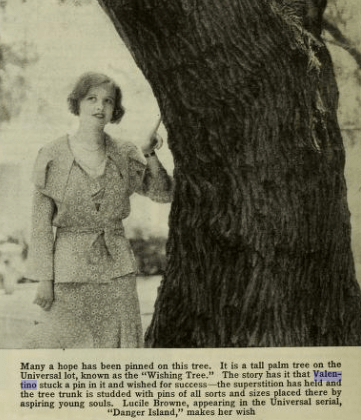
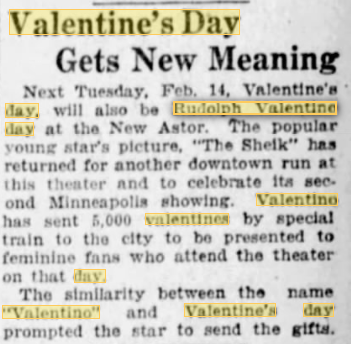
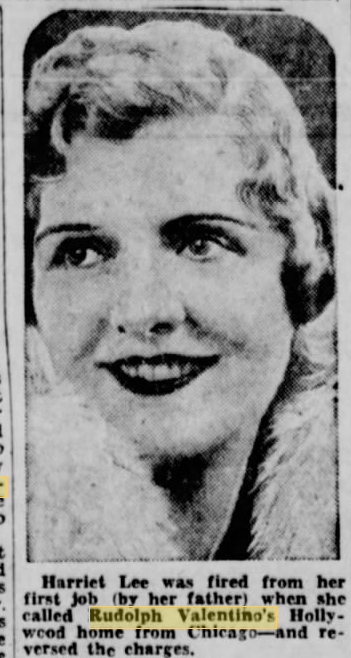
18 Feb 1932 Raid On Tomb of Valentino
Ghouls, it is suspected, have planned to steal the body of Rudolph Valentino for commercial reasons. Five men were recently discovered by a florist attempting to break into the crypt containing the embalmed boy of the famous silent film star.
27 Jun 43 Who Really Wrote Day Dreams Book of Poetry
25 Jul 1943 – A Bookman’s Holiday By Charles Collins
It was said, that Rudolph Valentino’s book of verses, “Day Dreams” was ghost writed by Gordon Seagrove, former Chicago Tribune reporter and thereafter an advertising stylist, it was slightly off the track. The truth in a nugget is that Mr. Seagrove nearly wrote “Day Dreams”. The inside story, in his own words, is better than the original. “I didn’t write one line of ‘Day Dreams’ says the erstwhile skipper of the yacht Vanadis,” and if I did I would be glad to atone for it on the scaffold. But..when the great lover was becoming a biological urge I saw him in a dancing exhibition, I think in the Bismarck Gardens. When he ended his program countless frustrated mommas took off their wrist watches, rings, etc. and threw them on the stage. That did something to me. How, I pondered, could Seagrove get some of those coconuts? So he hatched up a scheme for a deluxe volume of love poetry by Valentino, to be written and published by himself (Gordon Seagrove), and submitted to the Great Lover who said “Yes”. A serious accident in the Mackinac yacht race delayed the ambitious Seagrove, but after he had been patched up in the hospital ‘all bound with woolen string and wires” he began to write the poems. “It was Eddie Guest with allot of hot Italian background says Seagrove, “a whiff of the desert and a dash of ‘pale hands I loved beside the Shalimar”. All in all, it was good, heart-mellowing stuff, calculated to knock the matrons not into one loop but three. In due course, the verses were sent to Hollywood and approved. “But here the dirty hand of romance smote me. Valentino had met and fallen in love with Winifred Hudnut, also known as Natacha Rambova. This lady, who was a pallid kind of poet of the E.F. Cummings incoherent school, took one look at my meaty efforts and vetoed them forthwith. She substituted her own stuff, which now appears in Day Dreams – a new love in versification, in my opinion.. Rudolph Valentino was also the alleged author of a volume of memoirs called “My Private Diary” issued by the Occult Publishing Company, Chicago in 1929. It’s ghost writer has not yet confessed but I can tell you Rudolph Valentino did not write this book but Natacha Rambova who should get the writers credit.
14 Feb 1952 – Valentino’s Valentine
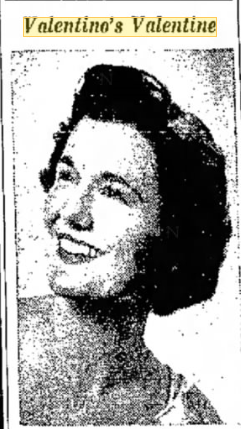
14 February is the perfect day to learn Edna Stansbury has been chosen as one of Rudolph Valentino’s Valentines. The modern day, version of the heart-throb of the Flapper Era, Anthony Dexter was this year’s judge for the 1952 Valentine Girl and her court. Candidates for the honor numbered 700, representatives from Beta Sigma Phi Sororities throughout the United States and Canada. Dexter chose Mrs Pat Lawrence a member of the California Chapter at Glendate as Valentines Girl. Miss Stanbury, named one of the 56 Valentines, had her portrait published in the Torch of Beta Sigma Phi. She was also offered a job has a sorority organizer. the younger group of business women. Had she been able to accept the work she would have toured the states and Canada form Nu Phi Mu Chapters. Miss Stansbury was chosen by Theta Chapter of Greeley to represent her group but only for her beauty but sparkling personality and service to the sorority.
10 Sep 1930 – Rudolph Valentino Converting films into talkies
10 Dec 1937 – Famous Designer Concerned for her Niece in War Torn Spain
Award winning interior designer Elsie De Wolfe, in private Lady Mendl, is regarded by many as about the most famous elderly socialite in New York, Paris. London without a care in the world or so one would think. These days, Lady Mendl is concerned for her equally famous niece fashion designer and the former Mrs. Valentino Winifred Hudnut. On a social scale, the former Mrs. Valentino outranks her Aunt due to courtesy of her marriage to a Spanish count in Majorca. Her husband is currently involved in the fighting and is away from the home front. Winifred Hudnut is still living in Spain near the French border devoting her life to caring for destitute and wounded people. Her aunt would like nothing better than to see her niece leave and return to safer shores. In the meantime, Winifred Hudnut is said to have grown quite plump and her hair has turned gray. She is still vastly interested in spiritualism.
26 Nov 1925 – Rudolph Valentino A Rex Beach Story
Rudolph Valentino’s new picture, “A Sainted Devil” from the story Ropes End by Rex Beach. Nita Naldi, Louis Lagrange, George Siegmann are a few of the prominent names which appear in the supporting cast of this production. It is a story laid in the Argentine, and tells of the country-wide search of a young Spaniard of wealthy parents for his convent-bred wife who was stolen from him on their wedding night by bandits. “A Sainted Devil” is declared to be the greatest Valentino production up to the presen
9 Dec 1924 – Closeup
Rudolph Valentino has a cottage on the United Pictures lot that is said to have cost $18,000. Here, when he begins work on United he will spend his time between scenes, resting, teaing, and possibly reading your letters girls.
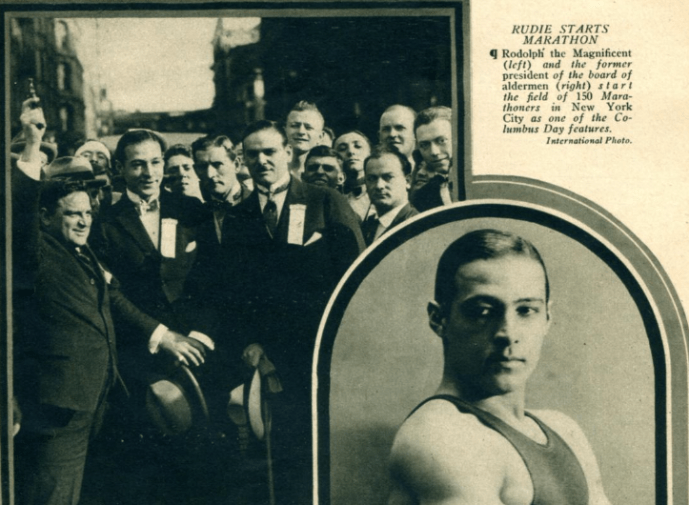
28 Jan 1923 – Movies get the Ax
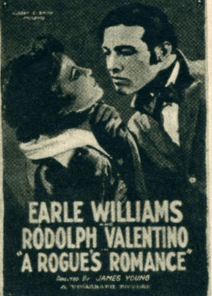
The coatless gentleman with poised hatchet in the accompanying photograph is doing a noble service in the motion picture industry. He is operating on old worn-out films that have been returned to the laboratory, exercising pre-natal influence on possible monkey gland movies so to speak. When he gets chopped to bits the canned drama you see surrounding him, there will be little danger of those films, descending upon an unsuspecting public in the form of warmed-over movies. So long old films can be purchased for a few dollars, unscrupulous dealers will re-hash them, insert a few new titles, play up any personality who may have acquired a box-office value, even though he may have been only atmosphere in the picture, and make a big profit at the expense of the confidence of the public in motion pictures. Rudolph Valentino has suffered perhaps more than any other actor from these warmed-over films. For several years, Valentino had hard sledding in the picture game. He considered himself fortunate to get small bit parts in inferior films. Now his name alone will bring out the S.R.O. sign at any theatre, all his early indiscretions are being dusted off and re-billed as new pictures starring him. How exhibitors do not seem to mind betraying their patron’s confidence is shown in the advertisement of a Los Angeles theatre, reproduced on this page, advertising Unchartered Seas, a Metro Production. Alice Lake starred in this picture. Valentino had a good part, that of the third point of the eternal triangle, but he was not the leading character. The exhibitor, however featured Valentino’s name in bold letters, mentioning the star only casually in inconspicuous type in the body of the ad. Another instance is the illustration of the advertisement The Isle of Love, you will see the names of Julian Eltinge and Rudolph Valentino in lettering of the same size. You will probably not notice the statement this picture is “revised” from An Enchantress, the type is so small. From the posters one can conclude Rudy was the main squeeze. As a matter of cold fact, he does very little. He appears in a few dancing scenes that is all. In Rogues Romance was probably the most flagrant example of monkey-gland movies that antagonize a none-too-trusting public. The posters show a range of shots from this Earl Williams picture, all featuring Valentino. Occasionally, they allow Williams the star, a circle insert in one corner of the bills. You will notice all scenes are dancing scenes. There is a reason as you discovered if you paid out your money to see a Valentino film. Valentino does an apache dance. It was a good dance but not long enough to bolster up the Valentino billing. So, they cut in a repetition of the dance; they have Williams seem to like the dance so much he asks Rudy to do it again. They had to prolong his action someway, else he would have appeared only in a few short flashes. Taking advantage of his phenomenal rise to fame, Vitagraph is reviving this production of other days and in billing the picture is giving the perfect love equal prominence with the star. A woman patron who sat through two performances of A Delicious Little Devil didn’t do it because she liked the picture. She thought she had missed Rudy somewhere coming in. Because Valentino’s name had been billed as big as Mae Murray’s the real star, she had gutlessly expected to see him have a real part. The exhibitor probably wouldn’t have mentioned Mae at all if she hadn’t threatened legal action if she wasn’t given proper credit. The woman went out solemnly searing she would never patronize the movie house again.
Feb 1923 – Rodolph Stops The Show
Rodolph Valentino has always refused to make personal appearances, but he made one that wasn’t on the cards. The other evening, in New York Rudy sneaked into the Rivoli Theatre to see how his new picture, The Young Rajah went over with the audience. Somebody recognized him; the news that he was in the audience spread and the crowd applauded until Rudy got up and say a few well chosen words.
1920’s Alvarado Hotel

In 1878, Fred Harvey began a partnership with the Atchison, Topeka and Santa Fe Railway. In 1889, the Railway gave Harvey exclusive rights to manage and operate his eating houses, lunch stands, and hotel facilities upon the Santa Fe’s railroads west of the Missouri River. The Harvey Houses took pride in their first class food, service, and cleanliness. In 1902, the Alvarado Hotel part of the Harvey House chain of hotels was built in Albuquerque, New Mexico was a shining gem named after Hernandez de Alvarado, a captain of artillery in Coronado’s famous expedition. This famous hotel contained 75 guest rooms, restaurant, front lobby, reading room and barber shop with electric lights and the latest modern conveniences of the day. The interior was decorated in a traditional southwest theme with carved beams, massive stone fireplaces, and Spanish/Indian decorative features throughout the hotel. Famous silent film celebrities of the day Rudolph Valentino, Hedda Hopper, the Crown Prince of Denmark, Jack Dempsey, and Douglas Fairbanks with Mary Pickford, and many more would disembark from the transcontinental passenger trains that would often stop allowing their famous passengers a chance to freshen up and take a meal at the Alvarado Hotel. A popular pastime for townsfolk was watching the parade of movie stars and other notables descending daily from the rail cars to eat, stretch a bit, and perhaps purchase items from the Indians selling their wares outside the museum. In the 1930’s the hotel became a relic of the past and its history is no more except in pictures..


July 1923 – Marriage Under Difficulties
Wherein the strenuous time Rudolph Valentino has had in getting himself married to Natacha Rambova had anhything to do with it or not, but anyway Rudi is slated for the hospital suffering from a nervous breakdown. All of the nurses at prestigious John Hopkins Hospital are aflutter over the ‘sheiks’ pending arrival. But he can cheer up on one point, Indiana authorities say he is legally married at last.
10 Sep 1925 – Valentino Horse Injury
Rudolph Valentino, film actor, was scratched and bruised at Lankershim, near here, today when he was dragged some distance by a galloping horse. The scene which Valentino was making for the screen required him to halt a running horse. He grabbed the animal by the bridle, but the horse, entering into the spirit of the act, kept going, bumping the actor along the road. Valentino must appear in Justice Court here Friday and stand trial on a speeding charge. Such was the response of Justice Joseph Marchetti yesterday to Valentino’s plea that he move his court temporarily to his studio. Valentino had declared that if he should have to leave the studio and go to court the wheels of production would stop and much money would be lost while the cameras waited for his reappearance.
2019 – Five Year Blog Anniversary

All About Rudy Blog is five years old and what a journey of discovery this has been for both you and I. After all this time, I am amazed finding new and exciting things, I continuously find about Rudolph Valentino an amazing silent film actor. My research takes me to the far wide reaches of the Internet, books, and newspaper archives. I look for items of interest for you in hope you will continue to visit my blog and travel with me back to a time of joy and laughter news articles and pictures of an bygone era. The news articles I find may contain either factual or non-factual items. The fun is in reading what they wrote about Rudy back then. If there is anything you would like to read more of please drop a comment. Thank you for your support.

Aug 1922 – Not Quite A Hero
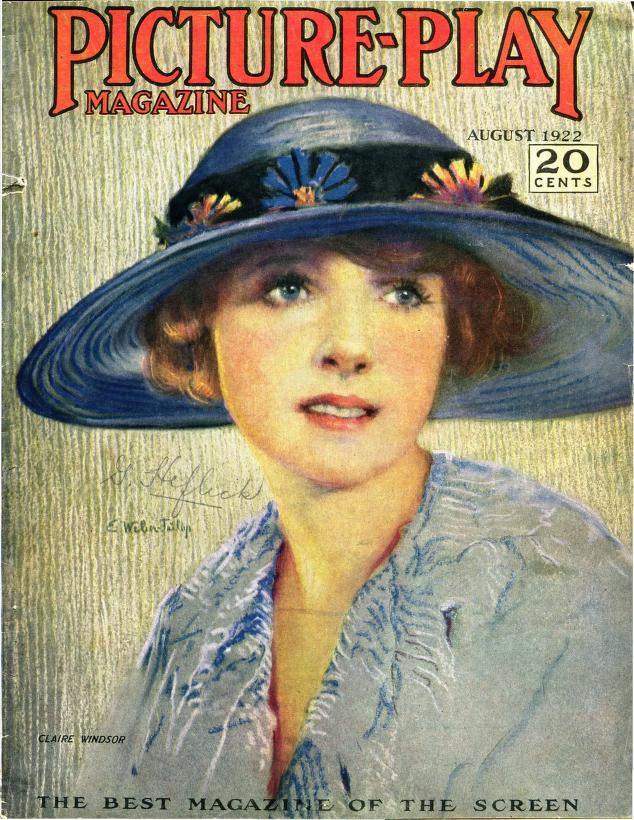
In the heat of discussion about Rudolph Valentino in which everyone who ever goes to the movies seems to be taking part what the man is really like is almost lost sight of in the maze of conjecture, misconception, and exaggeration spread about him. Here he is as he really is. Once upon a time, there was a young man who was not a perfect specimen of American manhood. He was not remarkably dauntless not brave. His appearance did not suggest shining virtue nor impeccable nobility. In spite of the fact that he lacked all the glorious qualities of a real movie hero, Rudolph Valentino went into the movies. The casting director whom he interviewed decided he wasn’t the sort of man who would appeal to an American girl. He did not seem fitted to jump off cliffs, rescue fair maidens, or register high-minded devotion in the close-ups. They admitted however, that he could dance and that he was a good type for what is recognized about the studios, and nowhere else as a “society villain” But they forgot to find out whether or not he could act. Sometimes big movie organizations are careless about such things. I am not, going to tell you about “How One Young Man Made Good” I don’t need to. You probably saw “The Four Horsemen of the Apocalypse” But I am going to set forth my theory of his phenomenal rise to fame, the secret of his success. It is this? He does not look like your husband. He is not in the least like your brother. He does not resemble the man you mother thinks you should marry. He is not the nice boy who takes you to all the high school dances. And so women go to see him in motion pictures because he typifies romance. Out in Hollywood, the men who know him like him. The women who know him but they won’t tell. As for Valentino himself, he doesn’t talk about it. If you happen to be one of those irate fans who have been disgusted with the interviews in which his opinions on love and the ladies have been set forth at wearying length, please accept my word for it that such statements which he really made were wrung from him and that some of them were as new and strange to him when he saw them on the printed page. If he ever saw them as they were to you. Certainly, I found him shy on all such subjects; he honestly does not want to be considered a matinee idol. You cannot blame him, for where are the matinee idols of yesteryear? I have tried to talk to Valentino about love, women and matrimony. Every time, I broached the subjects he side-stepped them. But let us hasten on to the interview. I met Mr. Valentino on the Lasky lot. With me was the perfect Valentino fan when she saw him come up to us both she said “please introduce me by my maiden name and don’t say anything about my husband and baby”. Whereupon she removed her wedding ring, and slipped it into her handbag. There’s a little bit of bad in every good little girl. Mr. Valentino suggested luncheon and escorted us to his motor. “It needs cleaning” he explained “but it runs beautifully”. In half a minute we were a half mile away. When Mr. Valentino made his entrance into the restaurant every woman in sight gave a moan of joy and all the women tourists were oh so glad they had come to California. Mr. Valentino did not look to the left or the right but at the menu card. Our luncheon was the result of a promise. When I saw the preview of “The Four Horsemen” in New York, June Mathis who wrote the scenario came up to me, “Keep an eye on my Julio. I picked him myself and, if he isn’t one of the coming favorites I’ll eat that film”. After the picture, I saw June and congratulated her. So there I became the perfect fan. He found out the perfect fan loved to dance and so he talked about dancing and orchestras and about the charm of sitting in a pleasant restaurant with agreeable and well-behaved persons all about you. He hates vulgarity and vulgar dancing. Then he turned to me and said June Mathis discovered me and gave me a part when life was not so easy. And now, she will write all my pictures. She is a capable, humorous and generous woman. I am eternally grateful to her. No one realizes how much she had to do with the success of “The Four Horsemen” she was on the set every day. She suggested a hundred small touches. And now she will supervise “Blood and Sand”. I am immensely glad because it is the first picture in which I am in the starring role. And I know that I can trust Miss Mathis advice and good judgement. Mr. Valentino was quite sincere. He is not half-hearted about his praise or his blame. Sometimes when it comes to blaming actors, actresses or directors, he refuses to be politic. Who says that the Italian’s are a suave race? But his greatest virtue is his loyalty to his friends. With all the feminine world accepting him as a romantic figure, he refuses to accept his role; his good qualities are commonplace. I said that he evaded discussing love, marriage and women. Yet, I discovered indirectly what sort of woman he does like. During our conversation, he professed an admiration for only one type; he likes clever, sophisticated, amusing and capable women. He has no eyes for the beautiful and brainless. Although he probably won’t admit if he did. I think he rather likes em’ rather strong-minded. No power on earth can make him speak even tolerantly of his picture “The Sheik”. In vain, do you tell him the movie has made money, that brought him stardom, that it is one of the most popular pictures of the year. Mr. Valentino will simply reply the movie was a fatal error and hopes he will never appear in another picture like it. “What nonsense it was. I neither acted like an Englishman or an Oriental” I was obliged to play like an emotional Italian. It was all out of character. The Oriental is stolid and the Englishman prides himself on self-control. “When the picture came out, I received many letters and some were flattering. But the intelligent critics told me what they thought of my acting. They said that Ihat I had achieved a little success and that evidently I was content to take advantage of that success. Letters like that are not pleasant are they? I am not trying to please those who are easily pleased. I value the opinion of the intelligent critics. This maybe a blow to the Valentino fans, but he honestly dislikes silly letters. “Just now, I need honest criticism and good advice, I appreciate it. Again, Mr. Valentino seemed sincere. Success has made him sensitive and hypercritical of his own work. He is not vain but shrew and careful minded that he takes his popularity with large grains of salt. “Hollywood” said Valentino is a small town not physically but mentally”. A great deal has been said about the frivolous of the movie colony. All of us need honest recreation. We need to forget the studio when our work is finished. I like to dance and I like to go to restaurants with my friends. But I don’t like vulgarity in dancing and so-called wild times I have seen in the cafes in Los Angeles were rather childish and silly. Several years ago, New York had become a delightful and cosmopolitan city. Out here we have to still learn how to amuse ourselves. One cannot escape boredom merely by going out and spending allot of money. No reformer is needed to tell the better-class actors and actresses that they cannot enjoy themselves merely by going out and drinking too much. I am afraid, I have made Rudolph Valentino a serious young man. Most of the time he wears a mask, and he uses his charming manners as a sort of guard. He has no particular pose; he is a dignified and courteous gentleman and is witty in a sharp way. When he spoke of the conventional “happy ending” to movie stories the perfect Valentino fan hung on his words. “The happy ending” has come to be nothing but a rubber stamp. I think the public is tired of it. After all, only one love affair in a thousand ends happily. And an affair of that sort is too dull to be interesting. Romance doesn’t make men and women happy. Human beings are made happy by such things as success, food, a good home, pleasant friends. Romance is something that makes them more than just happy. A refutation of the Pollyanna philosophy. Love doesn’t make the world go round it makes it go sidewise, zigzag, up and down and backward.. In his attitude, toward his art, he reminds me of the adored Caruso. When Caruso made a sensational success in opera, the wise men said that he couldn’t stay a public favorite. Caruso remained a favorite until he died. Valentino and Caruso are much alike in their way of talking and speaking. Caruso was supposed to have a wicked voice whatever that means and Valentino is supposed to have wicked eyes. At heart, Valentino is the same as Caruso and one of the most interesting things about him is the violently contrasting opinions in the outbursts of feeling that his sensational success has caused. If you’ve been reading ‘What the Fans Think’ you know what I mean. I know of no one in pictures the mention of whose name will start so violent a discussion. Hazel Shelly told you, last month that he was vain, calculating, and upstage. She refused to meet him. Hazel is entitled to her opinion, but you missed the chance of your life. Years from now, you’re going to sit down and cry about it. Ethel Sands gave a good impression of him thoroughly honest and to my mind accurate. And now, having given my own appraisal, I wish to add the opinions of some of those who have worked for him. June Mathis “I have worked with Rudy a long time. I can assure you he is a nice boy. He has been the target of professional jealousy. He has kept his head and his temper. He is reasonable and not all temperamental. After finishing “Blood and Sand” Nita Naldi discussed Valentino. “When I came out here, I did not think he could act”. Now I apologize. He is a real actor and I suppose some of our love scenes will look pretty warm. The script called for them. Valentino was courteous and decent. Some actors and I have played with prominent ones like to spoil the scene by putting in little asides. Valentino does not. Said Lila Lee “Blood and Sand” was a real inspiration. Imagine Fred Niblo, Valentino, and June Mathis working on the same picture. Valentino sn’t a bit mean about wanting the star part. Mrs. Mathis “we are all fond of Rudy. I like an accomplished man. He speaks five languages and plays and sings beautifully. The perfect Valentino fan ended up the chorus “I would leave my husband for him but I am afraid I would annoy him.” Mr. Valentino is a wonderful relief he doesn’t flirt, he is quite sincere. By the time you read this you will have known for some weeks that Rudolph Valentino is married again. The lucky lady is Natacha Rambova alias Winifred Hudnut. Valentino’s opinions on his marriage are sound: “it will be the best thing in the world for me. I shall have a clever wife to advise and encourage me. I know that I shall be very happy we have the same friends and same tastes.” Both Natacha and Rudy will be the most charming couple in Hollywood. They have established their own intellectual circle, and they are far from the mad movie set. Is she jealous of his leading women? I don’t think so. She merely smiles as Valentino bows to his favorite heroine. It is easy for a woman to fall in love with her man, but it is hard for her to gain his respect and devotion and this Natacha Rambova alias Winifred Hudnut has done.
Oct 1923 – My Honeymoon by Mrs. Valentino
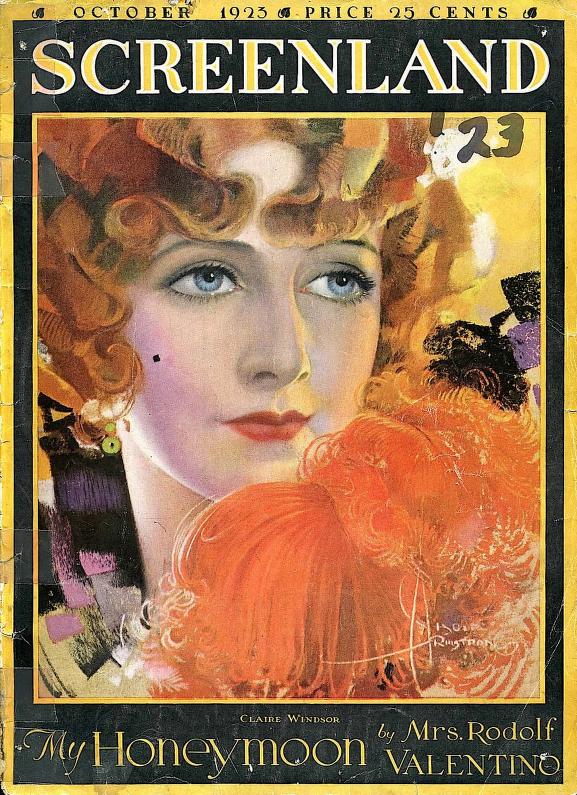
Would you consider yourself the luckiest girl in the world if you married a man who owned $60,000? Would you think you were in for a life of bliss if your husband had no position and stood small chance of getting a position for several years? Would you think you stood on top of the world if your husband were dragged from the honeymoon to answer a charge of bigamy? No, you would not and very likely you would go home to father and the certainty of three meals a day. Mrs. Valentino naturally enough won’t admit that she wasn’t the luckiest girl in the world. But she will admit that the first months of their married life weren’t all moonlight and roses. For moonlight please substitute the unbecoming glare of publicity and for roses please substitute legal papers. But it’s all over now. In her apartment in the Hotel des Artistes, Mrs. Valentino prepared for a trip to France and Italy. Another honeymoon, no, just a vacation it will be a rest from the long dreary and lonesome months spent on the dancing tour. There are all sorts of movie wives – frivolous ones who step=out, there are the home-loving ones who do the mending, there are the wives with careers of their own and there are the wives with influence. Mrs. Valentino is one of few wives who has influence – she reminds you of Mary Pickford. She talks business in a sane, cool-headed way. She is engrossed in her husband’s success and his ambitions. Like Mary Pickford, she is of the Disraeli, the Colonel House and the Charles Evans of the household, and naturally, her husband thinks she is the whole works. Does she care that women mob her husband every time he appears in public? N he’s going to make good o, she doesn’t she is used to it. When Rudolph begins working on his new pictures for Ritz Carlton, he’s going to make good pictures. And, I believe the public will like them, and then, we’ll know that it has been worth all the trouble and all the fights. Substitute the small blond Mary Pickford for the tall dark Mrs. Valentino and you have the same arguments that launched Douglas and Mary on their career as independent artists. Mary, stubborn and contrary, also fought her way through lawsuits, and matrimonial difficulties. A pretty woman with an idea firmly fixed in her mind can battle strong men. Beside their stubbornness, Mary and Mrs. Valentino have another trait in common. They have a shared sense of humor. They can laugh at their husband’s jokes and the grotesque comedy of the rest of the world. They are experts at discovering the silver lining and at making the best of bad situations. The dancing tour may have been bad in many ways, but its made new friends for her husband. The lawsuit was disagreeable but it has proved to the public that he has the courage of his convictions. The more adventures that befall you in marriage, the less possibility is there that marriage will suddenly turn dull and stale. And marriage can weather many storms but it can’t stand a long period of calm. Just ask the man who has the placid wife.


1925 – Rudolph Valentino in New Mexico
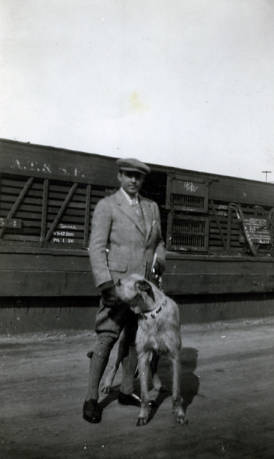
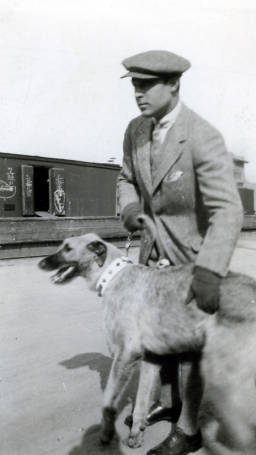
These two rare photos were taken near the Santa Fe Railway Depot, New Mexico. Rudolph Valentino was walking his dog while the train stopped to pickup/drop off passengers.

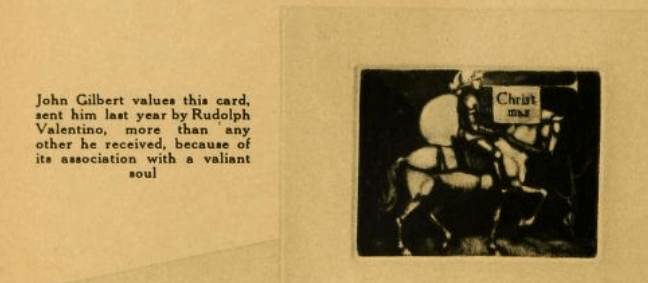
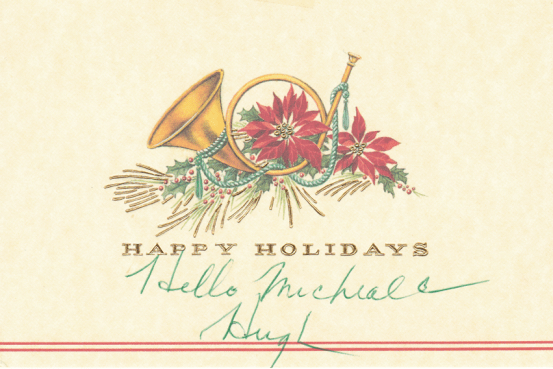
Valentino Christmas Cards
Rudolph Valentino loved this time of the year. Here are two examples of Christmas Cards he sent to his friends.

21 Dec 1925 – Real Name
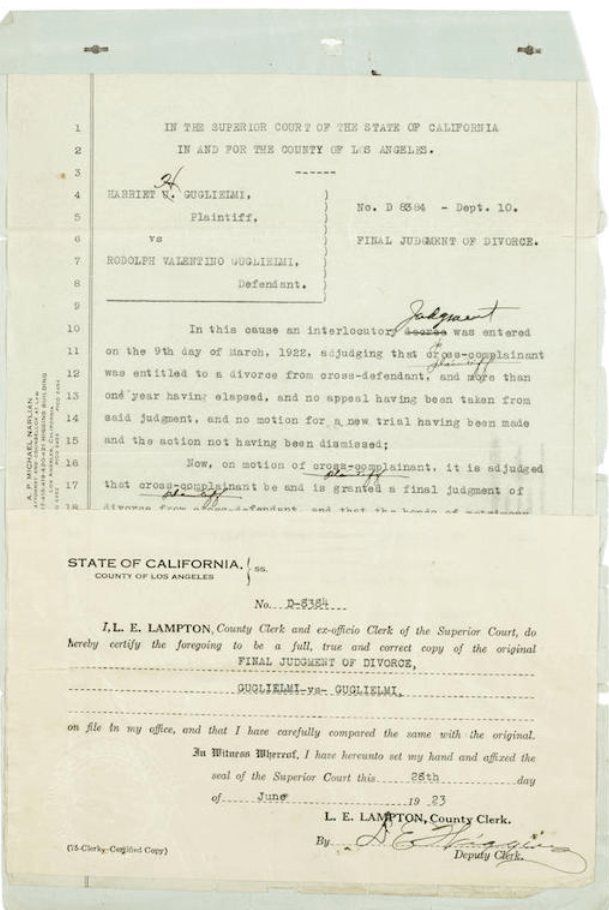
Paris Mrs Rudolph Valentino (Winifred Hudnut) has filed a petition for divorce against moving picture star whose real name is Rudolfo Guglielmi but Valentino today appeared to be unperturbed by the news that the proceedings had reached official form in Paris. He nonchalantly refused to reply to inquirers who had divined his identity, although he was cited under the name of Guglielmi. Valentino dined at a fashionable hotel tonight and after that left with friends to explore the diverting quarters of the capital. Valentino wife’s name was given in the petition of Winifred De Wolfe and was set forth that they were married in Crown Point, IN on 15 Mar 1923. The proceedings here will follow the usual simple and expeditious course when there is no opposition.
11 Dec 1951 – Valentino “Widow” Suicide
Mrs. Marion Wilson Watson, 45, who claimed to have been married to Rudolph Valentino, committed suicide on Saturday. Mrs. Watson, a former actress, was a known as Marion Benda on the stage. She made annual pilgrimages to the Hollywood mausoleum where Valentino is buried. She claimed that she and Valentino had been married in 1925 and that she went abroad to bear him a daughter. Valentino* relatives said her story was untrue.
9 Dec 1924 Closeup
Rudolph Valentino has a cottage on the United Pictures lot that is said to have cost $18,000. Here, when he begins work on United he will spend his time between scenes, resting, tea-ing, and possibly reading your letters girls.
6 Oct 1927 – Moving Picture Star Distribution of Personal Effects
A bullfighter’s cape, worn by Mr. Rudolph Valentino, has been sent to Sydney, to be placed in the new Capitol Theatre. as a memorial to the late star, after Valentino’s death. His personal belongings went into private hands, but members of the motion picture industry spent a year gathering up his studio vestments. These are now being distributed to tie principal theatres throughout the world.

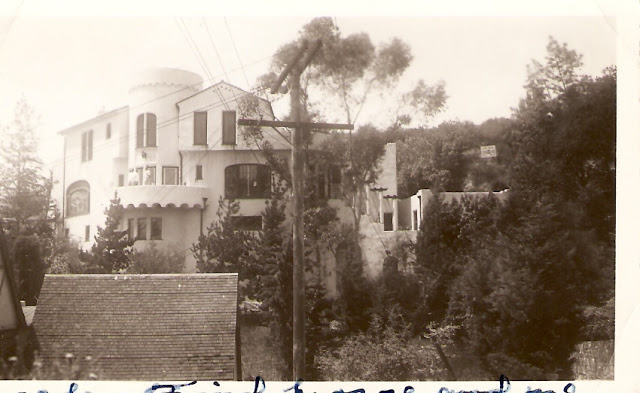
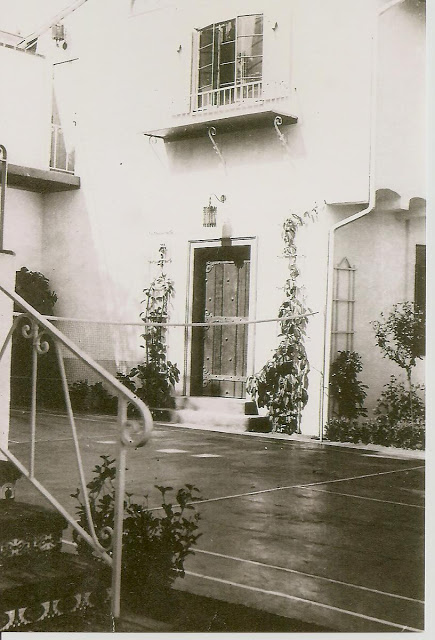
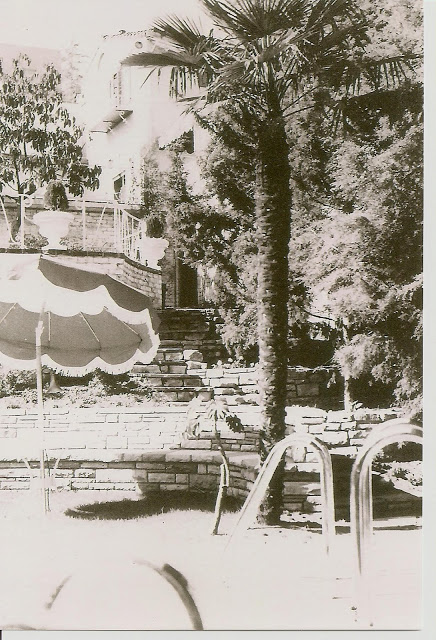
1940’s – Villa Valentino Whitley Heights


29 Nov 1940 – Shocking
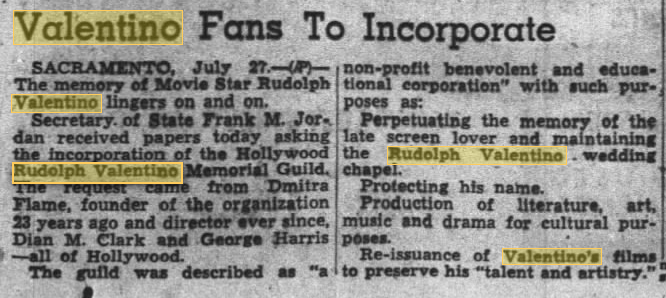
Millions of Rudolph Valentino fans were shocked when his manager George Ullman admitted, during a law suit that he had hired 40 press agents and 1500 policemen to dramatize the star’s funeral.
3 Nov 1926- The Secrets of Valentinos Last Romance
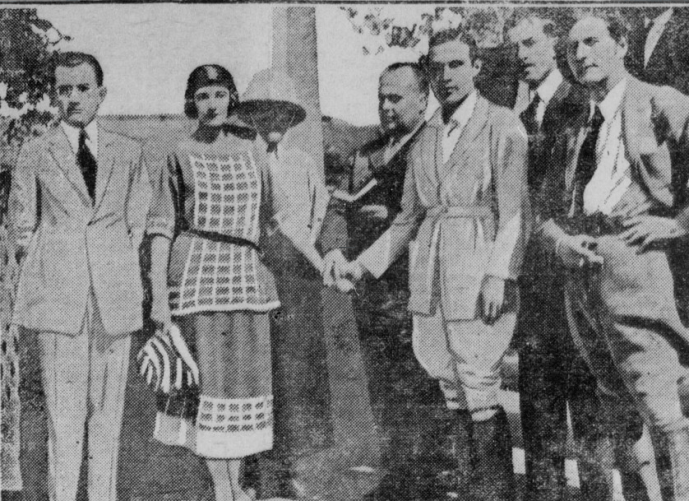
A cat may look at the Queen but a little chorus girl even though she may be one of Ziegfeld’s most glorified may not publicly make indiscreet remarks about a great movie star. This Marion Kay Benda, one of the follies beauties, discovered when, in an interview given immediately after the death of Rudolph Valentino she said “He was not engaged to marry Miss Negri, you’ll notice all the statements have come from her. He never denied any of them because he was too fine. He did think a great deal of her, but he had absolutely no intention of marrying her. I know. He often, in my presence, refused to speak to her on long distance telephone calls. “No one knew him as I did. He was the most wonderful person I have ever known. I can’t believe that he is dead. He was so fine, so wonderful, so sincere, and I know he liked me very much. He couldn’t stand “rounder’s” and his ideals were of the highest. In every sense of the word he was an artist.” A rumor was circulating at that time that Miss Benda and Valentino were secretly married a few weeks before, this the show girl denied. “Oh those things always are said” she complained. “People cannot understand being simply good friends. I’ve known Mr. Valentino for four weeks and I saw him a great deal. Often we hired a cab and drove through Central Park after the show and then there were early morning walks and talks.” It was in the company of Miss Benda that Valentino attended his last social evening. The two of them, accompanied by Buzz Warburton, jr. went to Texas Guinn’s Night Club on the evening preceding the star’s fatal operation. During Valentino’s illness there was a long procession of greater and lesser lights of the theatrical world calling at the hospital and leaving flowers, but all visitors were denied admittance to the sickroom. And it wasn’t of his companions in the night clubs and after-theater suppers that Rudolph spoke when he was strong enough to talk but of his friends in the movie world. Welcome enough, then, were the tempestuous Polish star’s long-distance telephone calls. The little chorus girl who believes that “no one knew him as I knew him” was evidently quite forgotten. Her change as a protégé of the famous sheik had been snatched from her, and the limelight of public interest shone on her only for a moment and then promptly turned in another direction. Stars in the movie world are the “clannish” on earth. They have their scraps and jealousies, rivalries and revenges in private life, just like other folks, but it is an unwritten law that those shall never be divulged for publication. One great consolation Miss Negri has, and that is that it was her image which floated across the mind of Valentino the last moment before he lost conscious contact with life. Dawn was just breaking in the sky when Dr. Meeker noticed that his patient was trying to say something. After a night of agony he was too weak to raise his voice above a whisper. The doctor placed his ear near the dying star’s lips and just managed to catch the words “Pola, Pola” if she does not come in time…tell her I think of her. Those were the last words Valentino uttered in English. From that time on, until he passed away at midday, delirium and coma alternated, and all the incoherent remarks which passed his lips were in the old mother tongue. This message was relayed by Dr. Meeker to Mary Pickford and from her to Norma Talmadge. The Polish actress received it in the Campbell undertaking rooms at the funeral of Valentino began. There was so much talk about whether Pola and Rudy were or were not engaged that finally the star herself denied it. “We were not formally betrothed,” she gave out the statement while enroute to Hollywood on the funeral train. “Rudy never believed in formal engagements neither do I”. “The reason the betrothal was never announced was that Rudy thought such an arrangement appeared too businesslike a proposition, and I agreed with him.” We frequently discussed our marriage plans for next April, and our closest friends knew of them. We thought our private lives belonged to us, and we did not want to make publicity of it. In a very clever composition contained in a book of poems in verse and prose which the late star published two years ago, he expressed a pessimistic viewpoint towards romance. Under the title “The Kaleidoscope of Love Synonyms and Antonyms,” he describes its birth, rise, fall, and disintegration. Is analysis runs as follows:
A-Adoration, Anticipation, Affinity, Arguments
B-Beauty, Bliss, Bitterness, Bondage
C-Caresses, Circumstances, Confidence, Charm
D-Desire, Delusion, Dreams, Divorce
E-Ecstasy, Engagement, Ego, End
F-Fascination, Forgetfulness, Flatter, Faith
G-Gossip, Gratitude, Gifts, Goodbye
H-Happiness, Honor, Heartache, Hell
I-Intuition, Irony, Idolatry, Integrity
J-Jealousy, Joy, Justice, June
K-Kisses, Keepsakes, Knowledge, Kismet
L-Lips, Loneliness, Logic, Longing
M-Marriage, Morality, Money, Man
N-No, Nearest, Novelty. Never
O-Opposition, Own, Offering, Opulence
P-Passion, Promise, Pride, Proposal
Q-Quality, Quest, Queries, Quarrels
R-Romance, Reveries, Realization, Remembrance
S-Sympathy, Sacrifice, Shame, Settlement
T-Thoughts, Truth, Temper, Tears
U-Unkindness, Understanding, Uncertainty, Unfaithfulness
V-Virtue, Vanity, Vows, Vengeance
W- Wisdom, Wishes, Wedlock, Woman
X-The unknown love
Y-Youth, Yearning, Yes, Yawn
Z=Zenith, Zest, Zeal, Zero
So he described in 26 versions the span between the alpha and the omega of the little game of love. In real life, Valentino was as much the great lover as he was on the screen, but he failed to domineer over the ladies he wooed and won without the air of the scenario writer to chasten their independence of spirit. Jean Acker, his first wife, went “on the road” in vaudeville very shortly after their marriage, and it was not until a few weeks before the star’s death that they were reconciled. Natacha Rambova, her successor, also insisted on putting her career first, and, in spite of many reported attempts to adjust matters, this marriage too went on the rocks. Had Valentino Married Pola, would their union have been any more permanent? At the time the exotic Natacha Rambova left her famous husband, ostensibly on a “vacation from matrimony” she was asked if a divorce were in the offering. “I don’t know,” she answered. “There will simply have to be some sort of adjustment. And frankly I haven’t the least idea how we can arrange matters so that we can live together without constant irritation cropping up. “My husband wants me to give up work and devote myself to the home. If I did that, what should I do with all my idle hours?” We have servants who are much more capable of running the house than I am. I have always worked all my life I have had the urge to create. I cannot give this up it is part of myself”. So Natacha Rambova sailed to Paris. At the finish of his picture Valentino came to New York. He as was his habit, refused to commit himself beyond giving more or less of a repetition of what his beautiful wife had said. He was seen a lot in the company of Mae Murray, who had just returned from Paris, where she had obtained a divorce from Bob Leonard, the Broadway matchmakers got busy, but both denied any romantic attachment. Miss Murray intimated that reconciliation with her former husband might be possible; Valentino was less frank, but those who looked wisely declared that the Valentino-Rambova frayed romance was on the verge of a renaissance. As things turned out, the little follies girl was quite correct in her statement that Rudy and Pola were not engaged. However, she spoke out of her turn and was set down.
19 Dec 1926 – The Lair of the Falcon
20 Sep 1930 – Regains Valentino Gems
A suit to recover a ring and a stickpin she had purchased from the estate of Rudolph Valentino, motion picture actor was won by Mrs Zunilda Mancini, 255, West Thirty Third St, NYC after an all-day trial yesterday before Justice Sulzberger in Third district Municipal Court. Louis Halle of 152 West 42nd Street, attorney for the defense, said that Justice Sulzbergers decision would be appealed. Mrs Mancini, 70 years old, brought the action against Miss June Bruce of 230 West 11th Street, NYC a clerk in the customs service, who said the ring, valued at $400 and the stickpin worth $25 had been given to her by Mrs Mancini for services as secretary and for kindness extended to the plaintiff. Mrs Mancini testified that she became interested in Valentino after his death and that she had contributed $5000 to the Valentino Memorial Fund. She told of going to Hollywood and of buying various articles from the late actors estate including the jewelry in ligitation. She denied giving away the jewelry
28 May 1927 – Rudolph Valentino Sheik Deceased Film Star Makes Spirit Return
28 Mar 1985 – Her Memories Are of a Glittering Past
Some women would envy Ann Carlin Carey. She waltzed with “the great lover” as she toured the eastern United States as a singer and dancer. Carey glided across many floors and concert halls with Rudolph Valentino who has been called the greatest romantic male star of the silent film era. After she was crowned Miss Buffalo at 21 she was one of 12 women chosen to accompany Valentino’s singing and dancing act. “He was a good dancer” said Carey. Everywhere he went Valentino was idolized. The women loved him and the men hated him but I never thought much about his popularity.
15 Jul 1938 – Beulah Livingstone
According to Beulah Livingstone, who writes publicity for a company sponsoring the revival of “Son of the Sheik” the name of Rudolph Valentino will remain a magic one as long as romance flourishes on the movie screen. “It was the late Valentino”, declares Miss Livingstone “who set the hears of the nation thumping wildly with his forthright technique of love-making, and his rugged he-man characterizations set another precedent in screen acting. Those who remember and love him for his screen contributions, as well as the newer generation who have never had the opportunity to see the great idol of filmdom, will be happy to learn that his last and greatest picture has been booked for local presentation. We have known Beulah Livingstone since back in the good old silent days, when we were young and innocent and the brain-storms that flowed so profusely from her sturdy typewriter were eagerly accepted and passed on without blue penciling to our readers. But a lot of water has shot over the Chaudière since “Son of the Sheik” was produced and released to a clamoring public, and we confess that Beulah’s effusive if well-turned, phrases anent the current revival of Rudolph Valentino productions from the dimly-passed silent days leaves us as cold as one early morning last winter when the radiator on the old bus froze stiff and we bravely ventured forth to walk the two miles to our office. For the information of those who might be interested, and just to keep the record clear, we might add that the rejuvenated “Son of the Sheik” contains sound effects and a newly arranged musical score. Acting, directing, technical effects, and camera work have come a long way, however, from the days when every other girl of teen-age sent in a quarter for her idol’s photograph and mounted it on the boudoir table.

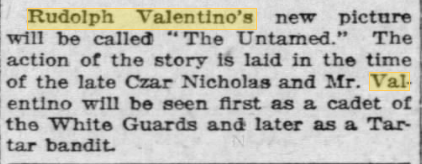
2 Dec 1926- Valentino is Still Making Films
Natacha Rambova declares that she is having spirit talks with her former husband, Rudolph Valentino. In the first place, she claims that he gave her his impressions of His own funeral, saying he disliked intensely the public’s lack of reverence. ‘It looked to much as though they were out to see a ‘show the screen star complained. Valentino also told her that he is quickly making -friends on the ‘other side.’ His first astral friendship, he said, was with.’ Caruso; whom he said he found a most likeable fellow. Life on the astral plane would appear to be very much like that of the world Valentino has left. In any event according to Natacha Rambova their demand for moving pictures for she claims Valentino gave her details of resuming his screen career in the spiritual world. Valentino still loves no other woman in his life added Natacha.
28 May 1927 – Rudolph Valentino Sheik Deceased Film Star Makes Spirit Return
1932 – NY Fashionable Clubs
Casanova Club, on West 54th Street, is smart and fashionable. Here you can hear Ruth Etting sing and listen to Harry Rosenthal and his orchestra. Emily Vanderbilt and they do the snootier spots, of course, where the lorgnettes get in your hair. Rudy Valentino’s pet place was Texas Guinan’s, where I saw him last, a few nights before he passed away. It was at La Guinan’s 54th Street place that Rudy defended himself from the attacks of a Chicago editorial- First who poked ridicule at Valentino because he wore a slave bracelet “which is too effeminate in America.” My newspaper assigned me to ask Rudy about it. I never saw a fellow get so sore. He pounded the night- club table furiously and argued that every gentleman in Europe wore them. Rudy added: “It seems to me that almost every Yankee soldier during the war wore them too but at the time they were called identification tags!” “And.” he said, “I don’t care what anybody says about me wearing it. I wear it chiefly for the sentiment it packs. It was given to me by my first wife, Jean Acker, and I hope it’s there when I’m dead.” And it was on his lifeless wrist, at that. But it was removed before his interment and auctioned with his other effects. Speaking of Rudy reminds me that, when he died, over a million New Yorkers crowded Broadway and the funeral church to watch his cortege go by. A year after when his effects were auctioned at a Main Stem store only seven people came to buy! But his films are still going strong and they are the only films of a deceased star that seem to get over. “Monsieur Beaucaire,” for example, was a feature in New York recently. And, while the subject of Rudy has come up again, it serves as a moral to this piece on movie stars and others who Go Broadway. Rudy might have been alive today if he had heeded the counsel of physicians and others and stayed away from the sophisticated places. But Rudy, they will tell you, kept post-poning his visit to the hospital until it was too late.
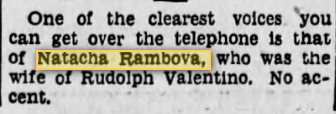

23 Aug 18 – 91st Rudolph Valentino Memorial Service
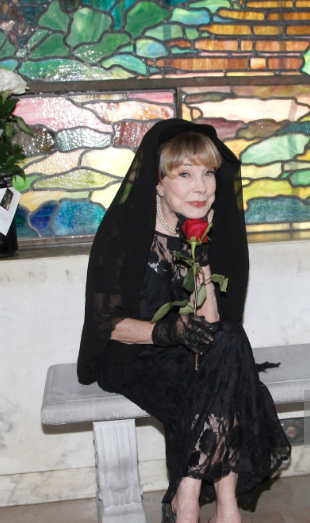
On 23 August every year, there is an annual memorial service held for Rudolph Valentino at Hollywood Forever Cemetery, Los Angeles, California. This year marks the 91st anniversary of his passing and once again the Valentino Memorial Committee put together a respectful tribute to a silent film legend.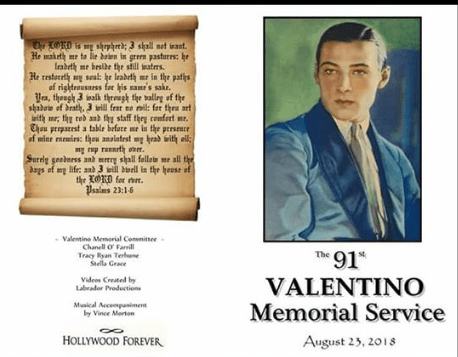
This year marks the 100th Anniversary of the release of his movie “A Society Sensation” starring Rudolph Valentino and Carmel Myers. Noted guest speakers were Ms. Brandee Cox, Academy of Motion Picture Arts & Sciences and Marc Wannamaker, Hollywood historian. Also in attendance was the cast and director of an upcoming movie about the famous “Lady in Black” titled “Silent Life”. For the second year this was lived streamed via Facebook to a world-wide audience of fans of Rudolph Valentino.
1951 – The Carmel Myers Show
In 1951, The Carmel Myers Show, was one of the first interview style shows that was briefly on TV. The featured guest, noted soprano and film star, Jeanette MacDonald, was a friend of Miss Myers who came to prominence during the silent film era. Miss Myers was a co-star of Rudolph Valentino in “A Society Sensation”.
 All About Rudolph Valentino
You must be logged in to post a comment.