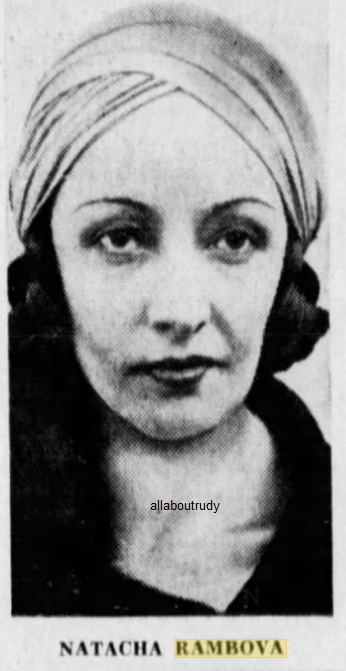
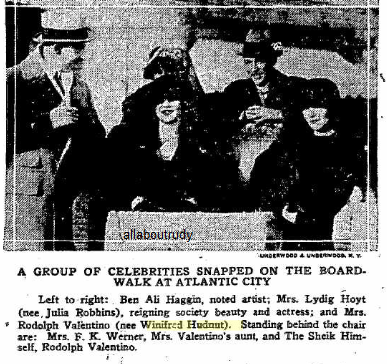
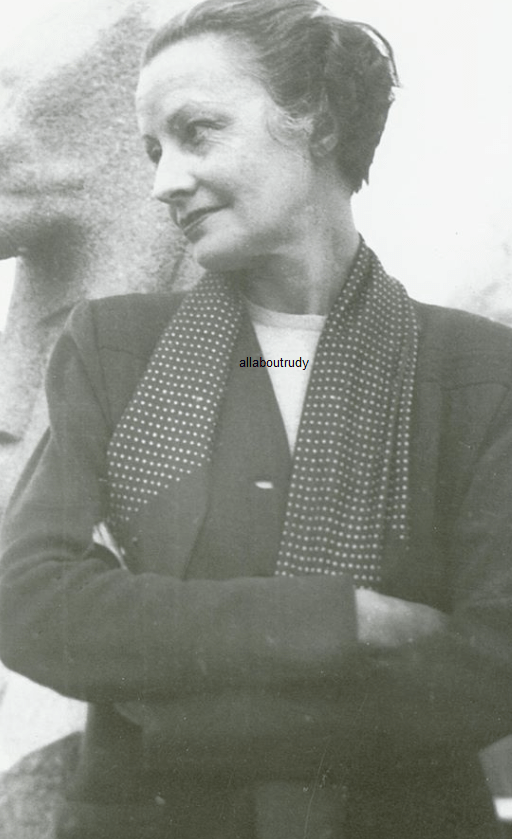
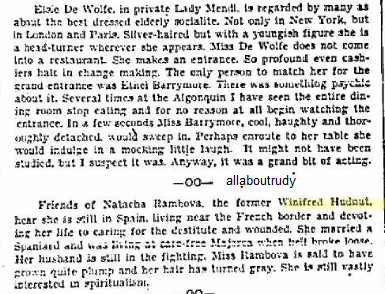
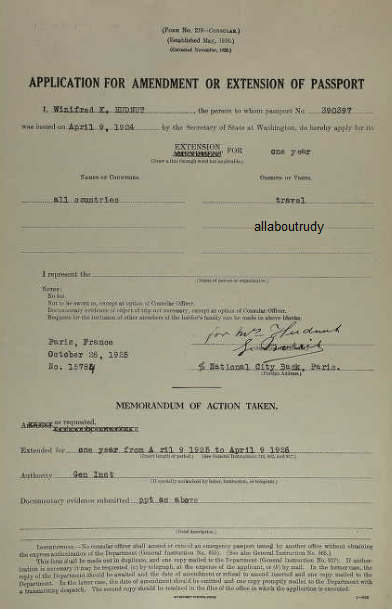
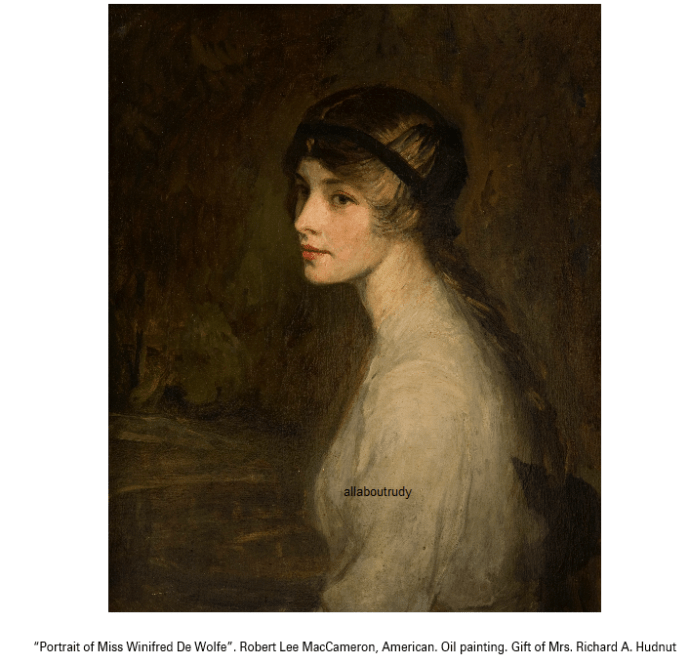
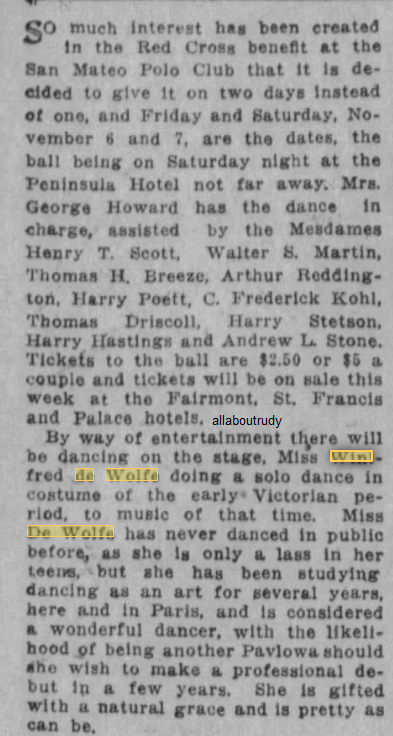
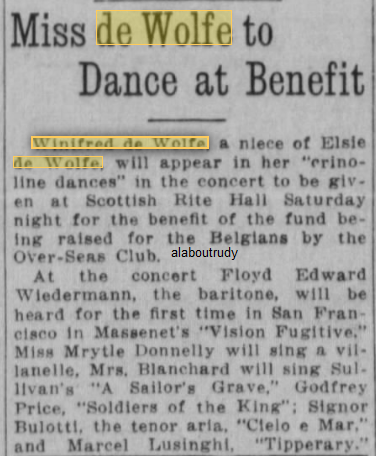
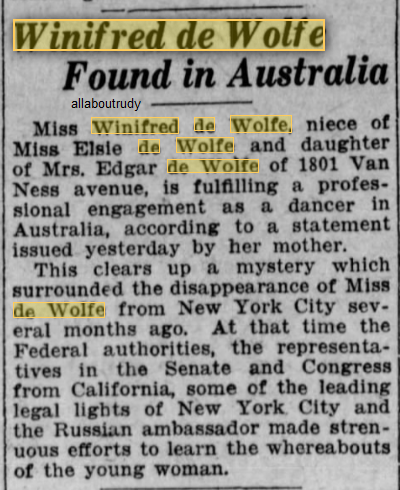
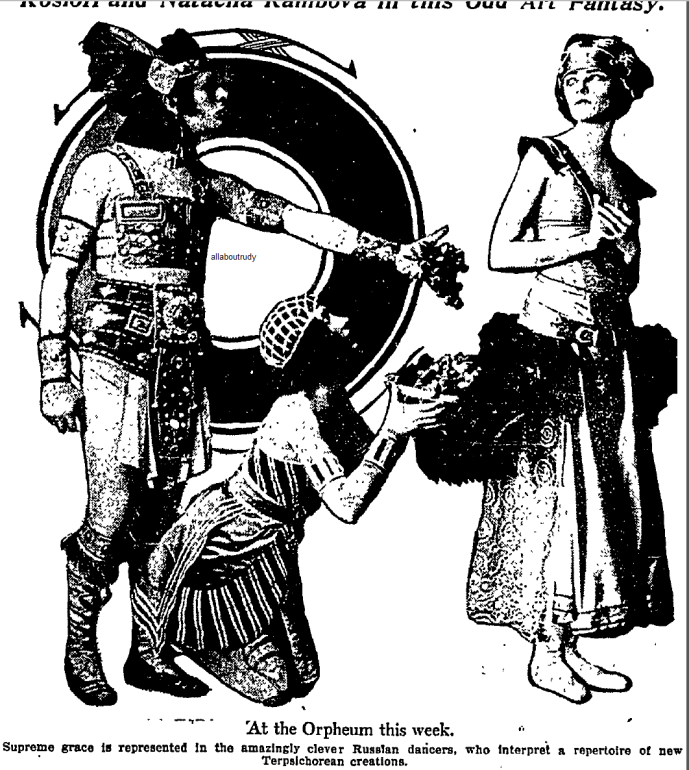
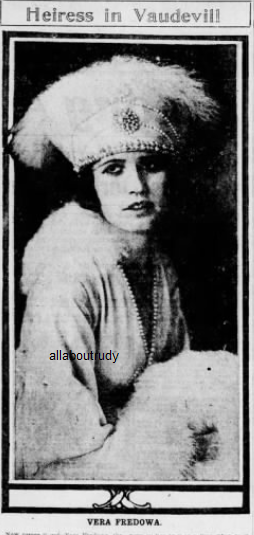
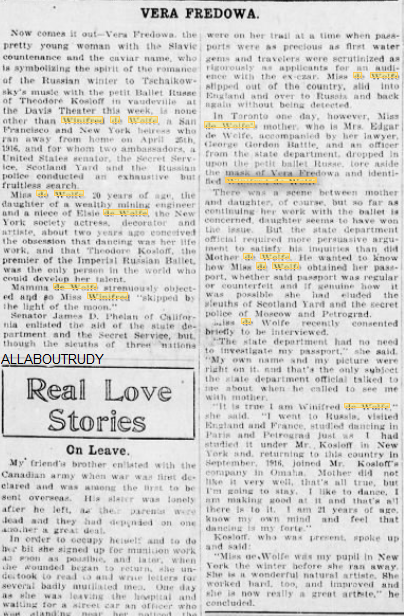
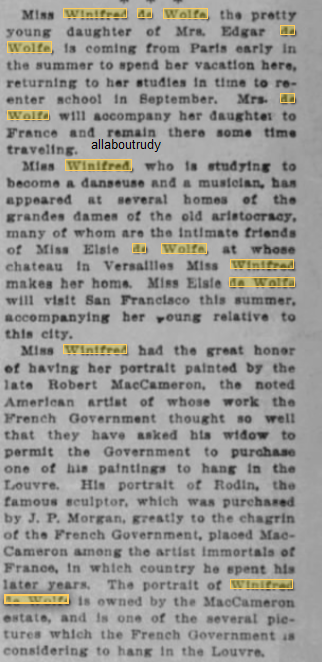
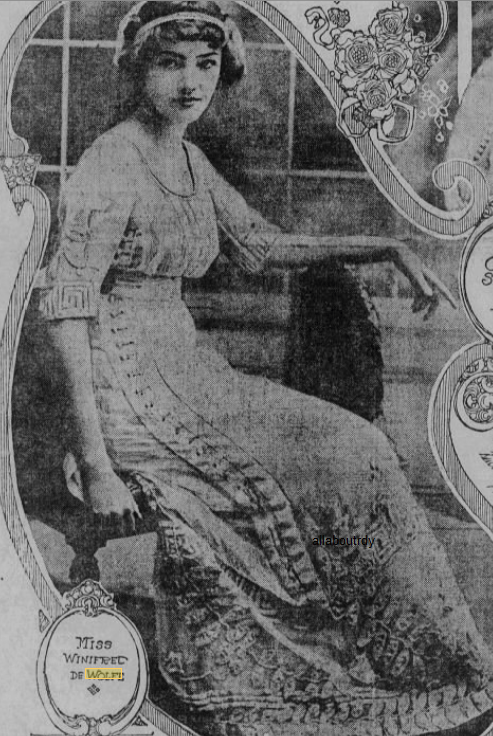
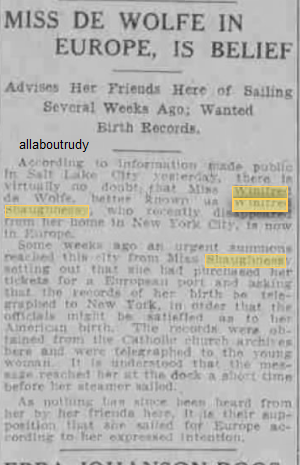
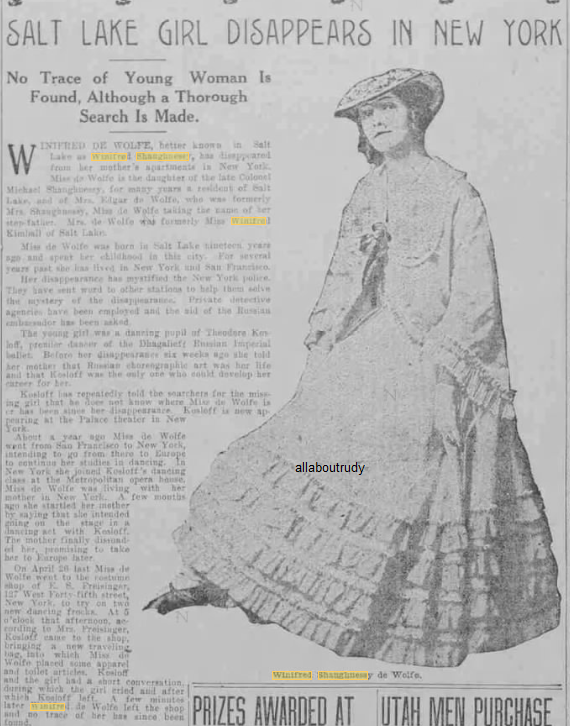
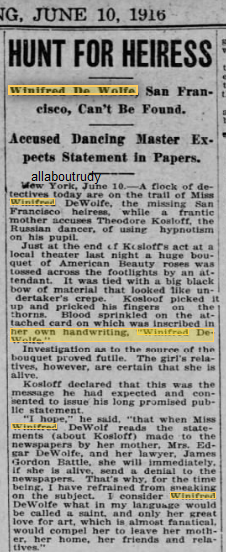
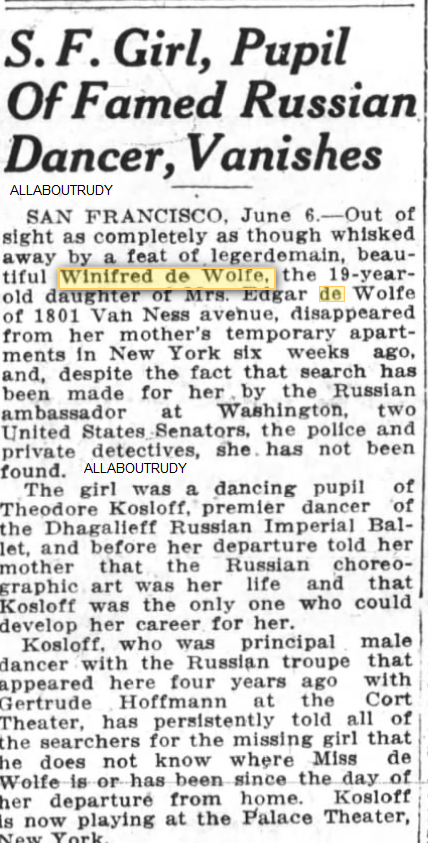
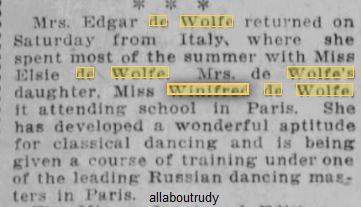
The strange disappearance of Winifred de Wolfe is greatly worrying her friends and relatives here where she was born and spent a great deal of her childhood. Though leaving Salt Lake City when a youngster, there are many of the old friends of her parents who have seen her in San Francisco where she resided for years. She is a beauty in every sense of the word, flowerlike in her loveliness, and has the brains air and breeding which distinguished her parents. Her father was the late Colonel Shaughnessy and her mother Winifred Kimball Shaugnessy a vivacious beauty who spent most of her time here until she married de Wolfe a San Francisco Hotel man.

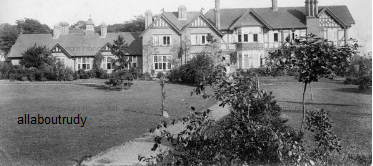
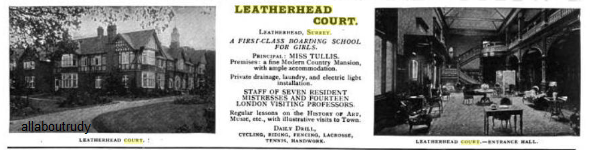
Leatherhead Court, Surrey was a British boarding school for upper class children. For 9 years, this was considered home, and the foundation of the woman Natacha would become.

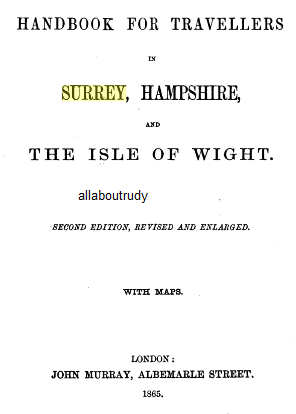
Described in a 1865 traveler’s handbook, Leatherhead must at one time of been a place of considerably more importance that at present, since the Sheriff’s County Court was anciently held here, and was only removed to Guilford at he end of Henry III’s reign. Now a large village of 4 streets, from the back of one of which extensive gardens slope downwards to the Mole, here no longer “sullen” and stealing onward toward the rich meadows of Stoke and Cobham. The river where Leatherhead Court students would often be found at art or nature appreciation lessons. This river is crossed by a bridge of 14 arches; close to which is “The Running Horse” a small inn, said to be the hostel in which Elynour Rummyng as celebrated by Skelton, Henry VIII’s poet laureate, in verses more curious than edifying. The local church were many of the students, teachers and staff would partake of Sunday services stands upon high ground of the Mickelham Road, was granted to the priory of Leeds in Kent about the middle of the 14th century, from which time it principally dates. The piers of the nave may, however, be earlier. The stain glass window of the E. Window was collected at Rouen by the Rev.James Dallaway, victor of Leatherhead for many years; during which he published his History of West Sussex undertaken at the expense of the Duke of Norfolk. There are no monuments of interest in the church. The inscription on that of Robert Gardiner (d.1571(, in the S. aisle was written by Thomas Churchyard “court poet” to Queen Elizabeth I. Leatherhead is in the midst of much picturesque and varied scenery.
For 9 years, Winifred Shaughnessy attended Leatherhead Court, a select girls school and below is information about the school that was her home during her formative years.

—————————————————————————————————————————————-
LEATHERHEAD COURT, LEATHERHEAD SURREY.
A RESIDENTIAL SCHOOL FOR GIRLS.
PRINICIPAL – MISS TULLIS.
The school is situated one –and-three-quarter miles from Leatherhead Station, one-and-a-half from that of Cobham, and nearly twenty from London. The Front of the House faces a little west of south, is 110 feet in length, and contains the chief reception-rooms and several of the school bedrooms. The Central Hall stands behind the chief reception rooms, is 66 feet by 27, and is open to the roof. It is used as a school reading room, for musical evenings, etc. It is heated by radiators and an open fire, and lighted, like the entire house, by electricity. Eleven of the school bedrooms open from the gallery. A weekly pianoforte recital is given in the Central Hall and occasional School Concerts, and the furnishings include a Lipp concert grand pianoforte of the highest grade. Also a Welte-Steinway pianoforte. The West extends back 162 feet and contains two Girls’ Sitting Rooms, Workshop, and four classrooms, all with School bedrooms over. One of the Sitting Rooms is used as a School Library and contains over 1,000 books for reading and reference. Besides over 1,000 ordinary reading and reference books the Library and the Central Hall contain a large number standard works on architecture, sculpture, painting and music etc. Some hundreds of photographs and lantern slides are used to illustrate the same subjects. The eastern side extends 187 feet, and contains, in addition to ordinary house ccommodation, the schoolroom, 50 feet by 20, and the studio, specially built and facing north, 25 feet by 20. The corner room with the bay window is the dinning room.
The hours of the meals on ordinary days are:
Breakfast 7.50
Milk 11.00
Lunch 12.15
Tea 3.15
Dinner 7.00
French is always spoken at two of the tables, and German at a third.
On the half-holidays the hours are:
Breakfast 7.50
Milk and Bun 11.00
Dinner 1.00
Tea 4.30
Supper 7.30
In warm summer weather the hour for tea on ordinary days is altered to suit the changed school-hours, and, whenever possible, the meal is taken to the garden. The Schoolroom, 50 feet by 20, is used for drill and dancing lessons, class singing, lectures and assemblies. Also for weekly and occasional dances, lantern lectures, and entertainments. The end of the room has a fixed platform, which can be enlarged when necessary, fitted with head and foot lights, and a sheet for a very fine electric lantern is ready for use. The Studio is 25 feet by 20, and was specially planned for its purpose. It is lighted by a large window facing north. There four Classrooms, all well lighted, warmed, ventilated, and furnished with single desks, etc. The Workshop contains the benches, etc., needed for carving, metal work, and other handwork. The Bedrooms are divided by curtains, so that each girl has a private cubicle containing bed, washstand, etc. A few single bedrooms are also available. The Bungalow (a Sanatorium) faces south and has a lofty and pleasant invalid’s room with bathroom adjoining, a convalescent’s room and a veranda, as well as accommodation for a nurse and a maid. The chief courtyard is a quadrangle, and is used for drill and as an outdoor gymnasium when the weather is suitable. One of the rooms overlooking the courtyard is fitted as a school kitchen for cooking lessons. Lacrosse is played during the winter and spring terms, and tennis in the summer. During the summer term the lacrosse field is divided into seven full-sized tennis courts. Each girl who desires it can have a small garden.

This is the last house Natacha Rambova called home. In her later years, Natacha Rambova, was living in New Milford, CT with two Yorkies and her faithful associate Helen Ducey. When Natacha’s health started to fail, she agreed to move in with her cousin Ann Wollen and her mother Katherine Peterson. Both were her nearest living relatives and they took care of her and made legal decisions until the end. The address was 3805 Mayfair Drive, Pasadena, California. Built in 1950, this home was a modest single-family home, 1822 square feet with 4 bedrooms and 2 bathrooms. This home last sold for $313,000 in April 1995.

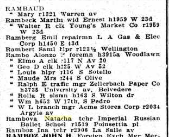
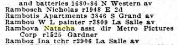
1920 Natacha Rambova L.A. Phone Directory

1921 Natacha Rambova L.A. Phone Directory

1944 Natacha Rambova Manhattan City Directory

1945 Natacha Rambova Manhattan City Directory

1953 Natacha Rambova Manhattan City Directory

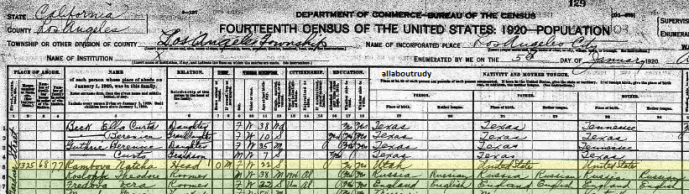
In 1920, the 14th Census of the U.S. was conducted and it shows Natacha was living with Theodore Kostloff and Vera Fredova.
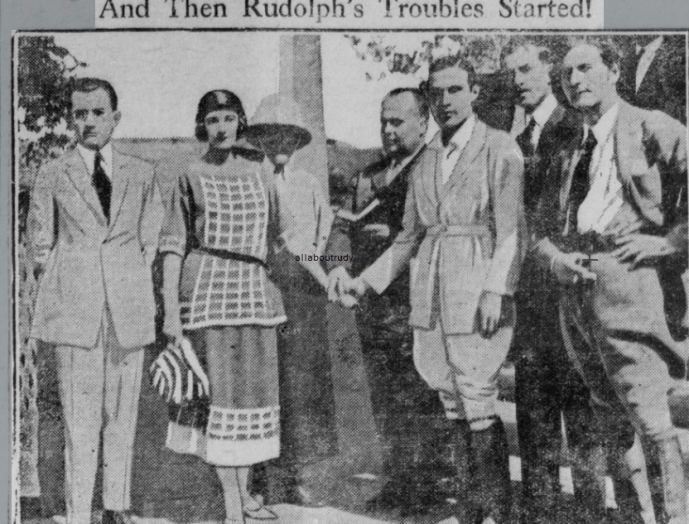
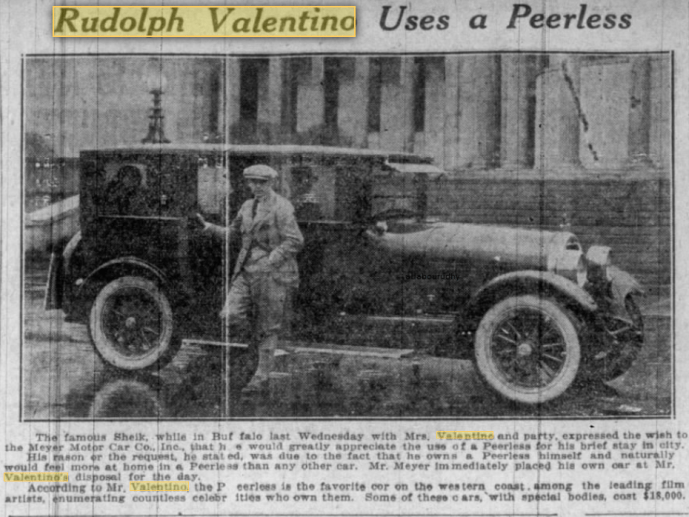
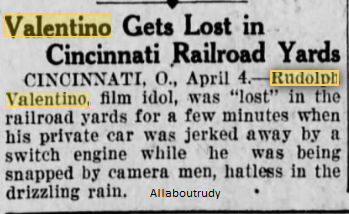
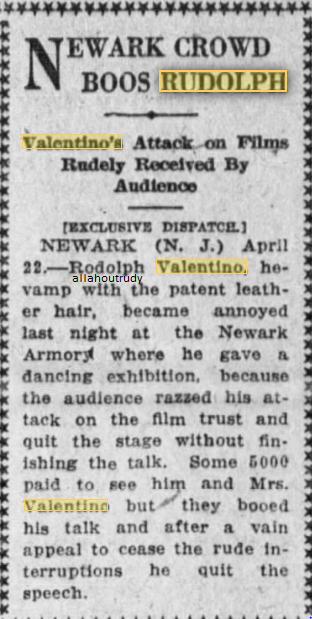
On May 30, 1923, film star Rudolph Valentino (1895-1926), in the midst of a personal appearance tour that took him to all parts of the country, arrives for his only known visit to Seattle. The actor gives a dance exhibition, thrilling local audiences with a glimpse of his famous Argentine tango, and lends his movie star persona to Children’s Orthopedic Hospital on behalf of their annual fundraising effort. Trouble in Paradise During his 1923 Seattle visit, Rudolph Valentino was in the midst of a dispute with his studio, Lasky-Paramount. Battles over power and control were being waged behind-the-scenes, but publicly the actor claimed to be protesting the cheap program films to which he had been assigned, as well as the practice of block booking. In an era when popular movie stars routinely appeared in three or four new film releases a year, Valentino resisted the studio’s demand that he work. (Block booking was an early distribution practice whereby a studio would tie the releases of major stars to less ambitious efforts. Exhibitors wishing to screen “marquee” pictures had to sign exclusive agreements that forced them to also show the studio’s third-rate potboilers. Exhibitors strongly protested this arrangement.) For failure to work, Lasky-Paramount eventually suspended Rudolph Valentino, and went as far as to obtain a court injunction preventing the actor from appearing onscreen until after his Paramount contract expired on February 7, 1924. The studio felt they had called Valentino’s bluff, since he and second wife, Natacha Rambova (formerly Winifred Kimball Shaughnessy) were heavily in debt. But the pair countered by mounting a personal appearance tour organized by George Ullman (later Valentino’s business manager), and sponsored by Minerlava, a beauty clay company. For 17 weeks, the couple gave dance exhibitions across the United States for a reported $7,000 per week, keeping Rudolph Valentino in the public eye and, based on their commercial pitches for Minerlava, providing the company with valuable exposure. The tour began in the spring of 1923 in Wichita, Kansas, where public schools closed on the day of his appearance. “The Sheik” Comes to Seattle Despite the excitement that Rudolph Valentino brought to almost every stop on his itinerary, the star’s arrival in Seattle was relatively low-key. The Valentinos were expected at 9:40 in the evening on May 30, 1923, traveling from Spokane in the star’s private rail car. From the train station, they were to be whisked to the Hippodrome at 5th Avenue and University Street, where Valentino was slated to help judge a combination dance contest/beauty pageant at 10:00 p.m. According to publicity for the event, the pageant served as a national search to help find the star’s next leading lady (a role which eventually went to veteran Paramount actress Bebe Daniels). Unfortunately, their train arrived much later than expected, and the Valentinos entered the Hippodrome well after the dancing competition. The actor then sat with other judges behind a curtain for the remainder of the beauty pageant, which concealed him from the audience, most of whom had come solely for the opportunity to see the motion picture star in person. When all was said and done, Rudolph Valentino personally selected Katherine Cuddy, a local stenographer, as the beauty contest winner, turning down the half-hearted challenge of Seattle Mayor and fellow judge Edwin J. Brown (1864-1941) on behalf of another contestant. It is hoped that Brown’s candidate did not know that the Mayor was championing her cause, for the next day it was widely reported that Valentino rejected her for having bad teeth. (Ironically, Brown — who was a prominent Seattle dentist as well as a doctor, lawyer, and politician — did not notice this defect.) The Valentinos followed the beauty judging with an electrifying demonstration of their famous Argentine tango, recreating the dance scene from The Four Horsemen of the Apocalypse. Both were dressed for the part; as one account put it: “It is in Rodolph’s [sic] blood to wear black velvet pantaloons and stamp his black patent leather boots and click castanets. His manner was quite Argentine; his hair quite brilliantine” (Dean). Natasha Rambova was also clad in black velvet, offset with a red Carmen-like shawl. “[She] is very brave to put on a ten-dollar pair of black silk stockings so close to her partner’s three-inch silver spurs,” noted Times reporter Dora Dean. The Private Valentino Dean managed to sneak backstage after the exhibition and take a spot in Rudolph Valentino’s dressing room, where she found the actor quite blunt about all the attention his appearances had been garnering. The moment he arrived at the Hippodrome, for instance, a large crowd of girls — “starving for romance,” the actor noted with some disdain — surged toward the stage. Adoration of this sort wore on Valentino, for it overshadowed his attempts to be taken seriously as a performer. “`From persons who saw the Four Horsemen I have received intelligent letters of appreciation,’ [Valentino] said. `I like them better
than the adoring notes from little girls who want me for their sheik.’ “`But what are you going to do, when all those darling girls want to see you ride [in] the desert and gnash your teeth?’ he was asked. “`Ah, they should stay at home with their husbands,’ said the slick-haired actor” (Dean). Wanda Von Kettler, writing for the Star, also managed to get herself into Rudolph Valentino’s dressing room at the Hippodrome. It must have been a crowded place: Mayor Brown and Washington’s Lieutenant Governor William Jennings “Wee” Coyle (1888-1977) also fought for space amongst a crowd of reporters and fans. According to Kettler: “Beside Rodolph [sic] sat Mrs. Valentino, his tall and slender brown-eyed wife, in her Argentine dancing costume … “He surveyed his guests. Then told them that he wasn’t a `sheik.’ “`Of course,’ he declared, with a somewhat resigned laugh, `I’ve gotten considerable publicity because of the name. But I don’t know if it’s been the right kind of publicity. The very sentimental girls think I’m all right. They like me. But what about the intelligent women — and the men? Don’t they think I’m a mollycoddle? They do. When I go back in pictures, after the fight with the movie concern is over, I’m going to prove that I’m not the type they think I am …’ “Valentino plans to write a book. He confided so to some of us Wednesday night. “`It’s going to be a book on the tango,’ he declared. `I’m going to teach all America to dance that dance. Everybody seems to like it, so why not help them learn it.’ “‘Dancing,’ he added, `is the greatest stimulant of the day, and is more and more being recognized as such. Since the event of prohibition it has increased 50 per cent.’ “Valentino doesn’t mind’ the letters he receives from admiring ladies. “`I’m very glad to know,’ he explained Wednesday night, `that I’m being appreciated. I like to hear the opinion of the public, whether it’s for or against me. But I know the ladies aren’t `in love’ with me. They’re in love with an `ideal’ and they sometimes write to me as a result.’ “As for Mrs. Valentino – being a sheik’s wife doesn’t bother her at all. When asked about her stand on the matter, she laughed and replied, `I want him to be popular. The more popular he is, the better I like it’” (Kettler). The Pound Party Following the Hippodrome appearance, the Valentinos traveled northward for scheduled engagements in Vancouver, British Columbia. They returned to Seattle on June 1, 1923, for a visit to Children’s Orthopedic Hospital, where they were guests of honor at the institution’s Pound Party. An annual charity event, the benefit took its name directly from its open request: In lieu of donations, the Hospital accepted a pound of anything — food, clothing, etc. — which could be used to help those in need. The Valentinos were the hit of the function, which a spokesman later declared the most successful in the history of Children’s Orthopedic. In total, the event netted a record amount of food and clothing and almost $400 in donations, $10 of which came from the actor himself. Credit for the success was given solely to Rudolph Valentino’s appearance, which garnered much more public interest than past charity drives. It also attracted hundreds of fans to the front lawn of the Hospital, mostly young women hoping to catch a glimpse of the actor as he came and went from the gathering. Thankfully, the throng outside conducted itself in an orderly fashion and the party went off without a hitch. After partaking in an afternoon tea and reception, the Valentinos went from bed to bed throughout the Hospital, visiting nearly every child and showing a sincere concern for their well being. “A few of the sheik’s queries concerning child culture demonstrated a decided lack of knowledge on the subject but a willingness to learn,” the Post-Intelligencer got several nurses to admit afterward. “He was quite exercised over the lack of teeth in the mouth of one baby, age eight days”. After the Pound Party concluded, the Valentinos slipped quietly out of the city, making their way first to Tacoma, then back down the coast toward Hollywood. The last word on Rudolph Valentino’s 1923 Seattle appearance fell to the Star, which produced a column entitled “Letters from Chief Seattle” after the city’s Indian namesake: “Dear Rudy: “I have met many movie stars, and most of them were painfully conceited. I am glad to see that egotism plays but little part in your character. It is more or less evident that you have been grossly caricatured by envious persons. Come back to Seattle soon and stay longer. CHIEF SEATTLE” (“Letters to Chief Seattle”). From Man to Myth Some six weeks after his Seattle visit, the actor came to an agreement with Lasky-Paramount, which allowed him to return for an additional two films at $7,500 per week. More importantly, the agreement gave the Valentinos complete creative control over both projects. But the triumph was short-lived. After finishing his Lasky-Paramount contract, Rudolph Valentino jumped to United Artists, where studio executives were adamant that Natasha Rambova — who exercized tremendous influence on her husband’s career — not interfere with their pictures. Valentino agreed to this stipulation, but it led to conflict within the marriage and helped bring about its demise. Still, the United Artists period was a successful one for the actor professionally. He made two of his better films with the studio, The Eagle (1925) and The Son of the Sheik (1926), a semi-sequel to his 1921 monster hit.
|
|


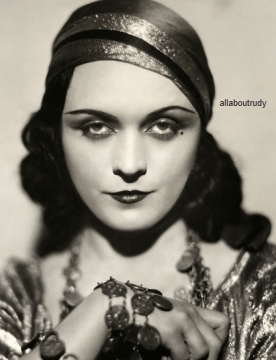
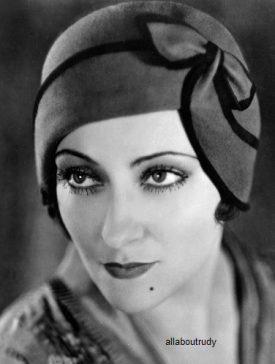
According to Irwin Zeltner (1971), “Hollywood has had many famous feuds, but cannot compare with the feud between two 1920’s silent film stars Gloria Swanson and Pola Negri. At the time, both were two of the most exotic women this town had known and experienced. The battleground was Paramount Studio in which their movies were made. When I first met Gloria Swanson, I was a bit startled by her voice. It was anything but musical. She was charming, but I quickly noted she spoke with an unmistakable midwestern accent. My first impression of her was she appeared tiny. Reared in Chicago by her U.S. Army officer father, in her early teens she was employed as ribbon clerk in a store not far from the stockyards. Somehow, like so many other famous discoveries, she landed a job with Mack Sennett Studios. She was standing in the doorway of a shack on the Sennett lot one day, when the great star maker Cecil B. Demille chanced by. DeMille, as he told me later, did a double-take and his intuitive perception told him this young lady had personality, charm, and appearance wholly distinctive. In a short while Miss Swanson was before the DeMille camera clothed in costumes that then were a shock to Hollywood. Her hair was done up in bizarre styles, and in a few lessons, she was taught to gesture with an elongated cigarette holder. The soon-to become famous Miss Swanson was thus prepared for the roles she was assigned to, and these were mostly females of questionable morals. With everything against her, she somehow remembered her public-school motto “Perseverance Wins”. How well I remember how exciting my duties were in behalf of two of her productions “Feet of Clay” and “Madame Sans Gene” released a couple of years later. These activities brought me in close contact with Miss Swanson and during one of our frequent meetings I was astonished when she spoke out most critically of Pola Negri who had appeared on the Hollywood scene to challenge Gloria’s pre-eminence as “Queen of the Movies”. “Mr. Zeltner”, she said I am the topmost female star of our industry and I cannot seem to get our Paramount Studio to subdue that Pola Negri woman, that foreigner, that gypsy. I listened carefully, as Gloria after a moments rest continued her tirade. Her eyes glinted, and she was relentless and more sharply demanding than ever. It was not long in coming a showdown with Paramount Studio officials and Adolph Zukor a kingly little man who was President. In his effort to calm the tempestuous Miss Swanson, Zukor offered her a contract in which Paramount was to pay her upwards of one million dollars annually. But she would not give an inch. About this time, I had luncheon with Miss Swanson, and no sooner had sat down when I ventured to inquire about her latest Paramount offer. Her reply was quick “Mr. Zeltner I am forming my own production company. I am the reigning female star of the movie world and determined to remain as such”. I will make arrangements to release my pictures through an affiliation with United Artists. She would be joining Douglas Fairbanks, Mary Pickford, Charlie Chaplain, Harold Lloyd, Rudolph Valentino. It was not long, after Gloria now complete master of her fate, realized her star was glowing less brilliantly. Gloria carried her head high, persevered as was her wont and never for a moment allowed her battle with Pola Negri to lapse. Miss Negri kept up the challenge. However, it was now Hollywood History that Miss Swanson won that war, and for along time sustained her exalted position. It was producer Ernest Lubitsch, who brought the gifted Pola Negri to America and to the Paramount Studio. Here she immediately clashed with Gloria Swanson. I had the pleasure of meeting Miss Negri on the day of her arrival. This very exotic female was a genuine gypsy. Her father died in exile in Siberia after he had become involved in Poland’s fight for independence from Russia. Miss Negri in my opinion was a beautiful and talented woman. She achieved considerable success on the Warsaw stage. In Berlin, impresario Max Herinhardt directed her to state and screen stardom. Miss Negri was well-known on the European Continent as a dancer, having graduated from the Russian Imperial Ballet School. Her combined abilities were now being praised in movie and stage circles in America and juicy contracts were being offered to her. Somewhere in between Miss Negri married and then shelved a real count. The one thing, I keenly remember of Miss Negri on the day of her arrival was that she kept reminding all and sundry that she was a countess. It was only natural for Lubitsch, to star her in his epic “Gypsy Blood”. This of course, was produced by Paramount Studio. Her role was that of a sultry vamp, and the picture was a box-office success. Soon as the cameras started to grind on this picture, and all through production her famous clash with Gloria Swanson on the same lot flared and it forthwith, grew in intensity. The battle between them both was so bad Paramount officially shifted Gloria to the East Coast Studio. Later when they sent her to Paris, one of her first achievements was to acquire a titled husband a marquis. Now her fight with Miss Negri was really joined. While this was all going on, Miss Negri was succeeding in turning everyone in Hollywood against her. She held everyone and everything in contempt. She avoided all social contacts, remaining in solitude and her music and literature and an occasional visit from a European friend. Miss Negri found herself completely rejected and she took great comfort in the romance and love that quietly existed between her and Rudolph Valentino. Incidentally, I was one of only a few close friends of Rudy’s to know of this romance. When word came to Miss Negri in Hollywood the Latin Lover was on his deathbed, she made a transcontinental dash to be at his bedside. It is true among Valentino’s last words were “If she does not get here in time, tell her I love her”. This message which she received in Hollywood, gave her license to display great grief and some have said was laying it on too thick. About this time, her popularity started to rapidly decline, and Paramount Studios found it hard to sell her films. Heroic efforts were made to remold the temptress image, but everything fizzled. Abruptly she went back to Germany, where she was understood and admired. Again, she married to a fake Prince and I was not surprised by the news at all. I received a cable invitation to come to Germany. This and a later letter detailed her desire for American promotional campaigns for her pictures. She was frank enough to state our methods applied to her German Films would rebound in her favor in the U.S. and this she wanted more than anything else. Even though she was offering me an amount more than what I was currently earning I respectfully declined. My regard for Pola as an actress never wavered and nor my respect until one day, I received authentic information from a remarkably close friend in American news that Miss Negri was linked with Adolf Hitler. My friend queried her on this, and she never denied the association with the Fuhrer. Her only comment was that there had been many prominent men in her life, with Valentino heading the list”.
Reference:
Zeltner, I. (1971). What the stars told me: Hollywood in its Heyday. Exposition Press.
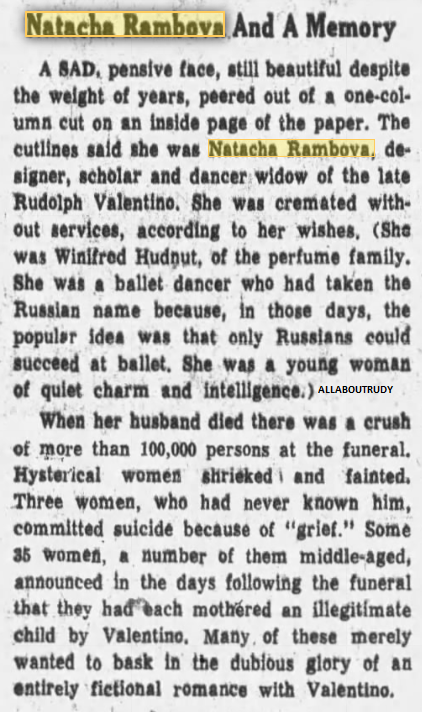
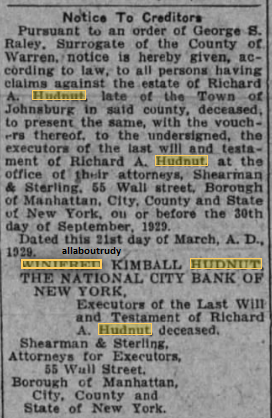
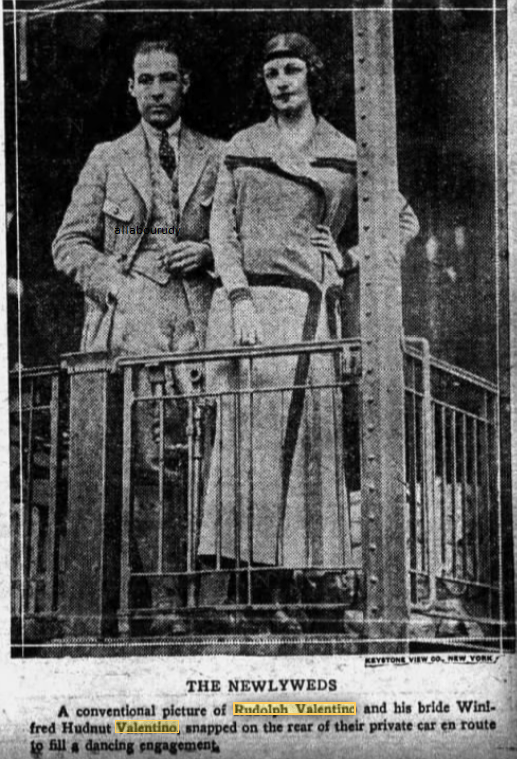
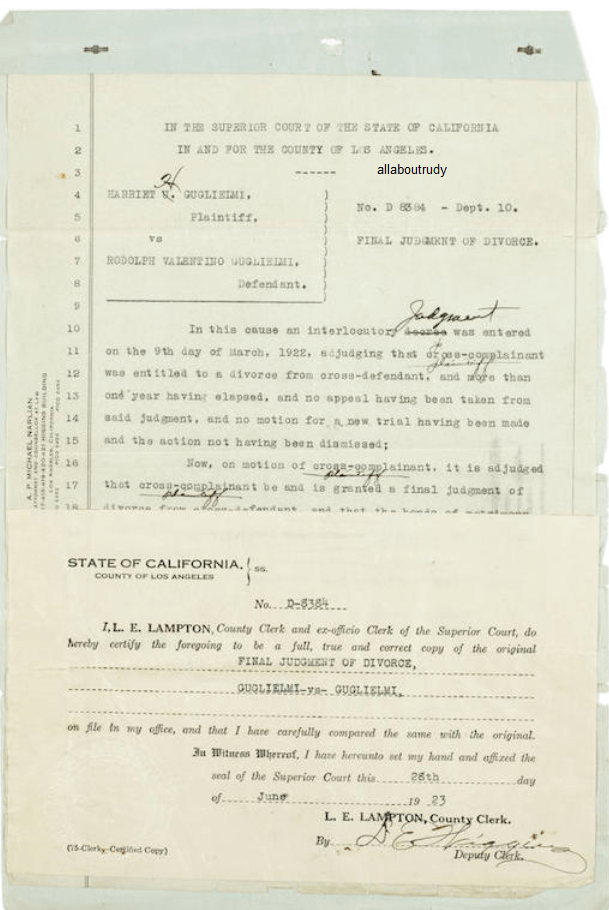
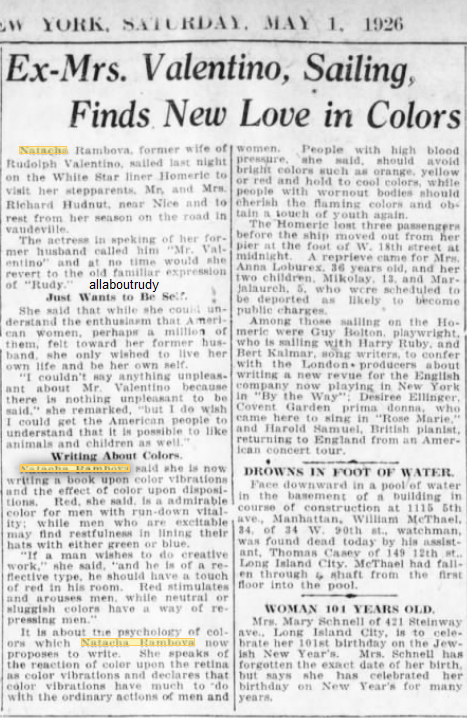
Reports in circulation here today that Winifred Hudnut, bride of Rudolph Valentino had sent in her permanent resignation as art director for Nazimova were denied here today by the United Studios. “Wo have received no official word from Miss Rambova since she lofts here,” it was declared. “It is possible the resignation may have been sent to Mme. Nazimova, who is away, but we have heard nothing about. Mme. Nazimova will not return until June 1. and there is no way for ns to check up on the rumor.”, Miss Hudnut, under the name of Natcha Rambova, was employed as art director by Mine. Nazimova at the United Studios up to the time of her separation from Valentino, now under a charge of bigamy. Miss Hudnut took her vacation at the time of the wedding and has made no formal communication [since. Her leave of absence has ‘not yet expired, it was. stated. Preparations to bring to a final the California statute prohibiting marriage within a year from the granting of interlocutory decrees of divorce were being made by counsel for Rudolph Valentino today. The ultimate decision is expecting-to be brought to the ‘supreme court in an effort to defend the marriage of Valentino in Mexicali and similar marriages of at least twenty other picture stars and persons said to be under investigation. The strongest efforts will be made to quash the case against Valentino in’ the justice court, was learned today, but both state and defense are preparing for a long series of appeals. The attorney in charge of Valentino’s defense dared that hundreds of marriages in the State of California believed themselves to be united will depend on the outcome of this court. The district attorney’s office continued its efforts to piece meal its case against Valentino will be arraigned before Justice Vincent Bowser.
Rudolph Valentino birthday was on Mother’s Day and a dinner at the home of Pola Negri celebrated his special day. On being questioned as to what birthday it would be Rudy safely remarked he would be just one year older than he was last year, and it was not a matter to be laughed about. Pola has not yet left for that love test separation, her last reason being that the rate of exchange abroad or her health, or the health of her mother had suddenly determined the silent film actress to cancel her sailing arrangements a week ago. Rudy meanwhile is staying up nights reading stories to find one for his next picture.
On reaching Chicago, from escaping the madness she was forced to leave behind when she married Rudolph Valentino in Mexico. It was revealed by her friends that until her marriage she was Winifred de Wolfe daughter of Mrs. Edgar de Wolfe and niece of Elsie de Wolfe, well known interior decorator. This discovery recalled the fact a world-wide search was being made for her in 1916, when she suddenly disappeared from New York. Two Senators and a Russian Ambassador participated in the search. She refused to discuss this disappearance when asked about it tonight. Neither would she say anything about her relationship with a married Theodore Kosloff, Russian dancer with whom she was found as a dancer going by another name of Vera Fredov. In 1916, she left her home and told her mother the married Kosloff was the only person in the world who could develop her talents. After months of searching she was found with his troupe in Chicago. Later on, Kosloff declared “Miss De Wolfe came to my studio in New York. She wanted to dance the Russian dance. She was not like those other girls who would come to be thinking I could help them. “Altogether she is the same as a blue diamond. Her family did not want her to go on the stage, but it is her life not theirs. Some girls dance and sing but never have I seen such a clever girl as she to get what she wanted. I prepared to give her a chance on the stage. She designed and sewed costumes and did whatever I asked she was dedicated.
“Fame is like a giant x-ray. Once you are exposed beneath it, the very beatings of your heart are shown to a gaping world.” — Natacha Rambova, December 1922.
|
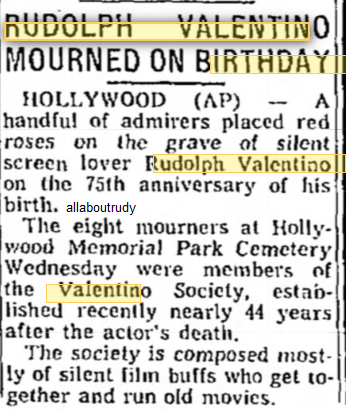
A church dedicated to the memory of the late Silent Film superstar Rudolph Valentino has been opened here. The opening service of the “Valentino Memorial Church of Psychic Fellowship” was conducted on a recent Sunday evening. The program ncluded piano selections from music used in Valetnino’s last movie “The Son of the Sheik”.
|

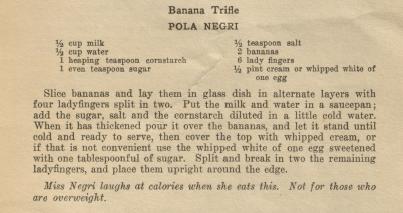
Pola Negri was not a gourmet chef nor did she know her way around the kitchen like her mother. She was more interested in acting and her name in lights than a husband or family of her own.
It’s tough luck to be a motion picture actress and to have a “public” “Hello, glad to see you again. Let’s have a little talk over in this nice dark corner”. It was at the Famous Players Studio in Long Island. The girl who greeted me was dressed in a short and rather shabby blue serge skirt and blouse. On her head was a saucy little black tam. Tortoise rimmed spectacles shaded her eyes against the Klieg lights. I looked at her searchingly. Had I ever seen her before? Then gasped, “Good Heavens, its Dorothy Dalton” In real life, Dorothy Dalton is the most gorgeous person you can imagine, the sort of girl who buys all the beautiful clothes the rest of us only look at through the store windows. When a mere man sees Dorothy in her home or at parties he calls for a pair of blinders to protect himself against her charms. But in the studio one generally sees another Dorothy. “The tragedy of clothes” she sighted, as she drew up a studio chair and light a cigarette and adjusted her anti0kleig spectacles. I adore clothes always have. The lovelier and more feminine they are the better I like them. My idea of a perfect picture is one in which I can show off all the new clothes in the shops and do plenty of acting, too. But will the public stand for it? Hardly, they want to see me in ‘rough and readies’ garbed as a man and being a real roughneck. I decide after every new picture the next one will be just the kind I want. I lie awake nights planning what I will wear. And then I begin to read scenarios. Invariably the ones with the punch, the stories from which real box office success can be made, cast me as a gypsy or an apache or a girl masquerading as a man. Now, while I love clothes, I will forego them to really act. And I have to take out my love for pretty things in my few social hours”. Do you have to read many scenarios I asked Miss Dalton? “I do, and it wouldn’t be so bad if all my friends didn’t write so many scenarios and expect me to get them accepted. I have a cousin, who recently wrote an interesting and really good scenario that is, it would have been, if we were still doing one-reelers”. There is something refreshing about this lady she is unique and in one respect is willing to admit once upon a time, her popularity was on the wane. It was about two years ago, and then she did something which, up to now, no other motion picture star accomplished she “came back” in the face of a public that was losing interest. “Yes, I suppose no other actress has done it” said Miss Dalton, “some actresses have left the screen and returned to find themselves more popular than ever. I happened to have several bad stories. That is the reason, I’m so careful now to make sure I have the right story before I begin work. Miss Dalton works like a Trojan, and this in spite the fact she had a naturally lazy temperament before she became an actress. She comes of a fine Chicago family; was the spoiled young daughter of a well-to-do and prosperous real estate dealer. No one ever expected the willful Dorothy to work for her living. Her father was only too happy to gratify her every whim “as long as I didn’t ask for pearls and diamonds”. Dorothy’s mother was of the old-school and believe a woman’s place was in the home, and that she shouldn’t know too much about business life because it unfitted the girl for matrimony. May be it was just because Dorothy’s mother knew so little about business and was so helpless when it came to knowing about stocks and bonds and other investments that her father determined she was going to become a lawyer. “He wanted me to be able to look after the legal side of his business” said Miss Dalton “he thought if anything happened to him I would be able to look over his affairs and keep people from cheating mother” “My early ambition was to become a surgeon. I adored cutting things up. But finally, I decided I wanted to act. I would act, whether my family would let me or not. Nothing was going to stop me and it didn’t as you can see.

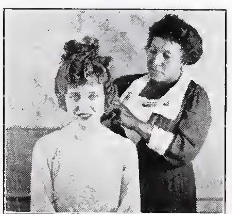
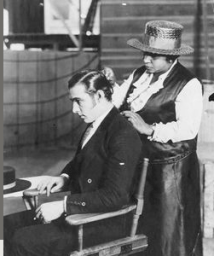
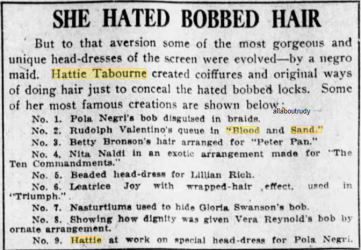
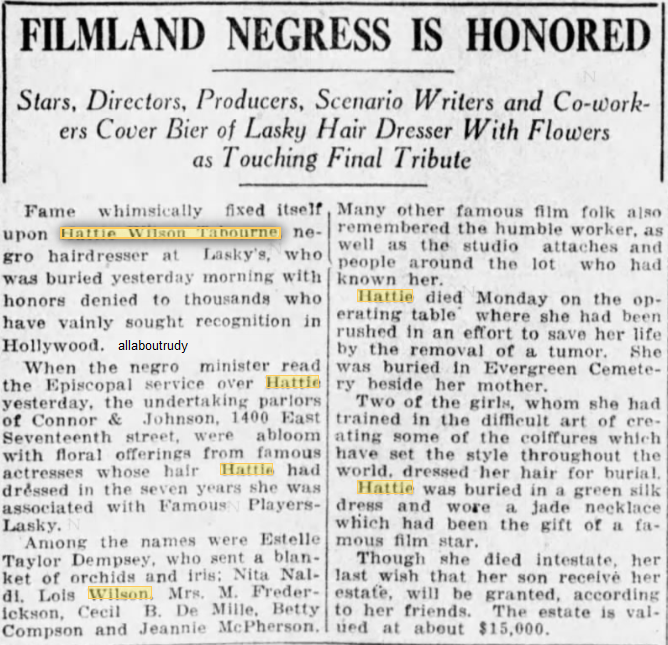
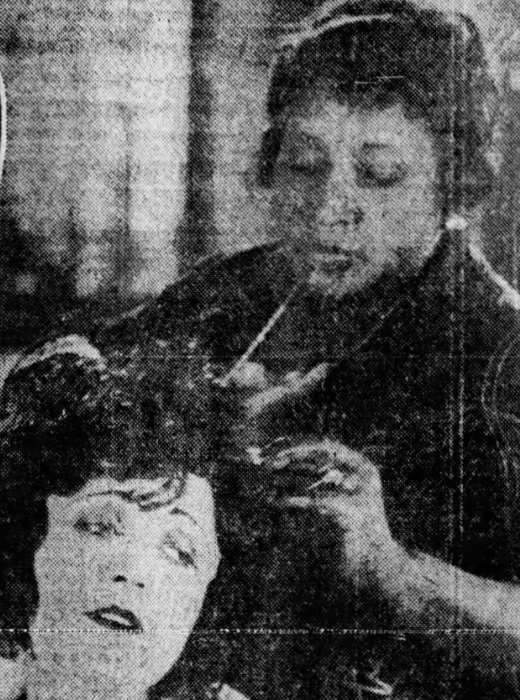
Blog readers are asking themselves who is Miss Hattie Wilson Tabourne? Simple, she was a famous Hollywood African American hairdresser whose artistic hairdressing skill was a major contribution to the movie industry and the careers of many Silent Film Stars in early twentieth century, Hollywood.


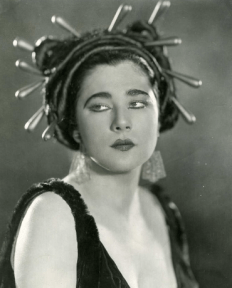
Miss Hattie came from a very humble background in Nebraska. As a young child, her family discovered she had a gift for hair dressing, and it was that talent that eventually led her to being discovered while working at a downtown Los Angeles Hairdressing establishment. Miss Hattie’s discovery led to a long-term contract working as a hairdresser for Famous Players-Lasky Studio and the rest is true Hollywood history. During her time, in Hollywood she styled the hair of Agnes Ayres, Dorothy Dalton, Nita Naldi, Cecil B. DeMille, Leatrice Joy, Lillian Rich, Pola Negri, Gloria Swanson, Rudolph Valentino during his movie “Blood and Sand”.


On 21 Mar 1923, Miss Hattie’s name was in the major papers as the creator of Gloria Swanson’s hairstyle called ‘Gloria’s Bob’. While working at Famous Players-Lasky Studios, she had the additional responsibility of training future hairdressers. On 23 Mar 1925, Miss Hattie died on an operating room table from complications as a result from a surgical procedure. At the time of her death, she was survived by a son. Miss Hattie is buried next to her mother at Evergreen Cemetery, Los Angeles. CA.

What makes a love affair that is talked about from one end of the country to another? The principals must of course be prominent. The man is handsome and the woman beautiful, why that helps. But when I think back over the love affairs that have had the most public attention, that have seemed to be the most envied. Winifred Hudnut and Rudolph Valentino were the sort of couple who ought to fall in love with each other and they did madly. The Rudolph Valentino fans breathed a heavy sigh of envy and within a few months they martially separated, and Rudolph was explaining in public that his wife wanted a career, whereas he wanted a home and children. In a word, what I remember is these famous love affairs is that they all ended unhappily. That is the type of great love? Does the romantic thing consider the real thing die in few months? Is it true that a passion makes a poor beginning for a marriage? I am sure that the answer is No. I am so sure that a mutual passion is the best beginning for a marriage. I am sure the basis of the marriages I mentioned was a powerful attraction which passed because it failed to develop into the real thing. We all make a distinction, though we do not all use the same words for it, between the physical and spiritual between love and passion it should prefer to make the distinction between passion and tenderness. Love requires both to be complete. Everyone has felt the physical attraction which is the basis of passion and the most usual beginning of love. But when you stop to analyze it, you will see a physical attraction is a comparatively impersonal thing. If you are at all aware of your wisdom of marrying a person of about our own age, of similar background, taste and ambition rather than sone who is much older or younger, or from a very different social environment, or with a different attitude toward life. But physical attraction is no respecter of wisdom. Perhaps that hidden part of ourselves, the primitive part which we all conceal even from our own minds is obedient to what civilization expects of us, every man is physically attracted to every woman and vice versa. We do not permit ourselves in recognizing it unless it has some suitability. Passion is almost impersonal in its beginning such as the case of Rudolph Valentino and Natacha Rambova. That we force it to be personal. We control it, stamp it out, unless the person for whom we feel passion, or the possibility of passion meets some of our other demands. What happens to a physical attraction is marriage? The same thing that happens to any other physical desire, it dies of its own gratification until its renewed. There are happy and loving marriages in which there are no children. But I doubt if there is any happier surgery for a marriage, any better any promise, this is not a passing fancy but the real thing, then the actual desire for children or purely rational grounds it may be argued that there are already plenty of people in the world. Adding to the number is taking on a responsibility for which nobody is every likely to thank you. It is perfectly true it is difficult to experience and trying to the nerves to have children. Nevertheless, people who love want children. People who love usually to do have children. Love which result in children are at least three times as likely to become big loves as those that do not.
Paramount and Rudolph Valentino have no corner on the sheik market, if they did make the tribe popular. John Davidson has a role of the sheik in Pricilla Dean’s “Under Two Flags”. He is one of the players in “Fools Paradise”.
Natacha Rambova like most people of a certain age started applying for social security benefits. Her SSN number was 040-38-9066
Memories that bless and burn: When an Eastern Society Woman Introduced herself to Rudolph Valentino at the Coconut Grove and offered him $5,000 to teach her to tango.
Advertising a beauty clay, rather than the latest kind of Vaseline Rudolph Valentino “The Perfect Lover” charmed a goodly crowd of his feminine admirers at the Armory Thursday evening. Charmed is the word for the youthful Sheik of the movies, sleep and well-mannered, radiant with the fire of youth handsome in the extreme, and attired in the costume in which he first came into fame was a real Prince Charming as he danced with the beautiful Winifred Hudnut, now Mrs. Valentino No.2 on the raised platform in the center of the Armory Floor. Rudy’s following is feminine there is no denying that, for how else would he acquire the title “The Perfect Lover” and is that not sufficient to line up the menfolk as his mortal enemies? It is safe to say that many of the male gender present Thursday night under protest maybe and who went to scoff were won to the ranks of Valentino fans. For Rudy certainly made a good impression though rather stingy in his dancing act. “It was a long wait for the advent of the Sheik, but the womenfolk thought it worthwhile, and loudly and convincingly did they voice their welcome when Rudolph and his wife made their appearance at 9:30 pm. Preceded by their own Argentine Orchestra, the noted pair, attired in the costume so well remembered in “The Four Horsemen” danced the Argentine Tango, a replica of the scene from the famous Ingram picture. With Sombrero, sash, velvet and gold boots and spurs, Valentino appeared as he did in his first big picture, and the scene in the darkened Armory with the spotlight playing on the raised platform, was unique and delightful. Valentino began as a tango dancer and Thursday nights exhibition showed he lost none of his nimbleness. So appealing was the applause that Valentino and his wife consented to an encore, after which the hero of the screen proved his versatility by making a speech. Perfectly at ease, with an Italian accent Valentino took the occasion to denounce what he termed the “picture trust” which he declared was responsible for the fact he was not now appearing in movies. “It was not a case salary with me but rather one of self-respect for I was not willing to appear in the sort of pictures, which the trust insisted I should make. Pictures such as the “Sheik, Young Rajah, and others of this caliber are not the sort in which I care to appear. Valentino himself, he was voted every bit as handsome off the screen as on, and even the men declared him a ‘regular fellow’. Showing evidence of education and culture minus the egoism attributed to him, the former tango dancer, who rose to the exalted position of “worlds most romantic figure” as the program termed him, the young lothario bids fair to hold his present popularity. For whom else would the women fold wait for two hours. Because of the crowd in front of the Armory Valentinos party entered by a side door only to be met with shrieks of delight as he stepped out into the hall. He certainly gave em a big thrill. Running Valentino to a close second for honors was the orchestra which he brought with him and Mrs. Valentino a chilly third. Billed as an Argentines orchestra and attired in gypsy costume, they made a picturesque appearance. Their music proved a delight, especially when they played for the local dancers and they were roundly applauded. The hall was decorated in American and Italian flags. The crowd, no so large as anticipated appeared to have enjoyed its evening.

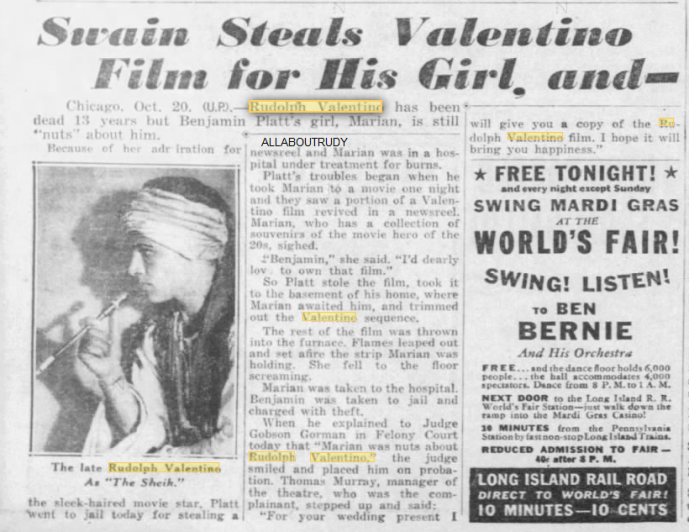
Although Rudolph Valentino did not appear in this film. D.W. Griffith did give him a screen test. I think he would of been a perfect fit in this film.
“Children ARE romance. They are the beginning and the end. They are romance, before their bright wings are clipped, before ever they have trailed in the dry dust of disillusion”.. – Rudolph Valentino, 1926
You must be logged in to post a comment.